

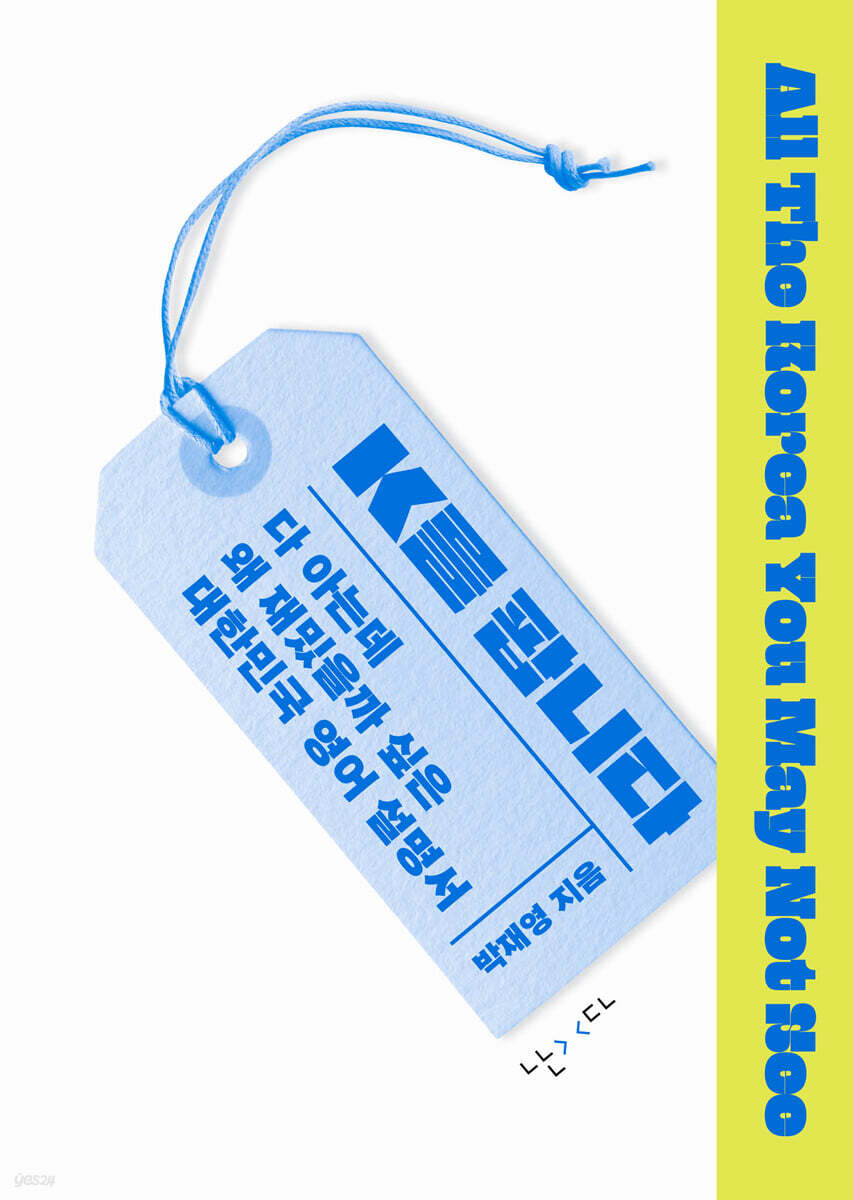
Sell K
 |
Description
Book Introduction
Recommended by essayist Kim Hon-bi!
I know everything, but I wonder why it's fun
Korean English manual
The new book, "Selling K," by Park Jae-young, a journalist and doctor turned author, and PD and host of the book podcast "YG and JYP's Desk," and a storyteller who freely crosses genres with his erudite yet witty banter, has been published by Nanda Publishing.
This is a new travel essay published four years after 『The Art of Travel Preparation』, which brought laughter with its unique approach to 'travel preparation' during the COVID-19 era.
"Selling K" is the first travel book about Korea written by a true Korean for foreigners. It is divided into 20 chapters and tells the stories of Korea that foreigners will find most fascinating.
Using artificial intelligence DeepL and ChatGPT, the 900-page Korean manuscript was converted into an 86,000-word English manuscript, and published in two languages, Korean and English, in one volume.
From the time he first wrote the Korean manuscript, author Jaeyoung Park kept the English translation in mind, and spent nearly a year refining the English text that DeepL had changed (fixing the error of translating gunmandu as military dumpling) and changing it into more 'plausible' sentences through conversations with ChatGPT.
No Korean has ever decided to write a book with this concept.
This is the first attempt of its kind in Korea, and based on this expertise, author Jaeyoung Park is preparing to give a lecture and publish a book on the topic of "Writing Books in English Using Artificial Intelligence."
With the K-content craze and global interest in Korea at an all-time high, I recommend this book to foreigners who want to know more about Korea, and to those who want to introduce the true face of Korea that cannot be grasped through Googling alone, but whose English skills are lacking, making it difficult to convey this.
For K-pop enthusiasts, this list of must-see attractions, movies and dramas to watch before traveling to Korea, and even a very subjective list of the best restaurants and hot spots in Seoul will be of great help.
I know everything, but I wonder why it's fun
Korean English manual
The new book, "Selling K," by Park Jae-young, a journalist and doctor turned author, and PD and host of the book podcast "YG and JYP's Desk," and a storyteller who freely crosses genres with his erudite yet witty banter, has been published by Nanda Publishing.
This is a new travel essay published four years after 『The Art of Travel Preparation』, which brought laughter with its unique approach to 'travel preparation' during the COVID-19 era.
"Selling K" is the first travel book about Korea written by a true Korean for foreigners. It is divided into 20 chapters and tells the stories of Korea that foreigners will find most fascinating.
Using artificial intelligence DeepL and ChatGPT, the 900-page Korean manuscript was converted into an 86,000-word English manuscript, and published in two languages, Korean and English, in one volume.
From the time he first wrote the Korean manuscript, author Jaeyoung Park kept the English translation in mind, and spent nearly a year refining the English text that DeepL had changed (fixing the error of translating gunmandu as military dumpling) and changing it into more 'plausible' sentences through conversations with ChatGPT.
No Korean has ever decided to write a book with this concept.
This is the first attempt of its kind in Korea, and based on this expertise, author Jaeyoung Park is preparing to give a lecture and publish a book on the topic of "Writing Books in English Using Artificial Intelligence."
With the K-content craze and global interest in Korea at an all-time high, I recommend this book to foreigners who want to know more about Korea, and to those who want to introduce the true face of Korea that cannot be grasped through Googling alone, but whose English skills are lacking, making it difficult to convey this.
For K-pop enthusiasts, this list of must-see attractions, movies and dramas to watch before traveling to Korea, and even a very subjective list of the best restaurants and hot spots in Seoul will be of great help.
- You can preview some of the book's contents.
Preview
index
#.
Preface for Korean Readers Only 004
0.
Introduction 012
1.
If you only eat one meal, it's pork belly 030
2.
Soju, Korea's Soul Drink 054
3.
Seoul is really complicated 077
4.
Seoul's Best Subway 101
5.
Chicken and beer at the baseball stadium 129
6.
Korean Fried Chicken and Chicken and Beer 160
7.
Kimchi, Doenjang, and Oldboy 186
8.
The surprising history of Korea 213
9.
These are the things that Korea is number one in the world 246
10.
Only in Korea, only Koreans 277
11.
Hangul, the only alphabet with a known inventor.
12.
346 Amazing Korean Restaurant Cultures
13.
Koreans' Unstoppable Love of Noodles and Soup 373
14.
Bibimbap and Street Food 402
15.
Seoul, the city that never sleeps 433
16.
464 Movies and Dramas to Watch Before Traveling to Korea
17.
Finding K-Pop Hot Spots 496
18.
A very subjective list of 524 hot places in Seoul
19.
556 of Seoul's Best Restaurants, Highly Subjective
20.
Where should I go if I leave Seoul? 601
0.
A Journey Beyond Guides: Unveiling the Untold Korea 018
1.
If you're only eating one meal, choose 'samgyeopsal' 040
2.
Soju, the Korean Soul Drink 064
3.
The Hustle and Bustle of Seoul 090
4.
Seoul Subway: The Best in the World 113
5.
Enjoy Your Chimaek at the Ballpark 142
6.
Korea Fried Chicken and Chimaek 171
7.
Kimchi, Doenjang, and 〈Oldboy〉 197
8.
Uncovering the Hidden Gems of Korean History 227
9.
Why are Koreans #1 in these particular metrics? 259
10.
Only Korea, Only Korean 293
11.
Hangul: The Only Alphabet with a Known Inventor 328
12.
Unveiling the Marvels of Korean Restaurant Culture 357
13.
Noodlicious Obsession: Koreans' Passion for Noodles and Pot Liquor 385
14.
Bimimbap and Street Food Extravaganza 415
15.
Seoul: The City That Never Sleeps 446
16.
From Screen to Korea: Must-Watch Movies and Dramas Before Your Trip 478
17.
Discover K-pop Spots 508
18.
Curated Collection of Seoul's Hottest Spots 538
19.
Curated Collection of Seoul's Yummiest Restaurants 574
20.
Beyond Seoul: Exploring the Best of Korea's Regions 620
Preface for Korean Readers Only 004
0.
Introduction 012
1.
If you only eat one meal, it's pork belly 030
2.
Soju, Korea's Soul Drink 054
3.
Seoul is really complicated 077
4.
Seoul's Best Subway 101
5.
Chicken and beer at the baseball stadium 129
6.
Korean Fried Chicken and Chicken and Beer 160
7.
Kimchi, Doenjang, and Oldboy 186
8.
The surprising history of Korea 213
9.
These are the things that Korea is number one in the world 246
10.
Only in Korea, only Koreans 277
11.
Hangul, the only alphabet with a known inventor.
12.
346 Amazing Korean Restaurant Cultures
13.
Koreans' Unstoppable Love of Noodles and Soup 373
14.
Bibimbap and Street Food 402
15.
Seoul, the city that never sleeps 433
16.
464 Movies and Dramas to Watch Before Traveling to Korea
17.
Finding K-Pop Hot Spots 496
18.
A very subjective list of 524 hot places in Seoul
19.
556 of Seoul's Best Restaurants, Highly Subjective
20.
Where should I go if I leave Seoul? 601
0.
A Journey Beyond Guides: Unveiling the Untold Korea 018
1.
If you're only eating one meal, choose 'samgyeopsal' 040
2.
Soju, the Korean Soul Drink 064
3.
The Hustle and Bustle of Seoul 090
4.
Seoul Subway: The Best in the World 113
5.
Enjoy Your Chimaek at the Ballpark 142
6.
Korea Fried Chicken and Chimaek 171
7.
Kimchi, Doenjang, and 〈Oldboy〉 197
8.
Uncovering the Hidden Gems of Korean History 227
9.
Why are Koreans #1 in these particular metrics? 259
10.
Only Korea, Only Korean 293
11.
Hangul: The Only Alphabet with a Known Inventor 328
12.
Unveiling the Marvels of Korean Restaurant Culture 357
13.
Noodlicious Obsession: Koreans' Passion for Noodles and Pot Liquor 385
14.
Bimimbap and Street Food Extravaganza 415
15.
Seoul: The City That Never Sleeps 446
16.
From Screen to Korea: Must-Watch Movies and Dramas Before Your Trip 478
17.
Discover K-pop Spots 508
18.
Curated Collection of Seoul's Hottest Spots 538
19.
Curated Collection of Seoul's Yummiest Restaurants 574
20.
Beyond Seoul: Exploring the Best of Korea's Regions 620
Into the book
Even the extra meat I ordered was gone.
So, can I just calculate and leave now? No.
Most Koreans start their 'meal' after eating all the meat like this.
In fact, if the waiters come up to you and ask if you want more meat and you say you're done, they'll ask you again.
Then what would you like to eat?
What? Are you saying all this food we've been eating wasn't a meal? Surprisingly, Koreans often finish their meal with a Korean stew like kimchi jjigae or doenjang jjigae (soybean paste stew) and rice, or a cold noodle dish called naengmyeon (cold noodles) after a heaping helping of meat.
--- From "If You Only Eat One Meal, It's Samgyeopsal"
In Korea, the type of alcohol itself can have subtly different social meanings.
There's a difference in feeling when you contact a friend and say, "Let's have a drink of soju" versus "Let's have a drink of beer."
Saying "let's have a beer" literally means "let's have a time of fellowship" or "I have something (not too serious) to talk about," but saying "let's have a drink of soju" can mean "I have a special story to tell" or "I'm going through a tough time and want to get drunk, so please get drunk with me."
--- From "Soju, Koreans' Soul Drink"
Korea has the world's lowest birth rate and the world's fastest aging population.
In particular, the problem of low birth rates is truly serious.
South Korea has the lowest birth rate in the world.
Korea's total fertility rate (TFR) in 2022 will be only 0.78 (Japan, which is struggling with a chronic low birth rate, will also have a TFR of 1.26 in 2022).
--- From "Korea is number one in the world in these things"
Another unique thing about weddings is the existence of 'guest workers'.
Koreans tend to perceive having too few guests at a wedding as a loss of face.
So, if there are too few people to invite (due to various reasons), they sometimes pay a small amount of money and invite fake guests.
It's not very common, but it's not very rare either.
In the movie “Parasite,” there is a line in which actress Park So-dam says she used to work as a “wedding guest” a lot in the past.
--- From "Only in Korea, Only Koreans"
One ingredient that cannot be left out among those eaten only by Koreans is perilla, which is similar to sesame (although they have similar shapes and similar Korean names, they are said to be quite different taxonomically).
It is different from the shiso eaten in Japan and is also very different from the coriander commonly used in Southeast Asian cuisine.
Perilla is a truly unique plant.
Sesame seeds are eaten or pressed for oil.
Shiso and coriander eat the leaves.
However, perilla seeds are eaten, oil is extracted, and the leaves are also eaten.
Perilla oil, made from roasted perilla seeds, is used in a variety of Korean dishes along with sesame oil, and powdered perilla seeds are also used as a spice in various foods.
But the most important use of perilla is to eat the leaves.
Sesame leaves refer to the leaves of the perilla plant.
Koreans eat it a lot in a variety of ways, but no one in the world eats it except Koreans (and not many Koreans even know this fact).
Since it is a plant that is eaten so often, I think it is natural that it is available overseas as well.
Also, many Koreans mistakenly believe that perilla leaves are sesame leaves, not perilla seeds.
This is probably because sesame oil is used much more than peanut oil.
However, Koreans do not eat sesame leaves either.
So, can I just calculate and leave now? No.
Most Koreans start their 'meal' after eating all the meat like this.
In fact, if the waiters come up to you and ask if you want more meat and you say you're done, they'll ask you again.
Then what would you like to eat?
What? Are you saying all this food we've been eating wasn't a meal? Surprisingly, Koreans often finish their meal with a Korean stew like kimchi jjigae or doenjang jjigae (soybean paste stew) and rice, or a cold noodle dish called naengmyeon (cold noodles) after a heaping helping of meat.
--- From "If You Only Eat One Meal, It's Samgyeopsal"
In Korea, the type of alcohol itself can have subtly different social meanings.
There's a difference in feeling when you contact a friend and say, "Let's have a drink of soju" versus "Let's have a drink of beer."
Saying "let's have a beer" literally means "let's have a time of fellowship" or "I have something (not too serious) to talk about," but saying "let's have a drink of soju" can mean "I have a special story to tell" or "I'm going through a tough time and want to get drunk, so please get drunk with me."
--- From "Soju, Koreans' Soul Drink"
Korea has the world's lowest birth rate and the world's fastest aging population.
In particular, the problem of low birth rates is truly serious.
South Korea has the lowest birth rate in the world.
Korea's total fertility rate (TFR) in 2022 will be only 0.78 (Japan, which is struggling with a chronic low birth rate, will also have a TFR of 1.26 in 2022).
--- From "Korea is number one in the world in these things"
Another unique thing about weddings is the existence of 'guest workers'.
Koreans tend to perceive having too few guests at a wedding as a loss of face.
So, if there are too few people to invite (due to various reasons), they sometimes pay a small amount of money and invite fake guests.
It's not very common, but it's not very rare either.
In the movie “Parasite,” there is a line in which actress Park So-dam says she used to work as a “wedding guest” a lot in the past.
--- From "Only in Korea, Only Koreans"
One ingredient that cannot be left out among those eaten only by Koreans is perilla, which is similar to sesame (although they have similar shapes and similar Korean names, they are said to be quite different taxonomically).
It is different from the shiso eaten in Japan and is also very different from the coriander commonly used in Southeast Asian cuisine.
Perilla is a truly unique plant.
Sesame seeds are eaten or pressed for oil.
Shiso and coriander eat the leaves.
However, perilla seeds are eaten, oil is extracted, and the leaves are also eaten.
Perilla oil, made from roasted perilla seeds, is used in a variety of Korean dishes along with sesame oil, and powdered perilla seeds are also used as a spice in various foods.
But the most important use of perilla is to eat the leaves.
Sesame leaves refer to the leaves of the perilla plant.
Koreans eat it a lot in a variety of ways, but no one in the world eats it except Koreans (and not many Koreans even know this fact).
Since it is a plant that is eaten so often, I think it is natural that it is available overseas as well.
Also, many Koreans mistakenly believe that perilla leaves are sesame leaves, not perilla seeds.
This is probably because sesame oil is used much more than peanut oil.
However, Koreans do not eat sesame leaves either.
--- From "Only in Korea, Only Koreans"
Publisher's Review
Amazing and fascinating K-stories told by a true Korean
Selling/digging K
Even Koreans who are quite good at English have a hard time knowing English words for things like perilla leaves, bean sprouts, seaweed, old farts, alcohol consumption, and surfing.
Even for people who are fluent in English, it is not easy to 'properly' explain how Korean soy sauce is different from Japanese soy sauce, how soy sauce, doenjang, and gochujang are made, why there are so many red crosses on the streets of Korea at night, what pork belly, chicken, naengmyeon, kimchi, and soju mean to Koreans, what kind of places are the academies, company dinners, jjimjilbangs, and karaoke rooms that are often shown in Korean movies, and why Korean restaurants have spoon holders under the tables, call bells, and scissors and tongs.
Also, we are so accustomed to our own culture that we often cannot distinguish between what is common in other countries and what is unique to us.
_From “Preface for Korean Readers Only”
To help those who visit Korea see more and create more joy and memories, author Jaeyoung Park, who sells/digges for Korea, tells various 'stories' in two languages.
Yes, that's right.
This book contains not 'information' but 'stories', surprising and fascinating K-stories.
Based on my experience traveling to over 20 countries and living in the United States, I tell stories about how Korea differs from other countries, what foreigners are curious about and find interesting, and things that we are so familiar with that we overlook them, but when viewed through the eyes of a foreigner, they become interesting. I tell stories that are both informative and entertaining.
At the same time, it shows that even those who live in Korea may have thought so, each and every one of them has an interesting story, making it a very enjoyable read.
The breathtaking humor that elicits exclamations like, "I already know this story, but it's so funny!" gives us the exhilarating feeling of "I hit the jackpot."
For those looking for English-language resources that properly introduce Korea, "K for Sale" will quench their thirst.
Seoul, the city that never sleeps
The surprising history of Korea
While reading the book, Korean readers will gain a new sense of their own position and conditions that they had vaguely felt.
South Korea has an area of approximately 100,000 square kilometers.
It ranks 107th in the world in terms of area.
About 50 million people live in a small area.
The population density is just over 500 people per square kilometer.
It ranks second after Bangladesh among countries with a population of over 10 million, and first among OECD countries.
The chaos of the capital city of Seoul is beyond imagination.
Seoul, one of the most complex cities in the world, has ten million people, or 20 percent of the total population, living in an area of only about 600 square kilometers.
The population density of Seoul is a whopping 16,000 people.
Seoul's population was not that large from the beginning.
The city's population first surpassed one million in 1942, but was utterly destroyed during the three-year Korean War starting in 1950.
Until the 1950s, when Korea was one of the poorest countries in the world, the population of Seoul was less than 2 million, but by the 1970s, Korea had developed at a tremendous rate.
Per capita GDP exceeded $200 in 1969, $400 in 1973, and $1,000 in 1977.
In 1983, it exceeded $2,000, and four years later, in 1987, it exceeded $3,000.
In 1988, when the Seoul Olympics were held for the first time among developing countries, Korea's per capita GDP was $4,755.
This is the so-called 'Miracle on the Han River'.
Accordingly, in 1988, Seoul's population exceeded 10 million.
It took only 35 years for the ruins of the Korean War to transform into a megacity with a population of 10 million.
Korea has experienced in a few decades what other countries have experienced over a hundred or two hundred years.
These are the things that Korea is number one in the world for.
Only in Korea, only Koreans
Facts we thought we already knew are presented in a new light through the multi-layered and unique perspective of author Park Jae-young.
As a journalist whose job is to make difficult texts easy to understand, and as someone who has also written a novel about a hospital that was made into a drama, his strengths include clear and easy-to-read sentences.
Park Jae-young's writing, which moves so freely, depicts the spectrum between nationalism, symbolized by K, and Hell Joseon, sometimes humorously and sometimes chillingly.
According to him, Korea's college enrollment rate is the highest in the world.
There are very few Koreans who cannot read Hangul, so the basic illiteracy rate is close to zero, but the actual literacy rate necessary for social life is not high at all.
Internet speeds are at a world-class level, three to four times faster than the global average, and smartphone penetration is at 95 percent.
In the e-sports and memory semiconductor fields, Samsung Electronics and SK Hynix are number one in the world, accounting for 70% of the global memory semiconductor market.
More than 40 percent of all ships built worldwide are made in Korea, and the world's largest and second-largest steel mills are both located there.
Koreans also work the longest hours in the world. According to the OECD, as of 2020, Koreans work an average of 1,908 hours per year.
South Korea has the world's fastest aging population and the lowest birth rate in the world.
Korea's total fertility rate (TFR) in 2022 will be only 0.78 (Japan, which is struggling with a chronic low birth rate, will also have a TFR of 1.26 in 2022).
In Korean real estate, there is a unique housing type called a "semi-basement," which is the house where the main family in the movie "Parasite" lived.
At Korean weddings, where a small number of guests is considered a loss of face, there is a 'guest worker' system.
Koreans eat more than 300 different types of vegetables, even occasionally.
If you stand anywhere in a large city like Seoul, you can walk a few minutes in any direction and there is bound to be a restaurant that sells samgyeopsal.
Spoons and chopsticks are hidden in drawers attached to the underside of tables in Korean restaurants.
A variety of foods that were not even ordered are provided unlimitedly as side dishes without additional charge.
Koreans eat perilla leaves, a type of sesame leaf that no one in the world eats, in a variety of ways.
Although there are more fried chicken restaurants in South Korea (about 80,000) than there are McDonald's (about 38,000) and Starbucks (about 34,000) worldwide combined, the high rate of self-employment is also an indicator of the weakness of the Korean economy, where it is difficult to find new employment once you lose your job.
On the other hand, many Koreans can tell which brand of chicken it is just by eating one piece.
Even just by smelling it! In Korea, chicken, pizza, whatever you're thinking of, it's delivered.
In this country where novelty and joy await
I'll be waiting for you to arrive soon.
In his previous work, "The Art of Travel Preparation," Park Jae-young recommended that rather than making going to a special place and having a special experience the main goal of a trip, one should find joy in the entire process of preparing for the trip and savoring memories over a long period of time.
Time always flows at the same speed, and every moment in life is only once, he said gently.
This story is not limited to silk travel.
Just as the previous work humorously encouraged us to let go of our impatience or anxiety that there might be something better than our own lives, the moment here and now, Park Jae-young's stories of Korea and K-Story might be subtly telling us how to love our own lives here and now.
“Korea is probably not the best country in the world.
Few people would consider Korea to be one of the most fantastic travel destinations in the world.
But Korea is a truly interesting country, and a place where you can create more memories than any other country.” (Introduction) For those who want to set out to discover their own ‘true self’ in life, this 648-page book will serve as a map for an exciting and rewarding journey.
Anyway, I hope you visit this charming country, Korea, at least once, have a more exciting time during your stay in Korea than any other travel destination, and cherish those happy memories for a long time.
We look forward to your arrival in this country, where wonders and delights await you.
See you in Korea soon.
_From the "Preface"
Selling/digging K
Even Koreans who are quite good at English have a hard time knowing English words for things like perilla leaves, bean sprouts, seaweed, old farts, alcohol consumption, and surfing.
Even for people who are fluent in English, it is not easy to 'properly' explain how Korean soy sauce is different from Japanese soy sauce, how soy sauce, doenjang, and gochujang are made, why there are so many red crosses on the streets of Korea at night, what pork belly, chicken, naengmyeon, kimchi, and soju mean to Koreans, what kind of places are the academies, company dinners, jjimjilbangs, and karaoke rooms that are often shown in Korean movies, and why Korean restaurants have spoon holders under the tables, call bells, and scissors and tongs.
Also, we are so accustomed to our own culture that we often cannot distinguish between what is common in other countries and what is unique to us.
_From “Preface for Korean Readers Only”
To help those who visit Korea see more and create more joy and memories, author Jaeyoung Park, who sells/digges for Korea, tells various 'stories' in two languages.
Yes, that's right.
This book contains not 'information' but 'stories', surprising and fascinating K-stories.
Based on my experience traveling to over 20 countries and living in the United States, I tell stories about how Korea differs from other countries, what foreigners are curious about and find interesting, and things that we are so familiar with that we overlook them, but when viewed through the eyes of a foreigner, they become interesting. I tell stories that are both informative and entertaining.
At the same time, it shows that even those who live in Korea may have thought so, each and every one of them has an interesting story, making it a very enjoyable read.
The breathtaking humor that elicits exclamations like, "I already know this story, but it's so funny!" gives us the exhilarating feeling of "I hit the jackpot."
For those looking for English-language resources that properly introduce Korea, "K for Sale" will quench their thirst.
Seoul, the city that never sleeps
The surprising history of Korea
While reading the book, Korean readers will gain a new sense of their own position and conditions that they had vaguely felt.
South Korea has an area of approximately 100,000 square kilometers.
It ranks 107th in the world in terms of area.
About 50 million people live in a small area.
The population density is just over 500 people per square kilometer.
It ranks second after Bangladesh among countries with a population of over 10 million, and first among OECD countries.
The chaos of the capital city of Seoul is beyond imagination.
Seoul, one of the most complex cities in the world, has ten million people, or 20 percent of the total population, living in an area of only about 600 square kilometers.
The population density of Seoul is a whopping 16,000 people.
Seoul's population was not that large from the beginning.
The city's population first surpassed one million in 1942, but was utterly destroyed during the three-year Korean War starting in 1950.
Until the 1950s, when Korea was one of the poorest countries in the world, the population of Seoul was less than 2 million, but by the 1970s, Korea had developed at a tremendous rate.
Per capita GDP exceeded $200 in 1969, $400 in 1973, and $1,000 in 1977.
In 1983, it exceeded $2,000, and four years later, in 1987, it exceeded $3,000.
In 1988, when the Seoul Olympics were held for the first time among developing countries, Korea's per capita GDP was $4,755.
This is the so-called 'Miracle on the Han River'.
Accordingly, in 1988, Seoul's population exceeded 10 million.
It took only 35 years for the ruins of the Korean War to transform into a megacity with a population of 10 million.
Korea has experienced in a few decades what other countries have experienced over a hundred or two hundred years.
These are the things that Korea is number one in the world for.
Only in Korea, only Koreans
Facts we thought we already knew are presented in a new light through the multi-layered and unique perspective of author Park Jae-young.
As a journalist whose job is to make difficult texts easy to understand, and as someone who has also written a novel about a hospital that was made into a drama, his strengths include clear and easy-to-read sentences.
Park Jae-young's writing, which moves so freely, depicts the spectrum between nationalism, symbolized by K, and Hell Joseon, sometimes humorously and sometimes chillingly.
According to him, Korea's college enrollment rate is the highest in the world.
There are very few Koreans who cannot read Hangul, so the basic illiteracy rate is close to zero, but the actual literacy rate necessary for social life is not high at all.
Internet speeds are at a world-class level, three to four times faster than the global average, and smartphone penetration is at 95 percent.
In the e-sports and memory semiconductor fields, Samsung Electronics and SK Hynix are number one in the world, accounting for 70% of the global memory semiconductor market.
More than 40 percent of all ships built worldwide are made in Korea, and the world's largest and second-largest steel mills are both located there.
Koreans also work the longest hours in the world. According to the OECD, as of 2020, Koreans work an average of 1,908 hours per year.
South Korea has the world's fastest aging population and the lowest birth rate in the world.
Korea's total fertility rate (TFR) in 2022 will be only 0.78 (Japan, which is struggling with a chronic low birth rate, will also have a TFR of 1.26 in 2022).
In Korean real estate, there is a unique housing type called a "semi-basement," which is the house where the main family in the movie "Parasite" lived.
At Korean weddings, where a small number of guests is considered a loss of face, there is a 'guest worker' system.
Koreans eat more than 300 different types of vegetables, even occasionally.
If you stand anywhere in a large city like Seoul, you can walk a few minutes in any direction and there is bound to be a restaurant that sells samgyeopsal.
Spoons and chopsticks are hidden in drawers attached to the underside of tables in Korean restaurants.
A variety of foods that were not even ordered are provided unlimitedly as side dishes without additional charge.
Koreans eat perilla leaves, a type of sesame leaf that no one in the world eats, in a variety of ways.
Although there are more fried chicken restaurants in South Korea (about 80,000) than there are McDonald's (about 38,000) and Starbucks (about 34,000) worldwide combined, the high rate of self-employment is also an indicator of the weakness of the Korean economy, where it is difficult to find new employment once you lose your job.
On the other hand, many Koreans can tell which brand of chicken it is just by eating one piece.
Even just by smelling it! In Korea, chicken, pizza, whatever you're thinking of, it's delivered.
In this country where novelty and joy await
I'll be waiting for you to arrive soon.
In his previous work, "The Art of Travel Preparation," Park Jae-young recommended that rather than making going to a special place and having a special experience the main goal of a trip, one should find joy in the entire process of preparing for the trip and savoring memories over a long period of time.
Time always flows at the same speed, and every moment in life is only once, he said gently.
This story is not limited to silk travel.
Just as the previous work humorously encouraged us to let go of our impatience or anxiety that there might be something better than our own lives, the moment here and now, Park Jae-young's stories of Korea and K-Story might be subtly telling us how to love our own lives here and now.
“Korea is probably not the best country in the world.
Few people would consider Korea to be one of the most fantastic travel destinations in the world.
But Korea is a truly interesting country, and a place where you can create more memories than any other country.” (Introduction) For those who want to set out to discover their own ‘true self’ in life, this 648-page book will serve as a map for an exciting and rewarding journey.
Anyway, I hope you visit this charming country, Korea, at least once, have a more exciting time during your stay in Korea than any other travel destination, and cherish those happy memories for a long time.
We look forward to your arrival in this country, where wonders and delights await you.
See you in Korea soon.
_From the "Preface"
GOODS SPECIFICS
- Date of issue: June 30, 2024
- Page count, weight, size: 648 pages | 850g | 148*208*31mm
- ISBN13: 9791191859997
- ISBN10: 1191859991
You may also like
카테고리
korean


korean

![GQ KOREA Mark (Monthly): December [2025]](http://librairie.coreenne.fr/cdn/shop/files/8ef265dbbfbf186523ed75ba7319009d.jpg?v=1765340328&width=3840)


