

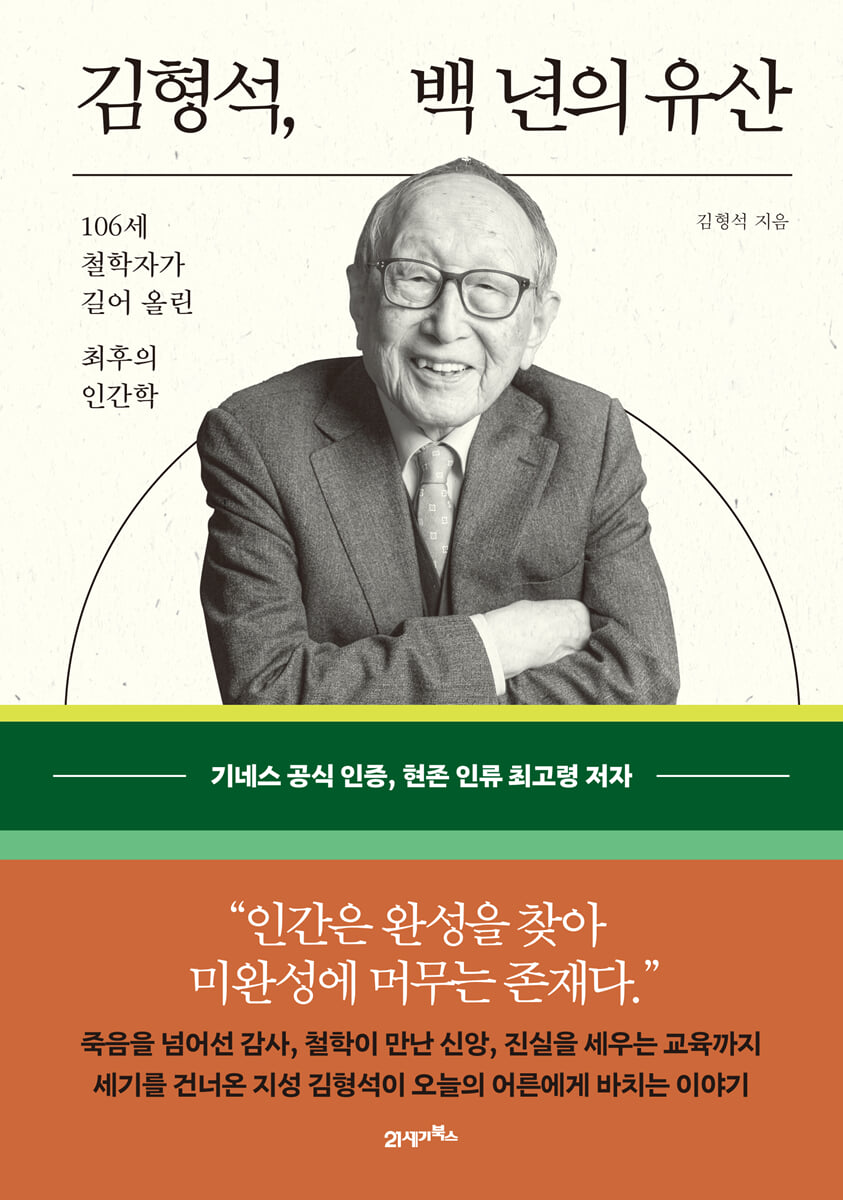
Kim Hyung-seok, A Century of Legacy
 |
Description
Book Introduction
"Our era's last legacy, containing a century of thought."
Officially certified by Guinness World Records, Professor Kim Hyung-seok, the oldest living author, shares his "Eternal Culture."
Love and conscience, freedom and gratitude… Reclaiming the coordinates of life we've lost!
Professor Kim Hyung-seok, the oldest philosopher in Korea at 106 years old and the world's oldest author according to Guinness World Records, has been exploring the value of philosophy and faith in humanity for over a century.
"Kim Hyung-seok, A Hundred Year Legacy" is the weight of the time he lived through, and the ultimate conversation left behind at the end of a hundred years of thinking.
In this book, he weaves together philosophy and religion, death and life, society and community into a single thought, seeking to restore the 'human dignity' that this era has lost.
Never once turning a blind eye to the times, he has transformed times of confusion and hurt into insight. He still offers a calm and resolute answer to the question, “What is a human life?”
“Love and conscience, freedom and gratitude.” These words, which he has held onto throughout his life, are not outdated virtues, but the minimum standards for humans to remain human.
He interprets death as the completion of life and solitude as the source of thought, and suggests a human path that begins within the individual and expands to society and the community.
Kim Hyung-seok does not leave the conclusions of this century-long thought as abstract theories, but revives them as the “language of living conscience.”
Professor Kim Hyung-seok's weighty message, "Never forget gratitude, and uphold humanity and goodness to the end," ultimately expands the value of "love" into the duty of individuals and communities, and the ultimate ethics of life.
"Kim Hyung-seok, A Hundred Year Legacy" is the voice of the last philosopher left in an age of vanishing reason, and a declaration of the times for us to stand again as human beings.
Officially certified by Guinness World Records, Professor Kim Hyung-seok, the oldest living author, shares his "Eternal Culture."
Love and conscience, freedom and gratitude… Reclaiming the coordinates of life we've lost!
Professor Kim Hyung-seok, the oldest philosopher in Korea at 106 years old and the world's oldest author according to Guinness World Records, has been exploring the value of philosophy and faith in humanity for over a century.
"Kim Hyung-seok, A Hundred Year Legacy" is the weight of the time he lived through, and the ultimate conversation left behind at the end of a hundred years of thinking.
In this book, he weaves together philosophy and religion, death and life, society and community into a single thought, seeking to restore the 'human dignity' that this era has lost.
Never once turning a blind eye to the times, he has transformed times of confusion and hurt into insight. He still offers a calm and resolute answer to the question, “What is a human life?”
“Love and conscience, freedom and gratitude.” These words, which he has held onto throughout his life, are not outdated virtues, but the minimum standards for humans to remain human.
He interprets death as the completion of life and solitude as the source of thought, and suggests a human path that begins within the individual and expands to society and the community.
Kim Hyung-seok does not leave the conclusions of this century-long thought as abstract theories, but revives them as the “language of living conscience.”
Professor Kim Hyung-seok's weighty message, "Never forget gratitude, and uphold humanity and goodness to the end," ultimately expands the value of "love" into the duty of individuals and communities, and the ultimate ethics of life.
"Kim Hyung-seok, A Hundred Year Legacy" is the voice of the last philosopher left in an age of vanishing reason, and a declaration of the times for us to stand again as human beings.
- You can preview some of the book's contents.
Preview
index
Preface│A Letter to the Readers
Part 1.
What the Past Has Taught Me - Reflections on a 106-Year-Old and the Questions That Shape Life
Looking Back on a Century: What Does Life Leave Behind?
Small things done in low places are not abandoned.
Memories with Mrs. Yuk Young-soo
Ending Life's Last Lecture with Hope
A Dialogue Between Three Philosophers on Religion
I wanted to become a professor worthy of the name.
Christianity is a historical faith
When the world's conscience is at its lowest, the Christian mission is to provide hope.
Can we change the character that determines our destiny?
The last words of my wife, who had been speechless for 20 years after battling an illness.
Stories around the lecture
The Story of Yun Dong-ju and Me
A story like a novel
Part 2.
Reading Today Through the Lens of a Century of Philosophy - Insights That Transcend the Times and Responsibility for Humanity
What kind of philosophy is the pragmatism that leads the 21st century?
A society that gives priority to those who arrive later
Historical creation, not geopolitical destiny, is what matters.
Who keeps turning back the clock of history?
Liberation is the starting point toward the completion of unification.
How should we view communism, a legacy of the 20th century?
History is moving toward an open society.
This is what the Korean people think about the Korean economy.
Judgment and choice are the people's rights.
The qualifications of a president that the people want
The river of history is destined to flow into the sea.
We live in the 21st century without leaders.
It seems that social ills will not be cured even after 100 years.
Part 3.
Love and Wisdom for the Next Generation - On Education, Youth, and Hope
What would a 105-year-old professor say to his first-year high school students?
If I were to become the Minister of Education
The Korean Sports Council must be reborn for its juniors.
Who should lead the future society?
Is a Third Order Society Possible?
Conditions for elites to be patriotic
The future of our nation depends on the humanities.
March 1st Movement Humanism is the driving force of the future.
Education with love is our hope.
Big country, small country, happy country
Can Philosophy and Faith Coexist?
For the globalization of Korean culture
I think I grew up with Gandhi.
Appendix - We Must Become a Reading Nation
Part 1.
What the Past Has Taught Me - Reflections on a 106-Year-Old and the Questions That Shape Life
Looking Back on a Century: What Does Life Leave Behind?
Small things done in low places are not abandoned.
Memories with Mrs. Yuk Young-soo
Ending Life's Last Lecture with Hope
A Dialogue Between Three Philosophers on Religion
I wanted to become a professor worthy of the name.
Christianity is a historical faith
When the world's conscience is at its lowest, the Christian mission is to provide hope.
Can we change the character that determines our destiny?
The last words of my wife, who had been speechless for 20 years after battling an illness.
Stories around the lecture
The Story of Yun Dong-ju and Me
A story like a novel
Part 2.
Reading Today Through the Lens of a Century of Philosophy - Insights That Transcend the Times and Responsibility for Humanity
What kind of philosophy is the pragmatism that leads the 21st century?
A society that gives priority to those who arrive later
Historical creation, not geopolitical destiny, is what matters.
Who keeps turning back the clock of history?
Liberation is the starting point toward the completion of unification.
How should we view communism, a legacy of the 20th century?
History is moving toward an open society.
This is what the Korean people think about the Korean economy.
Judgment and choice are the people's rights.
The qualifications of a president that the people want
The river of history is destined to flow into the sea.
We live in the 21st century without leaders.
It seems that social ills will not be cured even after 100 years.
Part 3.
Love and Wisdom for the Next Generation - On Education, Youth, and Hope
What would a 105-year-old professor say to his first-year high school students?
If I were to become the Minister of Education
The Korean Sports Council must be reborn for its juniors.
Who should lead the future society?
Is a Third Order Society Possible?
Conditions for elites to be patriotic
The future of our nation depends on the humanities.
March 1st Movement Humanism is the driving force of the future.
Education with love is our hope.
Big country, small country, happy country
Can Philosophy and Faith Coexist?
For the globalization of Korean culture
I think I grew up with Gandhi.
Appendix - We Must Become a Reading Nation
Detailed image
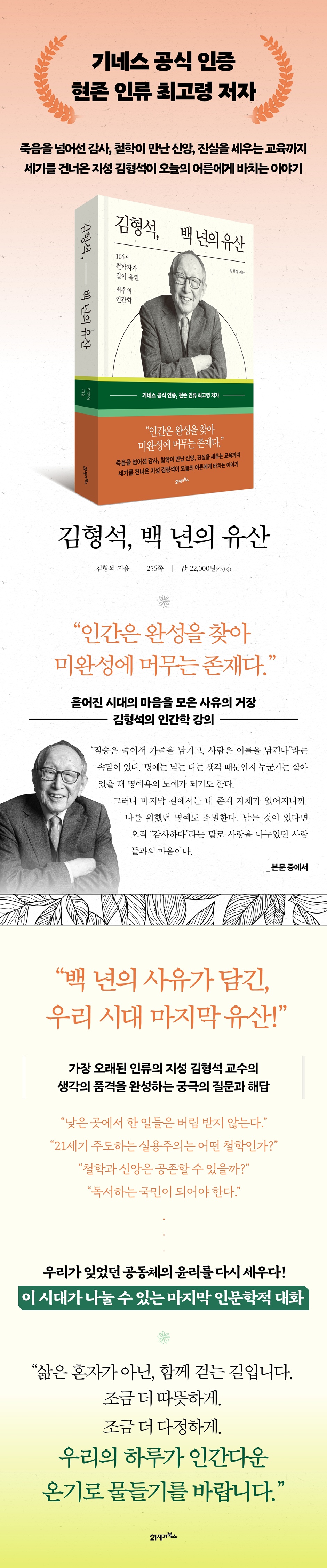
Into the book
Is there still hope for me?
The hope of the past 100 years was before me.
Now, my time is running out.
Still, greater hope remains.
It is a hope for countless juniors and disciples for the future of the Republic of Korea.
The time given to all of us is not long.
But history for the fatherland is eternal.
It is the duty of all of us to live for that historical mission.
--- From "Finishing Life's Last Lecture at 105"
A person who possesses thoughts that seek eternity in time and human values in society can act through thoughts, acquire new habits through improvement of actions, and overcome the limitations of the given fate.
Such efforts are also necessary.
So true faith presents the human possibility of giving birth to a new life.
The common values are truth, freedom, and humanity.
To give up even that would be to reject the duty of human life.
So, humans are destined to remain incomplete while seeking perfection.
--- From "Can we change the character that determines our fate?"
I don't know if love is that eternal.
Ethicists talk about the good and evil in life.
When life ends, good and evil disappear.
But artists believe that beauty never disappears.
Maybe it's because love is eternal.
But selfish love for oneself disappears along with the person.
Love is not something that is taken away.
It is to give.
The more people you give love to, the more that love will last forever.
--- From "A Story Like a Novel"
There are institutions that are recognized as having significant social responsibilities.
Educational institutions such as universities, large-scale general hospitals, and banks are not institutions that make or own money themselves.
It is a volunteer organization that helps the social economy and works for the people.
They should have the same social responsibilities as public servants who receive taxes and work for the people.
School conglomerates, money-making hospitals, and financial institutions chasing vested interests undermine the socioeconomic order.
A society that enjoys wealth while neglecting the families next door who suffer from poverty and hunger does not deserve to enjoy wealth.
--- From "A society that gives priority to those who arrive later"
The mission of our time is grave: to pass on to future generations the ideal of a Republic of Korea that can coexist as a cultural powerhouse rather than a communist regime that dreams of military prosperity before the passage of time.
It is time to find out what is the best way to achieve that goal.
History is not the legacy of geopolitical space.
We must become a nation that embodies and practices freedom and humanity, and an advanced nation that bestows good fruits upon neighboring countries.
--- From "Historical creation, not geopolitical destiny, is important"
If economic policies fail and most of the population suffers from poverty and hunger, everything else will be in vain.
We must escape absolute poverty even if it means turning stones into rice cakes.
But the economy is not everything in life for humans, nor is it the ultimate goal of life.
Poverty of spiritual values does not create economic value.
If the spirit of humanity is excluded, economic failure and poverty can rapidly worsen.
The economy must be able to create a higher economy by starting with fostering a society without poverty.
Although the economy is the first priority of politics, the value of politics can only be completed through ethics and humanism.
--- From "Liberation is the starting point toward the completion of unification"
Two organizations can and should coexist within one community.
Through the friendly competition between these organizations, the community continues to grow and develop.
Selfish competition is a bad habit that leads to a backward society.
However, a more desirable option is for both groups to work together to find a consensus through dialogue that creates growth and development for the entire community.
It is the constructive attitude and responsibility of the community for individuals to work for society through organizations and for groups to cooperate with each other for the future of the nation and people.
It's not a matter of taking sides.
The hope of the past 100 years was before me.
Now, my time is running out.
Still, greater hope remains.
It is a hope for countless juniors and disciples for the future of the Republic of Korea.
The time given to all of us is not long.
But history for the fatherland is eternal.
It is the duty of all of us to live for that historical mission.
--- From "Finishing Life's Last Lecture at 105"
A person who possesses thoughts that seek eternity in time and human values in society can act through thoughts, acquire new habits through improvement of actions, and overcome the limitations of the given fate.
Such efforts are also necessary.
So true faith presents the human possibility of giving birth to a new life.
The common values are truth, freedom, and humanity.
To give up even that would be to reject the duty of human life.
So, humans are destined to remain incomplete while seeking perfection.
--- From "Can we change the character that determines our fate?"
I don't know if love is that eternal.
Ethicists talk about the good and evil in life.
When life ends, good and evil disappear.
But artists believe that beauty never disappears.
Maybe it's because love is eternal.
But selfish love for oneself disappears along with the person.
Love is not something that is taken away.
It is to give.
The more people you give love to, the more that love will last forever.
--- From "A Story Like a Novel"
There are institutions that are recognized as having significant social responsibilities.
Educational institutions such as universities, large-scale general hospitals, and banks are not institutions that make or own money themselves.
It is a volunteer organization that helps the social economy and works for the people.
They should have the same social responsibilities as public servants who receive taxes and work for the people.
School conglomerates, money-making hospitals, and financial institutions chasing vested interests undermine the socioeconomic order.
A society that enjoys wealth while neglecting the families next door who suffer from poverty and hunger does not deserve to enjoy wealth.
--- From "A society that gives priority to those who arrive later"
The mission of our time is grave: to pass on to future generations the ideal of a Republic of Korea that can coexist as a cultural powerhouse rather than a communist regime that dreams of military prosperity before the passage of time.
It is time to find out what is the best way to achieve that goal.
History is not the legacy of geopolitical space.
We must become a nation that embodies and practices freedom and humanity, and an advanced nation that bestows good fruits upon neighboring countries.
--- From "Historical creation, not geopolitical destiny, is important"
If economic policies fail and most of the population suffers from poverty and hunger, everything else will be in vain.
We must escape absolute poverty even if it means turning stones into rice cakes.
But the economy is not everything in life for humans, nor is it the ultimate goal of life.
Poverty of spiritual values does not create economic value.
If the spirit of humanity is excluded, economic failure and poverty can rapidly worsen.
The economy must be able to create a higher economy by starting with fostering a society without poverty.
Although the economy is the first priority of politics, the value of politics can only be completed through ethics and humanism.
--- From "Liberation is the starting point toward the completion of unification"
Two organizations can and should coexist within one community.
Through the friendly competition between these organizations, the community continues to grow and develop.
Selfish competition is a bad habit that leads to a backward society.
However, a more desirable option is for both groups to work together to find a consensus through dialogue that creates growth and development for the entire community.
It is the constructive attitude and responsibility of the community for individuals to work for society through organizations and for groups to cooperate with each other for the future of the nation and people.
It's not a matter of taking sides.
--- From "Social ills don't seem to be cured even after 100 years"
Publisher's Review
“What makes humans human?”
The ultimate anthropology completed by 106-year-old philosopher Professor Kim Hyung-seok
We live in an age where love, justice, consideration, and gratitude are gradually disappearing.
In a society where people judge each other rather than understand each other and prioritize efficiency over empathy, human dignity is increasingly fading.
In times like these, the question, “What makes humans human?” becomes more urgent.
Professor Kim Hyung-seok, a 106-year-old philosopher and author of “Kim Hyung-seok, A Hundred Year Legacy,” is a person who has pondered and pondered this question throughout his life.
Officially recognized by Guinness World Records as the world's oldest writer, he has been exploring the values that humans should uphold and the direction in which reason should advance for over a century.
"Kim Hyung-seok, A Hundred Year Legacy" is the conclusion of that long journey, and the philosopher's final plea for us to regain our humanity in this age of chaos.
Professor Kim Hyung-seok says that in this era where humanity is being erased and everyone is pursuing only capital and power,
“Humanism precedes all material things and ideologies.”
In this way, through this book, he transcends the cynicism of the times and asks about the minimum ethics required for humans to remain human, based on his lifelong beliefs of love, conscience, freedom, and gratitude.
This book, which weaves together thoughts encompassing life and death, individuals and communities, in warm language, is a record of anthropology that encapsulates Professor Kim Hyeong-seok's century-long philosophy.
Professor Kim Hyung-seok coolly diagnoses political, religious, and social problems, yet never loses his warm trust in humanity.
It emphasizes love over efficiency and conscience over knowledge, ultimately making us reflect on the meaning of 'living like a human being.'
“Humanism is the perfection of a human life.”
Let's talk about the next 100 years with the insights of the past 100 years!
In this book, Professor Kim Hyung-seok reflects on moments in Korea's history based on his 106 years of life experience, diagnoses the present era through the perspective of wisdom and insight accumulated over time, and, as the greatest adult of this era, warmly comforts and encourages the anxious future of young people.
In this way, 『Kim Hyung-seok, A Hundred Year Legacy』, which encompasses the past, present, and future, is the culmination of the wisdom achieved by a century of philosophy.
Part 1 covers the insights gained from looking back on a century of life and the 'questions that permeate a century of life.'
The conclusion of 106 years of philosophical inquiry is the weighty insight that “humans are beings who pursue perfection but remain incomplete.”
As we follow the trajectory of his life, written in the language of humility and consideration, we soon realize that the most meaningful life for us is not one of money or fame, but one that leaves behind gratitude and love.
In Part 2, Professor Kim Hyung-seok, as an intellectual of this era and a living witness to Korean history, looks at today's Korean society.
While sharply pointing out real-world issues such as politics, education, religion, and generational conflict, at its core it contains an unchanging, warm gaze toward humanity.
Professor Kim Hyung-seok's words, emphasizing that a nation should be built on the spirit of humanity, not power, make us reflect on the politics of this era, which is rife with criticism and hatred.
In Part 3, as a great adult who lived a century earlier, he delivers a message of advice and encouragement to the next generation living in a time of turmoil.
He says, “True happiness lies not in having more, but in loving more deeply.”
His voice, emphasizing spiritual abundance over material wealth, comforts our lives, exhausted by excessive competition, and helps us restore the values of true community that this era has lost: respect and trust.
“Trust and love people until the end!”
In an age of hatred and division, the courage to dream of hope
Today, we live in an age where even the words love and conscience feel unfamiliar.
However, Professor Kim Hyung-seok's philosophy still speaks to us with a strong resonance.
“How should humans live in a world where people cannot trust each other?” He suggests ‘love’ as the answer to that question.
For Professor Kim Hyung-seok, love is not an emotion but a human duty, and conscience is the power that sustains that love.
This book, which reawakens the 'human value' we have forgotten, is the final message of a philosopher who believes in hope to the end even in an age of hatred and division.
Through this book, readers will be reminded of the inherent human path of living by trusting and respecting one another.
For readers in this age of lost direction and adrift, Professor Kim Hyung-seok's message in "Kim Hyung-seok, A Hundred Year Legacy" conveys the unchanging values of love and freedom, and will serve as a guide to life that can be trusted and followed.
The ultimate anthropology completed by 106-year-old philosopher Professor Kim Hyung-seok
We live in an age where love, justice, consideration, and gratitude are gradually disappearing.
In a society where people judge each other rather than understand each other and prioritize efficiency over empathy, human dignity is increasingly fading.
In times like these, the question, “What makes humans human?” becomes more urgent.
Professor Kim Hyung-seok, a 106-year-old philosopher and author of “Kim Hyung-seok, A Hundred Year Legacy,” is a person who has pondered and pondered this question throughout his life.
Officially recognized by Guinness World Records as the world's oldest writer, he has been exploring the values that humans should uphold and the direction in which reason should advance for over a century.
"Kim Hyung-seok, A Hundred Year Legacy" is the conclusion of that long journey, and the philosopher's final plea for us to regain our humanity in this age of chaos.
Professor Kim Hyung-seok says that in this era where humanity is being erased and everyone is pursuing only capital and power,
“Humanism precedes all material things and ideologies.”
In this way, through this book, he transcends the cynicism of the times and asks about the minimum ethics required for humans to remain human, based on his lifelong beliefs of love, conscience, freedom, and gratitude.
This book, which weaves together thoughts encompassing life and death, individuals and communities, in warm language, is a record of anthropology that encapsulates Professor Kim Hyeong-seok's century-long philosophy.
Professor Kim Hyung-seok coolly diagnoses political, religious, and social problems, yet never loses his warm trust in humanity.
It emphasizes love over efficiency and conscience over knowledge, ultimately making us reflect on the meaning of 'living like a human being.'
“Humanism is the perfection of a human life.”
Let's talk about the next 100 years with the insights of the past 100 years!
In this book, Professor Kim Hyung-seok reflects on moments in Korea's history based on his 106 years of life experience, diagnoses the present era through the perspective of wisdom and insight accumulated over time, and, as the greatest adult of this era, warmly comforts and encourages the anxious future of young people.
In this way, 『Kim Hyung-seok, A Hundred Year Legacy』, which encompasses the past, present, and future, is the culmination of the wisdom achieved by a century of philosophy.
Part 1 covers the insights gained from looking back on a century of life and the 'questions that permeate a century of life.'
The conclusion of 106 years of philosophical inquiry is the weighty insight that “humans are beings who pursue perfection but remain incomplete.”
As we follow the trajectory of his life, written in the language of humility and consideration, we soon realize that the most meaningful life for us is not one of money or fame, but one that leaves behind gratitude and love.
In Part 2, Professor Kim Hyung-seok, as an intellectual of this era and a living witness to Korean history, looks at today's Korean society.
While sharply pointing out real-world issues such as politics, education, religion, and generational conflict, at its core it contains an unchanging, warm gaze toward humanity.
Professor Kim Hyung-seok's words, emphasizing that a nation should be built on the spirit of humanity, not power, make us reflect on the politics of this era, which is rife with criticism and hatred.
In Part 3, as a great adult who lived a century earlier, he delivers a message of advice and encouragement to the next generation living in a time of turmoil.
He says, “True happiness lies not in having more, but in loving more deeply.”
His voice, emphasizing spiritual abundance over material wealth, comforts our lives, exhausted by excessive competition, and helps us restore the values of true community that this era has lost: respect and trust.
“Trust and love people until the end!”
In an age of hatred and division, the courage to dream of hope
Today, we live in an age where even the words love and conscience feel unfamiliar.
However, Professor Kim Hyung-seok's philosophy still speaks to us with a strong resonance.
“How should humans live in a world where people cannot trust each other?” He suggests ‘love’ as the answer to that question.
For Professor Kim Hyung-seok, love is not an emotion but a human duty, and conscience is the power that sustains that love.
This book, which reawakens the 'human value' we have forgotten, is the final message of a philosopher who believes in hope to the end even in an age of hatred and division.
Through this book, readers will be reminded of the inherent human path of living by trusting and respecting one another.
For readers in this age of lost direction and adrift, Professor Kim Hyung-seok's message in "Kim Hyung-seok, A Hundred Year Legacy" conveys the unchanging values of love and freedom, and will serve as a guide to life that can be trusted and followed.
GOODS SPECIFICS
- Date of issue: November 12, 2025
- Format: Hardcover book binding method guide
- Page count, weight, size: 256 pages | 462g | 154*218*20mm
- ISBN13: 9791173575471
- ISBN10: 1173575472
You may also like
카테고리
korean


korean

![GQ KOREA Mark (Monthly): December [2025]](http://librairie.coreenne.fr/cdn/shop/files/8ef265dbbfbf186523ed75ba7319009d.jpg?v=1765340328&width=3840)


