

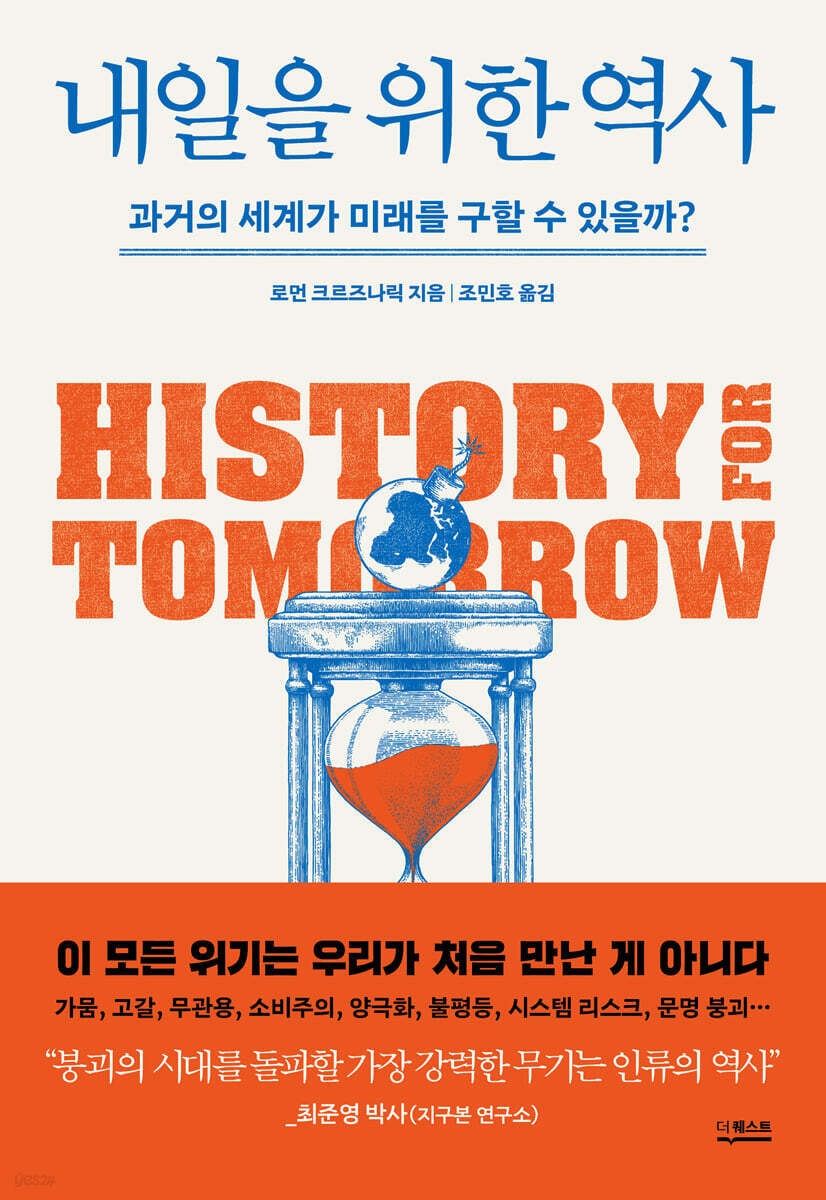
History for Tomorrow
 |
Description
Book Introduction
Resource depletion, intolerance, consumerism, polarization, tragedy of the commons,
Democracy disintegration, information monopolies, inequality, AI risks, and the collapse of civilization.
History Answers the Ten Greatest Crises Facing Humanity Today
"The most powerful weapon to overcome the age of collapse is human history."
Dr. Choi Jun-young (Global Research Institute)
Can humanity avoid the worst tomorrow?
In the 21st century, humanity is staggering into an era of permanent crisis.
Resource depletion, polarization, intolerance, AI risks… How will we navigate all this? Politicians and the media are trapped in a perpetual "now" responding to the latest headlines and social media posts, while so-called tech gurus insist we must trust in future technological innovations that will soon save us.
But perhaps hope for the future can be found not in looking forward, but in looking back? Roman Krznaric, a social philosopher, cultural thinker, member of the non-profit Club of Rome, and dialogue activist, approaches this simple yet profound question with an "applied history" approach.
“History, when faced with a crisis that seems to have no answer, is full of fascinating examples, which lead to surprising questions.” _From the preface
Democracy disintegration, information monopolies, inequality, AI risks, and the collapse of civilization.
History Answers the Ten Greatest Crises Facing Humanity Today
"The most powerful weapon to overcome the age of collapse is human history."
Dr. Choi Jun-young (Global Research Institute)
Can humanity avoid the worst tomorrow?
In the 21st century, humanity is staggering into an era of permanent crisis.
Resource depletion, polarization, intolerance, AI risks… How will we navigate all this? Politicians and the media are trapped in a perpetual "now" responding to the latest headlines and social media posts, while so-called tech gurus insist we must trust in future technological innovations that will soon save us.
But perhaps hope for the future can be found not in looking forward, but in looking back? Roman Krznaric, a social philosopher, cultural thinker, member of the non-profit Club of Rome, and dialogue activist, approaches this simple yet profound question with an "applied history" approach.
“History, when faced with a crisis that seems to have no answer, is full of fascinating examples, which lead to surprising questions.” _From the preface
index
Foreword: Looking Back to Move Forward
Chapter 1.
How to Break Fossil Fuel Addiction: The Power of Resistance and Disobedience
A Tale of Two Rebellions / The Hidden History of Radicalism / Reviving the Dying Flame of Gradualism
Chapter 2.
How to Cultivate Generosity: Living Together in the Medieval Islamic Kingdom
Chinese Americans and the Yellow Peril / Al-Andalus: Tolerance and Turmoil in a Medieval Islamic Kingdom / Designing Coexistence for the Cities of Tomorrow
Chapter 3.
How to Escape Consumerism: Pre-Industrial Japan and Designing a Regenerative Economy
The Extreme Movement toward a Simpler Life / Edonomics: Sustainability Lessons from Pre-Industrial Japan / Redesigning Choices for a Sustainable Future
Chapter 4.
How to Tame Social Media: The Birth of Print Culture and the Coffeehouse
How Printing Fueled Polarization, Persecution, and Violence / Coffeehouse Culture and the Birth of Public Sphere / From Print Thinking to Digital Thinking
Chapter 5.
How to Get Water for Everyone: Water Wars and the Greatness of the Commons
How Water Builds and Breaks Civilizations / Hydrodemocracy and a Promise for All / A New Era of Water Wars / 21st-Century Water Resources Management with a Touch of History
Chapter 6.
How to Rekindle Faith in Democracy: Rediscovering the Community Democracy of the Past
How Democracy Was Designed Undemocratically / An Unofficial History of Democracy / How Kurdish Revolutionaries Embraced Communal Democracy / Citizens' Assemblies and Deliberative Democracy
Chapter 7.
Managing Genetic Engineering: The Myth of Eugenics and the Quest for the Common Good
American Eugenics and the Road to Auschwitz / The Dime-Dime March and the Polio Eradication Campaign / The Genetic Commons and the Entrepreneurial State
Chapter 8.
How to Close the Inequality Gap: The Fight for Equality in Kerala and Finland
How Kerala's Women Resisted Caste and Colonialism / Finntopia: How Finland Emerged from a Peripheral Backwater to an Egalitarian Showcase / The Power of Radical Hope and Solidarity
Chapter 9. How to Effectively Control AI: From Capital Exploitation to Distributed Ownership
How Financial Capitalism Became an Out-of-Control Supersystem / Capitalism Incarnate: AI, the Technology of Extraction / Distributed Ownership: From Silicon Valley to Cooperative Valley
Chapter 10.
How to Avoid Civilization Collapse: How Nations and Empires Survive Crisis and Change
Asabiya and the Power of Collective Solidarity / Love for Life and Reconciliation with the Living World / Crisis Response: How to Create Transformative Change Through Crisis
Conclusion: Five Reasons Why Fundamental Hope Remains
Chapter 1.
How to Break Fossil Fuel Addiction: The Power of Resistance and Disobedience
A Tale of Two Rebellions / The Hidden History of Radicalism / Reviving the Dying Flame of Gradualism
Chapter 2.
How to Cultivate Generosity: Living Together in the Medieval Islamic Kingdom
Chinese Americans and the Yellow Peril / Al-Andalus: Tolerance and Turmoil in a Medieval Islamic Kingdom / Designing Coexistence for the Cities of Tomorrow
Chapter 3.
How to Escape Consumerism: Pre-Industrial Japan and Designing a Regenerative Economy
The Extreme Movement toward a Simpler Life / Edonomics: Sustainability Lessons from Pre-Industrial Japan / Redesigning Choices for a Sustainable Future
Chapter 4.
How to Tame Social Media: The Birth of Print Culture and the Coffeehouse
How Printing Fueled Polarization, Persecution, and Violence / Coffeehouse Culture and the Birth of Public Sphere / From Print Thinking to Digital Thinking
Chapter 5.
How to Get Water for Everyone: Water Wars and the Greatness of the Commons
How Water Builds and Breaks Civilizations / Hydrodemocracy and a Promise for All / A New Era of Water Wars / 21st-Century Water Resources Management with a Touch of History
Chapter 6.
How to Rekindle Faith in Democracy: Rediscovering the Community Democracy of the Past
How Democracy Was Designed Undemocratically / An Unofficial History of Democracy / How Kurdish Revolutionaries Embraced Communal Democracy / Citizens' Assemblies and Deliberative Democracy
Chapter 7.
Managing Genetic Engineering: The Myth of Eugenics and the Quest for the Common Good
American Eugenics and the Road to Auschwitz / The Dime-Dime March and the Polio Eradication Campaign / The Genetic Commons and the Entrepreneurial State
Chapter 8.
How to Close the Inequality Gap: The Fight for Equality in Kerala and Finland
How Kerala's Women Resisted Caste and Colonialism / Finntopia: How Finland Emerged from a Peripheral Backwater to an Egalitarian Showcase / The Power of Radical Hope and Solidarity
Chapter 9. How to Effectively Control AI: From Capital Exploitation to Distributed Ownership
How Financial Capitalism Became an Out-of-Control Supersystem / Capitalism Incarnate: AI, the Technology of Extraction / Distributed Ownership: From Silicon Valley to Cooperative Valley
Chapter 10.
How to Avoid Civilization Collapse: How Nations and Empires Survive Crisis and Change
Asabiya and the Power of Collective Solidarity / Love for Life and Reconciliation with the Living World / Crisis Response: How to Create Transformative Change Through Crisis
Conclusion: Five Reasons Why Fundamental Hope Remains
Detailed image

Into the book
History reminds us of past crises, reveals various social structures that were almost forgotten, exposes the roots of current injustice and power relations, and provides clues to guide change for survival and prosperity.
History is a counselor, not a prophet.
It encourages us to ask new questions and realize that other paths are possible.
Goethe understood the nourishment that history provides, saying, “He who cannot use 3,000 years of history will only live from day to day.”
--- From the "Preface"
What does "radical" mean, and how does it bring about disruptive change? Scholars who have studied social movements in recent decades have consistently observed that the most successful protest movements throughout history, those that fought for fundamental human rights and social justice, were far more effective when led by radical organizations or forces.
Radicals take more extreme positions than the mainstream moderates, making the moderates' existing demands appear acceptable or "reasonable" to those in power.
That's actually true.
Radicals can change the terms of the debate, thus altering the so-called "Overton Window."
--- 「Chapter 1.
From "How to Break Fossil Fuel Addiction: The Power of Resistance and Disobedience"
The psychological phenomenon underlying generosity is well explained by 'contact theory'.
The main point is this.
When different groups are forced to interact, cooperate, and interact on relatively equal terms, the result is generally a reduction in prejudice, stereotypes, and other divisions, large and small.
An analysis of over 500 different studies found that in over 94 percent of cases, intergroup contact reduced prejudice and increased tolerance.
Representative examples include cases where children of different ethnicities and religions played on the same soccer team, or cases where Chinese immigrants fought alongside white people during World War II, where people of different races banded together and put their lives on the line for each other.
The cities and towns of Al-Andalus are a remarkable example of contact theory working on a large scale, based on a long medieval history and complex realities of the time.
Brian Catlas argues that the history of coexistence of different communities in the Islamic-dominated Iberian Peninsula is a testament to “our remarkable capacity as humans to get along despite our differences and flaws.”
--- Chapter 2.
From "How to Cultivate Generosity: Living Together in the Medieval Islamic Kingdoms"
The path toward a regenerative future for humanity can be usefully approached as a design problem.
It involves 'designing out' (or 'editing out') certain consumer choices that push the Earth's ecosystems beyond their capacity, so that they no longer appear on the menu of choices, while simultaneously 'designing in' (or 'editing in') alternative choices that allow us to safely stay within ecological limits.
In an age where everyday consumer decisions can have destructive and sometimes invisible impacts on the environment, we must restructure the very fabric of human choice.
We can glean two fundamental insights from the Edo period to spark the regenerative revolution we urgently need.
--- 「Chapter 3.
From "How to Escape Consumerism: Pre-Industrial Japan and Designing a Regenerative Economy"
The history of the printing press, which shows how easily communications technology can be abused as a tool of violence and oppression, provides a sobering warning in the age of social media.
Of course, we cannot deny the revolutionary achievements brought about by the printing press.
Thanks to the printing press, from the late 17th century onwards, rationalist thinking that rejected superstitions such as magic and sorcery began to spread.
Printing facilitated the development of mass literacy and amplified the pleasure and intellectual liberation of reading.
(Omitted) There is also an unexpected and surprising fact: the printing press played a fundamental role in the establishment of modern democratic culture and human rights in the 18th century.
How could this be possible? Because it created a new, invisible continent called the "public sphere."
But this would not have been possible without the help of another revolutionary invention: the coffee house.
--- Chapter 4.
From "How to Tame Social Media: Print Culture and the Birth of the Coffee House"
Drawing on decades of empirical research, Ostrom explored the economic realm of the commons, where human communities successfully managed resources like land and water without relying on markets or the state, demonstrating that the essence of human existence is closer to cooperation.
He refuted the widespread belief that establishing commons would lead to communities wasting shared resources without any self-control and to individuals competing for their own selfish interests.
This prejudice has long been known as the 'Tragedy of the Commons'.
However, Ostrom argued that throughout history, numerous communities have successfully created and implemented democratic self-governance systems for managing shared resources.
--- 「Chapter 5.
From “How to Get Water for All: Water Wars and the Greatness of the Commons”
It is precisely these cases, conspicuously missing from mainstream democracy courses and textbooks, that are crucial to the future of our democracy.
These historical examples open the door to insight that politics can be conducted in a completely different way today, when fundamental reform is urgently needed.
The representative democratic model that typifies the West is in serious crisis.
Just looking at the results of the opinion polls reveals it all.
Across the world, trust in representative democratic institutions and politicians is already rapidly declining, a phenomenon that political researcher and cultural historian David Van Reybrouck has described as “democratic fatigue syndrome.”
--- Chapter 6.
From "How to Rekindle Belief in Democracy: Rediscovering Past Community Democracy"
From this story, we can gain two historical insights into the management of genetic engineering technologies.
First, both the campaign and the research to develop the polio vaccine were oriented toward the "bonum commune," or "common good."
It wasn't about expanding the realm of medicine to include personal choices, like choosing a child's eye color or enhancing intelligence.
Polio was a deadly infectious disease that could infect any child, and the Salk vaccine was developed to help all children, regardless of economic status, race, or nationality.
Jonas Salk's unequivocal statement, "There are no patents," reflected his firm belief that vaccines were a gift to humanity and future generations.
Sok also emphasized that only then can we become 'good ancestors'.
Second, both the Salk and Sabin vaccines were developed without the involvement of commercially obsessed pharmaceutical companies.
This was a clear signal that innovation in the medical field does not necessarily require economic incentives from the market and for-profit investments from companies.
--- Chapter 7.
From “How to Manage Genetic Engineering: The Façade of Eugenics and the Quest for the Common Good”
Kerala and Finland, the unlikely pairings of countries that at first glance seem very different, both demonstrate the power of social movements to create more equal societies and pressure governments to distribute resources more equitably.
The people here have repeatedly risen up against colonialism, patriarchy, classism, landlordism, low wages, and extreme poverty.
They worked tirelessly and selflessly to build organizations, willing to take chances and risks.
They responded to the establishment with cries of “Shoot me first!”
Their decades-long struggle reveals the truth that equality can only triumph when everyone works together.
This is a direct refutation of Walter Scheidel's claim that only extreme crises, such as war or disaster, create equality.
--- Chapter 8.
From "How to Close the Inequality Gap: The Struggle for Equality in Kerala and Finland"
What should we do about this corporate behavior? One option is to transfer major AI companies to public ownership, run by an "entrepreneurial state" that fosters innovation while maintaining ethical oversight (see Chapter 7).
This is what many countries did in the 20th century when they nationalized essential industries like coal and railways.
However, government-led governance carries its own risks, as evidenced by Vladimir Putin's use of Russia's AI capabilities to hack Western elections and the Chinese government's mass surveillance of its own citizens using AI facial recognition technology.
Yet history suggests another path, one that has been vigorous and desirable for more than a century, one in which both state control and corporate capitalism have been viable.
This path can inspire not only companies developing AI, but also those leveraging it in their businesses.
This model, now called "distributed ownership," is a form of economic democracy in which a company's owners are not shareholders and investors but rather a broader range of community stakeholders.
--- From "Chapter 9. How to Control AI Effectively: From Capital Exploitation to Distributed Ownership"
According to Hagens, humanity is rapidly approaching a critical turning point where this system can no longer be maintained.
The rapid increase in disposable carbon that humanity has used to build societies will push back against numerous ecological limits, including carbon dioxide emissions and biodiversity loss.
The gap between the money accumulating in the financial system and the physical resources the planet can sustainably provide will become too large.
The moment the party ends, we will face a moment of rupture where we will have to face reality seriously.
This is a massive adjustment phase called the 'Great Simplification'.
When that time comes, we will be forced to operate on a much lower and more sustainable level of energy supplied by renewable resources, and global GDP will decline significantly because we can no longer rely on the cheap, polluting energy of the industrial age.
Nate Hagens asks:
“In this process of great simplification, will we bend or break?” I wonder.
Faced with this massive simplification, will our society simply break apart and collapse in a shocking way, or will it bend with the flow of change and evolve more gradually toward forming a new ecological civilization?
Asabiya (collective solidarity) and biophilia (love of life) are two fundamental pillars that will help humanity build resilience that will bend rather than break during the great simplification process.
These two elements enable humanity to build a stable and integrated society based on solidarity within and between species, while respecting the Earth's non-negotiable biophysical limits.
However, building such a society on a large scale is bound to be a very slow process, as it requires instilling new values and worldviews over decades or even generations.
Therefore, we need one more capability: ‘crisis response.’
This triangular model of systemic change—whereby “social movements amplify crises,” “crises give meaning to ideas,” and “ideas inspire social movements”—has the advantage of giving our collective action a practical role.
In a crisis situation such as war, political and military leaders usually take charge.
On the other hand, the link of disruptive change is that citizens organize to move government to a decisive decision-making point, a 'crisis' in the ancient Greek sense.
The government will then feel pressure to respond to the turbulent situation by pursuing rapid and transformative policies.
The interaction of these three conditions creates pressure for change that stimulates political will.
History is a counselor, not a prophet.
It encourages us to ask new questions and realize that other paths are possible.
Goethe understood the nourishment that history provides, saying, “He who cannot use 3,000 years of history will only live from day to day.”
--- From the "Preface"
What does "radical" mean, and how does it bring about disruptive change? Scholars who have studied social movements in recent decades have consistently observed that the most successful protest movements throughout history, those that fought for fundamental human rights and social justice, were far more effective when led by radical organizations or forces.
Radicals take more extreme positions than the mainstream moderates, making the moderates' existing demands appear acceptable or "reasonable" to those in power.
That's actually true.
Radicals can change the terms of the debate, thus altering the so-called "Overton Window."
--- 「Chapter 1.
From "How to Break Fossil Fuel Addiction: The Power of Resistance and Disobedience"
The psychological phenomenon underlying generosity is well explained by 'contact theory'.
The main point is this.
When different groups are forced to interact, cooperate, and interact on relatively equal terms, the result is generally a reduction in prejudice, stereotypes, and other divisions, large and small.
An analysis of over 500 different studies found that in over 94 percent of cases, intergroup contact reduced prejudice and increased tolerance.
Representative examples include cases where children of different ethnicities and religions played on the same soccer team, or cases where Chinese immigrants fought alongside white people during World War II, where people of different races banded together and put their lives on the line for each other.
The cities and towns of Al-Andalus are a remarkable example of contact theory working on a large scale, based on a long medieval history and complex realities of the time.
Brian Catlas argues that the history of coexistence of different communities in the Islamic-dominated Iberian Peninsula is a testament to “our remarkable capacity as humans to get along despite our differences and flaws.”
--- Chapter 2.
From "How to Cultivate Generosity: Living Together in the Medieval Islamic Kingdoms"
The path toward a regenerative future for humanity can be usefully approached as a design problem.
It involves 'designing out' (or 'editing out') certain consumer choices that push the Earth's ecosystems beyond their capacity, so that they no longer appear on the menu of choices, while simultaneously 'designing in' (or 'editing in') alternative choices that allow us to safely stay within ecological limits.
In an age where everyday consumer decisions can have destructive and sometimes invisible impacts on the environment, we must restructure the very fabric of human choice.
We can glean two fundamental insights from the Edo period to spark the regenerative revolution we urgently need.
--- 「Chapter 3.
From "How to Escape Consumerism: Pre-Industrial Japan and Designing a Regenerative Economy"
The history of the printing press, which shows how easily communications technology can be abused as a tool of violence and oppression, provides a sobering warning in the age of social media.
Of course, we cannot deny the revolutionary achievements brought about by the printing press.
Thanks to the printing press, from the late 17th century onwards, rationalist thinking that rejected superstitions such as magic and sorcery began to spread.
Printing facilitated the development of mass literacy and amplified the pleasure and intellectual liberation of reading.
(Omitted) There is also an unexpected and surprising fact: the printing press played a fundamental role in the establishment of modern democratic culture and human rights in the 18th century.
How could this be possible? Because it created a new, invisible continent called the "public sphere."
But this would not have been possible without the help of another revolutionary invention: the coffee house.
--- Chapter 4.
From "How to Tame Social Media: Print Culture and the Birth of the Coffee House"
Drawing on decades of empirical research, Ostrom explored the economic realm of the commons, where human communities successfully managed resources like land and water without relying on markets or the state, demonstrating that the essence of human existence is closer to cooperation.
He refuted the widespread belief that establishing commons would lead to communities wasting shared resources without any self-control and to individuals competing for their own selfish interests.
This prejudice has long been known as the 'Tragedy of the Commons'.
However, Ostrom argued that throughout history, numerous communities have successfully created and implemented democratic self-governance systems for managing shared resources.
--- 「Chapter 5.
From “How to Get Water for All: Water Wars and the Greatness of the Commons”
It is precisely these cases, conspicuously missing from mainstream democracy courses and textbooks, that are crucial to the future of our democracy.
These historical examples open the door to insight that politics can be conducted in a completely different way today, when fundamental reform is urgently needed.
The representative democratic model that typifies the West is in serious crisis.
Just looking at the results of the opinion polls reveals it all.
Across the world, trust in representative democratic institutions and politicians is already rapidly declining, a phenomenon that political researcher and cultural historian David Van Reybrouck has described as “democratic fatigue syndrome.”
--- Chapter 6.
From "How to Rekindle Belief in Democracy: Rediscovering Past Community Democracy"
From this story, we can gain two historical insights into the management of genetic engineering technologies.
First, both the campaign and the research to develop the polio vaccine were oriented toward the "bonum commune," or "common good."
It wasn't about expanding the realm of medicine to include personal choices, like choosing a child's eye color or enhancing intelligence.
Polio was a deadly infectious disease that could infect any child, and the Salk vaccine was developed to help all children, regardless of economic status, race, or nationality.
Jonas Salk's unequivocal statement, "There are no patents," reflected his firm belief that vaccines were a gift to humanity and future generations.
Sok also emphasized that only then can we become 'good ancestors'.
Second, both the Salk and Sabin vaccines were developed without the involvement of commercially obsessed pharmaceutical companies.
This was a clear signal that innovation in the medical field does not necessarily require economic incentives from the market and for-profit investments from companies.
--- Chapter 7.
From “How to Manage Genetic Engineering: The Façade of Eugenics and the Quest for the Common Good”
Kerala and Finland, the unlikely pairings of countries that at first glance seem very different, both demonstrate the power of social movements to create more equal societies and pressure governments to distribute resources more equitably.
The people here have repeatedly risen up against colonialism, patriarchy, classism, landlordism, low wages, and extreme poverty.
They worked tirelessly and selflessly to build organizations, willing to take chances and risks.
They responded to the establishment with cries of “Shoot me first!”
Their decades-long struggle reveals the truth that equality can only triumph when everyone works together.
This is a direct refutation of Walter Scheidel's claim that only extreme crises, such as war or disaster, create equality.
--- Chapter 8.
From "How to Close the Inequality Gap: The Struggle for Equality in Kerala and Finland"
What should we do about this corporate behavior? One option is to transfer major AI companies to public ownership, run by an "entrepreneurial state" that fosters innovation while maintaining ethical oversight (see Chapter 7).
This is what many countries did in the 20th century when they nationalized essential industries like coal and railways.
However, government-led governance carries its own risks, as evidenced by Vladimir Putin's use of Russia's AI capabilities to hack Western elections and the Chinese government's mass surveillance of its own citizens using AI facial recognition technology.
Yet history suggests another path, one that has been vigorous and desirable for more than a century, one in which both state control and corporate capitalism have been viable.
This path can inspire not only companies developing AI, but also those leveraging it in their businesses.
This model, now called "distributed ownership," is a form of economic democracy in which a company's owners are not shareholders and investors but rather a broader range of community stakeholders.
--- From "Chapter 9. How to Control AI Effectively: From Capital Exploitation to Distributed Ownership"
According to Hagens, humanity is rapidly approaching a critical turning point where this system can no longer be maintained.
The rapid increase in disposable carbon that humanity has used to build societies will push back against numerous ecological limits, including carbon dioxide emissions and biodiversity loss.
The gap between the money accumulating in the financial system and the physical resources the planet can sustainably provide will become too large.
The moment the party ends, we will face a moment of rupture where we will have to face reality seriously.
This is a massive adjustment phase called the 'Great Simplification'.
When that time comes, we will be forced to operate on a much lower and more sustainable level of energy supplied by renewable resources, and global GDP will decline significantly because we can no longer rely on the cheap, polluting energy of the industrial age.
Nate Hagens asks:
“In this process of great simplification, will we bend or break?” I wonder.
Faced with this massive simplification, will our society simply break apart and collapse in a shocking way, or will it bend with the flow of change and evolve more gradually toward forming a new ecological civilization?
Asabiya (collective solidarity) and biophilia (love of life) are two fundamental pillars that will help humanity build resilience that will bend rather than break during the great simplification process.
These two elements enable humanity to build a stable and integrated society based on solidarity within and between species, while respecting the Earth's non-negotiable biophysical limits.
However, building such a society on a large scale is bound to be a very slow process, as it requires instilling new values and worldviews over decades or even generations.
Therefore, we need one more capability: ‘crisis response.’
This triangular model of systemic change—whereby “social movements amplify crises,” “crises give meaning to ideas,” and “ideas inspire social movements”—has the advantage of giving our collective action a practical role.
In a crisis situation such as war, political and military leaders usually take charge.
On the other hand, the link of disruptive change is that citizens organize to move government to a decisive decision-making point, a 'crisis' in the ancient Greek sense.
The government will then feel pressure to respond to the turbulent situation by pursuing rapid and transformative policies.
The interaction of these three conditions creates pressure for change that stimulates political will.
--- 「Chapter 10.
From "How to Avoid Civilization Collapse: How Nations and Empires Survive Crisis and Change"
From "How to Avoid Civilization Collapse: How Nations and Empires Survive Crisis and Change"
Publisher's Review
This is not the first crisis facing humanity.
Can we overcome this crisis and survive?
Throughout history, human society has constantly risen above adversity, faced challenges, and overcome crises.
Roman Krznaric, author of "The Power of Empathy," argues that history offers a fundamental vision of hope and is the most important tool for surviving and thriving in the turbulent times ahead.
Next, we explore insights and inspiration from the past 1,000 years of world history to help us address the ten most pressing challenges facing humanity in the 21st century, and show how the insights and wisdom gleaned from human history can help us address these challenges.
10 Questions to Ask Yourself in the Face of a Crisis
ㆍCan we break our addiction to fossil fuels before it's too late?
ㆍIn an era of global mass migration, how can we all live together?
ㆍCan we abandon consumerism and reduce waste?
ㆍHow can we tame social media?
ㆍHow can we get water for everyone?
ㆍCan we revive faith in democracy?
ㆍCan the risks of genetic engineering be reduced?
ㆍWhat are some ways to reduce the inequality gap?
ㆍHow can we effectively control artificial intelligence?
ㆍCan humanity avoid the collapse of civilization?
The perspective of applied history transcends time and space, from pre-colonial India to the Cuban Revolution, from the Qing Dynasty to the Finnish women's rights struggle, exploring the foundations of hope for navigating a turbulent future.
From bridging the inequality gap and controlling artificial intelligence to reviving faith in democracy and averting ecological collapse, this book shows that history is not simply a means of understanding the past, but a way to reframe our relationship with the future.
How have we found the answer so far?
Roman Krznaric, a member of the Club of Rome, a non-profit organization that warns about environmental and resource issues, and a research fellow at the Long Now Foundation, which proposes plans for a sustainable future, has sought answers to the challenges facing humanity today, such as the climate crisis, deepening inequality, the crisis of democracy, and technological monopolies, in the wisdom of past civilizations.
And these cases serve as a historical blueprint for the sustainability of human civilization.
The author's critical awareness begins with the observation that the weak flame of "gradualism" cannot resolve the urgent and complex crisis, and that we must rediscover the destructive potential of radical resistance movements like the "Extinction Rebellion" movement, which aims to break our addiction to fossil fuels (Chapter 1).
This leads to historical examples of breaking stereotypes in various fields.
In the issue of social tolerance, an essential element in the era of mass migration, the book introduces the 'Convivencia' culture, where Muslims, Jews, and Christians peacefully coexisted in the medieval Spanish kingdom of Al-Andalus (Chapter 2). In the economic field, the book presents the perfect circular economy model of Japan's Edo period before industrialization as a way to escape from infinite consumerism (Chapter 3).
To overcome the political polarization and fake news problems caused by social media, we suggest ways to redesign the digital public sphere by recalling the culture of coffeehouses in 18th-century London, which created an equal and deliberative public sphere (Chapter 4).
In the face of the crisis of water shortages and conflicts that are already sounding the alarm all over the world, the book presents as an alternative the democratic 'commons' management system that the 'water courts' of the Valencian region in medieval Spain have maintained for hundreds of years (Chapter 5). In the face of the limits of representative democracy due to the rise of far-right regimes and the loss of trust in elite politics today, the book introduces the Free State of Laetia, which operated a large-scale regional council community government in the 16th to 18th centuries, and the Kurdish autonomous government of Rojava, which advocated for community democracy, and urges the introduction of a citizens' assembly (deliberative democracy) to return power to the people (Chapter 6).
Who are we and what can we do?
The message that runs through these historical examples is the power of 'collective solidarity' and the importance of 'transformative action.'
As the examples of the lower caste uprising in Kerala, India, and the egalitarian movements, such as the women's suffrage movement in Finland, demonstrate (Chapter 8), the power of 'collective solidarity (asaviya)' through peaceful means is a key driving force in overcoming inequality and crisis.
By combining past wisdom with today's innovations, such as AI platform cooperatives (Chapter 9), the author offers a "fundamental hope" that our civilization can choose resilience—not "break" but "bend"—in the face of crisis, and transition to a sustainable ecological civilization.
In the final chapter of the book, the author identifies 'collective solidarity (asabiya),' 'biophilia,' and finally 'crisis response' as the fundamental pillars for preventing cataclysms and building human resilience.
And to explain the conditions under which large-scale, rapid, and transformative social change occurs, we present our own model called the 'Disruption Nexus'.
Historically, crises have been defined in several contexts, such as 'war,' 'disaster,' and 'revolution.' The emergency we are concerned with today does not fit these criteria, and is the kind of crisis that requires action 'before' an irreversible disaster occurs, thereby accelerating the tipping point of change.
The author sees the context that can trigger fundamental change as a “disruptive change,” and believes that change can be induced only when three key elements come together: first, a type of crisis (e.g., climate crisis, population cliff); second, a powerful social movement (e.g., candlelight vigils, environmental group activities); and third, a pioneering new idea (e.g., degrowth economy, community democracy).
The interaction of the three elements of 'crisis', 'movement', and 'ideology' stimulates political will and creates a transformative pressure that forces the entire society to take a new path at a critical juncture (this is the true meaning of 'crisis').
Therein lies humanity's fundamental hope.
Can we overcome this crisis and survive?
Throughout history, human society has constantly risen above adversity, faced challenges, and overcome crises.
Roman Krznaric, author of "The Power of Empathy," argues that history offers a fundamental vision of hope and is the most important tool for surviving and thriving in the turbulent times ahead.
Next, we explore insights and inspiration from the past 1,000 years of world history to help us address the ten most pressing challenges facing humanity in the 21st century, and show how the insights and wisdom gleaned from human history can help us address these challenges.
10 Questions to Ask Yourself in the Face of a Crisis
ㆍCan we break our addiction to fossil fuels before it's too late?
ㆍIn an era of global mass migration, how can we all live together?
ㆍCan we abandon consumerism and reduce waste?
ㆍHow can we tame social media?
ㆍHow can we get water for everyone?
ㆍCan we revive faith in democracy?
ㆍCan the risks of genetic engineering be reduced?
ㆍWhat are some ways to reduce the inequality gap?
ㆍHow can we effectively control artificial intelligence?
ㆍCan humanity avoid the collapse of civilization?
The perspective of applied history transcends time and space, from pre-colonial India to the Cuban Revolution, from the Qing Dynasty to the Finnish women's rights struggle, exploring the foundations of hope for navigating a turbulent future.
From bridging the inequality gap and controlling artificial intelligence to reviving faith in democracy and averting ecological collapse, this book shows that history is not simply a means of understanding the past, but a way to reframe our relationship with the future.
How have we found the answer so far?
Roman Krznaric, a member of the Club of Rome, a non-profit organization that warns about environmental and resource issues, and a research fellow at the Long Now Foundation, which proposes plans for a sustainable future, has sought answers to the challenges facing humanity today, such as the climate crisis, deepening inequality, the crisis of democracy, and technological monopolies, in the wisdom of past civilizations.
And these cases serve as a historical blueprint for the sustainability of human civilization.
The author's critical awareness begins with the observation that the weak flame of "gradualism" cannot resolve the urgent and complex crisis, and that we must rediscover the destructive potential of radical resistance movements like the "Extinction Rebellion" movement, which aims to break our addiction to fossil fuels (Chapter 1).
This leads to historical examples of breaking stereotypes in various fields.
In the issue of social tolerance, an essential element in the era of mass migration, the book introduces the 'Convivencia' culture, where Muslims, Jews, and Christians peacefully coexisted in the medieval Spanish kingdom of Al-Andalus (Chapter 2). In the economic field, the book presents the perfect circular economy model of Japan's Edo period before industrialization as a way to escape from infinite consumerism (Chapter 3).
To overcome the political polarization and fake news problems caused by social media, we suggest ways to redesign the digital public sphere by recalling the culture of coffeehouses in 18th-century London, which created an equal and deliberative public sphere (Chapter 4).
In the face of the crisis of water shortages and conflicts that are already sounding the alarm all over the world, the book presents as an alternative the democratic 'commons' management system that the 'water courts' of the Valencian region in medieval Spain have maintained for hundreds of years (Chapter 5). In the face of the limits of representative democracy due to the rise of far-right regimes and the loss of trust in elite politics today, the book introduces the Free State of Laetia, which operated a large-scale regional council community government in the 16th to 18th centuries, and the Kurdish autonomous government of Rojava, which advocated for community democracy, and urges the introduction of a citizens' assembly (deliberative democracy) to return power to the people (Chapter 6).
Who are we and what can we do?
The message that runs through these historical examples is the power of 'collective solidarity' and the importance of 'transformative action.'
As the examples of the lower caste uprising in Kerala, India, and the egalitarian movements, such as the women's suffrage movement in Finland, demonstrate (Chapter 8), the power of 'collective solidarity (asaviya)' through peaceful means is a key driving force in overcoming inequality and crisis.
By combining past wisdom with today's innovations, such as AI platform cooperatives (Chapter 9), the author offers a "fundamental hope" that our civilization can choose resilience—not "break" but "bend"—in the face of crisis, and transition to a sustainable ecological civilization.
In the final chapter of the book, the author identifies 'collective solidarity (asabiya),' 'biophilia,' and finally 'crisis response' as the fundamental pillars for preventing cataclysms and building human resilience.
And to explain the conditions under which large-scale, rapid, and transformative social change occurs, we present our own model called the 'Disruption Nexus'.
Historically, crises have been defined in several contexts, such as 'war,' 'disaster,' and 'revolution.' The emergency we are concerned with today does not fit these criteria, and is the kind of crisis that requires action 'before' an irreversible disaster occurs, thereby accelerating the tipping point of change.
The author sees the context that can trigger fundamental change as a “disruptive change,” and believes that change can be induced only when three key elements come together: first, a type of crisis (e.g., climate crisis, population cliff); second, a powerful social movement (e.g., candlelight vigils, environmental group activities); and third, a pioneering new idea (e.g., degrowth economy, community democracy).
The interaction of the three elements of 'crisis', 'movement', and 'ideology' stimulates political will and creates a transformative pressure that forces the entire society to take a new path at a critical juncture (this is the true meaning of 'crisis').
Therein lies humanity's fundamental hope.
GOODS SPECIFICS
- Date of issue: November 25, 2025
- Page count, weight, size: 375 pages | 526g | 148*215*23mm
- ISBN13: 9791140716425
- ISBN10: 1140716425
You may also like
카테고리
korean


korean

![GQ KOREA Mark (Monthly): December [2025]](http://librairie.coreenne.fr/cdn/shop/files/8ef265dbbfbf186523ed75ba7319009d.jpg?v=1765340328&width=3840)


