

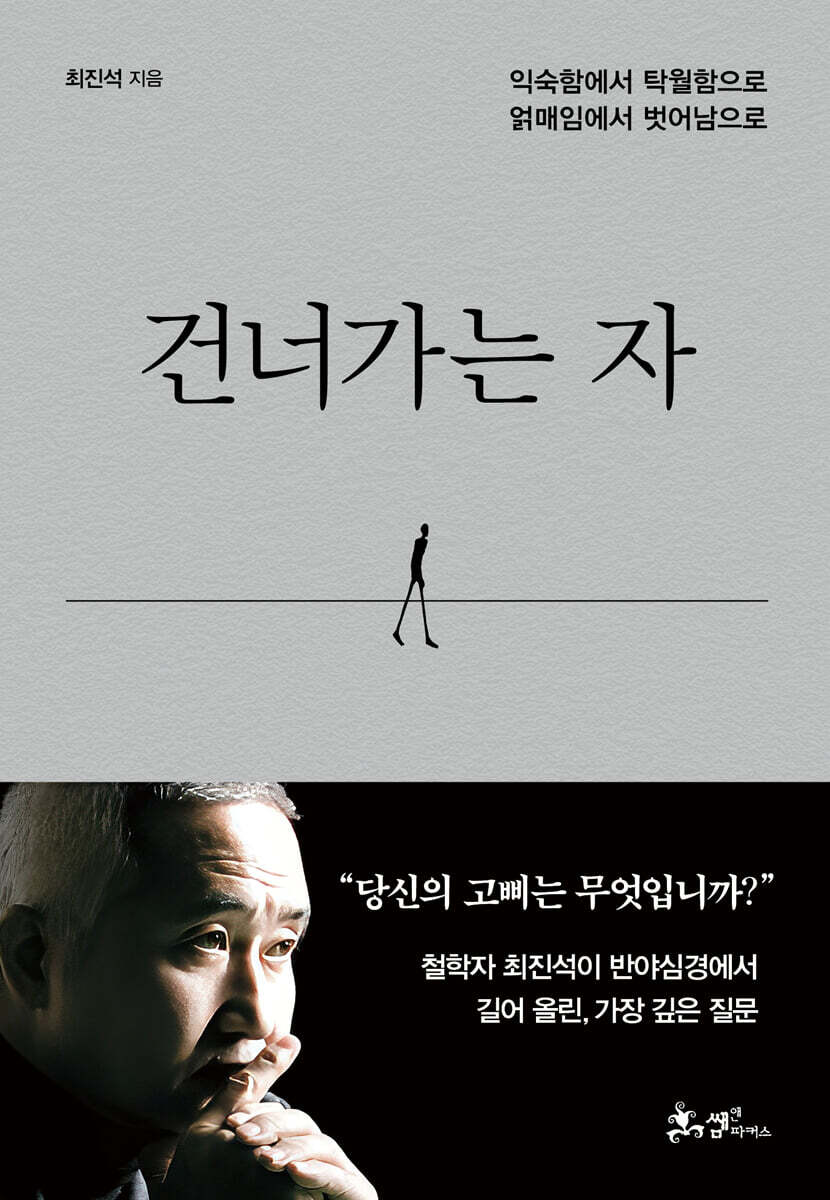
Crossing over
 |
Description
Book Introduction
“Are you staying in this familiar place, or are you trying to cross over to a new place?”
The Heart Sutra's koan of "a human life" in a time of upheaval
The Heart Sutra as a Guide to Life, Read with Philosopher Choi Jin-seok
The essence of wisdom gleaned from the classics of mankind
Nietzsche, who has been loved in Korea for a long time, and Augustine of the Confessions are still loved, and even the philosophy of Schopenhauer, who was somewhat unfamiliar, is receiving unprecedented interest.
These philosophers see life as suffering and the world as a painful place.
At the same time, it presents a methodology to overcome this pain.
However, it is a bit disappointing that a philosophy that seeks a glimmer of hope in such a pessimistic viewpoint is receiving attention.
Because it may be evidence that these are slightly more painful times than usual.
In times of such widespread suffering, what wisdom does Eastern philosophy offer?
For this answer, 『The Crosser』 came out.
Philosopher Jinseok Choi says:
The wisdom of crossing over, which does not age even after a very long time, is contained in the Heart Sutra.
Starting with 'Wisdom for Giving to Others', which is read in today's context, it introduces six types of wisdom and how to put them into practice.
In other words, 『The Crosser』 is the essence of wisdom that interprets the Heart Sutra from a modern perspective.
"How should we live this life?" We delve into the "wisdom of crossing over" offered by the classics of humanity, answering the question posed by this age of suffering.
The Heart Sutra's koan of "a human life" in a time of upheaval
The Heart Sutra as a Guide to Life, Read with Philosopher Choi Jin-seok
The essence of wisdom gleaned from the classics of mankind
Nietzsche, who has been loved in Korea for a long time, and Augustine of the Confessions are still loved, and even the philosophy of Schopenhauer, who was somewhat unfamiliar, is receiving unprecedented interest.
These philosophers see life as suffering and the world as a painful place.
At the same time, it presents a methodology to overcome this pain.
However, it is a bit disappointing that a philosophy that seeks a glimmer of hope in such a pessimistic viewpoint is receiving attention.
Because it may be evidence that these are slightly more painful times than usual.
In times of such widespread suffering, what wisdom does Eastern philosophy offer?
For this answer, 『The Crosser』 came out.
Philosopher Jinseok Choi says:
The wisdom of crossing over, which does not age even after a very long time, is contained in the Heart Sutra.
Starting with 'Wisdom for Giving to Others', which is read in today's context, it introduces six types of wisdom and how to put them into practice.
In other words, 『The Crosser』 is the essence of wisdom that interprets the Heart Sutra from a modern perspective.
"How should we live this life?" We delve into the "wisdom of crossing over" offered by the classics of humanity, answering the question posed by this age of suffering.
- You can preview some of the book's contents.
Preview
index
Introduction - The Path of Prajna that Illuminates the Laws of the World
Chapter 1: Realizing Humanity's Calling and Facing the Truth of the World
1-1 What is your reins?
1-2 The only child in heaven and earth
1-3 Why aren't you happy?
1-4 Escape from the Sea of Pain
1-5 Chayugopiyu Chamyeolgopimyeol
1-6 Self-destructive
1-7 The Reality of the World, Public
Chapter 2: This world is full of suffering, so we step onto the wisdom of Prajna and cross over.
2-1 Maha Prajna Paramita
2-2 Baramilda, crossing over
2-3 Wisdom that nurtures me
The power of 2-4 repetitions
2-5 Sacred Places
2-6 Five skandhas, color, perception, and consciousness
2-7 All five ions are empty
Chapter 3: Empty your mind to fill it more, and don't make a prize to see clearly.
3-1 Empty your mind
3-2 Do not build a prize
3-3 No ownership
3-4 Baekcheokgandujin Ilbo
3-5 color instant space empty color instant space
Chapter 4: Correcting Your Overturned Thinking and Choosing the Best Path
4-1 The Three Dharma Seals and the Dream of Evangelism
4-2 Immortality, non-birth, non-destruction, non-increase, non-increase
4-3 The most excellent way
Chapter 5: I Want Nothing, I Just Cross the Sea of Pain
5-1 The Twelve Links of Dependent Origination and the Four Noble Truths
5-2 Extreme Negativity
5-3 Wisdom of Prajna
5-4 I don't want anything
5-5 Free-standing angle
5-6 Spells to Cross the Impossible
Coming out - Let the scriptures be a light, not a shackle
Chapter 1: Realizing Humanity's Calling and Facing the Truth of the World
1-1 What is your reins?
1-2 The only child in heaven and earth
1-3 Why aren't you happy?
1-4 Escape from the Sea of Pain
1-5 Chayugopiyu Chamyeolgopimyeol
1-6 Self-destructive
1-7 The Reality of the World, Public
Chapter 2: This world is full of suffering, so we step onto the wisdom of Prajna and cross over.
2-1 Maha Prajna Paramita
2-2 Baramilda, crossing over
2-3 Wisdom that nurtures me
The power of 2-4 repetitions
2-5 Sacred Places
2-6 Five skandhas, color, perception, and consciousness
2-7 All five ions are empty
Chapter 3: Empty your mind to fill it more, and don't make a prize to see clearly.
3-1 Empty your mind
3-2 Do not build a prize
3-3 No ownership
3-4 Baekcheokgandujin Ilbo
3-5 color instant space empty color instant space
Chapter 4: Correcting Your Overturned Thinking and Choosing the Best Path
4-1 The Three Dharma Seals and the Dream of Evangelism
4-2 Immortality, non-birth, non-destruction, non-increase, non-increase
4-3 The most excellent way
Chapter 5: I Want Nothing, I Just Cross the Sea of Pain
5-1 The Twelve Links of Dependent Origination and the Four Noble Truths
5-2 Extreme Negativity
5-3 Wisdom of Prajna
5-4 I don't want anything
5-5 Free-standing angle
5-6 Spells to Cross the Impossible
Coming out - Let the scriptures be a light, not a shackle
Detailed image
.jpg)
Into the book
It's about how you have to deal with what your reins are in your life most importantly.
Otherwise I wouldn't know where I was going or even why I was riding a horse.
You will not be able to know the direction of your life and will not be able to enjoy it to the fullest.
This is why life becomes stagnant and we fall into a rut.
---From "What Are Your Reins"
The Buddha's first realization was that 'the world is an ocean of suffering.'
Now that we truly know that the world is an ocean of suffering, the Buddha's task becomes clear.
It is to save sentient beings by rescuing them from the sea of suffering.
Buddhism, all of Buddha's teachings are just different interpretations of the same story.
In the end, it all comes down to 'getting out of pain'.
---From "Escape from the Sea of Pain"
The ball is more of a symbol than an entity.
It's just like a sign.
So the ball is not a state of something that actually exists, but is just a simple logical concept.
It would not be wrong to say that there is no such thing as a ball.
When studying Buddhist scriptures and seeing the word emptiness, you should always think of your original nature.
---From "The Reality of the World - The Gong"
It may sound like a wonderful story to say that there is a high state called peace and that we must constantly advance towards that high state, but this is not the only Paramita.
Wherever you stand, building on what you know now, this very moment, and planning for the next, this courageous act of leaving behind the familiar and crossing into the unfamiliar, the dangerous, and the unexplained—this is Baramilda.
---From "Baramilda - Crossing Over"
At the moment when crossing over occurs, the grammar of 'there' is not yet mature enough to be recognized.
So the evaluation of those who cross over may not be so favorable.
No, most people evaluate it negatively, and sometimes even say it's weird or bad.
Buddha also had to endure the slander and defamation of the Brahmins, and Jesus also endured the humiliation of the legalists to build his own world of truth.
---From "The Power of Repetition"
Among those who embrace the Buddha's teachings, there are many who view a proactive approach to achieving something as low-level.
I also know that many people feel uncomfortable with the word ambition.
This is because we do not know how much the Buddha emphasized making great vows and how much he emphasized courage and diligence.
If you lose your attitude of diligence, you will immediately stop.
So, we must move forward without giving up.
out.
There's nothing we can do.
That's how humans are born.
---From "The Sacred Place"
There seems to be a clear current that considers freedom as approaching animalism, and that ignoring the rules of the world and the desire to develop is what constitutes a humane life, a free life, and a happy life.
However, strangely enough, this kind of current is especially common among people who are fond of Buddhism or Taoism, and I think it stems from a misunderstanding of emptiness and emptiness.
---From "Do not build a prize"
The world that can be approached with a possessive attitude is nothing more than a shallow and narrow world.
If only we can get rid of our fixed minds, if only we can get rid of our images, if only we can get rid of our possessive attitudes, we can face the truth of the world directly.
You can experience the world much more deeply and broadly.
Would a person who can approach the world as it is be closer to Buddha?
Or, would a person who can only come into contact with a certain framework be closer to Buddha?
---From "No Possession"
I know that instead of using the word success, I would use beautiful universal concepts like happiness or freedom to make it sound more plausible.
(Omitted) This is because I am well aware that most people misunderstand that living a high-quality life means lightly ignoring worldly life.
(Omitted) They say that if you study Buddhism incorrectly, success, money, and fame are all meaningless and that what is truly valuable is having a pure and good heart. However, Buddhism talks about success with class, money with class, and fame with class.
---From "Extreme Denial"
There is a big gap between understanding and recognizing something and putting it into practice.
These are two very different areas.
There is a big gap between understanding the ball and living by its logic.
If the process of understanding emptiness was the process until this spell appeared in the Heart Sutra, then this spell can be seen as a declaration of one's will to realize Prajna Paramita in one's life.
Because it is a task to bridge the great gap between understanding the Prajna Paramita and putting it into practice.
Otherwise I wouldn't know where I was going or even why I was riding a horse.
You will not be able to know the direction of your life and will not be able to enjoy it to the fullest.
This is why life becomes stagnant and we fall into a rut.
---From "What Are Your Reins"
The Buddha's first realization was that 'the world is an ocean of suffering.'
Now that we truly know that the world is an ocean of suffering, the Buddha's task becomes clear.
It is to save sentient beings by rescuing them from the sea of suffering.
Buddhism, all of Buddha's teachings are just different interpretations of the same story.
In the end, it all comes down to 'getting out of pain'.
---From "Escape from the Sea of Pain"
The ball is more of a symbol than an entity.
It's just like a sign.
So the ball is not a state of something that actually exists, but is just a simple logical concept.
It would not be wrong to say that there is no such thing as a ball.
When studying Buddhist scriptures and seeing the word emptiness, you should always think of your original nature.
---From "The Reality of the World - The Gong"
It may sound like a wonderful story to say that there is a high state called peace and that we must constantly advance towards that high state, but this is not the only Paramita.
Wherever you stand, building on what you know now, this very moment, and planning for the next, this courageous act of leaving behind the familiar and crossing into the unfamiliar, the dangerous, and the unexplained—this is Baramilda.
---From "Baramilda - Crossing Over"
At the moment when crossing over occurs, the grammar of 'there' is not yet mature enough to be recognized.
So the evaluation of those who cross over may not be so favorable.
No, most people evaluate it negatively, and sometimes even say it's weird or bad.
Buddha also had to endure the slander and defamation of the Brahmins, and Jesus also endured the humiliation of the legalists to build his own world of truth.
---From "The Power of Repetition"
Among those who embrace the Buddha's teachings, there are many who view a proactive approach to achieving something as low-level.
I also know that many people feel uncomfortable with the word ambition.
This is because we do not know how much the Buddha emphasized making great vows and how much he emphasized courage and diligence.
If you lose your attitude of diligence, you will immediately stop.
So, we must move forward without giving up.
out.
There's nothing we can do.
That's how humans are born.
---From "The Sacred Place"
There seems to be a clear current that considers freedom as approaching animalism, and that ignoring the rules of the world and the desire to develop is what constitutes a humane life, a free life, and a happy life.
However, strangely enough, this kind of current is especially common among people who are fond of Buddhism or Taoism, and I think it stems from a misunderstanding of emptiness and emptiness.
---From "Do not build a prize"
The world that can be approached with a possessive attitude is nothing more than a shallow and narrow world.
If only we can get rid of our fixed minds, if only we can get rid of our images, if only we can get rid of our possessive attitudes, we can face the truth of the world directly.
You can experience the world much more deeply and broadly.
Would a person who can approach the world as it is be closer to Buddha?
Or, would a person who can only come into contact with a certain framework be closer to Buddha?
---From "No Possession"
I know that instead of using the word success, I would use beautiful universal concepts like happiness or freedom to make it sound more plausible.
(Omitted) This is because I am well aware that most people misunderstand that living a high-quality life means lightly ignoring worldly life.
(Omitted) They say that if you study Buddhism incorrectly, success, money, and fame are all meaningless and that what is truly valuable is having a pure and good heart. However, Buddhism talks about success with class, money with class, and fame with class.
---From "Extreme Denial"
There is a big gap between understanding and recognizing something and putting it into practice.
These are two very different areas.
There is a big gap between understanding the ball and living by its logic.
If the process of understanding emptiness was the process until this spell appeared in the Heart Sutra, then this spell can be seen as a declaration of one's will to realize Prajna Paramita in one's life.
Because it is a task to bridge the great gap between understanding the Prajna Paramita and putting it into practice.
---From "The Spell that Crosses the Impossible"
Publisher's Review
“What are the reins of your life?”
A question posed by a long-standing philosophy in a complex and multifaceted era
Are you perhaps feeling unsettled right now?
No matter how hard I try, it's not easy to maintain my own health, and I'm not feeling like I'm struggling to keep up with the times, which don't seem to be getting any better in the future.
But the higher the waves, the more you have to lower your posture and keep your mind clear.
The more everything changes and falls apart, the more important it becomes to find the center of gravity in life.
Our days are so precious that we are lost and confused in the midst of the turbulent flow.
The ordinary daily routines that we may live without much thought about are, when viewed from afar, each step taken on the journey of life.
The footsteps we take each day add up to create the trajectory of our lives.
So, you have to think about it.
Where is my day headed today?
This book, "The Crossing One," uses the philosophy of the Heart Sutra to cross vast time and ask questions of you today.
Are you on the right track right now, or are you just taking steps knowing exactly where you are going?
Even if you do well, aren't you sometimes shaken by the storms of the times?
And what we need now is the 'wisdom of crossing over.'
The Heart Sutra's philosophy on life attitude
Wisdom of Crossing
When we think of Buddhism, the first concept that comes to mind is ‘emptiness.’
However, contrary to popular belief, 'gong' does not mean a profound, transcendent, and eternal truth.
From a philosophical point of view, it is merely a symbol for the saying, 'There is nothing in this world that is originally like that, fixed and unchanging.'
In a world where there is no fixed, unchanging entity, the desire to hold onto something certain and clear soon leads to suffering.
This perspective is hidden in the saying, 'Life is a sea of suffering,' and the wisdom to cross this sea of suffering is the 'wisdom of crossing.'
The wisdom of crossing over is accomplished in six ways.
First, wisdom that is given to others.
When I give to others, I know that I will grow and expand.
Second, the wisdom to keep your promises.
Constantly repeating the rules you have set without stopping
Third, the wisdom to silently endure suffering.
Enduring the criticism and humiliation that comes with breaking out of the mold
Fourth, the wisdom to move forward without retreating.
To advance to the end without retreating with an attitude of courage and determination
Fifth, the wisdom to protect your own mind.
Trusting yourself, caring for yourself, and treating yourself with the utmost respect
Sixth, the wisdom to put the five wisdoms into practice.
Understanding the ways of the world and putting the five wisdoms into practice
The wisdom of crossing over is taking the first step out of the familiar and into the unknown, without being crushed by the unstoppable flow of the world.
At the same time, we see things as they are.
It is a perspective that sees the world as it is, not as I want to see it.
And it is a step that continues without stopping, that is, a practice before knowledge.
In an age of ever-faster change and more painful
The essence of wisdom that becomes an anchor for the mind
The point that Professor Jinseok Choi repeatedly emphasizes ultimately comes down to one thing.
It means to become a ‘crosser.’
What exactly are we supposed to cross? The Heart Sutra answers this question.
That something is something that is brought up from ‘one’s inner self.’
If the content is set, everyone must learn the same route and content.
We must assume some fixed learning.
But since nothing in the world is fixed and unchanging, the wisdom of crossing over exists only in form.
Since only the form exists, you can fill in the content yourself.
Regardless of whether it is Eastern or Western philosophy, including Buddhism, Stoicism, Nietzsche, and Schopenhauer, the view that life is painful and the world is a painful place is not a particularly unusual or new perspective today.
But why does this philosophy seem to resonate so strongly now, in this day and age? It's probably because we live in a time of unprecedented change.
It must be so because it is a time filled with suffering.
"The Crosser" is a work that we must read at least once today, as it contains the wisdom of humanity that has been passed down without change for a long time, and the wisdom that is most needed in these particularly painful times.
Whenever pain surges, taste the essence of wisdom that will always be an anchor for your mind.
A question posed by a long-standing philosophy in a complex and multifaceted era
Are you perhaps feeling unsettled right now?
No matter how hard I try, it's not easy to maintain my own health, and I'm not feeling like I'm struggling to keep up with the times, which don't seem to be getting any better in the future.
But the higher the waves, the more you have to lower your posture and keep your mind clear.
The more everything changes and falls apart, the more important it becomes to find the center of gravity in life.
Our days are so precious that we are lost and confused in the midst of the turbulent flow.
The ordinary daily routines that we may live without much thought about are, when viewed from afar, each step taken on the journey of life.
The footsteps we take each day add up to create the trajectory of our lives.
So, you have to think about it.
Where is my day headed today?
This book, "The Crossing One," uses the philosophy of the Heart Sutra to cross vast time and ask questions of you today.
Are you on the right track right now, or are you just taking steps knowing exactly where you are going?
Even if you do well, aren't you sometimes shaken by the storms of the times?
And what we need now is the 'wisdom of crossing over.'
The Heart Sutra's philosophy on life attitude
Wisdom of Crossing
When we think of Buddhism, the first concept that comes to mind is ‘emptiness.’
However, contrary to popular belief, 'gong' does not mean a profound, transcendent, and eternal truth.
From a philosophical point of view, it is merely a symbol for the saying, 'There is nothing in this world that is originally like that, fixed and unchanging.'
In a world where there is no fixed, unchanging entity, the desire to hold onto something certain and clear soon leads to suffering.
This perspective is hidden in the saying, 'Life is a sea of suffering,' and the wisdom to cross this sea of suffering is the 'wisdom of crossing.'
The wisdom of crossing over is accomplished in six ways.
First, wisdom that is given to others.
When I give to others, I know that I will grow and expand.
Second, the wisdom to keep your promises.
Constantly repeating the rules you have set without stopping
Third, the wisdom to silently endure suffering.
Enduring the criticism and humiliation that comes with breaking out of the mold
Fourth, the wisdom to move forward without retreating.
To advance to the end without retreating with an attitude of courage and determination
Fifth, the wisdom to protect your own mind.
Trusting yourself, caring for yourself, and treating yourself with the utmost respect
Sixth, the wisdom to put the five wisdoms into practice.
Understanding the ways of the world and putting the five wisdoms into practice
The wisdom of crossing over is taking the first step out of the familiar and into the unknown, without being crushed by the unstoppable flow of the world.
At the same time, we see things as they are.
It is a perspective that sees the world as it is, not as I want to see it.
And it is a step that continues without stopping, that is, a practice before knowledge.
In an age of ever-faster change and more painful
The essence of wisdom that becomes an anchor for the mind
The point that Professor Jinseok Choi repeatedly emphasizes ultimately comes down to one thing.
It means to become a ‘crosser.’
What exactly are we supposed to cross? The Heart Sutra answers this question.
That something is something that is brought up from ‘one’s inner self.’
If the content is set, everyone must learn the same route and content.
We must assume some fixed learning.
But since nothing in the world is fixed and unchanging, the wisdom of crossing over exists only in form.
Since only the form exists, you can fill in the content yourself.
Regardless of whether it is Eastern or Western philosophy, including Buddhism, Stoicism, Nietzsche, and Schopenhauer, the view that life is painful and the world is a painful place is not a particularly unusual or new perspective today.
But why does this philosophy seem to resonate so strongly now, in this day and age? It's probably because we live in a time of unprecedented change.
It must be so because it is a time filled with suffering.
"The Crosser" is a work that we must read at least once today, as it contains the wisdom of humanity that has been passed down without change for a long time, and the wisdom that is most needed in these particularly painful times.
Whenever pain surges, taste the essence of wisdom that will always be an anchor for your mind.
GOODS SPECIFICS
- Date of issue: May 22, 2024
- Format: Hardcover book binding method guide
- Page count, weight, size: 312 pages | 468g | 128*188*18mm
- ISBN13: 9791165349646
- ISBN10: 1165349647
You may also like
카테고리
korean


korean

![GQ KOREA Mark (Monthly): December [2025]](http://librairie.coreenne.fr/cdn/shop/files/8ef265dbbfbf186523ed75ba7319009d.jpg?v=1765340328&width=3840)


