

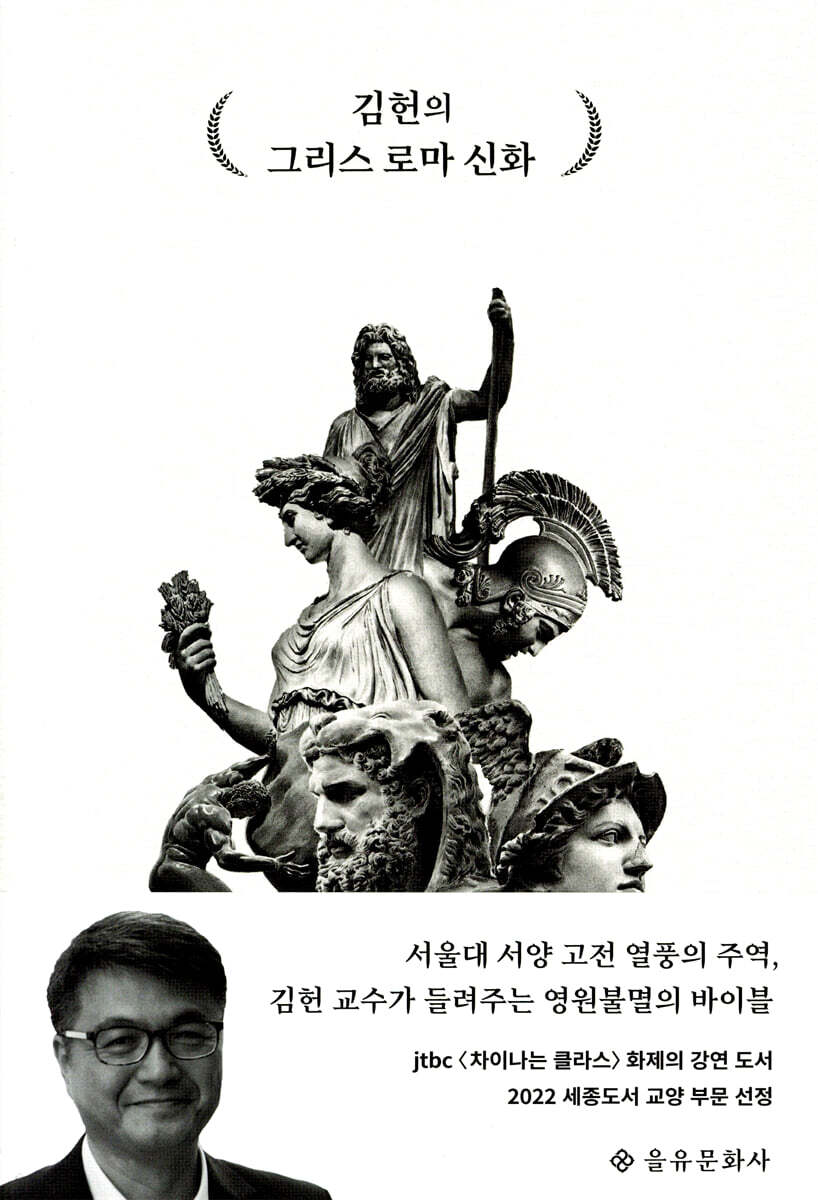
Kim Heon's Greek and Roman Mythology
 |
Description
Book Introduction
"Kim Heon's Greek and Roman Mythology," a one-volume overview of Greek and Roman mythology, the ultimate bible of humanity and the foundation of Western civilization, has been published by Eulyoo Publishing. Author Kim Heon is a classicist who has appeared on numerous broadcast programs, including [China Class], [My Library that Reads Books], and [Naked World History], to introduce classical works to the public. He has compiled the Greek and Roman mythology he has researched and taught in this book. · This is the ultimate must-read book for humanity, read only in one volume. · A new world of gods and heroes born from the deep reflections of a classicist · Detailed reproductions of classical works based on myths · A 21st-century myth based on Greek and Latin originals |
- You can preview some of the book's contents.
Preview
index
Introduction: A person who loves mythology
Part 1: From Chaos to Cosmos
1 Chaos, the yawn of creation | 2 From Chaos to Cosmos | 3 Janus, opening the gates of the world | 4 Chaos's terrifying descendants | 5 Gaia, establishing the first order | 6 Tartarus, ruling the underworld | 7 Eros, moving the world | 8 Uranus, reigning over the earth | 9 Uranus, who imprisoned his children in the earth | 10 Cronus, castrating his father | 11 The various stories of Aphrodite and Eros | 12 Zeus, waging war with his father | 13 Zeus, who seized eternal power | 14 Why is Zeus a womanizer? | 15 Prometheus, subduing Zeus | 16 Atlas' foolish choice | 17 The oath of the Styx River that even the gods cannot refuse | 18 Poseidon, becoming a slave | 19 Hades, becoming the king of the dead | 20 Plato's Vision of the Afterlife | 21 Hera Becomes Zeus's Wife
Part 2: The Glory of the Gods
1 Muses (Mousa), singing myths | 2 What did the nine Muses do? | 3 Athena, born from Zeus's head | 4 Apollo and Artemis, illuminating the world | 5 Apollo, who loved the laurel | 6 Asclepius, becoming the god of medicine | 7 Artemis, loving Orion? | 8 Ares, becoming the god of war | 9 Hephaestus, becoming the indomitable craftsman | 10 Aphrodite's men | 11 Maia, becoming the queen of May | 12 Hermes, becoming the messenger god | 13 The jealous goddess, ruining Aglaurus | 14 Dionysus, becoming the god of wine | 15 Dionysus, the master of tragedy | 16 Who is the maiden shining in the night sky? | 17 Who holds the scales? | 18 Zeus suppresses the rebellion of the giants | 19 Typhon, the giant, begets terrible children | 20 The glory of Zeus, the Olympian and Nemenian games | 21 The glory of Poseidon, the Isthmian games | 22 Medusa, Poseidon's woman | 23 Chiron, the teacher of heroes | 24 Eros loves Psyche | 25 Pan, astonishes people | 26 Ganymede, becomes the immortal attendant | 27 The gods live in science
Part 3: The Hero's Struggle
1 The birth of the first humans and heroes | 2 Pandora opens the jar lid | 3 Deucalion and Pyrrha survive the flood | 4 Io turns into a cow and wanders the world | 5 Phaethon falls from the sun's chariot | 6 Europa, the mother of European civilization | 7 Perseus establishes the Mycenaean civilization | 8 Tantalus, eternally thirsty and hungry | 9 Sisyphus, eternally rolling a rock uphill | 10 Bellerophon falls from Pegasus | 11 Theseus, on the path to becoming a hero | 12 Theseus defeats the Minotaur | 13 Aegeus falls into the Aegean Sea | 14 Hippolytus dies innocently | 15 Icarus loses his wings and falls | 16 Cadmus establishes Thebes | 17 Harmonia's necklace becomes the tragedy of Thebes | 18 From Cadmus to Oedipus | 19 Oedipus, Fighting Fate | 20 Oedipus's Two Sons, Waging War | 21 Antigone, Risking Her Life in a Challenge to Authority | 22 Jason, Searching for the Golden Fleece | 23 Why Was the Golden Fleece in Colchis? | 24 Jason and Medea, Icons of Love, Betrayal, and Revenge
Part 4: Immortality and Mortality
1 Hercules Completes the Twelve Labors | 2 Hercules Defeats Death and Becomes a God | 3 Orpheus Descends into Hades | 4 Castor and Polydeuces Become Gemini | 5 Helen's Men | 6 Agamemnon Sacrifices His Daughter | 7 Clytemnestra Dies by Her Children | 8 Achilles Chooses Immortal Fame | 9 Ajax's Dilemma | 10 The Trojan Horse Ends the War | 11 Why Did Odysseus Wander for Ten Years? | 12 Odysseus Returns to the Mortal World | 13 Aeneas Escapes Troy | 14 Aeneas's Choice: Love or Country? | 15 Romulus Kills Remus and Founds Rome | 16 Baucis and Philemon Become a Tree | 17 Arachne, turned into a spider | 18 Narcissus, falling in love | 19 Gyges's ring, asking for justice | 20 Midas, the golden hand and donkey ears | 21 Pygmalion's miracle | 22 The secret of love, finding the lost other half | 23 The farmer riding a dung beetle, saving the goddess of peace
Going Out: A Fable for Myth
Part 1: From Chaos to Cosmos
1 Chaos, the yawn of creation | 2 From Chaos to Cosmos | 3 Janus, opening the gates of the world | 4 Chaos's terrifying descendants | 5 Gaia, establishing the first order | 6 Tartarus, ruling the underworld | 7 Eros, moving the world | 8 Uranus, reigning over the earth | 9 Uranus, who imprisoned his children in the earth | 10 Cronus, castrating his father | 11 The various stories of Aphrodite and Eros | 12 Zeus, waging war with his father | 13 Zeus, who seized eternal power | 14 Why is Zeus a womanizer? | 15 Prometheus, subduing Zeus | 16 Atlas' foolish choice | 17 The oath of the Styx River that even the gods cannot refuse | 18 Poseidon, becoming a slave | 19 Hades, becoming the king of the dead | 20 Plato's Vision of the Afterlife | 21 Hera Becomes Zeus's Wife
Part 2: The Glory of the Gods
1 Muses (Mousa), singing myths | 2 What did the nine Muses do? | 3 Athena, born from Zeus's head | 4 Apollo and Artemis, illuminating the world | 5 Apollo, who loved the laurel | 6 Asclepius, becoming the god of medicine | 7 Artemis, loving Orion? | 8 Ares, becoming the god of war | 9 Hephaestus, becoming the indomitable craftsman | 10 Aphrodite's men | 11 Maia, becoming the queen of May | 12 Hermes, becoming the messenger god | 13 The jealous goddess, ruining Aglaurus | 14 Dionysus, becoming the god of wine | 15 Dionysus, the master of tragedy | 16 Who is the maiden shining in the night sky? | 17 Who holds the scales? | 18 Zeus suppresses the rebellion of the giants | 19 Typhon, the giant, begets terrible children | 20 The glory of Zeus, the Olympian and Nemenian games | 21 The glory of Poseidon, the Isthmian games | 22 Medusa, Poseidon's woman | 23 Chiron, the teacher of heroes | 24 Eros loves Psyche | 25 Pan, astonishes people | 26 Ganymede, becomes the immortal attendant | 27 The gods live in science
Part 3: The Hero's Struggle
1 The birth of the first humans and heroes | 2 Pandora opens the jar lid | 3 Deucalion and Pyrrha survive the flood | 4 Io turns into a cow and wanders the world | 5 Phaethon falls from the sun's chariot | 6 Europa, the mother of European civilization | 7 Perseus establishes the Mycenaean civilization | 8 Tantalus, eternally thirsty and hungry | 9 Sisyphus, eternally rolling a rock uphill | 10 Bellerophon falls from Pegasus | 11 Theseus, on the path to becoming a hero | 12 Theseus defeats the Minotaur | 13 Aegeus falls into the Aegean Sea | 14 Hippolytus dies innocently | 15 Icarus loses his wings and falls | 16 Cadmus establishes Thebes | 17 Harmonia's necklace becomes the tragedy of Thebes | 18 From Cadmus to Oedipus | 19 Oedipus, Fighting Fate | 20 Oedipus's Two Sons, Waging War | 21 Antigone, Risking Her Life in a Challenge to Authority | 22 Jason, Searching for the Golden Fleece | 23 Why Was the Golden Fleece in Colchis? | 24 Jason and Medea, Icons of Love, Betrayal, and Revenge
Part 4: Immortality and Mortality
1 Hercules Completes the Twelve Labors | 2 Hercules Defeats Death and Becomes a God | 3 Orpheus Descends into Hades | 4 Castor and Polydeuces Become Gemini | 5 Helen's Men | 6 Agamemnon Sacrifices His Daughter | 7 Clytemnestra Dies by Her Children | 8 Achilles Chooses Immortal Fame | 9 Ajax's Dilemma | 10 The Trojan Horse Ends the War | 11 Why Did Odysseus Wander for Ten Years? | 12 Odysseus Returns to the Mortal World | 13 Aeneas Escapes Troy | 14 Aeneas's Choice: Love or Country? | 15 Romulus Kills Remus and Founds Rome | 16 Baucis and Philemon Become a Tree | 17 Arachne, turned into a spider | 18 Narcissus, falling in love | 19 Gyges's ring, asking for justice | 20 Midas, the golden hand and donkey ears | 21 Pygmalion's miracle | 22 The secret of love, finding the lost other half | 23 The farmer riding a dung beetle, saving the goddess of peace
Going Out: A Fable for Myth
Detailed image

Into the book
Now we invite you to the world of mythology.
Most of them are stories of gods and heroes.
A hero is a demigod, half-human being born between a god and a human. He possesses divine abilities and a strong desire to enter the realm of the gods, but because he is ultimately human, he cannot overcome his limitations and falls at the boundary between god and human.
But whether heroes or gods, they are all mirrors that reflect human nature.
--- p.10
If we reinterpret the mythological symbolism and metaphorical meaning contained in the image of 'playboy Zeus,' there is something very important to learn.
In that respect, I'm actually very envious of Zeus.
Not because he can shape-shift freely, take women, and cheat to his heart's content, but because of the meaning his actions hold.
(…) His becoming a womanizer was not simply to satisfy his sexual desires, but rather part of a strategy to gain reliable allies to expand and stabilize his power.
--- p.83
In 『Protagoras』, it is said that the gods created animals and humans by mixing earth, fire, and a mixture of the two in the ground.
He then entrusted his brothers Prometheus and Epimetheus with the task of giving each animal and each human the abilities that suited them best.
Once Epimetheus had distributed various abilities to living beings, Prometheus decided to conduct the final inspection.
But Epimetheus completely forgot that humans existed and gave all his abilities to other animals.
First of all, he has lived up to his reputation as a 'metheus (one who thinks later (Epi-)' by putting things in a bad light.
I wonder what my brother would have thought if he found out about this. So, if the two brothers had swapped responsibilities, this mistake wouldn't have happened.
It would have been better if 'Pro-metheus' had distributed the powers, and Epimetheus had examined them later.
--- p.293
Was there really a golden fleece in Colchis? Well, I doubt many would believe such a mystical object actually existed.
But it cannot be said to be completely fiction.
In 2009, archaeologists Gambashiz and Sikaruliz, along with several German and Georgian archaeologists, were excavating in southwestern Georgia.
What is now Georgia was once Colchis, and it was there that gold mines dating back about 3,000 years were discovered.
Archaeologists claim that it is the oldest gold mine in the world.
And it is said that when panning for gold in the river that flows there, they mainly used wool.
I think that's how the myth of the golden fleece came about.
--- p.412
The protagonist of this work is Trugaios.
Since 'trux' means 'new wine', Trugaios means 'vinedresser'.
As the play begins, two servants come out on stage and grumble while making rice cakes with feces.
The audience must be wondering what the dung cakes would be used for. As it turns out, Trygaeus had caught a gigantic dung beetle somewhere, and the dung cakes his servants were making were food for the giant dung beetle.
Trygaeus boasts that he will feed the dung cake to the dung beetle to make it grow bigger and then ride it to the sky.
But why does Trygaius want to ascend to heaven?
He plans to meet Zeus, the greatest god, and settle the score.
“Why does Zeus make the Greeks keep fighting?
“When we all die, who will offer sacrifices to you?” That was the argument he was trying to make.
Most of them are stories of gods and heroes.
A hero is a demigod, half-human being born between a god and a human. He possesses divine abilities and a strong desire to enter the realm of the gods, but because he is ultimately human, he cannot overcome his limitations and falls at the boundary between god and human.
But whether heroes or gods, they are all mirrors that reflect human nature.
--- p.10
If we reinterpret the mythological symbolism and metaphorical meaning contained in the image of 'playboy Zeus,' there is something very important to learn.
In that respect, I'm actually very envious of Zeus.
Not because he can shape-shift freely, take women, and cheat to his heart's content, but because of the meaning his actions hold.
(…) His becoming a womanizer was not simply to satisfy his sexual desires, but rather part of a strategy to gain reliable allies to expand and stabilize his power.
--- p.83
In 『Protagoras』, it is said that the gods created animals and humans by mixing earth, fire, and a mixture of the two in the ground.
He then entrusted his brothers Prometheus and Epimetheus with the task of giving each animal and each human the abilities that suited them best.
Once Epimetheus had distributed various abilities to living beings, Prometheus decided to conduct the final inspection.
But Epimetheus completely forgot that humans existed and gave all his abilities to other animals.
First of all, he has lived up to his reputation as a 'metheus (one who thinks later (Epi-)' by putting things in a bad light.
I wonder what my brother would have thought if he found out about this. So, if the two brothers had swapped responsibilities, this mistake wouldn't have happened.
It would have been better if 'Pro-metheus' had distributed the powers, and Epimetheus had examined them later.
--- p.293
Was there really a golden fleece in Colchis? Well, I doubt many would believe such a mystical object actually existed.
But it cannot be said to be completely fiction.
In 2009, archaeologists Gambashiz and Sikaruliz, along with several German and Georgian archaeologists, were excavating in southwestern Georgia.
What is now Georgia was once Colchis, and it was there that gold mines dating back about 3,000 years were discovered.
Archaeologists claim that it is the oldest gold mine in the world.
And it is said that when panning for gold in the river that flows there, they mainly used wool.
I think that's how the myth of the golden fleece came about.
--- p.412
The protagonist of this work is Trugaios.
Since 'trux' means 'new wine', Trugaios means 'vinedresser'.
As the play begins, two servants come out on stage and grumble while making rice cakes with feces.
The audience must be wondering what the dung cakes would be used for. As it turns out, Trygaeus had caught a gigantic dung beetle somewhere, and the dung cakes his servants were making were food for the giant dung beetle.
Trygaeus boasts that he will feed the dung cake to the dung beetle to make it grow bigger and then ride it to the sky.
But why does Trygaius want to ascend to heaven?
He plans to meet Zeus, the greatest god, and settle the score.
“Why does Zeus make the Greeks keep fighting?
“When we all die, who will offer sacrifices to you?” That was the argument he was trying to make.
--- p.552
Publisher's Review
The main character of the classical music craze at Seoul National University,
Professor Kim Heon's Mythology Masterclass
This book contains the world of gods and heroes reborn through the reflections of Kim Heon, a professor at the Institute of Humanities at Seoul National University.
The author's lectures on Greek and Roman mythology, which he has been giving for nearly 20 years while studying the classics, including the philosophy of Plato and Aristotle, have become so well-known that they have replaced the top-ranking books in the Seoul National University Library.
"Kim Heon's Greek and Roman Mythology" is a book that compiles his lectures, and it provides an overview of the entire vast mythology, from Chaos, the beginning of the creation of heaven and earth, to the various gods and demigod heroes of Olympus.
Clear sentences using polite language systematically introduce difficult and complex ancient myths in an easy-to-understand manner.
In particular, while many existing books on Greek and Roman mythology were written by referencing books translated into other languages, including English, this book is unique in that it was written by a classicist based on his own interpretation and research of the original Greek and Latin texts.
Moreover, unlike existing books, this book introduces ancient literature and classical tragedy scenes related to mythology directly along with the original text, allowing for a more multifaceted approach.
For example, the anecdote of Zeus transforming into a bull to approach Europa is difficult to fully convey the atmosphere of that moment through a simple descriptive interpretation.
But when we tell the myth with lines like the Roman poet Ovid's, "He took the form of a bull, and mingled with the herd, / He mooed and glided along the soft grass," a much more pleasant and exciting scene is evoked.
That is, we can feel more vividly that for the Greeks and Romans of that time, myths were not dry texts like we encounter them today, but could be songs, poems, religions, and entertainment.
Well versed in Greek and Latin
Reading Myths Through the Etymology of Classical Scholars
The names of the various gods and characters appearing in mythology are not just simple titles, but also another clue containing the key to interpretation.
The author, who has studied ancient Greek and Latin for a long time, shows that there is another way to interpret myths through etymological analysis.
Using this method, we can infer from the outset that Hercules will meet a tragic end at the hands of Deianira.
Deianira was tricked by the Centaur Nessus into killing Heracles unintentionally.
Nessus once gave his blood to Deianira, claiming it was a love potion, but she later mistook it for a change of heart on Heracles' part and smeared his clothes with the blood and sent it to the hero.
But contrary to her expectations that he would find love again, Hercules, in his new clothes, becomes poisoned and dies in agony.
It's a surprising ending, but the name 'Deianeira' actually contains this tragedy.
In ancient Greek, 'D?i-' means 'to destroy' and 'an?r' means 'man', so her name literally means 'destroyer of men'.
In other words, the hero Hercules, who could be called the man among men, was destined to die by her hand.
In this way, the author unfolds a more interesting and fun story by explaining the names of various mythological figures that may seem difficult and unfamiliar, as if solving a word puzzle.
Reborn from the perspective of domestic researchers
Greek and Roman mythology that fits our circumstances
The books by Thomas Bulfinch and Gustav Schwab, which have been introduced in Korea, can be said to be representative books on Greek and Roman mythology in the English- and German-speaking worlds, respectively.
While these works were interpreted from the perspective of the respective cultural spheres, this book can be said to be a new reinterpretation of Greek and Roman mythology from the perspective of a domestic researcher.
It is noteworthy that the mythology of a region on the other side of the globe has similarities with our own mythology.
The story of King Midas, who took the side of the god Pan in a musical duel between the god Pan and the god Apollo, and was given long ears by Apollo, is reminiscent of the legend of King Gyeongmun's donkey ears in the Samguk Yusa.
Also, Apollo and Artemis, who represent the sun and the moon, are similar to the story of the siblings who became the sun and the moon, which is passed down not only in our country but also in many other countries.
While many countries generally view the sun as masculine and the moon as feminine, in northern Germany the moon god Mani is masculine and the sun god Sol or Sunna is feminine.
However, there is no significant difference in the fact that the sun and the moon are viewed as siblings.
Through the traditions intertwined with each of these cultures, readers can see that Greek and Roman mythology is not simply a myth from a distant foreign country, but rather a content that shows direct and indirect similarities not only with our own culture but also with many other cultures, and that it is connected to the fundamental collective unconscious of humanity.
Adding value to the book
Includes photo-realistic details
While many existing books simply include images of famous paintings or sculptures related to Greek and Roman mythology, this book adds value to the book by including detailed drawings of ancient sculptures drawn by experts, commissioned by the publisher to match the essence of the book.
Although it may seem similar at first glance to simply print a statue image and then add texture to it with a pencil, they are completely different.
These differences are similar to how, among the many similarly handed down Greek and Roman myths, the interpretation is conveyed with completely different feelings depending on which researcher selects and interprets which version based on which materials.
The illustrations included in the text are also different from the famous paintings or sculptures that we often see, and the texture of the pencil is vivid through handwork, making them feel like another work of art.
In particular, while some Greek and Roman mythology books use excessive color images to the point of being reminiscent of picture books, this book includes them in black and white, which blends naturally into the text without compromising readability, allowing readers to focus more on the content.
People who love mythology
He is a person who loves wisdom.
Another unique strength of this book is its humanistic perspective that reinterprets myths based on ancient Greek philosophy.
The author talks about 'Arche' as defined by Aristotle while explaining chaos, which marks the beginning of Greek and Roman mythology.
Arche is 'there is nothing before it, and something behind it', and based on this, the author makes it clear that we cannot ask what was before chaos came into being.
The author's extensive knowledge of the classics is not limited to simply interpreting Greek and Roman mythology.
While explaining Hades, who appears in mythology, the author also talks about the myth of Er, another afterlife suggested by Plato.
This content appears in Plato's Republic, and is similar to the heaven and hell of Christianity in that those who lived righteously had their good deeds written on a belt and worn on their chests and ascended to heaven, while those who did evil had their evil deeds written on their backs and fell into a hole in the ground to be punished.
On the other hand, the fact that after spending a thousand years in heaven and earth, one is called back and given a new life before the goddess of fate is similar to the Buddhist theory of reincarnation.
In this way, the author does not simply introduce interesting myths, but also provides in-depth comparative explanations of folktales passed down in each culture, thereby presenting ancient values and philosophy from various perspectives.
The numerous gods and heroes appearing in this book are not some alien beings far removed from us, but rather mirrors and typical examples of human nature.
Therefore, this book faithfully fulfills its function as a classic that makes us look back on ourselves even today.
Professor Kim Heon's Mythology Masterclass
This book contains the world of gods and heroes reborn through the reflections of Kim Heon, a professor at the Institute of Humanities at Seoul National University.
The author's lectures on Greek and Roman mythology, which he has been giving for nearly 20 years while studying the classics, including the philosophy of Plato and Aristotle, have become so well-known that they have replaced the top-ranking books in the Seoul National University Library.
"Kim Heon's Greek and Roman Mythology" is a book that compiles his lectures, and it provides an overview of the entire vast mythology, from Chaos, the beginning of the creation of heaven and earth, to the various gods and demigod heroes of Olympus.
Clear sentences using polite language systematically introduce difficult and complex ancient myths in an easy-to-understand manner.
In particular, while many existing books on Greek and Roman mythology were written by referencing books translated into other languages, including English, this book is unique in that it was written by a classicist based on his own interpretation and research of the original Greek and Latin texts.
Moreover, unlike existing books, this book introduces ancient literature and classical tragedy scenes related to mythology directly along with the original text, allowing for a more multifaceted approach.
For example, the anecdote of Zeus transforming into a bull to approach Europa is difficult to fully convey the atmosphere of that moment through a simple descriptive interpretation.
But when we tell the myth with lines like the Roman poet Ovid's, "He took the form of a bull, and mingled with the herd, / He mooed and glided along the soft grass," a much more pleasant and exciting scene is evoked.
That is, we can feel more vividly that for the Greeks and Romans of that time, myths were not dry texts like we encounter them today, but could be songs, poems, religions, and entertainment.
Well versed in Greek and Latin
Reading Myths Through the Etymology of Classical Scholars
The names of the various gods and characters appearing in mythology are not just simple titles, but also another clue containing the key to interpretation.
The author, who has studied ancient Greek and Latin for a long time, shows that there is another way to interpret myths through etymological analysis.
Using this method, we can infer from the outset that Hercules will meet a tragic end at the hands of Deianira.
Deianira was tricked by the Centaur Nessus into killing Heracles unintentionally.
Nessus once gave his blood to Deianira, claiming it was a love potion, but she later mistook it for a change of heart on Heracles' part and smeared his clothes with the blood and sent it to the hero.
But contrary to her expectations that he would find love again, Hercules, in his new clothes, becomes poisoned and dies in agony.
It's a surprising ending, but the name 'Deianeira' actually contains this tragedy.
In ancient Greek, 'D?i-' means 'to destroy' and 'an?r' means 'man', so her name literally means 'destroyer of men'.
In other words, the hero Hercules, who could be called the man among men, was destined to die by her hand.
In this way, the author unfolds a more interesting and fun story by explaining the names of various mythological figures that may seem difficult and unfamiliar, as if solving a word puzzle.
Reborn from the perspective of domestic researchers
Greek and Roman mythology that fits our circumstances
The books by Thomas Bulfinch and Gustav Schwab, which have been introduced in Korea, can be said to be representative books on Greek and Roman mythology in the English- and German-speaking worlds, respectively.
While these works were interpreted from the perspective of the respective cultural spheres, this book can be said to be a new reinterpretation of Greek and Roman mythology from the perspective of a domestic researcher.
It is noteworthy that the mythology of a region on the other side of the globe has similarities with our own mythology.
The story of King Midas, who took the side of the god Pan in a musical duel between the god Pan and the god Apollo, and was given long ears by Apollo, is reminiscent of the legend of King Gyeongmun's donkey ears in the Samguk Yusa.
Also, Apollo and Artemis, who represent the sun and the moon, are similar to the story of the siblings who became the sun and the moon, which is passed down not only in our country but also in many other countries.
While many countries generally view the sun as masculine and the moon as feminine, in northern Germany the moon god Mani is masculine and the sun god Sol or Sunna is feminine.
However, there is no significant difference in the fact that the sun and the moon are viewed as siblings.
Through the traditions intertwined with each of these cultures, readers can see that Greek and Roman mythology is not simply a myth from a distant foreign country, but rather a content that shows direct and indirect similarities not only with our own culture but also with many other cultures, and that it is connected to the fundamental collective unconscious of humanity.
Adding value to the book
Includes photo-realistic details
While many existing books simply include images of famous paintings or sculptures related to Greek and Roman mythology, this book adds value to the book by including detailed drawings of ancient sculptures drawn by experts, commissioned by the publisher to match the essence of the book.
Although it may seem similar at first glance to simply print a statue image and then add texture to it with a pencil, they are completely different.
These differences are similar to how, among the many similarly handed down Greek and Roman myths, the interpretation is conveyed with completely different feelings depending on which researcher selects and interprets which version based on which materials.
The illustrations included in the text are also different from the famous paintings or sculptures that we often see, and the texture of the pencil is vivid through handwork, making them feel like another work of art.
In particular, while some Greek and Roman mythology books use excessive color images to the point of being reminiscent of picture books, this book includes them in black and white, which blends naturally into the text without compromising readability, allowing readers to focus more on the content.
People who love mythology
He is a person who loves wisdom.
Another unique strength of this book is its humanistic perspective that reinterprets myths based on ancient Greek philosophy.
The author talks about 'Arche' as defined by Aristotle while explaining chaos, which marks the beginning of Greek and Roman mythology.
Arche is 'there is nothing before it, and something behind it', and based on this, the author makes it clear that we cannot ask what was before chaos came into being.
The author's extensive knowledge of the classics is not limited to simply interpreting Greek and Roman mythology.
While explaining Hades, who appears in mythology, the author also talks about the myth of Er, another afterlife suggested by Plato.
This content appears in Plato's Republic, and is similar to the heaven and hell of Christianity in that those who lived righteously had their good deeds written on a belt and worn on their chests and ascended to heaven, while those who did evil had their evil deeds written on their backs and fell into a hole in the ground to be punished.
On the other hand, the fact that after spending a thousand years in heaven and earth, one is called back and given a new life before the goddess of fate is similar to the Buddhist theory of reincarnation.
In this way, the author does not simply introduce interesting myths, but also provides in-depth comparative explanations of folktales passed down in each culture, thereby presenting ancient values and philosophy from various perspectives.
The numerous gods and heroes appearing in this book are not some alien beings far removed from us, but rather mirrors and typical examples of human nature.
Therefore, this book faithfully fulfills its function as a classic that makes us look back on ourselves even today.
GOODS SPECIFICS
- Publication date: March 30, 2022
- Page count, weight, size: 560 pages | 560g | 135*200*35mm
- ISBN13: 9788932474649
- ISBN10: 8932474648
You may also like
카테고리
korean


korean

![GQ KOREA Mark (Monthly): December [2025]](http://librairie.coreenne.fr/cdn/shop/files/8ef265dbbfbf186523ed75ba7319009d.jpg?v=1765340328&width=3840)


