

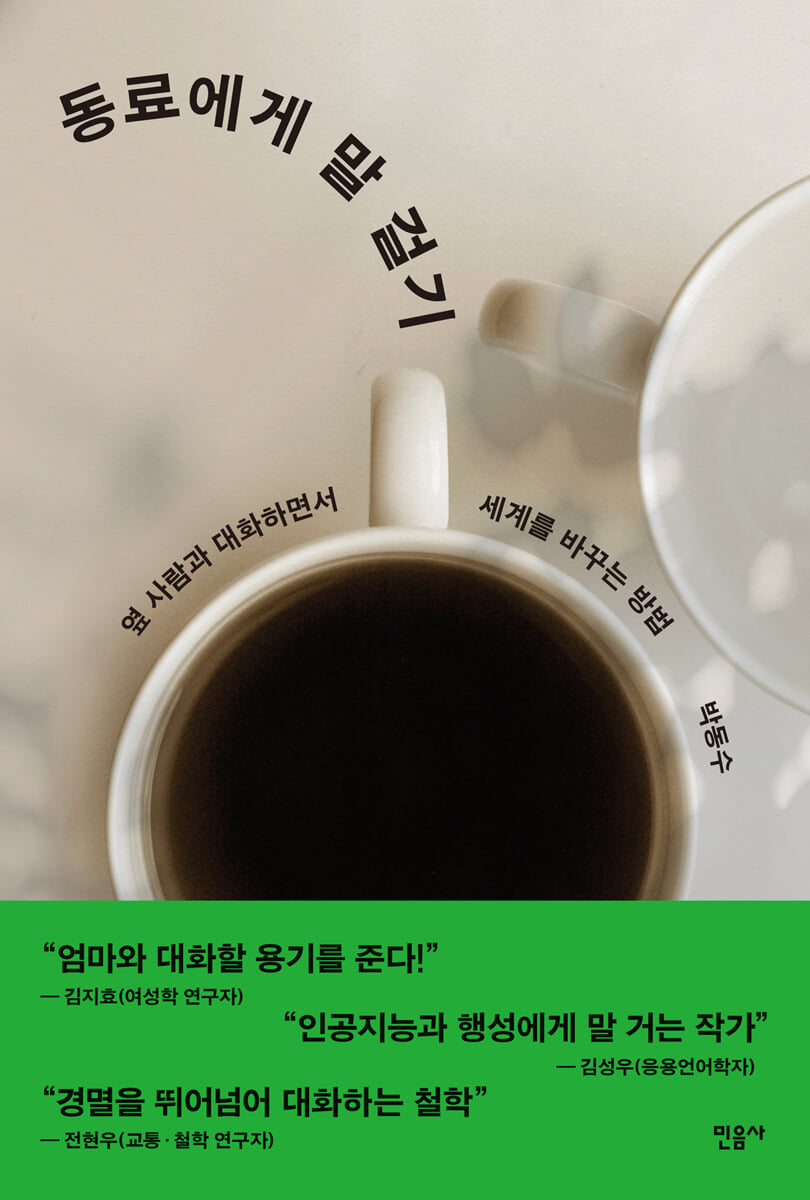
Talk to your colleagues
 |
Description
Book Introduction
- A word from MD
-
Reading and ConnectionA reading log by philosophy editor Park Dong-su, read slowly, deeply, and affectionately.
It is rare to find a book that allows one to think so broadly while reading.
By reading a variety of books, including literature and philosophy, I explore the past and present, subject and object, entanglement and coexistence.
In a world full of division and exclusion, I ask for your well-being.
October 24, 2025. Min-gyu Son, Humanities PD
Quick criticism creates enemies,
Slow conversation makes companions
“It gives me the courage to talk to my mom!”
- Kim Ji-hyo (Women's Studies Researcher)
"A Writer Who Talks to AI and Planets"
- Kim Seong-woo (applied linguist)
A Philosophy That Transcends Contempt
- Jeon Hyeon-woo (transportation and philosophy researcher)
In an age of division, is dialogue possible? "Talking to Your Colleague" begins with speaking to the person next to you.
Dongsu Park, editor of philosophy books, sets out to find a new philosophy for an age where words are out of place.
From family members with conflicting political views, to coworkers with different interests, to people who all react differently to climate change.
This is a guide to living as 'companions' in a world where we are all different but equally existent.
Slow conversation makes companions
“It gives me the courage to talk to my mom!”
- Kim Ji-hyo (Women's Studies Researcher)
"A Writer Who Talks to AI and Planets"
- Kim Seong-woo (applied linguist)
A Philosophy That Transcends Contempt
- Jeon Hyeon-woo (transportation and philosophy researcher)
In an age of division, is dialogue possible? "Talking to Your Colleague" begins with speaking to the person next to you.
Dongsu Park, editor of philosophy books, sets out to find a new philosophy for an age where words are out of place.
From family members with conflicting political views, to coworkers with different interests, to people who all react differently to climate change.
This is a guide to living as 'companions' in a world where we are all different but equally existent.
- You can preview some of the book's contents.
Preview
index
As I entered, from where I stood
Part 1: Where Philosophy Begins
Chapter 1: The Night Everyone Becomes a Philosopher - Carpenter Goni and Corrector Yurigwan
Chapter 2: Back to the Race - Writing a Family Story
Talk to your colleagues in Part 2
Chapter 3: Speaking in an Age of Dissonance - Speaking Without Parentheses
Chapter 4: Why Love and Care Are Not the Same Thing - Between Affection and Dependence
Chapter 5: We Are Not Goldfish in a Fishbowl - When Scholars and the Public Meet as Colleagues
Part 3: The Territory We Depend On
Chapter 6: Can AI Save Our Lives? - How to Avoid Confuse Maps with Territories
Chapter 7: Looking into the Pebbles in My Shoe - My Room and the Climate Crisis
How to Restart the Conclusion Story
Acknowledgements
References
Part 1: Where Philosophy Begins
Chapter 1: The Night Everyone Becomes a Philosopher - Carpenter Goni and Corrector Yurigwan
Chapter 2: Back to the Race - Writing a Family Story
Talk to your colleagues in Part 2
Chapter 3: Speaking in an Age of Dissonance - Speaking Without Parentheses
Chapter 4: Why Love and Care Are Not the Same Thing - Between Affection and Dependence
Chapter 5: We Are Not Goldfish in a Fishbowl - When Scholars and the Public Meet as Colleagues
Part 3: The Territory We Depend On
Chapter 6: Can AI Save Our Lives? - How to Avoid Confuse Maps with Territories
Chapter 7: Looking into the Pebbles in My Shoe - My Room and the Climate Crisis
How to Restart the Conclusion Story
Acknowledgements
References
Into the book
One attitude that this book consistently maintains is talking to your colleagues.
Why does philosophy books insist on mentioning colleagues? Traditionally, philosophers have followed two paths.
One is the path of the solitary thinker.
This is the image of a practitioner who tries to reach the truth through deep thought alone.
Another way is to seek the truth together with a teacher and a student, or with comrades of the same school.
But today's philosophy demands a relationship different from these two paths.
We can no longer only converse with those who share the same truth.
We have to live with people who have different worldviews, different values, and different languages.
In an age of pluralism, facing the climate crisis, and amidst the crisis of democracy, we must coexist with neighbors we cannot freely choose.
What is needed at this time is neither a relationship between comrades with the same beliefs nor a relationship between priests and priests who pass on the truth.
It is a relationship with colleagues, people who are different from each other but have no choice but to live together.
--- From "Entering"
“Do you want to be a philosopher?”
When a fellow editor asked me this question, seeing my unusual obsession with philosophy books, I just laughed it off.
“Yeah, I guess I should start with graduate school...” It was a question I often thought about to myself.
Am I an editor who wants to become a philosopher? Do I enjoy studying philosophy as an amateur, or do I want to pursue more professional training and produce new philosophies and research? This is a question that always comes up whenever I have to write about philosophy.
It means longing for a life that is both a worker and a non-worker.
Being tied to a professional identity, yet constantly experimenting with something beyond it.
Perhaps this is an extremely universal experience.
--- From Chapter 1, “A Night When Everyone Becomes a Philosopher”
In Gyeongsang Province, the Gyeongbu Expressway, the Gyeongju Bomun Tourist Complex, and the Gumi Industrial Complex, all built by the Park Chung-hee regime, still remain intact, and statues of Park Chung-hee commemorating his achievements exist throughout the province.
It is not a simple symbolic memory, but rather a folk tradition passed down through generations and a material reality that permeates the atmosphere of everyday life.
Even 'worship', which may seem somewhat bizarre to a Seoul native editor, has its own deep story and history that cannot be reduced to mere belief.
If you don't understand what local people value and are proud of, you can't change their thoughts and beliefs.
Because this is a question of pride and shame that exists before the question of right and wrong.
--- From Chapter 2, 'Return to Gyeongju'
I had a good relationship with my deceased father.
But as soon as politics came up as a topic, the atmosphere quickly turned cold.
One day, when a conversation ended up like an argument, I snapped in anger, “I can’t have a conversation with someone who hasn’t read a single book.”
Father asked quietly.
“So, does that mean my illiterate friend is not human?” I was speechless.
My father was saying that the life of his illiterate friend was inherently dignified.
On the other hand, I had already divided into those who read and those who did not, those who could communicate and those who could not.
It's as if we've defined certain types of people as beings that we don't even need to talk to.
As if we were hastily concluding that we cannot be friends with far-right supporters.
However, this attitude is what creates an 'absolute other who cannot communicate' from the beginning.
It is a mistake that blocks conversation from the start.
--- From Chapter 3, “Speaking in an Age of Discord”
In July 2025, world-renowned humanist Gayatri Spivak visited Korea.
I was invited as a keynote speaker to the 'International Conference on Critical Island Studies' held in Jeju, and gave a public lecture in Seoul.
The problem is that simultaneous Korean interpretation was not provided for the lecture.
There was a flood of protests on social media.
The controversy grew further a few days later when Spivak was caught being rude to a questioner during a keynote speech.
What was supposed to be a minor incident turned into the 'Spivac Scandal'.
The reactions were sharply divided.
The voices raising the issue of the lack of interpreters were dismissed as the misunderstanding of outsiders who were unaware of the poor academic environment.
There has also been criticism that the attitude of blindly following world-renowned scholars reveals the marginality of the Korean intellectual community.
There was also a counterargument that excessively highlighting the visit of the great scholar to Korea and ignoring the context of international academic exchange rather showed a colonial complex.
The controversy soon devolved into mutual disregard and contempt.
But there is something more important than debating who is right or wrong in this case.
The problem is that there was no proper relationship between scholars and the public, and even between scholars themselves.
The controversy surrounding Spivak's visit to Korea goes beyond a simple incident and raises more fundamental questions.
What kind of relationship should there be between scholars and the public?
--- From Chapter 5, “We Are Not Goldfish in a Fishbowl”
I wrote a draft of this chapter and asked ChatGPT to review it.
ChatGPT gave an immediate response.
The sentence structure is clear and the logical development is consistent. However, this part may be difficult for the reader, so add additional explanation.
It seemed plausible.
I sent a draft to the editor, incorporating some of those suggestions.
The editor was silent for several days.
This is a crucial difference from Chat GPT.
People need time and energy to respond appropriately.
After a while, the editor shared his honest thoughts.
“This chapter contains interesting anecdotes and introduces an excellent book, but it still feels soulless! (Sorry.) In particular, it feels like the author’s voice suddenly disappears in this part.
It would be a shame to skip the lengthy book introduction and get closer by asking questions to fellow philosophers.
“Would you like to reconsider why you wanted to tell this story?”
--- From Chapter 6, “Can Artificial Intelligence Save Life?”
As an exercise, instead of saying to far-right supporters, “They should think rationally, just like we do,” say, “We, like them, judge politics with emotion.
Let's say, "It's just that the deeper story is different."
Instead of saying to climate deniers, “They should trust science just like we do,” we should say, “We are just as anxious as they are.
Let's say, "We are afraid of the climate crisis, and they are afraid of their livelihoods."
This exercise teaches us to see our opponents not as objects of enlightenment but as equal negotiators, not as enemies but as potential allies.
This also shows why a strong turning point is necessary to understand and implement the project of 'Exploring the Form of Existence'.
Because in order to meet other forms of existence and other ontologies on an equal footing, we must think and act ‘like them.’
Why does philosophy books insist on mentioning colleagues? Traditionally, philosophers have followed two paths.
One is the path of the solitary thinker.
This is the image of a practitioner who tries to reach the truth through deep thought alone.
Another way is to seek the truth together with a teacher and a student, or with comrades of the same school.
But today's philosophy demands a relationship different from these two paths.
We can no longer only converse with those who share the same truth.
We have to live with people who have different worldviews, different values, and different languages.
In an age of pluralism, facing the climate crisis, and amidst the crisis of democracy, we must coexist with neighbors we cannot freely choose.
What is needed at this time is neither a relationship between comrades with the same beliefs nor a relationship between priests and priests who pass on the truth.
It is a relationship with colleagues, people who are different from each other but have no choice but to live together.
--- From "Entering"
“Do you want to be a philosopher?”
When a fellow editor asked me this question, seeing my unusual obsession with philosophy books, I just laughed it off.
“Yeah, I guess I should start with graduate school...” It was a question I often thought about to myself.
Am I an editor who wants to become a philosopher? Do I enjoy studying philosophy as an amateur, or do I want to pursue more professional training and produce new philosophies and research? This is a question that always comes up whenever I have to write about philosophy.
It means longing for a life that is both a worker and a non-worker.
Being tied to a professional identity, yet constantly experimenting with something beyond it.
Perhaps this is an extremely universal experience.
--- From Chapter 1, “A Night When Everyone Becomes a Philosopher”
In Gyeongsang Province, the Gyeongbu Expressway, the Gyeongju Bomun Tourist Complex, and the Gumi Industrial Complex, all built by the Park Chung-hee regime, still remain intact, and statues of Park Chung-hee commemorating his achievements exist throughout the province.
It is not a simple symbolic memory, but rather a folk tradition passed down through generations and a material reality that permeates the atmosphere of everyday life.
Even 'worship', which may seem somewhat bizarre to a Seoul native editor, has its own deep story and history that cannot be reduced to mere belief.
If you don't understand what local people value and are proud of, you can't change their thoughts and beliefs.
Because this is a question of pride and shame that exists before the question of right and wrong.
--- From Chapter 2, 'Return to Gyeongju'
I had a good relationship with my deceased father.
But as soon as politics came up as a topic, the atmosphere quickly turned cold.
One day, when a conversation ended up like an argument, I snapped in anger, “I can’t have a conversation with someone who hasn’t read a single book.”
Father asked quietly.
“So, does that mean my illiterate friend is not human?” I was speechless.
My father was saying that the life of his illiterate friend was inherently dignified.
On the other hand, I had already divided into those who read and those who did not, those who could communicate and those who could not.
It's as if we've defined certain types of people as beings that we don't even need to talk to.
As if we were hastily concluding that we cannot be friends with far-right supporters.
However, this attitude is what creates an 'absolute other who cannot communicate' from the beginning.
It is a mistake that blocks conversation from the start.
--- From Chapter 3, “Speaking in an Age of Discord”
In July 2025, world-renowned humanist Gayatri Spivak visited Korea.
I was invited as a keynote speaker to the 'International Conference on Critical Island Studies' held in Jeju, and gave a public lecture in Seoul.
The problem is that simultaneous Korean interpretation was not provided for the lecture.
There was a flood of protests on social media.
The controversy grew further a few days later when Spivak was caught being rude to a questioner during a keynote speech.
What was supposed to be a minor incident turned into the 'Spivac Scandal'.
The reactions were sharply divided.
The voices raising the issue of the lack of interpreters were dismissed as the misunderstanding of outsiders who were unaware of the poor academic environment.
There has also been criticism that the attitude of blindly following world-renowned scholars reveals the marginality of the Korean intellectual community.
There was also a counterargument that excessively highlighting the visit of the great scholar to Korea and ignoring the context of international academic exchange rather showed a colonial complex.
The controversy soon devolved into mutual disregard and contempt.
But there is something more important than debating who is right or wrong in this case.
The problem is that there was no proper relationship between scholars and the public, and even between scholars themselves.
The controversy surrounding Spivak's visit to Korea goes beyond a simple incident and raises more fundamental questions.
What kind of relationship should there be between scholars and the public?
--- From Chapter 5, “We Are Not Goldfish in a Fishbowl”
I wrote a draft of this chapter and asked ChatGPT to review it.
ChatGPT gave an immediate response.
The sentence structure is clear and the logical development is consistent. However, this part may be difficult for the reader, so add additional explanation.
It seemed plausible.
I sent a draft to the editor, incorporating some of those suggestions.
The editor was silent for several days.
This is a crucial difference from Chat GPT.
People need time and energy to respond appropriately.
After a while, the editor shared his honest thoughts.
“This chapter contains interesting anecdotes and introduces an excellent book, but it still feels soulless! (Sorry.) In particular, it feels like the author’s voice suddenly disappears in this part.
It would be a shame to skip the lengthy book introduction and get closer by asking questions to fellow philosophers.
“Would you like to reconsider why you wanted to tell this story?”
--- From Chapter 6, “Can Artificial Intelligence Save Life?”
As an exercise, instead of saying to far-right supporters, “They should think rationally, just like we do,” say, “We, like them, judge politics with emotion.
Let's say, "It's just that the deeper story is different."
Instead of saying to climate deniers, “They should trust science just like we do,” we should say, “We are just as anxious as they are.
Let's say, "We are afraid of the climate crisis, and they are afraid of their livelihoods."
This exercise teaches us to see our opponents not as objects of enlightenment but as equal negotiators, not as enemies but as potential allies.
This also shows why a strong turning point is necessary to understand and implement the project of 'Exploring the Form of Existence'.
Because in order to meet other forms of existence and other ontologies on an equal footing, we must think and act ‘like them.’
--- From "Conclusion: How to Restart the Story"
Publisher's Review
Neither friend nor foe
Coworkers, industry colleagues, fellow citizens,
Thinking with fellow Earthlings
Publishing editors are in the spotlight these days.
In a world overflowing with words and writing, from YouTube to artificial intelligence, editors are tasked with discerning what is meaningful and what is meaningless.
An editor who draws a map from book to book and anticipates what the reader wants to know one step ahead.
Among them, the editor of philosophy books who is unrivaled in drawing a network of books is Park Dong-su.
The author's second book, following his previous work, "Philosophy Book Reading Group," which introduced today's philosophy to those who have given up on philosophy, seeks a path through a world of extreme conflict.
One way to find new paths is to read famous Western philosophy books side by side with new books by peers.
It's a way to think with colleagues across knowledge hierarchies.
Park Dong-su reads contemporary books written by young authors on one side and contemporary philosophy after postmodernism on the other.
I read sociologist Didier Eribon's "Back to Rheims" alongside queer critic Lee Yeon-sook's "Here, Only Here" and "Mangoes and Grenades," which studies Okinawa, along with "Proof and Excuse," which interviews young men.
Then, difficult philosophy becomes clear and my colleague's story becomes profound.
As you read, you will change and a path to living differently in the same world will open up.
'Don't discuss politics with your family'?
'You can't talk to far-right supporters'?
In an age where words are contradictory, let's speak
When we talk about love, care, and politics
Our world is changing
Communication is not smooth in Korean society.
Amid rapid social change, a generational gap has widened, and even after democratization, an authoritarian culture still persists throughout society.
People who talk about the same experience in completely different ways.
How can dialogue be possible? Amidst the prevalence of "far-right" analysis in the media and academia, the author, a man born in the 1980s in Gyeongju, Gyeongsangbuk-do, engages in discourse that stereotypes "TK" (Daegu and Gyeongbuk).
The method of intervention is not to condone the choices of the people of the hometown, nor to criticize them by saying that the person involved will do so.
When you cannot understand the other person's language, it is a suggestion to change your own language to gain a new understanding.
Editors, who work between authors and readers, between male and female colleagues, between academia and the marketplace, are adept at rearranging language.
Watching 'TK's Daughters Breaking TK's Concrete' brings back memories of arguments with my late father, and reading philosophers who praise love together with researchers in the field of care.
This becomes a practice of creating networks in a world divided into individual domains.
And books become places for slow conversations that speak of complex realities in complex ways.
Everything exists,
In different forms
Crossing the 'deep story' that each person holds
A conversation that begins again on the basis of ontology
In an age of value confusion, philosophy is making a comeback.
We gain practical wisdom from cynical modern philosophers and learn how to ask good questions of artificial intelligence.
However, there are still questions that cannot be resolved by solving the immediate problem.
In the 21st century, a world interconnected on an unprecedented scale, where local incidents can quickly become global crises, a fundamentally new philosophy is needed.
French philosopher Bruno Latour, considered one of the greatest thinkers of the 21st century, explores the “modes of being” that help us understand today’s world.
The idea is that areas of human activity such as science, politics, law, religion, and economics each exist in their own unique way.
The world that modern philosophy has divided into rationality and irrationality, nature and society, matter and spirit, subject and object no longer exists.
Nevertheless, for us who are unknowingly returning to the old dichotomous thinking, a reexamination of ontology is urgently needed.
"Talking to Colleagues" is a book in which the editor who first introduced Latour to Korea empirically explains Latour's philosophy.
How are ancestral rites changing? Does artificial intelligence help or exploit humans? What does Spivak's visit to Korea mean to Koreans? Can livestock farmers and ecologists unite? These questions have no predetermined answers, and they cannot be resolved simply by listing individual experiences.
Only at the level of ontology should we begin by recognizing the different modes of existence.
This book will serve as a place to learn and practice 21st-century ontology.
Coworkers, industry colleagues, fellow citizens,
Thinking with fellow Earthlings
Publishing editors are in the spotlight these days.
In a world overflowing with words and writing, from YouTube to artificial intelligence, editors are tasked with discerning what is meaningful and what is meaningless.
An editor who draws a map from book to book and anticipates what the reader wants to know one step ahead.
Among them, the editor of philosophy books who is unrivaled in drawing a network of books is Park Dong-su.
The author's second book, following his previous work, "Philosophy Book Reading Group," which introduced today's philosophy to those who have given up on philosophy, seeks a path through a world of extreme conflict.
One way to find new paths is to read famous Western philosophy books side by side with new books by peers.
It's a way to think with colleagues across knowledge hierarchies.
Park Dong-su reads contemporary books written by young authors on one side and contemporary philosophy after postmodernism on the other.
I read sociologist Didier Eribon's "Back to Rheims" alongside queer critic Lee Yeon-sook's "Here, Only Here" and "Mangoes and Grenades," which studies Okinawa, along with "Proof and Excuse," which interviews young men.
Then, difficult philosophy becomes clear and my colleague's story becomes profound.
As you read, you will change and a path to living differently in the same world will open up.
'Don't discuss politics with your family'?
'You can't talk to far-right supporters'?
In an age where words are contradictory, let's speak
When we talk about love, care, and politics
Our world is changing
Communication is not smooth in Korean society.
Amid rapid social change, a generational gap has widened, and even after democratization, an authoritarian culture still persists throughout society.
People who talk about the same experience in completely different ways.
How can dialogue be possible? Amidst the prevalence of "far-right" analysis in the media and academia, the author, a man born in the 1980s in Gyeongju, Gyeongsangbuk-do, engages in discourse that stereotypes "TK" (Daegu and Gyeongbuk).
The method of intervention is not to condone the choices of the people of the hometown, nor to criticize them by saying that the person involved will do so.
When you cannot understand the other person's language, it is a suggestion to change your own language to gain a new understanding.
Editors, who work between authors and readers, between male and female colleagues, between academia and the marketplace, are adept at rearranging language.
Watching 'TK's Daughters Breaking TK's Concrete' brings back memories of arguments with my late father, and reading philosophers who praise love together with researchers in the field of care.
This becomes a practice of creating networks in a world divided into individual domains.
And books become places for slow conversations that speak of complex realities in complex ways.
Everything exists,
In different forms
Crossing the 'deep story' that each person holds
A conversation that begins again on the basis of ontology
In an age of value confusion, philosophy is making a comeback.
We gain practical wisdom from cynical modern philosophers and learn how to ask good questions of artificial intelligence.
However, there are still questions that cannot be resolved by solving the immediate problem.
In the 21st century, a world interconnected on an unprecedented scale, where local incidents can quickly become global crises, a fundamentally new philosophy is needed.
French philosopher Bruno Latour, considered one of the greatest thinkers of the 21st century, explores the “modes of being” that help us understand today’s world.
The idea is that areas of human activity such as science, politics, law, religion, and economics each exist in their own unique way.
The world that modern philosophy has divided into rationality and irrationality, nature and society, matter and spirit, subject and object no longer exists.
Nevertheless, for us who are unknowingly returning to the old dichotomous thinking, a reexamination of ontology is urgently needed.
"Talking to Colleagues" is a book in which the editor who first introduced Latour to Korea empirically explains Latour's philosophy.
How are ancestral rites changing? Does artificial intelligence help or exploit humans? What does Spivak's visit to Korea mean to Koreans? Can livestock farmers and ecologists unite? These questions have no predetermined answers, and they cannot be resolved simply by listing individual experiences.
Only at the level of ontology should we begin by recognizing the different modes of existence.
This book will serve as a place to learn and practice 21st-century ontology.
GOODS SPECIFICS
- Date of issue: October 24, 2025
- Page count, weight, size: 220 pages | 280g | 138*200*13mm
- ISBN13: 9788937492327
- ISBN10: 8937492326
You may also like
카테고리
korean


korean

![GQ KOREA Mark (Monthly): December [2025]](http://librairie.coreenne.fr/cdn/shop/files/8ef265dbbfbf186523ed75ba7319009d.jpg?v=1765340328&width=3840)


