

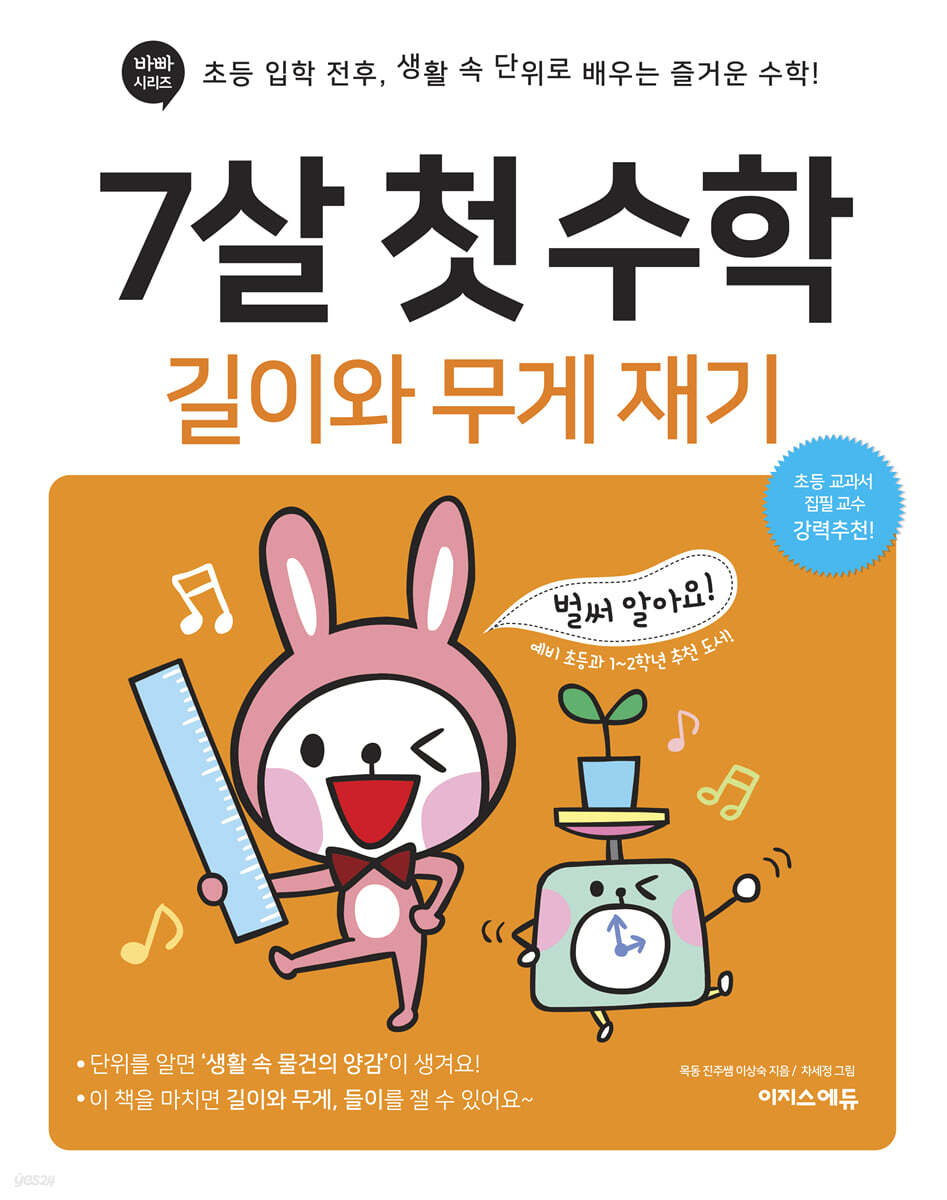
First Math Lessons for 7-Year-Olds: Measuring Length and Weight
 |
Description
Book Introduction
“Knowing the units gives you the ability to measure
“It creates a sense of ‘quantity of things’!”
Mokdong Jinju Teacher, a math textbook expert and teacher with 22 years of experience
A step-by-step, customized math study method for 7-year-olds!
The bestselling "First Math at Age 7" series for preschoolers follows "Clocks and Calendars" and "Counting Coins and Bills," and now includes "Measuring Length and Weight," a book that explores everyday units! From the moment we are born, we encounter units, such as "I am 50 cm tall and weigh 3 kg."
Also, when buying items at the mart, you can buy cheaper items by comparing length, weight, and volume.
Units like these are frequently used in everyday life and are essential for understanding the world.
Professor Kim Jin-ho, who is in charge of writing elementary school math textbooks, strongly recommended this book, saying, "If you apply what you learned in 'First Math for 7-Year-Olds - Measuring Length and Weight' to real-life situations, you will also solidify the foundation of units and measurement learned in grades 1-3." This book is especially designed to familiarize students with units by connecting them to real-life situations through the "Units in Everyday Life" section.
Children can compare length, weight, and volume through various situations they encounter in daily life and even use appropriate units.
It is also full of tips for novice parents on how to praise their children and how to become a great teacher just by reading.
Create joyful learning memories for your precious child before and after entering elementary school with "First Math at 7 Years Old"! Recommended for children from pre-elementary school students to first and second graders!
“It creates a sense of ‘quantity of things’!”
Mokdong Jinju Teacher, a math textbook expert and teacher with 22 years of experience
A step-by-step, customized math study method for 7-year-olds!
The bestselling "First Math at Age 7" series for preschoolers follows "Clocks and Calendars" and "Counting Coins and Bills," and now includes "Measuring Length and Weight," a book that explores everyday units! From the moment we are born, we encounter units, such as "I am 50 cm tall and weigh 3 kg."
Also, when buying items at the mart, you can buy cheaper items by comparing length, weight, and volume.
Units like these are frequently used in everyday life and are essential for understanding the world.
Professor Kim Jin-ho, who is in charge of writing elementary school math textbooks, strongly recommended this book, saying, "If you apply what you learned in 'First Math for 7-Year-Olds - Measuring Length and Weight' to real-life situations, you will also solidify the foundation of units and measurement learned in grades 1-3." This book is especially designed to familiarize students with units by connecting them to real-life situations through the "Units in Everyday Life" section.
Children can compare length, weight, and volume through various situations they encounter in daily life and even use appropriate units.
It is also full of tips for novice parents on how to praise their children and how to become a great teacher just by reading.
Create joyful learning memories for your precious child before and after entering elementary school with "First Math at 7 Years Old"! Recommended for children from pre-elementary school students to first and second graders!
- You can preview some of the book's contents.
Preview
index
A fun history of units
First yard | I already know the length!
Compare the length of one day
Compare the heights on the 2nd day
Compare the heights over 3 days
Compare the distances over 4 days
Measure the length in various units for 5 days.
Let's learn the 6-day cm unit
Let's learn the 7-day mm unit
Let's learn the 8-day m unit
Let's learn the 9-day Km unit
Second yard | I already know the weight!
Compare the weights after 10 days (1)
Let's compare the weights on the 11th (2)
Let's learn the 12-day kg unit
Let's learn the 13th g unit
Let's practice mixing weight units for 14 days.
Third Yard | The guys already know!
Let's compare the 15-day intake (1)
Let's compare the 16 days (2)
Let's learn about L units on the 17th
Let's learn the mL unit on the 18th
On the 19th, let's practice mixing the units.
First yard | I already know the length!
Compare the length of one day
Compare the heights on the 2nd day
Compare the heights over 3 days
Compare the distances over 4 days
Measure the length in various units for 5 days.
Let's learn the 6-day cm unit
Let's learn the 7-day mm unit
Let's learn the 8-day m unit
Let's learn the 9-day Km unit
Second yard | I already know the weight!
Compare the weights after 10 days (1)
Let's compare the weights on the 11th (2)
Let's learn the 12-day kg unit
Let's learn the 13th g unit
Let's practice mixing weight units for 14 days.
Third Yard | The guys already know!
Let's compare the 15-day intake (1)
Let's compare the 16 days (2)
Let's learn about L units on the 17th
Let's learn the mL unit on the 18th
On the 19th, let's practice mixing the units.
Detailed image

Publisher's Review
Enjoyable math study in everyday life!
The basics of units appearing in elementary school mathematics textbooks
Learn in a fun way by relating it to real life!
We encounter units of length and weight as soon as we are born!
From the moment we are born, we meet units.
From the moment you are born, you are already familiar with units of length and weight, such as “I am 50 cm tall and weigh 3 kg.”
Units are learned in elementary school math textbooks, but they are also frequently used in our daily lives and are essential for understanding the world.
If you learn with real-life materials, you'll quickly understand units!
In our daily lives, we often have to make judgments by comparing length, weight, and volume.
For example, when buying something, you can buy it cheaper by comparing the length, weight, and volume.
This book provides activities to compare length, weight, and volume using familiar materials commonly found around us.
If you learn naturally in your daily life, you will be able to accept the units without difficulty.
Estimate length, weight, and volume to help you develop a sense of volume!
Estimating the length, weight, and volume of objects around us is a great way to develop a sense of volume.
Using the real-life materials introduced in this book, ask questions about length, weight, and volume, such as, "How long is a pencil in centimeters?", "How many kilograms does a school bag weigh?", or "How many milliliters does a yogurt hold?" This will be a great way to develop your child's understanding of measurements.
Learn in a fun and enjoyable way, like playing, with the 'Units in Life' corner!
The best way for a child to learn math is through playful, real-world activities.
This book is organized to help you become familiar with units by connecting them to real life through the 'Units in Life' section on the last page of each date.
Children can compare length, weight, and volume through various situations they encounter in daily life, and even use appropriate units.
And one more important thing! The "joy of learning" experienced in childhood enhances the ability to "self-directed learning."
Please be generous with your encouragement and praise so that your study time becomes a happy memory!
Link to elementary school mathematics textbooks
*Mathematics 1st year, 1st semester, 4.
Compare
*Mathematics 2nd grade 1st semester 4.
Length measurement
*Mathematics 2nd year, 2nd semester, 3.
Length measurement
*Mathematics 3rd grade, 1st semester, 5.
Length and time
*Mathematics 3rd grade, 2nd semester, 5.
Load and weight
Structure and features of this book
[4-Step Study Method for Creating Enjoyable Study Memories]
By learning through play with this book, you'll develop both computational and mathematical thinking skills! Build a foundation in measurement and units with "Measuring Length and Weight."
Step 1) Share stories about the unit's history
Before we dive into this lesson, let's get the unit's history flowing to spark interest.
You can provide background knowledge to your child by simply reading along with the text that contains the oral language of your parents!
Step 2) Learn the concept by following along
You can naturally learn units of length, weight, and volume by writing and reading them.
Step 3) Solve problems and solidify concepts
Now let's try to solve the problem ourselves.
You can learn in a variety of fun ways, such as connecting lines appropriately and marking the correct value! Parents, please wait patiently for your child to solve each problem on their own.
Step 4) Developing a sense of unity in daily life
Through the 'Units in Daily Life' corner, children will have an indirect experience of using units in daily life and have a fun time.
Real-life situations double your interest and enhance your learning experience!
[Introducing the 7-Year-Old First Series]
The 7-Year-Old First Series is a book that creates enjoyable study memories for children before and after entering elementary school.
Rather than teaching study skills, we help students experience the joy of studying.
It's packed with great teaching tips for new parents to follow along and become a great teacher, making it a great homeschooling resource!
The basics of units appearing in elementary school mathematics textbooks
Learn in a fun way by relating it to real life!
We encounter units of length and weight as soon as we are born!
From the moment we are born, we meet units.
From the moment you are born, you are already familiar with units of length and weight, such as “I am 50 cm tall and weigh 3 kg.”
Units are learned in elementary school math textbooks, but they are also frequently used in our daily lives and are essential for understanding the world.
If you learn with real-life materials, you'll quickly understand units!
In our daily lives, we often have to make judgments by comparing length, weight, and volume.
For example, when buying something, you can buy it cheaper by comparing the length, weight, and volume.
This book provides activities to compare length, weight, and volume using familiar materials commonly found around us.
If you learn naturally in your daily life, you will be able to accept the units without difficulty.
Estimate length, weight, and volume to help you develop a sense of volume!
Estimating the length, weight, and volume of objects around us is a great way to develop a sense of volume.
Using the real-life materials introduced in this book, ask questions about length, weight, and volume, such as, "How long is a pencil in centimeters?", "How many kilograms does a school bag weigh?", or "How many milliliters does a yogurt hold?" This will be a great way to develop your child's understanding of measurements.
Learn in a fun and enjoyable way, like playing, with the 'Units in Life' corner!
The best way for a child to learn math is through playful, real-world activities.
This book is organized to help you become familiar with units by connecting them to real life through the 'Units in Life' section on the last page of each date.
Children can compare length, weight, and volume through various situations they encounter in daily life, and even use appropriate units.
And one more important thing! The "joy of learning" experienced in childhood enhances the ability to "self-directed learning."
Please be generous with your encouragement and praise so that your study time becomes a happy memory!
Link to elementary school mathematics textbooks
*Mathematics 1st year, 1st semester, 4.
Compare
*Mathematics 2nd grade 1st semester 4.
Length measurement
*Mathematics 2nd year, 2nd semester, 3.
Length measurement
*Mathematics 3rd grade, 1st semester, 5.
Length and time
*Mathematics 3rd grade, 2nd semester, 5.
Load and weight
Structure and features of this book
[4-Step Study Method for Creating Enjoyable Study Memories]
By learning through play with this book, you'll develop both computational and mathematical thinking skills! Build a foundation in measurement and units with "Measuring Length and Weight."
Step 1) Share stories about the unit's history
Before we dive into this lesson, let's get the unit's history flowing to spark interest.
You can provide background knowledge to your child by simply reading along with the text that contains the oral language of your parents!
Step 2) Learn the concept by following along
You can naturally learn units of length, weight, and volume by writing and reading them.
Step 3) Solve problems and solidify concepts
Now let's try to solve the problem ourselves.
You can learn in a variety of fun ways, such as connecting lines appropriately and marking the correct value! Parents, please wait patiently for your child to solve each problem on their own.
Step 4) Developing a sense of unity in daily life
Through the 'Units in Daily Life' corner, children will have an indirect experience of using units in daily life and have a fun time.
Real-life situations double your interest and enhance your learning experience!
[Introducing the 7-Year-Old First Series]
The 7-Year-Old First Series is a book that creates enjoyable study memories for children before and after entering elementary school.
Rather than teaching study skills, we help students experience the joy of studying.
It's packed with great teaching tips for new parents to follow along and become a great teacher, making it a great homeschooling resource!
GOODS SPECIFICS
- Date of issue: June 10, 2024
- Page count, weight, size: 96 pages | 346g | 225*285*6mm
- ISBN13: 9791163035954
- KC Certification: Certification Type: Conformity Confirmation
You may also like
카테고리
korean


korean

![GQ KOREA Mark (Monthly): December [2025]](http://librairie.coreenne.fr/cdn/shop/files/8ef265dbbfbf186523ed75ba7319009d.jpg?v=1765340328&width=3840)


