

My American Humanities Journey
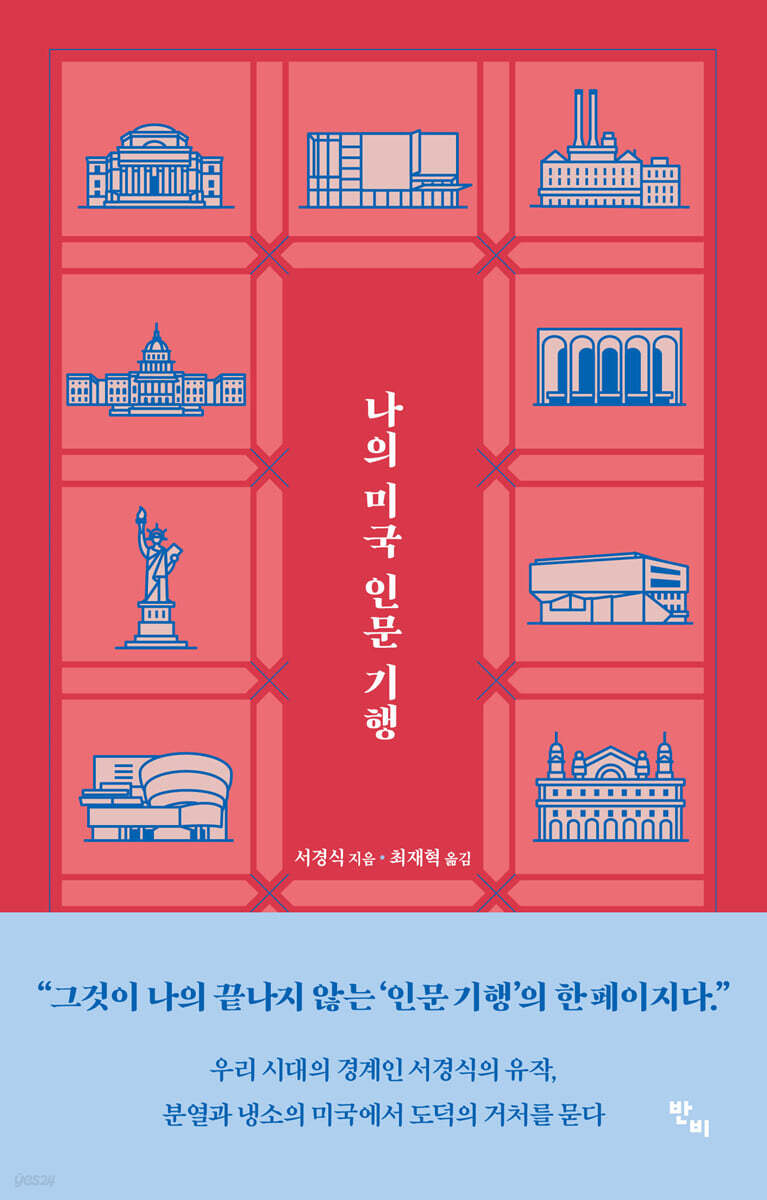 |
Description
Book Introduction
- A word from MD
- The third and final book in the 'My Humanities Travels' series, following 'My Italian Humanities Travels' and 'My British Humanities Travels'.
Even on the American side, the author's unique, sober insights into colonialism and the diaspora permeate the book.
We seek hope for humanity amidst the ongoing state violence and war.
- Son Min-gyu, humanities PD
“That is one page of my never-ending ‘humanities journey.’”
Seo Kyung-sik's last work, a boundary of our times,
Questioning the Place of Morality in a Divided and Cynic America
Seo Kyung-sik's last work, a boundary of our time
Reflecting on America's Cynicism and Division
On December 18, 2023, when diaspora essayist Seo Kyung-sik passed away, many mourned.
The reason so many people mourned Seo Gyeong-sik's death is probably because, during his lifetime, he had become a friend and teacher to countless people who were wandering without a place, through his uniquely beautiful writing that honed his sharp thoughts.
The posthumous work of Seo Kyung-sik, a friend and teacher to many, a figure of our time, “My American Humanities Journey,” has been published by Banbi.
"My American Humanities Journey" is the third and final book in the "My Humanities Journey" series, following "My Italian Humanities Journey" and "My British Humanities Journey."
His writing always contains a sharp and intense awareness of reality.
Previous books in the 'My Humanities Journey' series also captivated many readers with their insights into the meaning of humanism and the history of colonialism and imperialism.
In "My American Humanities Journey," in addition to the themes he has addressed in his previous works, his reflections on the bleak present-day world facing the United States, a country that has raised the banner of freedom and hospitality, shine particularly brightly.
Seo Kyung-sik asks about the “habitat of morality” amid the horrific realities of disasters, war crimes, and state violence that we prefer to ignore.
In this book, Seo Kyung-sik travels back and forth between 2016, just before Donald Trump became president, the 1980s, when he traveled to the United States to rescue his two older brothers (Seo Seung and Seo Jun-sik) who were imprisoned for their student activism, and 2020, a year suffering from the COVID-19 pandemic.
He travels across three time zones, expressing deep concern about a world where exclusion and hatred of minorities are intensifying and where “war-mongering hangs over us like a dark cloud.”
At the same time, he recalls the people and works of art he met in the United States and conveys his thoughts on building a 'good America' and, further, a 'good world.'
Seo Kyung-sik's last work, a boundary of our times,
Questioning the Place of Morality in a Divided and Cynic America
Seo Kyung-sik's last work, a boundary of our time
Reflecting on America's Cynicism and Division
On December 18, 2023, when diaspora essayist Seo Kyung-sik passed away, many mourned.
The reason so many people mourned Seo Gyeong-sik's death is probably because, during his lifetime, he had become a friend and teacher to countless people who were wandering without a place, through his uniquely beautiful writing that honed his sharp thoughts.
The posthumous work of Seo Kyung-sik, a friend and teacher to many, a figure of our time, “My American Humanities Journey,” has been published by Banbi.
"My American Humanities Journey" is the third and final book in the "My Humanities Journey" series, following "My Italian Humanities Journey" and "My British Humanities Journey."
His writing always contains a sharp and intense awareness of reality.
Previous books in the 'My Humanities Journey' series also captivated many readers with their insights into the meaning of humanism and the history of colonialism and imperialism.
In "My American Humanities Journey," in addition to the themes he has addressed in his previous works, his reflections on the bleak present-day world facing the United States, a country that has raised the banner of freedom and hospitality, shine particularly brightly.
Seo Kyung-sik asks about the “habitat of morality” amid the horrific realities of disasters, war crimes, and state violence that we prefer to ignore.
In this book, Seo Kyung-sik travels back and forth between 2016, just before Donald Trump became president, the 1980s, when he traveled to the United States to rescue his two older brothers (Seo Seung and Seo Jun-sik) who were imprisoned for their student activism, and 2020, a year suffering from the COVID-19 pandemic.
He travels across three time zones, expressing deep concern about a world where exclusion and hatred of minorities are intensifying and where “war-mongering hangs over us like a dark cloud.”
At the same time, he recalls the people and works of art he met in the United States and conveys his thoughts on building a 'good America' and, further, a 'good world.'
- You can preview some of the book's contents.
Preview
index
Opening remarks
Chapter 1 New York
Chapter 2 Washington, DC
Chapter 3: Detroit
Chapter 4 Back in New York 1
Chapter 5: Back to New York 2
Chapter 6 America 1
Chapter 7 America 2
Conclusion
Chapter 1 New York
Chapter 2 Washington, DC
Chapter 3: Detroit
Chapter 4 Back in New York 1
Chapter 5: Back to New York 2
Chapter 6 America 1
Chapter 7 America 2
Conclusion
Detailed image

Into the book
After much thought, I decided that if I was going anyway, it wouldn't be a bad idea to stop by New York on my way there and back and take some time to visit the places I had visited before.
Now that I think about my age, I think I might not have the opportunity to travel to the United States again.
Then, fragments of memories from long ago came back to me.
I can't say that they are only good memories, but they are such precious memories that they form an important part of humanity.
Those memories are also connected to the memories of 'good America' within me.
--- p.23
On the day I returned to Japan, Mr. B came to the airport to see me off and handed me five or six eggs he had boiled that morning, saying, “Eat them on the plane.”
I remembered you once saying that you liked boiled eggs.
The feeling from that time came back to me 30 years later.
In other words, I, who am in my mid-60s, have unexpectedly returned to my 30s.
Being 'young' doesn't necessarily mean being happy and joyful.
Rather, everything feels awkward, immature, prickly, and utterly lonely.
Even that feeling was revived in Manhattan.
I think 30 years ago I was at the crossroads of madness and death.
There are quite a few acquaintances who have disappeared across that crossroads.
At that time, I couldn't have imagined that I would be alive at this age.
I wonder if Mr. B is still healthy.
It is the power of Hopper's work that makes me think of that time.
--- p.41
Edward Hopper was born in 1882 in Nyack, New York.
"Nighthawks" is a work depicting people sitting in a diner late at night, and is also called "Nighthawks."
This painting was created in 1942, during World War II.
What kind of relationship do the men and women sitting in a late-night restaurant have?
What kind of conversation are they having?
Or maybe we're not talking about anything.
This painting evokes various imaginations in the viewer.
Most of Hopper's urban landscapes are filled with this kind of transparent and sorrowful air.
For me, it's the very essence of the American metropolis.
--- p.41, 43
“Lord, how long will it be…….”
This phrase was a common saying shared by many Koreans at the time, when it was literally like an endless dark night.
I was one of them.
But every time these words were about to come out of my mouth, I would get flustered and swallow them.
It was because I realized that I did not believe in God, and on the other hand, it seemed like asking 'how long' would not give me a hopeful answer.
--- p.57
Watching Carita perform, I feel as if I am in a cabaret in Berlin in the 1930s.
The Nazis, who advocated discrimination against Jews and xenophobia, emerged, and while the world was muttering, "Surely not," Hitler took power.
It was a time when the sound of World War II boots could be heard nearby.
It is now 2016 in New York, and Trump's (then presidential candidate) blatant racism and war-mongering are quietly gathering over the world like a dark cloud.
Many people, averting their eyes from anxiety, mutter, “Surely he won’t become president.” (This optimism was later betrayed.) I was intoxicated by the songs of Carita Matilla, but at the same time filled with a dark premonition that the entire world was falling apart.
--- p.47
The world was becoming bloody.
I felt like I was drowning in that sea of blood.
My first pilgrimage to Western art was in October 1983.
It was about two months after the Aquino murder.
I wanted to temporarily move my body to another world, and I wanted to breathe somehow.
But the works that drew me in wherever I went on my art tour were also bloody paintings depicting brutal scenes from history.
--- p.59, 61
Among them, the work that unexpectedly made me stop and stare blankly was George Bellows' "Two Members of This Club."
It was a work that really suited my mood at the time.
As I watched, a miserable feeling that could not be expressed in words welled up from the depths of my heart.
Not only the simple act of throwing a punch, but also the utterly obvious foolishness and cruelty of the human being who gambles on it as a spectacle.
It has something in common with the act of executing eight innocent political prisoners in an instant and shooting an opposition politician to death at the airport.
--- p.67
The two men, without hesitation, threw away the squeaky shoes they had been wearing, changed into new shoes, and began to walk briskly down the streets of Washington.
The moment I saw that sight, it came to mind.
'Ah, this is an American film... ... .' From the world of Bellos' paintings, where cigarette smoke billows and sweat and blood splatter, to the shoe shop scene, to the backs of the two women fading away with a cool and spirited air, it felt like an American film.
I felt like I was one of the characters in the movie.
The lead actor is probably Paul Newman from "The Hustler" (1961).
My heart was still dark, but thanks to this 'American film', the dark clouds that had always covered my heart seemed to clear away for a moment and become clear.
--- p.71, 73
When I first heard the term Mexican Muralism, I imagined folkloric works depicting mainly peasant life.
It was a foolish and shallow thought.
Because of the immature preconception that Rivera was a "left-wing painter," it was difficult to understand that he received support from Ford, the capitalist of capitalists, and that the artist himself happily accepted this.
But when I stood in front of the mural, I could tell that it was a masterpiece with a power of persuasion that far surpassed any doubts.
--- p.107
As a thinker and politician, Rivera is a loser.
But I don't feel like making fun of that kind of Rivera.
Standing before that mural, I feel a deep sense of interest and an indescribable sense of awe, as if standing before an ancient ruin.
Rivera's murals are an important source of information on the intellectual history of mankind.
Just as Rivera was inspired by the Aztec earth mother goddess Coatlicue, future generations of humanity may be able to unearth this mural from the ruins and gain new dreams and vitality for human liberation.
Wouldn't laughing at this be to surrender to the unbearable superficiality of the human spirit?
Rivera's work still speaks to people around the world who seek liberation.
There is also an endless stream of people who want to accept this and succeed it.
Korea's folk art movement is a good example.
As a thinker and politician, he may have been a loser, but as an artist, Diego Rivera deserves a different evaluation.
--- p.123
The driver stopped the car on the shoulder and pointed toward the valley, saying, “That’s Death Mountain.”
It was said to be so called because many workers who were mobilized to build the road to Panama died.
The victims were mostly black slaves from Jamaica.
Accustomed to the climate of the Caribbean islands, it is said that many of them died from not being able to withstand the cold mountain climate and hard labor.
They were dragged across the Atlantic Ocean from the deep African continent, then taken back to the deep mountains of the Caribbean, where they were deprived of their lives.
Beyond the basin, which embraced a beautiful, sun-drenched village, a mountain range stretched out in a series of layers.
I had the impression that the mountain range stretched halfway around the globe, all the way to Kyushu and Hokkaido in Japan.
Even the Mountain of Death, where the remains of Koreans who died from forced labor on the railroad and in the mines are buried.
Mountains of death continue to rise across the globe, where victims of colonial violence are buried in resentment and anger.
--- p.141
The installation, titled “Bed Down Location,” is viewed by the viewer lying on a large bed installed in the center of the room and looking up at the ceiling.
There, the night sky of Yemen or Pakistan is reflected, filled with countless twinkling stars.
But as the day gradually dawns and the sun rises, the sky becomes filled with unmanned attack drones.
In the largest room, a large screen shows various people's faces in slow motion.
Everyone looked as if they were speechless and dumbfounded.
Some people shed tears.
Probably the people looking at Ground Zero right after 9/11.
But this work does not end with this scene.
As you go behind the screen, a grainy black and white image flows.
A man is dragged into a barn-like room and is kneeling on the floor.
A figure who appears to be an American soldier points a rifle at the man and asks, “Are you al-Qaeda?”
When the man says no, the soldier threatens, "I can contact the Pakistani government and have your wife arrested!"
--- p.149, 151
Yet, even 'good America' is still struggling.
Examples include the protests against Trump that spread across the United States, the media that continues to criticize him, and the judiciary's injunction against the "7-Country Entry Ban," which temporarily banned the entry of citizens from seven Muslim-majority countries that the United States unilaterally designated as "terrorist risk countries."
MoMA exhibited works by artists from the countries where President Trump's travel ban was implemented, in protest.
The exhibition description states, “The exhibition was planned to clearly demonstrate that the ultimate values of hospitality and freedom are indispensable to this museum and to the United States.”
The spirit of Momadaun, the place of exile in "Guernica," is alive here too.
--- p.153, 155
“Ah, Ben Shan…….”
It felt like meeting an old friend again.
“Hey, Ben Shan! You’re here?” I felt like tapping him on the shoulder and calling out.
If I think about it, Ben Shan is the artist who represents 'good America' to me.
Just as the news that the Republican racist Trump had won the presidential primary was looming like a nightmare, I was reunited with a painting by Ben Shahn, who felt like an old friend, in an exhibition hall at MoMA.
The work is called “The Death of a Miner.”
--- p.165
Ben Shan is often referred to as a 'social realist' writer.
But the impression I get from his work is very different from the 'socialist realism' paintings of the Soviet Union, East Germany, or China.
It is characterized by warm colors, and shows a sense of texture and form reminiscent of a child's drawing rather than a faithful reproduction of reality.
It might be easy to misunderstand if I say 'child's drawing', but I don't mean sweet and cute.
It is not that it contains the meaning of shallow healing.
It's amazing that the essence of emotions like sadness or anger can be conveyed so warmly...
That's what I love about Ben Shanman's uniqueness.
--- p.167
I realized quite late in life how important the musical aspect was to Side.
It was only in the 1990s, when I began to visit the Salzburg Music Festival every summer and encountered the deep and wide world of Western classical music, and managed to publish my experiences in a book titled “My Western Music Pilgrimage,” that I began to realize the importance of music to Said.
In short, my experience was a quest to find an answer to the question, “What does ‘Western classical music’ mean to me, a ‘Zainichi Korean’?”
--- p.207
About ten years ago, when I saw this opera at the Salzburg Festival, I unexpectedly shed tears when I reached the finale, the sextet "All Women Are Like That."
Should I say it is 'fun yet sad'? It is because I am overcome with emotions that can only be called the 'absurdity of humanity'.
It was a strange and wonderful moment.
Perhaps it is because, as Said said, I realized that I myself am a modern person bound by the internal discipline of “consistency of identity.”
In that case, of course, Mozart, as well as Said, who pointed this out, are great beings.
If we consider the ingrained identity that Said possessed, his theory of "cosi fan tutte" is at least sufficiently convincing to me.
If I may be so inclined, how would I rate the opera "Roberto Devereux" that I saw recently?
As I thought about that, I suddenly felt like he was sitting somewhere in the large auditorium, and I looked around without realizing it.
--- p.213, 215
The reason I felt uneasy was because I expected that the place would be turned into a famous tourist attraction and that a huge commercial monument would be built there.
The background to 9/11 lies in the long history of corruption and injustice that the United States (international financial capital) has accumulated in the Third World, but it was also predicted that they would keep their mouths shut about this fact and tell a narrative centered on the United States.
It was because I did not want to hide the countless atrocities and tyranny that have been committed in Palestine, Afghanistan, Iraq, Syria, and other places since 9/11 under the guise of “commemorating the victims.”
--- p.217, 219
Immediately after the 9/11 terrorist attacks, American television stations broadcast footage of Palestinian people cheering at the news of the incident.
Watching this scene, I instinctively thought of Side.
If it were Side, what would he have said just now?
I believe that the problematic video had the effect of fanning hostility by further solidifying the average Westerner's prejudice that 'Palestinians = terrorists.'
But we need to think more deeply about the reasons why the Palestinian people felt the urge to rejoice at the news of the incident.
Before criticizing the Palestinian people for their lack of consideration for the victims, we should reflect on how much unjust sacrifice the Palestinian people have suffered due to the tyranny of Israel, backed by the United States, and how much interest and sympathy we have had for those sacrifices.
--- p.221, 223
Standing at Ground Zero, bathed in bright sunlight, mingling with tourists from all over the world, I thought again.
In the 21st century, which opened with 9/11, how much more destruction and slaughter will humanity continue to pile up?
--- p.223, 225
“We know we are destined for destruction,” he says, “but we want to keep moving forward.”
It talks about “the will to constantly tell the truth, even when the odds are against you.”
It's like a poem.
People do not fight because they are promised victory.
We question justice because injustice prevails, and we fight for truth because lies prevail.
In short, Side asks us where morality resides for those living in the modern world.
--- p.233
Like Said, there are many people in this world who are lonely, striving to live a life that spans multiple communities, but who, because of this, cannot find sympathizers who understand them.
This means that there are quite a few people who can understand the loneliness that Said felt.
But now, they are 'strangers' and lonely people who do not fit in with the places where they live.
Those who are placed in such mismatched positions see each other from afar, long to meet, and call out to each other.
But the barriers that divide and block them remain high and strong.
In such a situation, the side that stood tall like a milestone or lighthouse is no longer with us.
What a huge loss.
--- p.245
Still, within these fragmented narratives, I tried to focus on the aspects of what I consider "good America" (something we can also see in Ben Shann and Edward Said).
The reason is that it stems from my own attachment to the 'good America', but it is also because I cannot let go of the hope that the nation of the United States will move in the direction of the 'good America'.
For now, it's a slim hope, but even if it doesn't come to pass, I think it wouldn't be meaningless to preserve the memory of "good America" as seen through the eyes of a diaspora from the "Far East" for the distant future.
At least in my younger days, during those dark times, "Good America" was something that encouraged and empowered me.
--- p.252
When I heard the news of the executions in Myanmar, the grief I felt then came back to me vividly, even after more than half a century.
That era is not over.
The me of half a century ago is none other than the 'truth', and the me who has somehow lived peacefully since then is nothing more than a product of 'fiction'.
A situation where people are dying, getting sick, and suffering all over the world.
The truth is out there.
The place I am now is on the 'fiction' side.
--- p.257
What is 'America'?
It goes without saying that 'America' is not a single place, but rather a 'place' where multiple cultures clash and fight against each other.
I love 'America', and at the same time I hate it very much.
And this kind of extreme contradiction and struggle is what 'America' is.
--- p.260
Still, as I wrote this book, I thought back to the people who approached me with simple kindness at the time, a young man from the family of a political prisoner from the Far East.
We can't say things like, "The small power of those people can change the world."
Maybe I've lived too dark to say that.
Or perhaps there is still a greater and deeper darkness to be seen.
However, I still hope that by offering even a small piece of my experience, I can provide some help to those who despair of the reality of the world, which is not improving at all.
So as not to despair of humanity itself.
That is one page of my never-ending ‘humanities journey.’
Now that I think about my age, I think I might not have the opportunity to travel to the United States again.
Then, fragments of memories from long ago came back to me.
I can't say that they are only good memories, but they are such precious memories that they form an important part of humanity.
Those memories are also connected to the memories of 'good America' within me.
--- p.23
On the day I returned to Japan, Mr. B came to the airport to see me off and handed me five or six eggs he had boiled that morning, saying, “Eat them on the plane.”
I remembered you once saying that you liked boiled eggs.
The feeling from that time came back to me 30 years later.
In other words, I, who am in my mid-60s, have unexpectedly returned to my 30s.
Being 'young' doesn't necessarily mean being happy and joyful.
Rather, everything feels awkward, immature, prickly, and utterly lonely.
Even that feeling was revived in Manhattan.
I think 30 years ago I was at the crossroads of madness and death.
There are quite a few acquaintances who have disappeared across that crossroads.
At that time, I couldn't have imagined that I would be alive at this age.
I wonder if Mr. B is still healthy.
It is the power of Hopper's work that makes me think of that time.
--- p.41
Edward Hopper was born in 1882 in Nyack, New York.
"Nighthawks" is a work depicting people sitting in a diner late at night, and is also called "Nighthawks."
This painting was created in 1942, during World War II.
What kind of relationship do the men and women sitting in a late-night restaurant have?
What kind of conversation are they having?
Or maybe we're not talking about anything.
This painting evokes various imaginations in the viewer.
Most of Hopper's urban landscapes are filled with this kind of transparent and sorrowful air.
For me, it's the very essence of the American metropolis.
--- p.41, 43
“Lord, how long will it be…….”
This phrase was a common saying shared by many Koreans at the time, when it was literally like an endless dark night.
I was one of them.
But every time these words were about to come out of my mouth, I would get flustered and swallow them.
It was because I realized that I did not believe in God, and on the other hand, it seemed like asking 'how long' would not give me a hopeful answer.
--- p.57
Watching Carita perform, I feel as if I am in a cabaret in Berlin in the 1930s.
The Nazis, who advocated discrimination against Jews and xenophobia, emerged, and while the world was muttering, "Surely not," Hitler took power.
It was a time when the sound of World War II boots could be heard nearby.
It is now 2016 in New York, and Trump's (then presidential candidate) blatant racism and war-mongering are quietly gathering over the world like a dark cloud.
Many people, averting their eyes from anxiety, mutter, “Surely he won’t become president.” (This optimism was later betrayed.) I was intoxicated by the songs of Carita Matilla, but at the same time filled with a dark premonition that the entire world was falling apart.
--- p.47
The world was becoming bloody.
I felt like I was drowning in that sea of blood.
My first pilgrimage to Western art was in October 1983.
It was about two months after the Aquino murder.
I wanted to temporarily move my body to another world, and I wanted to breathe somehow.
But the works that drew me in wherever I went on my art tour were also bloody paintings depicting brutal scenes from history.
--- p.59, 61
Among them, the work that unexpectedly made me stop and stare blankly was George Bellows' "Two Members of This Club."
It was a work that really suited my mood at the time.
As I watched, a miserable feeling that could not be expressed in words welled up from the depths of my heart.
Not only the simple act of throwing a punch, but also the utterly obvious foolishness and cruelty of the human being who gambles on it as a spectacle.
It has something in common with the act of executing eight innocent political prisoners in an instant and shooting an opposition politician to death at the airport.
--- p.67
The two men, without hesitation, threw away the squeaky shoes they had been wearing, changed into new shoes, and began to walk briskly down the streets of Washington.
The moment I saw that sight, it came to mind.
'Ah, this is an American film... ... .' From the world of Bellos' paintings, where cigarette smoke billows and sweat and blood splatter, to the shoe shop scene, to the backs of the two women fading away with a cool and spirited air, it felt like an American film.
I felt like I was one of the characters in the movie.
The lead actor is probably Paul Newman from "The Hustler" (1961).
My heart was still dark, but thanks to this 'American film', the dark clouds that had always covered my heart seemed to clear away for a moment and become clear.
--- p.71, 73
When I first heard the term Mexican Muralism, I imagined folkloric works depicting mainly peasant life.
It was a foolish and shallow thought.
Because of the immature preconception that Rivera was a "left-wing painter," it was difficult to understand that he received support from Ford, the capitalist of capitalists, and that the artist himself happily accepted this.
But when I stood in front of the mural, I could tell that it was a masterpiece with a power of persuasion that far surpassed any doubts.
--- p.107
As a thinker and politician, Rivera is a loser.
But I don't feel like making fun of that kind of Rivera.
Standing before that mural, I feel a deep sense of interest and an indescribable sense of awe, as if standing before an ancient ruin.
Rivera's murals are an important source of information on the intellectual history of mankind.
Just as Rivera was inspired by the Aztec earth mother goddess Coatlicue, future generations of humanity may be able to unearth this mural from the ruins and gain new dreams and vitality for human liberation.
Wouldn't laughing at this be to surrender to the unbearable superficiality of the human spirit?
Rivera's work still speaks to people around the world who seek liberation.
There is also an endless stream of people who want to accept this and succeed it.
Korea's folk art movement is a good example.
As a thinker and politician, he may have been a loser, but as an artist, Diego Rivera deserves a different evaluation.
--- p.123
The driver stopped the car on the shoulder and pointed toward the valley, saying, “That’s Death Mountain.”
It was said to be so called because many workers who were mobilized to build the road to Panama died.
The victims were mostly black slaves from Jamaica.
Accustomed to the climate of the Caribbean islands, it is said that many of them died from not being able to withstand the cold mountain climate and hard labor.
They were dragged across the Atlantic Ocean from the deep African continent, then taken back to the deep mountains of the Caribbean, where they were deprived of their lives.
Beyond the basin, which embraced a beautiful, sun-drenched village, a mountain range stretched out in a series of layers.
I had the impression that the mountain range stretched halfway around the globe, all the way to Kyushu and Hokkaido in Japan.
Even the Mountain of Death, where the remains of Koreans who died from forced labor on the railroad and in the mines are buried.
Mountains of death continue to rise across the globe, where victims of colonial violence are buried in resentment and anger.
--- p.141
The installation, titled “Bed Down Location,” is viewed by the viewer lying on a large bed installed in the center of the room and looking up at the ceiling.
There, the night sky of Yemen or Pakistan is reflected, filled with countless twinkling stars.
But as the day gradually dawns and the sun rises, the sky becomes filled with unmanned attack drones.
In the largest room, a large screen shows various people's faces in slow motion.
Everyone looked as if they were speechless and dumbfounded.
Some people shed tears.
Probably the people looking at Ground Zero right after 9/11.
But this work does not end with this scene.
As you go behind the screen, a grainy black and white image flows.
A man is dragged into a barn-like room and is kneeling on the floor.
A figure who appears to be an American soldier points a rifle at the man and asks, “Are you al-Qaeda?”
When the man says no, the soldier threatens, "I can contact the Pakistani government and have your wife arrested!"
--- p.149, 151
Yet, even 'good America' is still struggling.
Examples include the protests against Trump that spread across the United States, the media that continues to criticize him, and the judiciary's injunction against the "7-Country Entry Ban," which temporarily banned the entry of citizens from seven Muslim-majority countries that the United States unilaterally designated as "terrorist risk countries."
MoMA exhibited works by artists from the countries where President Trump's travel ban was implemented, in protest.
The exhibition description states, “The exhibition was planned to clearly demonstrate that the ultimate values of hospitality and freedom are indispensable to this museum and to the United States.”
The spirit of Momadaun, the place of exile in "Guernica," is alive here too.
--- p.153, 155
“Ah, Ben Shan…….”
It felt like meeting an old friend again.
“Hey, Ben Shan! You’re here?” I felt like tapping him on the shoulder and calling out.
If I think about it, Ben Shan is the artist who represents 'good America' to me.
Just as the news that the Republican racist Trump had won the presidential primary was looming like a nightmare, I was reunited with a painting by Ben Shahn, who felt like an old friend, in an exhibition hall at MoMA.
The work is called “The Death of a Miner.”
--- p.165
Ben Shan is often referred to as a 'social realist' writer.
But the impression I get from his work is very different from the 'socialist realism' paintings of the Soviet Union, East Germany, or China.
It is characterized by warm colors, and shows a sense of texture and form reminiscent of a child's drawing rather than a faithful reproduction of reality.
It might be easy to misunderstand if I say 'child's drawing', but I don't mean sweet and cute.
It is not that it contains the meaning of shallow healing.
It's amazing that the essence of emotions like sadness or anger can be conveyed so warmly...
That's what I love about Ben Shanman's uniqueness.
--- p.167
I realized quite late in life how important the musical aspect was to Side.
It was only in the 1990s, when I began to visit the Salzburg Music Festival every summer and encountered the deep and wide world of Western classical music, and managed to publish my experiences in a book titled “My Western Music Pilgrimage,” that I began to realize the importance of music to Said.
In short, my experience was a quest to find an answer to the question, “What does ‘Western classical music’ mean to me, a ‘Zainichi Korean’?”
--- p.207
About ten years ago, when I saw this opera at the Salzburg Festival, I unexpectedly shed tears when I reached the finale, the sextet "All Women Are Like That."
Should I say it is 'fun yet sad'? It is because I am overcome with emotions that can only be called the 'absurdity of humanity'.
It was a strange and wonderful moment.
Perhaps it is because, as Said said, I realized that I myself am a modern person bound by the internal discipline of “consistency of identity.”
In that case, of course, Mozart, as well as Said, who pointed this out, are great beings.
If we consider the ingrained identity that Said possessed, his theory of "cosi fan tutte" is at least sufficiently convincing to me.
If I may be so inclined, how would I rate the opera "Roberto Devereux" that I saw recently?
As I thought about that, I suddenly felt like he was sitting somewhere in the large auditorium, and I looked around without realizing it.
--- p.213, 215
The reason I felt uneasy was because I expected that the place would be turned into a famous tourist attraction and that a huge commercial monument would be built there.
The background to 9/11 lies in the long history of corruption and injustice that the United States (international financial capital) has accumulated in the Third World, but it was also predicted that they would keep their mouths shut about this fact and tell a narrative centered on the United States.
It was because I did not want to hide the countless atrocities and tyranny that have been committed in Palestine, Afghanistan, Iraq, Syria, and other places since 9/11 under the guise of “commemorating the victims.”
--- p.217, 219
Immediately after the 9/11 terrorist attacks, American television stations broadcast footage of Palestinian people cheering at the news of the incident.
Watching this scene, I instinctively thought of Side.
If it were Side, what would he have said just now?
I believe that the problematic video had the effect of fanning hostility by further solidifying the average Westerner's prejudice that 'Palestinians = terrorists.'
But we need to think more deeply about the reasons why the Palestinian people felt the urge to rejoice at the news of the incident.
Before criticizing the Palestinian people for their lack of consideration for the victims, we should reflect on how much unjust sacrifice the Palestinian people have suffered due to the tyranny of Israel, backed by the United States, and how much interest and sympathy we have had for those sacrifices.
--- p.221, 223
Standing at Ground Zero, bathed in bright sunlight, mingling with tourists from all over the world, I thought again.
In the 21st century, which opened with 9/11, how much more destruction and slaughter will humanity continue to pile up?
--- p.223, 225
“We know we are destined for destruction,” he says, “but we want to keep moving forward.”
It talks about “the will to constantly tell the truth, even when the odds are against you.”
It's like a poem.
People do not fight because they are promised victory.
We question justice because injustice prevails, and we fight for truth because lies prevail.
In short, Side asks us where morality resides for those living in the modern world.
--- p.233
Like Said, there are many people in this world who are lonely, striving to live a life that spans multiple communities, but who, because of this, cannot find sympathizers who understand them.
This means that there are quite a few people who can understand the loneliness that Said felt.
But now, they are 'strangers' and lonely people who do not fit in with the places where they live.
Those who are placed in such mismatched positions see each other from afar, long to meet, and call out to each other.
But the barriers that divide and block them remain high and strong.
In such a situation, the side that stood tall like a milestone or lighthouse is no longer with us.
What a huge loss.
--- p.245
Still, within these fragmented narratives, I tried to focus on the aspects of what I consider "good America" (something we can also see in Ben Shann and Edward Said).
The reason is that it stems from my own attachment to the 'good America', but it is also because I cannot let go of the hope that the nation of the United States will move in the direction of the 'good America'.
For now, it's a slim hope, but even if it doesn't come to pass, I think it wouldn't be meaningless to preserve the memory of "good America" as seen through the eyes of a diaspora from the "Far East" for the distant future.
At least in my younger days, during those dark times, "Good America" was something that encouraged and empowered me.
--- p.252
When I heard the news of the executions in Myanmar, the grief I felt then came back to me vividly, even after more than half a century.
That era is not over.
The me of half a century ago is none other than the 'truth', and the me who has somehow lived peacefully since then is nothing more than a product of 'fiction'.
A situation where people are dying, getting sick, and suffering all over the world.
The truth is out there.
The place I am now is on the 'fiction' side.
--- p.257
What is 'America'?
It goes without saying that 'America' is not a single place, but rather a 'place' where multiple cultures clash and fight against each other.
I love 'America', and at the same time I hate it very much.
And this kind of extreme contradiction and struggle is what 'America' is.
--- p.260
Still, as I wrote this book, I thought back to the people who approached me with simple kindness at the time, a young man from the family of a political prisoner from the Far East.
We can't say things like, "The small power of those people can change the world."
Maybe I've lived too dark to say that.
Or perhaps there is still a greater and deeper darkness to be seen.
However, I still hope that by offering even a small piece of my experience, I can provide some help to those who despair of the reality of the world, which is not improving at all.
So as not to despair of humanity itself.
That is one page of my never-ending ‘humanities journey.’
--- p.261
Publisher's Review
Diego Rivera, Ben Shan, Picasso, Laura Poitrus… …
Found in a land of egocentrism and intolerance
Pieces of tolerance, solidarity, and resistance
After visiting the United States to help rescue his brothers who were imprisoned, he returned to the United States after 30 years to find that it was a place where egocentrism and intolerance were at their peak.
Despite his discriminatory remarks against minorities, Donald Trump has emerged as a strong presidential candidate, and the voices of those who advocate for "unity" rather than the value of diversity, where various cultures intermingle and "conflict and fight with each other," are growing louder by the day.
In such an America, Seo Kyung-sik encounters people who approach him with good intentions, and works that bravely tell the 'truth' even in the midst of a harsh reality.
Diego Rivera, who tried to infiltrate the public as a socialist in the United States, a synonym for capitalism; Ben Shan, who depicted the harsh reality and used his paintings as weapons of resistance and solidarity; Picasso's work "Guernica", which he created after he fled to the United States in protest against the Spanish dictator Franco; and Laura Poitras, who presented provocative works that question the state violence and surveillance in the United States...
Even in the midst of a bleak reality, Seo Kyung-sik strolls through the hallways of an art museum, appreciating works of art that resist injustice and seek to plant the seeds of liberation.
And now, looking straight at the gloomy present we live in, we ask the meaning of “writing and drawing.”
As Ben Shan said, “An artist is someone who always has the courage to confront arrogance and an attitude of contempt for the power that is alive and well,” the works of art brought to life by Seo Kyung-sik make us realize once again that we are ‘humans’ who know how to stand up to injustice and share goodwill.
In a America where voices of hatred and exclusion toward minorities are growing louder, the slivers of tolerance, solidarity, and empathy he discovered will lead us not to a world of "egocentrism and intolerance," but to a world of "hospitality and freedom," where "multiple cultures collide."
In an age where violence is becoming banal,
The thoughts of diaspora intellectuals who will become milestones
As he said, “We will live in a long nightmare era.”, the world has entered a ‘long nightmare era.’
The war has been ongoing since Russia invaded Ukraine in 2022, and Israel's bombing of the Gaza Strip continues to cause countless casualties every day.
In Myanmar, where the military took power after a coup, four political prisoners, including pro-democracy activists, were executed.
As we live in a world filled with a constant stream of desperate and horrific news, war, violence, and death are gradually becoming a “cliché” to us.
The name that Seo Kyung-sik, who is concerned about a world where violence is becoming commonplace and death is becoming tedious, picks up in this book is 'Edward Said.'
Said, “a Palestinian Arab, a Christian, and an American citizen,” “always fought on the side of the Palestinian people, who are constantly ignored around the world.” Seo Kyung-sik devotes the final two chapters of his book to reflecting on Said’s life and writings, which “constantly spoke the truth even when the odds were against them.”
Through this, we are reminded of the meaning of fighting for justice and truth without giving up in a world where people do not even hide their hostility toward the ‘other’ and “pile up destruction and slaughter.”
In the section commemorating Said, who has already passed away, the life of the author, who passed away last year, overlaps.
Said lived as a 'borderline person' with an identity as both Arab and American, and was lonely and unable to blend in anywhere.
Likewise, Seo Kyung-sik was also “a ‘foreigner’ who did not fit in with the place he lived and a lonely person.”
Seo Gyeong-sik, who left behind the "Conclusion" of this book as a posthumous work, is no longer with us.
But the writings he left behind, as they always have been, serve as “milestones or lighthouses,” connecting lonely people who long to find and meet each other beyond barriers.
“There are people all over the world who continue to speak the truth, far from vulgarity or vulgarity.
As he said, “Those people are our friends” (“Let’s keep telling the truth,” Hankyoreh), Seo Kyung-sik’s writing will give us the courage to befriend each other and tell the ‘truth’ even in harsh times.
Found in a land of egocentrism and intolerance
Pieces of tolerance, solidarity, and resistance
After visiting the United States to help rescue his brothers who were imprisoned, he returned to the United States after 30 years to find that it was a place where egocentrism and intolerance were at their peak.
Despite his discriminatory remarks against minorities, Donald Trump has emerged as a strong presidential candidate, and the voices of those who advocate for "unity" rather than the value of diversity, where various cultures intermingle and "conflict and fight with each other," are growing louder by the day.
In such an America, Seo Kyung-sik encounters people who approach him with good intentions, and works that bravely tell the 'truth' even in the midst of a harsh reality.
Diego Rivera, who tried to infiltrate the public as a socialist in the United States, a synonym for capitalism; Ben Shan, who depicted the harsh reality and used his paintings as weapons of resistance and solidarity; Picasso's work "Guernica", which he created after he fled to the United States in protest against the Spanish dictator Franco; and Laura Poitras, who presented provocative works that question the state violence and surveillance in the United States...
Even in the midst of a bleak reality, Seo Kyung-sik strolls through the hallways of an art museum, appreciating works of art that resist injustice and seek to plant the seeds of liberation.
And now, looking straight at the gloomy present we live in, we ask the meaning of “writing and drawing.”
As Ben Shan said, “An artist is someone who always has the courage to confront arrogance and an attitude of contempt for the power that is alive and well,” the works of art brought to life by Seo Kyung-sik make us realize once again that we are ‘humans’ who know how to stand up to injustice and share goodwill.
In a America where voices of hatred and exclusion toward minorities are growing louder, the slivers of tolerance, solidarity, and empathy he discovered will lead us not to a world of "egocentrism and intolerance," but to a world of "hospitality and freedom," where "multiple cultures collide."
In an age where violence is becoming banal,
The thoughts of diaspora intellectuals who will become milestones
As he said, “We will live in a long nightmare era.”, the world has entered a ‘long nightmare era.’
The war has been ongoing since Russia invaded Ukraine in 2022, and Israel's bombing of the Gaza Strip continues to cause countless casualties every day.
In Myanmar, where the military took power after a coup, four political prisoners, including pro-democracy activists, were executed.
As we live in a world filled with a constant stream of desperate and horrific news, war, violence, and death are gradually becoming a “cliché” to us.
The name that Seo Kyung-sik, who is concerned about a world where violence is becoming commonplace and death is becoming tedious, picks up in this book is 'Edward Said.'
Said, “a Palestinian Arab, a Christian, and an American citizen,” “always fought on the side of the Palestinian people, who are constantly ignored around the world.” Seo Kyung-sik devotes the final two chapters of his book to reflecting on Said’s life and writings, which “constantly spoke the truth even when the odds were against them.”
Through this, we are reminded of the meaning of fighting for justice and truth without giving up in a world where people do not even hide their hostility toward the ‘other’ and “pile up destruction and slaughter.”
In the section commemorating Said, who has already passed away, the life of the author, who passed away last year, overlaps.
Said lived as a 'borderline person' with an identity as both Arab and American, and was lonely and unable to blend in anywhere.
Likewise, Seo Kyung-sik was also “a ‘foreigner’ who did not fit in with the place he lived and a lonely person.”
Seo Gyeong-sik, who left behind the "Conclusion" of this book as a posthumous work, is no longer with us.
But the writings he left behind, as they always have been, serve as “milestones or lighthouses,” connecting lonely people who long to find and meet each other beyond barriers.
“There are people all over the world who continue to speak the truth, far from vulgarity or vulgarity.
As he said, “Those people are our friends” (“Let’s keep telling the truth,” Hankyoreh), Seo Kyung-sik’s writing will give us the courage to befriend each other and tell the ‘truth’ even in harsh times.
GOODS SPECIFICS
- Date of issue: January 19, 2024
- Page count, weight, size: 264 pages | 326g | 120*188*16mm
- ISBN13: 9791192908878
- ISBN10: 1192908872
You may also like
카테고리
korean


korean

![GQ KOREA Mark (Monthly): December [2025]](http://librairie.coreenne.fr/cdn/shop/files/8ef265dbbfbf186523ed75ba7319009d.jpg?v=1765340328&width=3840)


