

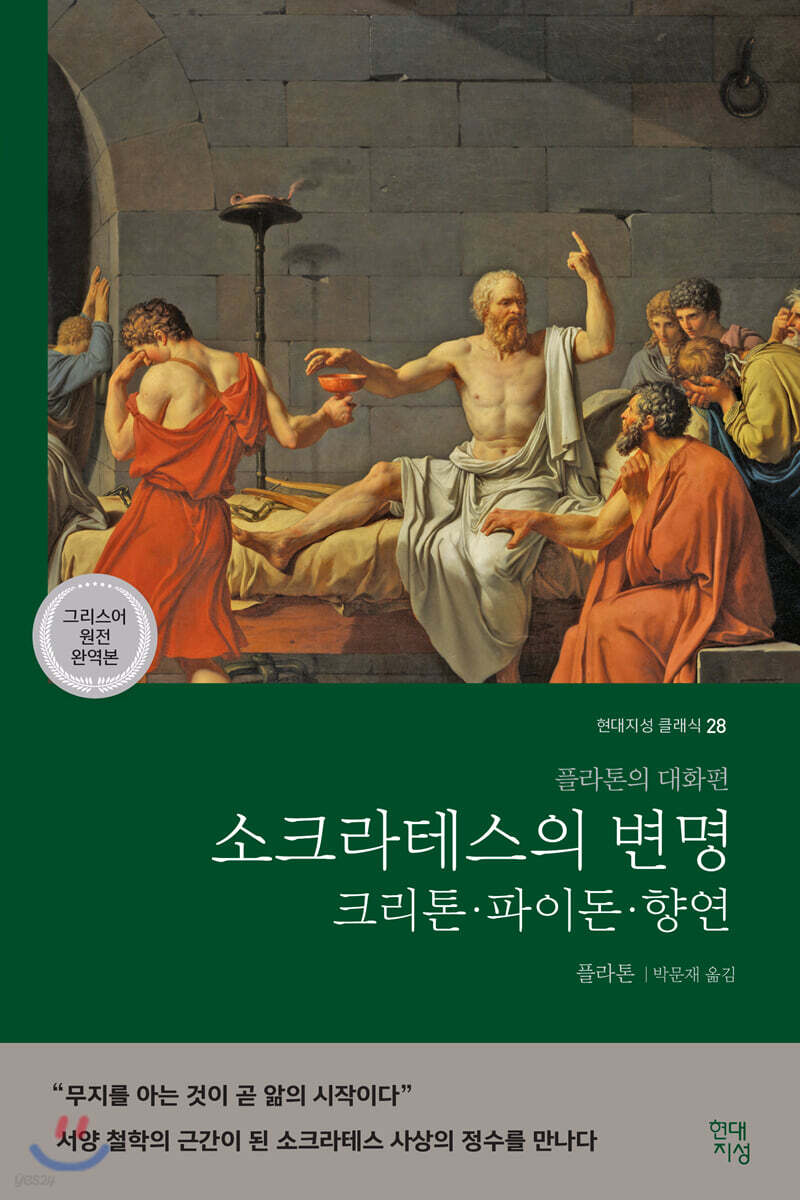
Apology, Crito, Phaedo, and Symposium of Socrates
 |
Description
Book Introduction
Discover the essence of Socratic thought, the foundation of Western philosophy, in one volume.
The Eternal Legacy of Humanity's Greatest Intellect, Read in its Complete Translation from the Original Greek
This book contains the thoughts of Socrates, a brilliant intellectual and philosopher of justice who gladly accepted even death in the face of true truth.
Around the 5th century BC, Socrates opposed the Sophists, who advocated relativistic and practical truths, and pursued absolute and unchanging truths, awakening people's ignorance through questions and dialogue.
Not only that, he was sentenced to death for blasphemy and remained steadfast in his thoughts and philosophy until his death, becoming the foundation of Western philosophy.
Although he did not write a single book until his death, all of his thoughts were preserved and passed down by his disciple Plato.
This book, also written by Plato, contains three books related to the death of Socrates - Apology, Crito, and Phaedo - and Symposium, which praises 'Eros'.
These four books are the early and middle works of the 25 dialogues called "Plato's Dialogues."
In the [Modern Intellect Classics] series, these four books were translated from the original Greek and compiled into one volume.
In addition, through the detailed annotations and commentary of professional translator Park Mun-jae, you can encounter the thoughts of Socrates and Plato more easily and in detail.
The Eternal Legacy of Humanity's Greatest Intellect, Read in its Complete Translation from the Original Greek
This book contains the thoughts of Socrates, a brilliant intellectual and philosopher of justice who gladly accepted even death in the face of true truth.
Around the 5th century BC, Socrates opposed the Sophists, who advocated relativistic and practical truths, and pursued absolute and unchanging truths, awakening people's ignorance through questions and dialogue.
Not only that, he was sentenced to death for blasphemy and remained steadfast in his thoughts and philosophy until his death, becoming the foundation of Western philosophy.
Although he did not write a single book until his death, all of his thoughts were preserved and passed down by his disciple Plato.
This book, also written by Plato, contains three books related to the death of Socrates - Apology, Crito, and Phaedo - and Symposium, which praises 'Eros'.
These four books are the early and middle works of the 25 dialogues called "Plato's Dialogues."
In the [Modern Intellect Classics] series, these four books were translated from the original Greek and compiled into one volume.
In addition, through the detailed annotations and commentary of professional translator Park Mun-jae, you can encounter the thoughts of Socrates and Plato more easily and in detail.
- You can preview some of the book's contents.
Preview
index
Note
Apology of Socrates
Crito
Phaedo
banquet
clear
Chronology
Apology of Socrates
Crito
Phaedo
banquet
clear
Chronology
Detailed image
.jpg)
Into the book
Even while I was defending myself, I felt that I should not do anything unbecoming of a free man, even if it meant avoiding danger, and I still do not regret having defended myself in that way.
It seems only natural to me that I would rather die defending myself that way than do whatever it takes to save my life.
Because it is not right for anyone, including myself, to resort to any means necessary to survive, whether in court or on the battlefield.
--- p.53
We must recognize that death is likely to be a good thing.
Because death is one of two things.
That is, death is either a cessation of existence, so that the dead cannot perceive it, or some change occurs, so that the soul moves from this world to the next world and lives there.
If, as the former says, when a person dies, all perception is lost and he sleeps, that is, he sleeps without dreams, then death is indeed a wonderful gain.
--- p.56
Moreover, as the latter says, if it is true that death is a transition from this world to the next, and that all the dead are in the next world, then, your judges, what could be better than that?--- p.57
Now it's time to leave.
I am leaving to die, and you are leaving to live.
But which of us is headed for a better place, no one but God knows. --- p.59
Is it right for us or for them to make a deal with some people and pay them money to take me out of here, or is it wrong for us or for them to do all this? --- p.73
So, when a person dies, the soul separates from the body and remains pure and alone, unaccompanied by anything that belongs to the body.
Didn't the soul, while living in this world, avoid the body and retreat into itself, constantly studying death and practicing dying? In fact, to truly practice philosophy is nothing more than to willingly and comfortably study death.
What is the practice of philosophy if not the practice of dying?
It seems only natural to me that I would rather die defending myself that way than do whatever it takes to save my life.
Because it is not right for anyone, including myself, to resort to any means necessary to survive, whether in court or on the battlefield.
--- p.53
We must recognize that death is likely to be a good thing.
Because death is one of two things.
That is, death is either a cessation of existence, so that the dead cannot perceive it, or some change occurs, so that the soul moves from this world to the next world and lives there.
If, as the former says, when a person dies, all perception is lost and he sleeps, that is, he sleeps without dreams, then death is indeed a wonderful gain.
--- p.56
Moreover, as the latter says, if it is true that death is a transition from this world to the next, and that all the dead are in the next world, then, your judges, what could be better than that?--- p.57
Now it's time to leave.
I am leaving to die, and you are leaving to live.
But which of us is headed for a better place, no one but God knows. --- p.59
Is it right for us or for them to make a deal with some people and pay them money to take me out of here, or is it wrong for us or for them to do all this? --- p.73
So, when a person dies, the soul separates from the body and remains pure and alone, unaccompanied by anything that belongs to the body.
Didn't the soul, while living in this world, avoid the body and retreat into itself, constantly studying death and practicing dying? In fact, to truly practice philosophy is nothing more than to willingly and comfortably study death.
What is the practice of philosophy if not the practice of dying?
--- p.138
Publisher's Review
Knowing ignorance is the beginning of knowledge.
Socrates, Awakening Ignorance Through Death
This book contains the thoughts of Socrates, a brilliant intellectual and philosopher of justice who gladly accepted even death in the face of true truth.
Around the 5th century BC, Socrates opposed the Sophists, who advocated relativistic and practical truths, and pursued absolute and unchanging truths, awakening people's ignorance through questions and dialogue.
Not only that, he was sentenced to death for blasphemy and remained steadfast in his thoughts and philosophy until his death, becoming the foundation of Western philosophy.
Although he did not write a single book until his death, all of his thoughts were preserved and passed down by his disciple Plato.
This book, also written by Plato, contains three books related to the death of Socrates - Apology, Crito, and Phaedo - and Symposium, which praises 'Eros'.
1.
Apology of Socrates
Socrates was tried in 399 BC on charges of impiety and corrupting the youth.
This book contains Socrates' defense of himself against the accusations that he was "corrupting the youth" and "believing in new gods unknown to the Athenians, rather than in the gods of the state."
The book consists of the first defense, the second defense after the guilty verdict, and the third defense after the death sentence. Socrates' defense is as follows.
One day, his friend received an oracle from the temple of Delphi, which said, “The wisest man is Socrates.”
He said that he sought out and talked with people who thought they were wise, wanting to know the meaning, but he found no one wiser than himself.
He argued that in the process, he incurred the hatred of many people and was subsequently accused.
Therefore, he says that the accusation that he believes in a new god is false because his actions were based on trust, and the accusation that he corrupted the youth is also false because the youth only imitated his actions.
2.
Crito
This book contains the story of Socrates, who comes to visit Crito, his friend, just before his execution day, and explains to him why he cannot escape from prison.
Crito persuades Socrates with three reasons.
First, if Socrates could be saved but was not saved, his friends would be cursed. Second, if Socrates chose death, he would be helping his enemies who had accused him. Third, if he died, he would not be able to fulfill his duty to his children.
Socrates uses reason and argument to explain why prison break is unjust.
He says that since he has lived in Athens for so long, he has already agreed to obey the law, and if he escapes, he will not only be breaking that agreement, but he will also be doing harm to himself, his friends, and the country.
Therefore, he is saying that the way to uphold justice is to choose death rather than to live shamefully, tarnish the true truth he pursued, and harm people.
3.
Phaedo
It contains the last moments of Socrates' life, when his friends and followers gathered together to discuss the topic of 'immortality of the soul.'
In this conversation, we get a glimpse of Socrates' final appearance, where he considers death a blessing rather than a disaster and accepts it with a joyful heart.
Socrates says that the death of a philosopher is not a calamity but a blessing, and that going from this world to the next is going to the land of the eternally blessed, and that because the philosopher's life in this world is a preparation for that, he accepts his death with a joyful heart.
4.
banquet
The Symposium is the second most read and loved book among Plato's works after The Republic.
In 416 BC, a banquet was held to celebrate the victory of the tragic playwright Agathon in the tragedy contest held at the Lenaia festival.
This book contains the praise of Eros, the god of love, by Socrates and his followers who attended the banquet.
At this banquet, others praise 'Eros' before Socrates.
They all regard the god 'Eros' as the object of their love or worship.
They continue to praise the 'god Eros' under the premise that he is perfect and utterly beautiful.
Socrates, on the other hand, argues:
'Eros' begins with the love of a person's beautiful body and develops into the love of beautiful things and virtues.
When you reach the state of contemplating and intuiting “beauty” itself, that is, “idea,” “Eros” is completed.
In addition, philosophy is ultimately about intuiting 'ideas', and the means of philosophy are reasoning and dialectics based on reason.
Therefore, philosophizing, that is, gaining knowledge of the 'ideas', the true things, through rational dialectics and reaching true wisdom, is 'eros' in its own sense.
Socrates, Awakening Ignorance Through Death
This book contains the thoughts of Socrates, a brilliant intellectual and philosopher of justice who gladly accepted even death in the face of true truth.
Around the 5th century BC, Socrates opposed the Sophists, who advocated relativistic and practical truths, and pursued absolute and unchanging truths, awakening people's ignorance through questions and dialogue.
Not only that, he was sentenced to death for blasphemy and remained steadfast in his thoughts and philosophy until his death, becoming the foundation of Western philosophy.
Although he did not write a single book until his death, all of his thoughts were preserved and passed down by his disciple Plato.
This book, also written by Plato, contains three books related to the death of Socrates - Apology, Crito, and Phaedo - and Symposium, which praises 'Eros'.
1.
Apology of Socrates
Socrates was tried in 399 BC on charges of impiety and corrupting the youth.
This book contains Socrates' defense of himself against the accusations that he was "corrupting the youth" and "believing in new gods unknown to the Athenians, rather than in the gods of the state."
The book consists of the first defense, the second defense after the guilty verdict, and the third defense after the death sentence. Socrates' defense is as follows.
One day, his friend received an oracle from the temple of Delphi, which said, “The wisest man is Socrates.”
He said that he sought out and talked with people who thought they were wise, wanting to know the meaning, but he found no one wiser than himself.
He argued that in the process, he incurred the hatred of many people and was subsequently accused.
Therefore, he says that the accusation that he believes in a new god is false because his actions were based on trust, and the accusation that he corrupted the youth is also false because the youth only imitated his actions.
2.
Crito
This book contains the story of Socrates, who comes to visit Crito, his friend, just before his execution day, and explains to him why he cannot escape from prison.
Crito persuades Socrates with three reasons.
First, if Socrates could be saved but was not saved, his friends would be cursed. Second, if Socrates chose death, he would be helping his enemies who had accused him. Third, if he died, he would not be able to fulfill his duty to his children.
Socrates uses reason and argument to explain why prison break is unjust.
He says that since he has lived in Athens for so long, he has already agreed to obey the law, and if he escapes, he will not only be breaking that agreement, but he will also be doing harm to himself, his friends, and the country.
Therefore, he is saying that the way to uphold justice is to choose death rather than to live shamefully, tarnish the true truth he pursued, and harm people.
3.
Phaedo
It contains the last moments of Socrates' life, when his friends and followers gathered together to discuss the topic of 'immortality of the soul.'
In this conversation, we get a glimpse of Socrates' final appearance, where he considers death a blessing rather than a disaster and accepts it with a joyful heart.
Socrates says that the death of a philosopher is not a calamity but a blessing, and that going from this world to the next is going to the land of the eternally blessed, and that because the philosopher's life in this world is a preparation for that, he accepts his death with a joyful heart.
4.
banquet
The Symposium is the second most read and loved book among Plato's works after The Republic.
In 416 BC, a banquet was held to celebrate the victory of the tragic playwright Agathon in the tragedy contest held at the Lenaia festival.
This book contains the praise of Eros, the god of love, by Socrates and his followers who attended the banquet.
At this banquet, others praise 'Eros' before Socrates.
They all regard the god 'Eros' as the object of their love or worship.
They continue to praise the 'god Eros' under the premise that he is perfect and utterly beautiful.
Socrates, on the other hand, argues:
'Eros' begins with the love of a person's beautiful body and develops into the love of beautiful things and virtues.
When you reach the state of contemplating and intuiting “beauty” itself, that is, “idea,” “Eros” is completed.
In addition, philosophy is ultimately about intuiting 'ideas', and the means of philosophy are reasoning and dialectics based on reason.
Therefore, philosophizing, that is, gaining knowledge of the 'ideas', the true things, through rational dialectics and reaching true wisdom, is 'eros' in its own sense.
GOODS SPECIFICS
- Publication date: November 15, 2019
- Page count, weight, size: 336 pages | 425g | 150*225*30mm
- ISBN13: 9791190398039
- ISBN10: 1190398036
You may also like
카테고리
korean


korean

![GQ KOREA Mark (Monthly): December [2025]](http://librairie.coreenne.fr/cdn/shop/files/8ef265dbbfbf186523ed75ba7319009d.jpg?v=1765340328&width=3840)


