

Robot Age, Human Work
 |
Description
Book Introduction
A must-read for those living in the age of artificial intelligence robots.
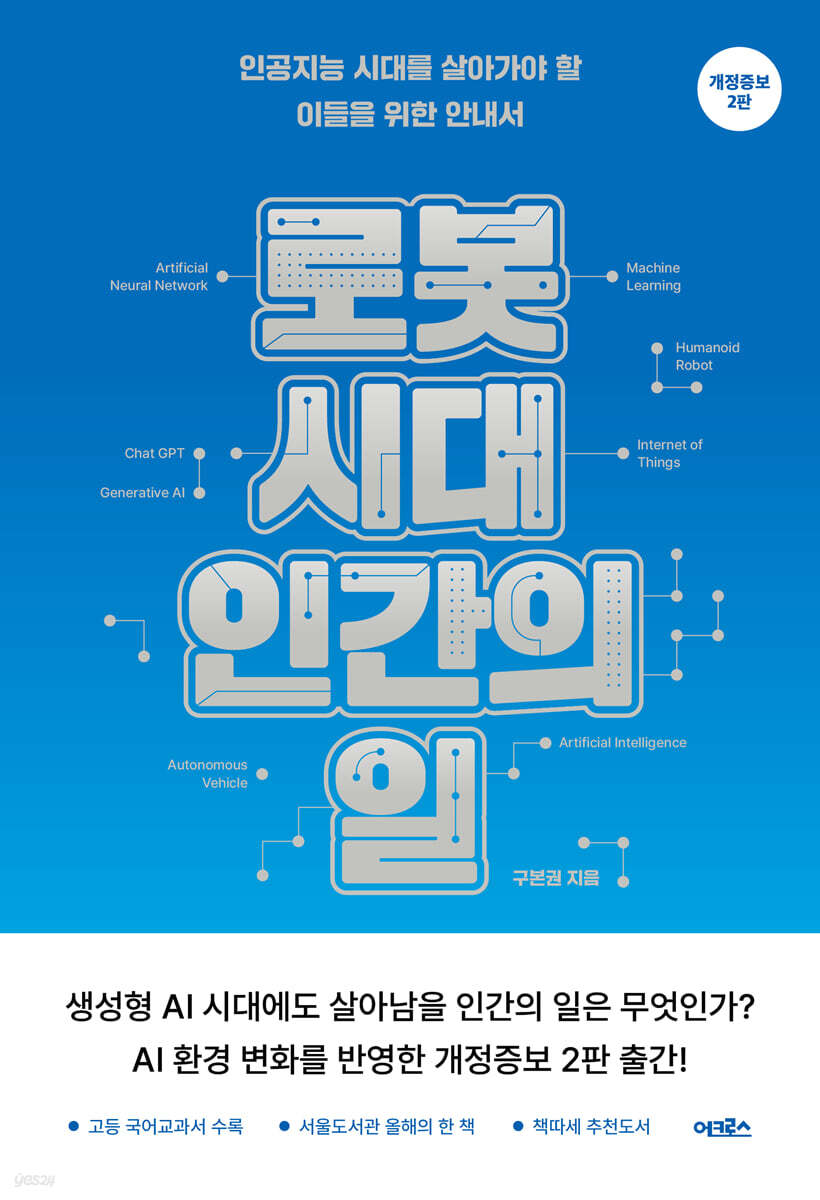
Revised and expanded second edition reflecting changes in the AI environment!
"Human Work in the Age of Robots," which has been praised as "the most outstanding liberal arts book preparing for the age of artificial intelligence robots" and established itself as a must-read for the age of artificial intelligence, is now meeting readers in its second revised and expanded edition.
Following the publication of the first edition in 2015, the revised and expanded edition in 2020 added questions about art and politics, which were considered to remain uniquely human domains. This revised and expanded second edition adds questions about generative AI, which is shaking up our society as a whole.
With generative AI projected to replace more than half of entry-level office workers, what should humans prepare for? As we move into a world where more and more tasks are delegated to AI, what human jobs will survive? In this book, the author, a digital humanist and IT journalist, guides us to find our own path, wisely engaging with increasingly intelligent tools and contemplating the issues that will forever remain human, no matter how advanced the machines become.
Revised and expanded second edition reflecting changes in the AI environment!
"Human Work in the Age of Robots," which has been praised as "the most outstanding liberal arts book preparing for the age of artificial intelligence robots" and established itself as a must-read for the age of artificial intelligence, is now meeting readers in its second revised and expanded edition.
Following the publication of the first edition in 2015, the revised and expanded edition in 2020 added questions about art and politics, which were considered to remain uniquely human domains. This revised and expanded second edition adds questions about generative AI, which is shaking up our society as a whole.
With generative AI projected to replace more than half of entry-level office workers, what should humans prepare for? As we move into a world where more and more tasks are delegated to AI, what human jobs will survive? In this book, the author, a digital humanist and IT journalist, guides us to find our own path, wisely engaging with increasingly intelligent tools and contemplating the issues that will forever remain human, no matter how advanced the machines become.
- You can preview some of the book's contents.
Preview
index
Preface to the Revised and Expanded 2nd Edition: In the Face of the Shocking Change of Generative Artificial Intelligence
Preface to the Revised Edition: New Questions Raised by AlphaGo
Prologue: The Age of Robots, Ushering in a "Brave New World"
Chapter 1 Algorithmic Ethics: With the advent of driverless cars, are human-driven cars more dangerous?
The race for self-driving cars / Planetary exploration technology coming to Earth / What will change when people stop driving / Can we hand over the steering wheel to robots / Who will be responsible for accidents involving self-driving cars / Who will die / Automation entering our lives from the road
Chapter 2: A Cultural History of Language: Is Learning a Foreign Language Necessary in the Age of Machine Translation?
The rise of Babel Fish, humanity's dream / From Enigma to AI, the history of machine translation / Human translation vs. machine translation / The "Chinese Room" thought experiment / Are human instincts a challenge for robots? / Learning a foreign language in an era of disappearing language barriers / In the age of the single-brained, can language skills be outsourced?
Chapter 3: The Sociology of Knowledge: In a Society Where Knowledge is Shared, Is It Necessary to Go to College?
College diplomas become mere pieces of paper / New education beyond the classroom / The paradox of a zero marginal cost society / From encyclopedias to Wikipedia, the treasure trove of human knowledge / The evolution of knowledge tools / The knowledge half-life: the shortening of information's shelf life / The path to becoming an intelligent being
Chapter 4: The Economics of Jobs: The Second Machine Age: Will My Job Survive in 10 Years?
What Two Airline Crashes Taught Us / Structural Unemployment / The Second Machine Age Dominating the Knowledge Industry / Were the Luddites Useless? / A Mispredicted Future / What Will Happen to My Job? / How Should We Work and Live in an Age of Lifelong Jobs?
Chapter 5: Artificial Intelligence in Art: Is Artistic Creativity a Uniquely Human Competitive Advantage?
AI that composes, draws, and writes / Questions about art / The nature of art being challenged / Who owns the copyright to AI art? / "Aura," the unique experience of the original that cannot be replicated
Chapter 6: The Humanities of Leisure: Will Robots Take Over Labor, Opening Up a Life with Evenings for Us?
Machines do the work, humans rest? / What is leisure? / The paradoxical era of time poverty / To be free in free time
Chapter 7 The Psychology of Relationships: Is the Era of Romance with Emotional Humanoid Robots Coming?
Transplanting emotions into robots / Can we fall in love with robots? / Joint funerals for companion robots / How do robots feel emotions? / Is it cruel to kick a robot dog? / What are emotions to humans?
Chapter 8: The Science of Artificial Intelligence: The Singularity of AI: Will Robots Really Threaten Humans?
Computers Beat the Chess God / The Ebb and Flow of AI Research / Humanity's Last Invention / The Evolution of Non-Conscious Intelligence / Asimov's 3+1 Robotics Principle / Another Question We Face
Chapter 9 The Anthropology of Curiosity: How Can Humans Compete Against Thinking Machines?
Fatal errors are the reason for survival / A history that has suppressed the question "why?" / A future without questions / The source of humanity's achievements / An era in which we must discover what we lack
Chapter 10: AI Judges: Should Fair Judgments Be Given to Robot Judges?
A 'robot judge' without a dispute over a verdict / A 'robot lawyer' that reads a billion precedents per second / An 'AI judge' that assesses the likelihood of repeat offenses / Even algorithms are full of 'discrimination' and 'bias' / An efficient but inexplicable algorithm / "Anyone would be better than current politicians"? / The paradox of pursuing freedom
Chapter 11: The Philosophy of Forgetting: A World Without Forgetting: What Should We Remember?
The Evolution of Machine Memory / The Right to Be Forgotten / The Gatekeeping Brain / If the Forgetting System Doesn't Work / The Conditions of Memory That Cannot Be Outsourced
Chapter 12: The Age of Mass Creativity: Is Generative AI a Stepping Stone or a Hurdle to Creativity?
Two landscapes brought about by generative AI / School education caught in the dilemma of 'allowing or blocking' / Technological characteristics of generative AI / The generative AI bomb dropped on the creativity debate / Will a 'Cambrian explosion of creativity' occur? / From the era of mass production to the era of mass creativity / What's more important than creative works / Changes in future creativity due to AI
Chapter 13 Digital Grammar: Should We Learn Robot Language?
The Illiterate of the Future / Code Literacy: Decoding the Black Box / The Tragedy of the Yir Yoront Tribe / Divine Humans, Human Humans
Preface to the Revised Edition: New Questions Raised by AlphaGo
Prologue: The Age of Robots, Ushering in a "Brave New World"
Chapter 1 Algorithmic Ethics: With the advent of driverless cars, are human-driven cars more dangerous?
The race for self-driving cars / Planetary exploration technology coming to Earth / What will change when people stop driving / Can we hand over the steering wheel to robots / Who will be responsible for accidents involving self-driving cars / Who will die / Automation entering our lives from the road
Chapter 2: A Cultural History of Language: Is Learning a Foreign Language Necessary in the Age of Machine Translation?
The rise of Babel Fish, humanity's dream / From Enigma to AI, the history of machine translation / Human translation vs. machine translation / The "Chinese Room" thought experiment / Are human instincts a challenge for robots? / Learning a foreign language in an era of disappearing language barriers / In the age of the single-brained, can language skills be outsourced?
Chapter 3: The Sociology of Knowledge: In a Society Where Knowledge is Shared, Is It Necessary to Go to College?
College diplomas become mere pieces of paper / New education beyond the classroom / The paradox of a zero marginal cost society / From encyclopedias to Wikipedia, the treasure trove of human knowledge / The evolution of knowledge tools / The knowledge half-life: the shortening of information's shelf life / The path to becoming an intelligent being
Chapter 4: The Economics of Jobs: The Second Machine Age: Will My Job Survive in 10 Years?
What Two Airline Crashes Taught Us / Structural Unemployment / The Second Machine Age Dominating the Knowledge Industry / Were the Luddites Useless? / A Mispredicted Future / What Will Happen to My Job? / How Should We Work and Live in an Age of Lifelong Jobs?
Chapter 5: Artificial Intelligence in Art: Is Artistic Creativity a Uniquely Human Competitive Advantage?
AI that composes, draws, and writes / Questions about art / The nature of art being challenged / Who owns the copyright to AI art? / "Aura," the unique experience of the original that cannot be replicated
Chapter 6: The Humanities of Leisure: Will Robots Take Over Labor, Opening Up a Life with Evenings for Us?
Machines do the work, humans rest? / What is leisure? / The paradoxical era of time poverty / To be free in free time
Chapter 7 The Psychology of Relationships: Is the Era of Romance with Emotional Humanoid Robots Coming?
Transplanting emotions into robots / Can we fall in love with robots? / Joint funerals for companion robots / How do robots feel emotions? / Is it cruel to kick a robot dog? / What are emotions to humans?
Chapter 8: The Science of Artificial Intelligence: The Singularity of AI: Will Robots Really Threaten Humans?
Computers Beat the Chess God / The Ebb and Flow of AI Research / Humanity's Last Invention / The Evolution of Non-Conscious Intelligence / Asimov's 3+1 Robotics Principle / Another Question We Face
Chapter 9 The Anthropology of Curiosity: How Can Humans Compete Against Thinking Machines?
Fatal errors are the reason for survival / A history that has suppressed the question "why?" / A future without questions / The source of humanity's achievements / An era in which we must discover what we lack
Chapter 10: AI Judges: Should Fair Judgments Be Given to Robot Judges?
A 'robot judge' without a dispute over a verdict / A 'robot lawyer' that reads a billion precedents per second / An 'AI judge' that assesses the likelihood of repeat offenses / Even algorithms are full of 'discrimination' and 'bias' / An efficient but inexplicable algorithm / "Anyone would be better than current politicians"? / The paradox of pursuing freedom
Chapter 11: The Philosophy of Forgetting: A World Without Forgetting: What Should We Remember?
The Evolution of Machine Memory / The Right to Be Forgotten / The Gatekeeping Brain / If the Forgetting System Doesn't Work / The Conditions of Memory That Cannot Be Outsourced
Chapter 12: The Age of Mass Creativity: Is Generative AI a Stepping Stone or a Hurdle to Creativity?
Two landscapes brought about by generative AI / School education caught in the dilemma of 'allowing or blocking' / Technological characteristics of generative AI / The generative AI bomb dropped on the creativity debate / Will a 'Cambrian explosion of creativity' occur? / From the era of mass production to the era of mass creativity / What's more important than creative works / Changes in future creativity due to AI
Chapter 13 Digital Grammar: Should We Learn Robot Language?
The Illiterate of the Future / Code Literacy: Decoding the Black Box / The Tragedy of the Yir Yoront Tribe / Divine Humans, Human Humans
Detailed image

Into the book
Generative artificial intelligence, represented by ChatGPT, has brought about new questions that never existed before in the world.
When artificial intelligence and robots first emerged, there was a period of emphasis and education that while simple tasks could be left to machines, creative work would remain the domain of humans. However, the situation has completely changed with 'generative artificial intelligence.'
Generative AI is a technology that literally specializes in creating things, so it can create anything you instruct it to do.
Humans are unhesitatingly carrying out activities that they have called 'creativity'.
As generative AI becomes more creative, new questions naturally arise.
“Is AI a tool that enhances human creativity, or a tool that undermines it?” This is the 13th question added to the revised second edition.
--- From "In the Face of the Shocking Change of Generative Artificial Intelligence"
The success of director Bong Joon-ho's "Parasite," which won four awards at the 2020 Academy Awards, including Best Picture and Best Director, also owes much to translation.
English subtitle translator Darcy Paquet presented a delicate and accurate translation that allowed the Korean language and unique culture to be naturally accepted in other languages and cultures, which led to the acclaim of Parasite among foreign film fans.
Ki-taek (Song Kang-ho) is impressed by his daughter's skill in creating a fake diploma using Photoshop and says, "Hey...
In the scene where he says, “Isn’t there something like a Seoul National University document forgery department?”, the English subtitles changed Seoul National University to ‘Oxford University.’
It is the creative result of a translator's careful selection of the most appropriate expression that can be understood as a symbol of a prestigious university by people around the world.
--- From "In the Age of Machine Translation, Is It Necessary to Learn Foreign Languages?"
In October 2018, the first painting created by artificial intelligence was put up for auction at Christie's in New York, USA.
The portrait of Edmond de Belamy, painted by the artificial intelligence painter Obvious, developed by French researchers, was sold for $432,000.
The initial expected auction price was around $10,000, but in the actual auction, collectors competitively raised their bids, and the item was sold for over 40 times that amount.
…Andy Warhol’s work was also on display at Christie’s auction that day, creating a contrast.
The Warhol work sold for $75,000.
--- From "Is artistic creativity truly a uniquely human ability?"
It is difficult for human referees to maintain focus and consistency in their decisions throughout the game.
Sports that subjectively assess artistic and technical achievements, such as gymnastics, figure skating, and music competitions, acknowledge the potential for bias and error in judging and have established mechanisms to minimize their impact.
It is a structure in which multiple judges participate and judge by averaging the remaining values excluding the highest and lowest scores.
Machines are not tired, nor are they innately patriotic or prejudiced.
Robot referees are expected to provide fair evaluations that will alleviate the concerns about bias and inconsistency of human referees.
Could robot referees move beyond sports and into courtrooms and politics?
When artificial intelligence and robots first emerged, there was a period of emphasis and education that while simple tasks could be left to machines, creative work would remain the domain of humans. However, the situation has completely changed with 'generative artificial intelligence.'
Generative AI is a technology that literally specializes in creating things, so it can create anything you instruct it to do.
Humans are unhesitatingly carrying out activities that they have called 'creativity'.
As generative AI becomes more creative, new questions naturally arise.
“Is AI a tool that enhances human creativity, or a tool that undermines it?” This is the 13th question added to the revised second edition.
--- From "In the Face of the Shocking Change of Generative Artificial Intelligence"
The success of director Bong Joon-ho's "Parasite," which won four awards at the 2020 Academy Awards, including Best Picture and Best Director, also owes much to translation.
English subtitle translator Darcy Paquet presented a delicate and accurate translation that allowed the Korean language and unique culture to be naturally accepted in other languages and cultures, which led to the acclaim of Parasite among foreign film fans.
Ki-taek (Song Kang-ho) is impressed by his daughter's skill in creating a fake diploma using Photoshop and says, "Hey...
In the scene where he says, “Isn’t there something like a Seoul National University document forgery department?”, the English subtitles changed Seoul National University to ‘Oxford University.’
It is the creative result of a translator's careful selection of the most appropriate expression that can be understood as a symbol of a prestigious university by people around the world.
--- From "In the Age of Machine Translation, Is It Necessary to Learn Foreign Languages?"
In October 2018, the first painting created by artificial intelligence was put up for auction at Christie's in New York, USA.
The portrait of Edmond de Belamy, painted by the artificial intelligence painter Obvious, developed by French researchers, was sold for $432,000.
The initial expected auction price was around $10,000, but in the actual auction, collectors competitively raised their bids, and the item was sold for over 40 times that amount.
…Andy Warhol’s work was also on display at Christie’s auction that day, creating a contrast.
The Warhol work sold for $75,000.
--- From "Is artistic creativity truly a uniquely human ability?"
It is difficult for human referees to maintain focus and consistency in their decisions throughout the game.
Sports that subjectively assess artistic and technical achievements, such as gymnastics, figure skating, and music competitions, acknowledge the potential for bias and error in judging and have established mechanisms to minimize their impact.
It is a structure in which multiple judges participate and judge by averaging the remaining values excluding the highest and lowest scores.
Machines are not tired, nor are they innately patriotic or prejudiced.
Robot referees are expected to provide fair evaluations that will alleviate the concerns about bias and inconsistency of human referees.
Could robot referees move beyond sports and into courtrooms and politics?
--- From "Should we rely on robots for fair judgment?"
Publisher's Review
Artificial intelligence technology has been developing at a dizzying pace.
Will it completely replace human life?
Another question raised by the emergence of generative AI
First published in 2015, "Robot Age, Human Work" has received praise from readers as "the most outstanding book to prepare for the Fourth Industrial Revolution," posing the knowledge we need to know and the questions we need to consider as we enter the era of artificial intelligence robots, the most rapid period of change in human history.
It was included in middle and high school Korean language textbooks and established itself as a must-read for career exploration. It was also selected as a recommended book by various schools, libraries, and local communities, reaching nearly 150,000 readers.
The revised and expanded second edition of "Robot Age, Human Work" updates the changes and information over the five years since the publication of the revised and expanded edition in 2020.
Author Koo Bon-kwon, a leading digital humanist and active IT journalist of our time, states in the preface to the second edition that “the changes that occurred between 2021 and 2025, the period of preparation for the second edition, were much greater than the changes that occurred between 2016 and 2020, when the first revised edition was being worked on.”
At the heart of this change is the emergence of generative artificial intelligence, such as ChatGPT, developed by OpenAI in 2022.
Generative artificial intelligence, which can instantly create anything upon command, appears to be encroaching on creativity, which was once thought to remain a uniquely human domain.
Witnessing this situation, the author raised a new question, which was added to this revised and expanded second edition.
Chapter 12, “Is AI a tool that helps human creativity, or a tool that undermines it?”
What human jobs will survive in the age of generative AI?
The power to survive in the increasingly urgent robot age
Great cartoonists of the past had their own drawing styles and handwriting that they honed over many years.
No matter how excellent one's drawing skills were, one had to train under a famous artist for a considerable period of time before being given the opportunity to publish one's work and receive recognition under one's own name.
As technology and platforms developed, the comics market shifted to 'webtoons', and the webtoon ecosystem became more active as talented artists entered the market and competed.
Since the advent of artificial intelligence and the availability of various AI creative tools, the path to becoming a cartoonist has completely changed.
The tools' role goes beyond the apprentice level of the past, and they not only draw or color pictures for you, but also quickly complete plots and scenarios.
By leveraging artificial intelligence, it is now possible to easily enter the world of creation even without special talent or skills in that field.
The educational field has been experiencing extreme confusion since the introduction of ChatGPT.
No matter how novel the task a teacher gives, the reality is that students end up having ChatGPT perform it.
As concerns arose that students' indiscriminate use of ChatGPT was threatening the essence of school education, the New York City Department of Education at one point banned the use of ChatGPT in schools.
While some people hail artificial intelligence as a magic wand that will usher in a new era of creativity, others see it as a hindrance to creativity, relying on technology and producing mediocre results.
In this way, the emergence of generative artificial intelligence poses questions of a different dimension than before.
Will machines now surpass the singularity? Even so, what is the essence of humanity that we must still ponder? What must we prepare to live as humanly as possible in the machine age?
The revised and expanded second edition of "Human Work in the Robot Age" poses these questions and asks what role humans should play in the face of the rapid development of artificial intelligence technology.
The author says that this fact is actually reassuring, saying, “Although artificial intelligence technology has developed at a dizzying pace, none of the existing questions have been resolved.”
And I urge readers to create new questions they never thought of before with this book, and to wisely relate to tools (artificial intelligence and robots) that are becoming increasingly smarter and more convenient, as we, as 'Homo Faber (instrumental man),' and to create our own questions and use them as a strength to survive in the robot age.
Recommendation
At a time when the era of the Fourth Industrial Revolution has arrived and the keyword "artificial intelligence" is overwhelming our society, this book poses important questions about what kind of work we will do and how we will live in the near future, surrounded by robots.
-A word from the selection committee for the '2017 Gumi City Book of the Year'
This book presents a new dimension of humanistic challenges brought about by technological advancements.
Artificial intelligence and robotics technology bring convenience, but they also bring about new, unprecedented problems, requiring us to think outside the box.
-Recommended books by the Chung-Ang University Regional Humanities Center
Will it completely replace human life?
Another question raised by the emergence of generative AI
First published in 2015, "Robot Age, Human Work" has received praise from readers as "the most outstanding book to prepare for the Fourth Industrial Revolution," posing the knowledge we need to know and the questions we need to consider as we enter the era of artificial intelligence robots, the most rapid period of change in human history.
It was included in middle and high school Korean language textbooks and established itself as a must-read for career exploration. It was also selected as a recommended book by various schools, libraries, and local communities, reaching nearly 150,000 readers.
The revised and expanded second edition of "Robot Age, Human Work" updates the changes and information over the five years since the publication of the revised and expanded edition in 2020.
Author Koo Bon-kwon, a leading digital humanist and active IT journalist of our time, states in the preface to the second edition that “the changes that occurred between 2021 and 2025, the period of preparation for the second edition, were much greater than the changes that occurred between 2016 and 2020, when the first revised edition was being worked on.”
At the heart of this change is the emergence of generative artificial intelligence, such as ChatGPT, developed by OpenAI in 2022.
Generative artificial intelligence, which can instantly create anything upon command, appears to be encroaching on creativity, which was once thought to remain a uniquely human domain.
Witnessing this situation, the author raised a new question, which was added to this revised and expanded second edition.
Chapter 12, “Is AI a tool that helps human creativity, or a tool that undermines it?”
What human jobs will survive in the age of generative AI?
The power to survive in the increasingly urgent robot age
Great cartoonists of the past had their own drawing styles and handwriting that they honed over many years.
No matter how excellent one's drawing skills were, one had to train under a famous artist for a considerable period of time before being given the opportunity to publish one's work and receive recognition under one's own name.
As technology and platforms developed, the comics market shifted to 'webtoons', and the webtoon ecosystem became more active as talented artists entered the market and competed.
Since the advent of artificial intelligence and the availability of various AI creative tools, the path to becoming a cartoonist has completely changed.
The tools' role goes beyond the apprentice level of the past, and they not only draw or color pictures for you, but also quickly complete plots and scenarios.
By leveraging artificial intelligence, it is now possible to easily enter the world of creation even without special talent or skills in that field.
The educational field has been experiencing extreme confusion since the introduction of ChatGPT.
No matter how novel the task a teacher gives, the reality is that students end up having ChatGPT perform it.
As concerns arose that students' indiscriminate use of ChatGPT was threatening the essence of school education, the New York City Department of Education at one point banned the use of ChatGPT in schools.
While some people hail artificial intelligence as a magic wand that will usher in a new era of creativity, others see it as a hindrance to creativity, relying on technology and producing mediocre results.
In this way, the emergence of generative artificial intelligence poses questions of a different dimension than before.
Will machines now surpass the singularity? Even so, what is the essence of humanity that we must still ponder? What must we prepare to live as humanly as possible in the machine age?
The revised and expanded second edition of "Human Work in the Robot Age" poses these questions and asks what role humans should play in the face of the rapid development of artificial intelligence technology.
The author says that this fact is actually reassuring, saying, “Although artificial intelligence technology has developed at a dizzying pace, none of the existing questions have been resolved.”
And I urge readers to create new questions they never thought of before with this book, and to wisely relate to tools (artificial intelligence and robots) that are becoming increasingly smarter and more convenient, as we, as 'Homo Faber (instrumental man),' and to create our own questions and use them as a strength to survive in the robot age.
Recommendation
At a time when the era of the Fourth Industrial Revolution has arrived and the keyword "artificial intelligence" is overwhelming our society, this book poses important questions about what kind of work we will do and how we will live in the near future, surrounded by robots.
-A word from the selection committee for the '2017 Gumi City Book of the Year'
This book presents a new dimension of humanistic challenges brought about by technological advancements.
Artificial intelligence and robotics technology bring convenience, but they also bring about new, unprecedented problems, requiring us to think outside the box.
-Recommended books by the Chung-Ang University Regional Humanities Center
GOODS SPECIFICS
- Date of issue: November 10, 2025
- Page count, weight, size: 416 pages | 560g | 147*215*20mm
- ISBN13: 9791167742483
- ISBN10: 1167742486
You may also like
카테고리
korean


korean

![GQ KOREA Mark (Monthly): December [2025]](http://librairie.coreenne.fr/cdn/shop/files/8ef265dbbfbf186523ed75ba7319009d.jpg?v=1765340328&width=3840)


