

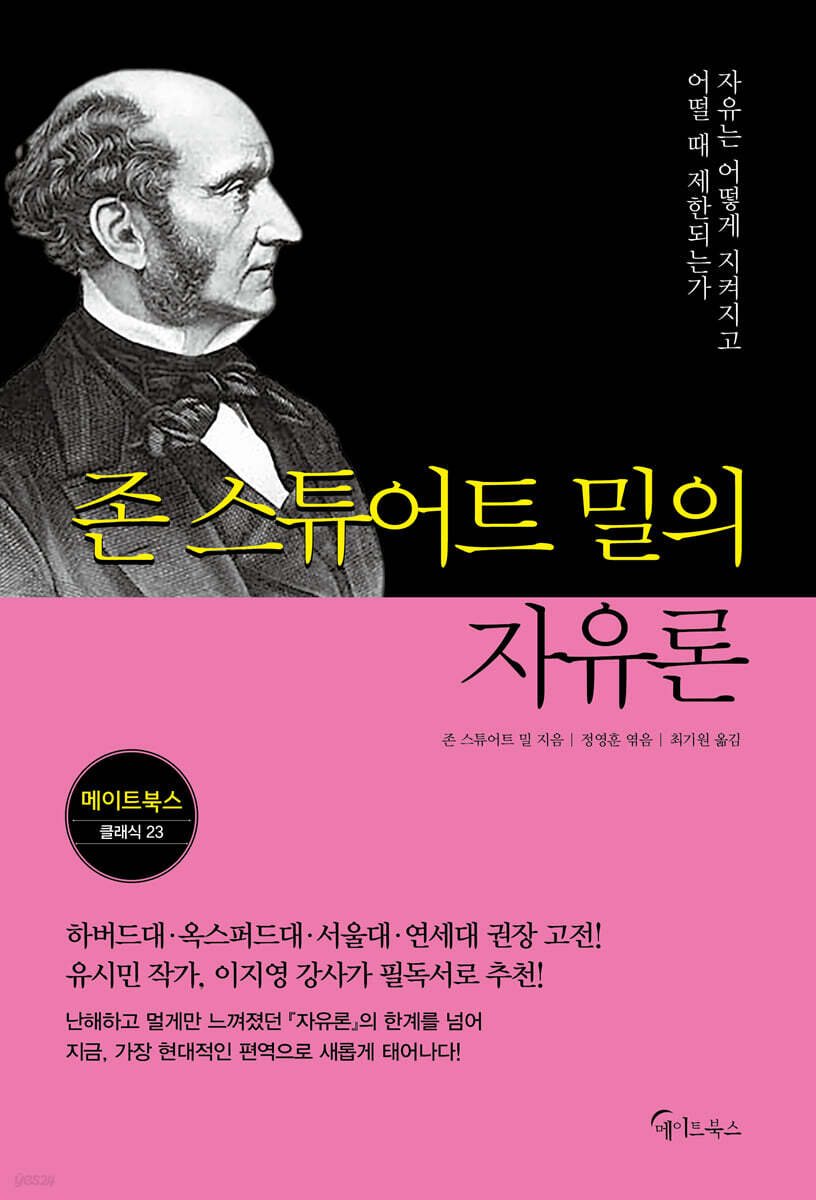
John Stuart Mill's On Liberty
 |
Description
Book Introduction
Violence in the name of public opinion: a warning that is still valid today!
A "readable 《On Liberty》" that transcends the barriers of the classics, reborn anew!
In his timeless masterpiece, “On Liberty,” 19th-century philosopher John Stuart Mill warned of something “more frightening than government”: the invisible violence known as public opinion.
He noted that the 'majority opinion' can suppress minority expression at any time, and that this suppression can operate not through legal sanctions but in much more subtle and powerful ways, through moral coercion and the enforcement of everyday silence.
Mill believed that as long as it did not harm others, all people have the right to judge and choose for themselves how to live their lives, and that this was not simply a declaration of liberalism, but an ethics of life that protected human dignity and responsibility.
He also emphasized that truth lives and breathes only in the midst of endless debate, counter-arguments, and the voices of opponents.
Mill's insight that truth survives only through constant verification and intersecting perspectives remains highly relevant even in today's information-abundant world.
It is precisely for this reason that On Liberty transcends time and remains a classic, reminding us of the value of dissenting voices and minority views.
The themes covered in On Liberty—hate, censorship, stigma, and the foundation of public opinion—remain remarkably relevant and current even 150 years later.
Rather, today is an era in which public opinion on social media, not the law, is the subject of censorship.
Therefore, On Liberty is not just a classic of the past, but a living, breathing philosophical weapon even at this very moment.
The only problem is the original text.
On Liberty is by no means an easy read.
The logic is deep, but the expressions are long, the paragraphs are long, and there are only chapter titles and no subheadings, so the reader has to figure out the structure as if wandering through a maze.
This book is a 'translated version' designed to overcome such barriers to entry.
Without simplifying or reducing Mill's thoughts, we have helpfully visualized and redesigned them using contemporary language and editing so that readers do not miss the flow of his thoughts.
I organized the structure so that it is easy to grasp the flow of the thoughts by adding subheadings to each one according to the logic and appropriately dividing long paragraphs.
This translation, which aims to bridge the gap between Mill and modern readers, deserves to be called 'On Liberty for Today' for precisely that reason.
A "readable 《On Liberty》" that transcends the barriers of the classics, reborn anew!
In his timeless masterpiece, “On Liberty,” 19th-century philosopher John Stuart Mill warned of something “more frightening than government”: the invisible violence known as public opinion.
He noted that the 'majority opinion' can suppress minority expression at any time, and that this suppression can operate not through legal sanctions but in much more subtle and powerful ways, through moral coercion and the enforcement of everyday silence.
Mill believed that as long as it did not harm others, all people have the right to judge and choose for themselves how to live their lives, and that this was not simply a declaration of liberalism, but an ethics of life that protected human dignity and responsibility.
He also emphasized that truth lives and breathes only in the midst of endless debate, counter-arguments, and the voices of opponents.
Mill's insight that truth survives only through constant verification and intersecting perspectives remains highly relevant even in today's information-abundant world.
It is precisely for this reason that On Liberty transcends time and remains a classic, reminding us of the value of dissenting voices and minority views.
The themes covered in On Liberty—hate, censorship, stigma, and the foundation of public opinion—remain remarkably relevant and current even 150 years later.
Rather, today is an era in which public opinion on social media, not the law, is the subject of censorship.
Therefore, On Liberty is not just a classic of the past, but a living, breathing philosophical weapon even at this very moment.
The only problem is the original text.
On Liberty is by no means an easy read.
The logic is deep, but the expressions are long, the paragraphs are long, and there are only chapter titles and no subheadings, so the reader has to figure out the structure as if wandering through a maze.
This book is a 'translated version' designed to overcome such barriers to entry.
Without simplifying or reducing Mill's thoughts, we have helpfully visualized and redesigned them using contemporary language and editing so that readers do not miss the flow of his thoughts.
I organized the structure so that it is easy to grasp the flow of the thoughts by adding subheadings to each one according to the logic and appropriately dividing long paragraphs.
This translation, which aims to bridge the gap between Mill and modern readers, deserves to be called 'On Liberty for Today' for precisely that reason.
- You can preview some of the book's contents.
Preview
index
Editor's Note: Transcending the Obscurity of Classics, Creating a Readable "On Liberty"
Chapter 1 Why should we discuss ‘freedom’?
Preventing the tyranny of the majority is the starting point of freedom.
Customs and moral judgments are not always right.
Individual freedom can only be restricted when it harms others.
The 'proper realm of freedom' cannot be invaded by anyone.
Freedom of thought and freedom of expression are the starting point of all freedom.
Chapter 2 Is it really possible that we are wrong?
Why are freedoms of thought and expression still under threat?
Even if it is a minority opinion, why should it not be silenced?
Why are we so easily convinced that our opinions are wrong?
Truth survives only after it has withstood verification and refutation.
Self-confidence alone should not ban doubt.
Truth without discussion is just dead truth.
Truth shines only after constant doubt and verification.
The most 'uncomfortable legacy' left by Socrates
The violence of 'social stigma' is more frightening than legal oppression.
Why is a society that suppresses expression dangerous?
An atmosphere that suppresses thought makes society sick.
Progress is impossible as long as we cling to prejudice and custom.
Chapter 3: Why are wrong opinions still necessary?
Dissenting opinions are essential for the truth.
True understanding begins with listening to the other person's arguments.
The forum for discussion must be open to everyone.
When free discussion disappears, truth ultimately dies.
Beliefs live and breathe through rebuttal, not repetition.
The balance created by conflicting opinions is the completion of truth.
Four Reasons Why Freedom of Expression Is Essential
The boundary between free expression of opinions and fair discussion
Chapter 4: Why is human individuality the essence of freedom?
Freedom of expression must lead to freedom of action.
A person's individuality has its own unique value.
There is no "my own choice" in a life lived solely according to convention.
What makes humans human is not just reason, but desire and impulse.
Personal impulses and preferences are becoming increasingly lacking.
The freedom to live different lives must be guaranteed.
The genius of a few must be freely expressed.
When public opinion suppresses "difference," civilization drifts in a dangerous direction.
When life becomes uniform, true happiness becomes distant.
A society where people without individuality are admired as ideal people
Freedom, not convention, leads to true improvement.
Resist the world's tendency to make everyone the same.
Chapter 5: To what extent can society intervene in individual freedom?
Where is the boundary between the individual and society?
Altruistic efforts for others need not diminish.
The issue of individual self-determination and social interference
If you do not harm others, you should not be disadvantaged.
Breaking rules designed to protect others must be punished.
We must ensure that freedom does not become a spark that harms the community.
You can't punish him just because he's drunk.
Freedom must not be violated by controlling it in the name of morality.
Someone's discomfort cannot be a reason to restrict freedom.
A society that tries to ban anything it deems wrong by law
The law should not interfere with an individual's free choice.
Silencing others can never be justified.
Chapter 6: How far can the principle of freedom be tolerated in reality?
The Principles of Freedom: Put to the Test in Life
Competition should be free, but how far can regulation go?
Even if it seems like a "personal problem," interference can sometimes be justified.
What if you make a living doing something the state deems harmful?
The state's special taxation of irritating substances
Should we leave it alone or help it?
Three Reasons Why Government Should Not Intervene
We must not become a country where everything must go through bureaucrats.
Freedom should not be abolished for the sake of increasing administrative efficiency.
Chapter 1 Why should we discuss ‘freedom’?
Preventing the tyranny of the majority is the starting point of freedom.
Customs and moral judgments are not always right.
Individual freedom can only be restricted when it harms others.
The 'proper realm of freedom' cannot be invaded by anyone.
Freedom of thought and freedom of expression are the starting point of all freedom.
Chapter 2 Is it really possible that we are wrong?
Why are freedoms of thought and expression still under threat?
Even if it is a minority opinion, why should it not be silenced?
Why are we so easily convinced that our opinions are wrong?
Truth survives only after it has withstood verification and refutation.
Self-confidence alone should not ban doubt.
Truth without discussion is just dead truth.
Truth shines only after constant doubt and verification.
The most 'uncomfortable legacy' left by Socrates
The violence of 'social stigma' is more frightening than legal oppression.
Why is a society that suppresses expression dangerous?
An atmosphere that suppresses thought makes society sick.
Progress is impossible as long as we cling to prejudice and custom.
Chapter 3: Why are wrong opinions still necessary?
Dissenting opinions are essential for the truth.
True understanding begins with listening to the other person's arguments.
The forum for discussion must be open to everyone.
When free discussion disappears, truth ultimately dies.
Beliefs live and breathe through rebuttal, not repetition.
The balance created by conflicting opinions is the completion of truth.
Four Reasons Why Freedom of Expression Is Essential
The boundary between free expression of opinions and fair discussion
Chapter 4: Why is human individuality the essence of freedom?
Freedom of expression must lead to freedom of action.
A person's individuality has its own unique value.
There is no "my own choice" in a life lived solely according to convention.
What makes humans human is not just reason, but desire and impulse.
Personal impulses and preferences are becoming increasingly lacking.
The freedom to live different lives must be guaranteed.
The genius of a few must be freely expressed.
When public opinion suppresses "difference," civilization drifts in a dangerous direction.
When life becomes uniform, true happiness becomes distant.
A society where people without individuality are admired as ideal people
Freedom, not convention, leads to true improvement.
Resist the world's tendency to make everyone the same.
Chapter 5: To what extent can society intervene in individual freedom?
Where is the boundary between the individual and society?
Altruistic efforts for others need not diminish.
The issue of individual self-determination and social interference
If you do not harm others, you should not be disadvantaged.
Breaking rules designed to protect others must be punished.
We must ensure that freedom does not become a spark that harms the community.
You can't punish him just because he's drunk.
Freedom must not be violated by controlling it in the name of morality.
Someone's discomfort cannot be a reason to restrict freedom.
A society that tries to ban anything it deems wrong by law
The law should not interfere with an individual's free choice.
Silencing others can never be justified.
Chapter 6: How far can the principle of freedom be tolerated in reality?
The Principles of Freedom: Put to the Test in Life
Competition should be free, but how far can regulation go?
Even if it seems like a "personal problem," interference can sometimes be justified.
What if you make a living doing something the state deems harmful?
The state's special taxation of irritating substances
Should we leave it alone or help it?
Three Reasons Why Government Should Not Intervene
We must not become a country where everything must go through bureaucrats.
Freedom should not be abolished for the sake of increasing administrative efficiency.
Detailed image

Into the book
Society can and does become a power in itself, issuing its own commands.
But when that order is wrong or invades the personal domain of an individual that should not be interfered with in the first place, the oppression that comes into play is far more threatening than any other political oppression.
Although it does not involve extreme punishment, there is little room for avoidance or escape.
Such oppression penetrates deeply into individual lives not through laws or institutions, but through customs, public opinion, and invisible expectations that permeate everyday life, ultimately entangling even the human soul.
Therefore, it is not enough for us to be protected merely from the tyranny of government power.
It must also be protected from the tyranny of prevailing public opinion and emotions.
--- From "Chapter 1: Why Should We Discuss 'Freedom'?"
There are unique areas in human life where society cannot intervene deeply.
Society has interests that are distinct from those of individuals, but can only express indirect interest in this area.
This area refers to the part of an individual's life and behavior that only affects him or herself.
Even if the influence extends to others, there is no reason to be concerned if it is based on free, voluntary, and uninformed consent.
The expression 'affects only oneself' here means a direct and primary influence.
Of course, it cannot be denied that some choices can indirectly affect others.
However, if we intervene in this area based on such a possibility, it is not simply interference, but an act that violates the essence of freedom.
--- From "Chapter 1: Why Should We Discuss 'Freedom'?"
Freedom of thought and freedom of expression are to some extent taken for granted in most countries that promote religious tolerance and liberal institutions.
However, the philosophical and practical foundations of where these freedoms come from and why they should be protected are surprisingly little known.
The reality is that even those who lead public opinion are unlikely to fully understand its depth.
This philosophical foundation of freedom, when properly understood, is never confined to one field.
Its scope of application is much broader and deeper.
And a closer look at this topic will be the most appropriate starting point for understanding the discussions that follow.
--- From "Chapter 1: Why Should We Discuss 'Freedom'?"
There is a world of difference between assuming that an opinion "might be true" when it has not been refuted despite ample opportunity for argument, and assuming that an opinion "is true" without any opportunity for refutation.
There is only one condition under which we can believe that an opinion is correct and have the justification to act accordingly.
Only when we are allowed complete freedom to refute and dispute that opinion do we truly have the legitimacy to follow it.
And if that condition is not met, then man is not entitled to rational certainty about any opinion.
Whether it's the history of opinion or the ordinary aspects of human life, why has this level of standard been maintained even today? Clearly, it's not because human reason is inherently superior.
Unless the subject is self-evident, ninety-nine out of a hundred people lack the ability to make sound judgments, and even the one remaining person has a limited and relative rather than absolute ability to make judgments.
--- From Chapter 2: Is it really possible that we are wrong?
Today's social exclusion no longer involves killing people or blatantly uprooting ideas.
But society still forces people to hide their thoughts and even give up on actively trying to make those thoughts known to the world.
In our society, heretical or fringe opinions may not gain significant influence over the decades, but they do not disappear completely either.
Such ideas do not spread like sparks that light up the world, but remain confined within the narrow confines of the few contemplative and scholarly individuals who first conceived them.
In the end, that light, whether true or false, does not illuminate the entire human society, but only quietly rises like smoke.
That silence, while seemingly peaceful, costs society as a whole a dear price: it permanently robs it of the possibility of accessing the truth.
--- From Chapter 2: Is it really possible that we are wrong?
When free discussion disappears, people end up not even knowing what their beliefs are based on.
Even if that happens, it could be considered as just an intellectual deficiency, not a moral defect.
That is, it can be thought that the value of belief itself in forming personality is still maintained.
But in reality, when the discussion disappears, not only the basis for the belief but also the meaning itself often fades.
The language that conveyed that belief no longer evokes a living concept, but only faintly recalls a fragment of the original meaning.
Deep understanding and self-confidence disappear, leaving behind only a few memorized phrases.
Even if some meaning remains, the essence disappears and only the shell and traces remain.
This historical experience, which shows how uncritical belief loses its essence and becomes nothing more than a formality, is a lesson that humanity should never overlook, and it is a lesson that cannot be over-thought, no matter how many times it is deeply reflected upon.
--- From "Chapter 3: Why Are Wrong Opinions Still Necessary?"
As is often said in politics, both forces that value "stability and order" and those that pursue "reform and change" are essential components of healthy politics.
This is especially true until one side broadens its horizons enough to discern what it "must keep" and what it "must discard" and embrace both order and reform.
These two perspectives complement each other's deficiencies and gain meaning from existence.
And it is the tension between the two that holds each force together, preventing it from losing its rationality and balance.
These conflicting values that make up life—democracy and aristocracy, property rights and equality, cooperation and competition, luxury and moderation, community and individuality, freedom and discipline—must be expressed in equal freedom.
And each of these values must be asserted and supported with equal force by people of equal talent and enthusiasm.
Otherwise, there is no way for either side to get their fair share.
--- From "Chapter 3: Why Are Wrong Opinions Still Necessary?"
Individual freedom can be restricted only under one condition.
That is, one should not exercise one's freedom in a way that harms others.
However, if a person acts according to his own judgment and will in matters that concern him alone, without harming others, then that freedom should be fully guaranteed as long as the consequences are only for him.
The claim that 'opinions should be free' means that the freedom to put those opinions into action should also be protected.
Humans can never be completely free from error, and most of what people believe to be truth is only a fragment of the truth.
--- From Chapter 4, “Why is human individuality the essence of freedom?”
When the direction of life is determined by the traditions and customs of society rather than by the inner self of the individual, one of the key elements of human happiness is lacking.
And that very element, the freedom to choose and take responsibility for one's own life, is the essential foundation for individual maturity and social progress.
The biggest obstacle to realizing this principle is not the technical discussion of how to implement it.
The more fundamental problem is that many people are not particularly interested in the goal itself.
The moment we establish the recognition that "the free expression of individuality is the core of human happiness," the numerous problems facing us today will become much easier to understand and much more naturally resolved.
Individuality is not a concept to be placed alongside civilization, education, or culture; it is the condition and starting point that makes all of these possible.
--- From Chapter 4, “Why is human individuality the essence of freedom?”
It is generally accepted that the ability to think and understand is, to a certain extent, the responsibility of each individual.
But such awareness does not easily extend to desires and impulses.
People with distinct desires or clear impulses are still often seen as anxious beings.
Until this inner strength is accepted as the essence of humanity, society's gaze will not become more lenient.
Desire and impulse, like faith and self-control, are also key elements that make us human.
The reason they are dangerous is not because they are excessive in themselves, but because they are out of place in the balance of life.
--- From Chapter 4, “Why is human individuality the essence of freedom?”
If there was ever a time to assert one's right to individuality, it is now.
Now, while the trend of forcibly making everyone the same has not yet fully taken root, is the last chance to resist.
The only time when we can successfully resist the trend of eroding individuality is in the 'early stages'.
The demand to make others like the masses feeds on the homogeneity they have created themselves and continues to grow.
When resistance is postponed, life eventually hardens into a uniform form.
By then, any deviation from that framework will be considered blasphemous, immoral, or even bizarre and unnatural.
If humans are deprived of diversity for a long time, they eventually lose the ability to even imagine it.
--- From Chapter 4, “Why is human individuality the essence of freedom?”
Society has completely dominated the earliest years of an individual's life.
In other words, an individual's entire childhood and adolescence were in the hands of society.
During that long period of time, society had ample opportunity to raise them as rational beings.
The current generation is in a position to influence not only the education of the next generation, but also the environment in which they will live.
Of course, it is not easy to raise them to be completely wise and good beings.
This is because the current generation has many shortcomings in wisdom and virtue.
Even if you put in your best effort, leading people in the right direction doesn't always go as planned.
Still, looking at the entire generation, it is entirely possible to raise the next generation to be slightly better people than the current generation.
If society has allowed countless people to grow up like mere children, and has failed to see the future rationally and act rationally, then society must bear the consequences.
--- From Chapter 5, “How far can society intervene in individual freedom?”
I want to make it clear that I am not trying to raise unnecessary concerns by raising questions that do not even exist.
One of the dangerous tendencies that humans often exhibit is that they often expand the scope of control in the name of morality, to the point where they end up violating individual freedoms that no one would suspect.
And there are already countless such cases.
--- From Chapter 5, “How far can society intervene in individual freedom?”
Freedom that allows one to give up one's freedom is never true freedom.
In such extreme cases, the persuasiveness of this logic becomes clear.
But its validity is by no means limited to this one case.
In fact, this principle holds true in a much broader context.
Of course, real life always comes with certain limitations.
Life constantly demands of us, even if it doesn't throw away our freedom entirely.
Sometimes, we are asked to live willingly giving up some of that freedom.
--- From "Chapter 6: How far is the principle of freedom allowed in reality?"
The true value of a nation ultimately comes from the depth and character of each and every one of its members.
Yet, some countries, in the name of slightly increasing administrative efficiency or simply mistaking the familiar appearance resulting from repeated practices for "administrative virtue," push aside the much more essential spiritual maturity and human dignity of citizens.
They even go so far as to diminish humans themselves in order to make control easier.
The result is clear.
Great things can never be accomplished by people who are intellectually, morally, and personally dwarfed.
The state may have created an administrative apparatus that operates like a flawless machine.
However, the 'life force', the only driving force that moved the machine, was driven out by itself.
No system, no government, can ever move forward even a single step without the very life force that is cast out for the sake of machine-like smoothness.
But when that order is wrong or invades the personal domain of an individual that should not be interfered with in the first place, the oppression that comes into play is far more threatening than any other political oppression.
Although it does not involve extreme punishment, there is little room for avoidance or escape.
Such oppression penetrates deeply into individual lives not through laws or institutions, but through customs, public opinion, and invisible expectations that permeate everyday life, ultimately entangling even the human soul.
Therefore, it is not enough for us to be protected merely from the tyranny of government power.
It must also be protected from the tyranny of prevailing public opinion and emotions.
--- From "Chapter 1: Why Should We Discuss 'Freedom'?"
There are unique areas in human life where society cannot intervene deeply.
Society has interests that are distinct from those of individuals, but can only express indirect interest in this area.
This area refers to the part of an individual's life and behavior that only affects him or herself.
Even if the influence extends to others, there is no reason to be concerned if it is based on free, voluntary, and uninformed consent.
The expression 'affects only oneself' here means a direct and primary influence.
Of course, it cannot be denied that some choices can indirectly affect others.
However, if we intervene in this area based on such a possibility, it is not simply interference, but an act that violates the essence of freedom.
--- From "Chapter 1: Why Should We Discuss 'Freedom'?"
Freedom of thought and freedom of expression are to some extent taken for granted in most countries that promote religious tolerance and liberal institutions.
However, the philosophical and practical foundations of where these freedoms come from and why they should be protected are surprisingly little known.
The reality is that even those who lead public opinion are unlikely to fully understand its depth.
This philosophical foundation of freedom, when properly understood, is never confined to one field.
Its scope of application is much broader and deeper.
And a closer look at this topic will be the most appropriate starting point for understanding the discussions that follow.
--- From "Chapter 1: Why Should We Discuss 'Freedom'?"
There is a world of difference between assuming that an opinion "might be true" when it has not been refuted despite ample opportunity for argument, and assuming that an opinion "is true" without any opportunity for refutation.
There is only one condition under which we can believe that an opinion is correct and have the justification to act accordingly.
Only when we are allowed complete freedom to refute and dispute that opinion do we truly have the legitimacy to follow it.
And if that condition is not met, then man is not entitled to rational certainty about any opinion.
Whether it's the history of opinion or the ordinary aspects of human life, why has this level of standard been maintained even today? Clearly, it's not because human reason is inherently superior.
Unless the subject is self-evident, ninety-nine out of a hundred people lack the ability to make sound judgments, and even the one remaining person has a limited and relative rather than absolute ability to make judgments.
--- From Chapter 2: Is it really possible that we are wrong?
Today's social exclusion no longer involves killing people or blatantly uprooting ideas.
But society still forces people to hide their thoughts and even give up on actively trying to make those thoughts known to the world.
In our society, heretical or fringe opinions may not gain significant influence over the decades, but they do not disappear completely either.
Such ideas do not spread like sparks that light up the world, but remain confined within the narrow confines of the few contemplative and scholarly individuals who first conceived them.
In the end, that light, whether true or false, does not illuminate the entire human society, but only quietly rises like smoke.
That silence, while seemingly peaceful, costs society as a whole a dear price: it permanently robs it of the possibility of accessing the truth.
--- From Chapter 2: Is it really possible that we are wrong?
When free discussion disappears, people end up not even knowing what their beliefs are based on.
Even if that happens, it could be considered as just an intellectual deficiency, not a moral defect.
That is, it can be thought that the value of belief itself in forming personality is still maintained.
But in reality, when the discussion disappears, not only the basis for the belief but also the meaning itself often fades.
The language that conveyed that belief no longer evokes a living concept, but only faintly recalls a fragment of the original meaning.
Deep understanding and self-confidence disappear, leaving behind only a few memorized phrases.
Even if some meaning remains, the essence disappears and only the shell and traces remain.
This historical experience, which shows how uncritical belief loses its essence and becomes nothing more than a formality, is a lesson that humanity should never overlook, and it is a lesson that cannot be over-thought, no matter how many times it is deeply reflected upon.
--- From "Chapter 3: Why Are Wrong Opinions Still Necessary?"
As is often said in politics, both forces that value "stability and order" and those that pursue "reform and change" are essential components of healthy politics.
This is especially true until one side broadens its horizons enough to discern what it "must keep" and what it "must discard" and embrace both order and reform.
These two perspectives complement each other's deficiencies and gain meaning from existence.
And it is the tension between the two that holds each force together, preventing it from losing its rationality and balance.
These conflicting values that make up life—democracy and aristocracy, property rights and equality, cooperation and competition, luxury and moderation, community and individuality, freedom and discipline—must be expressed in equal freedom.
And each of these values must be asserted and supported with equal force by people of equal talent and enthusiasm.
Otherwise, there is no way for either side to get their fair share.
--- From "Chapter 3: Why Are Wrong Opinions Still Necessary?"
Individual freedom can be restricted only under one condition.
That is, one should not exercise one's freedom in a way that harms others.
However, if a person acts according to his own judgment and will in matters that concern him alone, without harming others, then that freedom should be fully guaranteed as long as the consequences are only for him.
The claim that 'opinions should be free' means that the freedom to put those opinions into action should also be protected.
Humans can never be completely free from error, and most of what people believe to be truth is only a fragment of the truth.
--- From Chapter 4, “Why is human individuality the essence of freedom?”
When the direction of life is determined by the traditions and customs of society rather than by the inner self of the individual, one of the key elements of human happiness is lacking.
And that very element, the freedom to choose and take responsibility for one's own life, is the essential foundation for individual maturity and social progress.
The biggest obstacle to realizing this principle is not the technical discussion of how to implement it.
The more fundamental problem is that many people are not particularly interested in the goal itself.
The moment we establish the recognition that "the free expression of individuality is the core of human happiness," the numerous problems facing us today will become much easier to understand and much more naturally resolved.
Individuality is not a concept to be placed alongside civilization, education, or culture; it is the condition and starting point that makes all of these possible.
--- From Chapter 4, “Why is human individuality the essence of freedom?”
It is generally accepted that the ability to think and understand is, to a certain extent, the responsibility of each individual.
But such awareness does not easily extend to desires and impulses.
People with distinct desires or clear impulses are still often seen as anxious beings.
Until this inner strength is accepted as the essence of humanity, society's gaze will not become more lenient.
Desire and impulse, like faith and self-control, are also key elements that make us human.
The reason they are dangerous is not because they are excessive in themselves, but because they are out of place in the balance of life.
--- From Chapter 4, “Why is human individuality the essence of freedom?”
If there was ever a time to assert one's right to individuality, it is now.
Now, while the trend of forcibly making everyone the same has not yet fully taken root, is the last chance to resist.
The only time when we can successfully resist the trend of eroding individuality is in the 'early stages'.
The demand to make others like the masses feeds on the homogeneity they have created themselves and continues to grow.
When resistance is postponed, life eventually hardens into a uniform form.
By then, any deviation from that framework will be considered blasphemous, immoral, or even bizarre and unnatural.
If humans are deprived of diversity for a long time, they eventually lose the ability to even imagine it.
--- From Chapter 4, “Why is human individuality the essence of freedom?”
Society has completely dominated the earliest years of an individual's life.
In other words, an individual's entire childhood and adolescence were in the hands of society.
During that long period of time, society had ample opportunity to raise them as rational beings.
The current generation is in a position to influence not only the education of the next generation, but also the environment in which they will live.
Of course, it is not easy to raise them to be completely wise and good beings.
This is because the current generation has many shortcomings in wisdom and virtue.
Even if you put in your best effort, leading people in the right direction doesn't always go as planned.
Still, looking at the entire generation, it is entirely possible to raise the next generation to be slightly better people than the current generation.
If society has allowed countless people to grow up like mere children, and has failed to see the future rationally and act rationally, then society must bear the consequences.
--- From Chapter 5, “How far can society intervene in individual freedom?”
I want to make it clear that I am not trying to raise unnecessary concerns by raising questions that do not even exist.
One of the dangerous tendencies that humans often exhibit is that they often expand the scope of control in the name of morality, to the point where they end up violating individual freedoms that no one would suspect.
And there are already countless such cases.
--- From Chapter 5, “How far can society intervene in individual freedom?”
Freedom that allows one to give up one's freedom is never true freedom.
In such extreme cases, the persuasiveness of this logic becomes clear.
But its validity is by no means limited to this one case.
In fact, this principle holds true in a much broader context.
Of course, real life always comes with certain limitations.
Life constantly demands of us, even if it doesn't throw away our freedom entirely.
Sometimes, we are asked to live willingly giving up some of that freedom.
--- From "Chapter 6: How far is the principle of freedom allowed in reality?"
The true value of a nation ultimately comes from the depth and character of each and every one of its members.
Yet, some countries, in the name of slightly increasing administrative efficiency or simply mistaking the familiar appearance resulting from repeated practices for "administrative virtue," push aside the much more essential spiritual maturity and human dignity of citizens.
They even go so far as to diminish humans themselves in order to make control easier.
The result is clear.
Great things can never be accomplished by people who are intellectually, morally, and personally dwarfed.
The state may have created an administrative apparatus that operates like a flawless machine.
However, the 'life force', the only driving force that moved the machine, was driven out by itself.
No system, no government, can ever move forward even a single step without the very life force that is cast out for the sake of machine-like smoothness.
--- From "Chapter 6: How far is the principle of freedom allowed in reality?"
Publisher's Review
In an age where we seek out 'easy-to-read classics,' "On Liberty" is a must-read!
The quality of the classics has been preserved, and the path for readers has been broadened!
“On Liberty” is still required reading at prestigious universities around the world, including Stanford, Oxford, and the London School of Economics.
This is because "On Liberty" is the book that provides the most logical answers to fundamental questions in political philosophy, such as what is freedom, how far is the relationship between state power and the individual permissible, and how can the rule of the majority and the independence of the individual be harmonized.
However, compared to its philosophical depth, the actual completion rate is not that high.
The reason is clear.
Existing complete translations excel in academic rigor and faithful translation, but they offer little structural guidance or reading guides to help readers follow the topic and think about it.
Before following Mill's reasoning, the reader must first interpret the structure of the sentences, organize the flow of logic, and, if necessary, set subheadings in his or her own mind.
Because of Mill's writing style, which is characterized by long sentences and complex logical development, this may be a familiar reading style for philosophy majors, but it acts as a significant barrier to entry and fatigue for general readers or beginners to philosophy.
This book is a translated version designed to overcome just such limitations.
We have reorganized the titles of each chapter and added subtitles that were not present in the original text to clearly present the path to follow the logic.
For example, by selecting and using conceptual terms that naturally fit the reader's cognitive structure, such as 'hate speech and freedom,' 'the reality of public opinion dictatorship,' and 'state interference in individual lives,' abstract classics were rearranged in contemporary language.
Paragraphs are divided into appropriate lengths, and important concepts are visually emphasized according to context to ensure the flow of thought is not interrupted.
So this book is clearly different from existing complete translations.
This book serves as a guide for reading the classics of philosophy and as a guide for beginners.
This book, which maintains its depth while opening up new paths for the reader, transforms the classic On Liberty from a text to be simply 'read' into an experience to be 'thought about and internalized.'
In this day and age, for readers who long to read the classics but always find themselves turning back at the threshold, this translated edition serves as a very useful stepping stone and philosophical foundation.
This book, which possesses both 'intellectual depth' and 'practical application,' is the most practical guide to bringing the classics back into the real world.
Recommendations from readers who have read this book before
On Liberty was a book I always tried to write but gave up on halfway through.
The sentences were too long and it was difficult to follow the logical progression, so I often gave up.
However, this translation explains Mill's thoughts so smoothly and clearly that such inconvenience is hardly felt.
I just realized that even with just a subtitle, text can be read like this.
This is a really well-organized book that doesn't harm the original text, but allows the reader to keep track of the flow of thought.
- Office worker, 39 years old
At first, I started with the mindset of 'reading classics', but after finishing, I felt like I had developed a 'muscle of thinking' inside me.
Mill is not just someone who says, "Freedom is important," but he dissects freedom with thorough logic and makes us follow through to the end.
Yet, this translation is not difficult to understand, and the flow is natural, as if you were listening to a good lecture.
The explanation of how 'public opinion' becomes violence in modern society was particularly impressive.
- Housewife, 41 years old
I like classics, but I found On Liberty particularly difficult and couldn't read it properly.
Fortunately, this book firmly holds that frustration.
Thanks to the structural division of arguments and the provision of subtitles, it is readable and closer to the original text than any other commentary.
For the first time, I felt what it was like for the insights of a philosopher who penetrated an era to speak to our lives today.
- College student, 23 years old
I felt quite burdened to recommend On Liberty to my students.
However, this translated version of On Liberty actively guides the reader's flow of thought while maintaining philosophical depth.
I'm grateful that I can get my students to think philosophically about why we must protect freedom of expression and freedom of thought.
The phrase "easy-to-read classic" is no exaggeration; this book is absolutely essential in educational settings.
- Teacher, 47 years old
In these times, when we are hurt by a single word and live with an eye on public opinion, “On Liberty” resonates even more deeply.
Mill's argument is cold but precise, and this book presents it in a timely and contemporary way.
In particular, the part that said, “Truth survives only when we can hear even the wrong things” resonated deeply.
It was a reading experience that organized not only my head but also my heart.
- Office worker, 53 years old
I had only heard the title of "On Liberty" in class, and I never dared to approach it because I thought it was a difficult book.
But this translated version was much better at organizing my thoughts, and it was surprising how many parts actually connected to today's society.
There was more relatable content than I expected, so I felt like I was really studying philosophy.
If there's a classic you must read before going to college, I'd recommend this one.
- High school student, 18 years old
The quality of the classics has been preserved, and the path for readers has been broadened!
“On Liberty” is still required reading at prestigious universities around the world, including Stanford, Oxford, and the London School of Economics.
This is because "On Liberty" is the book that provides the most logical answers to fundamental questions in political philosophy, such as what is freedom, how far is the relationship between state power and the individual permissible, and how can the rule of the majority and the independence of the individual be harmonized.
However, compared to its philosophical depth, the actual completion rate is not that high.
The reason is clear.
Existing complete translations excel in academic rigor and faithful translation, but they offer little structural guidance or reading guides to help readers follow the topic and think about it.
Before following Mill's reasoning, the reader must first interpret the structure of the sentences, organize the flow of logic, and, if necessary, set subheadings in his or her own mind.
Because of Mill's writing style, which is characterized by long sentences and complex logical development, this may be a familiar reading style for philosophy majors, but it acts as a significant barrier to entry and fatigue for general readers or beginners to philosophy.
This book is a translated version designed to overcome just such limitations.
We have reorganized the titles of each chapter and added subtitles that were not present in the original text to clearly present the path to follow the logic.
For example, by selecting and using conceptual terms that naturally fit the reader's cognitive structure, such as 'hate speech and freedom,' 'the reality of public opinion dictatorship,' and 'state interference in individual lives,' abstract classics were rearranged in contemporary language.
Paragraphs are divided into appropriate lengths, and important concepts are visually emphasized according to context to ensure the flow of thought is not interrupted.
So this book is clearly different from existing complete translations.
This book serves as a guide for reading the classics of philosophy and as a guide for beginners.
This book, which maintains its depth while opening up new paths for the reader, transforms the classic On Liberty from a text to be simply 'read' into an experience to be 'thought about and internalized.'
In this day and age, for readers who long to read the classics but always find themselves turning back at the threshold, this translated edition serves as a very useful stepping stone and philosophical foundation.
This book, which possesses both 'intellectual depth' and 'practical application,' is the most practical guide to bringing the classics back into the real world.
Recommendations from readers who have read this book before
On Liberty was a book I always tried to write but gave up on halfway through.
The sentences were too long and it was difficult to follow the logical progression, so I often gave up.
However, this translation explains Mill's thoughts so smoothly and clearly that such inconvenience is hardly felt.
I just realized that even with just a subtitle, text can be read like this.
This is a really well-organized book that doesn't harm the original text, but allows the reader to keep track of the flow of thought.
- Office worker, 39 years old
At first, I started with the mindset of 'reading classics', but after finishing, I felt like I had developed a 'muscle of thinking' inside me.
Mill is not just someone who says, "Freedom is important," but he dissects freedom with thorough logic and makes us follow through to the end.
Yet, this translation is not difficult to understand, and the flow is natural, as if you were listening to a good lecture.
The explanation of how 'public opinion' becomes violence in modern society was particularly impressive.
- Housewife, 41 years old
I like classics, but I found On Liberty particularly difficult and couldn't read it properly.
Fortunately, this book firmly holds that frustration.
Thanks to the structural division of arguments and the provision of subtitles, it is readable and closer to the original text than any other commentary.
For the first time, I felt what it was like for the insights of a philosopher who penetrated an era to speak to our lives today.
- College student, 23 years old
I felt quite burdened to recommend On Liberty to my students.
However, this translated version of On Liberty actively guides the reader's flow of thought while maintaining philosophical depth.
I'm grateful that I can get my students to think philosophically about why we must protect freedom of expression and freedom of thought.
The phrase "easy-to-read classic" is no exaggeration; this book is absolutely essential in educational settings.
- Teacher, 47 years old
In these times, when we are hurt by a single word and live with an eye on public opinion, “On Liberty” resonates even more deeply.
Mill's argument is cold but precise, and this book presents it in a timely and contemporary way.
In particular, the part that said, “Truth survives only when we can hear even the wrong things” resonated deeply.
It was a reading experience that organized not only my head but also my heart.
- Office worker, 53 years old
I had only heard the title of "On Liberty" in class, and I never dared to approach it because I thought it was a difficult book.
But this translated version was much better at organizing my thoughts, and it was surprising how many parts actually connected to today's society.
There was more relatable content than I expected, so I felt like I was really studying philosophy.
If there's a classic you must read before going to college, I'd recommend this one.
- High school student, 18 years old
GOODS SPECIFICS
- Date of issue: June 25, 2025
- Page count, weight, size: 268 pages | 426g | 153*225*20mm
- ISBN13: 9791160029475
- ISBN10: 1160029474
You may also like
카테고리
korean


korean

![ELLE 엘르 스페셜 에디션 A형 : 12월 [2025]](http://librairie.coreenne.fr/cdn/shop/files/b8e27a3de6c9538896439686c6b0e8fb.jpg?v=1766436872&width=3840)


