

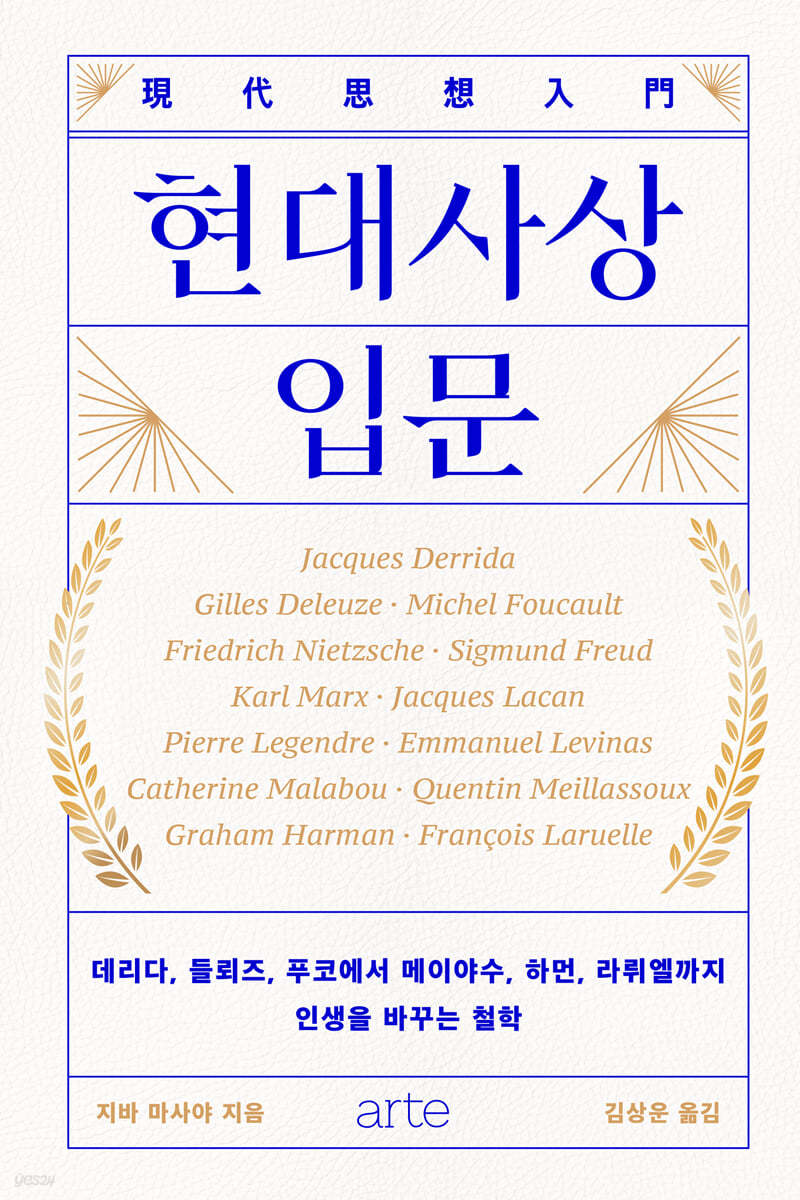
Introduction to Modern Thought
 |
Description
Book Introduction
The Grand Prize Winner of the 2023 New Book Awards Amazon Japan ranks #1 in philosophy A bestseller acclaimed by Japanese academics and loved by 150,000 readers. Here is a philosophy that will change your life! The ultimate introduction to philosophy, containing the essence of modern thought. Masaya Chiba, currently Japan's most notable young philosopher and considered to be changing the course of 21st-century Japanese philosophy, has published his new book, "Introduction to Modern Thought," as the 19th book in the Arte Philos series. In this new book, which immediately garnered rave reviews from Japanese academics and won the grand prize at the 2023 New Book Awards, the author guides readers into the world of “modern thought that changes lives.” Jacques Derrida, Gilles Deleuze, and Michel Foucault are cited as representatives of modern thought, and the essence of modern thought is explained with a focus on the three people who clearly demonstrated the 'philosophy of difference' in modern French thought. Among them, starting with Derrida, who methodologically revealed the philosophy of difference most sharply, the direction of introduction to modern thought is set, and by putting the keyword of “deconstruction” at the forefront, it strongly leads readers into a discussion on “why we must study modern thought now.” This book is both an introduction to modern thought and a source of reference for peering into the depths of modern thought. It introduces the 'origins' of modern thought (Nietzsche, Freud, Marx), the relationship between modern thought and 'psychoanalysis' (Lacan, Legendre), and post-poststructuralism (21st century modern thought trends, speculative realism), and is the only 'research book' that comprehensively forecasts even recent movements after modern thought. It is also evaluated as a groundbreaking 'popular book' that introduces modern thought in general in an easy-to-understand manner and suggests the possibility of applying modern thought to everyday life. Furthermore, this book explains how to 'read' modern thought and also provides 'how to create' modern thought (skills to become a new modern thinker), encouraging readers to move beyond this book and take the next step in their introduction to modern thought. |
- You can preview some of the book's contents.
Preview
index
Beginning: Why Modern Thought Now?
11 Why Study Modern Thought Now?
18 Introduction for Beginners
20 Poststructuralism and Postmodernism
23 Structuralism
25 Deconstruction of Binary Oppositions
28 The reality of life lies in the gray area.
Chapter 1 - Derrida: Deconstruction of Concepts
33 Derrida's unique style
37 Differences that break away from binary opposition
37 Modern thought is a philosophy of difference.
39 Paroles and Ecritures
40 Analysis of Binary Oppositions
44 The Importance of the Non-Essential
45 Is it close or far?
49 The Ethics of Deconstruction
52 Those who make foolish decisions are truly 'adults'.
Chapter 2 - Deleuze: Deconstruction of Being
57 Deleuze's Age
60 Differences precede identity
64 The tangled web of virtual relationships
66 All identity is temporary.
67 Process is always in progress
69 Not just a family story, but a variety of practices
72 Think twice
74 The necessity of 'not doing too much'
76 Nomad's Glass
79 Criticism of Management and Control Society
81 Balance between connection and disconnection
Chapter 3 - Foucault: Deconstruction of Society
85 Shaking the Binary Oppositional Schema of Power
90 Deconstruction of 'Normal' and 'Abnormal'
93 Three Faces of Power
94 Discipline Training: The Birth of a Mind That Practices Self-Monitoring
99 Biopolitics: Strengthening Material Management and Control
101 Letting Human Diversity Swim
103 Becoming a 'New Ancient'
107─Summary up to here
Chapter 4: The Origins of Modern Thought: Nietzsche, Freud, and Marx
113 Outside of order, as irrational
115 Nietzsche: The Matchmaking of Dionysus and Apollo
117 Towards the infrastructure
119 Freud: The Unconscious
122 The Practice and Function of Psychoanalysis
124 Unconsciousness and Chance
126 A rhythmic structure writhing under narrative meaning
128 Modern Finitude
134 Marx: Power and Economy
135 For everyone to regain their own power
Chapter 5: Psychoanalysis and Modern Thought: Lacan, Legendre
141 Psychoanalysis as a Presupposition of Modern Thought
142 Humans are animals of excess.
145 Instinct and Institution
148 Plasticity of desire
150 Lacan: Subjectification and Enjoyment
153 What is castration?
154 The Philosophy of Lack
155 The world of connected images and distinctions by language
159 Reality, the Unknowable "Real Exhaust"
161 Legendre: Dogmatic Anthropology
164 Finiteness by Ritual
166 Criticism of Negative Theology
Chapter 6: How to Create Modern Thought
173 To become a new modern thinker
175 Four Principles for Creating Modern Thought
177 Derrida: One-Ecriture
178 Deleuze: Difference in itself
179 Levinas: In a different way from what exists
183 Linking the Four Principles
184 Development into Post-Poststructuralism
185 Malabu: Plasticity of Form
187 Meiyasu: Absolute Reality and Its Changeability
Chapter 7 - Post-Poststructuralism
193 Modern Thought in the 21st Century
195 The emergence of speculative realism
196 Objectivity Outside of Meaning
198 Relativism of Reality Itself
200 The Thoroughness of Immanence: Harman, Laruelle
203 The Problem of Revenge and Modern Japanese Thought
206 New Finitude after Finitude
209 Wrestling with the Multiple Problem in a Finite Way
210 New Depths of Secularity
Appendix - Reading Modern Thought
217 All reading is incomplete
219 Four Points for Reading Modern Thought
219 Guess the structure of the original text as if it were English.
221 Don't be swayed by the rhetoric; extract only the necessary information.
222 Ignore proper nouns and fragments of knowledge
222 Be aware of the binary opposition of concepts
Case 1: “That’s cool.”
Case 2: Not delving into the rhetoric of "Gaptukti"
230 Case 3: Remove the decorations and leave only the frame.
233 Case 4: High degree of faultiness of the excuse
240 Conclusion: Order and Deviance
245 Translator's Note
11 Why Study Modern Thought Now?
18 Introduction for Beginners
20 Poststructuralism and Postmodernism
23 Structuralism
25 Deconstruction of Binary Oppositions
28 The reality of life lies in the gray area.
Chapter 1 - Derrida: Deconstruction of Concepts
33 Derrida's unique style
37 Differences that break away from binary opposition
37 Modern thought is a philosophy of difference.
39 Paroles and Ecritures
40 Analysis of Binary Oppositions
44 The Importance of the Non-Essential
45 Is it close or far?
49 The Ethics of Deconstruction
52 Those who make foolish decisions are truly 'adults'.
Chapter 2 - Deleuze: Deconstruction of Being
57 Deleuze's Age
60 Differences precede identity
64 The tangled web of virtual relationships
66 All identity is temporary.
67 Process is always in progress
69 Not just a family story, but a variety of practices
72 Think twice
74 The necessity of 'not doing too much'
76 Nomad's Glass
79 Criticism of Management and Control Society
81 Balance between connection and disconnection
Chapter 3 - Foucault: Deconstruction of Society
85 Shaking the Binary Oppositional Schema of Power
90 Deconstruction of 'Normal' and 'Abnormal'
93 Three Faces of Power
94 Discipline Training: The Birth of a Mind That Practices Self-Monitoring
99 Biopolitics: Strengthening Material Management and Control
101 Letting Human Diversity Swim
103 Becoming a 'New Ancient'
107─Summary up to here
Chapter 4: The Origins of Modern Thought: Nietzsche, Freud, and Marx
113 Outside of order, as irrational
115 Nietzsche: The Matchmaking of Dionysus and Apollo
117 Towards the infrastructure
119 Freud: The Unconscious
122 The Practice and Function of Psychoanalysis
124 Unconsciousness and Chance
126 A rhythmic structure writhing under narrative meaning
128 Modern Finitude
134 Marx: Power and Economy
135 For everyone to regain their own power
Chapter 5: Psychoanalysis and Modern Thought: Lacan, Legendre
141 Psychoanalysis as a Presupposition of Modern Thought
142 Humans are animals of excess.
145 Instinct and Institution
148 Plasticity of desire
150 Lacan: Subjectification and Enjoyment
153 What is castration?
154 The Philosophy of Lack
155 The world of connected images and distinctions by language
159 Reality, the Unknowable "Real Exhaust"
161 Legendre: Dogmatic Anthropology
164 Finiteness by Ritual
166 Criticism of Negative Theology
Chapter 6: How to Create Modern Thought
173 To become a new modern thinker
175 Four Principles for Creating Modern Thought
177 Derrida: One-Ecriture
178 Deleuze: Difference in itself
179 Levinas: In a different way from what exists
183 Linking the Four Principles
184 Development into Post-Poststructuralism
185 Malabu: Plasticity of Form
187 Meiyasu: Absolute Reality and Its Changeability
Chapter 7 - Post-Poststructuralism
193 Modern Thought in the 21st Century
195 The emergence of speculative realism
196 Objectivity Outside of Meaning
198 Relativism of Reality Itself
200 The Thoroughness of Immanence: Harman, Laruelle
203 The Problem of Revenge and Modern Japanese Thought
206 New Finitude after Finitude
209 Wrestling with the Multiple Problem in a Finite Way
210 New Depths of Secularity
Appendix - Reading Modern Thought
217 All reading is incomplete
219 Four Points for Reading Modern Thought
219 Guess the structure of the original text as if it were English.
221 Don't be swayed by the rhetoric; extract only the necessary information.
222 Ignore proper nouns and fragments of knowledge
222 Be aware of the binary opposition of concepts
Case 1: “That’s cool.”
Case 2: Not delving into the rhetoric of "Gaptukti"
230 Case 3: Remove the decorations and leave only the frame.
233 Case 4: High degree of faultiness of the excuse
240 Conclusion: Order and Deviance
245 Translator's Note
Detailed image
.jpg)
Into the book
If there is no more organic noise than the order artificially created by humans, thinking becomes rigid.
I have a plant on my desk.
Plants follow the order of nature while at the same time showing an externality that transcends the linguistic order of humans.
Plants cannot be managed as you wish.
They can spread out and multiply as they please.
Sometimes, when we turn our attention to plants as such 'others', it has the effect of opening a hole in our tendency to tie things up in words.
Raising animals is the same.
People find comfort in having their desires for control disrupted by others.
This is paradoxical.
The more you try to manage everything, the more anxious and nervous you become about even the slightest deviation.
Rather, anxiety is alleviated by not rejecting the disruption of order.
That's why people date and get married.
It may be because we need to live with disruptive factors rather than to create order.
--- p.17
There are also good introductory books on Derrida, and in Japan there is a very important study by Hiroki Azuma called Ontological, Postal: On Jacques Derrida.
This is a full-fledged study, but it's also an interesting book that can be read like a detective novel, so if you're interested in Derrida, I highly recommend reading it.
This book is the first step toward that goal, a 'introduction for beginners', a 'introduction for beginners'.
(……)
Even experts wouldn't have suddenly started reading it on their own. They would have heard some common sense, like "Derrida generally talks like this," while talking to a university professor or senior, and then started reading thinking, "Oh, that's how it is."
But the general reader doesn't have that opportunity.
So, in this book, I want to open up to the general public the foundations of modern thought, which have been considered "that's how it is" in the world of experts for the past 30 years or so.
--- pp.19~20
If given the power to punish, what they will ultimately punish will be dissenting opinions.
--- pp.20~21
To call it a deviation from order might sound like praising someone who is running wild, but I would like to change the image a little.
It means welcoming and accepting those who do not follow one's own order.
There are bound to be troubles, and it is impossible for people to avoid hurting each other.
There is a charm to life, even when we are more or less disorganized or passive.
--- p.28
We live with typists.
There are often instances where the batter has the initiative and is swayed by it.
It may seem like I hate it, but it also seems like there's a joy in it.
This positivity is important.
It doesn't necessarily have to be active.
However, passively doing what others tell you to do is difficult in its own way.
So, it is not possible to simply determine which is positive and which is negative when it comes to activity and passivity.
There is a gray area where activity and passivity push and entangle each other, and that is where the reality of life lies.
--- p.29
'Difference' is opposed to 'sameness', that is, 'identity'.
Identity is a definition that fixes things as “this is like this.”
The philosophy of difference, on the other hand, is a way of thinking that values discrepancies (gaps) or changes that do not necessarily fit into a definition.
(……) Now, it has been said that identity and difference form a binary opposition, and it is a major policy of modern thought to emphasize the difference in that binary opposition and to think that it is not a fixed state but discrepancy [gap] or change that is important.
--- p.37
Learning Derrida will enable you to challenge the binary oppositions that confront you in your daily life and work.
If you keep nagging like this, neither your life nor your work will be successful (laughs).
This focus on the negative side is what Derrida calls 'inversion' in the following quote.
“……In any classical philosophical confrontation, we are not dealing with a peaceful coexistence of confrontation, but with a violent hierarchy.
One of the two terms commands the other (value-wise, logically, etc.) and occupies a higher position.
“Deconstructing this opposition means, first of all, overturning the hierarchical order at a certain moment.”
--- p.42
“I am closest to myself” may be a philosophical expression, but that is identity.
It is about protecting one's inner self.
In contrast, Derrida's deconstruction opens the body to external forces, saying, "I will not change.
It is a call to tear off the armor of “this is how it is” and open our bodies to the world where others are.
--- p.49
Foolishness is precisely the consideration for others.
We must constantly revisit our decisions, constantly pondering how we will respond to other opportunities in the bubble of foolishness.
By looking at things deconstructively, we are not freed from biased decisions, but rather we are forced to make biased decisions all the time, and we must be aware that this is accompanied by a lingering attachment to otherness, like a potential virtual aura.
That is the ethics of Derridaian deconstruction, and I think there is kindness for those who have that kind of consciousness.
--- p.52
For example, we may think every day that it is difficult to start a task, that it is difficult to finish a task, but we may think that everything is in the middle, that there is no real beginning or real end.
Speaking this way, doesn't it seem like something that could be applied to self-development in business? In fact, I've been applying this mindset for some time now.
When I have to write a manuscript, it's hard to get my head down and work hard, so I start with something low-barrier, like opening my computer, checking Twitter, and then checking my emails along the way, and maybe replying to at least one message.
Then something starts to flow out, a process begins.
Sometimes, I take notes of things that come to mind, and I think it would be good to incorporate those notes into the manuscript.
In other words, I think that it is okay to abandon the normative consciousness that says, “I have started writing in earnest now,” and start writing without knowing why, and now that I recognize it as a formal work, it is okay.
And then, for some reason, I just write down things that come to mind, and then it becomes writing.
--- p.68
Deleuze and Guattari's ideas can be said to be about creating a semi-stable state on one's own by taking on various challenges in various relationships, rather than entrusting oneself to a model that is given to one semi-forcibly from outside.
This is a pretty strict requirement.
I think it's a difficult task.
What Deleuze and Guattari are thinking of is a kind of artistic or quasi-artistic practice.
We are trying to create various activities to secure our own stability and become our own independent dwelling place in our own lives.
It's good to draw, it's good to grow plants, it's good to immerse yourself in social activities.
By organizing such new activities in various ways, you can semi-stabilize your life, but there is no need to explore your true self. So, let's do many things, and if we do many things, things will work out somehow.
Deleuze and Guattari's ideas are so optimistic and they are ideas that push people to take action.
--- p.72
Don't you all realize how much the "let's give it a try" mentality and social policies are designed to protect the values of the mainstream, urging people to "go with the flow" (don't rebel against power, just follow it)? Foucault's work is what makes us think so bitterly.
In such a situation, the question of what freedom in life is is a very difficult one.
Would it be liberating to eliminate all the governance techniques I've just described? As long as diverse people live together, coordination of relationships is necessary and cannot be left unattended.
As soon as something starts to adjust there, it quickly transforms into discipline training or biopolitics.
Perhaps a utopia without any power relations would be impossible.
--- p.101
It was in the 19th century that a new form of knowledge emerged that focused on deviations from order.
Until then, the fundamental task of knowledge was how to properly capture the world in a rational order.
However, in the 19th century, there was a shift in direction, with the real problem being on the side of irrationality.
Its representatives are Nietzsche, Freud, and, in a way, Marx.
To put it very crudely, the 20th-century sense that “what is dangerous is creative” can be found in these three people if we go back in time.
--- p.114
Humans originally had the power to use it as they pleased, but due to a chance difference in position, they are being exploited.
To put it bluntly, everyone has the power to be anarchic and Dionysian, but they are restricted.
What this thinking reveals is the direction of the labor movement, where workers must regain their own power and become more autonomous.
That power sometimes becomes a force against exploitation, such as strikes or other resistance movements.
--- p.135
The development of post-poststructuralism in the West in the 21st century can be said to be unfolding in a form that further deconstructs the poststructuralist binary opposition of identity and difference.
However, I think that modern Japanese thought pioneered such a problem awareness and carried out its own independent development.
However, Westerners are not aware of the context and are pursuing another deconstruction separately from it.
--- pp.184~185
This book was written to encourage those who feel the energy of breaking free from the mold of "it has to be done this way" and therefore feel lonely in this world, to express that energy artistically.
I hope this book will help you make your life more vibrant.
I have a plant on my desk.
Plants follow the order of nature while at the same time showing an externality that transcends the linguistic order of humans.
Plants cannot be managed as you wish.
They can spread out and multiply as they please.
Sometimes, when we turn our attention to plants as such 'others', it has the effect of opening a hole in our tendency to tie things up in words.
Raising animals is the same.
People find comfort in having their desires for control disrupted by others.
This is paradoxical.
The more you try to manage everything, the more anxious and nervous you become about even the slightest deviation.
Rather, anxiety is alleviated by not rejecting the disruption of order.
That's why people date and get married.
It may be because we need to live with disruptive factors rather than to create order.
--- p.17
There are also good introductory books on Derrida, and in Japan there is a very important study by Hiroki Azuma called Ontological, Postal: On Jacques Derrida.
This is a full-fledged study, but it's also an interesting book that can be read like a detective novel, so if you're interested in Derrida, I highly recommend reading it.
This book is the first step toward that goal, a 'introduction for beginners', a 'introduction for beginners'.
(……)
Even experts wouldn't have suddenly started reading it on their own. They would have heard some common sense, like "Derrida generally talks like this," while talking to a university professor or senior, and then started reading thinking, "Oh, that's how it is."
But the general reader doesn't have that opportunity.
So, in this book, I want to open up to the general public the foundations of modern thought, which have been considered "that's how it is" in the world of experts for the past 30 years or so.
--- pp.19~20
If given the power to punish, what they will ultimately punish will be dissenting opinions.
--- pp.20~21
To call it a deviation from order might sound like praising someone who is running wild, but I would like to change the image a little.
It means welcoming and accepting those who do not follow one's own order.
There are bound to be troubles, and it is impossible for people to avoid hurting each other.
There is a charm to life, even when we are more or less disorganized or passive.
--- p.28
We live with typists.
There are often instances where the batter has the initiative and is swayed by it.
It may seem like I hate it, but it also seems like there's a joy in it.
This positivity is important.
It doesn't necessarily have to be active.
However, passively doing what others tell you to do is difficult in its own way.
So, it is not possible to simply determine which is positive and which is negative when it comes to activity and passivity.
There is a gray area where activity and passivity push and entangle each other, and that is where the reality of life lies.
--- p.29
'Difference' is opposed to 'sameness', that is, 'identity'.
Identity is a definition that fixes things as “this is like this.”
The philosophy of difference, on the other hand, is a way of thinking that values discrepancies (gaps) or changes that do not necessarily fit into a definition.
(……) Now, it has been said that identity and difference form a binary opposition, and it is a major policy of modern thought to emphasize the difference in that binary opposition and to think that it is not a fixed state but discrepancy [gap] or change that is important.
--- p.37
Learning Derrida will enable you to challenge the binary oppositions that confront you in your daily life and work.
If you keep nagging like this, neither your life nor your work will be successful (laughs).
This focus on the negative side is what Derrida calls 'inversion' in the following quote.
“……In any classical philosophical confrontation, we are not dealing with a peaceful coexistence of confrontation, but with a violent hierarchy.
One of the two terms commands the other (value-wise, logically, etc.) and occupies a higher position.
“Deconstructing this opposition means, first of all, overturning the hierarchical order at a certain moment.”
--- p.42
“I am closest to myself” may be a philosophical expression, but that is identity.
It is about protecting one's inner self.
In contrast, Derrida's deconstruction opens the body to external forces, saying, "I will not change.
It is a call to tear off the armor of “this is how it is” and open our bodies to the world where others are.
--- p.49
Foolishness is precisely the consideration for others.
We must constantly revisit our decisions, constantly pondering how we will respond to other opportunities in the bubble of foolishness.
By looking at things deconstructively, we are not freed from biased decisions, but rather we are forced to make biased decisions all the time, and we must be aware that this is accompanied by a lingering attachment to otherness, like a potential virtual aura.
That is the ethics of Derridaian deconstruction, and I think there is kindness for those who have that kind of consciousness.
--- p.52
For example, we may think every day that it is difficult to start a task, that it is difficult to finish a task, but we may think that everything is in the middle, that there is no real beginning or real end.
Speaking this way, doesn't it seem like something that could be applied to self-development in business? In fact, I've been applying this mindset for some time now.
When I have to write a manuscript, it's hard to get my head down and work hard, so I start with something low-barrier, like opening my computer, checking Twitter, and then checking my emails along the way, and maybe replying to at least one message.
Then something starts to flow out, a process begins.
Sometimes, I take notes of things that come to mind, and I think it would be good to incorporate those notes into the manuscript.
In other words, I think that it is okay to abandon the normative consciousness that says, “I have started writing in earnest now,” and start writing without knowing why, and now that I recognize it as a formal work, it is okay.
And then, for some reason, I just write down things that come to mind, and then it becomes writing.
--- p.68
Deleuze and Guattari's ideas can be said to be about creating a semi-stable state on one's own by taking on various challenges in various relationships, rather than entrusting oneself to a model that is given to one semi-forcibly from outside.
This is a pretty strict requirement.
I think it's a difficult task.
What Deleuze and Guattari are thinking of is a kind of artistic or quasi-artistic practice.
We are trying to create various activities to secure our own stability and become our own independent dwelling place in our own lives.
It's good to draw, it's good to grow plants, it's good to immerse yourself in social activities.
By organizing such new activities in various ways, you can semi-stabilize your life, but there is no need to explore your true self. So, let's do many things, and if we do many things, things will work out somehow.
Deleuze and Guattari's ideas are so optimistic and they are ideas that push people to take action.
--- p.72
Don't you all realize how much the "let's give it a try" mentality and social policies are designed to protect the values of the mainstream, urging people to "go with the flow" (don't rebel against power, just follow it)? Foucault's work is what makes us think so bitterly.
In such a situation, the question of what freedom in life is is a very difficult one.
Would it be liberating to eliminate all the governance techniques I've just described? As long as diverse people live together, coordination of relationships is necessary and cannot be left unattended.
As soon as something starts to adjust there, it quickly transforms into discipline training or biopolitics.
Perhaps a utopia without any power relations would be impossible.
--- p.101
It was in the 19th century that a new form of knowledge emerged that focused on deviations from order.
Until then, the fundamental task of knowledge was how to properly capture the world in a rational order.
However, in the 19th century, there was a shift in direction, with the real problem being on the side of irrationality.
Its representatives are Nietzsche, Freud, and, in a way, Marx.
To put it very crudely, the 20th-century sense that “what is dangerous is creative” can be found in these three people if we go back in time.
--- p.114
Humans originally had the power to use it as they pleased, but due to a chance difference in position, they are being exploited.
To put it bluntly, everyone has the power to be anarchic and Dionysian, but they are restricted.
What this thinking reveals is the direction of the labor movement, where workers must regain their own power and become more autonomous.
That power sometimes becomes a force against exploitation, such as strikes or other resistance movements.
--- p.135
The development of post-poststructuralism in the West in the 21st century can be said to be unfolding in a form that further deconstructs the poststructuralist binary opposition of identity and difference.
However, I think that modern Japanese thought pioneered such a problem awareness and carried out its own independent development.
However, Westerners are not aware of the context and are pursuing another deconstruction separately from it.
--- pp.184~185
This book was written to encourage those who feel the energy of breaking free from the mold of "it has to be done this way" and therefore feel lonely in this world, to express that energy artistically.
I hope this book will help you make your life more vibrant.
--- p.243
Publisher's Review
Why should we study modern thought now?
In an age of flat debate, how to grasp reality with "high resolution"
“A direction that values deviation, does not divide things into binary oppositions, and carries out finite actions one by one.
I think that acquiring modern thought is a step towards becoming a true 'adult'.
This would be equivalent to the task of re-understanding the world more precisely.”
― Atsushi Maejima (Editor-in-Chief of Bunshun Shinsho), in his review of the Grand Prize winner of the 'Shinsho Grand Prize 2023'
"Introduction to Modern Thought" begins by examining the "reasons" for studying modern thought, emphasizing that one can think about complex things without simplifying them.
Some might argue that "simplifying the complex is intelligence," but the author suggests the following values:
"There is a reality in the world that is destroyed by simplification, and we must respect that reality." Is it truly right to simplify ourselves, our lives, and society, eliminate noise, and pursue only the pure and the right? Modern thought provides tools to grasp the difficulties of reality, which defy order, with a "higher resolution" than before, and this discussion moves toward the ethical aspect of preserving the "diversity of life."
The idea of creating order is necessary in its own right.
However, thoughts that deviate from the order are also essential. Within the balance of this dual system, the author proposes that we learn to think in a way that "deconstructs" binary oppositions.
Deconstructing binary oppositions is not about "allowing any claim to be OK." Rather, it involves an ethics that confronts others and respects their "otherness," and an ethics that thoroughly questions the established order and fundamentally considers the possibility of "togetherness."
Masaya Chiba emphasizes that learning this modern ideology is the way to live a vibrant and artistic life.
A groundbreaking 'research book' that sheds new light on order and deviation.
A popular book that presents the practicality of modern thought.
Through this book, the author does not simply explain an 'introduction' to modern thought.
Starting with the question, “Why should we study modern thought?”, it discusses the “usefulness” of modern thought as a tool for capturing high-resolution, realistic perspectives on social issues, including life’s concerns.
It suggests that facing the reality of life in the "gray zone" where the activity (subjective life) and passivity (the initiative of others) push and entangle with each other is the way to confront the essence of the problem.
It also talks about the deconstruction of binary oppositions and the attitude of fluidly changing one's views through the paradox of 'deviation' (the rhythmic movement between fixed identity and difference).
In this respect, this book is a groundbreaking "research" that sheds new light on modern thought through the two-part drama of "order and deviance," a theme that Masaya Chiba has long struggled with, and a "popular practical book" that suggests ways to broaden the framework of the way of thinking that limits oneself.
Here, the author specifically encourages those who inevitably feel lonely in a world where life and society are ordered (simplified, purified), to feel the energy of breaking free from the mold and express it artistically.
In other words, a ‘deviation’ occurs from the ‘stubborn law’, and the author divides the discussion on “how to defend this deviation” into three axes: Derrida, Deleuze, and Foucault.
Modern thought is the 'philosophy of difference'
Guided by Derrida, Deleuze, and Foucault
Deconstruction of concepts, existence, and society
“If you hold this book in one hand and read Derrida and Deleuze, the content is surprisingly easy to understand.”
― Saori Fukuoka (Junkudo Bookstore/Tatsukawa Takashimaya), in her review of the 2023 New Book Award winners
Modern thought regards order as something temporarily fixed (this term is a concept of Masaya Chiba captured in Derrida's worldview) and examines a state in which various elements coexist while constantly undergoing deviations.
This relationship between 'order and deviation' provides the author with the idea of deconstruction, breaking free from the framework of "it must be done this way," and thus develops into the question of "what does it mean to live artistically?"
This book mentions Jacques Derrida, Gilles Deleuze, and Michel Foucault as representatives who clearly demonstrated the 'philosophy of difference' in French modern thought, and discusses the three axes of 'deconstruction' centered on these three people.
Derrida, with his 'deconstruction of concepts', Deleuze with his 'deconstruction of being', and Foucault with his 'deconstruction of society', discuss the direction of modern thought that emphasizes difference and values 'deviation' and 'change' in the binary opposition between identity and difference that has long been discussed in the history of philosophy.
Furthermore, by further thoroughgoing modern ideological thinking, it 'deconstructs the binary opposition between identity and difference' and emphasizes that the rhythmic movement between static identity and difference is the true charm of modern thought.
That is, the ethics of respecting otherness and the true art of living lie in the ambiguity of allowing one's various ways of life to 'swim' without being divided into either side of a binary opposition.
“First, let’s get familiar with Derrida’s argument called the deconstruction of binary oppositions.
By extending it to all beings, we move beyond the distinctions of “a cup is a cup, a cat is a cat, that person is that person, I am I,” and move toward a Deleuzian vision in which things unfold dynamically and transversally.
But at the same time, there is also unrelatedness everywhere, and not everything is connected and confusing, making it a 'mess'.
The image of a world with bubbles like soda.
This is the deconstruction of existence.
From here, the discussion moves to the specifics of social problems.
First, we recognize the power relations that exclude us by saying, “That is not a proper way to live, it is a deviation.”
And we recognize that it is not simply a system that is being imposed, but a system that people have unconsciously created out of their own anxieties.
“The critique of the management and control society that seeks to escape from it is the deconstruction of society.” - From the text (page 110)
A perspective that examines the core of modern thought
From the 'origins' of modern thought to 'speculative realism'
“It strips away the armor that modern thought has been wearing and conveys only the core [essence] that remains.
“Writing something like this requires considerable determination and skill.”
― Masatoshi Tanaka (Editor-in-Chief of Juko Shinsho), in his review of the 2023 Shinsho Grand Prize winners
This book presents a perspective that looks into the core of modern thought.
It introduces the 'origins' of modern thought (Nietzsche, Freud, Marx), the relationship between modern thought and 'psychoanalysis' (Lacan, Legendre), and post-poststructuralism (21st century modern thought trends, speculative realism), and discusses various ideas that can help us understand modern thought in a comprehensive or in-depth manner, rather than superficially.
· Origins of modern thought: Nietzsche, Freud, Marx
How to see things beyond binary oppositions
Masaya Chiba explains the origins of modern thought by arguing that “human thought has always embraced darkness.”
It is a novel point of view that avoiding accidents in thinking, that is, deconstructing things by breaking away from binary oppositions, is the discovery of 'infrastructure' in a broad sense.
The author introduces Nietzsche and Freud, who discussed the 'infrastructure (repressed unconscious)' in a broad sense, and Marx, who discussed the 'infrastructure (original term)' referring to the economic formation of society, and states that they are the 'origins' of modern thought.
Nietzsche, who was the first in the history of philosophy to clearly present a gesture that celebrates irrationality; Freud's concept of the unconscious, that the chain of unconscious words and images within me is the other (other) within me; and Marx, who discussed how to recover one's original power (anarchic and Dionysian power) that remained at the level of the unconscious and how to impose an independent order different from the exploitative structure. These three people pursued the following.
“Rather than aiming for a flat, average society, let’s aim for a society that somehow gets around, even if it’s bumpy.”
In other words, to shake off the obsession with competing with everyone on the same standards and achieving success, we must go back further in our own formation, open up the possibility of 'chance', and undertake the practical task of regaining our own power.
The author argues that this is the way to “raise consciousness,” that is, the disorganized direction of modern thought.
Psychoanalysis and Modern Thought: Lacan, Legendre
Will you live an infinite tragedy or a finite comedy?
The author points out that although modern thought criticizes psychoanalysis, it was originally inspired by psychoanalysis.
Psychoanalysis defines human beings in a nutshell as follows:
“Humans are animals of excess.” The author explains that humans of excess (who deviate from order) do not live according to instinct, but rather always possess the “plasticity of desire,” which means that everything they do is “perverse.”
This is precisely what deconstructs the binary opposition between normal and abnormal, order and deviation, and emphasizes that what we think of as 'normal' is also 'a deviation from normality' and 'an arrival at normality.'
Lacan, through the concept of 'object a', shows how limited and finite (subjectified) humans are, and Legendre, through 'dogmatic anthropology', sets up a situation in which order is assembled through castration.
This is interpreted by the author as follows:
The argument is that humans are beings of excess and have an impulse toward deviance through “ordering through routines,” but there is also a duality in that they find comfort and ‘pleasure’ by ritualistically limiting themselves.
That dilemma is the very 'human drama', and rather than living a 'singular' tragic life of repeatedly seeking the apparent object a, achieving it, and then being disillusioned, we conclude that we should make life more 'plural' and acknowledge each person's autonomous joy.
· How to 'read' modern thought, how to 'make' modern thought
In the philosophy of the other (Levinas)
Post-poststructuralism (Malabou, Meillassoux, Harman, Laruelle)
"In addition to sketching a rough outline of modern thought, it also reveals techniques for reading it, giving readers the courage to move on to the next step without stopping."
― Takujitsu Yoneoka [Nippan (Japan's largest publishing wholesaler)], in his review of the 'New Book Award 2023' grand prize winner
The translator of this book, Kim Sang-woon (a researcher of modern political philosophy), praised the book, saying, “Derrida’s arguments, which are notoriously difficult, are presented in a very easy and concise manner, but rather than remaining at a rudimentary level, he shows the rather difficult arguments in an easy-to-understand way.”
The strength of this book lies in its ability to connect rather complex discussions to real-life contexts, a point at the heart of which are the appendix's "Reading Modern Thought" and Chapter 6, "How to Create Modern Thought."
The author mentions that the detailed rhetoric of 'modern thought texts' is a barrier to entry, and proposes a methodology that thoroughly lowers this obstacle.
“① Be aware of the binary opposition of concepts.
② Read while ignoring proper nouns and fragments of knowledge, and look them up later if necessary.
③ Do not be swayed by ‘high-class’ rhetoric.
④ Since the original is in French, it is similar to English in that it is a Western language, but it is somewhat conscious of the grammatical structure.” Based on these four concepts, the method of ‘reading multiple times as if applying thin layers’ is explained in detail.
The most helpful part is the part where he takes difficult sentences from Derrida, Deleuze, etc. and explains them in case studies on how to read them.
Masaya Chiba goes beyond 'how to read' modern thought and also teaches us 'how to create' new modern thought.
By analyzing the method of differentiating existing ideas from new ideas (differentiation), we diagram the ‘method of creating modern French ideas.’
These are “① the principle of otherness, ② the principle of transcendence, ③ the principle of extremism, and ④ the principle of anti-common sense.”
The author mentions Levinas's 'philosophy of the other' as a representative example.
Levinas criticizes the dangers inherent in Heidegger's existing 'ontology' and analyzes that he developed his thoughts with the bold keyword of 'in a way different from what exists', taking the position that "the history of philosophy has excluded the problem of the other, so we must think of a philosophy that turns toward the other."
Describing recent philosophical developments in the 21st century, called 'post-poststructuralism', he mentions Catherine Malabou, Quentin Meillassoux, Graham Harman, and François Laruelle.
This paper explains how the philosophies presented by these four people fit into the diagram analyzed by Masaya Chiba.
Through the author's detailed explanations, readers can learn the 'principles for asking questions from a modern ideological perspective' and, more boldly, approach the 'principles for becoming a new modern thinker.'
As Masaya Chiba boasted, “there is no other introductory book that explains modern thought in this way.”
Easy to understand, applicable to life,
Above all, 『Introduction to Modern Thought』 is comforting and encouraging.
“I am pleased that you have commented that I explain modern thought not through superficial knowledge but through a physical and concrete way of chewing and connecting it to society.
“I refrain from formalistic explanations as much as possible, and write about what I have personally learned over the past 25 years of studying modern thought.”
― Masaya Chiba, from his acceptance speech at the 2023 New Book Awards
What the author ultimately shows the reader through modern thought is that the world is “not a mass of puzzles.”
The world is a “field of scattered problems” formed by the unconscious and chance, and there is a “different depth” other than the bottomless “swamp-like depth,” which is “a new depth of secularity.”
It is the depth of what is inherent here and now.
He emphasizes that by understanding modern thought and looking at the world, we can “acquire a different kind of mystery than when viewed from the perspective of modern finiteness,” and that it will guide us to a world that is “not a mystery that continues to drag us into darkness, but a mystery of a bright and clear sky, a mystery because it is clear.”
This book has the advantage of being written in easy-to-understand sentences, allowing one to quickly grasp the overall philosophy underlying modern thought, starting with an overview of modern thought.
Of course, it is up to the reader to reach the depths of modern thought, apply them to real life, and discover the “mystery of the clear and bright sky.”
In an age of flat debate, how to grasp reality with "high resolution"
“A direction that values deviation, does not divide things into binary oppositions, and carries out finite actions one by one.
I think that acquiring modern thought is a step towards becoming a true 'adult'.
This would be equivalent to the task of re-understanding the world more precisely.”
― Atsushi Maejima (Editor-in-Chief of Bunshun Shinsho), in his review of the Grand Prize winner of the 'Shinsho Grand Prize 2023'
"Introduction to Modern Thought" begins by examining the "reasons" for studying modern thought, emphasizing that one can think about complex things without simplifying them.
Some might argue that "simplifying the complex is intelligence," but the author suggests the following values:
"There is a reality in the world that is destroyed by simplification, and we must respect that reality." Is it truly right to simplify ourselves, our lives, and society, eliminate noise, and pursue only the pure and the right? Modern thought provides tools to grasp the difficulties of reality, which defy order, with a "higher resolution" than before, and this discussion moves toward the ethical aspect of preserving the "diversity of life."
The idea of creating order is necessary in its own right.
However, thoughts that deviate from the order are also essential. Within the balance of this dual system, the author proposes that we learn to think in a way that "deconstructs" binary oppositions.
Deconstructing binary oppositions is not about "allowing any claim to be OK." Rather, it involves an ethics that confronts others and respects their "otherness," and an ethics that thoroughly questions the established order and fundamentally considers the possibility of "togetherness."
Masaya Chiba emphasizes that learning this modern ideology is the way to live a vibrant and artistic life.
A groundbreaking 'research book' that sheds new light on order and deviation.
A popular book that presents the practicality of modern thought.
Through this book, the author does not simply explain an 'introduction' to modern thought.
Starting with the question, “Why should we study modern thought?”, it discusses the “usefulness” of modern thought as a tool for capturing high-resolution, realistic perspectives on social issues, including life’s concerns.
It suggests that facing the reality of life in the "gray zone" where the activity (subjective life) and passivity (the initiative of others) push and entangle with each other is the way to confront the essence of the problem.
It also talks about the deconstruction of binary oppositions and the attitude of fluidly changing one's views through the paradox of 'deviation' (the rhythmic movement between fixed identity and difference).
In this respect, this book is a groundbreaking "research" that sheds new light on modern thought through the two-part drama of "order and deviance," a theme that Masaya Chiba has long struggled with, and a "popular practical book" that suggests ways to broaden the framework of the way of thinking that limits oneself.
Here, the author specifically encourages those who inevitably feel lonely in a world where life and society are ordered (simplified, purified), to feel the energy of breaking free from the mold and express it artistically.
In other words, a ‘deviation’ occurs from the ‘stubborn law’, and the author divides the discussion on “how to defend this deviation” into three axes: Derrida, Deleuze, and Foucault.
Modern thought is the 'philosophy of difference'
Guided by Derrida, Deleuze, and Foucault
Deconstruction of concepts, existence, and society
“If you hold this book in one hand and read Derrida and Deleuze, the content is surprisingly easy to understand.”
― Saori Fukuoka (Junkudo Bookstore/Tatsukawa Takashimaya), in her review of the 2023 New Book Award winners
Modern thought regards order as something temporarily fixed (this term is a concept of Masaya Chiba captured in Derrida's worldview) and examines a state in which various elements coexist while constantly undergoing deviations.
This relationship between 'order and deviation' provides the author with the idea of deconstruction, breaking free from the framework of "it must be done this way," and thus develops into the question of "what does it mean to live artistically?"
This book mentions Jacques Derrida, Gilles Deleuze, and Michel Foucault as representatives who clearly demonstrated the 'philosophy of difference' in French modern thought, and discusses the three axes of 'deconstruction' centered on these three people.
Derrida, with his 'deconstruction of concepts', Deleuze with his 'deconstruction of being', and Foucault with his 'deconstruction of society', discuss the direction of modern thought that emphasizes difference and values 'deviation' and 'change' in the binary opposition between identity and difference that has long been discussed in the history of philosophy.
Furthermore, by further thoroughgoing modern ideological thinking, it 'deconstructs the binary opposition between identity and difference' and emphasizes that the rhythmic movement between static identity and difference is the true charm of modern thought.
That is, the ethics of respecting otherness and the true art of living lie in the ambiguity of allowing one's various ways of life to 'swim' without being divided into either side of a binary opposition.
“First, let’s get familiar with Derrida’s argument called the deconstruction of binary oppositions.
By extending it to all beings, we move beyond the distinctions of “a cup is a cup, a cat is a cat, that person is that person, I am I,” and move toward a Deleuzian vision in which things unfold dynamically and transversally.
But at the same time, there is also unrelatedness everywhere, and not everything is connected and confusing, making it a 'mess'.
The image of a world with bubbles like soda.
This is the deconstruction of existence.
From here, the discussion moves to the specifics of social problems.
First, we recognize the power relations that exclude us by saying, “That is not a proper way to live, it is a deviation.”
And we recognize that it is not simply a system that is being imposed, but a system that people have unconsciously created out of their own anxieties.
“The critique of the management and control society that seeks to escape from it is the deconstruction of society.” - From the text (page 110)
A perspective that examines the core of modern thought
From the 'origins' of modern thought to 'speculative realism'
“It strips away the armor that modern thought has been wearing and conveys only the core [essence] that remains.
“Writing something like this requires considerable determination and skill.”
― Masatoshi Tanaka (Editor-in-Chief of Juko Shinsho), in his review of the 2023 Shinsho Grand Prize winners
This book presents a perspective that looks into the core of modern thought.
It introduces the 'origins' of modern thought (Nietzsche, Freud, Marx), the relationship between modern thought and 'psychoanalysis' (Lacan, Legendre), and post-poststructuralism (21st century modern thought trends, speculative realism), and discusses various ideas that can help us understand modern thought in a comprehensive or in-depth manner, rather than superficially.
· Origins of modern thought: Nietzsche, Freud, Marx
How to see things beyond binary oppositions
Masaya Chiba explains the origins of modern thought by arguing that “human thought has always embraced darkness.”
It is a novel point of view that avoiding accidents in thinking, that is, deconstructing things by breaking away from binary oppositions, is the discovery of 'infrastructure' in a broad sense.
The author introduces Nietzsche and Freud, who discussed the 'infrastructure (repressed unconscious)' in a broad sense, and Marx, who discussed the 'infrastructure (original term)' referring to the economic formation of society, and states that they are the 'origins' of modern thought.
Nietzsche, who was the first in the history of philosophy to clearly present a gesture that celebrates irrationality; Freud's concept of the unconscious, that the chain of unconscious words and images within me is the other (other) within me; and Marx, who discussed how to recover one's original power (anarchic and Dionysian power) that remained at the level of the unconscious and how to impose an independent order different from the exploitative structure. These three people pursued the following.
“Rather than aiming for a flat, average society, let’s aim for a society that somehow gets around, even if it’s bumpy.”
In other words, to shake off the obsession with competing with everyone on the same standards and achieving success, we must go back further in our own formation, open up the possibility of 'chance', and undertake the practical task of regaining our own power.
The author argues that this is the way to “raise consciousness,” that is, the disorganized direction of modern thought.
Psychoanalysis and Modern Thought: Lacan, Legendre
Will you live an infinite tragedy or a finite comedy?
The author points out that although modern thought criticizes psychoanalysis, it was originally inspired by psychoanalysis.
Psychoanalysis defines human beings in a nutshell as follows:
“Humans are animals of excess.” The author explains that humans of excess (who deviate from order) do not live according to instinct, but rather always possess the “plasticity of desire,” which means that everything they do is “perverse.”
This is precisely what deconstructs the binary opposition between normal and abnormal, order and deviation, and emphasizes that what we think of as 'normal' is also 'a deviation from normality' and 'an arrival at normality.'
Lacan, through the concept of 'object a', shows how limited and finite (subjectified) humans are, and Legendre, through 'dogmatic anthropology', sets up a situation in which order is assembled through castration.
This is interpreted by the author as follows:
The argument is that humans are beings of excess and have an impulse toward deviance through “ordering through routines,” but there is also a duality in that they find comfort and ‘pleasure’ by ritualistically limiting themselves.
That dilemma is the very 'human drama', and rather than living a 'singular' tragic life of repeatedly seeking the apparent object a, achieving it, and then being disillusioned, we conclude that we should make life more 'plural' and acknowledge each person's autonomous joy.
· How to 'read' modern thought, how to 'make' modern thought
In the philosophy of the other (Levinas)
Post-poststructuralism (Malabou, Meillassoux, Harman, Laruelle)
"In addition to sketching a rough outline of modern thought, it also reveals techniques for reading it, giving readers the courage to move on to the next step without stopping."
― Takujitsu Yoneoka [Nippan (Japan's largest publishing wholesaler)], in his review of the 'New Book Award 2023' grand prize winner
The translator of this book, Kim Sang-woon (a researcher of modern political philosophy), praised the book, saying, “Derrida’s arguments, which are notoriously difficult, are presented in a very easy and concise manner, but rather than remaining at a rudimentary level, he shows the rather difficult arguments in an easy-to-understand way.”
The strength of this book lies in its ability to connect rather complex discussions to real-life contexts, a point at the heart of which are the appendix's "Reading Modern Thought" and Chapter 6, "How to Create Modern Thought."
The author mentions that the detailed rhetoric of 'modern thought texts' is a barrier to entry, and proposes a methodology that thoroughly lowers this obstacle.
“① Be aware of the binary opposition of concepts.
② Read while ignoring proper nouns and fragments of knowledge, and look them up later if necessary.
③ Do not be swayed by ‘high-class’ rhetoric.
④ Since the original is in French, it is similar to English in that it is a Western language, but it is somewhat conscious of the grammatical structure.” Based on these four concepts, the method of ‘reading multiple times as if applying thin layers’ is explained in detail.
The most helpful part is the part where he takes difficult sentences from Derrida, Deleuze, etc. and explains them in case studies on how to read them.
Masaya Chiba goes beyond 'how to read' modern thought and also teaches us 'how to create' new modern thought.
By analyzing the method of differentiating existing ideas from new ideas (differentiation), we diagram the ‘method of creating modern French ideas.’
These are “① the principle of otherness, ② the principle of transcendence, ③ the principle of extremism, and ④ the principle of anti-common sense.”
The author mentions Levinas's 'philosophy of the other' as a representative example.
Levinas criticizes the dangers inherent in Heidegger's existing 'ontology' and analyzes that he developed his thoughts with the bold keyword of 'in a way different from what exists', taking the position that "the history of philosophy has excluded the problem of the other, so we must think of a philosophy that turns toward the other."
Describing recent philosophical developments in the 21st century, called 'post-poststructuralism', he mentions Catherine Malabou, Quentin Meillassoux, Graham Harman, and François Laruelle.
This paper explains how the philosophies presented by these four people fit into the diagram analyzed by Masaya Chiba.
Through the author's detailed explanations, readers can learn the 'principles for asking questions from a modern ideological perspective' and, more boldly, approach the 'principles for becoming a new modern thinker.'
As Masaya Chiba boasted, “there is no other introductory book that explains modern thought in this way.”
Easy to understand, applicable to life,
Above all, 『Introduction to Modern Thought』 is comforting and encouraging.
“I am pleased that you have commented that I explain modern thought not through superficial knowledge but through a physical and concrete way of chewing and connecting it to society.
“I refrain from formalistic explanations as much as possible, and write about what I have personally learned over the past 25 years of studying modern thought.”
― Masaya Chiba, from his acceptance speech at the 2023 New Book Awards
What the author ultimately shows the reader through modern thought is that the world is “not a mass of puzzles.”
The world is a “field of scattered problems” formed by the unconscious and chance, and there is a “different depth” other than the bottomless “swamp-like depth,” which is “a new depth of secularity.”
It is the depth of what is inherent here and now.
He emphasizes that by understanding modern thought and looking at the world, we can “acquire a different kind of mystery than when viewed from the perspective of modern finiteness,” and that it will guide us to a world that is “not a mystery that continues to drag us into darkness, but a mystery of a bright and clear sky, a mystery because it is clear.”
This book has the advantage of being written in easy-to-understand sentences, allowing one to quickly grasp the overall philosophy underlying modern thought, starting with an overview of modern thought.
Of course, it is up to the reader to reach the depths of modern thought, apply them to real life, and discover the “mystery of the clear and bright sky.”
GOODS SPECIFICS
- Date of issue: May 30, 2023
- Format: Hardcover book binding method guide
- Page count, weight, size: 264 pages | 414g | 132*204*20mm
- ISBN13: 9788950927400
- ISBN10: 8950927403
You may also like
카테고리
korean


korean

![GQ KOREA Mark (Monthly): December [2025]](http://librairie.coreenne.fr/cdn/shop/files/8ef265dbbfbf186523ed75ba7319009d.jpg?v=1765340328&width=3840)


