

Other people's hearts
 |
Description
Book Introduction
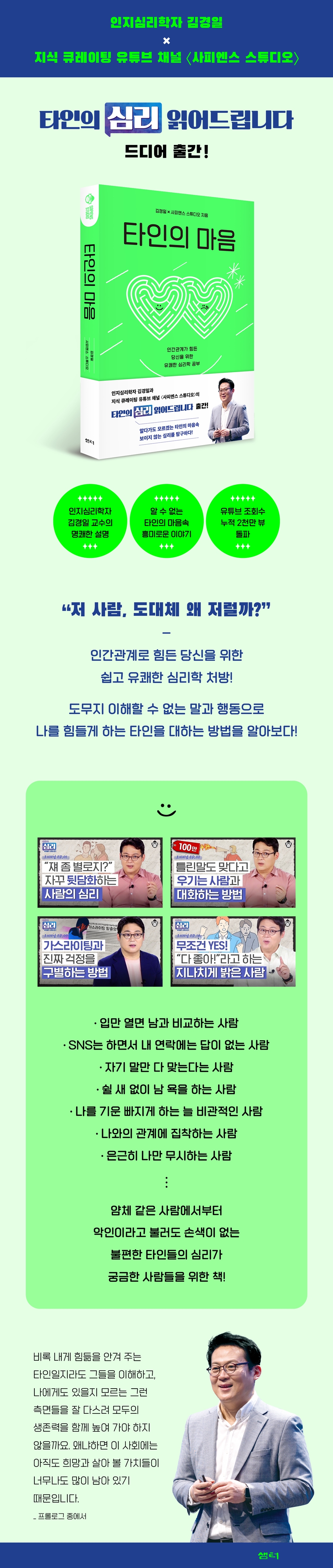
With cognitive psychologist Kim Kyung-il Knowledge curating YouTube channel Sapiens Studio 'Reading Other People's Psychology' published! A person who compares himself to others whenever he opens his mouth. A person who uses SNS but doesn't respond to my messages. A person who believes that only what he says is right People who constantly badmouth others, etc… You make me suffer with words and actions that I cannot understand. Exploring the psychology of uncomfortable others! 'Reading Other People's Psychology', produced by CJ ENM's digital knowledge platform Sapiens Studio, created by cognitive psychologist Kim Kyung-il, who conveys human psychology in the easiest and clearest way, and the production team of tvN's 'Reading Books' and 'Unexpected Adults', has been published as a book. 『The Minds of Others』 is a book based on the popular content 'Reading the Minds of Others' (20 million cumulative views, as of October 2022) of the knowledge curating YouTube channel Sapiens Studio with 1.65 million subscribers. It adds depth to the book by including content that was not covered in the video. It also examines the words and actions of others that cause us difficulties through various examples, and easily explains what their inner psychology is and how we can understand them and maintain healthy relationships. The book features various types of other people that we have encountered in person or seen through the media in our relationships, from people we commonly see around us who badmouth others at every opportunity, compare ourselves to others, and secretly ignore us, to gaslighters, sociopaths, and malicious commenters that we would never want to meet in our lives. But these people who seem completely different have something in common. It is because of these that some people get hurt and feel pain. The author says that having a hard time because of these people means that when I show this kind of behavior, someone else also has a hard time because of me, and that in order to avoid becoming that kind of person, we need to think about others and look after them. If you understand the other person's feelings behind their words and actions and what their inner thoughts are, you will be able to create a happier relationship without getting hurt. If you're currently feeling stressed by someone's words and actions, or anxious and struggling with a relationship that just won't work out, I hope this book will help you understand the psychology of others and provide you with the wisdom and communication skills to maintain your relationships. |
- You can preview some of the book's contents.
Preview
index
prolog
Chapter 1: Why Does That Person Put Me to the Test?
The psychology of a person who manipulates someone
What's always hidden behind a bright face
If there is someone next to you who compares himself to others whenever he opens his mouth
Why do you use social media but not respond to my messages?
The psychology of a pessimistic person who discourages me
How to spot a flirtatious womanizer
Attitude toward habitual latecomers
Chapter 2: About the hearts of others, which are difficult to understand
Why You Should Avoid Narcissists
Are you a sociopath if you don't have empathy?
Anonymous killers, something only malicious commenters have
What a helpless person needs
The psychology of a person who believes that only what he says is true
How to deal with people who badmouth others at every opportunity
Advice for Praise-Hungry People
Chapter 3: Practice Understanding Others' Minds
There's a reason people are obsessed.
Why We're Obsessed with MBTI
If you are afraid of meeting strangers
How to Avoid Falling Prey to an Annoying Boss
The psychology of someone who misses 'latte'
The dangers of playing with each other
How to Deal with Someone Who Subtly Ignores You
Appendix | Q&A
Chapter 1: Why Does That Person Put Me to the Test?
The psychology of a person who manipulates someone
What's always hidden behind a bright face
If there is someone next to you who compares himself to others whenever he opens his mouth
Why do you use social media but not respond to my messages?
The psychology of a pessimistic person who discourages me
How to spot a flirtatious womanizer
Attitude toward habitual latecomers
Chapter 2: About the hearts of others, which are difficult to understand
Why You Should Avoid Narcissists
Are you a sociopath if you don't have empathy?
Anonymous killers, something only malicious commenters have
What a helpless person needs
The psychology of a person who believes that only what he says is true
How to deal with people who badmouth others at every opportunity
Advice for Praise-Hungry People
Chapter 3: Practice Understanding Others' Minds
There's a reason people are obsessed.
Why We're Obsessed with MBTI
If you are afraid of meeting strangers
How to Avoid Falling Prey to an Annoying Boss
The psychology of someone who misses 'latte'
The dangers of playing with each other
How to Deal with Someone Who Subtly Ignores You
Appendix | Q&A
Detailed image
Into the book
Gaslighting instills in the other person a habit called "mental helplessness."
Our brain is much more affected by the frequency of the shock than by the magnitude.
Experiencing great helplessness once is easy to overcome.
But when small "mental incapacity" is repeatedly built up through gaslighting, the brain makes irreversible decisions.
'Let's not move anymore,' he said.
So, if you feel like you're not doing anything right when you meet someone, or if you feel like you're constantly losing energy, you should be suspicious.
No matter how kind and nice the other person is, if this situation keeps happening, you may be being gaslighted without even realizing it.
---From "The Psychology of a Manipulator"
Pessimistic people also have characteristics in the words they use.
As explained earlier, the reason people easily fall into pessimism is because they often experience misfortune and their pessimistic predictions often turn out to be correct.
In such cases, there is something that pessimistic people say most often.
“See, I knew it.” This is a phrase we often use, but for pessimistic people, it becomes a kind of psychological seed money that leads to pessimism.
By saying this to yourself, you are making a pessimistic prediction about the future, and this naturally leads to negative consequences.
That is, it is the worst kind of self-hypnosis.
Another characteristic of the speech of pessimistic people is that they use a remarkably small number of verbs.
Verbs express the action of 'doing something', and pessimistic people have no desire to do anything in the future.
---From "The Psychology of Pessimistic People Who Drain Me"
People with high empathy are good at understanding even the emotions of narcissists.
That's why you can be easily swayed by them.
Even if you are not a narcissist yourself, there is a high probability that you will be influenced by the thoughts of the narcissists around you and develop wrong values.
While avoiding them is best if possible, what should you do if you're involved with a narcissist in a work relationship? In such cases, you need to meet someone of a completely different type, someone with opposing or even completely opposite perspectives.
It's a kind of psychological water ride by hearing opposing opinions.
Only then can we avoid being influenced by that person's wrong thoughts or desires.
This is also why it is important to meet diverse people.
Meeting a variety of people with different values can help reduce the chances of being harmed by people with a certain disposition.
---From "Why You Should Avoid Narcissists"
It's natural to feel "scared" or "uneasy" before meeting a stranger.
And then you could react like that and end it there.
But it is your decision to say, 'Let's overcome it and meet up sometime.'
That doesn't mean I want to say, 'You absolutely have to be courageous' or 'It's weird if you don't have courage.'
But if you muster up the courage just once, you can decide whether or not to be brave when a similar situation arises again, and whether or not you need to be brave.
After that, it may vary depending on the individual's personality.
However, I hope that you will have the courage to make your own decision so that it doesn't end with just a 'reaction' from the beginning.
---From "If you're afraid of meeting strangers"
Professor Lee Ki-beom of the University of Calgary in Canada has determined the truth about human relationships through research.
The point is not whether the person is similar to me or different, but whether he is truthful or not.
In psychology, being 'authentic' means 'having sincerity', which means not hiding your true intentions from the other person.
That's the only way to become truly good friends.
Actually, the rest may be different from mine.
So if I want to become close to someone, I have to be honest about my intentions.
And as we get older, we need the social grace to be able to talk about this honestly and without being rude.
I believe these are two of the best social skills and some of the most important skills we can develop as we age.
Our brain is much more affected by the frequency of the shock than by the magnitude.
Experiencing great helplessness once is easy to overcome.
But when small "mental incapacity" is repeatedly built up through gaslighting, the brain makes irreversible decisions.
'Let's not move anymore,' he said.
So, if you feel like you're not doing anything right when you meet someone, or if you feel like you're constantly losing energy, you should be suspicious.
No matter how kind and nice the other person is, if this situation keeps happening, you may be being gaslighted without even realizing it.
---From "The Psychology of a Manipulator"
Pessimistic people also have characteristics in the words they use.
As explained earlier, the reason people easily fall into pessimism is because they often experience misfortune and their pessimistic predictions often turn out to be correct.
In such cases, there is something that pessimistic people say most often.
“See, I knew it.” This is a phrase we often use, but for pessimistic people, it becomes a kind of psychological seed money that leads to pessimism.
By saying this to yourself, you are making a pessimistic prediction about the future, and this naturally leads to negative consequences.
That is, it is the worst kind of self-hypnosis.
Another characteristic of the speech of pessimistic people is that they use a remarkably small number of verbs.
Verbs express the action of 'doing something', and pessimistic people have no desire to do anything in the future.
---From "The Psychology of Pessimistic People Who Drain Me"
People with high empathy are good at understanding even the emotions of narcissists.
That's why you can be easily swayed by them.
Even if you are not a narcissist yourself, there is a high probability that you will be influenced by the thoughts of the narcissists around you and develop wrong values.
While avoiding them is best if possible, what should you do if you're involved with a narcissist in a work relationship? In such cases, you need to meet someone of a completely different type, someone with opposing or even completely opposite perspectives.
It's a kind of psychological water ride by hearing opposing opinions.
Only then can we avoid being influenced by that person's wrong thoughts or desires.
This is also why it is important to meet diverse people.
Meeting a variety of people with different values can help reduce the chances of being harmed by people with a certain disposition.
---From "Why You Should Avoid Narcissists"
It's natural to feel "scared" or "uneasy" before meeting a stranger.
And then you could react like that and end it there.
But it is your decision to say, 'Let's overcome it and meet up sometime.'
That doesn't mean I want to say, 'You absolutely have to be courageous' or 'It's weird if you don't have courage.'
But if you muster up the courage just once, you can decide whether or not to be brave when a similar situation arises again, and whether or not you need to be brave.
After that, it may vary depending on the individual's personality.
However, I hope that you will have the courage to make your own decision so that it doesn't end with just a 'reaction' from the beginning.
---From "If you're afraid of meeting strangers"
Professor Lee Ki-beom of the University of Calgary in Canada has determined the truth about human relationships through research.
The point is not whether the person is similar to me or different, but whether he is truthful or not.
In psychology, being 'authentic' means 'having sincerity', which means not hiding your true intentions from the other person.
That's the only way to become truly good friends.
Actually, the rest may be different from mine.
So if I want to become close to someone, I have to be honest about my intentions.
And as we get older, we need the social grace to be able to talk about this honestly and without being rude.
I believe these are two of the best social skills and some of the most important skills we can develop as we age.
---From "The Dangers of Playing Among Yourself"
Publisher's Review
In order to increase everyone's 'survival ability'
I need time to understand others and reflect on myself.
Humans are social beings who live in relationships with others from the moment they are born.
However, it is by no means easy to maintain good relationships without any conflict with others in a given environment, such as family, friends, and colleagues.
If you look around, there are more people who don't agree with you than people who do, and there are many people who are so incomprehensible that you wonder, "Why is that person like that?"
And when we meet these people, most of us feel the difficulties of the relationship.
Of course, at first, you may resent and hate that person and try to improve the relationship, but that is not a fundamental solution.
So how can we maintain happy relationships without being hurt by others?
The author says that I must first look back at myself.
Simply put, before judging others, think about whether you are that kind of person to someone else.
For example, if there is someone next to you who is always cheerful and says that everything is 'okay', rather than dismissing it by saying, "That person always pretends to be okay," you should reflect on whether you have been taking their feelings too lightly.
I may have reacted negatively when that person showed signs of difficulty or hardship or expressed sadness.
The next thing to do is to practice understanding other people's minds.
Everyone is different.
But because we are different, we are also human.
If we don't acknowledge differences and don't even try to understand the other person's feelings, the difficult times for both the other person and ourselves will continue, and our ability to survive will inevitably decline.
That is precisely why we must not neglect our efforts to understand others.
“Even if they are others who cause me difficulties, shouldn’t I understand them and manage the aspects of myself that I might have, so that we can all increase our survival skills together?
Because there is still so much hope and value left in this society.” _From the prologue
The various emotions felt when facing big and small problems in relationships are not difficulties experienced only by certain people.
So maybe we can solve it together.
In psychology, 'authenticity' is defined as revealing one's true self, making oneself and the other person feel comfortable.
Understanding others is not easy.
However, if you treat the other person with 'sincerity' and try to understand them, you will definitely be able to develop a good relationship with them, whether they are someone you just met or someone you have known for a long time.
I need time to understand others and reflect on myself.
Humans are social beings who live in relationships with others from the moment they are born.
However, it is by no means easy to maintain good relationships without any conflict with others in a given environment, such as family, friends, and colleagues.
If you look around, there are more people who don't agree with you than people who do, and there are many people who are so incomprehensible that you wonder, "Why is that person like that?"
And when we meet these people, most of us feel the difficulties of the relationship.
Of course, at first, you may resent and hate that person and try to improve the relationship, but that is not a fundamental solution.
So how can we maintain happy relationships without being hurt by others?
The author says that I must first look back at myself.
Simply put, before judging others, think about whether you are that kind of person to someone else.
For example, if there is someone next to you who is always cheerful and says that everything is 'okay', rather than dismissing it by saying, "That person always pretends to be okay," you should reflect on whether you have been taking their feelings too lightly.
I may have reacted negatively when that person showed signs of difficulty or hardship or expressed sadness.
The next thing to do is to practice understanding other people's minds.
Everyone is different.
But because we are different, we are also human.
If we don't acknowledge differences and don't even try to understand the other person's feelings, the difficult times for both the other person and ourselves will continue, and our ability to survive will inevitably decline.
That is precisely why we must not neglect our efforts to understand others.
“Even if they are others who cause me difficulties, shouldn’t I understand them and manage the aspects of myself that I might have, so that we can all increase our survival skills together?
Because there is still so much hope and value left in this society.” _From the prologue
The various emotions felt when facing big and small problems in relationships are not difficulties experienced only by certain people.
So maybe we can solve it together.
In psychology, 'authenticity' is defined as revealing one's true self, making oneself and the other person feel comfortable.
Understanding others is not easy.
However, if you treat the other person with 'sincerity' and try to understand them, you will definitely be able to develop a good relationship with them, whether they are someone you just met or someone you have known for a long time.
GOODS SPECIFICS
- Publication date: November 4, 2022
- Page count, weight, size: 304 pages | 434g | 135*200*18mm
- ISBN13: 9788946422278
- ISBN10: 8946422270
You may also like
카테고리
korean


korean

![GQ KOREA Mark (Monthly): December [2025]](http://librairie.coreenne.fr/cdn/shop/files/8ef265dbbfbf186523ed75ba7319009d.jpg?v=1765340328&width=3840)


