

About the dog whining
 |
Description
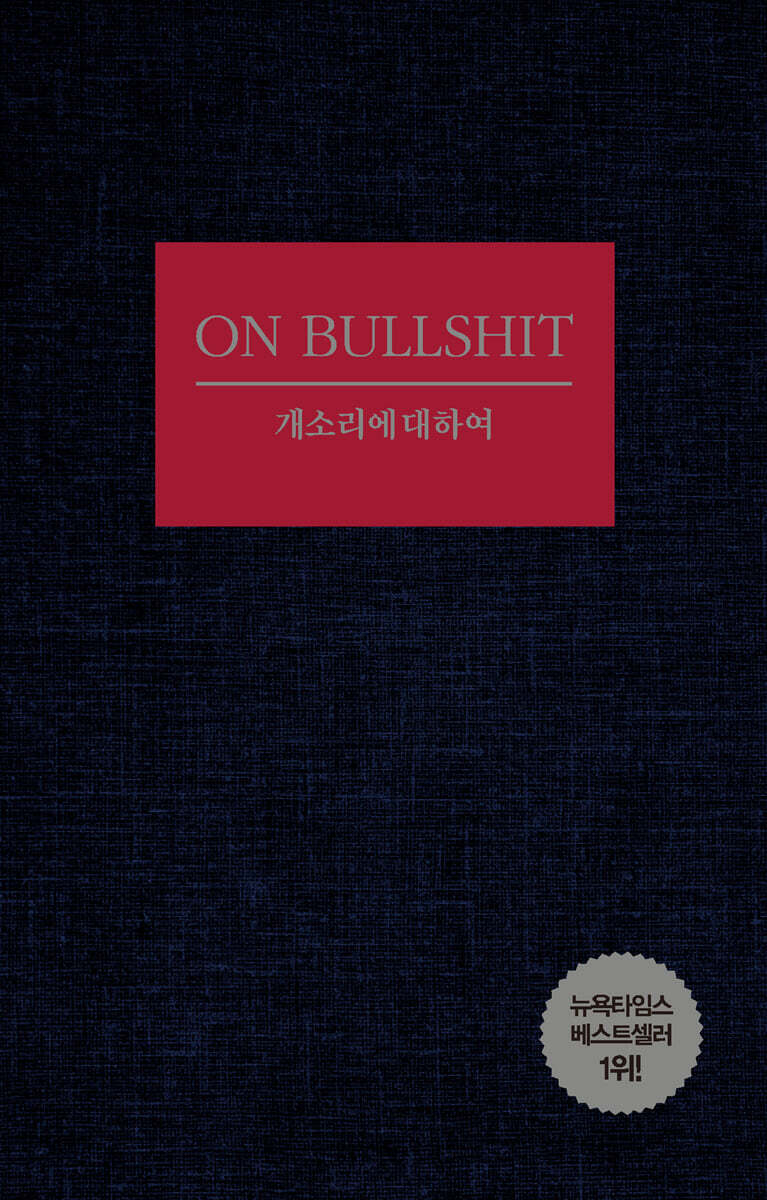
Book Introduction
“One of the most striking features of our culture is the prevalence of bullshit.” - Harry G.
Frankfort
Why is bullshit more dangerous than lies?
A unique philosophy book that reached number one on the New York Times bestseller list.
A modern philosophical classic that predicted the era of fake news and post-truth.
Bulshwit is a slang word translated as dog sound in Korean. In English-speaking countries, it is a taboo word used as a swear word like the 'f-word', but in fact, 'dog sound' has a rather complex semantic structure hidden within it.
Harry Frankfort, a professor of philosophy at Princeton University, uses the meticulous conceptual analysis characteristic of analytic philosophy to dissect the hidden meaning behind the word "bullshit" we use in our daily lives and its social impact.
The author uses language analysis techniques to persuasively explain the nature of 'dog talk,' the difference between dog talk and lies, and why we should be wary of dog talk.
It was also widely cited as a book that interpreted the phenomenon surrounding Trump's vulgar language, which was constantly controversial during the US presidential election.
This book is a revised edition of 『On Dog Talk』, with some translations refined and additional translator's notes added.
Frankfort
Why is bullshit more dangerous than lies?
A unique philosophy book that reached number one on the New York Times bestseller list.
A modern philosophical classic that predicted the era of fake news and post-truth.
Bulshwit is a slang word translated as dog sound in Korean. In English-speaking countries, it is a taboo word used as a swear word like the 'f-word', but in fact, 'dog sound' has a rather complex semantic structure hidden within it.
Harry Frankfort, a professor of philosophy at Princeton University, uses the meticulous conceptual analysis characteristic of analytic philosophy to dissect the hidden meaning behind the word "bullshit" we use in our daily lives and its social impact.
The author uses language analysis techniques to persuasively explain the nature of 'dog talk,' the difference between dog talk and lies, and why we should be wary of dog talk.
It was also widely cited as a book that interpreted the phenomenon surrounding Trump's vulgar language, which was constantly controversial during the US presidential election.
This book is a revised edition of 『On Dog Talk』, with some translations refined and additional translator's notes added.
index
About the dog whining 7
Translator's Note 70
Release | Kang Sung-hoon (Professor of Philosophy, Seoul National University) 83
Translator's Note 70
Release | Kang Sung-hoon (Professor of Philosophy, Seoul National University) 83
Into the book
One of the most striking features of our culture is the prevalence of bullshit.
Everyone knows this.
We all go around talking nonsense to some degree.
Yet, we tend to take this situation for granted.
Most people are quite confident that they have enough sense to notice bullshit and not be fooled by it.
…as a result, we don’t have a clear understanding of what bullshit is, why there is so much of it, or what function it serves.
--- p.7
It seems reasonable to understand that a carelessly made, crude object is in some way similar to a dog's whistle.
But in what way is this so? Is it similar in that bullshit itself is always produced carelessly or haphazardly, that it's never carefully crafted, that the meticulous care Longfellow alluded to in its production is not observed? Are bullshit speakers inherently thoughtless idiots? Are their products always sloppy and crude? The word "shit" certainly suggests otherwise.
Stools are not designed or handcrafted.
It's just a fight or a lie.
It may or may not look somewhat tangled, but in no way is it elaborate.
--- p.26
What made Wittgenstein uncomfortable was clearly not that Pascal made a mistake in expressing his feelings.
It's not even because she made a careless mistake.
…the point is rather that Pascal described a state of affairs without faithfully adhering to the constraints required to accurately describe reality.
…her statement is not based on the belief that it is true, nor is it based on the belief that it is not true, as would be the case if it were a lie.
It is precisely this lack of concern for the truth, this indifference to what the real state of affairs is.
This is what I see as the essence of bullshit.
--- p.36-38
There are situations where you can't avoid yelling.
This is the case when you are asked to speak even though you do not know what you are talking about.
Thus, whenever the opportunity or obligation to speak on a topic exceeds the speaker's knowledge of the facts related to that topic, the production of nonsense becomes active.
This discrepancy is especially common in the lives of public figures.
…similar cases arise from the widespread belief that it is the responsibility of citizens in a democracy to have an opinion on everything, or at least on everything that concerns national affairs.
As conscientious moral agents, some believe it is their responsibility to evaluate events and situations occurring in all areas of the world.
For them, the phenomenon of personal opinions not being meaningfully connected to an understanding of reality is, needless to say, even more serious.
Everyone knows this.
We all go around talking nonsense to some degree.
Yet, we tend to take this situation for granted.
Most people are quite confident that they have enough sense to notice bullshit and not be fooled by it.
…as a result, we don’t have a clear understanding of what bullshit is, why there is so much of it, or what function it serves.
--- p.7
It seems reasonable to understand that a carelessly made, crude object is in some way similar to a dog's whistle.
But in what way is this so? Is it similar in that bullshit itself is always produced carelessly or haphazardly, that it's never carefully crafted, that the meticulous care Longfellow alluded to in its production is not observed? Are bullshit speakers inherently thoughtless idiots? Are their products always sloppy and crude? The word "shit" certainly suggests otherwise.
Stools are not designed or handcrafted.
It's just a fight or a lie.
It may or may not look somewhat tangled, but in no way is it elaborate.
--- p.26
What made Wittgenstein uncomfortable was clearly not that Pascal made a mistake in expressing his feelings.
It's not even because she made a careless mistake.
…the point is rather that Pascal described a state of affairs without faithfully adhering to the constraints required to accurately describe reality.
…her statement is not based on the belief that it is true, nor is it based on the belief that it is not true, as would be the case if it were a lie.
It is precisely this lack of concern for the truth, this indifference to what the real state of affairs is.
This is what I see as the essence of bullshit.
--- p.36-38
There are situations where you can't avoid yelling.
This is the case when you are asked to speak even though you do not know what you are talking about.
Thus, whenever the opportunity or obligation to speak on a topic exceeds the speaker's knowledge of the facts related to that topic, the production of nonsense becomes active.
This discrepancy is especially common in the lives of public figures.
…similar cases arise from the widespread belief that it is the responsibility of citizens in a democracy to have an opinion on everything, or at least on everything that concerns national affairs.
As conscientious moral agents, some believe it is their responsibility to evaluate events and situations occurring in all areas of the world.
For them, the phenomenon of personal opinions not being meaningfully connected to an understanding of reality is, needless to say, even more serious.
--- p.66-67
Publisher's Review
What the hell is a moral philosopher from Princeton University talking about?
"On Bullshit"? Is this really a topic worthy of discussion by a renowned philosopher? The book's perplexing title, paradoxically, serves as a reminder of what philosophy can and should do.
At first glance, the title suggests that this is a light essay, but this book is by no means an easy read.
The author, a philosophy professor at Princeton University, provides insight into the widespread "bullshit phenomenon" of our time, highlighting the dangers of how bullshit fuels indifference to truth and fosters an irresponsible language culture.
Today, bullshit is actively produced in all fields, including politics, society, economy, and culture, but the author's concern is that many people are easily deceived by bullshit due to the lack of a framework for understanding it.
The author wrote this book to raise awareness about the prevalence of dog whining by presenting a 'theory' about dog whining.
Although it is a short book, it contains much deeper and more profound content than its thickness suggests.
A feast of words indifferent to the truth: Analyzing the meaning of "bullshit."
It's not quite enough to call bullshit a blatant lie, but it's also too absurd to be taken at face value. However, unlike simple nonsense, it's a statement that hides the speaker's subtle intentions.
The hidden intention here is not to deliberately tell the truth incorrectly.
Rather, the intention is to say that for a specific purpose, regardless of whether the statement is true or false, regardless of its truth value.
The author cites as an example a Fourth of July orator who pontificates on “our great and blessed country, where our founding fathers, under the protection of God, created a new era for mankind.”
Here the speaker is not lying.
In fact, the speaker had no intention of deceiving the audience about American history.
His concern is to make people see themselves as patriots who are proud of their country's origins.
In this way, the purpose of nonsense is not to deceive the listener about what is being said, but to make the listener form a certain impression about the speaker.
In other words, they have a plan to expand their own influence regardless of what the truth is.
A liar is interested in the truth, but a whiner ignores it.
What's the difference between bullshit and lies? Is bullshit not as bad or dangerous as lying? The author argues that's absolutely not the case.
In fact, bullshit is more dangerous than lies.
A liar must at least respect the truth in that he must know what the truth is, since he must deliberately misrepresent the truth.
Also, a lie requires a great deal of effort and careful construction to be successful, whereas a bully doesn't have to do that.
Because dog whining is essentially indifferent to the truth.
Even if what you said turns out to be false, nonsense is just nonsense, and you don't have to take responsibility for your mistakes like you would for lying.
So, it doesn't matter if you say it without thinking.
Bullshit is certainly more dangerous than lies in that it undermines the authority of truth and encourages thoughtless and irresponsible speech and actions.
Gossip is not a truth or a lie spoken after careful consideration, but a cunning and destructive linguistic act that denies the very logic of truth and falsehood and distorts the truth.
Trump didn't lie.
People are tolerant of dog whining.
I think that we should distinguish between right and wrong in lying, but if we try to argue about nonsense, we are likely to be criticized as if we are attacking someone who is trying to kill us when we said it to make them laugh.
But it becomes a serious problem when nonsense that can achieve its purpose without being criticized becomes a discourse with great social influence.
Just look at Trump, who has incited anti-immigrant sentiment and racism in American society with nonsense like, "Thousands of Muslim Americans cheered while watching the 9/11 terrorist attacks" and "81% of the white people killed were killed by black people."
It didn't matter whether "thousands" actually cheered or whether the "81%" figure was accurate.
What does it matter whether that statement is true or false?
If only people could be angry at illegal immigrants and black people.
And his strategy was quite successful.
Despite everything being exposed as a lie, Trump's approval ratings have not fallen.
What mattered to his supporters was not the truth of the words, but building a wall on the Mexican border.
The power of the bullshit could not be dispelled by exposing the falsity of the statement by presenting the facts.
This is because dog-speaking is a language game performed in a logical space where truth and falsehood are not issues at all.
You can't beat the shameless, blathering rabble of the Trump type by simply confronting them with facts, as if they were liars.
A unique philosophy book that stands out for its meticulous conceptual analysis and clear writing style.
This book is an essay that philosophically analyzes the concept of everyday language, "dog talk."
Language criticism, which delves into the meaning of words we use thoughtlessly in everyday life, leads to social criticism.
The political frame theory of the past Lee Myung-bak administration's "saving" of the Four Major Rivers Project and the "confinement" of the female National Intelligence Service employee, as well as the marketing positioning theory contained in the corporate advertisement of a certain conglomerate that restructured even new employees while campaigning that "people are the future," can all be considered nonsense.
From the language of politics and the media, which takes no responsibility even if it turns out to be false, to social media, which can be called a sea of nonsense, in a society where almost everything is turned into nonsense, in order to avoid being fooled by the nonsense of the nonsense-mongers, it is necessary to have a conceptual framework for what constitutes nonsense.
This book is not a quick read, but as you follow it line by line, the meticulousness and thoroughness characteristic of analytic philosophy add to the enjoyment of reading.
This is a rare masterpiece that shows how analytic philosophy, often considered a philosophy divorced from reality, can be integrated with reality.
“Through Wittgenstein, Ezra Pound, St. Augustine, and the spy novelist Eric Ambler, Frankfort asks questions that everyone knows but no one knows.
What is the dog whining about, after all? Frankfort points out that it's neither one nor the other.
Liars and honest people are different, but at least they share a concern for the truth.
But the whiners are indifferent to the truth."
-The New York Times
"I'll just say one thing.
Read it.
It's beautiful, clear, ironic and profound.
It is a model that shows what philosophy can and should do.
It's a small but highly provocative masterpiece.
This is not real bullshit."
-The Sunday Times (London)
"This is a book the world needs.
…Our culture today is rife with bullshit.
We are confident that most of us can distinguish and refute this.
But Frankfort shows the reader just how insidious and destructive bullshit can be.
…a book that will change your life."
-Playboy
Harry Frankfort, a professor of philosophy at Princeton University, has written a scholarly and formal essay on the double-crossing pretense of embellishing the truth and intentionally obfuscating the story.
…I’m sure he enjoyed writing this.
The witty prose is fun."
-The Boston Globe
"On Bullshit"? Is this really a topic worthy of discussion by a renowned philosopher? The book's perplexing title, paradoxically, serves as a reminder of what philosophy can and should do.
At first glance, the title suggests that this is a light essay, but this book is by no means an easy read.
The author, a philosophy professor at Princeton University, provides insight into the widespread "bullshit phenomenon" of our time, highlighting the dangers of how bullshit fuels indifference to truth and fosters an irresponsible language culture.
Today, bullshit is actively produced in all fields, including politics, society, economy, and culture, but the author's concern is that many people are easily deceived by bullshit due to the lack of a framework for understanding it.
The author wrote this book to raise awareness about the prevalence of dog whining by presenting a 'theory' about dog whining.
Although it is a short book, it contains much deeper and more profound content than its thickness suggests.
A feast of words indifferent to the truth: Analyzing the meaning of "bullshit."
It's not quite enough to call bullshit a blatant lie, but it's also too absurd to be taken at face value. However, unlike simple nonsense, it's a statement that hides the speaker's subtle intentions.
The hidden intention here is not to deliberately tell the truth incorrectly.
Rather, the intention is to say that for a specific purpose, regardless of whether the statement is true or false, regardless of its truth value.
The author cites as an example a Fourth of July orator who pontificates on “our great and blessed country, where our founding fathers, under the protection of God, created a new era for mankind.”
Here the speaker is not lying.
In fact, the speaker had no intention of deceiving the audience about American history.
His concern is to make people see themselves as patriots who are proud of their country's origins.
In this way, the purpose of nonsense is not to deceive the listener about what is being said, but to make the listener form a certain impression about the speaker.
In other words, they have a plan to expand their own influence regardless of what the truth is.
A liar is interested in the truth, but a whiner ignores it.
What's the difference between bullshit and lies? Is bullshit not as bad or dangerous as lying? The author argues that's absolutely not the case.
In fact, bullshit is more dangerous than lies.
A liar must at least respect the truth in that he must know what the truth is, since he must deliberately misrepresent the truth.
Also, a lie requires a great deal of effort and careful construction to be successful, whereas a bully doesn't have to do that.
Because dog whining is essentially indifferent to the truth.
Even if what you said turns out to be false, nonsense is just nonsense, and you don't have to take responsibility for your mistakes like you would for lying.
So, it doesn't matter if you say it without thinking.
Bullshit is certainly more dangerous than lies in that it undermines the authority of truth and encourages thoughtless and irresponsible speech and actions.
Gossip is not a truth or a lie spoken after careful consideration, but a cunning and destructive linguistic act that denies the very logic of truth and falsehood and distorts the truth.
Trump didn't lie.
People are tolerant of dog whining.
I think that we should distinguish between right and wrong in lying, but if we try to argue about nonsense, we are likely to be criticized as if we are attacking someone who is trying to kill us when we said it to make them laugh.
But it becomes a serious problem when nonsense that can achieve its purpose without being criticized becomes a discourse with great social influence.
Just look at Trump, who has incited anti-immigrant sentiment and racism in American society with nonsense like, "Thousands of Muslim Americans cheered while watching the 9/11 terrorist attacks" and "81% of the white people killed were killed by black people."
It didn't matter whether "thousands" actually cheered or whether the "81%" figure was accurate.
What does it matter whether that statement is true or false?
If only people could be angry at illegal immigrants and black people.
And his strategy was quite successful.
Despite everything being exposed as a lie, Trump's approval ratings have not fallen.
What mattered to his supporters was not the truth of the words, but building a wall on the Mexican border.
The power of the bullshit could not be dispelled by exposing the falsity of the statement by presenting the facts.
This is because dog-speaking is a language game performed in a logical space where truth and falsehood are not issues at all.
You can't beat the shameless, blathering rabble of the Trump type by simply confronting them with facts, as if they were liars.
A unique philosophy book that stands out for its meticulous conceptual analysis and clear writing style.
This book is an essay that philosophically analyzes the concept of everyday language, "dog talk."
Language criticism, which delves into the meaning of words we use thoughtlessly in everyday life, leads to social criticism.
The political frame theory of the past Lee Myung-bak administration's "saving" of the Four Major Rivers Project and the "confinement" of the female National Intelligence Service employee, as well as the marketing positioning theory contained in the corporate advertisement of a certain conglomerate that restructured even new employees while campaigning that "people are the future," can all be considered nonsense.
From the language of politics and the media, which takes no responsibility even if it turns out to be false, to social media, which can be called a sea of nonsense, in a society where almost everything is turned into nonsense, in order to avoid being fooled by the nonsense of the nonsense-mongers, it is necessary to have a conceptual framework for what constitutes nonsense.
This book is not a quick read, but as you follow it line by line, the meticulousness and thoroughness characteristic of analytic philosophy add to the enjoyment of reading.
This is a rare masterpiece that shows how analytic philosophy, often considered a philosophy divorced from reality, can be integrated with reality.
“Through Wittgenstein, Ezra Pound, St. Augustine, and the spy novelist Eric Ambler, Frankfort asks questions that everyone knows but no one knows.
What is the dog whining about, after all? Frankfort points out that it's neither one nor the other.
Liars and honest people are different, but at least they share a concern for the truth.
But the whiners are indifferent to the truth."
-The New York Times
"I'll just say one thing.
Read it.
It's beautiful, clear, ironic and profound.
It is a model that shows what philosophy can and should do.
It's a small but highly provocative masterpiece.
This is not real bullshit."
-The Sunday Times (London)
"This is a book the world needs.
…Our culture today is rife with bullshit.
We are confident that most of us can distinguish and refute this.
But Frankfort shows the reader just how insidious and destructive bullshit can be.
…a book that will change your life."
-Playboy
Harry Frankfort, a professor of philosophy at Princeton University, has written a scholarly and formal essay on the double-crossing pretense of embellishing the truth and intentionally obfuscating the story.
…I’m sure he enjoyed writing this.
The witty prose is fun."
-The Boston Globe
GOODS SPECIFICS
- Date of issue: August 16, 2023
- Page count, weight, size: 96 pages | 100*152*15mm
- ISBN13: 9791157833023
- ISBN10: 1157833020
You may also like
카테고리
korean


korean

![GQ KOREA Mark (Monthly): December [2025]](http://librairie.coreenne.fr/cdn/shop/files/8ef265dbbfbf186523ed75ba7319009d.jpg?v=1765340328&width=3840)


