

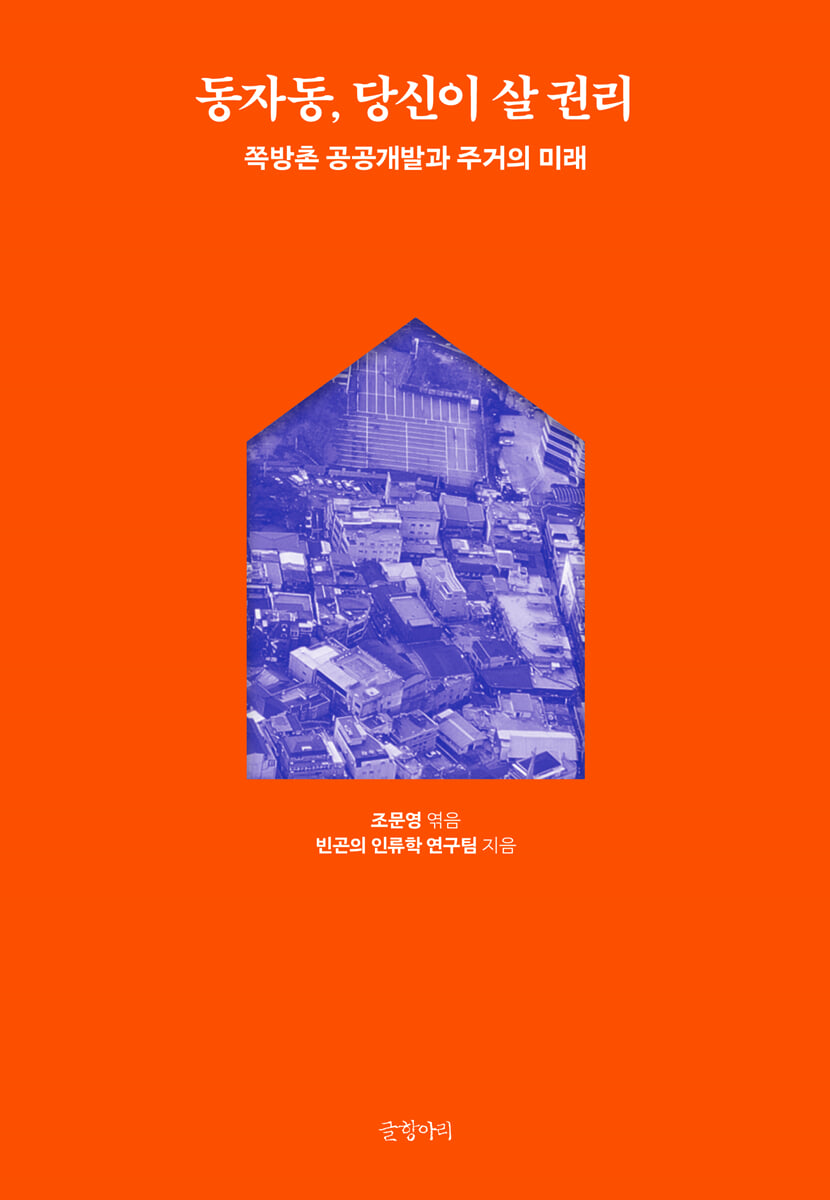
Dongja-dong, your right to live
 |
Description
Book Introduction
Dongja-dong, Seoul's largest shantytown and a "core site" where the contradictions of poverty, housing, and development are condensed.
The clock there stopped in February 2021.
Despite the announcement of a groundbreaking public development project that will rewrite the history of housing for the urban poor,
A home without a future and a public future indefinitely
Demanding Housing Rights Against the "Slow Violence" Against the Poor
As if mocking the long-standing efforts to secure the right to public rental housing, the public discourse surrounding housing in Korean society has always focused solely on real estate, making it an axiom that the owner's property rights take precedence over the human right to housing.
Meanwhile, the government announced a plan for the Dongja-dong project.
(…) Residents who were repeatedly evicted from their homes and ended up settling in shantytowns, as well as anti-poverty groups that have long fought to realize the right to housing, “had hope.”
But the government's announcement is now being called a death knell among the residents of the shantytown.
Dongja-dong is no longer defined solely as an administrative district in Yongsan-gu, Seoul, or as a specific neighborhood with a high concentration of poor people.
It is a place where people are found dead in windowless goshiwons, studio apartments, and semi-basements simply because they are poor, even though per capita income has long since surpassed $30,000, and it is a place where we question what it means to discuss the future in a country where narratives of growth, development, and real estate dominate the public sphere even as pandemics and climate disasters unfold.
_「Entering」
The clock there stopped in February 2021.
Despite the announcement of a groundbreaking public development project that will rewrite the history of housing for the urban poor,
A home without a future and a public future indefinitely
Demanding Housing Rights Against the "Slow Violence" Against the Poor
As if mocking the long-standing efforts to secure the right to public rental housing, the public discourse surrounding housing in Korean society has always focused solely on real estate, making it an axiom that the owner's property rights take precedence over the human right to housing.
Meanwhile, the government announced a plan for the Dongja-dong project.
(…) Residents who were repeatedly evicted from their homes and ended up settling in shantytowns, as well as anti-poverty groups that have long fought to realize the right to housing, “had hope.”
But the government's announcement is now being called a death knell among the residents of the shantytown.
Dongja-dong is no longer defined solely as an administrative district in Yongsan-gu, Seoul, or as a specific neighborhood with a high concentration of poor people.
It is a place where people are found dead in windowless goshiwons, studio apartments, and semi-basements simply because they are poor, even though per capita income has long since surpassed $30,000, and it is a place where we question what it means to discuss the future in a country where narratives of growth, development, and real estate dominate the public sphere even as pandemics and climate disasters unfold.
_「Entering」
- You can preview some of the book's contents.
Preview
index
Entering
Glossary of Terms
Dongja-dong Public Housing Project Timeline
Part 1: The Intersection of Policy and Movement
Chapter 1: Public Development of the Alley in Front of Seoul Station
Chapter 2: The Housing Rights Movement: Changing the Development Landscape
Part 2: The Collision of Public and Private
Chapter 3 Public in the making
Chapter 4: "Effort is the only way to buy."
Residents of Dongja-dong, Part 3
Chapter 5 Who owns it?
Chapter 6: Building a Home for the Residents of the Attic
Going out
main
References
Search
Glossary of Terms
Dongja-dong Public Housing Project Timeline
Part 1: The Intersection of Policy and Movement
Chapter 1: Public Development of the Alley in Front of Seoul Station
Chapter 2: The Housing Rights Movement: Changing the Development Landscape
Part 2: The Collision of Public and Private
Chapter 3 Public in the making
Chapter 4: "Effort is the only way to buy."
Residents of Dongja-dong, Part 3
Chapter 5 Who owns it?
Chapter 6: Building a Home for the Residents of the Attic
Going out
main
References
Search
Into the book
A research and movement network that links social movements and policy research has raised its voice to the political and administrative circles and led to substantial improvements in the housing environment.
(…) The existence of experts9 who are from the Korea Research Institute for Human Settlements and have been working in the government and raising their voices on the need for housing rights and the introduction of public housing shows that the research and movement network was not hastily formed in a short period of time, but was steadily formed through the democratization movement.
Representative examples include former Blue House policy chief Kim Soo-hyun, former Minister of Land, Infrastructure and Transport Byeon Chang-heum, Korea Research Institute for Human Settlements director Kang Hyun-soo, and Korea Housing Management Corporation president Seo Jong-gyun.
Researchers who are deployed in administrative power have long built personal networks as part of a "policy network" that influences policy formation while providing relevant knowledge and ideas, and have become a link that takes seriously issues raised by civil society and the media and brings about practical action.
---From "Public Development of the Alley Village in Front of Seoul Station"
In Korean society, where the two major political parties are constantly at odds with each other, elections held every four or five years have a significant impact on government policy.
The actual Dongja-dong business was directly affected by the ups and downs of the government.
The 2021 Seoul mayoral by-election, the 2022 presidential election, and the local elections in May of the same year resulted in both a change in the president and the mayor of Seoul.
Most of the people who led the announcement of the Dongja-dong public housing project in February 2021 have left their positions, and most of the working-level staff have moved to other departments.
---From "Public Development of the Alley Village in Front of Seoul Station"
Although the state has shown some lukewarm moves to guarantee the right to housing for a decent life, the right to housing remains an unfamiliar concept in our society today.
This is the exact opposite of the situation where property rights are generally treated as if they were inviolable rights (although the Constitution states that they can be limited for 'public necessity').
(…) Even though the concept of housing rights is unfamiliar, the desire and efforts for humane housing have continued steadily.
Beyond the “right to live in a healthy and pleasant environment” stipulated in the Constitution, the communal movement to create a home for “our” poor, the resistance of the poor against expulsion, alienation, and exclusion from the state and capital, and the attempts to seek an environment in which we can live together while broadening the horizons of vulnerable beings are valuable traces of the history of the housing rights movement in Korea (even if they were not named as such at the time).
This is why the government's announcement of a public development plan for the shantytowns is not an unusual event, but the result of long-term anti-poverty efforts.
---From "The Housing Rights Movement: Changing the Development Landscape"
The housing benefits paid to the vulnerable class are only enough to barely escape non-housing or barely pay rent without being able to escape, so rather than contributing to the goal of improving housing conditions, they have only enriched the pockets of owners of small apartments.
A policy that looks at the attic only from the perspective of economic and material conditions is bound to have limitations.
Choi Eun-young, director of the Urban Research Institute, pointed this out in an interview with the press, saying, “We need to sufficiently increase the housing allowance so that poor housing such as gobang (one-room) is eliminated.”
---From "Public in the making"
For residents who have been living on the streets, in semi-basements, and in shabby motels since before they moved into the attic, extreme heat and extreme cold are a daily occurrence.
Their daily lives are intertwined with disaster (Kang Jun-mo 2020).
When we think of the word 'disaster', we tend to think of only large-scale, temporary events such as tsunamis, typhoons, and nuclear power plant accidents.
But the disaster in Dongja-dong did not come like a huge wave.
Disasters that have become a part of daily life slowly pour out from the physical structure of the room and accumulate in the lives, thoughts, bodies, and minds of the residents.
---From "Building a Home for the Residents of the Gosiwon"
The roles of the cooperative are diverse.
The cooperative, which started as a mutual aid cooperative, provides low-interest loans to some residents who cannot obtain loans from institutional financial institutions, with money directly contributed by the residents.
It wasn't smooth sailing from the start.
It took time to build trust among residents.
There were also suspicious glances.
There was even an instance where residents broke the windows of the cooperative's office.
But people didn't give up.
After much hard work, the cooperative has now become an indispensable organization in Dongja-dong.
(…) The existence of experts9 who are from the Korea Research Institute for Human Settlements and have been working in the government and raising their voices on the need for housing rights and the introduction of public housing shows that the research and movement network was not hastily formed in a short period of time, but was steadily formed through the democratization movement.
Representative examples include former Blue House policy chief Kim Soo-hyun, former Minister of Land, Infrastructure and Transport Byeon Chang-heum, Korea Research Institute for Human Settlements director Kang Hyun-soo, and Korea Housing Management Corporation president Seo Jong-gyun.
Researchers who are deployed in administrative power have long built personal networks as part of a "policy network" that influences policy formation while providing relevant knowledge and ideas, and have become a link that takes seriously issues raised by civil society and the media and brings about practical action.
---From "Public Development of the Alley Village in Front of Seoul Station"
In Korean society, where the two major political parties are constantly at odds with each other, elections held every four or five years have a significant impact on government policy.
The actual Dongja-dong business was directly affected by the ups and downs of the government.
The 2021 Seoul mayoral by-election, the 2022 presidential election, and the local elections in May of the same year resulted in both a change in the president and the mayor of Seoul.
Most of the people who led the announcement of the Dongja-dong public housing project in February 2021 have left their positions, and most of the working-level staff have moved to other departments.
---From "Public Development of the Alley Village in Front of Seoul Station"
Although the state has shown some lukewarm moves to guarantee the right to housing for a decent life, the right to housing remains an unfamiliar concept in our society today.
This is the exact opposite of the situation where property rights are generally treated as if they were inviolable rights (although the Constitution states that they can be limited for 'public necessity').
(…) Even though the concept of housing rights is unfamiliar, the desire and efforts for humane housing have continued steadily.
Beyond the “right to live in a healthy and pleasant environment” stipulated in the Constitution, the communal movement to create a home for “our” poor, the resistance of the poor against expulsion, alienation, and exclusion from the state and capital, and the attempts to seek an environment in which we can live together while broadening the horizons of vulnerable beings are valuable traces of the history of the housing rights movement in Korea (even if they were not named as such at the time).
This is why the government's announcement of a public development plan for the shantytowns is not an unusual event, but the result of long-term anti-poverty efforts.
---From "The Housing Rights Movement: Changing the Development Landscape"
The housing benefits paid to the vulnerable class are only enough to barely escape non-housing or barely pay rent without being able to escape, so rather than contributing to the goal of improving housing conditions, they have only enriched the pockets of owners of small apartments.
A policy that looks at the attic only from the perspective of economic and material conditions is bound to have limitations.
Choi Eun-young, director of the Urban Research Institute, pointed this out in an interview with the press, saying, “We need to sufficiently increase the housing allowance so that poor housing such as gobang (one-room) is eliminated.”
---From "Public in the making"
For residents who have been living on the streets, in semi-basements, and in shabby motels since before they moved into the attic, extreme heat and extreme cold are a daily occurrence.
Their daily lives are intertwined with disaster (Kang Jun-mo 2020).
When we think of the word 'disaster', we tend to think of only large-scale, temporary events such as tsunamis, typhoons, and nuclear power plant accidents.
But the disaster in Dongja-dong did not come like a huge wave.
Disasters that have become a part of daily life slowly pour out from the physical structure of the room and accumulate in the lives, thoughts, bodies, and minds of the residents.
---From "Building a Home for the Residents of the Gosiwon"
The roles of the cooperative are diverse.
The cooperative, which started as a mutual aid cooperative, provides low-interest loans to some residents who cannot obtain loans from institutional financial institutions, with money directly contributed by the residents.
It wasn't smooth sailing from the start.
It took time to build trust among residents.
There were also suspicious glances.
There was even an instance where residents broke the windows of the cooperative's office.
But people didn't give up.
After much hard work, the cooperative has now become an indispensable organization in Dongja-dong.
---From "Building a Home for the Residents of the Gosiwon"
Publisher's Review
A place you can encounter when you turn your head to the right from Seoul Station overlooking Seoul Square.
Behind the towering skyscrapers lies Dongja-dong, Seoul's largest shantytown.
This is a place where those who were separated from their families in childhood, directly hit by the economic crisis, and victims of illegal forced labor gather, and it is the heart of South Korea that has captured the world with the adjective K. It is an administrative district in Yongsan-gu, Seoul, and a 'core site' where the contradictions surrounding development are condensed beyond the slum-dense area.
This book sheds light on the residents of these shantytowns who still have to fight for their right to housing despite the announcement of the "Public Housing and Urban Regeneration Project to Improve the Residential Environment of the Seoul Station Shisha Village (hereinafter referred to as the Dongja-dong Project)", a new news that has reached the area.
Even though two years have passed since the public development plan was announced, there has been no significant progress, and residents are living in small rooms measuring about two pyeong (approximately 7.5 square meters) while paying monthly rents four times higher than the average monthly rent per pyeong for apartments in Seoul.
The history of development in our country, which has prioritized economic rationality as its top priority, has been centered on private development that has resulted in forced evictions and forced migration.
The Dongja-dong project sought to put the brakes on this inertia by adopting a first-migrate, first-good circulation method of building public housing, settling tenants, and then building private housing.
However, in the face of the unwavering goal of profit maximization in real estate investment culture, the public's stated cause is constantly being pushed back in the name of "social consensus."
The authors, professors and students of the 2022 first semester course "Anthropology of Poverty" at Yonsei University's Department of Cultural Anthropology, do not simply list the desires and actions of the subjects as observers conducting field research, but rather as participants and accomplices, they listen to the interests asserted by the residents of the attic, the owner, and the government, while keenly pointing out the relationships between them, which are sometimes conflicting and sometimes colluding.
What the author wants to emphasize through this process is that “even though the battle lines have become more complex, what does not change is the misery of the poor” (10).
Why did the government decide to launch the Dongja-dong project?
Can decent homes and villages be built in the heart of Seoul for the poor? On February 5, 2021, the Ministry of Land, Infrastructure and Transport, the Seoul Metropolitan Government, and Yongsan District announced a redevelopment project plan that could answer this question.
It was a public development project that guaranteed the right to housing for tenants.
The Dongja-dong project, in which the public directly acquires land and develops it for the resettlement of residents, was a truly groundbreaking plan that overturned the existing development logic in which indigenous residents were forced out whenever redevelopment was carried out.
In our society, urban redevelopment has largely been a matter of profit-seeking, and the protection of property rights has taken precedence over the guarantee of housing rights.
But even in this situation, turning points continued to appear.
To address the negative impacts of existing projects, new initiatives were introduced, and in the process, the role of the public was emphasized, creating new values such as "regeneration" and "inclusion" that created a new field of development.
At the same time, social events such as the Gukil Gosiwon fire intersected with various development discourses, and the activities of anti-poverty groups that organized the voices of those living in non-residential housing and emphasized the need for environmental improvement influenced the government's decisions on public housing projects.
“If you look at the 1980s when I was in school, there was a lot of labor movement, but there was also a lot of poverty movement.
(…) What we did at that time was to develop the area while establishing housing measures for the tenants living there, which was an old demand. (51)”
As can be seen in the above remarks by former Minister of Land, Infrastructure and Transport Kim Hyun-mee, the moral obligation of the 586 generation, the central actors in the project, to society is also cited as a background that made the public housing project possible.
Policymakers who shared their experiences in the democratization movement, which encompassed labor and poverty movements in their youth, actively pursued the development of shantytowns with the will to solve poverty and housing problems.
Not a buy house, but a live house
In this book, a house is a commodity, a house, and eventually a home (215).
If for the owners of the attic, the attic exists as a commodity: a thing to be bought and sold, a barrier preventing them from falling out of the middle class, a means to realize investment profits, and insurance that guarantees the future, then for the attic residents, the house functions as a physical space where they can escape the snow and rain and lie down in peace, and as a final bastion against street life.
“Even if it is a very narrow space, it is a place of residence that must be protected by some, and a place to live connected to neighbors and the world” (66).
In fact, residents are expanding their homes beyond mere physical spaces into spaces for interaction and care.
The Dongja-dong Sarangbang Village Residents' Cooperative, a resident-led organization, and the Dongja-dong Sarangbang management team are developing the Dongja-dong Saekkum Park and the cooperative/sarangbang office into a community space where they study the spirit of resident organizations, jointly purchase daily necessities, gather for feasts on holidays and Parents' Day, and ask about each other's well-being.
We created a home, a treasure trove, as a care network where people take care of each other.
As the book argues, “What poor people, who have felt the limitations of resources and opportunities throughout their lives, need is not ‘my’ house, but ‘our’ house” (91), public development should not be a project that simply provides ‘new houses’, but a project that creates an ‘environment’ where people can live a humane life with social interaction.
They go beyond cultivating their own homes and actively strive to secure better lands by holding rallies in front of the Presidential Office and the National Assembly in Yongsan, calling for public development.
While the logic of capital encroaches on the public sphere,
The Growing Shadow of 'Slow Violence'
The author's sentiment that runs throughout this book is impatience.
While the policy is not making meaningful progress, the health of the people living in the shantytowns is deteriorating by the day.
Poor housing eats away at your flesh.
Choi Hye-seong (pseudonym), representative of the Korean Doctors' Association for Humanitarian Practice, asserts that health problems cannot be solved unless people change their housing patterns.
Because the cooking facilities are poor, meals become poor, and because the restrooms are poor, digestive diseases become worse.
Since it is difficult to stretch the body, it is natural that the musculoskeletal system is strained.
Although it has been over two years since CEO Choi began providing medical services in Dongja-dong, only a small number of residents have seen their health improve.
He said loneliness in particular had a serious impact on residents' health.
“I always tell them not to drink or smoke whenever they go.
But because my situation doesn't change, I can't quit drinking and smoking, which provide me with comfort. (217)” One resident confided that he cannot invite neighbors or acquaintances into his small room where he can even lie down alone, and that he watches television or drinks all day because negative thoughts come up when he is isolated in a dark and dirty room.
The conditions of a boarding house, which must directly face climate disasters such as heat waves and extreme cold, make daily life a struggle against disaster.
Disasters that have become a part of daily life slowly pour out from the physical structure of the room and accumulate in the lives, thoughts, bodies, and minds of the residents.
Environmentalist Rob Nixon (2011) called this “slow violence.”
Climate disasters gradually approach vulnerable people, becoming a part of their daily lives, and then, at some point, escalate into a major disaster.
Professor Jo Moon-young of Yonsei University's Department of Cultural Anthropology, who compiled this book, concluded the preface as follows:
“While the government indefinitely postponed the district designation, originally scheduled for December 2021, due to conflict over development methods, and even within the authorities, there was a shift in blame, obituaries began to pour in from the Dongja-dong shantytown.
“Sixty residents have passed away in the two years since the project was announced on February 5, 2021 (according to the Dongja-dong Sarangbang Village Residents’ Cooperative).” This book is the result of the will of twenty-six authors to bring to the forefront the discourse on housing rights, which has been overshadowed by property rights and has not been able to be at the center of the capitalist public sphere, and in doing so, to ‘recreate the public.’
Behind the towering skyscrapers lies Dongja-dong, Seoul's largest shantytown.
This is a place where those who were separated from their families in childhood, directly hit by the economic crisis, and victims of illegal forced labor gather, and it is the heart of South Korea that has captured the world with the adjective K. It is an administrative district in Yongsan-gu, Seoul, and a 'core site' where the contradictions surrounding development are condensed beyond the slum-dense area.
This book sheds light on the residents of these shantytowns who still have to fight for their right to housing despite the announcement of the "Public Housing and Urban Regeneration Project to Improve the Residential Environment of the Seoul Station Shisha Village (hereinafter referred to as the Dongja-dong Project)", a new news that has reached the area.
Even though two years have passed since the public development plan was announced, there has been no significant progress, and residents are living in small rooms measuring about two pyeong (approximately 7.5 square meters) while paying monthly rents four times higher than the average monthly rent per pyeong for apartments in Seoul.
The history of development in our country, which has prioritized economic rationality as its top priority, has been centered on private development that has resulted in forced evictions and forced migration.
The Dongja-dong project sought to put the brakes on this inertia by adopting a first-migrate, first-good circulation method of building public housing, settling tenants, and then building private housing.
However, in the face of the unwavering goal of profit maximization in real estate investment culture, the public's stated cause is constantly being pushed back in the name of "social consensus."
The authors, professors and students of the 2022 first semester course "Anthropology of Poverty" at Yonsei University's Department of Cultural Anthropology, do not simply list the desires and actions of the subjects as observers conducting field research, but rather as participants and accomplices, they listen to the interests asserted by the residents of the attic, the owner, and the government, while keenly pointing out the relationships between them, which are sometimes conflicting and sometimes colluding.
What the author wants to emphasize through this process is that “even though the battle lines have become more complex, what does not change is the misery of the poor” (10).
Why did the government decide to launch the Dongja-dong project?
Can decent homes and villages be built in the heart of Seoul for the poor? On February 5, 2021, the Ministry of Land, Infrastructure and Transport, the Seoul Metropolitan Government, and Yongsan District announced a redevelopment project plan that could answer this question.
It was a public development project that guaranteed the right to housing for tenants.
The Dongja-dong project, in which the public directly acquires land and develops it for the resettlement of residents, was a truly groundbreaking plan that overturned the existing development logic in which indigenous residents were forced out whenever redevelopment was carried out.
In our society, urban redevelopment has largely been a matter of profit-seeking, and the protection of property rights has taken precedence over the guarantee of housing rights.
But even in this situation, turning points continued to appear.
To address the negative impacts of existing projects, new initiatives were introduced, and in the process, the role of the public was emphasized, creating new values such as "regeneration" and "inclusion" that created a new field of development.
At the same time, social events such as the Gukil Gosiwon fire intersected with various development discourses, and the activities of anti-poverty groups that organized the voices of those living in non-residential housing and emphasized the need for environmental improvement influenced the government's decisions on public housing projects.
“If you look at the 1980s when I was in school, there was a lot of labor movement, but there was also a lot of poverty movement.
(…) What we did at that time was to develop the area while establishing housing measures for the tenants living there, which was an old demand. (51)”
As can be seen in the above remarks by former Minister of Land, Infrastructure and Transport Kim Hyun-mee, the moral obligation of the 586 generation, the central actors in the project, to society is also cited as a background that made the public housing project possible.
Policymakers who shared their experiences in the democratization movement, which encompassed labor and poverty movements in their youth, actively pursued the development of shantytowns with the will to solve poverty and housing problems.
Not a buy house, but a live house
In this book, a house is a commodity, a house, and eventually a home (215).
If for the owners of the attic, the attic exists as a commodity: a thing to be bought and sold, a barrier preventing them from falling out of the middle class, a means to realize investment profits, and insurance that guarantees the future, then for the attic residents, the house functions as a physical space where they can escape the snow and rain and lie down in peace, and as a final bastion against street life.
“Even if it is a very narrow space, it is a place of residence that must be protected by some, and a place to live connected to neighbors and the world” (66).
In fact, residents are expanding their homes beyond mere physical spaces into spaces for interaction and care.
The Dongja-dong Sarangbang Village Residents' Cooperative, a resident-led organization, and the Dongja-dong Sarangbang management team are developing the Dongja-dong Saekkum Park and the cooperative/sarangbang office into a community space where they study the spirit of resident organizations, jointly purchase daily necessities, gather for feasts on holidays and Parents' Day, and ask about each other's well-being.
We created a home, a treasure trove, as a care network where people take care of each other.
As the book argues, “What poor people, who have felt the limitations of resources and opportunities throughout their lives, need is not ‘my’ house, but ‘our’ house” (91), public development should not be a project that simply provides ‘new houses’, but a project that creates an ‘environment’ where people can live a humane life with social interaction.
They go beyond cultivating their own homes and actively strive to secure better lands by holding rallies in front of the Presidential Office and the National Assembly in Yongsan, calling for public development.
While the logic of capital encroaches on the public sphere,
The Growing Shadow of 'Slow Violence'
The author's sentiment that runs throughout this book is impatience.
While the policy is not making meaningful progress, the health of the people living in the shantytowns is deteriorating by the day.
Poor housing eats away at your flesh.
Choi Hye-seong (pseudonym), representative of the Korean Doctors' Association for Humanitarian Practice, asserts that health problems cannot be solved unless people change their housing patterns.
Because the cooking facilities are poor, meals become poor, and because the restrooms are poor, digestive diseases become worse.
Since it is difficult to stretch the body, it is natural that the musculoskeletal system is strained.
Although it has been over two years since CEO Choi began providing medical services in Dongja-dong, only a small number of residents have seen their health improve.
He said loneliness in particular had a serious impact on residents' health.
“I always tell them not to drink or smoke whenever they go.
But because my situation doesn't change, I can't quit drinking and smoking, which provide me with comfort. (217)” One resident confided that he cannot invite neighbors or acquaintances into his small room where he can even lie down alone, and that he watches television or drinks all day because negative thoughts come up when he is isolated in a dark and dirty room.
The conditions of a boarding house, which must directly face climate disasters such as heat waves and extreme cold, make daily life a struggle against disaster.
Disasters that have become a part of daily life slowly pour out from the physical structure of the room and accumulate in the lives, thoughts, bodies, and minds of the residents.
Environmentalist Rob Nixon (2011) called this “slow violence.”
Climate disasters gradually approach vulnerable people, becoming a part of their daily lives, and then, at some point, escalate into a major disaster.
Professor Jo Moon-young of Yonsei University's Department of Cultural Anthropology, who compiled this book, concluded the preface as follows:
“While the government indefinitely postponed the district designation, originally scheduled for December 2021, due to conflict over development methods, and even within the authorities, there was a shift in blame, obituaries began to pour in from the Dongja-dong shantytown.
“Sixty residents have passed away in the two years since the project was announced on February 5, 2021 (according to the Dongja-dong Sarangbang Village Residents’ Cooperative).” This book is the result of the will of twenty-six authors to bring to the forefront the discourse on housing rights, which has been overshadowed by property rights and has not been able to be at the center of the capitalist public sphere, and in doing so, to ‘recreate the public.’
GOODS SPECIFICS
- Date of issue: March 31, 2023
- Page count, weight, size: 256 pages | 360g | 135*195*16mm
- ISBN13: 9791169090971
- ISBN10: 1169090974
You may also like
카테고리
korean


korean

![GQ KOREA Mark (Monthly): December [2025]](http://librairie.coreenne.fr/cdn/shop/files/8ef265dbbfbf186523ed75ba7319009d.jpg?v=1765340328&width=3840)


