

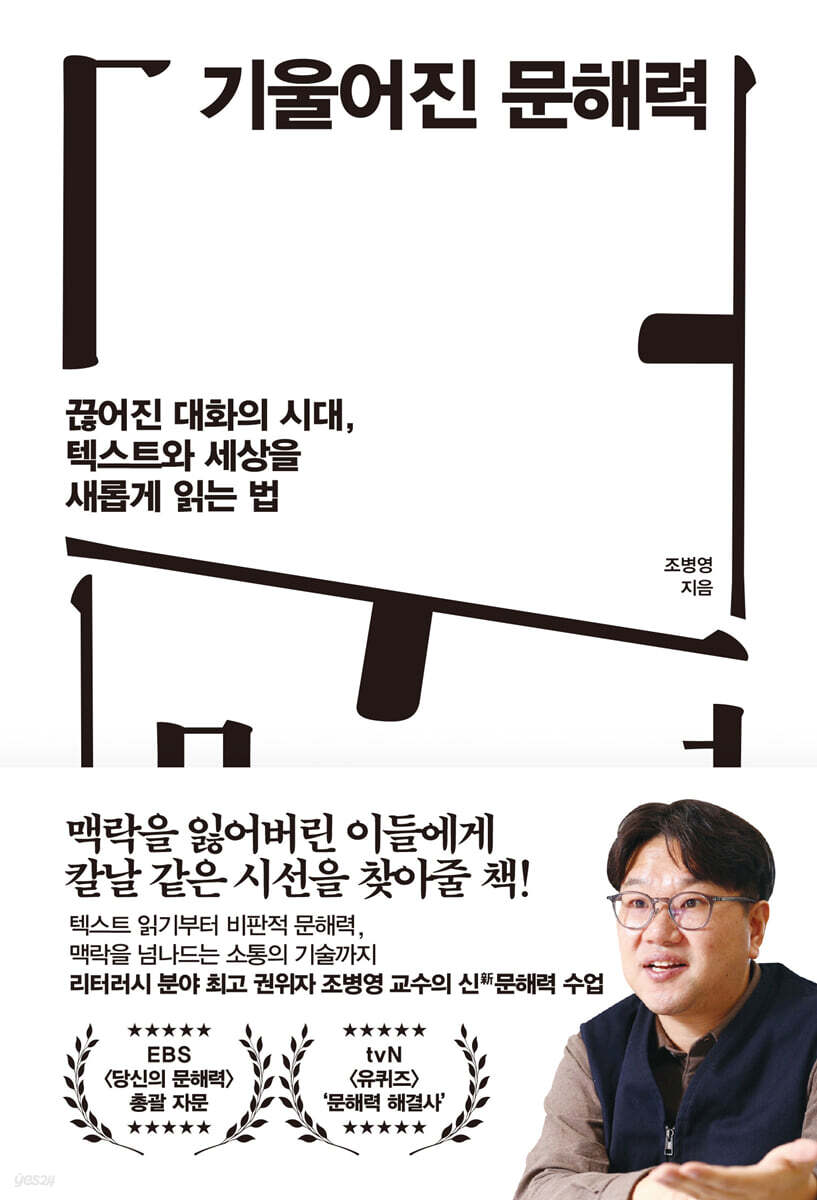
slanted literacy
 |
Description
Book Introduction
A time to add wisdom to my life, the 'Life Lessons' series.
From text reading to digital literacy,
From communication skills to empathy literacy
A new literacy class by Professor Cho Byeong-yeong, a leading authority in the field of literacy.
All the essential knowledge you need for life, all in one place! The twenty-sixth book in the "Life Lessons" series, a fascinating intellectual experience presented by Korea's leading professors, has been published.
The Life Lectures series, which transcribes the lectures of the best professors in various fields from universities across the country, including history, philosophy, science, medicine, and art, into books, provides readers with useful knowledge to live today and insight to look forward to tomorrow.
It is a knowledge and culture brand that allows you to encounter the best knowledge content in everyday life through not only books but also online lectures, YouTube, and podcasts.
"Slanted Literacy" is a book that redefines the literacy we need today.
The literacy we have learned so far has been automatic reading for improving grades and social status.
Professor Cho Byeong-yeong, a leading authority in the field of literacy, says that in this era where critical literacy for reflection is becoming rare, our thinking is becoming increasingly skewed.
This book offers a small hope and clue that literacy can go beyond the written word and contribute to social communication, cooperation, trust, and recovery as we move beyond the functional literacy schema and attempt to encounter and perceive the text of life.
From text reading to digital literacy,
From communication skills to empathy literacy
A new literacy class by Professor Cho Byeong-yeong, a leading authority in the field of literacy.
All the essential knowledge you need for life, all in one place! The twenty-sixth book in the "Life Lessons" series, a fascinating intellectual experience presented by Korea's leading professors, has been published.
The Life Lectures series, which transcribes the lectures of the best professors in various fields from universities across the country, including history, philosophy, science, medicine, and art, into books, provides readers with useful knowledge to live today and insight to look forward to tomorrow.
It is a knowledge and culture brand that allows you to encounter the best knowledge content in everyday life through not only books but also online lectures, YouTube, and podcasts.
"Slanted Literacy" is a book that redefines the literacy we need today.
The literacy we have learned so far has been automatic reading for improving grades and social status.
Professor Cho Byeong-yeong, a leading authority in the field of literacy, says that in this era where critical literacy for reflection is becoming rare, our thinking is becoming increasingly skewed.
This book offers a small hope and clue that literacy can go beyond the written word and contribute to social communication, cooperation, trust, and recovery as we move beyond the functional literacy schema and attempt to encounter and perceive the text of life.
- You can preview some of the book's contents.
Preview
index
Entering
If we can set the tilted world straight with literacy,
Can I read Part 1 again?
New Literacy, New Literacy
worst reader
Are reading and writing value-neutral?
How We Learned Literacy
New Literacy from an Evolved Perspective
intertext
distributed knowledge
New literacy
- Literacy strategies
Survival Literacy in the New Media Age
Why are we fooled by fakes?
Intelligent Evolution of Media
The paradox of knowledge
When reading, how much of a lack of content knowledge can cause problems?
Rebellion of Faith
The persistent influence of false beliefs
DSLR Strategy for Ultra-High Pixels
- Literacy strategies
Critical Literacy in the AI Age
AI and Critical Literacy
What's wrong?
AI, something is strange
Suspicious artificial intelligence
AI stability issues
Human Literacy vs. AI Literacy
We keep tilting
Factual truth, emotional truth
- Literacy strategies
Literacy and Your Epistemology
Literacy and Epistemology
Open epistemology vs. closed epistemology
epistemological dilemma
Don't be quiet to those in power
- Literacy strategies
How to Read Part 2
Reading of Consciousness and Reflection
The Meaning of Rereading in a World That's Too Fast
The Pitfalls of Speed Reading
The Betrayal of Learned Reading
How Thought Works
Criteria for Judging Understanding and the Landscape of Reading
- Literacy strategies
A break in reading, a new pace
A new literacy environment
New thinking habits
- Literacy strategies
On how to read properly
Can I see a gorilla?
confirmation bias
Slanted reason
Are you stuck in a recommendation algorithm and attacking straw men?
Breaks in reading and new speeds
- Literacy strategies
The identity of a reading human
Five Identities of a Reading Human
Time for self-examination
- Literacy strategies
Part 3: True Literacy
Literacy: Connecting Symbols and Meaning, the World
What is literacy?
What to read and write
Text and symbols
Text, Me, and Meaning
Text shows the world again
Sign literacy
The Book of the World
Geographer of Dead Knowledge
For adaptation, power, and dignity
- Literacy strategies
Practice of mind, thoughts, and body
There is no literacy gene
Literacy is a matter of the heart
The practice of the mind determines literacy.
The Matthew Effect: The Rich Get Richer and the Poor Get Poorer Phenomenon of Literacy
Experience of success
- Literacy strategies
Learning from experience, space, and connection
Experience, connection, understanding and expansion
Discourse experience, communication and modes of being
The ability to understand various forms of communication, metadiscourse
The Rules of Literacy, the Rules of the Game
Literacy develops with experience.
- Literacy strategies
Will reading Part 4 make me happy?
Designing Communication with Literacy
A true listener
Finding common ground
Hear even what is inaudible
Show good faith
- Literacy strategies
The power of 'reversal' continues to be refined.
Reading is difficult
Reading is fun
Immerse yourself
- Literacy strategies
A text about growth, change, and life
Will reading and writing well make me happy?
Four Things Your Conscious Brain Does
Verbal communication, brain plasticity, and social relationships
Youth Literacy
- Literacy strategies
loose solidarity, communal friendship
I'm okay
Dignity and Well-being
Giant's Literacy
- Literacy strategies
Acknowledgements
Main keywords
Americas
If we can set the tilted world straight with literacy,
Can I read Part 1 again?
New Literacy, New Literacy
worst reader
Are reading and writing value-neutral?
How We Learned Literacy
New Literacy from an Evolved Perspective
intertext
distributed knowledge
New literacy
- Literacy strategies
Survival Literacy in the New Media Age
Why are we fooled by fakes?
Intelligent Evolution of Media
The paradox of knowledge
When reading, how much of a lack of content knowledge can cause problems?
Rebellion of Faith
The persistent influence of false beliefs
DSLR Strategy for Ultra-High Pixels
- Literacy strategies
Critical Literacy in the AI Age
AI and Critical Literacy
What's wrong?
AI, something is strange
Suspicious artificial intelligence
AI stability issues
Human Literacy vs. AI Literacy
We keep tilting
Factual truth, emotional truth
- Literacy strategies
Literacy and Your Epistemology
Literacy and Epistemology
Open epistemology vs. closed epistemology
epistemological dilemma
Don't be quiet to those in power
- Literacy strategies
How to Read Part 2
Reading of Consciousness and Reflection
The Meaning of Rereading in a World That's Too Fast
The Pitfalls of Speed Reading
The Betrayal of Learned Reading
How Thought Works
Criteria for Judging Understanding and the Landscape of Reading
- Literacy strategies
A break in reading, a new pace
A new literacy environment
New thinking habits
- Literacy strategies
On how to read properly
Can I see a gorilla?
confirmation bias
Slanted reason
Are you stuck in a recommendation algorithm and attacking straw men?
Breaks in reading and new speeds
- Literacy strategies
The identity of a reading human
Five Identities of a Reading Human
Time for self-examination
- Literacy strategies
Part 3: True Literacy
Literacy: Connecting Symbols and Meaning, the World
What is literacy?
What to read and write
Text and symbols
Text, Me, and Meaning
Text shows the world again
Sign literacy
The Book of the World
Geographer of Dead Knowledge
For adaptation, power, and dignity
- Literacy strategies
Practice of mind, thoughts, and body
There is no literacy gene
Literacy is a matter of the heart
The practice of the mind determines literacy.
The Matthew Effect: The Rich Get Richer and the Poor Get Poorer Phenomenon of Literacy
Experience of success
- Literacy strategies
Learning from experience, space, and connection
Experience, connection, understanding and expansion
Discourse experience, communication and modes of being
The ability to understand various forms of communication, metadiscourse
The Rules of Literacy, the Rules of the Game
Literacy develops with experience.
- Literacy strategies
Will reading Part 4 make me happy?
Designing Communication with Literacy
A true listener
Finding common ground
Hear even what is inaudible
Show good faith
- Literacy strategies
The power of 'reversal' continues to be refined.
Reading is difficult
Reading is fun
Immerse yourself
- Literacy strategies
A text about growth, change, and life
Will reading and writing well make me happy?
Four Things Your Conscious Brain Does
Verbal communication, brain plasticity, and social relationships
Youth Literacy
- Literacy strategies
loose solidarity, communal friendship
I'm okay
Dignity and Well-being
Giant's Literacy
- Literacy strategies
Acknowledgements
Main keywords
Americas
Detailed image

Into the book
We now live in the age of micropropaganda, a world filled with lies at the level of fine dust.
Lies in the digital age are more systematic than we think.
Those who sustain their petty power through lies establish consistency among lies and construct a plausible fictional world where lies become the principles and norms of life.
They try to give us the 'illusion' that we are living comfortably in their world without any problems.
In this day and age, what is more unfortunate than not being able to distinguish between illusion and fact, truth and falsehood, is that we are in a position where we can live in the world without any problems, without being able to discern and reject what is truly false.
--- From "Entering"
Media connects things to convey content and messages.
This is called mediation, or mediation or adjustment.
However, media also change themselves as they influence each other's functions and forms.
YouTube is a new media modeled after TV of the past, but these days, TV seems to have become a strange public media modeled after YouTube, overflowing with content focused on exposing private lives and entertainment.
This phenomenon of media being connected and the past and present influencing each other and changing is called remediation, or remediation or correction.
--- From "Intelligent Evolution of Media"
D_Distrust
Don't believe everything you see.
Just because you see it doesn't mean it's true.
Rather than believing everything we see, let us seek and examine what is unseen.
Be mindful of things that are unfairly obscured or appear large and important.
Let us be wary of hasty judgments.
--- From "DSLR Strategy for Penetrating Ultra-High Pixels"
Critical literacy is literacy that does not depend on the individual to be a system.
Literacy is the ability to think, judge, and act as a fully autonomous subject of meaning.
It is not only the literacy to handle information, the literacy to function as a person in daily life or as an economic being, but also the literacy to consider how we can read and write in a way that will benefit ourselves and our community.
--- From "AI and Critical Literacy"
AI consistently fails to apply what it has learned in context A to context B.
Humans have a very high-level ability to apply what they have learned in context A to context B.
This is called transfer learning.
--- From "Suspicious Artificial Intelligence"
In a fast-paced environment, there is no room for thought and reflection to breathe, no space to immerse oneself and create new meaning.
It is self-evident that it is difficult to fully grasp writing without investing effort and resources in thinking.
Asking, "Why don't I understand? Nothing sticks in my head? How do I read?" while quickly finishing a piece is a lament based on a flawed premise.
There is only one answer.
Read slowly.
--- From "The Betrayal of Learned Reading"
Our brain strives for efficiency.
In other words, the brain tries to maximize the cost-effectiveness.
When we casually watch videos on the Internet, most people think, 'I'm watching everything in this video,' but in many cases, people unintentionally only watch what they want to see.
--- From "Can I See the Gorilla"
Texts re-express our world (the world of experience, the world of life, the world of knowledge, the world of learning, the world of work, the world of play, the world of people, the world of life, the world of humanities, the world of nature, etc.).
In English it is representation, and in Korean it is re-enactment.
Presentation means 'to show', and the prefix re- is added to this word to make it 'to show again'.
Text is not a mirror that reflects the world, but a medium that shows the world again.
The reader connects it to his own world and creates a new world.
Reading and writing are the work of reshaping and reproposing the world.
--- From "Text Shows the World Again"
The little prince encounters the symbol 'tame', understands its meaning through questions, and experiences the word firsthand as he practices taming the fox.
This moving scene, which is read every time, subtly suggests that literacy is ultimately embodied in life experience.
Diverse life experiences, experiences of communication, experiences of discourse context, experiences of existence, and experiences of reading and writing provide a higher level of literacy.
Lies in the digital age are more systematic than we think.
Those who sustain their petty power through lies establish consistency among lies and construct a plausible fictional world where lies become the principles and norms of life.
They try to give us the 'illusion' that we are living comfortably in their world without any problems.
In this day and age, what is more unfortunate than not being able to distinguish between illusion and fact, truth and falsehood, is that we are in a position where we can live in the world without any problems, without being able to discern and reject what is truly false.
--- From "Entering"
Media connects things to convey content and messages.
This is called mediation, or mediation or adjustment.
However, media also change themselves as they influence each other's functions and forms.
YouTube is a new media modeled after TV of the past, but these days, TV seems to have become a strange public media modeled after YouTube, overflowing with content focused on exposing private lives and entertainment.
This phenomenon of media being connected and the past and present influencing each other and changing is called remediation, or remediation or correction.
--- From "Intelligent Evolution of Media"
D_Distrust
Don't believe everything you see.
Just because you see it doesn't mean it's true.
Rather than believing everything we see, let us seek and examine what is unseen.
Be mindful of things that are unfairly obscured or appear large and important.
Let us be wary of hasty judgments.
--- From "DSLR Strategy for Penetrating Ultra-High Pixels"
Critical literacy is literacy that does not depend on the individual to be a system.
Literacy is the ability to think, judge, and act as a fully autonomous subject of meaning.
It is not only the literacy to handle information, the literacy to function as a person in daily life or as an economic being, but also the literacy to consider how we can read and write in a way that will benefit ourselves and our community.
--- From "AI and Critical Literacy"
AI consistently fails to apply what it has learned in context A to context B.
Humans have a very high-level ability to apply what they have learned in context A to context B.
This is called transfer learning.
--- From "Suspicious Artificial Intelligence"
In a fast-paced environment, there is no room for thought and reflection to breathe, no space to immerse oneself and create new meaning.
It is self-evident that it is difficult to fully grasp writing without investing effort and resources in thinking.
Asking, "Why don't I understand? Nothing sticks in my head? How do I read?" while quickly finishing a piece is a lament based on a flawed premise.
There is only one answer.
Read slowly.
--- From "The Betrayal of Learned Reading"
Our brain strives for efficiency.
In other words, the brain tries to maximize the cost-effectiveness.
When we casually watch videos on the Internet, most people think, 'I'm watching everything in this video,' but in many cases, people unintentionally only watch what they want to see.
--- From "Can I See the Gorilla"
Texts re-express our world (the world of experience, the world of life, the world of knowledge, the world of learning, the world of work, the world of play, the world of people, the world of life, the world of humanities, the world of nature, etc.).
In English it is representation, and in Korean it is re-enactment.
Presentation means 'to show', and the prefix re- is added to this word to make it 'to show again'.
Text is not a mirror that reflects the world, but a medium that shows the world again.
The reader connects it to his own world and creates a new world.
Reading and writing are the work of reshaping and reproposing the world.
--- From "Text Shows the World Again"
The little prince encounters the symbol 'tame', understands its meaning through questions, and experiences the word firsthand as he practices taming the fox.
This moving scene, which is read every time, subtly suggests that literacy is ultimately embodied in life experience.
Diverse life experiences, experiences of communication, experiences of discourse context, experiences of existence, and experiences of reading and writing provide a higher level of literacy.
--- From "Literacy Develops Through Experience"
Publisher's Review
How does literacy develop?
From metadiscourse to the rules of the game
A literacy promotion project that shifts the frame of consciousness and reflection.
What is literacy?
Professor Cho Byeong-yeong, a world-renowned authority on literacy, reminds us that literacy goes beyond simple technical reading and is the foundation of human society.
Literacy encompasses the totality of human social behavior, in which we combine “symbols” such as words, colors, and pictures to create “meaning,” communicate with intention, and participate in the “world.”
Human genes did not evolve for literacy, yet humans were able to read and write, and to build some of the most sophisticated cultural products.
Literacy was not simply a matter of reading text; it was the foundation of history and power, and the most fundamental ability involved in the quality and dignity of life.
What is our literacy level like today?
Literacy issues, such as the 'deep apology' and 'what the heck' controversies, are often addressed as vocabulary or reading comprehension questions for tests.
However, as the book's title, "Tilted Literacy," suggests, the literacy truly under threat may be the critical literacy that engages in perception and communication. The development of AI, algorithms, and the new media industry are outpacing the entrenchment of biased thinking, ideological polarization, and the production of fake news and sensational content.
In a world so easily swayed by falsehoods and false claims, what kind of literacy do we need, and how can we cultivate it?
"Slanted Literacy" begins with these questions and explores how literacy can contribute to finding the common sense we are losing.
How is literacy achieved?
Stop, read, dive deep!
How is true literacy achieved?
The author redefines literacy as an "attitude toward life," and sparks a diverse discussion surrounding literacy through the lens of literacy skills, epistemological literacy, and communicative literacy.
Literacy, which allows us to communicate rationally and grow endlessly, begins with stopping, thinking deeply, asking questions, and reading slowly.
Here, reading slowly is a sophisticated intellectual endeavor that sharply questions, examines, and synthesizes the intentions of the person behind the text, what he or she is trying to achieve through the argument, what knowledge I use to understand the text, and what texts I derive from it.
Literacy is only completed when a text is embodied through such efforts and integrated into one's attitude toward life.
We dream of literacy as a social practice that extends beyond the process of understanding symbols and meanings and into daily life.
The author says that literacy that is merely read and remains in the mind is intangible and does not gain vitality.
Those who strive to practice literacy can be called true readers and true listeners in that they acknowledge their own inclinations, correct them, and strive to improve, even if they inevitably fall short.
Now, as we experience an era of disconnection in communication and empathy, it is time to begin a literacy project.
From metadiscourse to the rules of the game
A literacy promotion project that shifts the frame of consciousness and reflection.
What is literacy?
Professor Cho Byeong-yeong, a world-renowned authority on literacy, reminds us that literacy goes beyond simple technical reading and is the foundation of human society.
Literacy encompasses the totality of human social behavior, in which we combine “symbols” such as words, colors, and pictures to create “meaning,” communicate with intention, and participate in the “world.”
Human genes did not evolve for literacy, yet humans were able to read and write, and to build some of the most sophisticated cultural products.
Literacy was not simply a matter of reading text; it was the foundation of history and power, and the most fundamental ability involved in the quality and dignity of life.
What is our literacy level like today?
Literacy issues, such as the 'deep apology' and 'what the heck' controversies, are often addressed as vocabulary or reading comprehension questions for tests.
However, as the book's title, "Tilted Literacy," suggests, the literacy truly under threat may be the critical literacy that engages in perception and communication. The development of AI, algorithms, and the new media industry are outpacing the entrenchment of biased thinking, ideological polarization, and the production of fake news and sensational content.
In a world so easily swayed by falsehoods and false claims, what kind of literacy do we need, and how can we cultivate it?
"Slanted Literacy" begins with these questions and explores how literacy can contribute to finding the common sense we are losing.
How is literacy achieved?
Stop, read, dive deep!
How is true literacy achieved?
The author redefines literacy as an "attitude toward life," and sparks a diverse discussion surrounding literacy through the lens of literacy skills, epistemological literacy, and communicative literacy.
Literacy, which allows us to communicate rationally and grow endlessly, begins with stopping, thinking deeply, asking questions, and reading slowly.
Here, reading slowly is a sophisticated intellectual endeavor that sharply questions, examines, and synthesizes the intentions of the person behind the text, what he or she is trying to achieve through the argument, what knowledge I use to understand the text, and what texts I derive from it.
Literacy is only completed when a text is embodied through such efforts and integrated into one's attitude toward life.
We dream of literacy as a social practice that extends beyond the process of understanding symbols and meanings and into daily life.
The author says that literacy that is merely read and remains in the mind is intangible and does not gain vitality.
Those who strive to practice literacy can be called true readers and true listeners in that they acknowledge their own inclinations, correct them, and strive to improve, even if they inevitably fall short.
Now, as we experience an era of disconnection in communication and empathy, it is time to begin a literacy project.
GOODS SPECIFICS
- Date of issue: January 17, 2025
- Page count, weight, size: 300 pages | 128*188*20mm
- ISBN13: 9791171179916
- ISBN10: 117117991X
You may also like
카테고리
korean


korean

![GQ KOREA Mark (Monthly): December [2025]](http://librairie.coreenne.fr/cdn/shop/files/8ef265dbbfbf186523ed75ba7319009d.jpg?v=1765340328&width=3840)


