

Please take care of the culture
 |
Description
Book Introduction
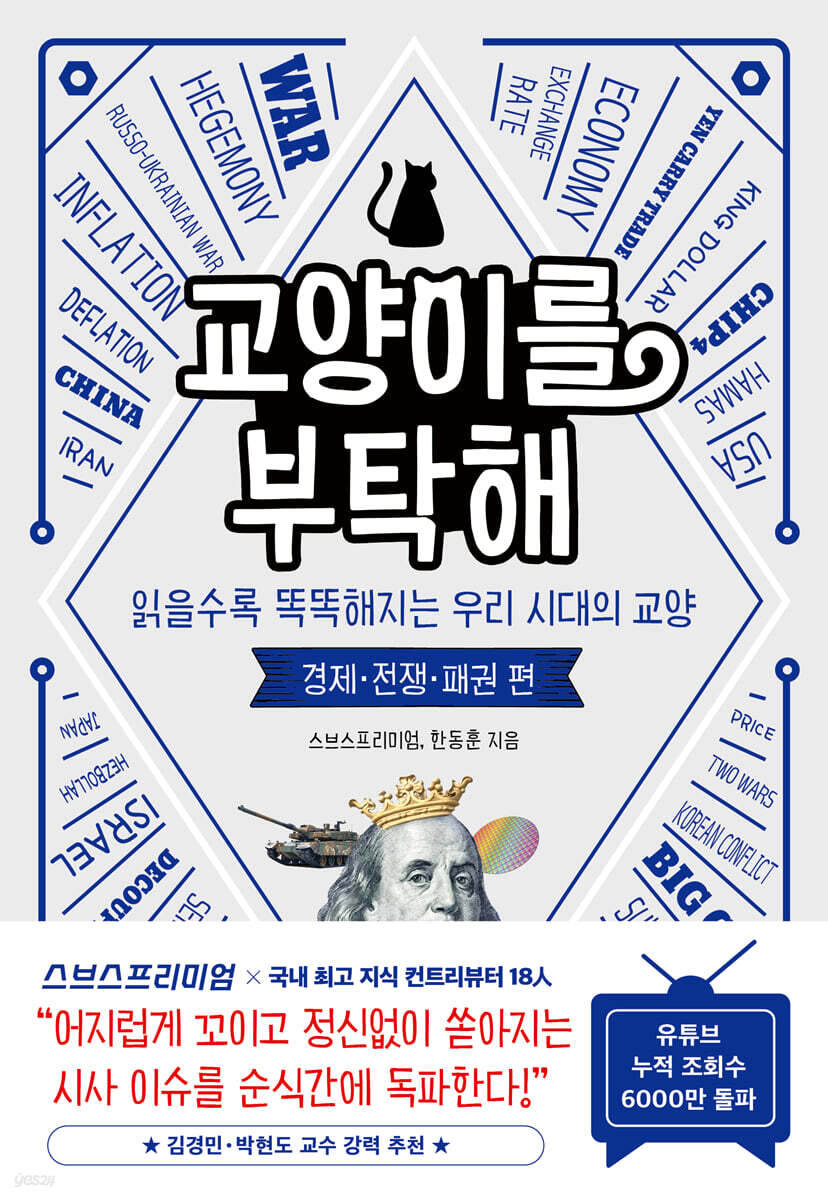
Dizzyingly tangled and pouring out like crazy
Read current issues in an instant!
Through the intellectual perspectives of 18 of the country's top experts
The one and only current affairs textbook to understand today's world.
★ YouTube cumulative views exceed 60 million ★
★ SBS Premium Original Content ★
★ Highly recommended by Professors Kim Kyung-min and Park Hyeon-do ★
The world today is in turmoil several times a day.
Breaking news about the latest developments is pouring in at every moment, but it's not easy to keep up with them all and understand them all.
The more I look at it, the more confusing it becomes.
Even just scanning the headlines can be overwhelming, thanks to the difficult concepts and complex context.
But if I close my eyes and ears, I worry that I might get lost in this crazy world and become an uncultured person.
"Please Take Care of My Culture" addresses these concerns in one fell swoop. This book, a reorganized and edited version of SBS Premium's original content, "Please Take Care of My Culture," offers a clearer view of today's world through the intellectual perspectives of 18 of Korea's top experts.
How will the world change in the Trump 2.0 era? Will fluctuating interest rates and exchange rates be beneficial or detrimental to the economy? How will wars in Europe and the Middle East impact the political landscape in East Asia and the Korean Peninsula? What wisdom can we offer to overcome the turbulent real estate market and the low birth rate? This book seeks answers to questions that transcend the boundaries of "economy, war, and hegemony," revealing the "true" face of a world previously obscured.
Thanks to its outstanding insight, it has been loved as a ‘must-have content for cultured people’, with over 60 million cumulative views on YouTube alone.
The process of filling the gaps between daily life and the world with a broad range of knowledge covering various current issues is both fun and beneficial.
Above all, it is ‘cost-effective’.
For those of us who keep saying, “It’s so busy, it’s so busy in modern society,” we’ve compiled only the key points so that you can understand them with just one read.
In short, this book instantly ‘upgrades’ our perspective on the world.
If you dream of becoming an "intellectual adult" who can answer any question, participate in any conversation, and communicate with anyone, open this book.
You will gain insights to understand the present and prepare for the future.
Read current issues in an instant!
Through the intellectual perspectives of 18 of the country's top experts
The one and only current affairs textbook to understand today's world.
★ YouTube cumulative views exceed 60 million ★
★ SBS Premium Original Content ★
★ Highly recommended by Professors Kim Kyung-min and Park Hyeon-do ★
The world today is in turmoil several times a day.
Breaking news about the latest developments is pouring in at every moment, but it's not easy to keep up with them all and understand them all.
The more I look at it, the more confusing it becomes.
Even just scanning the headlines can be overwhelming, thanks to the difficult concepts and complex context.
But if I close my eyes and ears, I worry that I might get lost in this crazy world and become an uncultured person.
"Please Take Care of My Culture" addresses these concerns in one fell swoop. This book, a reorganized and edited version of SBS Premium's original content, "Please Take Care of My Culture," offers a clearer view of today's world through the intellectual perspectives of 18 of Korea's top experts.
How will the world change in the Trump 2.0 era? Will fluctuating interest rates and exchange rates be beneficial or detrimental to the economy? How will wars in Europe and the Middle East impact the political landscape in East Asia and the Korean Peninsula? What wisdom can we offer to overcome the turbulent real estate market and the low birth rate? This book seeks answers to questions that transcend the boundaries of "economy, war, and hegemony," revealing the "true" face of a world previously obscured.
Thanks to its outstanding insight, it has been loved as a ‘must-have content for cultured people’, with over 60 million cumulative views on YouTube alone.
The process of filling the gaps between daily life and the world with a broad range of knowledge covering various current issues is both fun and beneficial.
Above all, it is ‘cost-effective’.
For those of us who keep saying, “It’s so busy, it’s so busy in modern society,” we’ve compiled only the key points so that you can understand them with just one read.
In short, this book instantly ‘upgrades’ our perspective on the world.
If you dream of becoming an "intellectual adult" who can answer any question, participate in any conversation, and communicate with anyone, open this book.
You will gain insights to understand the present and prepare for the future.
- You can preview some of the book's contents.
Preview
index
Part 1: The Economy: A World on the Brink of Boom and Recession
1.
The overheated engine called America
A Perfect Storm Gathers for the Global Economy | Supply Chains Collapse | Milestones of an Economic Crisis | People Are Getting Poorer | Interest Rate Cuts Can't Be Delayed Any Longer | The Boundary Between Inflation and Deflation
2.
China on the brink
Mao Zedong's Shadow Over Xi Jinping│Long Live the Emperor! Long Live! Long Live!│The End of the Golden Goose│The Bubble Begins to Burst│Security Over Economy│Why Does China Dream of War?│"Thank You, Xi Jinping"│China's Path and Korea's Path
3.
Japan's attempt at a reversal
From 'Lost' to 'Reclaimed'│Abenomics: A Gamble│The Japanese Who Became Poor Suddenly│The Yen Carry Trade: A Request from the Japanese Prime Minister│Still at a Standstill│The Era of Long-Term Low Growth Has Arrived│Why We Should Learn from Japan
4.
Korea's Strategy: Focus on Productivity
The Gates of Hell Opened by 1 Percentage Point│Sony Chairman's Cry│Protect the Domestic Market│Korea Kills Two Birds│Internet and Fax│Prepare for a Great Transformation
Part 2: War: A World Ignites with Hostile Symbiosis
5.
The long history of the Russian-Russian War
The Specter of Kievan Rus's│Ukraine as a Gateway│From Euromaidan to the Donbas War│The Impact on the Korean Economy│K-9's Northern Expedition│Why Poland is Nervous│The Russo-Russian War Becomes Our Issue
6.
The prelude to the Fifth Middle East War
The Thorn Under the Nail│The Structure of the Wicked and the Righteous│The Other Side of Peace│Hamas Will Never Die│America's Hands and Feet Tied for the Presidential Election│Iran in a Tough Situation│Is This the Prelude to the Fifth Middle East War│The Trap of Hostile Symbiosis
7.
North Korea prepares for war
Password '7271953'│The Birth of a New Blood Alliance?│The History of the ROK-US Mutual Defense Treaty│Abandoning the Dream of a Normal Nation│Why North Korea Can't Give Up Nuclear Weapons│Something That Could Happen Only on the Verge of War│Does the 'Supreme Leader' Dream of War?
8.
Korea's Strategy: Prepare for a Hard Landing Unification
A Little Girl Next to an ICBM | The Nonsense of North Korea's Collapse? | The Special Relationship Between North Korea and China | Why Neither Sunshine nor Pressure Works | The Truth and Lies of a National Alliance | Prepare for a Hard Landing | Is Peaceful Coexistence Possible?
Part 3: Hegemony: The World Embarks on a New Era
9.
The Lion Awakens, America
Blow Up TSMC│Biden's Big Picture│The Advent of America First│The Rust Belt Rebellion│America's Accounting Ledger│US Forces in Korea and Nuclear Weapons│Politicians vs. Businessmen│The Lion Doesn't Sleep Tonight
10.
The new master of the Middle East
America Shoots Itself in the Foot│Bin Salman Laughs at Biden│The Carter Doctrine Collapses│Unconventional, Unconventional, Unconventional!│Saudi Arabia Takes the Lead│The Future After Oil
11.
China's Risky Gamble
The pandemic has become a battleground for systemic warfare. A unified front under Xi Jinping. The 4Ds weighing down China's economy. Xi Jinping is obsessed with an exit strategy. Taiwan is in danger.
12.
Korea's Strategy: Leverage Autonomy
The tangled web of industry and security│Korean companies being pushed out of the Chinese market│China's rise in high-tech industries│Need to manage distance with China│Need to manage distance with the United States│Ambiguity, clarity, and autonomy│The semiconductor industry in crisis│Korea's secret weapon
Part 4 Korea: The World We Will Face
13.
Population Decline Express
Korea Becomes the 'First Penguin'│Reasons for the Fall│How Nations Collapse│The Crumbling Social Safety Net│1,100 Trillion Won Hidden│Fundamental Reforms Are Needed│Generation X Holds the Sword
14.
The turbulent real estate market and the dream of a megacity
The ticking time bomb of jeonse│A fatal blow of policy failure│PF loan defaults│Missing the golden hour│Is abolition the only answer for the two rental laws│Policy goals lost│The beginning of normalization
15.
Hippocrates in the Age of Aging
Why have there been so many residents? The problem is the number of doctors. No, the problem is the medical fee. The problem is the imbalance of people and finances. There is no more time. The light and dark of the self-care era.
The Power of Culture to Understand the Pulse of Chaotic Times? Lee Hyun-sik, SBS D Content Production Committee Member
How "Please Take Care of My Culture" Came to Life? Planning and Directing by Han Dong-hoon
More to see
The people who created "Please Take Care of My Culture"
1.
The overheated engine called America
A Perfect Storm Gathers for the Global Economy | Supply Chains Collapse | Milestones of an Economic Crisis | People Are Getting Poorer | Interest Rate Cuts Can't Be Delayed Any Longer | The Boundary Between Inflation and Deflation
2.
China on the brink
Mao Zedong's Shadow Over Xi Jinping│Long Live the Emperor! Long Live! Long Live!│The End of the Golden Goose│The Bubble Begins to Burst│Security Over Economy│Why Does China Dream of War?│"Thank You, Xi Jinping"│China's Path and Korea's Path
3.
Japan's attempt at a reversal
From 'Lost' to 'Reclaimed'│Abenomics: A Gamble│The Japanese Who Became Poor Suddenly│The Yen Carry Trade: A Request from the Japanese Prime Minister│Still at a Standstill│The Era of Long-Term Low Growth Has Arrived│Why We Should Learn from Japan
4.
Korea's Strategy: Focus on Productivity
The Gates of Hell Opened by 1 Percentage Point│Sony Chairman's Cry│Protect the Domestic Market│Korea Kills Two Birds│Internet and Fax│Prepare for a Great Transformation
Part 2: War: A World Ignites with Hostile Symbiosis
5.
The long history of the Russian-Russian War
The Specter of Kievan Rus's│Ukraine as a Gateway│From Euromaidan to the Donbas War│The Impact on the Korean Economy│K-9's Northern Expedition│Why Poland is Nervous│The Russo-Russian War Becomes Our Issue
6.
The prelude to the Fifth Middle East War
The Thorn Under the Nail│The Structure of the Wicked and the Righteous│The Other Side of Peace│Hamas Will Never Die│America's Hands and Feet Tied for the Presidential Election│Iran in a Tough Situation│Is This the Prelude to the Fifth Middle East War│The Trap of Hostile Symbiosis
7.
North Korea prepares for war
Password '7271953'│The Birth of a New Blood Alliance?│The History of the ROK-US Mutual Defense Treaty│Abandoning the Dream of a Normal Nation│Why North Korea Can't Give Up Nuclear Weapons│Something That Could Happen Only on the Verge of War│Does the 'Supreme Leader' Dream of War?
8.
Korea's Strategy: Prepare for a Hard Landing Unification
A Little Girl Next to an ICBM | The Nonsense of North Korea's Collapse? | The Special Relationship Between North Korea and China | Why Neither Sunshine nor Pressure Works | The Truth and Lies of a National Alliance | Prepare for a Hard Landing | Is Peaceful Coexistence Possible?
Part 3: Hegemony: The World Embarks on a New Era
9.
The Lion Awakens, America
Blow Up TSMC│Biden's Big Picture│The Advent of America First│The Rust Belt Rebellion│America's Accounting Ledger│US Forces in Korea and Nuclear Weapons│Politicians vs. Businessmen│The Lion Doesn't Sleep Tonight
10.
The new master of the Middle East
America Shoots Itself in the Foot│Bin Salman Laughs at Biden│The Carter Doctrine Collapses│Unconventional, Unconventional, Unconventional!│Saudi Arabia Takes the Lead│The Future After Oil
11.
China's Risky Gamble
The pandemic has become a battleground for systemic warfare. A unified front under Xi Jinping. The 4Ds weighing down China's economy. Xi Jinping is obsessed with an exit strategy. Taiwan is in danger.
12.
Korea's Strategy: Leverage Autonomy
The tangled web of industry and security│Korean companies being pushed out of the Chinese market│China's rise in high-tech industries│Need to manage distance with China│Need to manage distance with the United States│Ambiguity, clarity, and autonomy│The semiconductor industry in crisis│Korea's secret weapon
Part 4 Korea: The World We Will Face
13.
Population Decline Express
Korea Becomes the 'First Penguin'│Reasons for the Fall│How Nations Collapse│The Crumbling Social Safety Net│1,100 Trillion Won Hidden│Fundamental Reforms Are Needed│Generation X Holds the Sword
14.
The turbulent real estate market and the dream of a megacity
The ticking time bomb of jeonse│A fatal blow of policy failure│PF loan defaults│Missing the golden hour│Is abolition the only answer for the two rental laws│Policy goals lost│The beginning of normalization
15.
Hippocrates in the Age of Aging
Why have there been so many residents? The problem is the number of doctors. No, the problem is the medical fee. The problem is the imbalance of people and finances. There is no more time. The light and dark of the self-care era.
The Power of Culture to Understand the Pulse of Chaotic Times? Lee Hyun-sik, SBS D Content Production Committee Member
How "Please Take Care of My Culture" Came to Life? Planning and Directing by Han Dong-hoon
More to see
The people who created "Please Take Care of My Culture"
Detailed image

Into the book
Inflation in the United States is slowing noticeably.
Based on the Consumer Price Index (CPI), in July 2024, the increase was only 2.9 percent compared to the same month of the previous year.
The 2 percent increase is the first since March 2021, and it even soared to 9 percent in the summer of 2022 as the pandemic was winding down. Personal consumption expenditures (PCE), a widely watched indicator, is also declining, following a similar trend to the CPI.
It is a situation where we can cautiously predict that inflation has passed its peak.
How can we achieve economic growth while increasing consumer spending power at this crucial time of falling prices? Simply releasing money will only lead to higher prices, so a more "soft" approach is needed.
The card that can be used in this situation is ‘interest rate.’
In September 2024, the interest rate cut was finally implemented.
The rate has been lowered by 0.5 percentage points, and it is expected to be lowered one or two more times within the year.
--- 「1.
From "The Overheated Engine of America"
Financial markets around the world are flooded with funds raised through the "yen carry trade."
Yen carry trade is the act of borrowing yen with low interest rates and investing it in assets of countries with high interest rates.
Since the interest rate on yen is not that high, borrowing money is not burdensome.
In this situation, what would happen if Japan significantly raised interest rates, or even pretended to? Naturally, yen would flow out of financial markets around the world, rushing back to Japan.
If the pace is too fast for us to respond quickly, we cannot avoid a global financial crisis.
(The damage to the Korean financial market, where a lot of Japanese capital has entered, will be particularly significant.)
--- 「3.
From "Japan Seeking a Reversal"
There is a reason why Poland is adopting Korean weapons systems specialized for defense.
Because, just like Crimea is in Ukraine, Poland also has a region that is like a 'thorn under the nail'.
It is Kaliningrad, a Russian territory separated from the mainland and attached to Poland.
The problem is that it is only about 100 kilometers from Russia's ally, Belarus.
Kaliningrad is located on the Baltic Sea, so if Russia were to deploy troops there by surprise, not only the three Scandinavian countries but even Germany would be within striking distance.
This is why both Poland and NATO desperately need to defend the border region with Kaliningrad.
--- 「5.
From the long history of the Russian-Russian War
It is clear that the United States will be very meticulous in its accounting in the future.
That is, we will no longer make concessions to other countries and will not suffer any losses.
America First is now the new normal.
Indeed, Trump's belief that we need to "decouple" with China—that is, remove China from our entire supply chain so that it can never again steal American interests—is bordering on fundamentalism.
It was even written in Agenda 47 that China would be stripped of its most-favored-nation status.
If most-favored-nation treatment is eliminated, only certain countries can be singled out and treated badly.
For example, by imposing a 60 percent import tariff on China alone.
During his first term in office, Trump demanded $5 billion in defense cost-sharing, more than five times the previous amount.
This reflected Trump's unique negotiating style of first 'spending' a large sum and then gradually reducing it while observing the other party's reaction, which only led to strong opposition from South Korea.
It wasn't until March 2021, about a month after the Biden administration took office, that South Korea and the United States finally reached a final agreement on 1.2 trillion won, a 13.9 percent increase from the previous amount.
The problem is that this agreement was for six years.
This means that since the agreement was originally supposed to be applied from 2020, it will have to be renegotiated at the end of 2025.
If Trump were the US president at that time, he might demand more than $5 billion this time.
To prepare for that eventuality, South Korea and the United States agreed in advance on the next round of defense cost-sharing in October 2024, just before the U.S. presidential election.
Of course, Trump is an unpredictable figure, so if he were to be re-elected, he might find fault with the agreement, saying he would overturn it if it was "favorable" to Korea.
In fact, he hinted at that about ten days after the new agreement was drafted.
“If it were me, I would have said, ‘Come up with $10 billion.’
“Because Korea is a ‘money machine.’”
--- 「9.
From "A Lion Awakens, America"
'Decoupling' is a long-standing issue that has been brewing since before the US-China economic war, and it is also difficult to resolve because it is intertwined with security issues.
In Chapter 2, it was explained that one of the major policies proposed by Xi Jinping since taking office is 'Made in China 2025.'
The key was to foster cutting-edge industries and reduce dependence on Western countries in those fields.
Xi Jinping's intention was to prepare for a possible war over Taiwan in the future.
Western countries, which had firmly believed that China would become a free and democratic society once it was integrated into the global economy and got a taste for money, were greatly shocked by Xi Jinping's judgment.
Soon, one by one, they began to decoupling from China.
At the same time, foreign companies have been fleeing China in droves to avoid U.S. tariffs.
This is why public foreign direct investment in 2023 shrank by more than 30 percent compared to the previous year.
Looking at the third quarter of 2023 alone, it decreased by a whopping 82 percent.
It is no exaggeration to say that the Chinese economy has been stranded due to Xi Jinping's excessive decoupling.
--- 「11.
From "China's Dangerous Gamble"
Korea, too, must devise measures at the government level to attract semiconductor companies from around the world.
This is the background for the introduction of the so-called 'K-Chips Act (Partial Amendment to the Special Tax Exceptions and Restrictions Act)' in 2023.
The main purpose of this law is to provide tax benefits to semiconductor companies.
While this would certainly be an incentive, many experts are unanimous in saying it is still not enough.
In other words, direct support such as subsidies is needed rather than indirect support such as tax benefits.
The need for such generous support is also due to the characteristics of the Korean semiconductor industry.
Samsung Electronics and SK Hynix, the two giants, specialize in foundries.
Therefore, the more semiconductor factories there are, the better, but it costs about 50 trillion won just to increase one production line.
For this reason, it is not easy to induce semiconductor companies to invest in facilities with tax benefits alone.
--- 「12.
From "Korea's Strategy: Leverage Autonomy"
As people get older, they visit the hospital more often.
For example, as of 2022, the average annual medical expenses per person for the entire population was 2.06 million won, but if you look only at the elderly population aged 65 and over, the difference is more than double, reaching 5.347 million won per person.
This is because the elderly population, which accounts for 17 percent of the total population, spent 43.1 percent of total medical expenses.
In monetary terms, it amounts to 44 trillion won, and it is estimated that it will increase every year to 59 trillion won in 2025, 130 trillion won in 2035, and 390 trillion won in 2060.
There's no way this huge amount of money could just fall from the sky.
Ultimately, the burden falls on the young population, and the rapidly decreasing numbers are a major problem.
As of 2023, the national health insurance budget is estimated at 25 trillion won, which means it will only last until 2028.
This is why the prospect that half of our future salaries will inevitably be 'taken' away as health insurance premiums is gaining ground.
Who would get married and have children in such a situation?
Based on the Consumer Price Index (CPI), in July 2024, the increase was only 2.9 percent compared to the same month of the previous year.
The 2 percent increase is the first since March 2021, and it even soared to 9 percent in the summer of 2022 as the pandemic was winding down. Personal consumption expenditures (PCE), a widely watched indicator, is also declining, following a similar trend to the CPI.
It is a situation where we can cautiously predict that inflation has passed its peak.
How can we achieve economic growth while increasing consumer spending power at this crucial time of falling prices? Simply releasing money will only lead to higher prices, so a more "soft" approach is needed.
The card that can be used in this situation is ‘interest rate.’
In September 2024, the interest rate cut was finally implemented.
The rate has been lowered by 0.5 percentage points, and it is expected to be lowered one or two more times within the year.
--- 「1.
From "The Overheated Engine of America"
Financial markets around the world are flooded with funds raised through the "yen carry trade."
Yen carry trade is the act of borrowing yen with low interest rates and investing it in assets of countries with high interest rates.
Since the interest rate on yen is not that high, borrowing money is not burdensome.
In this situation, what would happen if Japan significantly raised interest rates, or even pretended to? Naturally, yen would flow out of financial markets around the world, rushing back to Japan.
If the pace is too fast for us to respond quickly, we cannot avoid a global financial crisis.
(The damage to the Korean financial market, where a lot of Japanese capital has entered, will be particularly significant.)
--- 「3.
From "Japan Seeking a Reversal"
There is a reason why Poland is adopting Korean weapons systems specialized for defense.
Because, just like Crimea is in Ukraine, Poland also has a region that is like a 'thorn under the nail'.
It is Kaliningrad, a Russian territory separated from the mainland and attached to Poland.
The problem is that it is only about 100 kilometers from Russia's ally, Belarus.
Kaliningrad is located on the Baltic Sea, so if Russia were to deploy troops there by surprise, not only the three Scandinavian countries but even Germany would be within striking distance.
This is why both Poland and NATO desperately need to defend the border region with Kaliningrad.
--- 「5.
From the long history of the Russian-Russian War
It is clear that the United States will be very meticulous in its accounting in the future.
That is, we will no longer make concessions to other countries and will not suffer any losses.
America First is now the new normal.
Indeed, Trump's belief that we need to "decouple" with China—that is, remove China from our entire supply chain so that it can never again steal American interests—is bordering on fundamentalism.
It was even written in Agenda 47 that China would be stripped of its most-favored-nation status.
If most-favored-nation treatment is eliminated, only certain countries can be singled out and treated badly.
For example, by imposing a 60 percent import tariff on China alone.
During his first term in office, Trump demanded $5 billion in defense cost-sharing, more than five times the previous amount.
This reflected Trump's unique negotiating style of first 'spending' a large sum and then gradually reducing it while observing the other party's reaction, which only led to strong opposition from South Korea.
It wasn't until March 2021, about a month after the Biden administration took office, that South Korea and the United States finally reached a final agreement on 1.2 trillion won, a 13.9 percent increase from the previous amount.
The problem is that this agreement was for six years.
This means that since the agreement was originally supposed to be applied from 2020, it will have to be renegotiated at the end of 2025.
If Trump were the US president at that time, he might demand more than $5 billion this time.
To prepare for that eventuality, South Korea and the United States agreed in advance on the next round of defense cost-sharing in October 2024, just before the U.S. presidential election.
Of course, Trump is an unpredictable figure, so if he were to be re-elected, he might find fault with the agreement, saying he would overturn it if it was "favorable" to Korea.
In fact, he hinted at that about ten days after the new agreement was drafted.
“If it were me, I would have said, ‘Come up with $10 billion.’
“Because Korea is a ‘money machine.’”
--- 「9.
From "A Lion Awakens, America"
'Decoupling' is a long-standing issue that has been brewing since before the US-China economic war, and it is also difficult to resolve because it is intertwined with security issues.
In Chapter 2, it was explained that one of the major policies proposed by Xi Jinping since taking office is 'Made in China 2025.'
The key was to foster cutting-edge industries and reduce dependence on Western countries in those fields.
Xi Jinping's intention was to prepare for a possible war over Taiwan in the future.
Western countries, which had firmly believed that China would become a free and democratic society once it was integrated into the global economy and got a taste for money, were greatly shocked by Xi Jinping's judgment.
Soon, one by one, they began to decoupling from China.
At the same time, foreign companies have been fleeing China in droves to avoid U.S. tariffs.
This is why public foreign direct investment in 2023 shrank by more than 30 percent compared to the previous year.
Looking at the third quarter of 2023 alone, it decreased by a whopping 82 percent.
It is no exaggeration to say that the Chinese economy has been stranded due to Xi Jinping's excessive decoupling.
--- 「11.
From "China's Dangerous Gamble"
Korea, too, must devise measures at the government level to attract semiconductor companies from around the world.
This is the background for the introduction of the so-called 'K-Chips Act (Partial Amendment to the Special Tax Exceptions and Restrictions Act)' in 2023.
The main purpose of this law is to provide tax benefits to semiconductor companies.
While this would certainly be an incentive, many experts are unanimous in saying it is still not enough.
In other words, direct support such as subsidies is needed rather than indirect support such as tax benefits.
The need for such generous support is also due to the characteristics of the Korean semiconductor industry.
Samsung Electronics and SK Hynix, the two giants, specialize in foundries.
Therefore, the more semiconductor factories there are, the better, but it costs about 50 trillion won just to increase one production line.
For this reason, it is not easy to induce semiconductor companies to invest in facilities with tax benefits alone.
--- 「12.
From "Korea's Strategy: Leverage Autonomy"
As people get older, they visit the hospital more often.
For example, as of 2022, the average annual medical expenses per person for the entire population was 2.06 million won, but if you look only at the elderly population aged 65 and over, the difference is more than double, reaching 5.347 million won per person.
This is because the elderly population, which accounts for 17 percent of the total population, spent 43.1 percent of total medical expenses.
In monetary terms, it amounts to 44 trillion won, and it is estimated that it will increase every year to 59 trillion won in 2025, 130 trillion won in 2035, and 390 trillion won in 2060.
There's no way this huge amount of money could just fall from the sky.
Ultimately, the burden falls on the young population, and the rapidly decreasing numbers are a major problem.
As of 2023, the national health insurance budget is estimated at 25 trillion won, which means it will only last until 2028.
This is why the prospect that half of our future salaries will inevitably be 'taken' away as health insurance premiums is gaining ground.
Who would get married and have children in such a situation?
--- 「15.
From “Hippocrates in the Age of Aging”
From “Hippocrates in the Age of Aging”
Publisher's Review
My lunch price changed because of the Russian War?
Capturing the changes in the world that shake up our daily lives!
The only current affairs textbook for intellectual adults
Have you ever suddenly noticed that lunch prices have gone up? In fact, consumer prices in Korea have risen dramatically in recent years, reaching a whopping 6 percent in June 2022.
If you search the Internet because you are curious about the reason, you will find many articles pointing to the Russian-Russian War as the cause.
Even after reading a few of them, I still can't understand how a war raging thousands of kilometers away could affect prices in Korea.
In this way, our daily lives and the world are so complexly and at the same time so tightly connected.
This is not the only case.
As the presidential election is held in the United States, the Korean real estate market is in turmoil.
If Japan changes its exchange rate policy, the Donghak ants' stock accounts may be emptied.
Even as the conflict between China and Taiwan intensifies, the possibility of war breaking out in Korea increases.
In short, to understand what is happening before our eyes, we must look at what is happening in the world together.
However, it is not easy for us, who are busy with our daily lives, to understand all of this.
This is because it encompasses the actions of numerous countries, organizations, and individuals, while simultaneously digging into the nuances of all kinds of events and issues.
"Please Take Care of My Culture" accomplishes just that difficult task.
Based on the core content of "Please Take Care of My Culture," a program trusted by 6.3 million subscribers, this book clearly exposes the complex and chaotic nature of current affairs! For example, the book covers the Russo-Japanese War, but it goes beyond simply providing a brief overview of the situation.
It meticulously traces the entire process through which the war's aftermath disrupted supply chains for essential raw materials like wheat and oil, derailing U.S. stimulus plans and ultimately leading to the contraction of the South Korean economy.
This provides a glimpse into today's rapidly changing world, following the context of 'economy, war, and hegemony.'
If you've ever wondered why things like this happen to you, find the answers in this book.
By following the connections between key current issues, you will experience the amazing experience of understanding the world in a comprehensive way.
Are the equations of economy, war, and hegemony changing?
An era of great change, a world in turmoil
Discover the essential knowledge that will serve as your compass!
The book travels around the world using the keywords 'economy', 'war', and 'hegemony'.
Based on the latest news, extensive knowledge, and in-depth analysis, the international situation can be summed up in a single word: "Great Transition."
The threat of inflation and deflation coexist, wars are escalating in double and triple waves, and conflicts among hegemonic powers are more intense than ever.
A world you have never experienced before is unfolding.
In Part 1, Economy, we examine the current state of the global economy, which is on a roller coaster ride, and forecast its future direction.
Today, the world economy stands on the borderline between boom and recession.
The US quantitative easing, implemented amid the pandemic emergency, appeared to support the global economy, but it also brought about a backlash in the form of inflation, and the high interest rate policy initiated in response cast the shadow of deflation.
The book comprehensively considers the Fed's interest rate cuts, the new normal of protectionism, and Trump's re-election to provide a proactive outlook on the future of the global economy.
We also deliver must-see economic news, including Japan's interest rate adjustments, the yen carry trade, signs of a Chinese economic collapse, and trends in major raw material markets.
In Part 2, the war reveals the true nature of the war that threatens not only Europe and the Middle East but also East Asia.
The Russian-Korean War provided South Korea with an unexpected opportunity to promote its "K-defense industry," but North Korea's participation in the war significantly shook the political situation in East Asia.
In addition, the US's increasingly escalating public pressure is significantly heightening tensions in Taiwan and the South China Sea.
Meanwhile, Israel is launching a prelude to the Fifth Middle East War by attacking not only Hamas and Hezbollah but also Iran.
The book identifies the core of all these crises as a 'hostile symbiotic relationship' and predicts the future situation.
We also examine the increasingly serious crisis on the Korean Peninsula, from the garbage balloon to the ICBM launch, and explore ways to avoid war.
〈Part 3: Hegemony〉 looks at the world from a larger perspective.
The book begins with the hottest topic, the US presidential election.
It also presents a different perspective, focusing more on the similarities between Harris and Trump than their differences.
This suggests that 'America First' has become the new normal.
The America of the future, especially in the Trump 2.0 era, will not hesitate to harm not only its enemies but also its allies for its own benefit.
Trump is already openly suggesting renegotiation, saying he will seek a larger share of defense costs from South Korea.
America's actions are also complicating the calculations of countries around the world.
The book closely examines the diplomatic tactics of Saudi Arabia, a new hegemon, China's unyielding challenge, and Japan's penchant for opportunity, unfolding a map of the world that will change in the future.
The book emphasizes that these three elements are not cut cleanly.
The economy is affected by war, and war cannot be sustained without the economy.
Meanwhile, many countries are using these two as long-term partners to aim for the position of the next hegemon.
By weaving together the economics, war, and hegemony, this book serves as a compass that will keep us from getting lost amidst the great tectonic shifts.
From the demographic cliff to export crunches and the risk of war
Korea has become the 'first penguin' in times of crisis!
What survival strategies are needed in this age of great transformation?
The book, which examined the direction of the global economy and political situation in Parts 1-3, turns to Part 4, Korea, to examine the urgent issues facing us in earnest.
What stance should we take between the "Global West" and the "Global East"? How can we avoid war when we are connected by a single fuse with powder kegs across the Asia-Pacific, from North Korea to Taiwan? What should we do to balance trade with China and the United States? None of these challenges are easy, and Korea's situation is like the calm before a storm.
For this reason, Korea is often called the 'first penguin' on the international stage.
It means being the first to experience a crisis.
The book outlines the strategies Korea should adopt in response to the changing equations of economy, war, and hegemony.
The biggest problem for Korea, which lives on exports, is that its exports to China are decreasing.
This is a secondary effect of the US-China economic war, but it is also due to China's own strengthened capabilities.
Technological advancements have eliminated the need to import semiconductors, smartphones, displays, solar panels, and automobiles from Korea.
The book identifies new markets and future food sources as necessary for Korea, and finds hints in the increasing export volume to the United States.
Next, it presents a "hard landing unification plan" and "strategic autonomy" as insights to avoid war and wisely navigate the US-China relationship.
Finally, the book addresses issues within Korea.
The serious low birth rate and aging population, the resulting depletion of social security funds, the resulting healthcare crisis, the falling potential growth rate, and the chaotic real estate market are problems that cannot be solved by adding one or two new laws or policies.
More fundamental structural reform is needed.
The book explores ways to design a new Korea, using keywords such as “enhancing productivity,” “pension reform,” and “megacity.”
We live in an age where nothing is unconnected.
This means that we are not simply communicating and receiving news from people on the other side of the globe, but are now facing crises and opportunities of global scale.
Therefore, interest in the world, that is, ‘culture’, is more necessary than ever.
In an age of great transformation, liberal arts are a force that will not be easily shaken and will reach higher.
If you've been searching for that kind of strength, you'll find it in this book, which accurately captures the essence of worldly affairs.
Capturing the changes in the world that shake up our daily lives!
The only current affairs textbook for intellectual adults
Have you ever suddenly noticed that lunch prices have gone up? In fact, consumer prices in Korea have risen dramatically in recent years, reaching a whopping 6 percent in June 2022.
If you search the Internet because you are curious about the reason, you will find many articles pointing to the Russian-Russian War as the cause.
Even after reading a few of them, I still can't understand how a war raging thousands of kilometers away could affect prices in Korea.
In this way, our daily lives and the world are so complexly and at the same time so tightly connected.
This is not the only case.
As the presidential election is held in the United States, the Korean real estate market is in turmoil.
If Japan changes its exchange rate policy, the Donghak ants' stock accounts may be emptied.
Even as the conflict between China and Taiwan intensifies, the possibility of war breaking out in Korea increases.
In short, to understand what is happening before our eyes, we must look at what is happening in the world together.
However, it is not easy for us, who are busy with our daily lives, to understand all of this.
This is because it encompasses the actions of numerous countries, organizations, and individuals, while simultaneously digging into the nuances of all kinds of events and issues.
"Please Take Care of My Culture" accomplishes just that difficult task.
Based on the core content of "Please Take Care of My Culture," a program trusted by 6.3 million subscribers, this book clearly exposes the complex and chaotic nature of current affairs! For example, the book covers the Russo-Japanese War, but it goes beyond simply providing a brief overview of the situation.
It meticulously traces the entire process through which the war's aftermath disrupted supply chains for essential raw materials like wheat and oil, derailing U.S. stimulus plans and ultimately leading to the contraction of the South Korean economy.
This provides a glimpse into today's rapidly changing world, following the context of 'economy, war, and hegemony.'
If you've ever wondered why things like this happen to you, find the answers in this book.
By following the connections between key current issues, you will experience the amazing experience of understanding the world in a comprehensive way.
Are the equations of economy, war, and hegemony changing?
An era of great change, a world in turmoil
Discover the essential knowledge that will serve as your compass!
The book travels around the world using the keywords 'economy', 'war', and 'hegemony'.
Based on the latest news, extensive knowledge, and in-depth analysis, the international situation can be summed up in a single word: "Great Transition."
The threat of inflation and deflation coexist, wars are escalating in double and triple waves, and conflicts among hegemonic powers are more intense than ever.
A world you have never experienced before is unfolding.
In Part 1, Economy, we examine the current state of the global economy, which is on a roller coaster ride, and forecast its future direction.
Today, the world economy stands on the borderline between boom and recession.
The US quantitative easing, implemented amid the pandemic emergency, appeared to support the global economy, but it also brought about a backlash in the form of inflation, and the high interest rate policy initiated in response cast the shadow of deflation.
The book comprehensively considers the Fed's interest rate cuts, the new normal of protectionism, and Trump's re-election to provide a proactive outlook on the future of the global economy.
We also deliver must-see economic news, including Japan's interest rate adjustments, the yen carry trade, signs of a Chinese economic collapse, and trends in major raw material markets.
In Part 2, the war reveals the true nature of the war that threatens not only Europe and the Middle East but also East Asia.
The Russian-Korean War provided South Korea with an unexpected opportunity to promote its "K-defense industry," but North Korea's participation in the war significantly shook the political situation in East Asia.
In addition, the US's increasingly escalating public pressure is significantly heightening tensions in Taiwan and the South China Sea.
Meanwhile, Israel is launching a prelude to the Fifth Middle East War by attacking not only Hamas and Hezbollah but also Iran.
The book identifies the core of all these crises as a 'hostile symbiotic relationship' and predicts the future situation.
We also examine the increasingly serious crisis on the Korean Peninsula, from the garbage balloon to the ICBM launch, and explore ways to avoid war.
〈Part 3: Hegemony〉 looks at the world from a larger perspective.
The book begins with the hottest topic, the US presidential election.
It also presents a different perspective, focusing more on the similarities between Harris and Trump than their differences.
This suggests that 'America First' has become the new normal.
The America of the future, especially in the Trump 2.0 era, will not hesitate to harm not only its enemies but also its allies for its own benefit.
Trump is already openly suggesting renegotiation, saying he will seek a larger share of defense costs from South Korea.
America's actions are also complicating the calculations of countries around the world.
The book closely examines the diplomatic tactics of Saudi Arabia, a new hegemon, China's unyielding challenge, and Japan's penchant for opportunity, unfolding a map of the world that will change in the future.
The book emphasizes that these three elements are not cut cleanly.
The economy is affected by war, and war cannot be sustained without the economy.
Meanwhile, many countries are using these two as long-term partners to aim for the position of the next hegemon.
By weaving together the economics, war, and hegemony, this book serves as a compass that will keep us from getting lost amidst the great tectonic shifts.
From the demographic cliff to export crunches and the risk of war
Korea has become the 'first penguin' in times of crisis!
What survival strategies are needed in this age of great transformation?
The book, which examined the direction of the global economy and political situation in Parts 1-3, turns to Part 4, Korea, to examine the urgent issues facing us in earnest.
What stance should we take between the "Global West" and the "Global East"? How can we avoid war when we are connected by a single fuse with powder kegs across the Asia-Pacific, from North Korea to Taiwan? What should we do to balance trade with China and the United States? None of these challenges are easy, and Korea's situation is like the calm before a storm.
For this reason, Korea is often called the 'first penguin' on the international stage.
It means being the first to experience a crisis.
The book outlines the strategies Korea should adopt in response to the changing equations of economy, war, and hegemony.
The biggest problem for Korea, which lives on exports, is that its exports to China are decreasing.
This is a secondary effect of the US-China economic war, but it is also due to China's own strengthened capabilities.
Technological advancements have eliminated the need to import semiconductors, smartphones, displays, solar panels, and automobiles from Korea.
The book identifies new markets and future food sources as necessary for Korea, and finds hints in the increasing export volume to the United States.
Next, it presents a "hard landing unification plan" and "strategic autonomy" as insights to avoid war and wisely navigate the US-China relationship.
Finally, the book addresses issues within Korea.
The serious low birth rate and aging population, the resulting depletion of social security funds, the resulting healthcare crisis, the falling potential growth rate, and the chaotic real estate market are problems that cannot be solved by adding one or two new laws or policies.
More fundamental structural reform is needed.
The book explores ways to design a new Korea, using keywords such as “enhancing productivity,” “pension reform,” and “megacity.”
We live in an age where nothing is unconnected.
This means that we are not simply communicating and receiving news from people on the other side of the globe, but are now facing crises and opportunities of global scale.
Therefore, interest in the world, that is, ‘culture’, is more necessary than ever.
In an age of great transformation, liberal arts are a force that will not be easily shaken and will reach higher.
If you've been searching for that kind of strength, you'll find it in this book, which accurately captures the essence of worldly affairs.
GOODS SPECIFICS
- Date of issue: November 8, 2024
- Page count, weight, size: 404 pages | 620g | 145*210*25mm
- ISBN13: 9791168342392
- ISBN10: 1168342392
You may also like
카테고리
korean


korean

![GQ KOREA Mark (Monthly): December [2025]](http://librairie.coreenne.fr/cdn/shop/files/8ef265dbbfbf186523ed75ba7319009d.jpg?v=1765340328&width=3840)


