

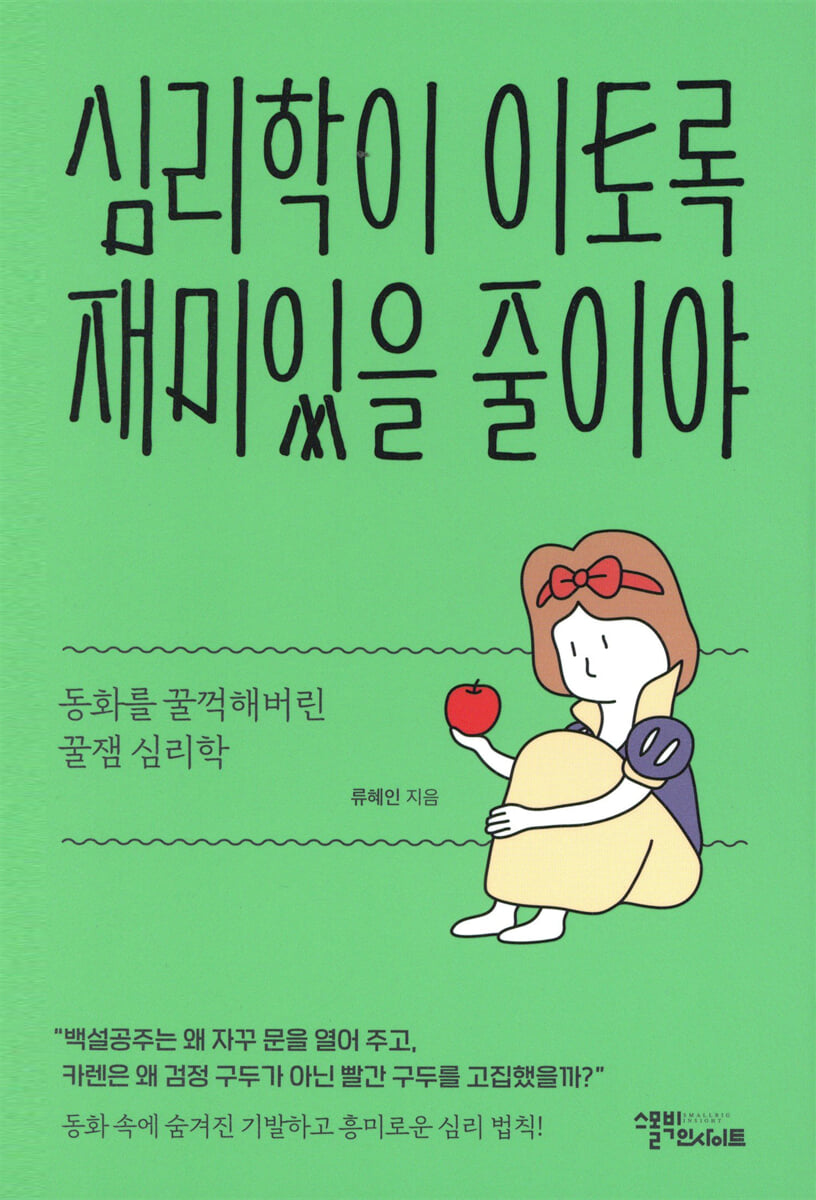
I never knew psychology could be this fun
 |
Description
Book Introduction
Psychology through fairy tales that provide both fun and knowledge!
There are many scenes and characters in the fairy tales I read as a child that are difficult to understand.
There's Snow White, who almost lost her life because she opened the door to strangers every time, and there's the fox who served food to cranes on a flat plate even though he knew they had long, sharp beaks.
However, even characters and scenes that are difficult to understand can be sufficiently explained through psychology.
Snow White needed the 'comfort of touch' due to her lack of affection, and the fox was not trying to trick the crane, but was caught up in the 'fictional consensus effect' of believing his own thoughts to be universally valid.
By using psychology in this way, we can easily explain the minds of the characters in fairy tales that were difficult to understand.
This book is one that teaches psychology in an easy and fun way through fairy tales we read as children.
So why bother explaining psychology through fairy tales?
That's because the worries and difficult situations the characters in fairy tales face are so similar to our lives.
We too need someone's affection, so we sometimes choose the wrong kind of love, and we sometimes make mistakes with others because we are too confident in our own judgment.
So, if we understand the minds of the characters in fairy tales, we can get hints that can help us solve our worries about work, relationships, and love.
Through this book, I will be able to experience the fun of psychology and solve my mental problems.
There are many scenes and characters in the fairy tales I read as a child that are difficult to understand.
There's Snow White, who almost lost her life because she opened the door to strangers every time, and there's the fox who served food to cranes on a flat plate even though he knew they had long, sharp beaks.
However, even characters and scenes that are difficult to understand can be sufficiently explained through psychology.
Snow White needed the 'comfort of touch' due to her lack of affection, and the fox was not trying to trick the crane, but was caught up in the 'fictional consensus effect' of believing his own thoughts to be universally valid.
By using psychology in this way, we can easily explain the minds of the characters in fairy tales that were difficult to understand.
This book is one that teaches psychology in an easy and fun way through fairy tales we read as children.
So why bother explaining psychology through fairy tales?
That's because the worries and difficult situations the characters in fairy tales face are so similar to our lives.
We too need someone's affection, so we sometimes choose the wrong kind of love, and we sometimes make mistakes with others because we are too confident in our own judgment.
So, if we understand the minds of the characters in fairy tales, we can get hints that can help us solve our worries about work, relationships, and love.
Through this book, I will be able to experience the fun of psychology and solve my mental problems.
- You can preview some of the book's contents.
Preview
index
01 What is right for me will surely be right for others.
The fictional consensus effect of [The Fox and the Crane]
02 Why should we be obsessed with the future when we are told to be happy now?
Delayed Gratification in [The Ant and the Grasshopper]
03 If you want to be good at persuading, you have to start well.
[Cowardly Bat]'s anchoring effect
04 The more people there are to help, the less they help.
The Bystander Effect in The Little Match Girl
05 The hunger of the heart is more painful than the hunger of the body.
[Snow White]'s comforting touch
06 Why does the team I support always lose?
The illusory correlation between the rooster and the worker
07 When you want to make a big request, start with a small request.
Technique for stepping into the doorway of [the sun and moon]
08 Why You Should Look at the Situation, Not the Person
The Fundamental Attribution Error in [The Rich Man and the Donkey]
09 The more you tell me not to do something, the more I want to do it.
The psychological backlash of [Red Shoes]
10 The best choice is better than the best choice
The Law of the Satisfied in The Little Mermaid
11. Offer help whenever you have the chance.
The Law of Reciprocity in [The Stork's Judgment]
12 As the group grows larger, individuals put less effort into it.
The Ringelmann effect of [shortened pants]
13 The psychology of relying on people who are better than you
The Reflected Glory Effect of [The Unbelievable Scholar]
14 As frustration increases, so does aggression.
The Frustration-Attack Hypothesis of [The Fisherman and the Demon]
15 Psychological Reasons Why Clothes Become Wings
Stereotypes and prejudices in [Scholar's Clothes]
16 Even rational people love fake news.
Confirmation bias in [The Magistrate's Verdict]
17 An impatient personality causes heart disease.
Type A behavioral type in [Wind and Sun]
18 Reasons Why Third Place is Happier than Second Place
The Frame Effect of [The Umbrella Seller and the Straw Sandal Seller]
19 It's better to be wrong than to be bullied
The Sympathy Effect of [The Emperor's New Clothes]
20 Everything I choose must be right.
Cognitive dissonance in [The Fox and the Grapes]
21 If you have a pretty face, you will also have a pretty personality.
The Halo Effect in [Cinderella]
22 Perfect love requires three things:
The Triangular Theory of Love in [Lion in Love]
23 A rotten box is more of a problem than a rotten apple.
The mock prison experiment in [Les Misérables]
24 Positivity makes even the last place first.
The Rosenthal Effect in Princess Pyeonggang and Ondal
25 Appropriate rewards and punishments determine the future.
Strengthening and Punishment of [The Boy Who Became a Thief]
The fictional consensus effect of [The Fox and the Crane]
02 Why should we be obsessed with the future when we are told to be happy now?
Delayed Gratification in [The Ant and the Grasshopper]
03 If you want to be good at persuading, you have to start well.
[Cowardly Bat]'s anchoring effect
04 The more people there are to help, the less they help.
The Bystander Effect in The Little Match Girl
05 The hunger of the heart is more painful than the hunger of the body.
[Snow White]'s comforting touch
06 Why does the team I support always lose?
The illusory correlation between the rooster and the worker
07 When you want to make a big request, start with a small request.
Technique for stepping into the doorway of [the sun and moon]
08 Why You Should Look at the Situation, Not the Person
The Fundamental Attribution Error in [The Rich Man and the Donkey]
09 The more you tell me not to do something, the more I want to do it.
The psychological backlash of [Red Shoes]
10 The best choice is better than the best choice
The Law of the Satisfied in The Little Mermaid
11. Offer help whenever you have the chance.
The Law of Reciprocity in [The Stork's Judgment]
12 As the group grows larger, individuals put less effort into it.
The Ringelmann effect of [shortened pants]
13 The psychology of relying on people who are better than you
The Reflected Glory Effect of [The Unbelievable Scholar]
14 As frustration increases, so does aggression.
The Frustration-Attack Hypothesis of [The Fisherman and the Demon]
15 Psychological Reasons Why Clothes Become Wings
Stereotypes and prejudices in [Scholar's Clothes]
16 Even rational people love fake news.
Confirmation bias in [The Magistrate's Verdict]
17 An impatient personality causes heart disease.
Type A behavioral type in [Wind and Sun]
18 Reasons Why Third Place is Happier than Second Place
The Frame Effect of [The Umbrella Seller and the Straw Sandal Seller]
19 It's better to be wrong than to be bullied
The Sympathy Effect of [The Emperor's New Clothes]
20 Everything I choose must be right.
Cognitive dissonance in [The Fox and the Grapes]
21 If you have a pretty face, you will also have a pretty personality.
The Halo Effect in [Cinderella]
22 Perfect love requires three things:
The Triangular Theory of Love in [Lion in Love]
23 A rotten box is more of a problem than a rotten apple.
The mock prison experiment in [Les Misérables]
24 Positivity makes even the last place first.
The Rosenthal Effect in Princess Pyeonggang and Ondal
25 Appropriate rewards and punishments determine the future.
Strengthening and Punishment of [The Boy Who Became a Thief]
Into the book
In Aesop's well-known fable, [The Fox and the Crane], the fox appears as the seed of conflict.
When a crane is invited into the house and served soup on a flat plate, the crane cannot eat the soup.
Moreover, he deserves to be criticized for eating the soup that the cranes couldn't eat.
But why did the fox do such a thing? Perhaps it was simply a 'misunderstanding.'
This is because of what is called the 'fictitious consensus effect' in psychology.
The fictitious consensus effect refers to the false belief that others will behave in the same way because we believe that our thoughts are universally valid.
--- p.17
In the story [The Ant and the Grasshopper], the ants work continuously without resting on hot summer days to prepare for the cold winter.
On the other hand, it can be said that Bejjangi lived his life focusing more on present happiness.
There are no right answers in life.
Some say, "Don't sacrifice your present happiness for future happiness," while others say, "Prepare now for future happiness."
If you don't know the answer, you should try to be aware of where your happiness ultimately lies at every moment.
--- p.31
Why on earth did Snow White always open her door to strangers, despite the dwarves' earnest pleas? It was probably because of loneliness.
Snow White lost her mother shortly after she was born.
Besides, her father was the king of a country and had no time to look after Snow White himself.
In this environment, Snow White desperately wanted to make 'contact' with someone.
Snow White opened the door to strangers every time because she needed what psychology calls 'contact comfort'.
--- p.56
The place where the Little Mermaid was born, that is, the Little Mermaid's 'group', is the world of mermaids under the sea.
But the group that the Little Mermaid wants to belong to is the human world outside the sea.
Here, the human world serves as the criterion for the Little Mermaid's selection, and is called the Little Mermaid's 'reference group'.
A reference group is a group that serves as a standard for a person's actions, thoughts, and choices.
In other words, the reason the Little Mermaid loved a human prince and eventually disappeared into the sea was because the Little Mermaid's reference group was in the world outside the sea.
--- p.106
It's common to see people saying things like, "That friend went to my high school" or "I took a picture with that person before" when watching a celebrity on TV.
But no one looks at a serial killer and says, "I was close with that guy when I was a kid."
This is due to what is called the 'reflected glory effect' in psychology.
The reflected glory effect is when you let people around you know that you are connected to a successful person, making your image look as good as that person.
--- p.135
The degree of unanimity among group members on an issue also has a significant impact on consensus.
If even one person disagrees with the overall opinion, the conformity effect is drastically weakened.
[The Emperor's New Clothes] In the fairy tale, when a boy behaved differently from the people, the people started gossiping, "The emperor is naked!"
As unanimity of opinion became impossible, the strength of agreement weakened.
When a crane is invited into the house and served soup on a flat plate, the crane cannot eat the soup.
Moreover, he deserves to be criticized for eating the soup that the cranes couldn't eat.
But why did the fox do such a thing? Perhaps it was simply a 'misunderstanding.'
This is because of what is called the 'fictitious consensus effect' in psychology.
The fictitious consensus effect refers to the false belief that others will behave in the same way because we believe that our thoughts are universally valid.
--- p.17
In the story [The Ant and the Grasshopper], the ants work continuously without resting on hot summer days to prepare for the cold winter.
On the other hand, it can be said that Bejjangi lived his life focusing more on present happiness.
There are no right answers in life.
Some say, "Don't sacrifice your present happiness for future happiness," while others say, "Prepare now for future happiness."
If you don't know the answer, you should try to be aware of where your happiness ultimately lies at every moment.
--- p.31
Why on earth did Snow White always open her door to strangers, despite the dwarves' earnest pleas? It was probably because of loneliness.
Snow White lost her mother shortly after she was born.
Besides, her father was the king of a country and had no time to look after Snow White himself.
In this environment, Snow White desperately wanted to make 'contact' with someone.
Snow White opened the door to strangers every time because she needed what psychology calls 'contact comfort'.
--- p.56
The place where the Little Mermaid was born, that is, the Little Mermaid's 'group', is the world of mermaids under the sea.
But the group that the Little Mermaid wants to belong to is the human world outside the sea.
Here, the human world serves as the criterion for the Little Mermaid's selection, and is called the Little Mermaid's 'reference group'.
A reference group is a group that serves as a standard for a person's actions, thoughts, and choices.
In other words, the reason the Little Mermaid loved a human prince and eventually disappeared into the sea was because the Little Mermaid's reference group was in the world outside the sea.
--- p.106
It's common to see people saying things like, "That friend went to my high school" or "I took a picture with that person before" when watching a celebrity on TV.
But no one looks at a serial killer and says, "I was close with that guy when I was a kid."
This is due to what is called the 'reflected glory effect' in psychology.
The reflected glory effect is when you let people around you know that you are connected to a successful person, making your image look as good as that person.
--- p.135
The degree of unanimity among group members on an issue also has a significant impact on consensus.
If even one person disagrees with the overall opinion, the conformity effect is drastically weakened.
[The Emperor's New Clothes] In the fairy tale, when a boy behaved differently from the people, the people started gossiping, "The emperor is naked!"
As unanimity of opinion became impossible, the strength of agreement weakened.
--- p.195
Publisher's Review
A fun psychology that will make you swallow a fairy tale!
People think of fairy tales simply as 'stories for children to read'.
Perhaps it is because the fairy tale is a bit exaggerated and forced to fit the child's level.
However, no other genre depicts human psychology as diversely and delicately as fairy tales.
Many of the characters and scenes in fairy tales are very similar to the various worries and problems we face in life.
Snow White, who always opens her door to strangers and ends up in danger, is a symbol of human loneliness, and the Little Match Girl, who freezes to death in the bitter cold without receiving help from others, is a reflection of the human psyche that is reluctant to step forward unless it is her own business.
And what about the little mermaid, who, despite knowing the prince didn't love her, couldn't give up on her love and ultimately vanished into thin air? These three stories are explained in this book using the psychological laws of "contact comfort," "the bystander effect," and "the law of satisfiers."
This book reflects our lives through characters and scenes from fairy tales.
And those images are explained in a way that is easy and fun to understand using psychology.
Through this book, readers will be able to easily learn psychology that can directly help their lives.
All of life's problems can be solved with the psychological laws of fairy tales!
Psychology is the study of the human mind.
So, learning psychology can be very helpful in solving various problems that arise in life.
The problem is that there aren't many books that teach psychology in an easy and fun way.
Accordingly, from the time I first studied psychology, I thought about how I could convey psychology to people in an easy and interesting way.
Then, I thought that if we used the 'fairy tales' we read as children, we could convey psychology, which can be considered difficult, to readers in an easy and fun way.
This book is the result of a long effort to make that idea a reality.
If we take a close look at the psychological states of the characters in the twenty-five fairy tales excerpted from this book, we can easily see that they are not much different from the problems we face in our daily lives.
Therefore, analyzing and explaining the problems of fairy tale characters from a psychological perspective directly helps us solve the worries and problems we face.
This book is fun, informative, and useful by using fairy tales to explain psychology.
For those who are new to psychology or find it difficult, this book will provide a variety of knowledge and new interest in psychology.
Additionally, psychological interpretations and explanations of fairy tale characters will provide fresh and bright hints that can help us solve various problems we face in life.
People think of fairy tales simply as 'stories for children to read'.
Perhaps it is because the fairy tale is a bit exaggerated and forced to fit the child's level.
However, no other genre depicts human psychology as diversely and delicately as fairy tales.
Many of the characters and scenes in fairy tales are very similar to the various worries and problems we face in life.
Snow White, who always opens her door to strangers and ends up in danger, is a symbol of human loneliness, and the Little Match Girl, who freezes to death in the bitter cold without receiving help from others, is a reflection of the human psyche that is reluctant to step forward unless it is her own business.
And what about the little mermaid, who, despite knowing the prince didn't love her, couldn't give up on her love and ultimately vanished into thin air? These three stories are explained in this book using the psychological laws of "contact comfort," "the bystander effect," and "the law of satisfiers."
This book reflects our lives through characters and scenes from fairy tales.
And those images are explained in a way that is easy and fun to understand using psychology.
Through this book, readers will be able to easily learn psychology that can directly help their lives.
All of life's problems can be solved with the psychological laws of fairy tales!
Psychology is the study of the human mind.
So, learning psychology can be very helpful in solving various problems that arise in life.
The problem is that there aren't many books that teach psychology in an easy and fun way.
Accordingly, from the time I first studied psychology, I thought about how I could convey psychology to people in an easy and interesting way.
Then, I thought that if we used the 'fairy tales' we read as children, we could convey psychology, which can be considered difficult, to readers in an easy and fun way.
This book is the result of a long effort to make that idea a reality.
If we take a close look at the psychological states of the characters in the twenty-five fairy tales excerpted from this book, we can easily see that they are not much different from the problems we face in our daily lives.
Therefore, analyzing and explaining the problems of fairy tale characters from a psychological perspective directly helps us solve the worries and problems we face.
This book is fun, informative, and useful by using fairy tales to explain psychology.
For those who are new to psychology or find it difficult, this book will provide a variety of knowledge and new interest in psychology.
Additionally, psychological interpretations and explanations of fairy tale characters will provide fresh and bright hints that can help us solve various problems we face in life.
GOODS SPECIFICS
- Publication date: August 30, 2021
- Page count, weight, size: 256 pages | 290g | 130*188*20mm
- ISBN13: 9791191731057
- ISBN10: 1191731057
You may also like
카테고리
korean


korean

![GQ KOREA Mark (Monthly): December [2025]](http://librairie.coreenne.fr/cdn/shop/files/8ef265dbbfbf186523ed75ba7319009d.jpg?v=1765340328&width=3840)


