

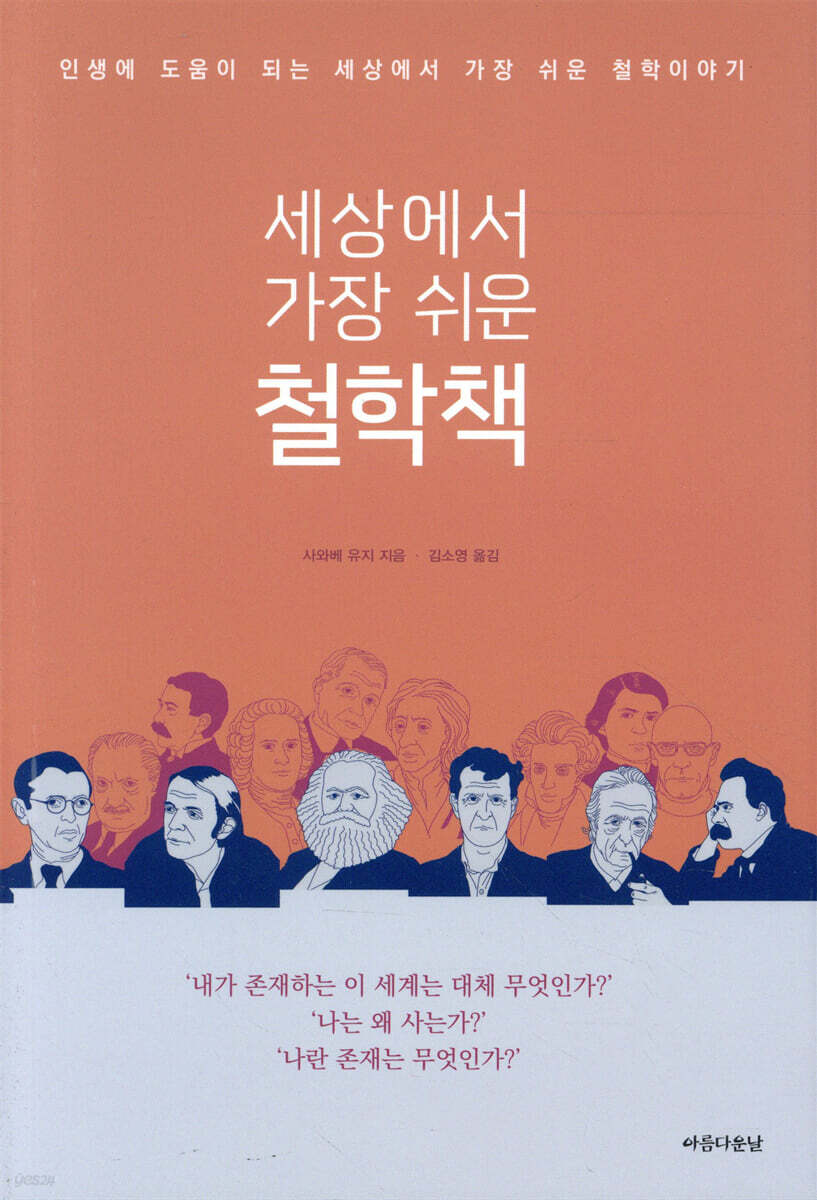
The easiest philosophy book in the world
 |
Description
Book Introduction
Philosophy is the study of wisdom and truth!
The world's easiest philosophy stories to help you in life
A collection of the thoughts of 32 Western philosophers.
Philosophy is the study of wisdom and truth.
‘What is this world I exist in?’ ‘Why do I live?’ ‘What am I in the first place?’ Probably everyone has thought about these things at least once.
Philosophy began with the desire to explore the 'truth' in response to simple questions that suddenly arose.
This book brings together the thoughts of 32 Western philosophers who faced these questions that people are curious about.
From ancient Greece to the present, the core ideas of major philosophers are pointed out and explained one by one with illustrations.
Philosophy did not arise out of thin air without any foreshadowing.
There is a 'flow' to how philosophy has come to this point.
How did Descartes say 'I think'?
How did we arrive at the proposition, "Therefore, I am?" Knowing the flow of events that led to that proposition will make you feel a little more familiar with philosophy.
This book follows the 'flow' step by step, taking into account the relationship between philosophers and the historical background.
When examining the thoughts of philosophers, there are many parts that make you nod in agreement. 'Everyone has a different perspective on things', 'I, who think this way, definitely exist', 'This apple can be said to exist because others say it exists'. In these ways, philosophy has the power to make us believe that it is at least 'true'.
When the 'truth' is revealed, my way of thinking will change, and my perspective on the world will also change.
The world's easiest philosophy stories to help you in life
A collection of the thoughts of 32 Western philosophers.
Philosophy is the study of wisdom and truth.
‘What is this world I exist in?’ ‘Why do I live?’ ‘What am I in the first place?’ Probably everyone has thought about these things at least once.
Philosophy began with the desire to explore the 'truth' in response to simple questions that suddenly arose.
This book brings together the thoughts of 32 Western philosophers who faced these questions that people are curious about.
From ancient Greece to the present, the core ideas of major philosophers are pointed out and explained one by one with illustrations.
Philosophy did not arise out of thin air without any foreshadowing.
There is a 'flow' to how philosophy has come to this point.
How did Descartes say 'I think'?
How did we arrive at the proposition, "Therefore, I am?" Knowing the flow of events that led to that proposition will make you feel a little more familiar with philosophy.
This book follows the 'flow' step by step, taking into account the relationship between philosophers and the historical background.
When examining the thoughts of philosophers, there are many parts that make you nod in agreement. 'Everyone has a different perspective on things', 'I, who think this way, definitely exist', 'This apple can be said to exist because others say it exists'. In these ways, philosophy has the power to make us believe that it is at least 'true'.
When the 'truth' is revealed, my way of thinking will change, and my perspective on the world will also change.
- You can preview some of the book's contents.
Preview
index
Chapter 1: The Philosopher Who Created Philosophy
Before reading this chapter · 12
Thales, the first philosopher to consider the origin of the world · 14
Socrates: Seek Truth with the Wisdom of Ignorance! · 23
Plato: Where does the essence of things (=ideas) lie? · 33
Aristotle Alone Explains the World · 43
Epicurus: The highest pleasure for humans is wisdom · 53
Chapter 2: Philosophers Who Created Modern Thought
Before reading this chapter · 64
Throw away your bacon bias and gain knowledge! · 66
Descartes: I exist, but does the world exist? · 76
Spinoza: Everything in this world is the appearance of God · 86
Locke: Humans are born with a blank slate · 96
Pascal: Man is weak, but he is great because he thinks · 106
Rousseau, the Enlightenment philosopher who said, "Emotions are better than reason" · 116
Kant's Objectivity is Created Within Subjectivity · 125
Hegel: Both Humans and Society Dialectically Move Toward the Ideal · 135
The contradictions of Marxist society are resolved through workers' revolution. · 144
Chapter 3: Philosophers Who Shake Up Modern Thought
Before Reading This Chapter · 156
Kierkegaard: Humans Can Live by Possibilities · 158
Nietzsche: Don't be a weakling! Be positive about life! · 168
Phenomenology: There is no truth or objectivity · 177
Freud: The human mind is controlled by the unconscious · 186
Existence Revealed Through Heidegger's Consideration · 196
Sartre: The Insignificant Self Can Be Transformed into a Meaningful Self · 205
Merleau-Ponty: Humans are one with the world through their bodies · 215
Bataille: Humans derive pleasure from consuming excess · 224
Perth knowledge becomes clear when actually used · 233
Wittgenstein's Theory of Thought and Language Game Theory · 242
Chapter 4: Philosophers Who Led Modern Thought
Before Reading This Chapter · 254
Saussure: Language Gives Order to the World · 256
Levi-Strauss: Society Has an Invisible Universal Structure · 265
Roland Barthes: Thrown into the Mythical World of Modernity · 275
Lacan: The human unconscious is made up of language · 285
Althusser: There is a human Marx and a scientific Marx · 294
Foucault Watches Himself · 304
Derrida's Thoughts and Says Are Disagreements · 313
Unlock the Possibilities of Desire with Deleuze's Nomad Thought! · 322
Conclusion · 332
Key References · 334
Before reading this chapter · 12
Thales, the first philosopher to consider the origin of the world · 14
Socrates: Seek Truth with the Wisdom of Ignorance! · 23
Plato: Where does the essence of things (=ideas) lie? · 33
Aristotle Alone Explains the World · 43
Epicurus: The highest pleasure for humans is wisdom · 53
Chapter 2: Philosophers Who Created Modern Thought
Before reading this chapter · 64
Throw away your bacon bias and gain knowledge! · 66
Descartes: I exist, but does the world exist? · 76
Spinoza: Everything in this world is the appearance of God · 86
Locke: Humans are born with a blank slate · 96
Pascal: Man is weak, but he is great because he thinks · 106
Rousseau, the Enlightenment philosopher who said, "Emotions are better than reason" · 116
Kant's Objectivity is Created Within Subjectivity · 125
Hegel: Both Humans and Society Dialectically Move Toward the Ideal · 135
The contradictions of Marxist society are resolved through workers' revolution. · 144
Chapter 3: Philosophers Who Shake Up Modern Thought
Before Reading This Chapter · 156
Kierkegaard: Humans Can Live by Possibilities · 158
Nietzsche: Don't be a weakling! Be positive about life! · 168
Phenomenology: There is no truth or objectivity · 177
Freud: The human mind is controlled by the unconscious · 186
Existence Revealed Through Heidegger's Consideration · 196
Sartre: The Insignificant Self Can Be Transformed into a Meaningful Self · 205
Merleau-Ponty: Humans are one with the world through their bodies · 215
Bataille: Humans derive pleasure from consuming excess · 224
Perth knowledge becomes clear when actually used · 233
Wittgenstein's Theory of Thought and Language Game Theory · 242
Chapter 4: Philosophers Who Led Modern Thought
Before Reading This Chapter · 254
Saussure: Language Gives Order to the World · 256
Levi-Strauss: Society Has an Invisible Universal Structure · 265
Roland Barthes: Thrown into the Mythical World of Modernity · 275
Lacan: The human unconscious is made up of language · 285
Althusser: There is a human Marx and a scientific Marx · 294
Foucault Watches Himself · 304
Derrida's Thoughts and Says Are Disagreements · 313
Unlock the Possibilities of Desire with Deleuze's Nomad Thought! · 322
Conclusion · 332
Key References · 334
Detailed image

Into the book
In ancient Greece, the world was explained entirely through mythology.
In response, the viewpoint that 'let's unravel this world ourselves without relying on myths' emerged, and this became the starting point of philosophy.
Therefore, the first philosophy originated from the question, 'What is this world made of?'
Thales, Heraclitus, Democritus, Pythagoras, and others answered this question.
Eventually, philosophy developed in Athens, the center of politics, economy, and culture. In the Athenian public square (Agora), intellectuals called Sophists gathered and engaged in heated debates to explore the truth of the world.
Meanwhile, Protagoras concluded that "the way people perceive things and their perspectives differ." In other words, this was relativism. The very effort to seek truth could be in vain.
The person who appeared at that time was Socrates. He appealed to the importance of seeking truth with the mindset of 'knowledge of ignorance', and shook up philosophy once again.
Socrates's spirit of inquiry in pursuit of truth was inherited by his disciples; Plato drew ideals, and Aristotle examined every nook and cranny of reality.
Aristotle achieved the great feat of systematically organizing the knowledge that existed until then, but this actually had a detrimental effect on the advancement of knowledge. Because of this, no philosopher since has surpassed Socrates, Plato, and Aristotle.
Afterwards, in Athens, which had completely declined due to the expeditions of Alexander the Great, new ideas emerged that focused on the lives of ordinary people, such as Zeno's asceticism and Epicurus' hedonism, which were different from those before.
---From "Before Reading Chapter 1"
Athens, the ancient Greek city that had borne sufficient fruit in terms of 'knowledge (ji, 知)', lost its former luster after being ruled by the Macedonian Kingdom of Alexander the Great and then by the Roman Empire.
After the collapse of the Roman Empire, the Middle Ages arrived.
European medieval society was centered around Christianity (Roman Catholic Church).
All disciplines, including philosophy, were absorbed into Christian theology.
Christian theology was completed by Thomas Aquinas in the 13th century, and his theological system is called Scholasticism.
Around the 16th century, academics and theology began to be separated.
Because the authority of the Roman Catholic Church, which had been powerful until then, began to decline.
The Renaissance was a period in which the culture of ancient Greece and Rome was re-examined and art and literature centered on humans emerged.
In the field of natural science, a clear picture of the world began to be presented based on experiments and observations.
And in philosophy, people who broke away from theology and explored the truth of this world appeared, and so-called modern philosophy was revived.
There are two major currents in modern philosophy.
British empiricism, beginning with Bacon and continuing with Locke, Berkeley, Hume, etc., and continental rationalism, beginning with Descartes and continuing with Spinoza and Leibniz.
The former is a style that finds general rules from a few samples, while the latter is a style that rationally derives the truth by piling up certain facts one by one.
In their pursuit of truth, they faced a great challenge: the question of whether the subjective and the objective were consistent.
To put it simply, it was a question of perception about whether we were correctly perceiving the world.
This problem was first concluded by Kant and Hegel in Germany.
Meanwhile, modern philosophy, strictly speaking, had nothing to do with real society, but Hegel was groundbreaking in that he created social thought (historical thought) by explaining the relationship between the self (subject) and society (object).
Marxism, which arose based on Hegel's ideas, had a tremendous influence on the era after the 19th century.
---From "Before Reading Chapter 2"
Let's review what we've talked about so far.
Ancient Greek philosophy raised the question, 'What is this world made of?'
In modern times, this problem was left to the rapidly developing natural sciences.
Instead, the central problem addressed by modern philosophy was the question of perception: 'Are we perceiving the world correctly?'
To put it simply, we can say that the issues dealt with in philosophy have shifted from the objective (the world) to the subjective (me).
In modern philosophy, the first person to reach a conclusion was Hegel.
He said, 'There is no need to think about objectivity.
He argued that 'everything is a world that appears through the consciousness of subjectivity.'
Then, by linking the problem of subjective perception with society and history, he expressed the idea that through the process of perception, humans, society, and history all approach the ideal.
This idea was developed by Marx and became the mainstream of thought in the 19th and 20th centuries.
If the thought that lies above that stream is called Hegelianism, then various forms of thought that do not belong to it and can be called anti-Hegelianism have emerged.
This chapter will cover existentialism from Kierkegaard, Heidegger, and Sartre, Nietzsche's philosophy of power, Husserl's phenomenology, Freud's unconscious, Merleau-Ponty's theory of the body, Bataille's eroticism, pragmatism developed in the United States, and Wittgenstein's theory of language games.
Although each theory seems to have developed separately by approaching philosophy in a different way, consciousness and unconsciousness, consciousness and body, and life and death can be viewed as opposing axes, and similar concerns can also be seen.
It can also be said that most of these thoughts have something in common in that they do not predict an ideal (truth), unlike Hegelianism which places an ideal (truth).
---From "Before Reading Chapter 3"
From the late 19th century to the 20th century, modern states accelerated capitalism, which in turn widened the gap between rich and poor.
This is the time when the problem of gap that we talk about in modern times has taken root.
Among the poor, complaints that their original humanity was being taken away by forced labor were spreading.
Marxism took up this discontent and rapidly spread it throughout the world.
Marxism influenced socialist countries such as the former Soviet Union, Eastern Europe, and China, but its negative aspects, such as its emphasis on equality and neglect of individual freedom, led to its gradual decline.
Structuralism emerged in France in the 1960s, replacing Marxism.
Structuralism is a way of thinking that says, 'In this society, there is a structure that we created without even knowing it, and we are defined by that structure, whether we know it or not.'
The source of structuralism was Saussure's linguistics, which disappeared half a century ago.
And in France in the 1960s, structuralists such as Levi-Strauss (cultural anthropology), Roland Barthes (semiotics), Lacan (psychoanalysis), and Althusser (philosophy) each drew a completely new picture of society in their respective fields of expertise.
However, the universal structure predicted by structuralism is something that cannot be changed no matter what humans do, and in a sense, it is positioned as truth.
The figures who emerged to criticize this are Foucault (history), Derrida (philosophy), and Deleuze (philosophy), who are called poststructuralists.
They differ from traditional structuralists in that they do not acknowledge the existence of truth.
Through keywords such as power, deconstruction, and diversity, they depicted the modern world we live in more precisely and in detail, and sought a new human attitude.
Furthermore, since the modern era, in which human self-consciousness pursued ideals, reached the point of mass murder seen in World War II, their thoughts also reveal a reflection on Western thought.
In response, the viewpoint that 'let's unravel this world ourselves without relying on myths' emerged, and this became the starting point of philosophy.
Therefore, the first philosophy originated from the question, 'What is this world made of?'
Thales, Heraclitus, Democritus, Pythagoras, and others answered this question.
Eventually, philosophy developed in Athens, the center of politics, economy, and culture. In the Athenian public square (Agora), intellectuals called Sophists gathered and engaged in heated debates to explore the truth of the world.
Meanwhile, Protagoras concluded that "the way people perceive things and their perspectives differ." In other words, this was relativism. The very effort to seek truth could be in vain.
The person who appeared at that time was Socrates. He appealed to the importance of seeking truth with the mindset of 'knowledge of ignorance', and shook up philosophy once again.
Socrates's spirit of inquiry in pursuit of truth was inherited by his disciples; Plato drew ideals, and Aristotle examined every nook and cranny of reality.
Aristotle achieved the great feat of systematically organizing the knowledge that existed until then, but this actually had a detrimental effect on the advancement of knowledge. Because of this, no philosopher since has surpassed Socrates, Plato, and Aristotle.
Afterwards, in Athens, which had completely declined due to the expeditions of Alexander the Great, new ideas emerged that focused on the lives of ordinary people, such as Zeno's asceticism and Epicurus' hedonism, which were different from those before.
---From "Before Reading Chapter 1"
Athens, the ancient Greek city that had borne sufficient fruit in terms of 'knowledge (ji, 知)', lost its former luster after being ruled by the Macedonian Kingdom of Alexander the Great and then by the Roman Empire.
After the collapse of the Roman Empire, the Middle Ages arrived.
European medieval society was centered around Christianity (Roman Catholic Church).
All disciplines, including philosophy, were absorbed into Christian theology.
Christian theology was completed by Thomas Aquinas in the 13th century, and his theological system is called Scholasticism.
Around the 16th century, academics and theology began to be separated.
Because the authority of the Roman Catholic Church, which had been powerful until then, began to decline.
The Renaissance was a period in which the culture of ancient Greece and Rome was re-examined and art and literature centered on humans emerged.
In the field of natural science, a clear picture of the world began to be presented based on experiments and observations.
And in philosophy, people who broke away from theology and explored the truth of this world appeared, and so-called modern philosophy was revived.
There are two major currents in modern philosophy.
British empiricism, beginning with Bacon and continuing with Locke, Berkeley, Hume, etc., and continental rationalism, beginning with Descartes and continuing with Spinoza and Leibniz.
The former is a style that finds general rules from a few samples, while the latter is a style that rationally derives the truth by piling up certain facts one by one.
In their pursuit of truth, they faced a great challenge: the question of whether the subjective and the objective were consistent.
To put it simply, it was a question of perception about whether we were correctly perceiving the world.
This problem was first concluded by Kant and Hegel in Germany.
Meanwhile, modern philosophy, strictly speaking, had nothing to do with real society, but Hegel was groundbreaking in that he created social thought (historical thought) by explaining the relationship between the self (subject) and society (object).
Marxism, which arose based on Hegel's ideas, had a tremendous influence on the era after the 19th century.
---From "Before Reading Chapter 2"
Let's review what we've talked about so far.
Ancient Greek philosophy raised the question, 'What is this world made of?'
In modern times, this problem was left to the rapidly developing natural sciences.
Instead, the central problem addressed by modern philosophy was the question of perception: 'Are we perceiving the world correctly?'
To put it simply, we can say that the issues dealt with in philosophy have shifted from the objective (the world) to the subjective (me).
In modern philosophy, the first person to reach a conclusion was Hegel.
He said, 'There is no need to think about objectivity.
He argued that 'everything is a world that appears through the consciousness of subjectivity.'
Then, by linking the problem of subjective perception with society and history, he expressed the idea that through the process of perception, humans, society, and history all approach the ideal.
This idea was developed by Marx and became the mainstream of thought in the 19th and 20th centuries.
If the thought that lies above that stream is called Hegelianism, then various forms of thought that do not belong to it and can be called anti-Hegelianism have emerged.
This chapter will cover existentialism from Kierkegaard, Heidegger, and Sartre, Nietzsche's philosophy of power, Husserl's phenomenology, Freud's unconscious, Merleau-Ponty's theory of the body, Bataille's eroticism, pragmatism developed in the United States, and Wittgenstein's theory of language games.
Although each theory seems to have developed separately by approaching philosophy in a different way, consciousness and unconsciousness, consciousness and body, and life and death can be viewed as opposing axes, and similar concerns can also be seen.
It can also be said that most of these thoughts have something in common in that they do not predict an ideal (truth), unlike Hegelianism which places an ideal (truth).
---From "Before Reading Chapter 3"
From the late 19th century to the 20th century, modern states accelerated capitalism, which in turn widened the gap between rich and poor.
This is the time when the problem of gap that we talk about in modern times has taken root.
Among the poor, complaints that their original humanity was being taken away by forced labor were spreading.
Marxism took up this discontent and rapidly spread it throughout the world.
Marxism influenced socialist countries such as the former Soviet Union, Eastern Europe, and China, but its negative aspects, such as its emphasis on equality and neglect of individual freedom, led to its gradual decline.
Structuralism emerged in France in the 1960s, replacing Marxism.
Structuralism is a way of thinking that says, 'In this society, there is a structure that we created without even knowing it, and we are defined by that structure, whether we know it or not.'
The source of structuralism was Saussure's linguistics, which disappeared half a century ago.
And in France in the 1960s, structuralists such as Levi-Strauss (cultural anthropology), Roland Barthes (semiotics), Lacan (psychoanalysis), and Althusser (philosophy) each drew a completely new picture of society in their respective fields of expertise.
However, the universal structure predicted by structuralism is something that cannot be changed no matter what humans do, and in a sense, it is positioned as truth.
The figures who emerged to criticize this are Foucault (history), Derrida (philosophy), and Deleuze (philosophy), who are called poststructuralists.
They differ from traditional structuralists in that they do not acknowledge the existence of truth.
Through keywords such as power, deconstruction, and diversity, they depicted the modern world we live in more precisely and in detail, and sought a new human attitude.
Furthermore, since the modern era, in which human self-consciousness pursued ideals, reached the point of mass murder seen in World War II, their thoughts also reveal a reflection on Western thought.
---From "Before Reading Chapter 4"
GOODS SPECIFICS
- Date of issue: May 10, 2021
- Page count, weight, size: 336 pages | 598g | 140*205*30mm
- ISBN13: 9791167090010
- ISBN10: 1167090012
You may also like
카테고리
korean


korean

![GQ KOREA Mark (Monthly): December [2025]](http://librairie.coreenne.fr/cdn/shop/files/8ef265dbbfbf186523ed75ba7319009d.jpg?v=1765340328&width=3840)


