

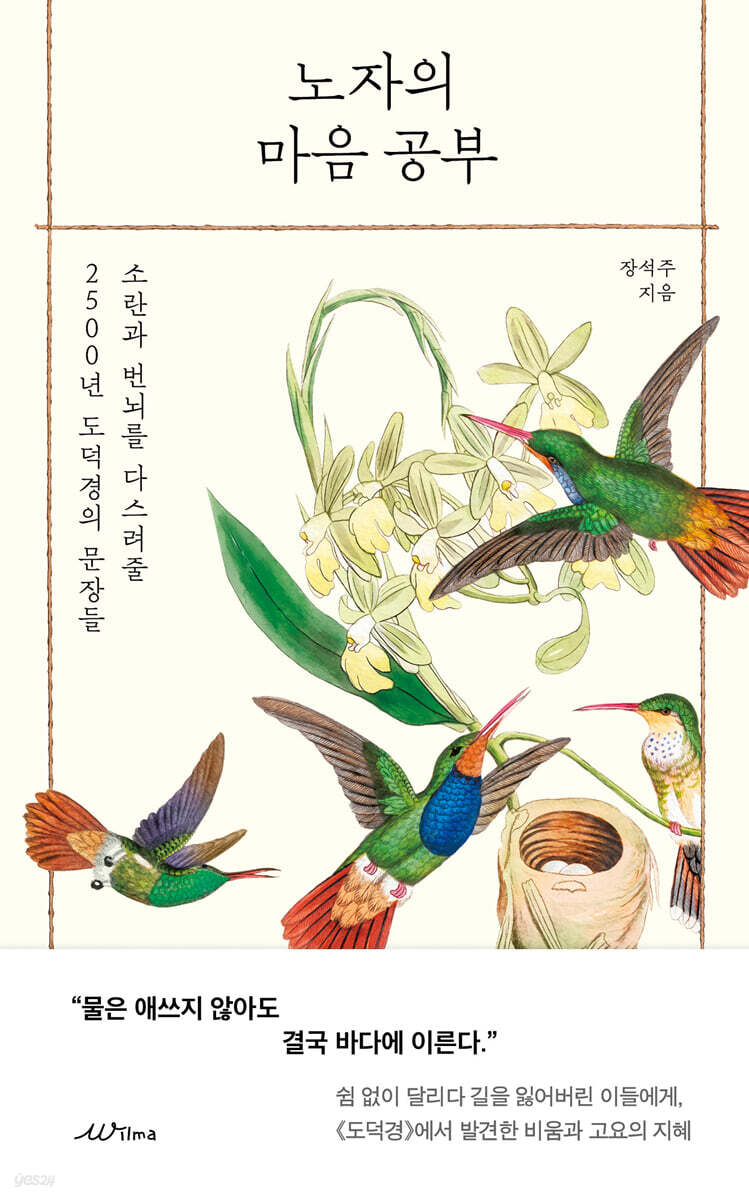
Studying Lao Tzu's mind
 |
Description
Book Introduction
“Information, relationships, competition, goals…
In an age of excess, there is no philosophy of life more certain than Lao Tzu.
To those who have lost their way while running without rest,
The 2,500-year-old Tao Te Ching's noble answer to the question "How should we live?"
★★★ Lao Tzu, a philosopher who inspired countless thinkers from both the East and the West, including Hegel and Tolstoy
★★★ A curated book of 34 chapters from the 81 chapters of the Tao Te Ching that are essential for modern people.
We all live in an age of excess.
Not only material and information, but also relationships, competition, and even life goals overflow.
We believe that we have to do more and have more to keep up, and we end up exhausted after days of being busy trying to fill something up.
It is no exaggeration to say that the anxiety and fatigue of countless modern people stem from this endless 'obsession with filling up.'
What is needed at this time is not greater compensation, but the wisdom to let go and empty oneself.
In an age of excess, emptiness can become more than an attitude; it can become a philosophy.
Lao Tzu's "Tao Te Ching," which is considered a classic in both the East and the West and has been read for over 2,500 years, talks about "emptiness and inaction."
The original order of life is revealed in an attitude of emptiness, non-forcing, non-possession, and non-dominant.
This book, "Studying Lao-tzu's Heart," selects 34 of the 81 chapters of the Tao Te Ching that resonate most with modern people, identifies the core ideas of each chapter, and connects the author's interpretation to today's reality.
Jang Seok-ju, a literary critic known for his prose and author who says he regained peace by studying Lao-tzu's thoughts whenever he had time for over a decade, says, "When life loses direction, you have to go back to the basics, and those basics are always in Lao-tzu's "Tao Te Ching."
As the author's words transform the difficult phrases of the classics into the language of our lives, we will discover wisdom still valid in the ancient voice of Lao-tzu.
“Whenever my mind becomes distracted and I become impatient, I take out the Tao Te Ching.
For example, this morning, I happened to open it and there were 64 pages.
'It is easy to guard when it is at ease, easy to plot when there are no signs, the soft is easy to break, the weak is easy to scatter (其安易持, 其未兆易謀, 其脆易泮 其微易散).' I recite this all day long and try to understand its meaning.
In the meantime, my mind gradually becomes peaceful.” _From the text
In an age of excess, there is no philosophy of life more certain than Lao Tzu.
To those who have lost their way while running without rest,
The 2,500-year-old Tao Te Ching's noble answer to the question "How should we live?"
★★★ Lao Tzu, a philosopher who inspired countless thinkers from both the East and the West, including Hegel and Tolstoy
★★★ A curated book of 34 chapters from the 81 chapters of the Tao Te Ching that are essential for modern people.
We all live in an age of excess.
Not only material and information, but also relationships, competition, and even life goals overflow.
We believe that we have to do more and have more to keep up, and we end up exhausted after days of being busy trying to fill something up.
It is no exaggeration to say that the anxiety and fatigue of countless modern people stem from this endless 'obsession with filling up.'
What is needed at this time is not greater compensation, but the wisdom to let go and empty oneself.
In an age of excess, emptiness can become more than an attitude; it can become a philosophy.
Lao Tzu's "Tao Te Ching," which is considered a classic in both the East and the West and has been read for over 2,500 years, talks about "emptiness and inaction."
The original order of life is revealed in an attitude of emptiness, non-forcing, non-possession, and non-dominant.
This book, "Studying Lao-tzu's Heart," selects 34 of the 81 chapters of the Tao Te Ching that resonate most with modern people, identifies the core ideas of each chapter, and connects the author's interpretation to today's reality.
Jang Seok-ju, a literary critic known for his prose and author who says he regained peace by studying Lao-tzu's thoughts whenever he had time for over a decade, says, "When life loses direction, you have to go back to the basics, and those basics are always in Lao-tzu's "Tao Te Ching."
As the author's words transform the difficult phrases of the classics into the language of our lives, we will discover wisdom still valid in the ancient voice of Lao-tzu.
“Whenever my mind becomes distracted and I become impatient, I take out the Tao Te Ching.
For example, this morning, I happened to open it and there were 64 pages.
'It is easy to guard when it is at ease, easy to plot when there are no signs, the soft is easy to break, the weak is easy to scatter (其安易持, 其未兆易謀, 其脆易泮 其微易散).' I recite this all day long and try to understand its meaning.
In the meantime, my mind gradually becomes peaceful.” _From the text
- You can preview some of the book's contents.
Preview
index
Preface_ Time to Read Lao Tzu
Chapter 1: Live Like Water
He Who Mourns Wins - Chapter 69 of the Tao Te Ching
When a worthless person hears the Tao, he laughs loudly - Chapter 41 of the Tao Te Ching
To live well, empty your greed - Chapter 19 of the Tao Te Ching
The Tao Does Not Claim Itself Great - Chapter 34 of the Tao Te Ching
He who knows himself is wise - Chapter 33 of the Tao Te Ching
Seek Nameless Simplicity - Chapter 37 of the Tao Te Ching
Live Like Water - Chapter 8 of the Tao Te Ching
What is straight appears crooked - Chapter 45 of the Tao Te Ching
If it rolls smoothly, it leaves no ruts. _Tao Te Ching, Chapter 27
The weak overcome the strong - Chapter 78 of the Tao Te Ching
The Tao follows nature _ Chapter 25 of the Tao Te Ching
Chapter 2: Ultimately, returning to the roots is clarity and tranquility.
Knowing Contentment Leaves No Discontent - Chapter 44 of the Tao Te Ching
If I had wisdom, I would take the main road. _Tao Te Ching, Chapter 53
Crossing the Ice-Covered Winter - Chapter 15 of the Tao Te Ching
The reason the world knows beauty is because there is ugliness - Chapter 2 of the Tao Te Ching
Compassion Can Be Bravery - Chapter 67 of the Tao Te Ching
The Tao is always nameless - Chapter 32 of the Tao Te Ching
Steaming a small fish - Chapter 60 of the Tao Te Ching
Take root, but make it strong - Chapter 59 of the Tao Te Ching
The virtue is so deep that it is like a newborn baby - Chapter 55 of the Tao Te Ching
Ultimately, returning to the roots is clarity and tranquility. _Tao Te Ching, Chapter 16
To be frugal with words is a natural virtue. _Tao Te Ching, Chapter 23
If it's high, press it down; if it's low, lift it up - Chapter 77 of the Tao Te Ching
Chapter 3: Big bowls are made late.
Shine but Don't Flash _Tao Te Ching, Chapter 58
The Root of All Being is Nothingness - Chapter 40 of the Tao Te Ching
A great vessel is made late - Chapter 41 of the Tao Te Ching
Heaven's net is wide and narrow, yet it misses nothing. _Tao Te Ching, Chapter 73
When you stop learning, there is no worry - Chapter 20 of the Tao Te Ching
Cannot stand on one's heels for long - Chapter 24 of the Tao Te Ching
Wearing sackcloth and embracing jade - Chapter 70 of the Tao Te Ching
Returning to Simplicity _ Chapter 28 of the Tao Te Ching
Great Virtue is Empty - Chapter 21 of the Tao Te Ching
Heaven and Earth Are Unkind - Chapter 5 of the Tao Te Ching
People are born, live, and die - Chapter 50 of the Tao Te Ching
Chapter 1: Live Like Water
He Who Mourns Wins - Chapter 69 of the Tao Te Ching
When a worthless person hears the Tao, he laughs loudly - Chapter 41 of the Tao Te Ching
To live well, empty your greed - Chapter 19 of the Tao Te Ching
The Tao Does Not Claim Itself Great - Chapter 34 of the Tao Te Ching
He who knows himself is wise - Chapter 33 of the Tao Te Ching
Seek Nameless Simplicity - Chapter 37 of the Tao Te Ching
Live Like Water - Chapter 8 of the Tao Te Ching
What is straight appears crooked - Chapter 45 of the Tao Te Ching
If it rolls smoothly, it leaves no ruts. _Tao Te Ching, Chapter 27
The weak overcome the strong - Chapter 78 of the Tao Te Ching
The Tao follows nature _ Chapter 25 of the Tao Te Ching
Chapter 2: Ultimately, returning to the roots is clarity and tranquility.
Knowing Contentment Leaves No Discontent - Chapter 44 of the Tao Te Ching
If I had wisdom, I would take the main road. _Tao Te Ching, Chapter 53
Crossing the Ice-Covered Winter - Chapter 15 of the Tao Te Ching
The reason the world knows beauty is because there is ugliness - Chapter 2 of the Tao Te Ching
Compassion Can Be Bravery - Chapter 67 of the Tao Te Ching
The Tao is always nameless - Chapter 32 of the Tao Te Ching
Steaming a small fish - Chapter 60 of the Tao Te Ching
Take root, but make it strong - Chapter 59 of the Tao Te Ching
The virtue is so deep that it is like a newborn baby - Chapter 55 of the Tao Te Ching
Ultimately, returning to the roots is clarity and tranquility. _Tao Te Ching, Chapter 16
To be frugal with words is a natural virtue. _Tao Te Ching, Chapter 23
If it's high, press it down; if it's low, lift it up - Chapter 77 of the Tao Te Ching
Chapter 3: Big bowls are made late.
Shine but Don't Flash _Tao Te Ching, Chapter 58
The Root of All Being is Nothingness - Chapter 40 of the Tao Te Ching
A great vessel is made late - Chapter 41 of the Tao Te Ching
Heaven's net is wide and narrow, yet it misses nothing. _Tao Te Ching, Chapter 73
When you stop learning, there is no worry - Chapter 20 of the Tao Te Ching
Cannot stand on one's heels for long - Chapter 24 of the Tao Te Ching
Wearing sackcloth and embracing jade - Chapter 70 of the Tao Te Ching
Returning to Simplicity _ Chapter 28 of the Tao Te Ching
Great Virtue is Empty - Chapter 21 of the Tao Te Ching
Heaven and Earth Are Unkind - Chapter 5 of the Tao Te Ching
People are born, live, and die - Chapter 50 of the Tao Te Ching
Detailed image

Into the book
The basis of the Tao Te Ching is ‘doing nothing and letting things happen naturally.’
Nature is like that by nature, it is like that by itself.
Nature runs smoothly without human intervention.
Birds fly in the air, fish play in the water, and all kinds of four-legged animals live on the land.
When the time comes, they grow and multiply.
While all plants and animals adapt to the natural world and survive, humans try to change it by adding their own strength.
Human civilization can be said to be the result of oppression and subjugation of nature.
Today's unprecedented climate crisis is a disaster that has come at such a cost.
Lao-tzu's teachings, which originated from the Taoist principle of nature, are still worthy of attention in modern times.
Humanity must heed the ancient wisdom of the Tao Te Ching and realize its necessity for poetic inspiration.
--- p.18~19
A great general shows compassion by making an effort to step back.
This compassion embodies the Tao of non-action that Lao Tzu speaks of.
He said, “He who mourns wins,” and he who mourns is the one who is compassionate.
“If you fight with compassion, you will win, and if you defend with compassion, you will be strong (夫慈以戰則勝, 以守則固)” (Tao Te Ching, Chapter 67) If we look closely at the days we live, we can see that they are a series of battles.
To win a fight, you must deliberately avoid harm and always humble yourself.
Humility is not showing off oneself, and it reveals its true value in not fighting with others.
Even if an argument arises, back off and embrace it with affection rather than getting angry.
This is the practice of Tao and the exercise of virtue.
He who embraces his enemies with compassion and mourns them will surely win.
--- p.39~40
Therefore, if you want to be at peace, you must let go of your greed.
Greed is the beginning of disaster.
Anyone who wants to live in simplicity must first empty themselves of their greed.
People expect that if they eat and drink and fill their stomachs, their desires will be fulfilled and their lives will prosper, but that is not life, it is a shackle that binds life.
The act of not putting food into the body is against desire.
This comes from will and determination.
If your will is weak, you cannot resist the desires that rise within you.
Rather, desire will overwhelm and bind that being.
My existence is the sum total of my will and passion to complete a life that transcends desire.
Inaction and desire are the two axes that support existence.
If emptiness and stillness are inaction, desire is longing for something and dedicating one's existence to it.
People say it is natural to desire something and strive to obtain it, but Lao Tzu advises to seek inaction and simplicity.
“If you have no desires and are calm, the world will naturally become righteous (不欲以靜, 天下將自).” Therefore, it is wise to empty oneself of desires [虛] and live in calm [靜].
--- p.81~82
Laozi, Mencius, and Confucius all loved water.
They enjoyed contemplating water and always praised its virtues.
Why did the sages of the East love water? Because water is the source of life.
Water springs up from the ground and flows without drying up, nourishing all kinds of plants.
Water generously provides for all living things and makes the earth fertile, but it does not claim its own virtue.
The sages of the East marveled at the inaction of water and saw the Tao arise in the physiology of water.
--- p.86~87
In Lao Tzu's system of thought, this is an event that arises from the irony that right is opposite.
The straight becomes perfect by embracing the crooked, and the truly strong embrace the fragile within.
The front becomes complete by embracing the back.
What is bright seems dark, what goes forward seems to go backward, and what is high seems to go down.
Everything that is white seems to be stained, everything that is wide seems narrow, and loud sounds are not heard by the ears.
This is the true nature of virtue as Lao Tzu speaks of it.
The fundamental function of Tao and virtue is to achieve harmony.
Those who achieve great things, are great in everything, are great in uprightness, have great skill, and speak well have already reached the Way and achieved virtue.
Daeseong (大成), Daeyeong (大盈), Daejik (大直), Daegyo (大巧), and Daebyeon (大辯) contain within them the opposite qualities of Yakgyeol (若缺), Yakchung (若沖), Yakgul (若屈), Yakjol (若拙), and Yaknul (若訥).
Things that are in conflict become whole by embracing them.
Therefore, what is perfect seems flawed, what is full seems empty, what is straight seems crooked, what is skilled seems clumsy, and what is eloquent seems clumsy.
--- p.97~98
Lao Tzu also recommends emptiness and stillness.
Tranquility is a core value of Lao Tzu's philosophy.
'Heo' means emptiness, and 'jeong' means stillness.
In the midst of the utmost emptiness, affection dwells.
Emptiness and silence are not separate, but move as one.
This is because you have to empty yourself to become still, and you have to become still to become empty.
Eastern philosophers have always considered poverty a virtue in life.
Poverty doesn't just mean not having money.
Poverty has internal and external aspects. Externally, it means having less, and internally, it means having less desires.
If you are poor in spirit, you can live simply.
Be free from greed and obsession.
That is why poverty becomes a virtue.
Only the poor in spirit are free from the trap of material things.
If you have a desire to have more, you will always be poor; if you are content with less, you are already rich.
Why is emptiness necessary in life? When we let go, empty ourselves, and possess less, our suffering diminishes.
Conversely, if you have too much, your worries will increase.
This is a very clear and simple truth.
By reducing your spending and being content with small possessions, you can prevent money from being wasted.
Money is an essential resource for living, but the moment you make it your life's purpose, your life becomes miserable.
The important thing in life is not to accumulate a lot of wealth, but to nurture health and life.
It is also about living a vibrant life, pursuing rewards and values, and striving for the gradual evolution of the soul.
Nature is like that by nature, it is like that by itself.
Nature runs smoothly without human intervention.
Birds fly in the air, fish play in the water, and all kinds of four-legged animals live on the land.
When the time comes, they grow and multiply.
While all plants and animals adapt to the natural world and survive, humans try to change it by adding their own strength.
Human civilization can be said to be the result of oppression and subjugation of nature.
Today's unprecedented climate crisis is a disaster that has come at such a cost.
Lao-tzu's teachings, which originated from the Taoist principle of nature, are still worthy of attention in modern times.
Humanity must heed the ancient wisdom of the Tao Te Ching and realize its necessity for poetic inspiration.
--- p.18~19
A great general shows compassion by making an effort to step back.
This compassion embodies the Tao of non-action that Lao Tzu speaks of.
He said, “He who mourns wins,” and he who mourns is the one who is compassionate.
“If you fight with compassion, you will win, and if you defend with compassion, you will be strong (夫慈以戰則勝, 以守則固)” (Tao Te Ching, Chapter 67) If we look closely at the days we live, we can see that they are a series of battles.
To win a fight, you must deliberately avoid harm and always humble yourself.
Humility is not showing off oneself, and it reveals its true value in not fighting with others.
Even if an argument arises, back off and embrace it with affection rather than getting angry.
This is the practice of Tao and the exercise of virtue.
He who embraces his enemies with compassion and mourns them will surely win.
--- p.39~40
Therefore, if you want to be at peace, you must let go of your greed.
Greed is the beginning of disaster.
Anyone who wants to live in simplicity must first empty themselves of their greed.
People expect that if they eat and drink and fill their stomachs, their desires will be fulfilled and their lives will prosper, but that is not life, it is a shackle that binds life.
The act of not putting food into the body is against desire.
This comes from will and determination.
If your will is weak, you cannot resist the desires that rise within you.
Rather, desire will overwhelm and bind that being.
My existence is the sum total of my will and passion to complete a life that transcends desire.
Inaction and desire are the two axes that support existence.
If emptiness and stillness are inaction, desire is longing for something and dedicating one's existence to it.
People say it is natural to desire something and strive to obtain it, but Lao Tzu advises to seek inaction and simplicity.
“If you have no desires and are calm, the world will naturally become righteous (不欲以靜, 天下將自).” Therefore, it is wise to empty oneself of desires [虛] and live in calm [靜].
--- p.81~82
Laozi, Mencius, and Confucius all loved water.
They enjoyed contemplating water and always praised its virtues.
Why did the sages of the East love water? Because water is the source of life.
Water springs up from the ground and flows without drying up, nourishing all kinds of plants.
Water generously provides for all living things and makes the earth fertile, but it does not claim its own virtue.
The sages of the East marveled at the inaction of water and saw the Tao arise in the physiology of water.
--- p.86~87
In Lao Tzu's system of thought, this is an event that arises from the irony that right is opposite.
The straight becomes perfect by embracing the crooked, and the truly strong embrace the fragile within.
The front becomes complete by embracing the back.
What is bright seems dark, what goes forward seems to go backward, and what is high seems to go down.
Everything that is white seems to be stained, everything that is wide seems narrow, and loud sounds are not heard by the ears.
This is the true nature of virtue as Lao Tzu speaks of it.
The fundamental function of Tao and virtue is to achieve harmony.
Those who achieve great things, are great in everything, are great in uprightness, have great skill, and speak well have already reached the Way and achieved virtue.
Daeseong (大成), Daeyeong (大盈), Daejik (大直), Daegyo (大巧), and Daebyeon (大辯) contain within them the opposite qualities of Yakgyeol (若缺), Yakchung (若沖), Yakgul (若屈), Yakjol (若拙), and Yaknul (若訥).
Things that are in conflict become whole by embracing them.
Therefore, what is perfect seems flawed, what is full seems empty, what is straight seems crooked, what is skilled seems clumsy, and what is eloquent seems clumsy.
--- p.97~98
Lao Tzu also recommends emptiness and stillness.
Tranquility is a core value of Lao Tzu's philosophy.
'Heo' means emptiness, and 'jeong' means stillness.
In the midst of the utmost emptiness, affection dwells.
Emptiness and silence are not separate, but move as one.
This is because you have to empty yourself to become still, and you have to become still to become empty.
Eastern philosophers have always considered poverty a virtue in life.
Poverty doesn't just mean not having money.
Poverty has internal and external aspects. Externally, it means having less, and internally, it means having less desires.
If you are poor in spirit, you can live simply.
Be free from greed and obsession.
That is why poverty becomes a virtue.
Only the poor in spirit are free from the trap of material things.
If you have a desire to have more, you will always be poor; if you are content with less, you are already rich.
Why is emptiness necessary in life? When we let go, empty ourselves, and possess less, our suffering diminishes.
Conversely, if you have too much, your worries will increase.
This is a very clear and simple truth.
By reducing your spending and being content with small possessions, you can prevent money from being wasted.
Money is an essential resource for living, but the moment you make it your life's purpose, your life becomes miserable.
The important thing in life is not to accumulate a lot of wealth, but to nurture health and life.
It is also about living a vibrant life, pursuing rewards and values, and striving for the gradual evolution of the soul.
--- p.130~131
Publisher's Review
An Eastern philosopher who predicted the misfortune caused by 'faster' and 'more' thousands of years ago
Why We Should Read Lao Tzu Now
It is said that Lao Tzu was an official in charge of the literature of the Zhou Dynasty.
He was a person who preceded Confucius, and there is even a record that Confucius went to see Laozi to ask about etiquette while staying in the Zhou Dynasty.
When the Zhou Dynasty declined, Laozi quietly left the country and, at the request of a gatekeeper named Yin Xi, left behind a writing of about 5,000 characters on the true Tao and life, which became the Tao Te Ching.
Author Jang Seok-ju, known as a master of reading, says, “If I were asked to choose just one book to take to a deserted island, I would gladly choose the Tao Te Ching.”
It is worth using as a guide for life, and if you look closely, it is full of sentences that will be helpful in work, relationships, and lifestyle habits.
Today, about 2,500 years later, we live in an age of material and information overload.
Lao Tzu had already long ago foreseen the fatigue and emptiness that the desire for 'more' and 'faster' would bring.
He says that we must let go of the desire to have more or control, and restore the original order of life in inner peace.
Nature takes its own path without effort, water eventually reaches the sea, and forests become green on their own.
The attitude of 'doing nothing and letting it be', which does not involve artificial force, is the right way to live, and it is the way to fill the void that cannot be filled with achievement alone.
So, for us today, the Tao Te Ching is not a difficult and rigid theoretical book, but rather a book to be kept by our side and frequently read, like a commentary on life.
The more you let go, the more fulfilling life becomes.
To you who is suffering because of a heart that cannot be put down
Why is emptiness necessary in life? If you let go first, your suffering will diminish.
Conversely, if you have too much, your worries will increase.
If you let go and are content with small possessions, you can reduce the size of your worries and even prevent money from being wasted.
In Eastern thought, 'poverty' is not a lack, but simplicity.
It is an attitude of living simply by having less on the outside and reducing greed on the inside.
When the mind becomes lighter, freedom from attachments arises.
If you try to have more, you will always have less, but if you are content with less, you will have more.
So, control and regulation, and knowing how to be ‘moderately satisfied’, would be the true wisdom of an adult.
Lao Tzu said this:
“If you know how to be content, you will not be disgraced; if you know how to stop, you will not be in danger and will last a long time.” The lives of the people of Ladakh, India, show this.
Despite the harsh climate and scarcity of resources, they farm according to the seasons and manage their daily lives through cooperation.
Even when you're busy, there's no need to rush.
Enjoy leisure while working slowly with horses, donkeys and hand tools instead of machines.
Although most Ladakhi people are poor and have little access to the benefits of civilization, there is no evidence that they are unhappy.
If I hate someone especially, it's because of my shortcomings.
If we can live like water, flowing like Lao Tzu said,
Almost all evaluations in the world are relative.
Existence and non-existence, high and low, beauty and ugliness, difficulty and ease are all relative.
If you regard one side as absolute, the other side will naturally become your enemy.
The more rigid the standards, the harsher the judgment.
When you particularly dislike someone and their minor flaws stand out, the underlying feeling is usually an obsession with the idea that 'I'm absolutely right.'
The deeper our inner greed becomes, the greater the shortcomings of others become.
If you are obsessed and cannot see yourself properly, you will end up being overly critical of others.
So, when we look at someone, the first thing we should do is not to find their flaws, but to notice our own obsessions and shortcomings.
There is a saying, 'Live like flowing water.'
Water flows to lower places, and when it encounters a rock, it changes course without fighting.
Wet the dry land without expecting anything in return.
If we don't try to win by following the example of water, but instead put aside our standards and take a lower position, the conflicts in our relationships will naturally decrease.
Why We Should Read Lao Tzu Now
It is said that Lao Tzu was an official in charge of the literature of the Zhou Dynasty.
He was a person who preceded Confucius, and there is even a record that Confucius went to see Laozi to ask about etiquette while staying in the Zhou Dynasty.
When the Zhou Dynasty declined, Laozi quietly left the country and, at the request of a gatekeeper named Yin Xi, left behind a writing of about 5,000 characters on the true Tao and life, which became the Tao Te Ching.
Author Jang Seok-ju, known as a master of reading, says, “If I were asked to choose just one book to take to a deserted island, I would gladly choose the Tao Te Ching.”
It is worth using as a guide for life, and if you look closely, it is full of sentences that will be helpful in work, relationships, and lifestyle habits.
Today, about 2,500 years later, we live in an age of material and information overload.
Lao Tzu had already long ago foreseen the fatigue and emptiness that the desire for 'more' and 'faster' would bring.
He says that we must let go of the desire to have more or control, and restore the original order of life in inner peace.
Nature takes its own path without effort, water eventually reaches the sea, and forests become green on their own.
The attitude of 'doing nothing and letting it be', which does not involve artificial force, is the right way to live, and it is the way to fill the void that cannot be filled with achievement alone.
So, for us today, the Tao Te Ching is not a difficult and rigid theoretical book, but rather a book to be kept by our side and frequently read, like a commentary on life.
The more you let go, the more fulfilling life becomes.
To you who is suffering because of a heart that cannot be put down
Why is emptiness necessary in life? If you let go first, your suffering will diminish.
Conversely, if you have too much, your worries will increase.
If you let go and are content with small possessions, you can reduce the size of your worries and even prevent money from being wasted.
In Eastern thought, 'poverty' is not a lack, but simplicity.
It is an attitude of living simply by having less on the outside and reducing greed on the inside.
When the mind becomes lighter, freedom from attachments arises.
If you try to have more, you will always have less, but if you are content with less, you will have more.
So, control and regulation, and knowing how to be ‘moderately satisfied’, would be the true wisdom of an adult.
Lao Tzu said this:
“If you know how to be content, you will not be disgraced; if you know how to stop, you will not be in danger and will last a long time.” The lives of the people of Ladakh, India, show this.
Despite the harsh climate and scarcity of resources, they farm according to the seasons and manage their daily lives through cooperation.
Even when you're busy, there's no need to rush.
Enjoy leisure while working slowly with horses, donkeys and hand tools instead of machines.
Although most Ladakhi people are poor and have little access to the benefits of civilization, there is no evidence that they are unhappy.
If I hate someone especially, it's because of my shortcomings.
If we can live like water, flowing like Lao Tzu said,
Almost all evaluations in the world are relative.
Existence and non-existence, high and low, beauty and ugliness, difficulty and ease are all relative.
If you regard one side as absolute, the other side will naturally become your enemy.
The more rigid the standards, the harsher the judgment.
When you particularly dislike someone and their minor flaws stand out, the underlying feeling is usually an obsession with the idea that 'I'm absolutely right.'
The deeper our inner greed becomes, the greater the shortcomings of others become.
If you are obsessed and cannot see yourself properly, you will end up being overly critical of others.
So, when we look at someone, the first thing we should do is not to find their flaws, but to notice our own obsessions and shortcomings.
There is a saying, 'Live like flowing water.'
Water flows to lower places, and when it encounters a rock, it changes course without fighting.
Wet the dry land without expecting anything in return.
If we don't try to win by following the example of water, but instead put aside our standards and take a lower position, the conflicts in our relationships will naturally decrease.
GOODS SPECIFICS
- Date of issue: November 17, 2025
- Page count, weight, size: 304 pages | 392g | 125*200*19mm
- ISBN13: 9791199496613
- ISBN10: 1199496618
You may also like
카테고리
korean


korean

![GQ KOREA Mark (Monthly): December [2025]](http://librairie.coreenne.fr/cdn/shop/files/8ef265dbbfbf186523ed75ba7319009d.jpg?v=1765340328&width=3840)


