

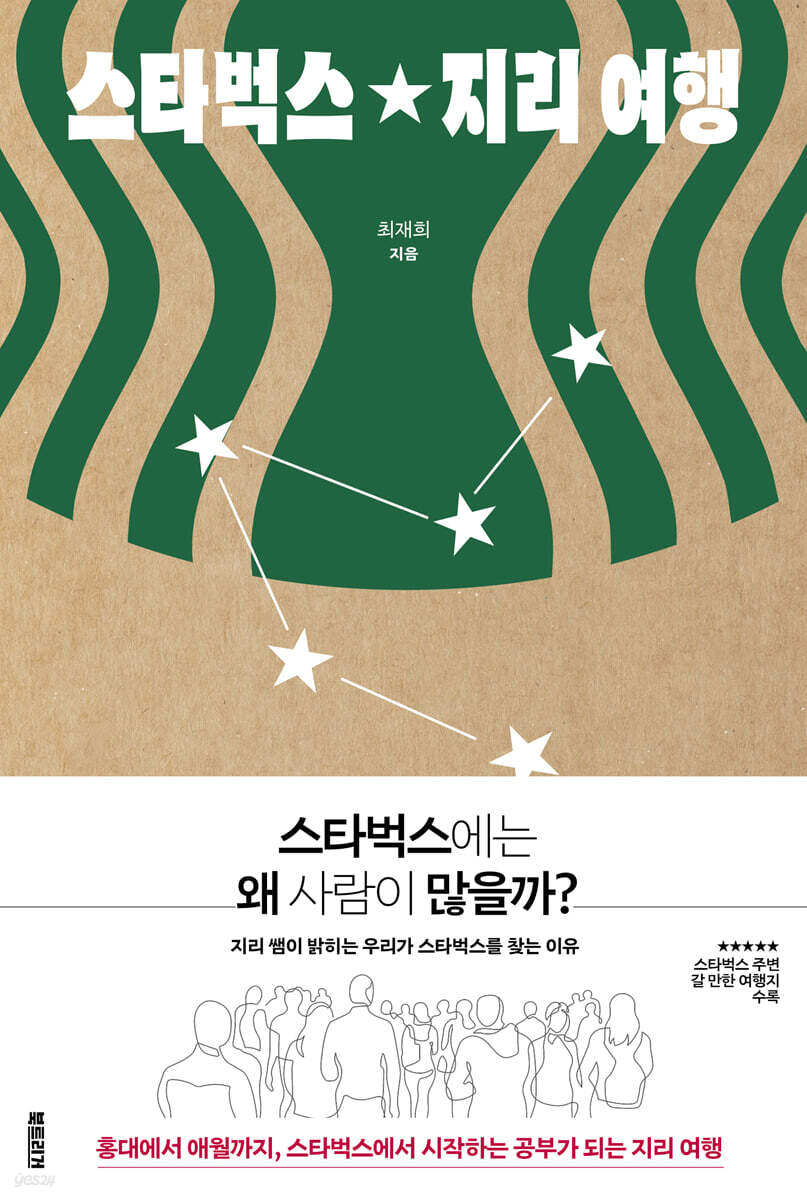
Starbucks Geography Tour
 |
Description
Book Introduction
“Why are there always so many people at Starbucks?”
Geography Teacher Reveals Why We Visit Starbucks
These days, when coffee is considered a necessity rather than a luxury, Starbucks has become so deeply ingrained in our lives that it wouldn't be strange to call it "Korea's No. 1 coffee destination."
What is it about Starbucks that attracts so many people and fuels its continued success? "Starbucks Geographical Journey" is a book born from this curiosity.
To satisfy my curiosity, the author chose 12 geographically significant Starbucks locations in Korea and decided to visit them in person.
The author, a current high school geography teacher, introduces six Starbucks in crowded locations and six Starbucks in locations with beautiful natural scenery.
And it explains why Starbucks opened a store there, from a geographical perspective, with lots of photos, maps, and diagrams.
If you think that it's natural for a Starbucks to be in a popular place, you're half right and half wrong.
There's a very clear reason why Starbucks is right there.
The author visits Starbucks across the country, examines the local commercial districts and natural landscapes from a geographical perspective, and then introduces 'Local travel destinations to enjoy with Starbucks' as an appendix.
In addition, globally significant Starbucks stores are also covered with interesting geographical stories.
As you follow in the author's footsteps, even the familiar Starbucks will take on a new, geographical meaning.
Geography Teacher Reveals Why We Visit Starbucks
These days, when coffee is considered a necessity rather than a luxury, Starbucks has become so deeply ingrained in our lives that it wouldn't be strange to call it "Korea's No. 1 coffee destination."
What is it about Starbucks that attracts so many people and fuels its continued success? "Starbucks Geographical Journey" is a book born from this curiosity.
To satisfy my curiosity, the author chose 12 geographically significant Starbucks locations in Korea and decided to visit them in person.
The author, a current high school geography teacher, introduces six Starbucks in crowded locations and six Starbucks in locations with beautiful natural scenery.
And it explains why Starbucks opened a store there, from a geographical perspective, with lots of photos, maps, and diagrams.
If you think that it's natural for a Starbucks to be in a popular place, you're half right and half wrong.
There's a very clear reason why Starbucks is right there.
The author visits Starbucks across the country, examines the local commercial districts and natural landscapes from a geographical perspective, and then introduces 'Local travel destinations to enjoy with Starbucks' as an appendix.
In addition, globally significant Starbucks stores are also covered with interesting geographical stories.
As you follow in the author's footsteps, even the familiar Starbucks will take on a new, geographical meaning.
- You can preview some of the book's contents.
Preview
index
Entering : Reading Geography from a Starbucks Seat
Chapter 1: Hot Places: There's Always a Starbucks
Information contained in space is powerful_Ewha R Branch
Hongdae's commercial district suffering from gentrification_Hongik University Station Exit 8
Wherever people gather, there is a cafe_ Gangnam R Branch
[World Geography with Starbucks] Starbucks Seattle Park Place
Chapter 2: A Newly Born Space: Starbucks Establishes Its Position as a Symbol of Space
How was Daechi-dong, the "Big Hill Village," created? _ Daechi Eunma Intersection Branch
Can Innovation City Succeed?_ Wonju Bangok DT Branch
A city built on the site of a vanished tidal flat_ Songdo Convensia Daero DT Branch
[World Geography with Starbucks] Starbucks Shanghai, China
Chapter 3: A Place Made by Rocks: Traveling with Starbucks is Fun
Walking the winding mountain road like a time traveler_ Mungyeong Saejae Branch
Master of Transformation, a Terrain Made of Granite_ Daegu Palgongsan Branch
Taste the scenery of Jeju, a volcanic island_ Jeju Aewol DT Branch
[World Geography with Starbucks] Starbucks Ibn Battuta Mall, Dubai
Chapter 4: Rivers and Seas: Adding Starbucks to Picturesque Landscapes
A place born from the harmony of mountains and rivers_Daeyangpyeong DTR Branch
A landscape created by capes and coastal terraces_ Ulsan Ganjeolgot Point
Gunsan, a city of history and reclamation_ Gunsan University Branch
[World Geography with Starbucks] Starbucks Bebek, Turkey
Appendix : Nearby Travel Destinations to Enjoy with Starbucks
Chapter 1: Hot Places: There's Always a Starbucks
Information contained in space is powerful_Ewha R Branch
Hongdae's commercial district suffering from gentrification_Hongik University Station Exit 8
Wherever people gather, there is a cafe_ Gangnam R Branch
[World Geography with Starbucks] Starbucks Seattle Park Place
Chapter 2: A Newly Born Space: Starbucks Establishes Its Position as a Symbol of Space
How was Daechi-dong, the "Big Hill Village," created? _ Daechi Eunma Intersection Branch
Can Innovation City Succeed?_ Wonju Bangok DT Branch
A city built on the site of a vanished tidal flat_ Songdo Convensia Daero DT Branch
[World Geography with Starbucks] Starbucks Shanghai, China
Chapter 3: A Place Made by Rocks: Traveling with Starbucks is Fun
Walking the winding mountain road like a time traveler_ Mungyeong Saejae Branch
Master of Transformation, a Terrain Made of Granite_ Daegu Palgongsan Branch
Taste the scenery of Jeju, a volcanic island_ Jeju Aewol DT Branch
[World Geography with Starbucks] Starbucks Ibn Battuta Mall, Dubai
Chapter 4: Rivers and Seas: Adding Starbucks to Picturesque Landscapes
A place born from the harmony of mountains and rivers_Daeyangpyeong DTR Branch
A landscape created by capes and coastal terraces_ Ulsan Ganjeolgot Point
Gunsan, a city of history and reclamation_ Gunsan University Branch
[World Geography with Starbucks] Starbucks Bebek, Turkey
Appendix : Nearby Travel Destinations to Enjoy with Starbucks
Detailed image
.jpg)
Into the book
Starbucks is known for its meticulous after-sales service, even after opening stores in carefully selected final candidate locations.
We closely monitor how many cups of coffee are sold per day, which coffees are sold more at which time of day, and what correlation there is between the weather in the area and the drinks sold.
On a midsummer day, that ice-crusted Frappuccino you buy at Starbucks could be a predicted menu item developed based on the store's big data.
In that sense, a cup of Starbucks drink in your hand is not unrelated to the ‘seat of Starbucks.’
--- From "Information contained in space is powerful_ Ewha R point"
As of July 2022, there are approximately 1,660 Starbucks stores in Korea.
Although it falls short of the approximately 15,500 stores in the United States, the country's home, the approximately 5,600 stores in China, a populous country, and the approximately 1,700 stores in Japan, it is said to be the fourth largest number of stores in the world.
When you look at the number of stores relative to the total population, it's a surprising number.
The nationwide distribution of the 1,660 stores is also very interesting.
Looking at each metropolitan government, Seoul has about 35% of the nation's stores, Gyeonggi Province has about 24%, and Busan has about 8%.
What we can see here is that the number of Starbucks stores is not simply proportional to the registered population residing in that area.
This means that the distribution of Starbucks stores is not evenly distributed across regions, and that there can be spatial discrimination even within the same region.
--- From "Wherever people gather, there is a cafe_ Gangnam R Branch"
What the innovation city's finger points to is the grand picture of balanced national development that aims to curb the concentration of population in the metropolitan area while simultaneously enhancing the competitiveness of local regions.
The construction of innovative cities, which aim to kill two birds with one stone: 'creating local jobs' and 'building new cities with refreshing residential environments,' is at the forefront of balanced national development.
… In the case of small provincial cities, there are not many places with Starbucks, but in the case of innovation cities, there is a Starbucks in most places.
The opening of a Starbucks store adds wings to the brand value of the innovation city, and Starbucks secures a certain level of demand, creating a virtuous cycle in which it gains the opportunity to open new stores.
--- From "Can Innovation City Succeed?_ Wonju Bangok DT Branch"
Currently, a provincial park has been developed in Mungyeong Saejae, and there is a constant stream of tourists due to the many things to see.
There are so many things to see in one day, including the drama set and the maze park.
Right here, you will find the Starbucks Mungyeong Saejae branch that you are looking for right now.
If you are a traveler to Mungyeong, you might be surprised to come across a Starbucks store in an unexpected place.
A Starbucks that doesn't even exist in downtown Mungyeong suddenly appears in a mountain valley like this.
But simply because it's a tourist destination doesn't mean Starbucks wouldn't open a store there. Adding a few geographical facts to the storytelling of the space gives this store a completely different feel.
Geographically, it is a space where sufficient demand is created.
--- From "Walking the Winding Mountain Road, Becoming a Time Traveler_ Mungyeong Saejae Branch"
The customers who visit Starbucks Ibn Battuta Mall are more tourists or overseas business travelers than locals.
The guests who visit here are Dubai's present and future.
As an international financial city, home to the busiest airport in the Middle East, and a world-class skyscraper hub, Dubai has transformed from a single national city into a global metropolis with an international brand.
Ibn Battuta Mall and Starbucks stores are a great match.
A feast of global coffee companies in global spaces in global cities.
In that sense, the name of the shopping mall using 'Ibn Battuta' is quite geographically accurate.
--- From "World Geography with Starbucks_ Starbucks Ibn Battuta Mall, Dubai"
The view from the Yangpyeong DTR branch has many geographically interesting aspects.
Looking out the window, you can see the blue Namhan River flowing leisurely between mountains with beautiful ridges and sandy islands covered in bushes.
These topographical elements come together to create a unique beauty that is unique to this place.
If I didn't have any of these, I don't think I would feel this beautiful.
--- From "A place born from the harmony of mountains and rivers_ The Yangpyeong DTR branch"
If the big picture of Ganjeolgot was drawn with the topographical element called a 'cape', the location of the Starbucks Ulsan Ganjeolgot branch could be drawn as a coastal terrace.
Coastal terraces literally mean step-shaped hills on the coast.
This means that it is a natural coastal hill created by nature, not one that was artificially created by laying foundation stones.
The shape is pretty, as if the design was completed to some extent and then constructed.
We closely monitor how many cups of coffee are sold per day, which coffees are sold more at which time of day, and what correlation there is between the weather in the area and the drinks sold.
On a midsummer day, that ice-crusted Frappuccino you buy at Starbucks could be a predicted menu item developed based on the store's big data.
In that sense, a cup of Starbucks drink in your hand is not unrelated to the ‘seat of Starbucks.’
--- From "Information contained in space is powerful_ Ewha R point"
As of July 2022, there are approximately 1,660 Starbucks stores in Korea.
Although it falls short of the approximately 15,500 stores in the United States, the country's home, the approximately 5,600 stores in China, a populous country, and the approximately 1,700 stores in Japan, it is said to be the fourth largest number of stores in the world.
When you look at the number of stores relative to the total population, it's a surprising number.
The nationwide distribution of the 1,660 stores is also very interesting.
Looking at each metropolitan government, Seoul has about 35% of the nation's stores, Gyeonggi Province has about 24%, and Busan has about 8%.
What we can see here is that the number of Starbucks stores is not simply proportional to the registered population residing in that area.
This means that the distribution of Starbucks stores is not evenly distributed across regions, and that there can be spatial discrimination even within the same region.
--- From "Wherever people gather, there is a cafe_ Gangnam R Branch"
What the innovation city's finger points to is the grand picture of balanced national development that aims to curb the concentration of population in the metropolitan area while simultaneously enhancing the competitiveness of local regions.
The construction of innovative cities, which aim to kill two birds with one stone: 'creating local jobs' and 'building new cities with refreshing residential environments,' is at the forefront of balanced national development.
… In the case of small provincial cities, there are not many places with Starbucks, but in the case of innovation cities, there is a Starbucks in most places.
The opening of a Starbucks store adds wings to the brand value of the innovation city, and Starbucks secures a certain level of demand, creating a virtuous cycle in which it gains the opportunity to open new stores.
--- From "Can Innovation City Succeed?_ Wonju Bangok DT Branch"
Currently, a provincial park has been developed in Mungyeong Saejae, and there is a constant stream of tourists due to the many things to see.
There are so many things to see in one day, including the drama set and the maze park.
Right here, you will find the Starbucks Mungyeong Saejae branch that you are looking for right now.
If you are a traveler to Mungyeong, you might be surprised to come across a Starbucks store in an unexpected place.
A Starbucks that doesn't even exist in downtown Mungyeong suddenly appears in a mountain valley like this.
But simply because it's a tourist destination doesn't mean Starbucks wouldn't open a store there. Adding a few geographical facts to the storytelling of the space gives this store a completely different feel.
Geographically, it is a space where sufficient demand is created.
--- From "Walking the Winding Mountain Road, Becoming a Time Traveler_ Mungyeong Saejae Branch"
The customers who visit Starbucks Ibn Battuta Mall are more tourists or overseas business travelers than locals.
The guests who visit here are Dubai's present and future.
As an international financial city, home to the busiest airport in the Middle East, and a world-class skyscraper hub, Dubai has transformed from a single national city into a global metropolis with an international brand.
Ibn Battuta Mall and Starbucks stores are a great match.
A feast of global coffee companies in global spaces in global cities.
In that sense, the name of the shopping mall using 'Ibn Battuta' is quite geographically accurate.
--- From "World Geography with Starbucks_ Starbucks Ibn Battuta Mall, Dubai"
The view from the Yangpyeong DTR branch has many geographically interesting aspects.
Looking out the window, you can see the blue Namhan River flowing leisurely between mountains with beautiful ridges and sandy islands covered in bushes.
These topographical elements come together to create a unique beauty that is unique to this place.
If I didn't have any of these, I don't think I would feel this beautiful.
--- From "A place born from the harmony of mountains and rivers_ The Yangpyeong DTR branch"
If the big picture of Ganjeolgot was drawn with the topographical element called a 'cape', the location of the Starbucks Ulsan Ganjeolgot branch could be drawn as a coastal terrace.
Coastal terraces literally mean step-shaped hills on the coast.
This means that it is a natural coastal hill created by nature, not one that was artificially created by laying foundation stones.
The shape is pretty, as if the design was completed to some extent and then constructed.
--- From "The scenery created by the cape and coastal terraces_ Ulsan Ganjeolgot Point"
Publisher's Review
The Starbucks in various parts of Korea that the geography teacher visited in person
What geographical secrets are hidden?
We live with coffee so close that there is even a saying, 'Korea is a coffee republic.'
It wouldn't be awkward to have a cafe next to a cafe, and another cafe next to that.
Teenagers turn to coffee to stay awake, and adults turn to coffee on a daily basis to the point of caffeine addiction, going beyond sleep-wake mode.
Perhaps for this reason, the number of Starbucks stores in Korea is approximately 1,660 as of July 2022, the fourth largest in the world after the United States (approximately 15,500), China (approximately 5,600), and Japan (approximately 1,700).
It's the fourth, but considering the number of stores relative to the total population, it's a surprising number.
In the winter of 2020, the author, a current high school geography teacher, read an article about Starbucks opening its 1,500th store and suddenly became curious.
"How does Starbucks choose its locations, and what geographical secrets lie behind them?" To find the answer, the author turned on a map application and examined the locations of Starbucks stores.
And I chose 12 geographically significant places and visited them in person.
"Starbucks Geography Tour" is a book that contains the process and content.
Starbucks opened a store there
There's a reason for everything
In Chapter 1, 'Hot Places - There's Always a Starbucks There', the author first sets out to find the first Starbucks store.
Where did Starbucks open its first store, a store so symbolic and crucial that it could determine the success or failure of a business? While many locations with high foot traffic like Jongno or Myeongdong were available, Starbucks surprisingly chose the location in front of Ewha Womans University.
The author decides to visit the first Starbucks store, ‘Ewha R Branch’, as his first travel destination and visits the area in front of Ewha Womans University for the first time in a long time.
The Ewha Womans University commercial district was renowned as one of the best commercial districts in Seoul in the 1990s.
The author walks along the street in front of Ewha Womans University, which was hit hard by gentrification and transformed from a fashion mecca into an officetel mecca, and retraces the history of the Ewha Womans University commercial district.
And it talks about why Starbucks chose this location as the site of its first store in 1999, and how Starbucks responded to the changes brought about by gentrification.
Following the Ewha R branch, the author moves to the Hongik University Station Exit 8 branch.
We explore the meaning behind the unique store name, "Hongdae Station Exit 8," and the relationship between the Hongdae and Sinchon commercial districts.
Meanwhile, if Hongik University Station is the busiest station north of the Han River in Seoul, Gangnam Station is the busiest station south of the Han River.
The author visits the 'Gangnam R branch' located at the Gangnam Station intersection and examines the correlation between the number of Starbucks stores and the number of floating population, confirming that locations with a high number of floating population are likely to be Starbucks locations.
In Chapter 2, 'A Newly Born Space - Starbucks, Establishing Its Position as a Symbol of Space', we visit a newly created urban space in an empty field and find out what role Starbucks plays there.
Daechi-dong is now known as the "number one private education district" and has become a neighborhood known nationwide, but just 50 years ago, it was nothing more than a low-lying wetland that would habitually flood whenever it rained heavily.
As Gangnam developed, large apartment complexes were built on this low-lying area, and the Daechi-dong academy district was formed.
The 'Daechi Eunma Intersection Branch' located here is a symbolic place that clearly shows the role of cafes in the academy district.
Wonju Innovation City, nestled at the foot of Mt. Chiak, is a futuristic city where nature and the city are beautifully harmonized.
Although Starbucks is rarely found in small provincial cities, interestingly, most innovation cities have Starbucks stores.
The author visits the Wonju Bangok DT branch to learn about what an innovation city is and why Starbucks is opening a store there.
Next, we head to the 'Songdo Convensia Daero DT Branch' in Songdo International City, Incheon, and think about the relationship between tidal flat reclamation, global warming, and the coffee industry's sensitivity to climate change.
In Chapter 3, 'Places Made by Rocks - Traveling with Starbucks is Fun', we visit Starbucks in mountains and islands and learn about the rocks and mountain ranges that make up the Korean Peninsula.
'Mungyeong Saejae Branch' is located at Mungyeong Saejae Pass, a mountain pass with an elevation of 642m that crosses the Sobaek Mountain Range.
We visit the Mungyeong Saejae branch and learn about the story behind Mungyeong Saejae and the process of forming the Sobaek Mountains, and think about why there is a Starbucks in Mungyeong Saejae when there is none in Mungyeong City.
Following the Mungyeong Saejae branch, the author visits the Daegu Palgongsan branch, which has a deep connection with granite.
From the Daegu Palgongsan Mountain branch, we look at the winding, undulating mountains and talk about the process of Palgongsan Mountain's formation and the characteristics of the granite mountain range.
Meanwhile, in Jeju, where I visited to live for a month, I visited the 'Jeju Aewol DT Branch', ate a Jeju-only menu, and looked at the topography of Jeju Island.
The Carrot Basalt Cake reflects on the relationship between Jeju Island's bedrock and carrot farming, while the Oreum Cheese Cake recalls the formation process and characteristics of Oreum.
Chapter 4, ‘Rivers and Seas - Adding Starbucks to Picturesque Scenery’ introduces Starbucks that are geographically significant and located near rivers or the sea.
The view outside the window of 'The Yangpyeong DTR Branch', which has been a hot topic since its opening due to its picturesque view, has many interesting points.
The blue Namhan River flowing leisurely between mountains with beautiful ridges and the sandy islands covered with bushes are geographical elements that double the charm of the Deoyangpyeong DTR point.
'Ulsan Ganjeolgot Point', which overlooks the ocean, is located in Ganjeolgot, Ulju-gun, Ulsan Metropolitan City, where the sun rises first on land in Korea during the winter.
The author visits Ulsan Ganjeolgot Point to see how the combination of the cape and coastal terraces suits the location of the lighthouse, and learns about the process by which the cape and coastal terraces are formed.
Finally, we visit Gunsan University Branch to look back on how reclamation has changed Gunsan's topography and reflect on the significance of the Saemangeum Project.
It's a matter of considering Starbucks' location.
It is a process of learning how to efficiently position space.
Starbucks, which opened its first store in Korea in 1999, surpassed 2 trillion won in annual sales in 2021, solidifying its position as the overwhelming leader in sales and profitability among domestic coffee shops.
There are many different perspectives on Starbucks' dominance.
On the one hand, people praise Starbucks' business acumen, while on the other hand, they criticize it for directly impacting the sales of small coffee shops in the area.
With terms like "Starbucks Index" and "Sse-kwon" now in everyday use, the author argues that before examining the meaning of Starbucks' dominance, we must first understand how it was possible.
We need to think about how much Starbucks considers the floating population and how much consideration is given to the natural landscape when deciding on a location.
At a time when Starbucks is “taking up space with an overwhelming number of stores and the number of people using its dedicated application is approaching 10 million,” examining Starbucks’ position is no different from the process of figuring out what the most efficient location for the space is.
If you've ever walked down the street and stumbled upon a Starbucks and thought, "Why is there a Starbucks in a place like this?", you should definitely read this book.
The answer is in this book.
What geographical secrets are hidden?
We live with coffee so close that there is even a saying, 'Korea is a coffee republic.'
It wouldn't be awkward to have a cafe next to a cafe, and another cafe next to that.
Teenagers turn to coffee to stay awake, and adults turn to coffee on a daily basis to the point of caffeine addiction, going beyond sleep-wake mode.
Perhaps for this reason, the number of Starbucks stores in Korea is approximately 1,660 as of July 2022, the fourth largest in the world after the United States (approximately 15,500), China (approximately 5,600), and Japan (approximately 1,700).
It's the fourth, but considering the number of stores relative to the total population, it's a surprising number.
In the winter of 2020, the author, a current high school geography teacher, read an article about Starbucks opening its 1,500th store and suddenly became curious.
"How does Starbucks choose its locations, and what geographical secrets lie behind them?" To find the answer, the author turned on a map application and examined the locations of Starbucks stores.
And I chose 12 geographically significant places and visited them in person.
"Starbucks Geography Tour" is a book that contains the process and content.
Starbucks opened a store there
There's a reason for everything
In Chapter 1, 'Hot Places - There's Always a Starbucks There', the author first sets out to find the first Starbucks store.
Where did Starbucks open its first store, a store so symbolic and crucial that it could determine the success or failure of a business? While many locations with high foot traffic like Jongno or Myeongdong were available, Starbucks surprisingly chose the location in front of Ewha Womans University.
The author decides to visit the first Starbucks store, ‘Ewha R Branch’, as his first travel destination and visits the area in front of Ewha Womans University for the first time in a long time.
The Ewha Womans University commercial district was renowned as one of the best commercial districts in Seoul in the 1990s.
The author walks along the street in front of Ewha Womans University, which was hit hard by gentrification and transformed from a fashion mecca into an officetel mecca, and retraces the history of the Ewha Womans University commercial district.
And it talks about why Starbucks chose this location as the site of its first store in 1999, and how Starbucks responded to the changes brought about by gentrification.
Following the Ewha R branch, the author moves to the Hongik University Station Exit 8 branch.
We explore the meaning behind the unique store name, "Hongdae Station Exit 8," and the relationship between the Hongdae and Sinchon commercial districts.
Meanwhile, if Hongik University Station is the busiest station north of the Han River in Seoul, Gangnam Station is the busiest station south of the Han River.
The author visits the 'Gangnam R branch' located at the Gangnam Station intersection and examines the correlation between the number of Starbucks stores and the number of floating population, confirming that locations with a high number of floating population are likely to be Starbucks locations.
In Chapter 2, 'A Newly Born Space - Starbucks, Establishing Its Position as a Symbol of Space', we visit a newly created urban space in an empty field and find out what role Starbucks plays there.
Daechi-dong is now known as the "number one private education district" and has become a neighborhood known nationwide, but just 50 years ago, it was nothing more than a low-lying wetland that would habitually flood whenever it rained heavily.
As Gangnam developed, large apartment complexes were built on this low-lying area, and the Daechi-dong academy district was formed.
The 'Daechi Eunma Intersection Branch' located here is a symbolic place that clearly shows the role of cafes in the academy district.
Wonju Innovation City, nestled at the foot of Mt. Chiak, is a futuristic city where nature and the city are beautifully harmonized.
Although Starbucks is rarely found in small provincial cities, interestingly, most innovation cities have Starbucks stores.
The author visits the Wonju Bangok DT branch to learn about what an innovation city is and why Starbucks is opening a store there.
Next, we head to the 'Songdo Convensia Daero DT Branch' in Songdo International City, Incheon, and think about the relationship between tidal flat reclamation, global warming, and the coffee industry's sensitivity to climate change.
In Chapter 3, 'Places Made by Rocks - Traveling with Starbucks is Fun', we visit Starbucks in mountains and islands and learn about the rocks and mountain ranges that make up the Korean Peninsula.
'Mungyeong Saejae Branch' is located at Mungyeong Saejae Pass, a mountain pass with an elevation of 642m that crosses the Sobaek Mountain Range.
We visit the Mungyeong Saejae branch and learn about the story behind Mungyeong Saejae and the process of forming the Sobaek Mountains, and think about why there is a Starbucks in Mungyeong Saejae when there is none in Mungyeong City.
Following the Mungyeong Saejae branch, the author visits the Daegu Palgongsan branch, which has a deep connection with granite.
From the Daegu Palgongsan Mountain branch, we look at the winding, undulating mountains and talk about the process of Palgongsan Mountain's formation and the characteristics of the granite mountain range.
Meanwhile, in Jeju, where I visited to live for a month, I visited the 'Jeju Aewol DT Branch', ate a Jeju-only menu, and looked at the topography of Jeju Island.
The Carrot Basalt Cake reflects on the relationship between Jeju Island's bedrock and carrot farming, while the Oreum Cheese Cake recalls the formation process and characteristics of Oreum.
Chapter 4, ‘Rivers and Seas - Adding Starbucks to Picturesque Scenery’ introduces Starbucks that are geographically significant and located near rivers or the sea.
The view outside the window of 'The Yangpyeong DTR Branch', which has been a hot topic since its opening due to its picturesque view, has many interesting points.
The blue Namhan River flowing leisurely between mountains with beautiful ridges and the sandy islands covered with bushes are geographical elements that double the charm of the Deoyangpyeong DTR point.
'Ulsan Ganjeolgot Point', which overlooks the ocean, is located in Ganjeolgot, Ulju-gun, Ulsan Metropolitan City, where the sun rises first on land in Korea during the winter.
The author visits Ulsan Ganjeolgot Point to see how the combination of the cape and coastal terraces suits the location of the lighthouse, and learns about the process by which the cape and coastal terraces are formed.
Finally, we visit Gunsan University Branch to look back on how reclamation has changed Gunsan's topography and reflect on the significance of the Saemangeum Project.
It's a matter of considering Starbucks' location.
It is a process of learning how to efficiently position space.
Starbucks, which opened its first store in Korea in 1999, surpassed 2 trillion won in annual sales in 2021, solidifying its position as the overwhelming leader in sales and profitability among domestic coffee shops.
There are many different perspectives on Starbucks' dominance.
On the one hand, people praise Starbucks' business acumen, while on the other hand, they criticize it for directly impacting the sales of small coffee shops in the area.
With terms like "Starbucks Index" and "Sse-kwon" now in everyday use, the author argues that before examining the meaning of Starbucks' dominance, we must first understand how it was possible.
We need to think about how much Starbucks considers the floating population and how much consideration is given to the natural landscape when deciding on a location.
At a time when Starbucks is “taking up space with an overwhelming number of stores and the number of people using its dedicated application is approaching 10 million,” examining Starbucks’ position is no different from the process of figuring out what the most efficient location for the space is.
If you've ever walked down the street and stumbled upon a Starbucks and thought, "Why is there a Starbucks in a place like this?", you should definitely read this book.
The answer is in this book.
GOODS SPECIFICS
- Publication date: October 5, 2022
- Page count, weight, size: 272 pages | 428g | 140*208*20mm
- ISBN13: 9791189799816
- ISBN10: 1189799812
You may also like
카테고리
korean


korean

![GQ KOREA Mark (Monthly): December [2025]](http://librairie.coreenne.fr/cdn/shop/files/8ef265dbbfbf186523ed75ba7319009d.jpg?v=1765340328&width=3840)


