

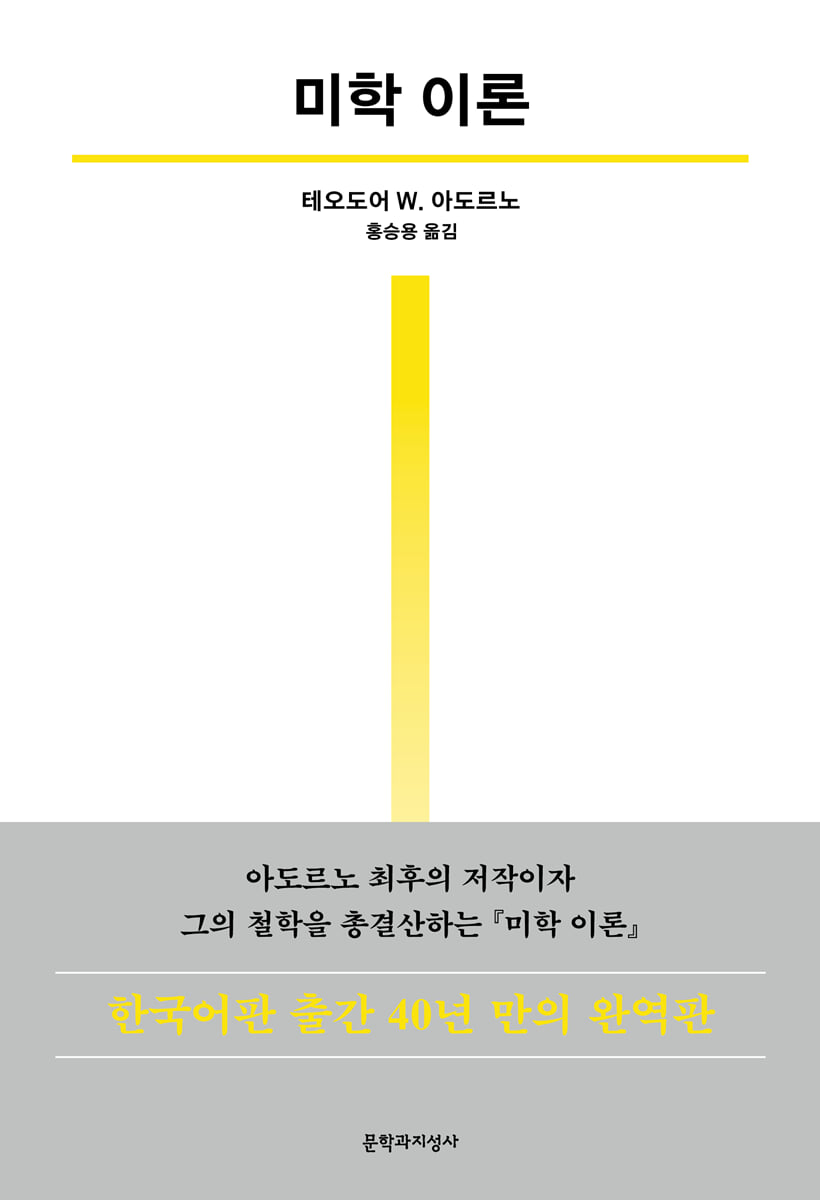
aesthetic theory
 |
Description
Book Introduction
Dialectically exploring the relationship between art and society
The most important aesthetic theory of the 20th century
The complete translation of Theodor Adorno's 『Aesthetic Theory (Asthetische Theorie)』, which is said to be "the starting point of all modern aesthetic discussions," "the most important aesthetic theory book of the 20th century," and "the final fruit of critical theory," has been published.
Adorno transferred the problematics of Dialectics of Enlightenment and Negative Dialectics to the realm of aesthetics, exploring how art, amidst the contradictions of modern reason, can become a form that reveals truth and preserves the possibility of liberation.
It is a contemporary classic that continues to inspire debate and influence in various fields such as philosophy, aesthetics, and social theory, and continues to exert influence to this day.
Aesthetic Theory was published in 1970, a year after Adorno's death, by Rolf Tiedemann, a philologist and second-generation Frankfurt School researcher, and Grete Adorno, Adorno's wife, by compiling his unfinished manuscript and editorial notes.
In Korea, it has been a steady bestseller since its publication in 1984 by Munhak-kwa-Jiseongsa with a translation by Adorno scholar Hong Seung-yong.
This revised edition, which has been newly published after 40 years, corrects the existing translation and includes translations of the "Appendix," "Draft Introduction," and "German Edition Editor's Note" that were omitted from the first edition.
Adorno gave several lectures on aesthetics from 1950 to 1968, and based on these lectures, he began working on the oral draft of "Aesthetic Theory" in earnest in 1961, undergoing numerous revisions, edits, and compositions until 1969.
However, this work, which he considered his life's work, was left unfinished when he passed away suddenly from a heart attack in August 1969.
Despite being an unfinished work, Aesthetic Theory provides an example of dialectical thinking.
In order to realize a narrative form that was consistent with his philosophical thinking, Adorno rejected a hierarchical system and attempted to structure the book in a fragmented and parallel structure so that the discussions and propositions on each topic would have equal importance, and so that meaning would be created through mutual tension.
The German editors stated that they made minimal interventions in the formatting or refining of the text, even when it appeared that repetition or inconsistency in the text was in need of correction during the manuscript editing process.
The revised Korean edition faithfully follows the editorial principles and structure of the German edition, but by referring to the notes Adorno left in his first draft, the content that was treated as headings at the top of the text in the German edition was added as subheadings of each section so that readers can check them.
The most important aesthetic theory of the 20th century
The complete translation of Theodor Adorno's 『Aesthetic Theory (Asthetische Theorie)』, which is said to be "the starting point of all modern aesthetic discussions," "the most important aesthetic theory book of the 20th century," and "the final fruit of critical theory," has been published.
Adorno transferred the problematics of Dialectics of Enlightenment and Negative Dialectics to the realm of aesthetics, exploring how art, amidst the contradictions of modern reason, can become a form that reveals truth and preserves the possibility of liberation.
It is a contemporary classic that continues to inspire debate and influence in various fields such as philosophy, aesthetics, and social theory, and continues to exert influence to this day.
Aesthetic Theory was published in 1970, a year after Adorno's death, by Rolf Tiedemann, a philologist and second-generation Frankfurt School researcher, and Grete Adorno, Adorno's wife, by compiling his unfinished manuscript and editorial notes.
In Korea, it has been a steady bestseller since its publication in 1984 by Munhak-kwa-Jiseongsa with a translation by Adorno scholar Hong Seung-yong.
This revised edition, which has been newly published after 40 years, corrects the existing translation and includes translations of the "Appendix," "Draft Introduction," and "German Edition Editor's Note" that were omitted from the first edition.
Adorno gave several lectures on aesthetics from 1950 to 1968, and based on these lectures, he began working on the oral draft of "Aesthetic Theory" in earnest in 1961, undergoing numerous revisions, edits, and compositions until 1969.
However, this work, which he considered his life's work, was left unfinished when he passed away suddenly from a heart attack in August 1969.
Despite being an unfinished work, Aesthetic Theory provides an example of dialectical thinking.
In order to realize a narrative form that was consistent with his philosophical thinking, Adorno rejected a hierarchical system and attempted to structure the book in a fragmented and parallel structure so that the discussions and propositions on each topic would have equal importance, and so that meaning would be created through mutual tension.
The German editors stated that they made minimal interventions in the formatting or refining of the text, even when it appeared that repetition or inconsistency in the text was in need of correction during the manuscript editing process.
The revised Korean edition faithfully follows the editorial principles and structure of the German edition, but by referring to the notes Adorno left in his first draft, the content that was treated as headings at the top of the text in the German edition was added as subheadings of each section so that readers can check them.
- You can preview some of the book's contents.
Preview
index
Art, Society, Aesthetics
The Loss of Art's Self-Evidentness | The Problem of Origin | The Truth Content and the Artwork | The Relationship between Art and Society | A Critique of Psychoanalytic Art Theory | Kant and Freud's Theories of Art | The Enjoyment of Art | Aesthetic Hedonism and the Happiness of Cognition
situation
The disintegration of materials | The de-artification of art; Critique of the cultural industry | The language of suffering | The philosophy of history of novelty | On the problem of immutability; Experiment (1) | A defense of isms | Isms as secularized schools | Production possibility and chance; The quality of modern art and works | 'Second reflection' | Novelty and continuity | The dialectic of integration and 'subjective perspective' | Novelty, utopia, negativity | Modern art and industrial production | Aesthetic rationality and criticism | The precept of prohibition | Experiment (2); Seriousness and irresponsibility | The ideal of darkness | The relationship to tradition | Subjectivity and the collective | Solipsism, the taboo on mimesis, maturity | 'Technique' | Expression and composition
Categories of beauty, beauty, and technology
The Category of Ugliness | The Historical Philosophy and Social Aspects of Ugliness | The Concept of Beauty | Mimesis and Rationality | The Concept of Composition | Technology | The Dialectics of Functionalism
natural beauty
A Verdict on Natural Beauty | Natural Beauty as "Escape" | On Cultural Landscapes | The Connection Between Artistic Beauty and Natural Beauty | The Historically Deformed Experience of Nature | The Analytical Nature of Aesthetic Perception | Natural Beauty as Interrupted History | Deterministic Indeterminacy | Natural Beauty as a Code for a State of Reconciliation | Metacritique of Hegel's Critique of Natural Beauty | The Transition from Natural Beauty to Artistic Beauty
Artistic Beauty: 'Phenomenon,' Mentalization, Intuition
The 'transcendent' as virtual | Aesthetic transcendence and disenchantment | Enlightenment and thrill | Art and the heterogeneous factor | Non-existence | Figural character | 'Rupture' | The collective character of the figurative content | Art as spiritual | The immanence and heterogeneous factor of the work | Hegel's spiritual aesthetics | The dialectic of spiritualization | Spiritualization and the state of chaos | The aporia of artistic intuition | Intuition and conceptuality; object-like character
Virtuality and Expression
The Crisis of the Virtual | Virtuality, Meaning, and 'Acrobatics' | The Salvation of the Virtual; Harmony and Dissonance | Expression and Dissonance | Subject-Object and Expression | Expression as Linguistic Character | Domination and Conceptual Cognition | Expression and Mimesis | The Dialectics of Interiority
Enigmatic nature, truth content, metaphysics
Criticism and salvation of myth | Mimetic elements and foolishness | Beneficial to whom | Enigmatic character and understanding | 'Nothing remains unchanged' | Enigma, letters, and interpretation | Interpretation as imitation | 'Barrier' | Broken transcendence | Enigmatic character, truth content, and the absolute | Truth content | Art and philosophy; the collective thought content of art | Truth as the illusion of the non-illusion | Mimesis and reconciliation with the fatal | Connection with darkness
Consistency and meaning
Logicㆍ317 | Logic, Causality, and Timeㆍ320 | Purposiveness of Purposelessnessㆍ324 | Formㆍ326 | Form and Contentㆍ333 | The Concept of Clear Expression (1)ㆍ338 | The Concept of Materialㆍ342 | The Concept of Material; Intention and Ideological Contentㆍ344 | Intention and Meaningㆍ349 | The Crisis of Meaningㆍ352 | The Concept of Harmony and the Ideology of Completenessㆍ361 | Affirmationㆍ366 | Critique of Doctrinalismㆍ369
Subject and Object
The Ambiguity of Subject and Object; On Aesthetic Feelings | Critique of Kant's Concept of Objectivity | Precarious Equilibrium | Linguistic Character and the Collective Subject | The Dialectic of Subject-Object | Genius | Originality | Fantasy and Reflection | Objectivity and Reification
Theory of Artworks
The processual nature of aesthetic experience; the processual nature of works of art | Perishability | The problem of artifacts and emergence | The work of art as a monad and immanent analysis | Art and works of art | The essentially constitutive nature of history; 'Intelligibility' | The necessity of objectification and decomposition | Unity and plurality | The category of intensity | 'What is the basis for calling a work beautiful?' | 'Depth' | The concept of clear expression (2) | The subdivision of the concept of progress | The development of productive forces | The changes in works of art | Interpretation, commentary, and criticism | The historicity of the content of truth; The sublime in nature and art | The sublime and play
Universal and Particular
Nominalism and the Decline of Genres | Ancient Genre Aesthetics | The Historical Philosophy of Convention | The Concept of Style | The Progress of Art | The Heterogeneity of Art History | Progress and Material Processing | 'Technology' | Art in the Industrial Age | Nominalism and Open Form | Composition; Static and Dynamism
society
The duality of art: social fact and autonomy; fetishistic nature; reception and production; selection of material: the artistic subject; relationship to science; art as a mode of response; ideology and truth; 'responsibility'; reception of avant-garde art; mediation between art and society; critique of catharsis; kitsch and vulgarity; stance on practice; influence, experience, 'shock'; participation; aestheticism, naturalism, Beckett; critique of managed art; the possibility of modern art; autonomy and heteronomy; political choice; progress and reaction; poverty of art and philosophy; the primacy of the object and art; the problem of solipsism and a false reconciliation
supplement
Theories on the Origin of Art: Boron
Introduction draft
Old elements of traditional aesthetics | Functional transformation of naiveté | Discord between traditional aesthetics and contemporary art | The truth-content and fetishistic nature of works of art | The necessity of aesthetics | Aesthetics as a refuge from metaphysics | Aesthetic experience as objective understanding | Analysis of the work's immanence and aesthetic theory | For the dialectic of aesthetic experience | The universal and the particular | Critique of phenomenological source research | Position on Hegelian aesthetics | The open nature of aesthetics | Formal aesthetics and content aesthetics (I) | Formal aesthetics and content aesthetics (II); Norms and slogans | Methodology, 'second reflection,' history
Editor's Note
Translator's Note
Lookup (Term)
Search (person name)
The Loss of Art's Self-Evidentness | The Problem of Origin | The Truth Content and the Artwork | The Relationship between Art and Society | A Critique of Psychoanalytic Art Theory | Kant and Freud's Theories of Art | The Enjoyment of Art | Aesthetic Hedonism and the Happiness of Cognition
situation
The disintegration of materials | The de-artification of art; Critique of the cultural industry | The language of suffering | The philosophy of history of novelty | On the problem of immutability; Experiment (1) | A defense of isms | Isms as secularized schools | Production possibility and chance; The quality of modern art and works | 'Second reflection' | Novelty and continuity | The dialectic of integration and 'subjective perspective' | Novelty, utopia, negativity | Modern art and industrial production | Aesthetic rationality and criticism | The precept of prohibition | Experiment (2); Seriousness and irresponsibility | The ideal of darkness | The relationship to tradition | Subjectivity and the collective | Solipsism, the taboo on mimesis, maturity | 'Technique' | Expression and composition
Categories of beauty, beauty, and technology
The Category of Ugliness | The Historical Philosophy and Social Aspects of Ugliness | The Concept of Beauty | Mimesis and Rationality | The Concept of Composition | Technology | The Dialectics of Functionalism
natural beauty
A Verdict on Natural Beauty | Natural Beauty as "Escape" | On Cultural Landscapes | The Connection Between Artistic Beauty and Natural Beauty | The Historically Deformed Experience of Nature | The Analytical Nature of Aesthetic Perception | Natural Beauty as Interrupted History | Deterministic Indeterminacy | Natural Beauty as a Code for a State of Reconciliation | Metacritique of Hegel's Critique of Natural Beauty | The Transition from Natural Beauty to Artistic Beauty
Artistic Beauty: 'Phenomenon,' Mentalization, Intuition
The 'transcendent' as virtual | Aesthetic transcendence and disenchantment | Enlightenment and thrill | Art and the heterogeneous factor | Non-existence | Figural character | 'Rupture' | The collective character of the figurative content | Art as spiritual | The immanence and heterogeneous factor of the work | Hegel's spiritual aesthetics | The dialectic of spiritualization | Spiritualization and the state of chaos | The aporia of artistic intuition | Intuition and conceptuality; object-like character
Virtuality and Expression
The Crisis of the Virtual | Virtuality, Meaning, and 'Acrobatics' | The Salvation of the Virtual; Harmony and Dissonance | Expression and Dissonance | Subject-Object and Expression | Expression as Linguistic Character | Domination and Conceptual Cognition | Expression and Mimesis | The Dialectics of Interiority
Enigmatic nature, truth content, metaphysics
Criticism and salvation of myth | Mimetic elements and foolishness | Beneficial to whom | Enigmatic character and understanding | 'Nothing remains unchanged' | Enigma, letters, and interpretation | Interpretation as imitation | 'Barrier' | Broken transcendence | Enigmatic character, truth content, and the absolute | Truth content | Art and philosophy; the collective thought content of art | Truth as the illusion of the non-illusion | Mimesis and reconciliation with the fatal | Connection with darkness
Consistency and meaning
Logicㆍ317 | Logic, Causality, and Timeㆍ320 | Purposiveness of Purposelessnessㆍ324 | Formㆍ326 | Form and Contentㆍ333 | The Concept of Clear Expression (1)ㆍ338 | The Concept of Materialㆍ342 | The Concept of Material; Intention and Ideological Contentㆍ344 | Intention and Meaningㆍ349 | The Crisis of Meaningㆍ352 | The Concept of Harmony and the Ideology of Completenessㆍ361 | Affirmationㆍ366 | Critique of Doctrinalismㆍ369
Subject and Object
The Ambiguity of Subject and Object; On Aesthetic Feelings | Critique of Kant's Concept of Objectivity | Precarious Equilibrium | Linguistic Character and the Collective Subject | The Dialectic of Subject-Object | Genius | Originality | Fantasy and Reflection | Objectivity and Reification
Theory of Artworks
The processual nature of aesthetic experience; the processual nature of works of art | Perishability | The problem of artifacts and emergence | The work of art as a monad and immanent analysis | Art and works of art | The essentially constitutive nature of history; 'Intelligibility' | The necessity of objectification and decomposition | Unity and plurality | The category of intensity | 'What is the basis for calling a work beautiful?' | 'Depth' | The concept of clear expression (2) | The subdivision of the concept of progress | The development of productive forces | The changes in works of art | Interpretation, commentary, and criticism | The historicity of the content of truth; The sublime in nature and art | The sublime and play
Universal and Particular
Nominalism and the Decline of Genres | Ancient Genre Aesthetics | The Historical Philosophy of Convention | The Concept of Style | The Progress of Art | The Heterogeneity of Art History | Progress and Material Processing | 'Technology' | Art in the Industrial Age | Nominalism and Open Form | Composition; Static and Dynamism
society
The duality of art: social fact and autonomy; fetishistic nature; reception and production; selection of material: the artistic subject; relationship to science; art as a mode of response; ideology and truth; 'responsibility'; reception of avant-garde art; mediation between art and society; critique of catharsis; kitsch and vulgarity; stance on practice; influence, experience, 'shock'; participation; aestheticism, naturalism, Beckett; critique of managed art; the possibility of modern art; autonomy and heteronomy; political choice; progress and reaction; poverty of art and philosophy; the primacy of the object and art; the problem of solipsism and a false reconciliation
supplement
Theories on the Origin of Art: Boron
Introduction draft
Old elements of traditional aesthetics | Functional transformation of naiveté | Discord between traditional aesthetics and contemporary art | The truth-content and fetishistic nature of works of art | The necessity of aesthetics | Aesthetics as a refuge from metaphysics | Aesthetic experience as objective understanding | Analysis of the work's immanence and aesthetic theory | For the dialectic of aesthetic experience | The universal and the particular | Critique of phenomenological source research | Position on Hegelian aesthetics | The open nature of aesthetics | Formal aesthetics and content aesthetics (I) | Formal aesthetics and content aesthetics (II); Norms and slogans | Methodology, 'second reflection,' history
Editor's Note
Translator's Note
Lookup (Term)
Search (person name)
Into the book
It has become self-evident that nothing is self-evident when it comes to art.
Neither art itself, nor its relationship to society as a whole, nor even art's right to survive are self-evident.
Things that could be dealt with without reflection or as if they were no problem have disappeared, but the infinite possibilities opened up thanks to reflection do not compensate for this.
In many dimensions, expansion appears to be contraction.
The sea of unforeseen things boldly pursued by the revolutionary art movements around 1910 did not bring the promised adventurous fortune.
Instead, the process that was triggered at that time eroded the very categories that had been the very reason for its departure.
[…] everywhere, artists, rather than rejoicing in their newfound freedom, immediately reverted to a nominal order that was now largely ineffective.
--- From "The Loss of Art's Self-Obviousness"
Even the most sublime work of art is not permanently free from the bonds of empirical reality; rather, it always confronts, at a historical moment, its state of bondage, polemically and concretely, albeit unconsciously, and thereby takes a definitive position on empirical reality.
Works of art, as windowless monads, 'represent' something other than themselves. This can only be grasped through the fact that their inherent historicity, which can be called the dialectic of nature and its mastery, is not only identical in essence with the historicity of the external world, but also becomes similar to it without imitating it.
Aesthetic productivity is identical with the productivity of useful labor and has the same teleology within itself.
Moreover, what can be called aesthetic relations of production, that is, all areas in which aesthetic productive forces are established and operate, are sediments or copies of social relations of production.
The dual nature of art as both autonomous and social fact also constantly manifests itself in the realm of autonomy.
--- From "The Relationship Between Art and Society"
Argumentative cognition also reaches reality and, in its own way, reaches various irrationalities arising from the laws of motion of reality, but some aspects of reality are difficult to deal with through rational cognition.
Suffering is alien to rational perception.
Rational cognition can comprehensively define suffering and provide means to alleviate it, but it is difficult to express suffering in experience.
That very expression would be irrational to rational cognition.
If we conceptualize suffering, it would be meaningless and inconsistent.
This can be seen in post-Hitler Germany.
Perhaps in an age of incomprehensible fear, Hegel's proposition that truth is concrete, which Brecht chose as his slogan, will still be fulfilled only through art.
Hegel's motif of art as a consciousness of need has proven true beyond anything he could have predicted.
In this way, it became a counterargument to Hegel's own judgment on art, namely cultural pessimism.
--- From "The Language of Suffering"
In recent times, people have often criticized Samuel Beckett for repeating his own ideas.
He took these accusations rather provocatively.
At this point he was conscious, and rightly so, of the necessity of continuing to move, but of the impossibility of doing so.
The gesture of standing still at the end of "Waiting for Godot" is a basic form of all his works, responding to just such a situation.
His response has unconditional power.
His work is derived from moments of negative opportunity.
The fullness of this moment is transformed into endless repetition and touches nothingness.
--- From "The Dialectic of Integration and 'Subjective Perspective'"
Art is a refuge for mimetic reactions.
In art, the subject confronts the other in a state of separation, even though the level of autonomy changes, without being completely separated from it.
Art's rejection of its magical ancestors implies that art has become involved in rationality.
The fact that art, a mimetic being, can exist in the midst of rationality and even utilize rational means is a response to the false irrationality of the rational world, the managed world.
For the ends of all rationality, which are the essence of the means of dominating nature, will not again be means, and therefore will be irrational.
Capitalist society conceals and denies this very irrationality.
On the other hand, art represents truth in a double sense.
That is, in that it maintains the image of the purpose covered with rationality, and in that it proves the irrationality or self-contradiction of the existing situation.
--- From "Mimesis and Rationality"
Music reveals the secrets of all art.
In music, social science, the movements and contradictions of society, appear only as shadows, saying something, but only when one tries to discern them, and this is true in all art.
--- From "The Two-Sidedness of Art"
It is also inappropriate to try to imagine what art will look like in a changing society.
Perhaps it will be a third entity, neither the art of the past nor the art of the present.
But even in a better age, we should rather hope that art disappears altogether than that it forgets the pain that is both its expression and its form.
Lack of freedom is nothing other than the falsification of human thought content into a positive state.
If, as hoped, the art of the future becomes positive again, the question of whether negativity still exists in reality will become truly urgent.
Such doubts are always pressing, and the threat of recurrence remains.
Moreover, freedom would be freedom from the principle of ownership, but this freedom is never something that can be owned.
But if we shake off the memory of accumulated suffering, what then is art as a historical account?
--- From "The Problem of Infantism and False Reconciliation"
In the case of Paul Celan, the most important representative of modern German hermetic lyric poetry, the experience of the hermetic was the opposite.
His lyric poetry is full of the shame of art, confronting the pain of not only sublimation but also escape from experience.
Celan's poems seek to express extreme astonishment through silence.
The truth content itself becomes something negative.
His poems imitate the feeble language of human beings, even the language below that of all organic beings.
That is, it imitates the language of dead things such as stones and stars.
The last remnants of the organism are also removed.
What Benjamin referred to as auraless lyricism in relation to Baudelaire's lyric poetry takes on its true form in Celan's poetry.
--- From the "Appendix"
Adorno did not complete his Aesthetic Theory.
It was because of the death that came suddenly.
However, his thoughts are summarized in 『Aesthetic Theory』.
Here, Adorno presents his own well-founded answers to the major problems of art and aesthetics, such as the autonomy and social nature of art, the cultural industry serving the interests of monopoly capital by deceiving the masses, the resistant meaning of genuine modern art, the historicity of major aesthetic categories including beauty and ugliness, the relationship between natural beauty and artistic beauty, the spirit or ideological content of art and the truth content, technology and materials, form and content, mimesis and composition, the necessity of immanent criticism and dialectical aesthetics, etc.
Adorno's answers may not be definitive or unique, but his dense discussions provide a wealth of insights and stimulation that are worthy of serious reading and debate even today.
Neither art itself, nor its relationship to society as a whole, nor even art's right to survive are self-evident.
Things that could be dealt with without reflection or as if they were no problem have disappeared, but the infinite possibilities opened up thanks to reflection do not compensate for this.
In many dimensions, expansion appears to be contraction.
The sea of unforeseen things boldly pursued by the revolutionary art movements around 1910 did not bring the promised adventurous fortune.
Instead, the process that was triggered at that time eroded the very categories that had been the very reason for its departure.
[…] everywhere, artists, rather than rejoicing in their newfound freedom, immediately reverted to a nominal order that was now largely ineffective.
--- From "The Loss of Art's Self-Obviousness"
Even the most sublime work of art is not permanently free from the bonds of empirical reality; rather, it always confronts, at a historical moment, its state of bondage, polemically and concretely, albeit unconsciously, and thereby takes a definitive position on empirical reality.
Works of art, as windowless monads, 'represent' something other than themselves. This can only be grasped through the fact that their inherent historicity, which can be called the dialectic of nature and its mastery, is not only identical in essence with the historicity of the external world, but also becomes similar to it without imitating it.
Aesthetic productivity is identical with the productivity of useful labor and has the same teleology within itself.
Moreover, what can be called aesthetic relations of production, that is, all areas in which aesthetic productive forces are established and operate, are sediments or copies of social relations of production.
The dual nature of art as both autonomous and social fact also constantly manifests itself in the realm of autonomy.
--- From "The Relationship Between Art and Society"
Argumentative cognition also reaches reality and, in its own way, reaches various irrationalities arising from the laws of motion of reality, but some aspects of reality are difficult to deal with through rational cognition.
Suffering is alien to rational perception.
Rational cognition can comprehensively define suffering and provide means to alleviate it, but it is difficult to express suffering in experience.
That very expression would be irrational to rational cognition.
If we conceptualize suffering, it would be meaningless and inconsistent.
This can be seen in post-Hitler Germany.
Perhaps in an age of incomprehensible fear, Hegel's proposition that truth is concrete, which Brecht chose as his slogan, will still be fulfilled only through art.
Hegel's motif of art as a consciousness of need has proven true beyond anything he could have predicted.
In this way, it became a counterargument to Hegel's own judgment on art, namely cultural pessimism.
--- From "The Language of Suffering"
In recent times, people have often criticized Samuel Beckett for repeating his own ideas.
He took these accusations rather provocatively.
At this point he was conscious, and rightly so, of the necessity of continuing to move, but of the impossibility of doing so.
The gesture of standing still at the end of "Waiting for Godot" is a basic form of all his works, responding to just such a situation.
His response has unconditional power.
His work is derived from moments of negative opportunity.
The fullness of this moment is transformed into endless repetition and touches nothingness.
--- From "The Dialectic of Integration and 'Subjective Perspective'"
Art is a refuge for mimetic reactions.
In art, the subject confronts the other in a state of separation, even though the level of autonomy changes, without being completely separated from it.
Art's rejection of its magical ancestors implies that art has become involved in rationality.
The fact that art, a mimetic being, can exist in the midst of rationality and even utilize rational means is a response to the false irrationality of the rational world, the managed world.
For the ends of all rationality, which are the essence of the means of dominating nature, will not again be means, and therefore will be irrational.
Capitalist society conceals and denies this very irrationality.
On the other hand, art represents truth in a double sense.
That is, in that it maintains the image of the purpose covered with rationality, and in that it proves the irrationality or self-contradiction of the existing situation.
--- From "Mimesis and Rationality"
Music reveals the secrets of all art.
In music, social science, the movements and contradictions of society, appear only as shadows, saying something, but only when one tries to discern them, and this is true in all art.
--- From "The Two-Sidedness of Art"
It is also inappropriate to try to imagine what art will look like in a changing society.
Perhaps it will be a third entity, neither the art of the past nor the art of the present.
But even in a better age, we should rather hope that art disappears altogether than that it forgets the pain that is both its expression and its form.
Lack of freedom is nothing other than the falsification of human thought content into a positive state.
If, as hoped, the art of the future becomes positive again, the question of whether negativity still exists in reality will become truly urgent.
Such doubts are always pressing, and the threat of recurrence remains.
Moreover, freedom would be freedom from the principle of ownership, but this freedom is never something that can be owned.
But if we shake off the memory of accumulated suffering, what then is art as a historical account?
--- From "The Problem of Infantism and False Reconciliation"
In the case of Paul Celan, the most important representative of modern German hermetic lyric poetry, the experience of the hermetic was the opposite.
His lyric poetry is full of the shame of art, confronting the pain of not only sublimation but also escape from experience.
Celan's poems seek to express extreme astonishment through silence.
The truth content itself becomes something negative.
His poems imitate the feeble language of human beings, even the language below that of all organic beings.
That is, it imitates the language of dead things such as stones and stars.
The last remnants of the organism are also removed.
What Benjamin referred to as auraless lyricism in relation to Baudelaire's lyric poetry takes on its true form in Celan's poetry.
--- From the "Appendix"
Adorno did not complete his Aesthetic Theory.
It was because of the death that came suddenly.
However, his thoughts are summarized in 『Aesthetic Theory』.
Here, Adorno presents his own well-founded answers to the major problems of art and aesthetics, such as the autonomy and social nature of art, the cultural industry serving the interests of monopoly capital by deceiving the masses, the resistant meaning of genuine modern art, the historicity of major aesthetic categories including beauty and ugliness, the relationship between natural beauty and artistic beauty, the spirit or ideological content of art and the truth content, technology and materials, form and content, mimesis and composition, the necessity of immanent criticism and dialectical aesthetics, etc.
Adorno's answers may not be definitive or unique, but his dense discussions provide a wealth of insights and stimulation that are worthy of serious reading and debate even today.
--- From the "Translator's Note"
Publisher's Review
Art as a mirror of negativity that reflects the world's negative aspects and reality
Aesthetic Theory combines philosophical and sociological analysis to explore how art can become a form that reveals truth and preserves the possibility of other worlds.
Adorno begins his book with the statement, “It has become self-evident that nothing about art is self-evident anymore,” evoking the changed status of art today and the dilemma it faces.
The characteristics of modern society that he criticizes can be summarized in the concept of a 'managed world (verwaltete Welt)'.
In this world dominated by modern rationality, the logic of identity reduces all objects to calculable ones, and a total domination is achieved that reduces even humans to mere components of the system.
The cultural industry functions as a device that tames human senses and desires and internalizes the logic of domination.
Under these conditions, art is either absorbed into the system or, conversely, completely isolated and pushed to the periphery.
Adorno finds critical possibilities precisely in this disconnect, in the autonomy of art.
Art is autonomous, but it is never unrelated to social reality.
A work of art does not simply imitate or reproduce society; rather, it reveals, within its own form, the experiences that society has suppressed and concealed, that is, the “truth content.”
Art, through its distance from reality, rather calls for a change in reality, thereby renewing the Hegelian movement of revealing truth through negativity on an aesthetic level.
A work of art clearly distinguishes itself from its own “other world of experience” and thereby functions as an “unconscious scheme for the transformation of the real world” by asserting that this world of experience itself must change.
Through the examples of various artists such as Beckett, Kafka, Celan, Thomas Mann, Schoenberg, Beethoven, Wagner, and Klee, Adorno shows that art is a place that dialectically reveals the truth of society through the form of negation.
For example, Schoenberg's atonal music and Beckett's plays expose the fragmented existence of modern society through negative forms that reject harmony or resolution.
Contemporary music condenses alienated social structures into its internal language, and Beckett's silence interrogates meaning itself.
In Adorno's words, "Beckett is more realist than the socialist realists who fabricate reality." Art is a "negative image of the world," a mirror of negativity that reflects reality, and in this mirror, humans can faintly perceive a world that has not yet arrived, a world of liberation.
The wounds and disharmony revealed by art serve not as despair but as a premonition of utopia.
The Legacy of Aesthetic Theory
Adorno's aesthetics had an explosive influence on later generations, but it also gave rise to diverse interpretations and conflicting evaluations.
As translator Hong Seung-yong points out, the focus on ideological analysis and the lack of analysis of material and economic foundations have often been cited as limitations.
Cynical assessments of popular culture were also seen as elitist and out of touch with the times, and Aesthetic Theory in particular was considered a book full of extreme negativity and despair, a paragon of apathy.
However, Adorno's thought still serves as a starting point for various philosophical and aesthetic discussions.
Those like Fredric Jameson and Susan Buck-Morse have re-evaluated Adorno's negativity as an ethical impetus to 'think about the impossibility of critique itself' and have attempted to restore his aesthetics within the coordinates of contemporary thought.
Rancière, who can be considered a critical reader of Adorno, also led the discussion on the ‘order of the sensible’ by varying Adorno’s ideas through ‘The Division of Sensibility’.
Adorno's thinking provided a framework for art to critically reflect on its own conditions, leaving a deep mark on the creation and practice of artists.
It is not difficult to detect points where Adorno's aesthetic thinking resonates in the works of Jean-Luc Godard, Harun Farocki, and others.
"Aesthetic Theory" is not a fossilized philosophical monument with a fixed meaning, but a book that stimulates new thought and practice.
His dense discussions still provide a wealth of insights and stimulation worthy of serious reading and debate today.
To properly appropriate Adorno's legacy, it is necessary to read this work closely and reconstruct its meaning within changing historical conditions.
Aesthetic Theory combines philosophical and sociological analysis to explore how art can become a form that reveals truth and preserves the possibility of other worlds.
Adorno begins his book with the statement, “It has become self-evident that nothing about art is self-evident anymore,” evoking the changed status of art today and the dilemma it faces.
The characteristics of modern society that he criticizes can be summarized in the concept of a 'managed world (verwaltete Welt)'.
In this world dominated by modern rationality, the logic of identity reduces all objects to calculable ones, and a total domination is achieved that reduces even humans to mere components of the system.
The cultural industry functions as a device that tames human senses and desires and internalizes the logic of domination.
Under these conditions, art is either absorbed into the system or, conversely, completely isolated and pushed to the periphery.
Adorno finds critical possibilities precisely in this disconnect, in the autonomy of art.
Art is autonomous, but it is never unrelated to social reality.
A work of art does not simply imitate or reproduce society; rather, it reveals, within its own form, the experiences that society has suppressed and concealed, that is, the “truth content.”
Art, through its distance from reality, rather calls for a change in reality, thereby renewing the Hegelian movement of revealing truth through negativity on an aesthetic level.
A work of art clearly distinguishes itself from its own “other world of experience” and thereby functions as an “unconscious scheme for the transformation of the real world” by asserting that this world of experience itself must change.
Through the examples of various artists such as Beckett, Kafka, Celan, Thomas Mann, Schoenberg, Beethoven, Wagner, and Klee, Adorno shows that art is a place that dialectically reveals the truth of society through the form of negation.
For example, Schoenberg's atonal music and Beckett's plays expose the fragmented existence of modern society through negative forms that reject harmony or resolution.
Contemporary music condenses alienated social structures into its internal language, and Beckett's silence interrogates meaning itself.
In Adorno's words, "Beckett is more realist than the socialist realists who fabricate reality." Art is a "negative image of the world," a mirror of negativity that reflects reality, and in this mirror, humans can faintly perceive a world that has not yet arrived, a world of liberation.
The wounds and disharmony revealed by art serve not as despair but as a premonition of utopia.
The Legacy of Aesthetic Theory
Adorno's aesthetics had an explosive influence on later generations, but it also gave rise to diverse interpretations and conflicting evaluations.
As translator Hong Seung-yong points out, the focus on ideological analysis and the lack of analysis of material and economic foundations have often been cited as limitations.
Cynical assessments of popular culture were also seen as elitist and out of touch with the times, and Aesthetic Theory in particular was considered a book full of extreme negativity and despair, a paragon of apathy.
However, Adorno's thought still serves as a starting point for various philosophical and aesthetic discussions.
Those like Fredric Jameson and Susan Buck-Morse have re-evaluated Adorno's negativity as an ethical impetus to 'think about the impossibility of critique itself' and have attempted to restore his aesthetics within the coordinates of contemporary thought.
Rancière, who can be considered a critical reader of Adorno, also led the discussion on the ‘order of the sensible’ by varying Adorno’s ideas through ‘The Division of Sensibility’.
Adorno's thinking provided a framework for art to critically reflect on its own conditions, leaving a deep mark on the creation and practice of artists.
It is not difficult to detect points where Adorno's aesthetic thinking resonates in the works of Jean-Luc Godard, Harun Farocki, and others.
"Aesthetic Theory" is not a fossilized philosophical monument with a fixed meaning, but a book that stimulates new thought and practice.
His dense discussions still provide a wealth of insights and stimulation worthy of serious reading and debate today.
To properly appropriate Adorno's legacy, it is necessary to read this work closely and reconstruct its meaning within changing historical conditions.
GOODS SPECIFICS
- Date of issue: October 20, 2025
- Format: Hardcover book binding method guide
- Page count, weight, size: 866 pages | 1,288g | 162*230*44mm
- ISBN13: 9788932044606
- ISBN10: 8932044600
You may also like
카테고리
korean


korean

![GQ KOREA Mark (Monthly): December [2025]](http://librairie.coreenne.fr/cdn/shop/files/8ef265dbbfbf186523ed75ba7319009d.jpg?v=1765340328&width=3840)


