

Time to walk around Wolseong
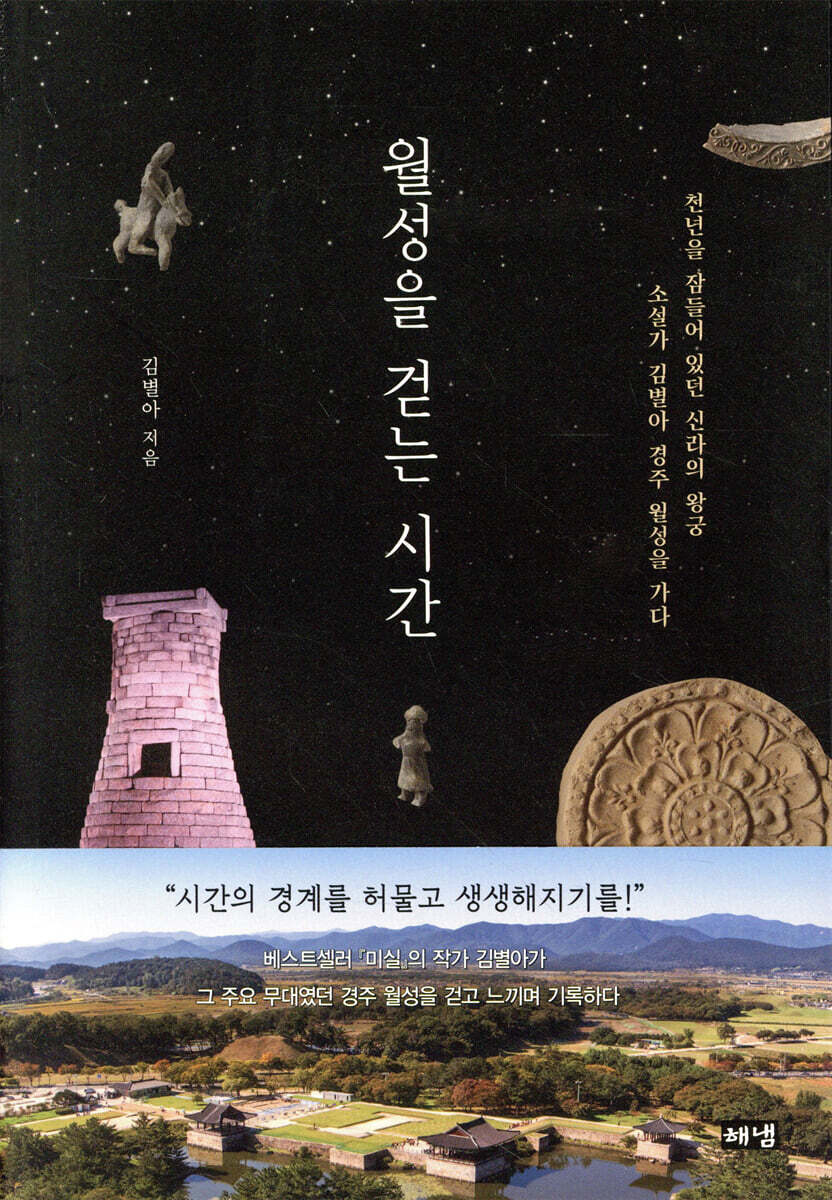 |
Description
Book Introduction
“Walk through another thousand years!”
The excavation site of Wolseong, the 'millennium-old palace', carefully revealed its inner workings
Seeing the historic sites inside and outside Wolseong with your own eyes and feet
Approaching the traces of a vast and distant time
Gyeongju, a city with a yearly increase in tourists of more than 10%, attracting over 12.7 million visitors annually (as of 2019).
As Korea's premier city of historical relics, it's a popular destination for school trips and is also famous for its hip Hwangridan-gil. But how much do we really know about the history and spatial significance of Gyeongju?
Kim Byeol-a, author of the best-selling novel "Misil," which won the first World Literature Award and sold over 200,000 copies, visited Wolseong and its surrounding areas in Gyeongju and published a new collection of essays, "Time to Walk Wolseong," in 2019 to experience Gyeongju "properly."
This book was completed through additional research and supplementation based on the content serialized in the [Gyeongbuk Daily Newspaper] for about a year starting in 2019.
The author of this work, which depicts the power struggles of the Silla royal family centered around the woman Misil, who was a goddess of sex, actually walked and recorded the excavation site of Wolseong, the royal castle of Silla, which was the main stage of the work, and thus, his unique perspective and literary sensibility combine to create a new era in the Gyeongju travelogue.
The excavation site of Wolseong, the 'millennium-old palace', carefully revealed its inner workings
Seeing the historic sites inside and outside Wolseong with your own eyes and feet
Approaching the traces of a vast and distant time
Gyeongju, a city with a yearly increase in tourists of more than 10%, attracting over 12.7 million visitors annually (as of 2019).
As Korea's premier city of historical relics, it's a popular destination for school trips and is also famous for its hip Hwangridan-gil. But how much do we really know about the history and spatial significance of Gyeongju?
Kim Byeol-a, author of the best-selling novel "Misil," which won the first World Literature Award and sold over 200,000 copies, visited Wolseong and its surrounding areas in Gyeongju and published a new collection of essays, "Time to Walk Wolseong," in 2019 to experience Gyeongju "properly."
This book was completed through additional research and supplementation based on the content serialized in the [Gyeongbuk Daily Newspaper] for about a year starting in 2019.
The author of this work, which depicts the power struggles of the Silla royal family centered around the woman Misil, who was a goddess of sex, actually walked and recorded the excavation site of Wolseong, the royal castle of Silla, which was the main stage of the work, and thus, his unique perspective and literary sensibility combine to create a new era in the Gyeongju travelogue.
- You can preview some of the book's contents.
Preview
index
Prologue | All Time in Wolseong, the Millennium Royal Palace
Chapter 1: The City That Slept for a Thousand Years
Wolseong, first encountered, then encountered again. The inner workings of history cautiously revealed their faces.
The Stage of Politics, the Arena of Power: Wolseong in Literature 1 『Samguk Sagi』
Wolseong 2 in ancient fantasy literature, full of mystery and miracles: Samguk Yusa and Hwarang Segi
Singing of the Ruins: Literature and Wolseong
Come anytime you want to see Wolseong and Wolseong Walk
· The foundation of life for the Silla people, where buildings were built again and again as they collapsed.
Interview with Lee Jong-hoon, former director of the Gyeongju National Research Institute of Cultural Heritage
Chapter 2: Traces of Life Found Through Time _ Stories Inside Wolseong
The Mystery of Wolseong: Two Bodies Buried Under the Wall
A small, foreigner-sized earthenware doll discovered in Wolseong, the tomb of King Wonseong, and Cheoyong
Looking at the Silla people's dining table, what did the people of Wolseong eat and live on?
Wolseong, the lifeline of the Silla people, flows through the Gyeongju River.
Ah, the night of Silla! A night of elegance, the night of Wolseong
Silla Donggung Palace and Wolji Pond 1, pouring out from the pond
Treasures finally out of the water: Donggung Palace and Wolji Pond 2
Silla Dynasty drinking game Donggung and Wolji 3
A Thousand Years Ago, Plagues, and Toilets: The Crown Prince and the Wolji Pond 4
· "Even if I spend all day digging dirt without finding anything," Interview with Kwon Se-gyu, Wolseong Excavation Team Leader
Chapter 3: What Did Silla Dream of? _ Stories Outside Wolseong
In search of the house of the dead, the royal tomb, the place where the lords of Wolseong are buried
The Path of Faith: From Bulguksa Temple to Seokguram Grotto, the World Dreamed of by the Masters of Wolseong
Hwangryongsa Temple Site, standing in ruins, reflects the grandeur and pride of the royal family.
The True King's Path, the Hero's Path: From Gamsansa Temple Site to Daewangam
Comparison of the royal palaces of Silla, Goguryeo, and Baekje, which were interlocked like dog teeth during the period
Walking through Jinpyeongwangneung and Myeongwolsanseong Fortress, I glimpsed the intense desire for power.
I remember as much as I love them. Silla and Wolseong existed because of 'them'.
Epilogue | Gyeongju Again
Chapter 1: The City That Slept for a Thousand Years
Wolseong, first encountered, then encountered again. The inner workings of history cautiously revealed their faces.
The Stage of Politics, the Arena of Power: Wolseong in Literature 1 『Samguk Sagi』
Wolseong 2 in ancient fantasy literature, full of mystery and miracles: Samguk Yusa and Hwarang Segi
Singing of the Ruins: Literature and Wolseong
Come anytime you want to see Wolseong and Wolseong Walk
· The foundation of life for the Silla people, where buildings were built again and again as they collapsed.
Interview with Lee Jong-hoon, former director of the Gyeongju National Research Institute of Cultural Heritage
Chapter 2: Traces of Life Found Through Time _ Stories Inside Wolseong
The Mystery of Wolseong: Two Bodies Buried Under the Wall
A small, foreigner-sized earthenware doll discovered in Wolseong, the tomb of King Wonseong, and Cheoyong
Looking at the Silla people's dining table, what did the people of Wolseong eat and live on?
Wolseong, the lifeline of the Silla people, flows through the Gyeongju River.
Ah, the night of Silla! A night of elegance, the night of Wolseong
Silla Donggung Palace and Wolji Pond 1, pouring out from the pond
Treasures finally out of the water: Donggung Palace and Wolji Pond 2
Silla Dynasty drinking game Donggung and Wolji 3
A Thousand Years Ago, Plagues, and Toilets: The Crown Prince and the Wolji Pond 4
· "Even if I spend all day digging dirt without finding anything," Interview with Kwon Se-gyu, Wolseong Excavation Team Leader
Chapter 3: What Did Silla Dream of? _ Stories Outside Wolseong
In search of the house of the dead, the royal tomb, the place where the lords of Wolseong are buried
The Path of Faith: From Bulguksa Temple to Seokguram Grotto, the World Dreamed of by the Masters of Wolseong
Hwangryongsa Temple Site, standing in ruins, reflects the grandeur and pride of the royal family.
The True King's Path, the Hero's Path: From Gamsansa Temple Site to Daewangam
Comparison of the royal palaces of Silla, Goguryeo, and Baekje, which were interlocked like dog teeth during the period
Walking through Jinpyeongwangneung and Myeongwolsanseong Fortress, I glimpsed the intense desire for power.
I remember as much as I love them. Silla and Wolseong existed because of 'them'.
Epilogue | Gyeongju Again
Detailed image
.jpg)
Into the book
“How can we explain such a strange absence and silence?”
Most people who visit Gyeongju know about Cheomseongdae, Bulguksa Temple, and Seokguram Grotto, but not Wolseong.
It wasn't even in the history textbooks I learned in school.
Wolseongji was actually left in perfect ruins for over a thousand years without even a trace of the palace.
Although the neighboring Anapji Pond (Donggung and Wolji Pond), Daereungwon Tomb, Hwangryongsa Temple, Namsan Mountain, and Cheomseongdae are located around Wolseong, there was no real space to explore them.
They ignored their living spaces and only visited graves, prayer places, and observatories.
How can I explain such a strange absence and silence? And yet, my heart beats with a pang of pride.
We seem to already know a lot about Silla and Seorabeol, but there is still much we do not know.
So, my heart, carrying the secret key called Wolseong, heads to Gyeongju, and my heart flutters with excitement at the things I already know and the things I still don't know.
---From the "Prologue"
Crossing the boundaries between history and mystery
The breath of the old Silla people still stirs beneath our feet!
Silla, the ancient kingdom that ruled the eastern and southern regions of the Korean Peninsula for 992 years from 57 BC to 935 AD, began and ended with the brilliant capital of Seorabeol-Gyeongju.
The people of Seorabeol, especially the royal family who were the rulers of the kingdom, looked at the stars at Cheomseongdae, prayed at Seokguram Grotto and Bulguksa Temple, and when they died, they were buried in Daereungwon.
But then, where did they live? Silla's thousand-year capital was Wolseong.
Wolseong was the palace of Silla for 834 years, from 101 AD during the reign of King Pasai to 935 AD when Silla fell.
Excluding the 5th king, King Pasai, who directly led the construction of the palace among the 56 kings but did not reside there for long, it was the residence and government office of 50 kings from the 6th king, King Jima, to the 56th king, King Gyeongsun, and it was the center of the Silla dynasty.
---From the "Prologue"
"Wolseong? Where on earth is that?" When I told people I was going to cover Wolseong, the reactions from those around me were usually similar.
Although they are educated people and have traveled to Gyeongju several times, they said they do not know much about Wolseong, and even if they do know about it, they only read about it in history books.
How can we tell them about Wolseong? In a world so fleeting that new things are created, or even erased, as quickly as they are created, what can make them rewind a millennium, even if only for a moment?
---From "Chapter 1: The City That Slept for a Thousand Years_The First Time I Met Wolseong, The Second Time I Met Wolseong"
The people who visit 'Wolseong-irang' the most are elementary, middle, and high school students who visit Wolseong for field trips or experiential learning.
There are some children who listen with one ear and let it go out the other without any interest, but sometimes there are 'history nerds' who surprise the commentators.
Commentators don't overuse empty promises to generate shallow interest.
He honestly confesses that even if he comes back as an adult in about 10 years, he will still be the same as he is now.
However, with a little hope, I tell them that if they are interested, they could major in a related field and work at Wolseong.
Yes, that's right.
Because Wolseong has been with us for a long time and will continue to be with us for a long time to come.
Researcher Lee Seong-moon gave his final remarks.
“It will take a while, so please wait patiently,” he added with a smile as the Wolseong commentator.
“If you want to see Wolseong, come anytime!”
---From "Chapter 1: The City That Has Slept for a Thousand Years_Come see it whenever you want"
I did everything that human power could do.
If you pile it up, it will collapse.
When it falls, it is built again.
In the face of such overwhelming force, the ancients tried to achieve what was impossible for humans to do by doing things that humans should not do.
It is a prayer that sacrifices be made to the gods of the land, water, and wind, or whatever spirit, so that the walls, bridges, and buildings that were painstakingly built will not collapse.
The story of the human pillar, as fierce as it was earnest and as terrifying as it was desperate, was confirmed for the first time in Korea through the excavation of the Wolseong Fortress Wall.
---From "Traces of Life Encountered Through Time in Chapter 2_Two Corpses Buried Under the Wall"
The abandoned pond was overgrown with weeds and had only a small amount of water pooled in the center.
To the northwest, weeping willows lined the grounds, and to the east, at Imhaejeong, people drank and played.
To the east was a bamboo forest, and behind it was a house that sold makgeolli and snacks, although it wasn't a formal bar.
It is said that there was a vendor selling boiled eggs, snacks, and soju across from the current Donggung and Wolji ticket booths, perhaps because it was considered an amusement park due to its pond and pavilion.
The wide wings of Wolseong, the shining evidence of the unification of the Three Kingdoms, were thus lost to time.
When the dredging work at An-apji Pond began, it was thought that the pond was covered with thick sediment and the water was not deep, so it would be possible to pump out the water with a water pump.
There is a story that while draining the water, many fish like carp came out, some of the large fish were put in the pond of Bulguksa Temple, and some were taken home by the workers. One fish was so big that it had to be carried on a carrying pole.
So who would have thought that the entire abandoned pond, An-apji, would be surrounded by such elaborate stone walls?
---From "Chapter 2 Traces of Life Found Through Tracing Time_Silla Pouring Out from the Pond"
The Silla people were neat people.
The flush toilet excavated from the Donggung building site is the most advanced type of ancient toilet.
After the royal family or nobles finished their business, they would pour water from a jar placed next to the toilet and pour it into the toilet hole.
The water carrying the sewage flowed down a sloping canal and appears to have collected in a facility similar to a modern septic tank.
However, it is said that the last part of the canal was connected under the Donghae Nambu Line railroad, so the entire remains could not be seen.
The remains of the Crown Prince's bathroom were also tested for the presence of parasite eggs.
However, unlike the Wanggung-ri relics, no parasite eggs were found, either because they were all washed away in the water or because Silla had a separate method for exterminating parasites.
---From "Chapter 2 Traces of Life Found Through Time_Plagues and Restrooms from a Thousand Years Ago"
“What good is it to dig all that up?” A guide from the Silla Cultural Center, whom we met at the excavation hall of Tomb No. 44 of the Choksam site, said something similar.
You can't know anything until you dig everything up.
Since the gold crown was discovered in the Noseo-dong Ancient Tombs in 1921, a total of six Silla gold crowns have been excavated.
But among them, there is not a single one whose owner can be clearly identified.
Even after a century of research, I haven't been able to identify a single owner. What will I gain by digging through everything, what will I uncover? I whisper to my son, who will one day build my grave.
“If I were the owner of the grave, it would be terrible if someone were to dig up my grave for any purpose!
---From "Chapter 3: What Did Silla Dream of? The Path of a True King, the Path of a Hero"
Even after living such a difficult life, King Munmu decided to remain a 'symbol' until the end.
Even after death, he is buried underwater, saying that he will uphold the Buddhist law and protect the country as a dragon of the East Sea.
The structure of King Munmu's tomb, known as 'Daewangam', is thought to be similar to the structure of the main hall of Gamsansa Temple.
From the time of the unification war for the unification of the Three Kingdoms, there was a tendency in Silla for the ruling class to sacrifice themselves.
It is said that the death rate of the ruling class above the county magistrate level, who were defending the country in the battle to expel the Tang army, was beyond imagination.
It is the practice of the so-called 'noblesse oblige', a moral duty corresponding to high social status.
And that too, by sacrificing the most precious and crucial asset a human being possesses: life.
Most people who visit Gyeongju know about Cheomseongdae, Bulguksa Temple, and Seokguram Grotto, but not Wolseong.
It wasn't even in the history textbooks I learned in school.
Wolseongji was actually left in perfect ruins for over a thousand years without even a trace of the palace.
Although the neighboring Anapji Pond (Donggung and Wolji Pond), Daereungwon Tomb, Hwangryongsa Temple, Namsan Mountain, and Cheomseongdae are located around Wolseong, there was no real space to explore them.
They ignored their living spaces and only visited graves, prayer places, and observatories.
How can I explain such a strange absence and silence? And yet, my heart beats with a pang of pride.
We seem to already know a lot about Silla and Seorabeol, but there is still much we do not know.
So, my heart, carrying the secret key called Wolseong, heads to Gyeongju, and my heart flutters with excitement at the things I already know and the things I still don't know.
---From the "Prologue"
Crossing the boundaries between history and mystery
The breath of the old Silla people still stirs beneath our feet!
Silla, the ancient kingdom that ruled the eastern and southern regions of the Korean Peninsula for 992 years from 57 BC to 935 AD, began and ended with the brilliant capital of Seorabeol-Gyeongju.
The people of Seorabeol, especially the royal family who were the rulers of the kingdom, looked at the stars at Cheomseongdae, prayed at Seokguram Grotto and Bulguksa Temple, and when they died, they were buried in Daereungwon.
But then, where did they live? Silla's thousand-year capital was Wolseong.
Wolseong was the palace of Silla for 834 years, from 101 AD during the reign of King Pasai to 935 AD when Silla fell.
Excluding the 5th king, King Pasai, who directly led the construction of the palace among the 56 kings but did not reside there for long, it was the residence and government office of 50 kings from the 6th king, King Jima, to the 56th king, King Gyeongsun, and it was the center of the Silla dynasty.
---From the "Prologue"
"Wolseong? Where on earth is that?" When I told people I was going to cover Wolseong, the reactions from those around me were usually similar.
Although they are educated people and have traveled to Gyeongju several times, they said they do not know much about Wolseong, and even if they do know about it, they only read about it in history books.
How can we tell them about Wolseong? In a world so fleeting that new things are created, or even erased, as quickly as they are created, what can make them rewind a millennium, even if only for a moment?
---From "Chapter 1: The City That Slept for a Thousand Years_The First Time I Met Wolseong, The Second Time I Met Wolseong"
The people who visit 'Wolseong-irang' the most are elementary, middle, and high school students who visit Wolseong for field trips or experiential learning.
There are some children who listen with one ear and let it go out the other without any interest, but sometimes there are 'history nerds' who surprise the commentators.
Commentators don't overuse empty promises to generate shallow interest.
He honestly confesses that even if he comes back as an adult in about 10 years, he will still be the same as he is now.
However, with a little hope, I tell them that if they are interested, they could major in a related field and work at Wolseong.
Yes, that's right.
Because Wolseong has been with us for a long time and will continue to be with us for a long time to come.
Researcher Lee Seong-moon gave his final remarks.
“It will take a while, so please wait patiently,” he added with a smile as the Wolseong commentator.
“If you want to see Wolseong, come anytime!”
---From "Chapter 1: The City That Has Slept for a Thousand Years_Come see it whenever you want"
I did everything that human power could do.
If you pile it up, it will collapse.
When it falls, it is built again.
In the face of such overwhelming force, the ancients tried to achieve what was impossible for humans to do by doing things that humans should not do.
It is a prayer that sacrifices be made to the gods of the land, water, and wind, or whatever spirit, so that the walls, bridges, and buildings that were painstakingly built will not collapse.
The story of the human pillar, as fierce as it was earnest and as terrifying as it was desperate, was confirmed for the first time in Korea through the excavation of the Wolseong Fortress Wall.
---From "Traces of Life Encountered Through Time in Chapter 2_Two Corpses Buried Under the Wall"
The abandoned pond was overgrown with weeds and had only a small amount of water pooled in the center.
To the northwest, weeping willows lined the grounds, and to the east, at Imhaejeong, people drank and played.
To the east was a bamboo forest, and behind it was a house that sold makgeolli and snacks, although it wasn't a formal bar.
It is said that there was a vendor selling boiled eggs, snacks, and soju across from the current Donggung and Wolji ticket booths, perhaps because it was considered an amusement park due to its pond and pavilion.
The wide wings of Wolseong, the shining evidence of the unification of the Three Kingdoms, were thus lost to time.
When the dredging work at An-apji Pond began, it was thought that the pond was covered with thick sediment and the water was not deep, so it would be possible to pump out the water with a water pump.
There is a story that while draining the water, many fish like carp came out, some of the large fish were put in the pond of Bulguksa Temple, and some were taken home by the workers. One fish was so big that it had to be carried on a carrying pole.
So who would have thought that the entire abandoned pond, An-apji, would be surrounded by such elaborate stone walls?
---From "Chapter 2 Traces of Life Found Through Tracing Time_Silla Pouring Out from the Pond"
The Silla people were neat people.
The flush toilet excavated from the Donggung building site is the most advanced type of ancient toilet.
After the royal family or nobles finished their business, they would pour water from a jar placed next to the toilet and pour it into the toilet hole.
The water carrying the sewage flowed down a sloping canal and appears to have collected in a facility similar to a modern septic tank.
However, it is said that the last part of the canal was connected under the Donghae Nambu Line railroad, so the entire remains could not be seen.
The remains of the Crown Prince's bathroom were also tested for the presence of parasite eggs.
However, unlike the Wanggung-ri relics, no parasite eggs were found, either because they were all washed away in the water or because Silla had a separate method for exterminating parasites.
---From "Chapter 2 Traces of Life Found Through Time_Plagues and Restrooms from a Thousand Years Ago"
“What good is it to dig all that up?” A guide from the Silla Cultural Center, whom we met at the excavation hall of Tomb No. 44 of the Choksam site, said something similar.
You can't know anything until you dig everything up.
Since the gold crown was discovered in the Noseo-dong Ancient Tombs in 1921, a total of six Silla gold crowns have been excavated.
But among them, there is not a single one whose owner can be clearly identified.
Even after a century of research, I haven't been able to identify a single owner. What will I gain by digging through everything, what will I uncover? I whisper to my son, who will one day build my grave.
“If I were the owner of the grave, it would be terrible if someone were to dig up my grave for any purpose!
---From "Chapter 3: What Did Silla Dream of? The Path of a True King, the Path of a Hero"
Even after living such a difficult life, King Munmu decided to remain a 'symbol' until the end.
Even after death, he is buried underwater, saying that he will uphold the Buddhist law and protect the country as a dragon of the East Sea.
The structure of King Munmu's tomb, known as 'Daewangam', is thought to be similar to the structure of the main hall of Gamsansa Temple.
From the time of the unification war for the unification of the Three Kingdoms, there was a tendency in Silla for the ruling class to sacrifice themselves.
It is said that the death rate of the ruling class above the county magistrate level, who were defending the country in the battle to expel the Tang army, was beyond imagination.
It is the practice of the so-called 'noblesse oblige', a moral duty corresponding to high social status.
And that too, by sacrificing the most precious and crucial asset a human being possesses: life.
---From "Chapter 3: What Did Silla Dream of? In Search of the House of the Dead"
Publisher's Review
Wolseong, the home of the Silla people, who built and rebuilt buildings as they collapsed.
A new chapter in the Gyeongju travelogue, reminding us of history, time, and courtesy toward people!
Wolseong is believed to have been the royal castle that protected Silla for a thousand years from 101 AD during the reign of King Pasai until 935 AD when Silla fell. It is believed to have been located in the Inwang-dong area of Gyeongju today.
Because its shape resembled a crescent moon, it was also called Wolseong or Banwolseong, but after the fall of Silla, traces of it gradually disappeared and even its existence disappeared.
The condition of the castle walls and surrounding area was confirmed by Japanese archaeologists in the 1910s, and the existence of a moat and the presence of buildings were confirmed through test excavations from the late 1970s to the mid-1980s.
During the three-stage excavation survey conducted by the National Research Institute of Cultural Heritage in Gyeongju from 1985 to 2010, the existence of vivid relics was revealed through the first comprehensive underground radar survey in 2007-2008.
Since December 2014, full-scale excavations have been conducted inside Wolseong, and secrets of ancient Silla that we had not known about are being revealed one by one.
Silla's economy, culture, and politics were centered around Wolseong, and although the royal capital remained unchanged for approximately 800 years, which is unprecedented in history, few people are truly aware of Woljeong's existence and value.
Therefore, the full-scale excavation and restoration of Wolseong has become an opportunity to rediscover Gyeongju not simply as a popular tourist destination, but as a vivid and living site of history.
Author Kim Byeol-a first examines the historical context of Wolseong, the "city that slept for a thousand years," by tracing various documents (Chapter 1) and interviewing those involved in the excavation work.
Next, we will unfold an interesting story related to ‘tracing the traces of the lives of the Silla people through time’ centered around the relics discovered within Wolseong (Chapter 2).
Furthermore, it expands its perspective beyond Wolseong to include Bulguksa Temple and the Tomb of King Munmu, and deals with the world, ideology, and rise and fall dreamed of by the ruling class of Silla, the owners of Wolseong (Chapter 3).
Through the novelist's imagination and savory prose, various historical facts and on-site excavation materials bring to life the fragmented history of Gyeongju and Silla.
A time of learning and imagination
Reflecting on human life as the present and past intersect
The author traces the spread of epidemics during the Silla Dynasty through the Samguk Sagi (History of the Three Kingdoms), and visits a flush toilet that reveals the neat and tidy nature of the Silla people, reminding us of our similarities with those of us today who are not suffering from COVID-19.
Through the stone statues and earthen figures guarding the royal tombs dressed in foreign attire, the spirit of inclusiveness of the Silla people, who respected and coexisted with foreign peoples, is also recalled in 21st century South Korea.
It also movingly portrays the lyricism of Gyeongju, the literary city where poets Jo Ji-hun and Park Mok-wol of the Cheongnokpa first met and shared a friendship, and which was also Kim Dong-ri's pride.
The story of the birth of the perfect ruin of Hwangryongsa Temple, the spirit of King Munmu who drowned himself in the East Sea to protect his country even after death, and the tense struggle of the three kingdoms that were intertwined like the teeth of a dog are captured in the perspective that extends beyond Wolseong, capturing the agony and beliefs of the kings of Silla, the 'millennial kingdom.'
Above all, the author focuses on the ongoing excavation sites in Wolseong and Gyeongju, vividly telling the voices of those involved and the stories behind them.
The process by which the abandoned pond An-apji was revealed to be the "Donggung and Wolji" that evidences the expansion of Wolseong, and the mystery of human bones and human sacrifices that surprised everyone when discovered near the Wolseong fortress walls in 2017 are fascinating to read over and over again.
Through this, the struggles of the excavation and restoration workers to revive the past and the passion of the people of Gyeongju to make this known to the world are fully conveyed.
Although the excavation site in Wolseong is covered with a blue 'gappa', it is open and alive in the lives of the citizens.
‘Time to Walk Wolseong’ was ultimately a time when the present and the past met.
The author compares encountering the vast and grand history of Silla to 'groping an elephant.'
There is still much that we do not know, but I urge you to break down the boundaries of time and experience it vividly.
Emphasizing that Wolseong is right at the center of it.
This book will allow those who wish to travel and study Gyeongju to explore its time and space more deeply and colorfully.
Furthermore, by providing surprising historical facts and new imaginations, it will provide another key to unlocking the secrets of racing that have always been with us but were previously unknown.
A new chapter in the Gyeongju travelogue, reminding us of history, time, and courtesy toward people!
Wolseong is believed to have been the royal castle that protected Silla for a thousand years from 101 AD during the reign of King Pasai until 935 AD when Silla fell. It is believed to have been located in the Inwang-dong area of Gyeongju today.
Because its shape resembled a crescent moon, it was also called Wolseong or Banwolseong, but after the fall of Silla, traces of it gradually disappeared and even its existence disappeared.
The condition of the castle walls and surrounding area was confirmed by Japanese archaeologists in the 1910s, and the existence of a moat and the presence of buildings were confirmed through test excavations from the late 1970s to the mid-1980s.
During the three-stage excavation survey conducted by the National Research Institute of Cultural Heritage in Gyeongju from 1985 to 2010, the existence of vivid relics was revealed through the first comprehensive underground radar survey in 2007-2008.
Since December 2014, full-scale excavations have been conducted inside Wolseong, and secrets of ancient Silla that we had not known about are being revealed one by one.
Silla's economy, culture, and politics were centered around Wolseong, and although the royal capital remained unchanged for approximately 800 years, which is unprecedented in history, few people are truly aware of Woljeong's existence and value.
Therefore, the full-scale excavation and restoration of Wolseong has become an opportunity to rediscover Gyeongju not simply as a popular tourist destination, but as a vivid and living site of history.
Author Kim Byeol-a first examines the historical context of Wolseong, the "city that slept for a thousand years," by tracing various documents (Chapter 1) and interviewing those involved in the excavation work.
Next, we will unfold an interesting story related to ‘tracing the traces of the lives of the Silla people through time’ centered around the relics discovered within Wolseong (Chapter 2).
Furthermore, it expands its perspective beyond Wolseong to include Bulguksa Temple and the Tomb of King Munmu, and deals with the world, ideology, and rise and fall dreamed of by the ruling class of Silla, the owners of Wolseong (Chapter 3).
Through the novelist's imagination and savory prose, various historical facts and on-site excavation materials bring to life the fragmented history of Gyeongju and Silla.
A time of learning and imagination
Reflecting on human life as the present and past intersect
The author traces the spread of epidemics during the Silla Dynasty through the Samguk Sagi (History of the Three Kingdoms), and visits a flush toilet that reveals the neat and tidy nature of the Silla people, reminding us of our similarities with those of us today who are not suffering from COVID-19.
Through the stone statues and earthen figures guarding the royal tombs dressed in foreign attire, the spirit of inclusiveness of the Silla people, who respected and coexisted with foreign peoples, is also recalled in 21st century South Korea.
It also movingly portrays the lyricism of Gyeongju, the literary city where poets Jo Ji-hun and Park Mok-wol of the Cheongnokpa first met and shared a friendship, and which was also Kim Dong-ri's pride.
The story of the birth of the perfect ruin of Hwangryongsa Temple, the spirit of King Munmu who drowned himself in the East Sea to protect his country even after death, and the tense struggle of the three kingdoms that were intertwined like the teeth of a dog are captured in the perspective that extends beyond Wolseong, capturing the agony and beliefs of the kings of Silla, the 'millennial kingdom.'
Above all, the author focuses on the ongoing excavation sites in Wolseong and Gyeongju, vividly telling the voices of those involved and the stories behind them.
The process by which the abandoned pond An-apji was revealed to be the "Donggung and Wolji" that evidences the expansion of Wolseong, and the mystery of human bones and human sacrifices that surprised everyone when discovered near the Wolseong fortress walls in 2017 are fascinating to read over and over again.
Through this, the struggles of the excavation and restoration workers to revive the past and the passion of the people of Gyeongju to make this known to the world are fully conveyed.
Although the excavation site in Wolseong is covered with a blue 'gappa', it is open and alive in the lives of the citizens.
‘Time to Walk Wolseong’ was ultimately a time when the present and the past met.
The author compares encountering the vast and grand history of Silla to 'groping an elephant.'
There is still much that we do not know, but I urge you to break down the boundaries of time and experience it vividly.
Emphasizing that Wolseong is right at the center of it.
This book will allow those who wish to travel and study Gyeongju to explore its time and space more deeply and colorfully.
Furthermore, by providing surprising historical facts and new imaginations, it will provide another key to unlocking the secrets of racing that have always been with us but were previously unknown.
GOODS SPECIFICS
- Publication date: August 25, 2022
- Page count, weight, size: 272 pages | 432g | 140*210*20mm
- ISBN13: 9791167140463
- ISBN10: 116714046X
You may also like
카테고리
korean


korean

![GQ KOREA Mark (Monthly): December [2025]](http://librairie.coreenne.fr/cdn/shop/files/8ef265dbbfbf186523ed75ba7319009d.jpg?v=1765340328&width=3840)


