

Rousseau's Emile
 |
Description
Book Introduction
Overcoming the barrier of lengthy original text
Containing the essence of 『Emile』!
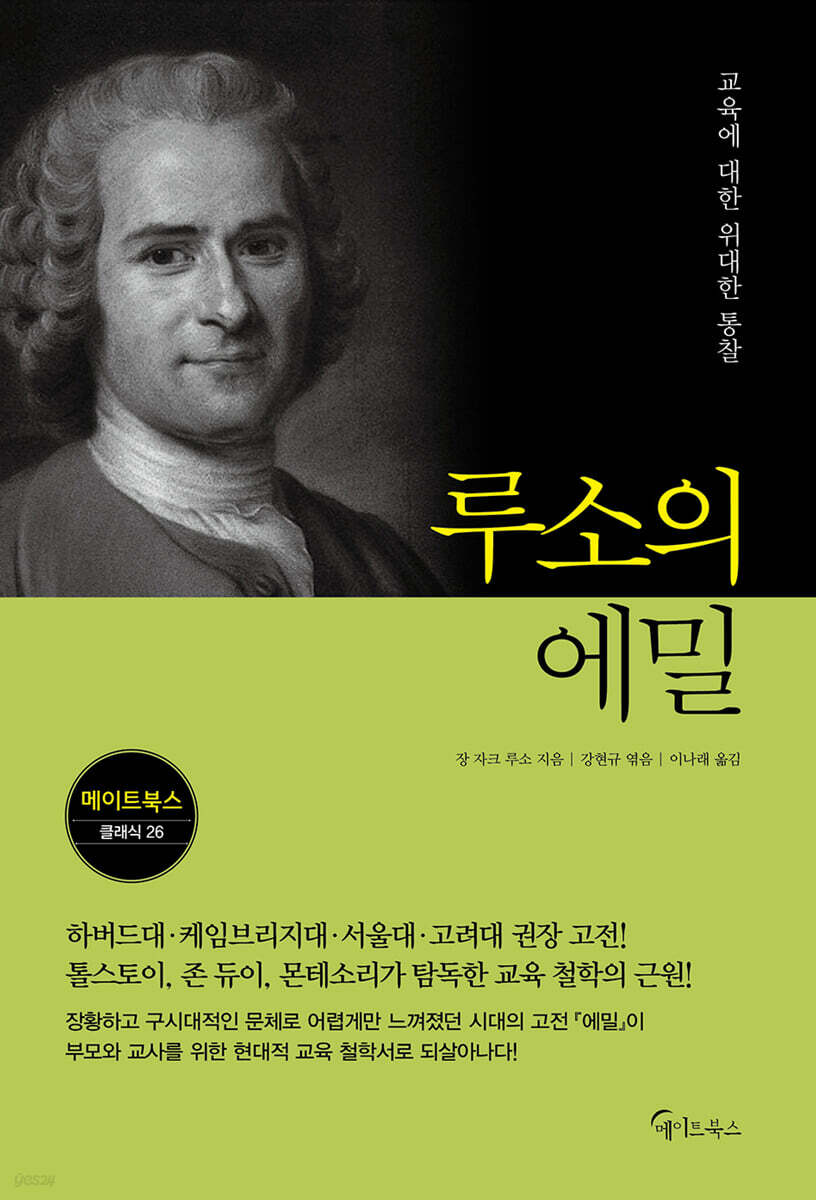
“What is a human being, and how does society shape the individual?” Rousseau’s Emile, the most radical and profound answer to this fundamental question, has been published by Matebooks in a completely new, contemporary translation.
Although several complete translations already exist in Korea, their vast volume and complex sentence structure have been a high barrier to general readers.
This translation is an attempt to break down that barrier.
This translation contains only the 'heart' of Rousseau.
By boldly removing overly lengthy or anachronistic parts and focusing only on the essence of thought centered around the essence of Rousseau's educational philosophy—nature, sense, habit, and autonomy—this book provides readers with a clarity that a complete translation cannot.
This is not a simple abridged version, but a new translation that maintains the logic and weight of the original text while creating a 'general education book that modern readers can read from beginning to end.'
"Emile" is not simply a theory of education.
It is a philosophical statement that asks what it means to be human and how society shapes individuals.
Rousseau viewed humans as inherently good beings and believed that social institutions undermine that nature.
His thinking remains revolutionary even today in that he viewed children not as objects to be adapted to the world, but as mirrors reflecting the distortions of the world.
When it was published in 1762, the book was banned and met with fierce criticism from the French Parliament in Paris and the Vatican, and Rousseau was forced to flee to Switzerland to avoid arrest, as it was a revolutionary idea that shook the times.
In today's educational reality, where we have lost our way amidst the pressures of information and competition, this book offers the most fundamental insight into restoring human nature.
In an age obsessed with information, competition, and achievement, where education prioritizes results over the human spirit, Rousseau's Emile has returned as a philosophical guide to the restoration of human nature.
Containing the essence of 『Emile』!
“What is a human being, and how does society shape the individual?” Rousseau’s Emile, the most radical and profound answer to this fundamental question, has been published by Matebooks in a completely new, contemporary translation.
Although several complete translations already exist in Korea, their vast volume and complex sentence structure have been a high barrier to general readers.
This translation is an attempt to break down that barrier.
This translation contains only the 'heart' of Rousseau.
By boldly removing overly lengthy or anachronistic parts and focusing only on the essence of thought centered around the essence of Rousseau's educational philosophy—nature, sense, habit, and autonomy—this book provides readers with a clarity that a complete translation cannot.
This is not a simple abridged version, but a new translation that maintains the logic and weight of the original text while creating a 'general education book that modern readers can read from beginning to end.'
"Emile" is not simply a theory of education.
It is a philosophical statement that asks what it means to be human and how society shapes individuals.
Rousseau viewed humans as inherently good beings and believed that social institutions undermine that nature.
His thinking remains revolutionary even today in that he viewed children not as objects to be adapted to the world, but as mirrors reflecting the distortions of the world.
When it was published in 1762, the book was banned and met with fierce criticism from the French Parliament in Paris and the Vatican, and Rousseau was forced to flee to Switzerland to avoid arrest, as it was a revolutionary idea that shook the times.
In today's educational reality, where we have lost our way amidst the pressures of information and competition, this book offers the most fundamental insight into restoring human nature.
In an age obsessed with information, competition, and achievement, where education prioritizes results over the human spirit, Rousseau's Emile has returned as a philosophical guide to the restoration of human nature.
- You can preview some of the book's contents.
Preview
index
Editor's Note: Rewriting "Emile" with 21st-Century Language and Editorial Sensibility
Preface: Principles of Education Applicable Anywhere
Prologue: Testing Real Education with My Virtual Student, Emil
Chapter 1: Six First Steps from Nature_Infancy
- Be rooted in nature and in harmony with your surroundings.
Education, through the harmony of "nature, others, and the environment," aims for a single goal. Nature becomes a habit, nurturing children through their natural instincts.
- Parents must wake up first to save their children.
Shouldn't we stop at protecting and guide our children? If mothers awaken first, families and society will awaken as well? Does a mother's love, whether insufficient or excessive, harm her children? Mothers embrace and nurture, while fathers guide and build them.
- Build strength in your child through gradual training.
Don't suppress them, but gradually strengthen them? The only habit you can teach your child is the freedom to resist habit. Let's train them slowly and overcome their fears.
- Let them learn through their own experiences with their body and senses.
We need to let them experience it firsthand, and let them learn on their own. They learn through their eyes and hands, and they learn language through objects.
- Be helpful, but firm in your desires and whims.
When a child cries, help them, but don't sway them. Even if a child's hands are rough, isn't that malice? It's the vitality of life itself? Don't give in to a child's whims or unreasonable desires.
- When your child learns to speak, don't rush and wait.
A child's first words should be clear and specific. Don't try to correct every little error in their speech. If you rush them, their speech will become more slurred.
Chapter 2: Eleven Steps to Growing Up in Nature_Childhood
- From crying to words, from pain to courage
Don't react to their crying, but approach them when they speak. Let them build courage through small pains. Don't overprotect them, but let them grow strong in freedom.
- Teach with the laws of nature instead of oppressive authority.
Should children be left to nature, not authority? Should they be given freedom, but their desires should be restrained? Should small pains prepare for great happiness? Should reason and morality not be rushed? Should education be guided by the laws of nature?
- An environment that protects nature's good impulses
Since a child's nature is good, should the environment be their teacher? Should we protect and wait for them rather than teach them? The educator's character and sincerity create the best environment.
Design, not preaching! Education is the structure of experience.
Let them learn through experience rather than lecture? Moments of passion, learning through experience? The path of an educator who protects children's thoughts.
- Eliminate commands, promises, and lies from education.
Even if you destroy something, don't get angry and let them experience it. Promises are learned through negotiation and autonomy. Lies are born with promises. Forced promises breed lies.
- Virtue is visible! Generosity is by example.
Calculated generosity isn't true virtue? Lead by example, not coercion. The limits of imitation and true morality.
- Protect your child from the illusion of early discipline.
Does today's suffering guarantee tomorrow's happiness? Even if you're called a prodigy, you're still just a child? Childhood isn't about preparation, it's about living a full life. A futile education trapped in symbols and words.
- Reading and language come late, reality and objects come first.
Memorizing words isn't knowledge? For a flexible brain, reality and objects come first. Reading comes late, learning comes from desire. Passive education isn't neglect. Intellect rooted in reality and physical strength are the foundation.
- The body comes first, the intellect follows.
The stronger the body, the stronger the child's reasoning. Sleep and exercise go hand in hand. Sleep and wakefulness are also educational.
A school of the senses! Learn by touching, measuring, and drawing.
Are your child's first teachers feet, hands, and eyes? Instead of instilling knowledge, train their senses and judgment. Tactile training in the dark, without light. Let them measure and estimate by feeling, away from tools. Drawing from real objects opens their eyes.
A child's music education should be structured rather than emotional.
A child's voice doesn't yet convey emotion? Develop a clear, unadorned voice. Music is about structure, not emotion.
Appetite is the first step to education! Trust your appetite more than vanity.
Is appetite the first step to education? Appetite is a far more desirable educational motivation than vanity.
- The happiness of childhood is the power to enjoy the present.
A child living in the present vs.
A child forced into a future? A child's language is unvarnished truth. He must learn to conform to the inevitability of nature.
- A child's discernment develops in the freedom that nature provides.
Free action, but not recklessness? When play and activity become life itself? Standing at the center of your peers with discernment.
Chapter 3: Growing Strength in Body and Mind_ Boyhood (Ages 12-15)
- Turn your power beyond desire into learning now.
When the power to surpass desire sprouts? How to transform your remaining strength into learning.
- Let's choose what to teach based on the criteria of 'benefit'.
What to teach and what to postpone? Experience over authority, and morality.
- Ignite curiosity and let them learn through their senses.
The Power of Curiosity: How to Distinguish Instinct from Vanity? From Sensation to Thought: Experience Comes First? Questioning That Prompts Self-Discovery? Sky Lessons: Astronomy Opened Through Observation? Tools Are Just Aids: The Trap of Symbols? How to Learn Geography: From the "Here and Now" to Maps
- Now is not the time to teach children academics.
In childhood, "methodology" is more important than "study"? Time is short, and assignments are plentiful. Don't force concentration; encourage it through enjoyment.
- Learn deeply with your hands and understand the principles on your own.
The laws of nature begin with the senses? Observation and experimentation connect experience? The first science discovered with hands and tools.
- Ask first about the 'benefit' and then ask 'why'.
Spending time based on "benefit"? Teaching the meaning of "benefit" through action? The power and trust of questioning? Let's ask questions carefully, only when truly necessary.
- Stop the injection and develop your judgment.
Is persuasion without experience a futile endeavor? Instead of comparing children with others, compete with yourself? Objects first, society later? Practice judgment to avoid errors.
- Let's teach life skills and survival techniques.
Exchange and division of labor are the very powers of coexistence. Let's start by teaching them how to preserve life. Is it talent or desire? Observation is the answer.
- Let's make the knowledge we know our own.
Knowledge that becomes mine: substance over quantity? Learning from experience? Judging by relationships, unwavering? Existing solely as oneself.
Chapter 4: The Age of Reason and Passion: From Adolescence to Young Adulthood (Ages 15-20)
- The body and mind of adolescence become a sign of a second birth.
Puberty, the second birth, begins in the body. The gaze changes, and attitudes learn independence. The turmoil of the mind prepares for maturity.
Education moves beyond discipline to the path of companionship.
Discipline retreats, and accompaniment begins? Authority comes from example, not coercion. Let's not rush growth, but follow the seasons.
Imagination and reason must be cultivated in a balanced way.
Does imagination foster both fear and passion? Should reason be built on sensory experience? Imagination and reason should cooperate, not conflict.
- It's time to learn how to deal with your emotions.
Don't treat your child's emotions as your enemy. Love becomes a test and a training ground for purification. Compassion expands, pride guards. Morality is built on emotions.
Justice and freedom are learned within society.
Justice is learned through play and interaction? Freedom grows with rules? Justice learned through social relationships.
- Faith and conscience grow from the inner voice.
Does faith sprout from freedom, not coercion? Autonomy of conscience and the role of educators? A living faith must grow from morality.
Love and friendship become the school of maturity.
Friendship is the first school of moral sentiments. Love is the most intense test.
Chapter 5: The Age of Wisdom and Marriage: The Perfection of Youth (Ages 20-25)
- Love comes splendidly at the end of youth.
Is the pinnacle of youth here and now? The sweet world opened by first love? The true taste of happiness that comes with waiting.
- When youth wavers, education holds them together until the end.
When ideals are lost, youth wavers. The power of education lies in fostering habits.
Happiness is near, but young people often lose their way.
Do we wander in search of happiness only to find it further away? Do we find happiness on the path nature shows us? Do we learn to desire and become slaves to it?
- Marriage and family are the first steps toward society.
Does marriage lead to freedom and maturity? Is the family the smallest society? Marriage and family are gateways to society.
- Youth becomes complete when they are with their country.
Is the homeland a stage for youth to practice virtue? The duty of living with the homeland.
Epilogue: The fruit of Emilian education is the birth of virtuous, free people.
Preface: Principles of Education Applicable Anywhere
Prologue: Testing Real Education with My Virtual Student, Emil
Chapter 1: Six First Steps from Nature_Infancy
- Be rooted in nature and in harmony with your surroundings.
Education, through the harmony of "nature, others, and the environment," aims for a single goal. Nature becomes a habit, nurturing children through their natural instincts.
- Parents must wake up first to save their children.
Shouldn't we stop at protecting and guide our children? If mothers awaken first, families and society will awaken as well? Does a mother's love, whether insufficient or excessive, harm her children? Mothers embrace and nurture, while fathers guide and build them.
- Build strength in your child through gradual training.
Don't suppress them, but gradually strengthen them? The only habit you can teach your child is the freedom to resist habit. Let's train them slowly and overcome their fears.
- Let them learn through their own experiences with their body and senses.
We need to let them experience it firsthand, and let them learn on their own. They learn through their eyes and hands, and they learn language through objects.
- Be helpful, but firm in your desires and whims.
When a child cries, help them, but don't sway them. Even if a child's hands are rough, isn't that malice? It's the vitality of life itself? Don't give in to a child's whims or unreasonable desires.
- When your child learns to speak, don't rush and wait.
A child's first words should be clear and specific. Don't try to correct every little error in their speech. If you rush them, their speech will become more slurred.
Chapter 2: Eleven Steps to Growing Up in Nature_Childhood
- From crying to words, from pain to courage
Don't react to their crying, but approach them when they speak. Let them build courage through small pains. Don't overprotect them, but let them grow strong in freedom.
- Teach with the laws of nature instead of oppressive authority.
Should children be left to nature, not authority? Should they be given freedom, but their desires should be restrained? Should small pains prepare for great happiness? Should reason and morality not be rushed? Should education be guided by the laws of nature?
- An environment that protects nature's good impulses
Since a child's nature is good, should the environment be their teacher? Should we protect and wait for them rather than teach them? The educator's character and sincerity create the best environment.
Design, not preaching! Education is the structure of experience.
Let them learn through experience rather than lecture? Moments of passion, learning through experience? The path of an educator who protects children's thoughts.
- Eliminate commands, promises, and lies from education.
Even if you destroy something, don't get angry and let them experience it. Promises are learned through negotiation and autonomy. Lies are born with promises. Forced promises breed lies.
- Virtue is visible! Generosity is by example.
Calculated generosity isn't true virtue? Lead by example, not coercion. The limits of imitation and true morality.
- Protect your child from the illusion of early discipline.
Does today's suffering guarantee tomorrow's happiness? Even if you're called a prodigy, you're still just a child? Childhood isn't about preparation, it's about living a full life. A futile education trapped in symbols and words.
- Reading and language come late, reality and objects come first.
Memorizing words isn't knowledge? For a flexible brain, reality and objects come first. Reading comes late, learning comes from desire. Passive education isn't neglect. Intellect rooted in reality and physical strength are the foundation.
- The body comes first, the intellect follows.
The stronger the body, the stronger the child's reasoning. Sleep and exercise go hand in hand. Sleep and wakefulness are also educational.
A school of the senses! Learn by touching, measuring, and drawing.
Are your child's first teachers feet, hands, and eyes? Instead of instilling knowledge, train their senses and judgment. Tactile training in the dark, without light. Let them measure and estimate by feeling, away from tools. Drawing from real objects opens their eyes.
A child's music education should be structured rather than emotional.
A child's voice doesn't yet convey emotion? Develop a clear, unadorned voice. Music is about structure, not emotion.
Appetite is the first step to education! Trust your appetite more than vanity.
Is appetite the first step to education? Appetite is a far more desirable educational motivation than vanity.
- The happiness of childhood is the power to enjoy the present.
A child living in the present vs.
A child forced into a future? A child's language is unvarnished truth. He must learn to conform to the inevitability of nature.
- A child's discernment develops in the freedom that nature provides.
Free action, but not recklessness? When play and activity become life itself? Standing at the center of your peers with discernment.
Chapter 3: Growing Strength in Body and Mind_ Boyhood (Ages 12-15)
- Turn your power beyond desire into learning now.
When the power to surpass desire sprouts? How to transform your remaining strength into learning.
- Let's choose what to teach based on the criteria of 'benefit'.
What to teach and what to postpone? Experience over authority, and morality.
- Ignite curiosity and let them learn through their senses.
The Power of Curiosity: How to Distinguish Instinct from Vanity? From Sensation to Thought: Experience Comes First? Questioning That Prompts Self-Discovery? Sky Lessons: Astronomy Opened Through Observation? Tools Are Just Aids: The Trap of Symbols? How to Learn Geography: From the "Here and Now" to Maps
- Now is not the time to teach children academics.
In childhood, "methodology" is more important than "study"? Time is short, and assignments are plentiful. Don't force concentration; encourage it through enjoyment.
- Learn deeply with your hands and understand the principles on your own.
The laws of nature begin with the senses? Observation and experimentation connect experience? The first science discovered with hands and tools.
- Ask first about the 'benefit' and then ask 'why'.
Spending time based on "benefit"? Teaching the meaning of "benefit" through action? The power and trust of questioning? Let's ask questions carefully, only when truly necessary.
- Stop the injection and develop your judgment.
Is persuasion without experience a futile endeavor? Instead of comparing children with others, compete with yourself? Objects first, society later? Practice judgment to avoid errors.
- Let's teach life skills and survival techniques.
Exchange and division of labor are the very powers of coexistence. Let's start by teaching them how to preserve life. Is it talent or desire? Observation is the answer.
- Let's make the knowledge we know our own.
Knowledge that becomes mine: substance over quantity? Learning from experience? Judging by relationships, unwavering? Existing solely as oneself.
Chapter 4: The Age of Reason and Passion: From Adolescence to Young Adulthood (Ages 15-20)
- The body and mind of adolescence become a sign of a second birth.
Puberty, the second birth, begins in the body. The gaze changes, and attitudes learn independence. The turmoil of the mind prepares for maturity.
Education moves beyond discipline to the path of companionship.
Discipline retreats, and accompaniment begins? Authority comes from example, not coercion. Let's not rush growth, but follow the seasons.
Imagination and reason must be cultivated in a balanced way.
Does imagination foster both fear and passion? Should reason be built on sensory experience? Imagination and reason should cooperate, not conflict.
- It's time to learn how to deal with your emotions.
Don't treat your child's emotions as your enemy. Love becomes a test and a training ground for purification. Compassion expands, pride guards. Morality is built on emotions.
Justice and freedom are learned within society.
Justice is learned through play and interaction? Freedom grows with rules? Justice learned through social relationships.
- Faith and conscience grow from the inner voice.
Does faith sprout from freedom, not coercion? Autonomy of conscience and the role of educators? A living faith must grow from morality.
Love and friendship become the school of maturity.
Friendship is the first school of moral sentiments. Love is the most intense test.
Chapter 5: The Age of Wisdom and Marriage: The Perfection of Youth (Ages 20-25)
- Love comes splendidly at the end of youth.
Is the pinnacle of youth here and now? The sweet world opened by first love? The true taste of happiness that comes with waiting.
- When youth wavers, education holds them together until the end.
When ideals are lost, youth wavers. The power of education lies in fostering habits.
Happiness is near, but young people often lose their way.
Do we wander in search of happiness only to find it further away? Do we find happiness on the path nature shows us? Do we learn to desire and become slaves to it?
- Marriage and family are the first steps toward society.
Does marriage lead to freedom and maturity? Is the family the smallest society? Marriage and family are gateways to society.
- Youth becomes complete when they are with their country.
Is the homeland a stage for youth to practice virtue? The duty of living with the homeland.
Epilogue: The fruit of Emilian education is the birth of virtuous, free people.
Detailed image

Into the book
We need strength because we are born weak.
You are thrown into the world empty-handed and need help to survive.
To escape from ignorance, one must have the power to judge.
Although we are born with nothing, everything we need to become adults can be acquired through education.
Humans learn from nature, other people, and the environment.
Through nature, we develop our intellectual and physical abilities, observe others and learn how to utilize those abilities, and interact with our environment to build our own experiences.
The charm of family life is the most powerful antidote to corrupt customs.
The commotion caused by children is not a hassle, but a joy worth enduring.
Thanks to children, fathers and mothers need and respect each other more, and their bond becomes stronger.
It doesn't matter whether the child creates or destroys it.
The act of changing the state of things is the purpose itself.
Even if they show destructive tendencies, it is not because of malice.
Creation is slow, but destruction is fast, so destruction is more suited to a child's energetic temperament.
The Creator of nature gave this life energy to the child, but placed limits on its physical abilities to ensure that it would not cause harm.
However, when children begin to view the people around them as tools to manipulate at will, they will try to use others to change the situation and compensate for their helplessness.
In this way, the child becomes annoying, overbearing, arrogant, and difficult to manage.
This is not the result of an innate instinct to dominate, but rather the instinct to dominate is formed through that process.
--- From "Chapter 1: Six First Steps Starting from Nature_ Infancy"
A child's behavior is not an expression of obedience, but of autonomous will.
Help from others is not evidence of obedience, but a willing favor.
Children should always feel free to act on their own, and even when adults help them.
When supplementing for lack of strength, it is best to help only enough for the child to move freely.
Excessive protection makes children arrogant.
Make your child feel embarrassed every time he or she needs help, and let him or her wait for the moment when he or she can boast about doing something on his or her own without relying on an adult.
Wrongful actions are originally intended to harm others.
But the child never has such a mind.
If you harbor even one ill will, everything will fall apart at that moment.
From then on, the child becomes irreversibly corrupted.
Some actions may seem bad to a stingy eye, but not to a rational standard.
To ensure that your child can make mistakes without getting into trouble, you need to keep dangerous objects out of reach so they don't pay dearly for their mistakes.
The more I emphasize my 'passive teaching method,' the louder the voices of opposition seem to grow.
But I am by no means arguing that it is okay to neglect children.
If you leave a child alone without teaching him anything, he will eventually take the man-made world as his teacher.
No matter how much you try to make your child physically inactive, it doesn't make his or her thinking more flexible.
Quite the opposite.
If you force a child to use up what little reason he has on things that seem most useless, the value of reason in his mind will hit rock bottom.
Having never experienced the usefulness of reason, the child eventually concludes that reason is a useless faculty.
--- From "Chapter 2 Eleven Steps Growing Up in Nature_ Childhood"
Humans are creatures who inherently pursue happiness, but it is impossible to fully satisfy that desire.
That's why I'm constantly looking for ways to make life better.
This is the first driving force of curiosity.
This is a natural tendency in the human mind, but it grows even stronger when supported by passion and reason.
Curiosity should be nurtured not out of a desire to show off, but out of an inner need to improve one's life.
The true teacher is always experience and feeling.
Only by experiencing the situation for oneself can one know what is truly helpful in one's life.
A child knows that he or she will become an adult someday.
For a child, the image of an adult that he or she can imagine is an opportunity to learn, but it is better not to know about the life of an adult that is beyond his or her comprehension.
This book is merely one long argument attempting to prove these educational principles.
If we can properly teach our children the meaning of the word 'beneficial', we will immediately have a powerful tool for guiding them.
This word leaves a deep impression on the child.
Emil still doesn't really understand death.
But since we are already accustomed to accepting the law of inevitability without resistance, we will accept it calmly without groaning or struggling when death approaches.
This is the only attitude that nature allows in the moment when everyone is afraid.
The best way to face death calmly is to live freely and not be attached to the human world.
--- From “Chapter 3: Growing Strength in Body and Mind_ Boyhood (12-15 Years Old)”
Adolescents are in a whirlwind of emotions they don't even know they have.
They laugh and cry for no reason, act on impulse, and sometimes contradict themselves.
But this instability is by no means negative.
It is a positive process in which nature's hands refine the still unfinished human being.
A little solitude is more beneficial than many words.
Let them walk alone in nature.
The wind on the roadside, the smell of grass, the distant sound of a bell - these sensations calm the mind.
Solitude is not an escape, it is an exercise in finding balance.
A mind that doesn't know how to be alone is always shaken by external noise.
Let yourself observe this time.
Justice and freedom are not separate virtues.
We grow together only when we live together in society, respecting each other's rights.
Freedom without justice is license, and justice without freedom is oppression.
These two virtues are cultivated simultaneously in social life, and they perfect humans as communal beings.
Nature gave us the instinct for freedom, but society provides the foundation of justice to ensure that freedom is not destroyed.
Individuals protect themselves in freedom and live with others in justice.
Only when these two virtues stand side by side does a human being become a subject of social life.
A young man who experiences love cannot control his emotions and goes to extremes.
Joy reaches its peak for a moment, but soon turns to jealousy and anxiety.
Love puts a young man to the test, and in the process, he comes to a desperate realization of who he is.
Rather than suppressing this love, educators should guide it in the right direction.
Love must not be sinful or neglected, but must be honestly shown in its two aspects of joy and pain.
Love can flow into self-destructive desire, or it can develop into a force that respects and takes responsibility for others.
Which way to go depends on the attitude of the educator and the youth's own reflection.
--- From “Chapter 4: The Age of Reason and Passion_ From Adolescence to Young Adulthood (15-20 Years Old)”
Their first love will last a long time because it comes from the sympathy of two hearts and the harmony of true feelings.
Emile surrenders himself rationally and with faith to the most ecstatic joy, without fear, regret, or guilt, but only the natural anxiety that comes with happiness.
Dear Emil, love and be loved.
Even if you don't get it right away, I hope you can enjoy that feeling for a long time.
Experience love and purity together.
Before you wait for paradise in the next world, you must create your own heaven in this world.
The various relationships formed within the family help us learn in advance how to live in society.
The relationship between parents and children, and between husband and wife, is a microcosm of social relationships and a training ground for them.
In this small community, children learn social sense by experiencing cooperation, conflict, and reconciliation.
Ultimately, the family becomes the most basic training ground before going beyond the individual's fence and entering society.
The order, responsibility, love, and dedication learned here will become a living force even when we move into the wider community.
You are thrown into the world empty-handed and need help to survive.
To escape from ignorance, one must have the power to judge.
Although we are born with nothing, everything we need to become adults can be acquired through education.
Humans learn from nature, other people, and the environment.
Through nature, we develop our intellectual and physical abilities, observe others and learn how to utilize those abilities, and interact with our environment to build our own experiences.
The charm of family life is the most powerful antidote to corrupt customs.
The commotion caused by children is not a hassle, but a joy worth enduring.
Thanks to children, fathers and mothers need and respect each other more, and their bond becomes stronger.
It doesn't matter whether the child creates or destroys it.
The act of changing the state of things is the purpose itself.
Even if they show destructive tendencies, it is not because of malice.
Creation is slow, but destruction is fast, so destruction is more suited to a child's energetic temperament.
The Creator of nature gave this life energy to the child, but placed limits on its physical abilities to ensure that it would not cause harm.
However, when children begin to view the people around them as tools to manipulate at will, they will try to use others to change the situation and compensate for their helplessness.
In this way, the child becomes annoying, overbearing, arrogant, and difficult to manage.
This is not the result of an innate instinct to dominate, but rather the instinct to dominate is formed through that process.
--- From "Chapter 1: Six First Steps Starting from Nature_ Infancy"
A child's behavior is not an expression of obedience, but of autonomous will.
Help from others is not evidence of obedience, but a willing favor.
Children should always feel free to act on their own, and even when adults help them.
When supplementing for lack of strength, it is best to help only enough for the child to move freely.
Excessive protection makes children arrogant.
Make your child feel embarrassed every time he or she needs help, and let him or her wait for the moment when he or she can boast about doing something on his or her own without relying on an adult.
Wrongful actions are originally intended to harm others.
But the child never has such a mind.
If you harbor even one ill will, everything will fall apart at that moment.
From then on, the child becomes irreversibly corrupted.
Some actions may seem bad to a stingy eye, but not to a rational standard.
To ensure that your child can make mistakes without getting into trouble, you need to keep dangerous objects out of reach so they don't pay dearly for their mistakes.
The more I emphasize my 'passive teaching method,' the louder the voices of opposition seem to grow.
But I am by no means arguing that it is okay to neglect children.
If you leave a child alone without teaching him anything, he will eventually take the man-made world as his teacher.
No matter how much you try to make your child physically inactive, it doesn't make his or her thinking more flexible.
Quite the opposite.
If you force a child to use up what little reason he has on things that seem most useless, the value of reason in his mind will hit rock bottom.
Having never experienced the usefulness of reason, the child eventually concludes that reason is a useless faculty.
--- From "Chapter 2 Eleven Steps Growing Up in Nature_ Childhood"
Humans are creatures who inherently pursue happiness, but it is impossible to fully satisfy that desire.
That's why I'm constantly looking for ways to make life better.
This is the first driving force of curiosity.
This is a natural tendency in the human mind, but it grows even stronger when supported by passion and reason.
Curiosity should be nurtured not out of a desire to show off, but out of an inner need to improve one's life.
The true teacher is always experience and feeling.
Only by experiencing the situation for oneself can one know what is truly helpful in one's life.
A child knows that he or she will become an adult someday.
For a child, the image of an adult that he or she can imagine is an opportunity to learn, but it is better not to know about the life of an adult that is beyond his or her comprehension.
This book is merely one long argument attempting to prove these educational principles.
If we can properly teach our children the meaning of the word 'beneficial', we will immediately have a powerful tool for guiding them.
This word leaves a deep impression on the child.
Emil still doesn't really understand death.
But since we are already accustomed to accepting the law of inevitability without resistance, we will accept it calmly without groaning or struggling when death approaches.
This is the only attitude that nature allows in the moment when everyone is afraid.
The best way to face death calmly is to live freely and not be attached to the human world.
--- From “Chapter 3: Growing Strength in Body and Mind_ Boyhood (12-15 Years Old)”
Adolescents are in a whirlwind of emotions they don't even know they have.
They laugh and cry for no reason, act on impulse, and sometimes contradict themselves.
But this instability is by no means negative.
It is a positive process in which nature's hands refine the still unfinished human being.
A little solitude is more beneficial than many words.
Let them walk alone in nature.
The wind on the roadside, the smell of grass, the distant sound of a bell - these sensations calm the mind.
Solitude is not an escape, it is an exercise in finding balance.
A mind that doesn't know how to be alone is always shaken by external noise.
Let yourself observe this time.
Justice and freedom are not separate virtues.
We grow together only when we live together in society, respecting each other's rights.
Freedom without justice is license, and justice without freedom is oppression.
These two virtues are cultivated simultaneously in social life, and they perfect humans as communal beings.
Nature gave us the instinct for freedom, but society provides the foundation of justice to ensure that freedom is not destroyed.
Individuals protect themselves in freedom and live with others in justice.
Only when these two virtues stand side by side does a human being become a subject of social life.
A young man who experiences love cannot control his emotions and goes to extremes.
Joy reaches its peak for a moment, but soon turns to jealousy and anxiety.
Love puts a young man to the test, and in the process, he comes to a desperate realization of who he is.
Rather than suppressing this love, educators should guide it in the right direction.
Love must not be sinful or neglected, but must be honestly shown in its two aspects of joy and pain.
Love can flow into self-destructive desire, or it can develop into a force that respects and takes responsibility for others.
Which way to go depends on the attitude of the educator and the youth's own reflection.
--- From “Chapter 4: The Age of Reason and Passion_ From Adolescence to Young Adulthood (15-20 Years Old)”
Their first love will last a long time because it comes from the sympathy of two hearts and the harmony of true feelings.
Emile surrenders himself rationally and with faith to the most ecstatic joy, without fear, regret, or guilt, but only the natural anxiety that comes with happiness.
Dear Emil, love and be loved.
Even if you don't get it right away, I hope you can enjoy that feeling for a long time.
Experience love and purity together.
Before you wait for paradise in the next world, you must create your own heaven in this world.
The various relationships formed within the family help us learn in advance how to live in society.
The relationship between parents and children, and between husband and wife, is a microcosm of social relationships and a training ground for them.
In this small community, children learn social sense by experiencing cooperation, conflict, and reconciliation.
Ultimately, the family becomes the most basic training ground before going beyond the individual's fence and entering society.
The order, responsibility, love, and dedication learned here will become a living force even when we move into the wider community.
--- From “Chapter 5: The Time of Wisdom and Marriage_ The Perfection of Youth (20-25 Years Old)”
Publisher's Review
Penetrating the essence of human-centered education
Great classic!
Rousseau saw children as “seeds capable of starting a new society.”
This thinking was a full-scale challenge to the aristocratic class order and formal education system of the time, and became the basis of the thoughts of numerous educational thinkers, including Pestalozzi, Froebel, Montessori, and even Dewey.
Rousseau's Emile, which poses the fundamental question of "How does one become human?", shows that for Rousseau, education was not about 'teaching' but about 'helping', and that it was about creating an environment that enabled liberation and growth, not coercion and indoctrination.
So, this book remains both an educational book and the most profound reflection on humanity.
Classics are not old books, but books that can answer today's questions as time passes. This book brings back to the present the voice of the "philosopher of freedom" who penetrated the essence of human-centered education.
"Emile" remains a required reading for liberal arts courses at leading universities around the world, and has become the foundation of educational thought that continues through Pestalozzi, Froebel, and Dewey.
This translation opens the door to that tradition again for modern readers.
This translation reconstructs the flow of Rousseau's thoughts and writing style without harming the warmth of his writing, making it accessible to today's readers.
To prevent readers from getting lost in the record of Rousseau's philosophical reflections, the original text's lengthy narrative has been divided into topics and reorganized into individual columns.
Each column has a clear title, sentences have been streamlined, and long paragraphs have been divided to maximize readability.
Therefore, this book will be the best guide for those who are not majoring in education, but who want to enter the classics without losing sight of philosophy, as well as for parents and citizens who want to rethink education.
Rousseau's living wisdom, such as "The only habit a child should acquire is the freedom to be untamed by any other habit," is even more urgent today, and this translated book will become a must-read for parents who want to raise their children properly.
This book asks all readers who want to relearn education, humanity, and freedom.
“Do we truly know children, and indeed, human beings?”
Reader Recommendations
“For me, who only worried about ‘what to make my child into,’ this book asks again, ‘how should I view my child?’
The original was so vast and difficult, but this translation clearly explains Rousseau's core ideas in modern language, so I was able to read it all the way through.
It's a classic that made me realize that true education begins with respecting a child's rhythm, away from competition and comparison."
- Housewife in her 30s (reader with elementary school-aged children)
“This book is a classic, but it is also the book closest to our current educational reality.
This translation maintains the rhythm of Rousseau's thoughts and the warmth of his style, while also being structured to be easily accessible to readers without an academic background.
Rousseau's "freedom from habit" is the origin of all educational discourse on creativity and autonomy today.
If you want to re-examine the essence of education, you should return to this book.”
- A housewife in her 40s (reader with a middle school-aged child)
“I have read countless educational books throughout my teaching career, but I always end up coming back to Rousseau.
This translation reconstructs the essence of the vast original text in a teacher's language, filling it with insights that can be immediately applied in the classroom.
This book doesn't tell you how to teach, it teaches you 'how to grow with your child.'"
- Middle school teacher in his 50s (25 years of experience as an educator)
“These days, parents say that their children’s emotions are more difficult than their grades.
Rousseau already knew the answer 250 years ago.
This translation preserves the philosophical depth of the original text, but strips away unnecessary details and rewrites it in language that resonates with parents today.
“We come to realize once again the fundamental principle that children should be respected as beings themselves, not as objects of correction.”
- Counseling psychologist in his 40s (parenting education instructor)
Great classic!
Rousseau saw children as “seeds capable of starting a new society.”
This thinking was a full-scale challenge to the aristocratic class order and formal education system of the time, and became the basis of the thoughts of numerous educational thinkers, including Pestalozzi, Froebel, Montessori, and even Dewey.
Rousseau's Emile, which poses the fundamental question of "How does one become human?", shows that for Rousseau, education was not about 'teaching' but about 'helping', and that it was about creating an environment that enabled liberation and growth, not coercion and indoctrination.
So, this book remains both an educational book and the most profound reflection on humanity.
Classics are not old books, but books that can answer today's questions as time passes. This book brings back to the present the voice of the "philosopher of freedom" who penetrated the essence of human-centered education.
"Emile" remains a required reading for liberal arts courses at leading universities around the world, and has become the foundation of educational thought that continues through Pestalozzi, Froebel, and Dewey.
This translation opens the door to that tradition again for modern readers.
This translation reconstructs the flow of Rousseau's thoughts and writing style without harming the warmth of his writing, making it accessible to today's readers.
To prevent readers from getting lost in the record of Rousseau's philosophical reflections, the original text's lengthy narrative has been divided into topics and reorganized into individual columns.
Each column has a clear title, sentences have been streamlined, and long paragraphs have been divided to maximize readability.
Therefore, this book will be the best guide for those who are not majoring in education, but who want to enter the classics without losing sight of philosophy, as well as for parents and citizens who want to rethink education.
Rousseau's living wisdom, such as "The only habit a child should acquire is the freedom to be untamed by any other habit," is even more urgent today, and this translated book will become a must-read for parents who want to raise their children properly.
This book asks all readers who want to relearn education, humanity, and freedom.
“Do we truly know children, and indeed, human beings?”
Reader Recommendations
“For me, who only worried about ‘what to make my child into,’ this book asks again, ‘how should I view my child?’
The original was so vast and difficult, but this translation clearly explains Rousseau's core ideas in modern language, so I was able to read it all the way through.
It's a classic that made me realize that true education begins with respecting a child's rhythm, away from competition and comparison."
- Housewife in her 30s (reader with elementary school-aged children)
“This book is a classic, but it is also the book closest to our current educational reality.
This translation maintains the rhythm of Rousseau's thoughts and the warmth of his style, while also being structured to be easily accessible to readers without an academic background.
Rousseau's "freedom from habit" is the origin of all educational discourse on creativity and autonomy today.
If you want to re-examine the essence of education, you should return to this book.”
- A housewife in her 40s (reader with a middle school-aged child)
“I have read countless educational books throughout my teaching career, but I always end up coming back to Rousseau.
This translation reconstructs the essence of the vast original text in a teacher's language, filling it with insights that can be immediately applied in the classroom.
This book doesn't tell you how to teach, it teaches you 'how to grow with your child.'"
- Middle school teacher in his 50s (25 years of experience as an educator)
“These days, parents say that their children’s emotions are more difficult than their grades.
Rousseau already knew the answer 250 years ago.
This translation preserves the philosophical depth of the original text, but strips away unnecessary details and rewrites it in language that resonates with parents today.
“We come to realize once again the fundamental principle that children should be respected as beings themselves, not as objects of correction.”
- Counseling psychologist in his 40s (parenting education instructor)
GOODS SPECIFICS
- Date of issue: November 1, 2025
- Page count, weight, size: 312 pages | 482g | 153*225*19mm
- ISBN13: 9791160029673
- ISBN10: 1160029679
You may also like
카테고리
korean


korean

![GQ KOREA Mark (Monthly): December [2025]](http://librairie.coreenne.fr/cdn/shop/files/8ef265dbbfbf186523ed75ba7319009d.jpg?v=1765340328&width=3840)


