

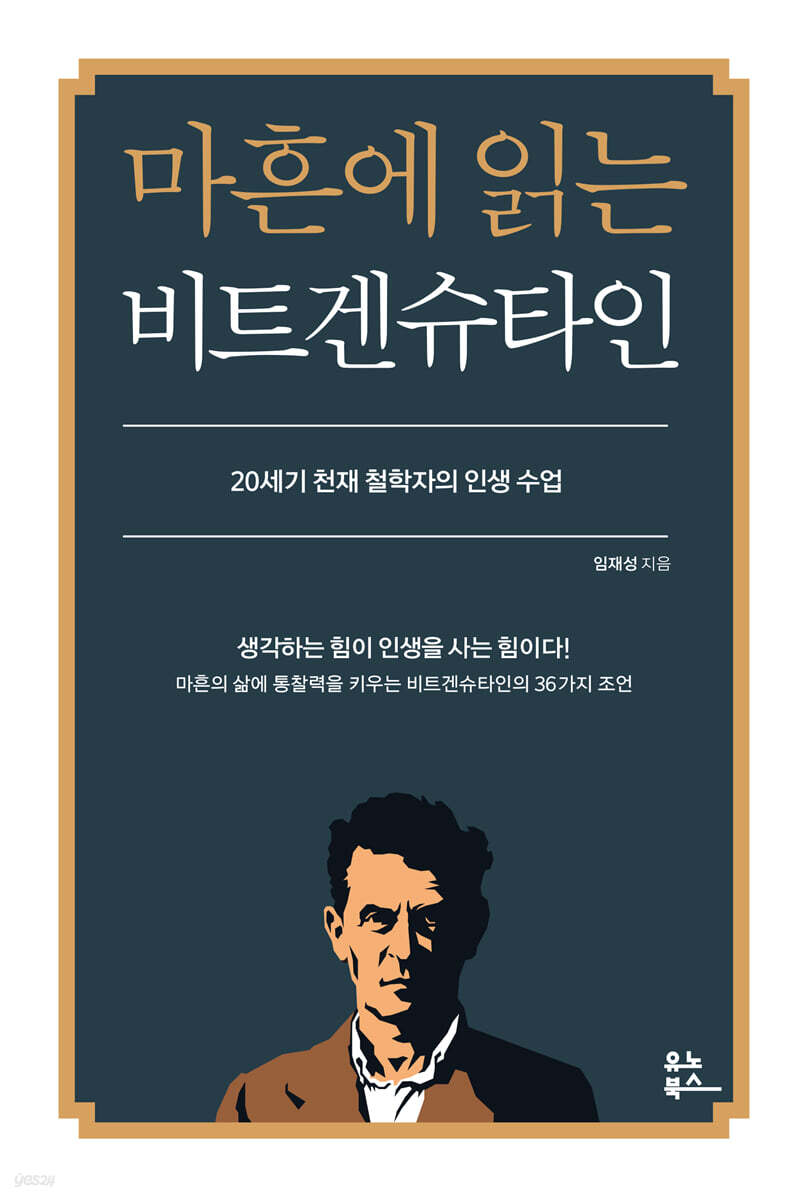
Reading Wittgenstein in your forties
 |
Description
Book Introduction
The power to think is the power to live!
Wittgenstein's 36 Tips for Gaining Insight into Your Forties
A book containing life lessons from a 20th-century genius philosopher for those in their forties.
Ludwig Wittgenstein said, “The power to think is the power to live.”
For us who live in a time when we must establish our own standards rather than those of external standards, "Reading Wittgenstein at Forty" unravels the life and philosophy of Wittgenstein, who constantly thought, broke himself down, and then rebuilt himself, into practical advice that can be applied to the daily lives of those in their forties.
Wittgenstein was praised as “a heretic who shook the history of philosophy with a single book,” “a giant of philosophy” followed by prominent figures around the world, and “the most influential philosopher of the 20th century” by Time magazine.
However, his philosophy is so difficult to understand that few books have summarized it in popular language.
Author Lim Jae-seong encountered Wittgenstein's only book, Tractatus Logico-Philosophicus, during a time of deep contemplation about life.
He wrestled with these complex sentences for a long time, trying to understand their hidden meaning, and finally rewrote them in the language of those living in their forties.
“Philosophy is like architecture, but its essence lies in building oneself.”
“If you want to become a better person, just keep doing your work silently.”
“When life gets tough, we try to change things first.
But the most fundamental and effective change begins with a change in attitude.”
In this way, Wittgenstein emphasizes to us living in the present age that we must find the essence of life.
In each chapter, "Reading Wittgenstein at Forty" discusses what is most important to me, how the language we use expands the world, how deeply we should think, when we can achieve true enlightenment, and what kind of life is meaningful.
By following the fundamental questions about life that Wittgenstein poses through this book, you will soon be able to live in the world according to the standards of your own choosing.
Are you stressed by complex interpersonal relationships? Do you feel like you're giving your life to others? Do you regret the past and worry about how to live your life going forward? Wittgenstein's insights into the power of thought can empower you to live life to the fullest.
Wittgenstein's 36 Tips for Gaining Insight into Your Forties
A book containing life lessons from a 20th-century genius philosopher for those in their forties.
Ludwig Wittgenstein said, “The power to think is the power to live.”
For us who live in a time when we must establish our own standards rather than those of external standards, "Reading Wittgenstein at Forty" unravels the life and philosophy of Wittgenstein, who constantly thought, broke himself down, and then rebuilt himself, into practical advice that can be applied to the daily lives of those in their forties.
Wittgenstein was praised as “a heretic who shook the history of philosophy with a single book,” “a giant of philosophy” followed by prominent figures around the world, and “the most influential philosopher of the 20th century” by Time magazine.
However, his philosophy is so difficult to understand that few books have summarized it in popular language.
Author Lim Jae-seong encountered Wittgenstein's only book, Tractatus Logico-Philosophicus, during a time of deep contemplation about life.
He wrestled with these complex sentences for a long time, trying to understand their hidden meaning, and finally rewrote them in the language of those living in their forties.
“Philosophy is like architecture, but its essence lies in building oneself.”
“If you want to become a better person, just keep doing your work silently.”
“When life gets tough, we try to change things first.
But the most fundamental and effective change begins with a change in attitude.”
In this way, Wittgenstein emphasizes to us living in the present age that we must find the essence of life.
In each chapter, "Reading Wittgenstein at Forty" discusses what is most important to me, how the language we use expands the world, how deeply we should think, when we can achieve true enlightenment, and what kind of life is meaningful.
By following the fundamental questions about life that Wittgenstein poses through this book, you will soon be able to live in the world according to the standards of your own choosing.
Are you stressed by complex interpersonal relationships? Do you feel like you're giving your life to others? Do you regret the past and worry about how to live your life going forward? Wittgenstein's insights into the power of thought can empower you to live life to the fullest.
- You can preview some of the book's contents.
Preview
index
To begin with, to meet Wittgenstein at the midpoint of one's life.
Chapter 1 Forty: What Matters Most to Me_Wittgenstein's Inner Self
The essence of life is me_myself
No matter what happens, don't lose yourself_Self-control
Don't let others control your emotions_Equanimity
Be grateful when life is good and be calm when it's bad_Balance
It is better to die after moving forward than to die while sitting down and sobbing_Overcoming
Tragedy begins with regret_Regret
Don't fight anxiety pointlessly, just be present in the moment_Quiet
Chapter 2: How Deep Should We Think? - Wittgenstein's Language
To think of a language is to think of a life_Language
Whereof one cannot speak, thereof be silent_Silence
Don't chat with others, talk to yourself_self-talk
Some words take time to realize their meaning_The Weight of Words
Don't be isolated_Communicate
Thoughts are rarely born in their entirety - The Expansion of Language and Thought
A well-written sentence melts the brain and heart_Writing
Chapter 3: How Deep Should We Think? - Wittgenstein's Thought
You can't teach how to think_understanding
No one can think for me_self-thinking
Life's problems are solved only from deep within_Depth
Don't forget the essence_Question
You can't tell the truth without abandoning lies_Truth
Take a step back and get a sense of the flow_View
Always start anew as if it were the first time_Transition
Without will, I don't exist_will
Chapter 4: When Do We Achieve True Enlightenment? - Wittgenstein's Insights
The body has limits, but the mind has no limits_Mind
Vanity destroys thinking_Vanity
If you can't be alone, you can't be strong_solitude
Accept your feelings as they are_Emotions
If you don't address the issue, the problem will disappear_essence
Philosophy is poetry_creativity
The truth is always where I stand_Discovery
Chapter 5: What Kind of Life is Meaningful? - Wittgenstein's The Meaning of Life
A true revolutionary is someone who changes me_Innovation
If you can move, don't stop learning_Learning
Even if you stumble and fall, get up and get back up_Resurgence
I already know what I need to do to be happy_happiness
Those who embrace fear and move forward grow_courage
If you are afraid of death, you are living an imperfect life_Death
How should I live this moment?_The meaning of life
References
Chapter 1 Forty: What Matters Most to Me_Wittgenstein's Inner Self
The essence of life is me_myself
No matter what happens, don't lose yourself_Self-control
Don't let others control your emotions_Equanimity
Be grateful when life is good and be calm when it's bad_Balance
It is better to die after moving forward than to die while sitting down and sobbing_Overcoming
Tragedy begins with regret_Regret
Don't fight anxiety pointlessly, just be present in the moment_Quiet
Chapter 2: How Deep Should We Think? - Wittgenstein's Language
To think of a language is to think of a life_Language
Whereof one cannot speak, thereof be silent_Silence
Don't chat with others, talk to yourself_self-talk
Some words take time to realize their meaning_The Weight of Words
Don't be isolated_Communicate
Thoughts are rarely born in their entirety - The Expansion of Language and Thought
A well-written sentence melts the brain and heart_Writing
Chapter 3: How Deep Should We Think? - Wittgenstein's Thought
You can't teach how to think_understanding
No one can think for me_self-thinking
Life's problems are solved only from deep within_Depth
Don't forget the essence_Question
You can't tell the truth without abandoning lies_Truth
Take a step back and get a sense of the flow_View
Always start anew as if it were the first time_Transition
Without will, I don't exist_will
Chapter 4: When Do We Achieve True Enlightenment? - Wittgenstein's Insights
The body has limits, but the mind has no limits_Mind
Vanity destroys thinking_Vanity
If you can't be alone, you can't be strong_solitude
Accept your feelings as they are_Emotions
If you don't address the issue, the problem will disappear_essence
Philosophy is poetry_creativity
The truth is always where I stand_Discovery
Chapter 5: What Kind of Life is Meaningful? - Wittgenstein's The Meaning of Life
A true revolutionary is someone who changes me_Innovation
If you can move, don't stop learning_Learning
Even if you stumble and fall, get up and get back up_Resurgence
I already know what I need to do to be happy_happiness
Those who embrace fear and move forward grow_courage
If you are afraid of death, you are living an imperfect life_Death
How should I live this moment?_The meaning of life
References
Detailed image

Into the book
Wittgenstein lived a lonely and anxious life all his life.
I had a hard time getting along with people around me.
I suffered from depression and had to fight fiercely with my inner conflict.
However, instead of running away from the pain, he trained himself by contemplating deeply through philosophy.
The diary entry for July 16, 1916 contains the following confession:
“A violent storm is coming.
I am stranded in the mountains, forced to survive in cold, wind, and thick fog with only poor equipment.
My whole body aches, and I am overcome with the fear that I might lose myself.
I may be a weak human being.
But my spirit still sustains me.”
--- From "No matter what happens, don't lose yourself"
“When life gets tough, we try to change things first.
But the most fundamental and effective change begins with a change in attitude.
But making up your mind is the hardest thing.”
Wittgenstein's philosophy provides important insights into overcoming despair.
If despair cannot be avoided, it should be used as an opportunity to understand life more deeply.
He believed that facing reality honestly without distorting it was the true way to overcome it.
--- From "It is better to die after moving forward to the end than to die while sitting down and sobbing"
“Even if the door is unlocked and can be opened from the inside, if he only pushes and does not think about pulling, he will still be trapped in the room.”
This suggests that our thinking can become trapped by language and our way of thinking.
Even if the door is open, if you don't know how to open it, you're trapped.
Likewise, we cannot discover new ideas and possibilities without expanding our linguistic and conceptual frameworks.
Wittgenstein's insight shows that expanding the language we use is a process that opens the door to thought.
As language becomes richer, the world we can understand and perceive also expands.
--- From "To think of a language is to think of a life"
“My thoughts are rarely born in a complete form.
Some thoughts are twisted or broken from the start, and some are immature and not ready to live alone in language.
“Like a newborn fetus, sentences come out incomplete, their most important parts not yet formed.”
Wittgenstein believed that thought does not exist in a complete form from the beginning, but is gradually refined through language.
Thoughts become clearer and deeper as we express them in words.
The meaning of words constantly changes and expands depending on how they are used.
Therefore, to develop thinking through language, we must delve deeply into the context and meaning of words.
--- From "It is rare for thoughts to be born in a complete form"
“Just because two people say the same thing doesn’t mean they think the same thing.
Even if we use the same language, the words can be interpreted differently depending on each person’s experience and context.”
This is why we need to ask deeper questions.
This is because asking questions can open up completely new perspectives by breaking the way of thinking that we previously took for granted.
You can also nod your head to the other person's interpretation.
You might think that what I've argued might be wrong.
So we need to break the mold of our thinking.
--- From "Don't Forget the Essence"
“The way to view the world with eternal eyes is not only through the artist’s creation.
I believe that is the way of reasoning.
Thinking is like flying high and looking out over the world.
“Rather than trying to change the world, it is about looking at it as it is and understanding it deeply.”
The thinking that Wittgenstein speaks of is also a process that allows us to look at problems in a new way.
If you try to solve problems only in familiar ways, you will reach a limit at some point.
It's like trying to find your way in the clouds.
If you don't see the whole picture, it's easy to get lost and end up in a dead end.
But when you go up a level and look at the bigger picture, the problem no longer seems like a huge wall, but rather begins to look like part of the map of life.
--- From "Take a step back and understand the flow"
“A truly happy person is not gripped by fear.
The same is true in moments leading up to death.
Happiness does not exist in the flow of time, but only in living in the present.
Death cannot intervene in a life lived fully in the present.
Death is not a part of life, but something that cannot be experienced within the world.”
Feeling and experiencing emotions fully is the way to live in the present.
When you are gripped by fear, you worry about the future, and when you suppress your emotions, you are stuck in the past.
However, only those who acknowledge and accept their emotions can live in the present.
--- From "Accept your feelings as they are"
“Sowing the seed of an idea and nurturing it to bear fruit are two entirely different things.”
Even if you gain intuitive insight through a metaphor, you must follow it up with a process of deep reflection and making it your own.
Just as seeds do not bear fruit on their own just by being sown, so too do thoughts bear fruit only after constant reflection and exploration.
Just as seeds must be wet by rain and shaken by wind to grow and bear fruit, so too must reason endure discomfort and confusion.
There are times when we experience the pain of having our familiar beliefs shaken and our comfortable frameworks of thought crumble.
But only after going through all that process can we approach true enlightenment through philosophy.
--- From "Philosophy is Poetry"
“A true revolutionary is someone who can change himself.”
Revolutionizing yourself means destroying your past self and being reborn as a better being.
Anyone can recognize their own shortcomings, but it is difficult to take action to change them.
But those who cannot change themselves cannot change the world.
A revolution that changes the world always begins with changing oneself.
Even after he gained fame as a philosopher, Wittgenstein was never complacent.
He constantly doubted and checked himself.
He knew that self-improvement was not a one-time event, but an ongoing process.
--- From "A true revolutionary is someone who changes me"
"What is the most fundamental question we face? What is the most important problem facing humanity? It is none other than 'How should we live?'
Human life is not about staying in a warm shelter and enjoying comfort.
We must not settle in one place, but stand up and move forward without stopping.
And as we move towards the final moments of our lives that we will inevitably face one day, we must ponder how we will live in this very moment.”
Wittgenstein's philosophy was a constant exploration of this question.
He lived his life by deeply contemplating and carving out his own path to make life entirely his own.
I had a hard time getting along with people around me.
I suffered from depression and had to fight fiercely with my inner conflict.
However, instead of running away from the pain, he trained himself by contemplating deeply through philosophy.
The diary entry for July 16, 1916 contains the following confession:
“A violent storm is coming.
I am stranded in the mountains, forced to survive in cold, wind, and thick fog with only poor equipment.
My whole body aches, and I am overcome with the fear that I might lose myself.
I may be a weak human being.
But my spirit still sustains me.”
--- From "No matter what happens, don't lose yourself"
“When life gets tough, we try to change things first.
But the most fundamental and effective change begins with a change in attitude.
But making up your mind is the hardest thing.”
Wittgenstein's philosophy provides important insights into overcoming despair.
If despair cannot be avoided, it should be used as an opportunity to understand life more deeply.
He believed that facing reality honestly without distorting it was the true way to overcome it.
--- From "It is better to die after moving forward to the end than to die while sitting down and sobbing"
“Even if the door is unlocked and can be opened from the inside, if he only pushes and does not think about pulling, he will still be trapped in the room.”
This suggests that our thinking can become trapped by language and our way of thinking.
Even if the door is open, if you don't know how to open it, you're trapped.
Likewise, we cannot discover new ideas and possibilities without expanding our linguistic and conceptual frameworks.
Wittgenstein's insight shows that expanding the language we use is a process that opens the door to thought.
As language becomes richer, the world we can understand and perceive also expands.
--- From "To think of a language is to think of a life"
“My thoughts are rarely born in a complete form.
Some thoughts are twisted or broken from the start, and some are immature and not ready to live alone in language.
“Like a newborn fetus, sentences come out incomplete, their most important parts not yet formed.”
Wittgenstein believed that thought does not exist in a complete form from the beginning, but is gradually refined through language.
Thoughts become clearer and deeper as we express them in words.
The meaning of words constantly changes and expands depending on how they are used.
Therefore, to develop thinking through language, we must delve deeply into the context and meaning of words.
--- From "It is rare for thoughts to be born in a complete form"
“Just because two people say the same thing doesn’t mean they think the same thing.
Even if we use the same language, the words can be interpreted differently depending on each person’s experience and context.”
This is why we need to ask deeper questions.
This is because asking questions can open up completely new perspectives by breaking the way of thinking that we previously took for granted.
You can also nod your head to the other person's interpretation.
You might think that what I've argued might be wrong.
So we need to break the mold of our thinking.
--- From "Don't Forget the Essence"
“The way to view the world with eternal eyes is not only through the artist’s creation.
I believe that is the way of reasoning.
Thinking is like flying high and looking out over the world.
“Rather than trying to change the world, it is about looking at it as it is and understanding it deeply.”
The thinking that Wittgenstein speaks of is also a process that allows us to look at problems in a new way.
If you try to solve problems only in familiar ways, you will reach a limit at some point.
It's like trying to find your way in the clouds.
If you don't see the whole picture, it's easy to get lost and end up in a dead end.
But when you go up a level and look at the bigger picture, the problem no longer seems like a huge wall, but rather begins to look like part of the map of life.
--- From "Take a step back and understand the flow"
“A truly happy person is not gripped by fear.
The same is true in moments leading up to death.
Happiness does not exist in the flow of time, but only in living in the present.
Death cannot intervene in a life lived fully in the present.
Death is not a part of life, but something that cannot be experienced within the world.”
Feeling and experiencing emotions fully is the way to live in the present.
When you are gripped by fear, you worry about the future, and when you suppress your emotions, you are stuck in the past.
However, only those who acknowledge and accept their emotions can live in the present.
--- From "Accept your feelings as they are"
“Sowing the seed of an idea and nurturing it to bear fruit are two entirely different things.”
Even if you gain intuitive insight through a metaphor, you must follow it up with a process of deep reflection and making it your own.
Just as seeds do not bear fruit on their own just by being sown, so too do thoughts bear fruit only after constant reflection and exploration.
Just as seeds must be wet by rain and shaken by wind to grow and bear fruit, so too must reason endure discomfort and confusion.
There are times when we experience the pain of having our familiar beliefs shaken and our comfortable frameworks of thought crumble.
But only after going through all that process can we approach true enlightenment through philosophy.
--- From "Philosophy is Poetry"
“A true revolutionary is someone who can change himself.”
Revolutionizing yourself means destroying your past self and being reborn as a better being.
Anyone can recognize their own shortcomings, but it is difficult to take action to change them.
But those who cannot change themselves cannot change the world.
A revolution that changes the world always begins with changing oneself.
Even after he gained fame as a philosopher, Wittgenstein was never complacent.
He constantly doubted and checked himself.
He knew that self-improvement was not a one-time event, but an ongoing process.
--- From "A true revolutionary is someone who changes me"
"What is the most fundamental question we face? What is the most important problem facing humanity? It is none other than 'How should we live?'
Human life is not about staying in a warm shelter and enjoying comfort.
We must not settle in one place, but stand up and move forward without stopping.
And as we move towards the final moments of our lives that we will inevitably face one day, we must ponder how we will live in this very moment.”
Wittgenstein's philosophy was a constant exploration of this question.
He lived his life by deeply contemplating and carving out his own path to make life entirely his own.
--- From "How will I live in this moment?"
Publisher's Review
Reading Wittgenstein in your forties
At the midpoint of our lives, we are now in our forties. We have been living our lives according to external standards and evaluations.
I've been running towards my goal without resting, but suddenly I think, "This isn't the life I truly wanted."
Relationships are still complicated, emotions are easily swayed, and even small decisions can be physically and mentally exhausting.
What we need now is our own standards to live life firmly.
This requires the power to think deeply about life.
Ludwig Wittgenstein, the most influential genius philosopher of the 20th century, was a philosopher who lived his life by his own standards until the moment he died.
He never stopped thinking even in the midst of a battlefield, and he controlled himself even amidst the pain and contradictions of life.
To us who are in our forties, Wittgenstein asks, “How should we live our lives?”
And he answers that developing the power of thinking is the power to live life.
The author worked at a stable large company and lived faithfully according to external standards.
But one day, he suddenly felt an unquenchable thirst in a corner of his heart, and the question, “What is truly important in life?” began to grow within him.
After much thought and wandering, he encountered Wittgenstein's philosophy.
This book, "Reading Wittgenstein at Forty," contains the power of living that the author learned from Wittgenstein's sentences.
He unravels Wittgenstein's philosophy into 36 practical tips, suggesting new ways for people in their forties to think, speak, and act.
Life Lessons from a 20th Century Genius Philosopher
《Reading Wittgenstein in Your Forties》converts Wittgenstein's philosophy into practical solutions that can be immediately applied in life at forty.
It goes beyond simply thinking and speaking philosophically and logically, but instead approaches it as a practical skill that can be applied to the moments that people in their forties see, hear, and feel in their daily lives.
Through this, we can re-establish the standards by which we live our lives.
The book is divided into five chapters.
Chapter 1, “Forty: What Matters Most to Me,” deals with the inner discipline that Wittgenstein emphasized.
“Don’t lose yourself!” The most important thing is the voice in my head.
We must live by our own standards, not by the gaze of others.
Chapter 2, “How Language Expands the World,” discusses the inseparable relationship between life and language, as in Wittgenstein’s words, “The limits of my language are the limits of my world” and “Whereof one cannot speak, thereof one must be silent.”
Chapter 3, “How Deep Should I Think?” emphasizes the importance of thinking, focusing on his statement, “Only I can wear the hat I put on my head.”
Chapter 4, “When Do We Achieve True Enlightenment?”, reveals the realization that we must change our perspective on problems, as in the saying, “Life’s problems disappear naturally when they are no longer problems, rather than when we try to solve them directly.”
Chapter 5, “What Kind of Life Is Meaningful,” sheds light on his life, where he said, “Tell them I lived a wonderful life,” before his death.
Life after forty is a time when you need to be strong.
But that strength is not something that someone else can give me; I have to cultivate it myself.
"Reading Wittgenstein at Forty" narrows the gap between philosophy and reality by using simple language we use in our daily lives.
What should I say? When should I remain silent? How should I think and how should I live? Only when the simple questions we encounter in daily life accumulate does the journey toward a solid life truly begin.
Don't think about life without Wittgenstein.
If you are in your forties and have lived your life conscious of other people's opinions and according to the standards set by society, you are bound to have worries that are always on your mind.
When I look back on the path I've walked at the midpoint of my life, I feel anew the distance from the life I truly wanted.
This book helps us discover our own standards for life that we have been ignoring and makes us think deeply about 'what is truly important' through Wittgenstein's thoughts.
Wittgenstein's philosophy changes the way we look at important issues in life.
It teaches us how to think more deeply about problems rather than trying to solve them hastily.
Through this book, readers can find the right center of their lives, learn how to move forward in a better direction without wavering, become more thoughtful, and find true happiness in life.
When you want to find your bearings in a turbulent life, when you want to solve life's most important problems, when you want to live fully as yourself until the very end, don't contemplate life without Wittgenstein.
For those in their forties who dream of not just a successful life, but the life they truly desire, this book is an essential companion.
As the power of thought becomes more important, let us look at life from the perspective of Wittgenstein, the heretic of philosophy and legendary genius.
At the midpoint of our lives, we are now in our forties. We have been living our lives according to external standards and evaluations.
I've been running towards my goal without resting, but suddenly I think, "This isn't the life I truly wanted."
Relationships are still complicated, emotions are easily swayed, and even small decisions can be physically and mentally exhausting.
What we need now is our own standards to live life firmly.
This requires the power to think deeply about life.
Ludwig Wittgenstein, the most influential genius philosopher of the 20th century, was a philosopher who lived his life by his own standards until the moment he died.
He never stopped thinking even in the midst of a battlefield, and he controlled himself even amidst the pain and contradictions of life.
To us who are in our forties, Wittgenstein asks, “How should we live our lives?”
And he answers that developing the power of thinking is the power to live life.
The author worked at a stable large company and lived faithfully according to external standards.
But one day, he suddenly felt an unquenchable thirst in a corner of his heart, and the question, “What is truly important in life?” began to grow within him.
After much thought and wandering, he encountered Wittgenstein's philosophy.
This book, "Reading Wittgenstein at Forty," contains the power of living that the author learned from Wittgenstein's sentences.
He unravels Wittgenstein's philosophy into 36 practical tips, suggesting new ways for people in their forties to think, speak, and act.
Life Lessons from a 20th Century Genius Philosopher
《Reading Wittgenstein in Your Forties》converts Wittgenstein's philosophy into practical solutions that can be immediately applied in life at forty.
It goes beyond simply thinking and speaking philosophically and logically, but instead approaches it as a practical skill that can be applied to the moments that people in their forties see, hear, and feel in their daily lives.
Through this, we can re-establish the standards by which we live our lives.
The book is divided into five chapters.
Chapter 1, “Forty: What Matters Most to Me,” deals with the inner discipline that Wittgenstein emphasized.
“Don’t lose yourself!” The most important thing is the voice in my head.
We must live by our own standards, not by the gaze of others.
Chapter 2, “How Language Expands the World,” discusses the inseparable relationship between life and language, as in Wittgenstein’s words, “The limits of my language are the limits of my world” and “Whereof one cannot speak, thereof one must be silent.”
Chapter 3, “How Deep Should I Think?” emphasizes the importance of thinking, focusing on his statement, “Only I can wear the hat I put on my head.”
Chapter 4, “When Do We Achieve True Enlightenment?”, reveals the realization that we must change our perspective on problems, as in the saying, “Life’s problems disappear naturally when they are no longer problems, rather than when we try to solve them directly.”
Chapter 5, “What Kind of Life Is Meaningful,” sheds light on his life, where he said, “Tell them I lived a wonderful life,” before his death.
Life after forty is a time when you need to be strong.
But that strength is not something that someone else can give me; I have to cultivate it myself.
"Reading Wittgenstein at Forty" narrows the gap between philosophy and reality by using simple language we use in our daily lives.
What should I say? When should I remain silent? How should I think and how should I live? Only when the simple questions we encounter in daily life accumulate does the journey toward a solid life truly begin.
Don't think about life without Wittgenstein.
If you are in your forties and have lived your life conscious of other people's opinions and according to the standards set by society, you are bound to have worries that are always on your mind.
When I look back on the path I've walked at the midpoint of my life, I feel anew the distance from the life I truly wanted.
This book helps us discover our own standards for life that we have been ignoring and makes us think deeply about 'what is truly important' through Wittgenstein's thoughts.
Wittgenstein's philosophy changes the way we look at important issues in life.
It teaches us how to think more deeply about problems rather than trying to solve them hastily.
Through this book, readers can find the right center of their lives, learn how to move forward in a better direction without wavering, become more thoughtful, and find true happiness in life.
When you want to find your bearings in a turbulent life, when you want to solve life's most important problems, when you want to live fully as yourself until the very end, don't contemplate life without Wittgenstein.
For those in their forties who dream of not just a successful life, but the life they truly desire, this book is an essential companion.
As the power of thought becomes more important, let us look at life from the perspective of Wittgenstein, the heretic of philosophy and legendary genius.
GOODS SPECIFICS
- Date of issue: May 7, 2025
- Page count, weight, size: 300 pages | 142*210*20mm
- ISBN13: 9791171831029
- ISBN10: 1171831021
You may also like
카테고리
korean


korean

![ELLE 엘르 스페셜 에디션 A형 : 12월 [2025]](http://librairie.coreenne.fr/cdn/shop/files/b8e27a3de6c9538896439686c6b0e8fb.jpg?v=1766436872&width=3840)


