

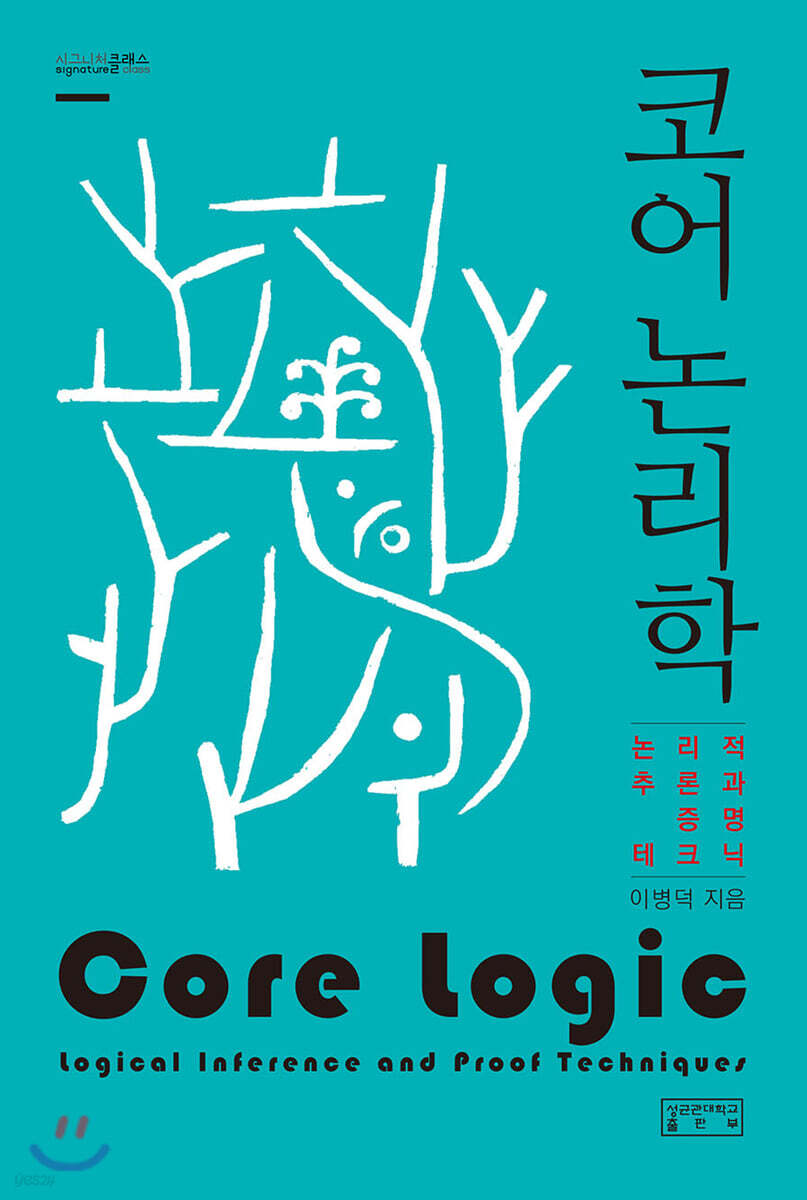
Core Logic
 |
Description
Book Introduction
The Essential Bible for Beginners in Logic
Core Logic
Logic is the study and evaluation of reasoning or argument.
Through logic, we develop the ability to distinguish between valid and invalid arguments.
Being able to distinguish between the two will not only allow you to present your arguments to others much more effectively, but it will also prevent you from making wrong judgments.
In a highly information-driven society, the logical ability to effectively judge and handle information is a crucial competitive advantage for modern people.
The first reason why we must learn logic now is precisely this ‘practical utility.’
"Core Logic" is the latest work by Professor Lee Byeong-deok (Department of Philosophy, Sungkyunkwan University, former President of the Korean Logic Society), who has dedicated himself to writing easy, systematic, and practical logic textbooks for a long time. Its primary goal is to help students who are new to logic acquire the ability to distinguish between valid and invalid arguments.
In particular, it provides a variety of opportunities to learn techniques for rigorously and logically proving the validity or invalidity of arguments through sentence logic and predicate logic.
Core Logic
Logic is the study and evaluation of reasoning or argument.
Through logic, we develop the ability to distinguish between valid and invalid arguments.
Being able to distinguish between the two will not only allow you to present your arguments to others much more effectively, but it will also prevent you from making wrong judgments.
In a highly information-driven society, the logical ability to effectively judge and handle information is a crucial competitive advantage for modern people.
The first reason why we must learn logic now is precisely this ‘practical utility.’
"Core Logic" is the latest work by Professor Lee Byeong-deok (Department of Philosophy, Sungkyunkwan University, former President of the Korean Logic Society), who has dedicated himself to writing easy, systematic, and practical logic textbooks for a long time. Its primary goal is to help students who are new to logic acquire the ability to distinguish between valid and invalid arguments.
In particular, it provides a variety of opportunities to learn techniques for rigorously and logically proving the validity or invalidity of arguments through sentence logic and predicate logic.
- You can preview some of the book's contents.
Preview
index
preface
Chapter 1__What is an argument?
Chapter 2: Deductive and Inductive Arguments
Chapter 3: Logical Connectors: Negation, Conjunction, and Declaration
Chapter 4: Contradiction, Opposition, Minor Contradictions, Categorical Statements, and Venn Diagrams
Chapter 5: Proof of Validity Using the Language and Truth Table of Sentence Logic
Chapter 6: Conditional statements, biconditional statements, necessary conditions, and sufficient conditions
Chapter 7: Sentence Logic I: Proving Validity by Natural Deduction
Chapter 8__Sentence Logic II: Derivation Rules
Chapter 9__Predicate Logic I: The Language of Predicate Logic
Chapter 10: Predicate Logic II: Semantics and Validity
Chapter 11: Multiple Quantified Sentences
Chapter 12: Natural Deduction of Predicate Logic
Chapter 13: Identity Sentences and Definite Descriptive Phrases
Chapter 14: Understanding Arguments Through Reconstruction
Chapter 15: Informal Errors
Appendix__Syllogism
Practice Problem Answers
Search
Chapter 1__What is an argument?
Chapter 2: Deductive and Inductive Arguments
Chapter 3: Logical Connectors: Negation, Conjunction, and Declaration
Chapter 4: Contradiction, Opposition, Minor Contradictions, Categorical Statements, and Venn Diagrams
Chapter 5: Proof of Validity Using the Language and Truth Table of Sentence Logic
Chapter 6: Conditional statements, biconditional statements, necessary conditions, and sufficient conditions
Chapter 7: Sentence Logic I: Proving Validity by Natural Deduction
Chapter 8__Sentence Logic II: Derivation Rules
Chapter 9__Predicate Logic I: The Language of Predicate Logic
Chapter 10: Predicate Logic II: Semantics and Validity
Chapter 11: Multiple Quantified Sentences
Chapter 12: Natural Deduction of Predicate Logic
Chapter 13: Identity Sentences and Definite Descriptive Phrases
Chapter 14: Understanding Arguments Through Reconstruction
Chapter 15: Informal Errors
Appendix__Syllogism
Practice Problem Answers
Search
Detailed image

Publisher's Review
The Essential Bible for Beginners in Logic
Core Logic
Beginners who want to systematically understand logic step by step
Prospective civil servants and legal professionals preparing for the PSAT and LEET
The most basic and practical logic textbook for modern people
Logic is the study and evaluation of reasoning or argument.
Through logic, we develop the ability to distinguish between valid and invalid arguments.
Being able to distinguish between the two will not only allow you to present your arguments to others much more effectively, but it will also prevent you from making wrong judgments.
In a highly information-driven society, the logical ability to effectively judge and handle information is a crucial competitive advantage for modern people.
The first reason why we must learn logic now is precisely this ‘practical utility.’
This book is the latest work by Professor Lee Byeong-deok (Department of Philosophy, Sungkyunkwan University, former President of the Korean Logic Society), who has dedicated himself to writing easy, systematic, and practical logic textbooks for a long time. Its primary goal is to help students who are new to logic acquire the ability to distinguish between valid and invalid arguments.
In particular, it provides a variety of opportunities to learn techniques for rigorously and logically proving the validity or invalidity of arguments through sentence logic and predicate logic.
The author's work has been evaluated as the best logic textbook suited to our circumstances by students taking general and symbolic logic courses at various universities, as well as test takers preparing for the verbal logic section of the Public Service Aptitude Test (PSAT) and the reasoning section of the Law School Admission Test (LEET).
The five core concepts of this book
Logic should never be limited to memorized knowledge; it should foster the ability to evaluate and prove the validity and invalidity of various types of arguments encountered in real life.
So the author says he wrote this book so that even students who are new to logic can learn core proof techniques in a systematic yet accessible way.
In particular, by excluding unnecessary discussions, the basic concepts of sentence logic, predicate logic, and informal logic were organized so that they could be learned in a single semester.
The proof technique by natural deduction is systematically used throughout the book.
In particular, by first introducing the basic inference rules and then introducing the remaining useful rules as derived rules proven by the basic rules, it was structured so that students could systematically understand the inference rules and also easily utilize them.
Unlike existing logic textbooks, it focuses on developing students' ability to prove the validity of arguments on their own while studying logic.
Therefore, we have provided a wealth of proof examples and practice problems that fit this purpose.
Additionally, the answers to all practice problems are included at the end of the book so that you can check for yourself whether your answers are correct.
Most introductory logic books do not cover the semantics of predicate logic.
Therefore, there is a problem that it is possible to prove that an argument in predicate logic is valid, but it is difficult to prove that it is invalid.
This book makes it easy to prove invalid arguments using simple model world theory by adding the semantics of predicate logic.
By reconstructing everyday arguments and adding informal fallacies, it is designed to allow students to gauge how to apply formal logic techniques to real-world cases they encounter on a daily basis.
Core Logic
Beginners who want to systematically understand logic step by step
Prospective civil servants and legal professionals preparing for the PSAT and LEET
The most basic and practical logic textbook for modern people
Logic is the study and evaluation of reasoning or argument.
Through logic, we develop the ability to distinguish between valid and invalid arguments.
Being able to distinguish between the two will not only allow you to present your arguments to others much more effectively, but it will also prevent you from making wrong judgments.
In a highly information-driven society, the logical ability to effectively judge and handle information is a crucial competitive advantage for modern people.
The first reason why we must learn logic now is precisely this ‘practical utility.’
This book is the latest work by Professor Lee Byeong-deok (Department of Philosophy, Sungkyunkwan University, former President of the Korean Logic Society), who has dedicated himself to writing easy, systematic, and practical logic textbooks for a long time. Its primary goal is to help students who are new to logic acquire the ability to distinguish between valid and invalid arguments.
In particular, it provides a variety of opportunities to learn techniques for rigorously and logically proving the validity or invalidity of arguments through sentence logic and predicate logic.
The author's work has been evaluated as the best logic textbook suited to our circumstances by students taking general and symbolic logic courses at various universities, as well as test takers preparing for the verbal logic section of the Public Service Aptitude Test (PSAT) and the reasoning section of the Law School Admission Test (LEET).
The five core concepts of this book
Logic should never be limited to memorized knowledge; it should foster the ability to evaluate and prove the validity and invalidity of various types of arguments encountered in real life.
So the author says he wrote this book so that even students who are new to logic can learn core proof techniques in a systematic yet accessible way.
In particular, by excluding unnecessary discussions, the basic concepts of sentence logic, predicate logic, and informal logic were organized so that they could be learned in a single semester.
The proof technique by natural deduction is systematically used throughout the book.
In particular, by first introducing the basic inference rules and then introducing the remaining useful rules as derived rules proven by the basic rules, it was structured so that students could systematically understand the inference rules and also easily utilize them.
Unlike existing logic textbooks, it focuses on developing students' ability to prove the validity of arguments on their own while studying logic.
Therefore, we have provided a wealth of proof examples and practice problems that fit this purpose.
Additionally, the answers to all practice problems are included at the end of the book so that you can check for yourself whether your answers are correct.
Most introductory logic books do not cover the semantics of predicate logic.
Therefore, there is a problem that it is possible to prove that an argument in predicate logic is valid, but it is difficult to prove that it is invalid.
This book makes it easy to prove invalid arguments using simple model world theory by adding the semantics of predicate logic.
By reconstructing everyday arguments and adding informal fallacies, it is designed to allow students to gauge how to apply formal logic techniques to real-world cases they encounter on a daily basis.
GOODS SPECIFICS
- Date of issue: August 30, 2019
- Page count, weight, size: 484 pages | 692g | 153*224*24mm
- ISBN13: 9791155503416
- ISBN10: 1155503414
You may also like
카테고리
korean


korean

![GQ KOREA Mark (Monthly): December [2025]](http://librairie.coreenne.fr/cdn/shop/files/8ef265dbbfbf186523ed75ba7319009d.jpg?v=1765340328&width=3840)


