

Why do I keep repeating my feelings of helplessness?
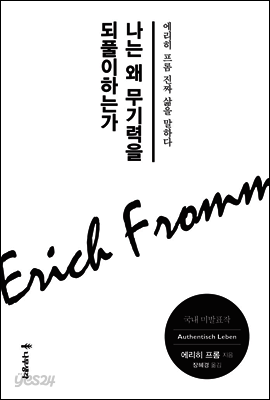 |
Description
Book Introduction
Erich Fromm's penetrating insight into the times
The reason you are lethargic is
Because I live as 'the me others want me to be'
Erich Fromm predicted the troubles of our time.
Erich Fromm argues that modern people's self-esteem comes from their socio-economic roles rather than from their activities as individual human beings who love and think.
Our goal is to sell ourselves in the market and make a profit.
The world created by human hands for happiness and comfort has alienated humans, and modern people are subservient to it in a cowardly and helpless manner.
When you know what you want, what your own thoughts are, and what your own feelings are, you will act according to your own will.
But modern people do not know this, and so they rely on anonymous authorities and accept a self created according to external expectations.
And in the process, I feel increasingly helpless.
Despite all these advances and achievements, modern man suffers from a profound sense of helplessness.
Erich Fromm uses Freudian psychoanalysis for social analysis.
Only by knowing yourself can you take care of yourself.
Erich Fromm clearly defines 'real life' as a state in which a person is connected to his or her own self and environment, and strongly emphasizes that one can live a real life only when one experiences one's own life.
His representative texts included in this book teach us how humans can regain their self-reliance.
If we focus on what makes up our reality, we can also realize the potential hidden within us.
Because “joy is the result of an intensive life” (Erich Fromm).
"Why I Repeat Apathy: Erich Fromm on Real Life" invites you into that world of joy.
The reason you are lethargic is
Because I live as 'the me others want me to be'
Erich Fromm predicted the troubles of our time.
Erich Fromm argues that modern people's self-esteem comes from their socio-economic roles rather than from their activities as individual human beings who love and think.
Our goal is to sell ourselves in the market and make a profit.
The world created by human hands for happiness and comfort has alienated humans, and modern people are subservient to it in a cowardly and helpless manner.
When you know what you want, what your own thoughts are, and what your own feelings are, you will act according to your own will.
But modern people do not know this, and so they rely on anonymous authorities and accept a self created according to external expectations.
And in the process, I feel increasingly helpless.
Despite all these advances and achievements, modern man suffers from a profound sense of helplessness.
Erich Fromm uses Freudian psychoanalysis for social analysis.
Only by knowing yourself can you take care of yourself.
Erich Fromm clearly defines 'real life' as a state in which a person is connected to his or her own self and environment, and strongly emphasizes that one can live a real life only when one experiences one's own life.
His representative texts included in this book teach us how humans can regain their self-reliance.
If we focus on what makes up our reality, we can also realize the potential hidden within us.
Because “joy is the result of an intensive life” (Erich Fromm).
"Why I Repeat Apathy: Erich Fromm on Real Life" invites you into that world of joy.
- You can preview some of the book's contents.
Preview
index
Introduction _ Rainer Funk
01 Humans want to be like others.
02 The essence of humanity is not the answer, but the question.
03 Freedom is the realization of true personality.
04 The self is as strong as it is active.
05 Humans sell their personalities on the market.
06 Modern people are in a state of deep helplessness.
07 See the difference between reality and illusion
References
source
01 Humans want to be like others.
02 The essence of humanity is not the answer, but the question.
03 Freedom is the realization of true personality.
04 The self is as strong as it is active.
05 Humans sell their personalities on the market.
06 Modern people are in a state of deep helplessness.
07 See the difference between reality and illusion
References
source
Detailed image

Into the book
We produce machines that behave like humans, and we produce humans that behave increasingly like machines.
If in the 19th century you risked becoming a slave, today you risk becoming a robot or an automaton.
Of course, it definitely saves time.
But even after saving time, we are at a loss as to what to do with the time we have saved.
At best, you're just trying to kill time.
What would happen if we only worked three days a week? There aren't enough hospitals to accommodate the spiritual breakdown that occurs when people have too much time and don't know what to do.
---From "Humans want to be like others"
Human beings invest their human nature in earning a living and use their human power to satisfy their ever-increasing desires, which are mostly artificially fostered.
In doing so, we run the risk of forgetting that we are human.
Therefore, it has never been more difficult, nor more urgent, to rethink the traditional view of human nature.
---From "The essence of human beings is not answers, but questions"
They may spend their entire lives lamenting and grieving over how much they suffer because of their various personalities.
They may boast about their willingness to change themselves, but a closer look reveals that this only serves to further solidify their conviction that they are incapable of changing anything.
The gap between these unconscious convictions and conscious compensatory activities often feels bizarre.
They chase this doctor, then that doctor, this religious theory, that philosophical theory, and every week they come up with a new plan for how to change themselves, hoping that the romantic relationship will bring about a tremendous change.
But all these diligent actions and intentional efforts are merely an umbrella to cover up a deep sense of helplessness.
If in the 19th century you risked becoming a slave, today you risk becoming a robot or an automaton.
Of course, it definitely saves time.
But even after saving time, we are at a loss as to what to do with the time we have saved.
At best, you're just trying to kill time.
What would happen if we only worked three days a week? There aren't enough hospitals to accommodate the spiritual breakdown that occurs when people have too much time and don't know what to do.
---From "Humans want to be like others"
Human beings invest their human nature in earning a living and use their human power to satisfy their ever-increasing desires, which are mostly artificially fostered.
In doing so, we run the risk of forgetting that we are human.
Therefore, it has never been more difficult, nor more urgent, to rethink the traditional view of human nature.
---From "The essence of human beings is not answers, but questions"
They may spend their entire lives lamenting and grieving over how much they suffer because of their various personalities.
They may boast about their willingness to change themselves, but a closer look reveals that this only serves to further solidify their conviction that they are incapable of changing anything.
The gap between these unconscious convictions and conscious compensatory activities often feels bizarre.
They chase this doctor, then that doctor, this religious theory, that philosophical theory, and every week they come up with a new plan for how to change themselves, hoping that the romantic relationship will bring about a tremendous change.
But all these diligent actions and intentional efforts are merely an umbrella to cover up a deep sense of helplessness.
---From "Modern people are in a deep sense of helplessness"
Publisher's Review
Erich Fromm's penetrating insight into the times
The reason you are lethargic is
Because I live as 'the me others want me to be'
Erich Fromm predicted the troubles of our time.
“Is it normal for me to live like this?” Something feels wrong, but I don’t know.
It is even confusing whether the problem is external or internal, material or mental.
Modern people have transformed society to pursue the greatest happiness for the greatest number more than any other era in the past.
And we tried to actively involve individuals in this change.
At the same time, he amassed unexpected wealth, and with that wealth, he opened up the possibility of satisfying the material desires of all mankind for the first time in history.
Never before have humans been so masters of the material world as they are today.
But we let the wonderful world of things we have created dictate the direction and pace of our lives.
What kind of relationship do modern people have with themselves? Are they living authentic lives, as the subject of their own lives? Am I the real me in the eyes of others?
Erich Fromm argues that modern people's self-esteem comes from their socio-economic roles rather than from their activities as individual human beings who love and think.
Our goal is to sell ourselves in the market and make a profit.
The world created by human hands for happiness and comfort has alienated humans, and modern people are subservient to it in a cowardly and helpless manner.
When you know what you want, what your own thoughts are, and what your own feelings are, you will act according to your own will.
But modern people do not know this, and so they rely on anonymous authorities and accept a self created according to external expectations.
And in the process, I feel increasingly helpless.
Despite all these advances and achievements, modern man suffers from a profound sense of helplessness.
Erich Fromm uses Freudian psychoanalysis for social analysis.
Only by knowing yourself can you take care of yourself.
Erich Fromm clearly defines 'real life' as a state in which a person is connected to his or her own self and environment, and strongly emphasizes that one can live a real life only when one experiences one's own life.
His representative texts included in this book teach us how humans can regain their self-reliance.
If we focus on what makes up our reality, we can also realize the potential hidden within us.
Because “joy is the result of an intensive life” (Erich Fromm).
"Why I Repeat Apathy: Erich Fromm on Real Life" invites you into that world of joy.
Still surprising realism and sharp insight
Erich Fromm's book, "Why I Repeat Apathy: Erich Fromm Talks About Real Life," which has not been published in Korea, is a collection of lecture notes, papers, and books written by Erich Fromm since the 1930s.
Rainer Funk, Erich Fromm's last assistant and psychiatrist, has compiled a powerful collection of works that confirm Fromm's early recognition of social development in psychological dynamics.
Through these writings, Erich Fromm encourages modern people to challenge themselves to live authentically.
In Chapter 1, Fromm diagnoses that modern people try to connect with the outside world by becoming like others in order to relieve loneliness and helplessness.
This flawed approach naturally raises the question of human nature in Chapter 2.
Chapter 3 delves into questions about human nature based on various understandings of freedom.
Although most modern people think of spontaneity as nothing more than an impulse, spontaneity and spontaneous activity are characteristics of freedom and self-existence.
This and voluntary love and labor are discussed in Chapter 4.
Fromm then goes on to discuss the process by which education destroys spontaneous emotions, creates false thoughts and false wills.
Chapter 5 explains the mechanism by which the compulsion to make oneself into a marketable commodity causes one to lose one's self.
Chapter 6 is devoted to the feeling of helplessness that comes from not being able to live a real life.
First, we will explain how helplessness is rationalized and discuss the common reactions that occur when helplessness is suppressed.
The final seven chapters deal with how to regain your true life.
The solution Erich Fromm suggests is to begin to 'see' without making empirical judgments, to admire everything, to experience oneself, and to develop the ability to conflict.
Although published over 30 years apart, the writings contained here are consistent and still shine with remarkable realism and keen insight.
Fromm's achievements in psychological dynamics, which were early on to recognize social development, are clearly evident.
Note
This book is a compilation of Erich Fromm's writings on leading a life, compiled by Rainer Funk of the International Erich Fromm Society.
The sources are as follows:
Unpublished domestic works are marked in bold.
01 Lecture from 1958, "The Moral Responsibility of Modern Man"
02, 03 Introduction to Human Nature (co-authored by Erich Fromm and Ramon Sirau)
04 Excerpt from "Escape from Freedom"
05 Excerpts from "Escape from Freedom" and "Sane Society"
06 "On Helplessness," an article published in the Journal of Social Research in 1937
07 Lectures: 'Clinical Aspects of Psychoanalysis' (1974), 'The Creative Man' (1959)
The reason you are lethargic is
Because I live as 'the me others want me to be'
Erich Fromm predicted the troubles of our time.
“Is it normal for me to live like this?” Something feels wrong, but I don’t know.
It is even confusing whether the problem is external or internal, material or mental.
Modern people have transformed society to pursue the greatest happiness for the greatest number more than any other era in the past.
And we tried to actively involve individuals in this change.
At the same time, he amassed unexpected wealth, and with that wealth, he opened up the possibility of satisfying the material desires of all mankind for the first time in history.
Never before have humans been so masters of the material world as they are today.
But we let the wonderful world of things we have created dictate the direction and pace of our lives.
What kind of relationship do modern people have with themselves? Are they living authentic lives, as the subject of their own lives? Am I the real me in the eyes of others?
Erich Fromm argues that modern people's self-esteem comes from their socio-economic roles rather than from their activities as individual human beings who love and think.
Our goal is to sell ourselves in the market and make a profit.
The world created by human hands for happiness and comfort has alienated humans, and modern people are subservient to it in a cowardly and helpless manner.
When you know what you want, what your own thoughts are, and what your own feelings are, you will act according to your own will.
But modern people do not know this, and so they rely on anonymous authorities and accept a self created according to external expectations.
And in the process, I feel increasingly helpless.
Despite all these advances and achievements, modern man suffers from a profound sense of helplessness.
Erich Fromm uses Freudian psychoanalysis for social analysis.
Only by knowing yourself can you take care of yourself.
Erich Fromm clearly defines 'real life' as a state in which a person is connected to his or her own self and environment, and strongly emphasizes that one can live a real life only when one experiences one's own life.
His representative texts included in this book teach us how humans can regain their self-reliance.
If we focus on what makes up our reality, we can also realize the potential hidden within us.
Because “joy is the result of an intensive life” (Erich Fromm).
"Why I Repeat Apathy: Erich Fromm on Real Life" invites you into that world of joy.
Still surprising realism and sharp insight
Erich Fromm's book, "Why I Repeat Apathy: Erich Fromm Talks About Real Life," which has not been published in Korea, is a collection of lecture notes, papers, and books written by Erich Fromm since the 1930s.
Rainer Funk, Erich Fromm's last assistant and psychiatrist, has compiled a powerful collection of works that confirm Fromm's early recognition of social development in psychological dynamics.
Through these writings, Erich Fromm encourages modern people to challenge themselves to live authentically.
In Chapter 1, Fromm diagnoses that modern people try to connect with the outside world by becoming like others in order to relieve loneliness and helplessness.
This flawed approach naturally raises the question of human nature in Chapter 2.
Chapter 3 delves into questions about human nature based on various understandings of freedom.
Although most modern people think of spontaneity as nothing more than an impulse, spontaneity and spontaneous activity are characteristics of freedom and self-existence.
This and voluntary love and labor are discussed in Chapter 4.
Fromm then goes on to discuss the process by which education destroys spontaneous emotions, creates false thoughts and false wills.
Chapter 5 explains the mechanism by which the compulsion to make oneself into a marketable commodity causes one to lose one's self.
Chapter 6 is devoted to the feeling of helplessness that comes from not being able to live a real life.
First, we will explain how helplessness is rationalized and discuss the common reactions that occur when helplessness is suppressed.
The final seven chapters deal with how to regain your true life.
The solution Erich Fromm suggests is to begin to 'see' without making empirical judgments, to admire everything, to experience oneself, and to develop the ability to conflict.
Although published over 30 years apart, the writings contained here are consistent and still shine with remarkable realism and keen insight.
Fromm's achievements in psychological dynamics, which were early on to recognize social development, are clearly evident.
Note
This book is a compilation of Erich Fromm's writings on leading a life, compiled by Rainer Funk of the International Erich Fromm Society.
The sources are as follows:
Unpublished domestic works are marked in bold.
01 Lecture from 1958, "The Moral Responsibility of Modern Man"
02, 03 Introduction to Human Nature (co-authored by Erich Fromm and Ramon Sirau)
04 Excerpt from "Escape from Freedom"
05 Excerpts from "Escape from Freedom" and "Sane Society"
06 "On Helplessness," an article published in the Journal of Social Research in 1937
07 Lectures: 'Clinical Aspects of Psychoanalysis' (1974), 'The Creative Man' (1959)
GOODS SPECIFICS
- Date of issue: August 8, 2016
- Page count, weight, size: 208 pages | 276g | 128*188*20mm
- ISBN13: 9791186688519
- ISBN10: 1186688513
You may also like
카테고리
korean


korean

![GQ KOREA Mark (Monthly): December [2025]](http://librairie.coreenne.fr/cdn/shop/files/8ef265dbbfbf186523ed75ba7319009d.jpg?v=1765340328&width=3840)


