

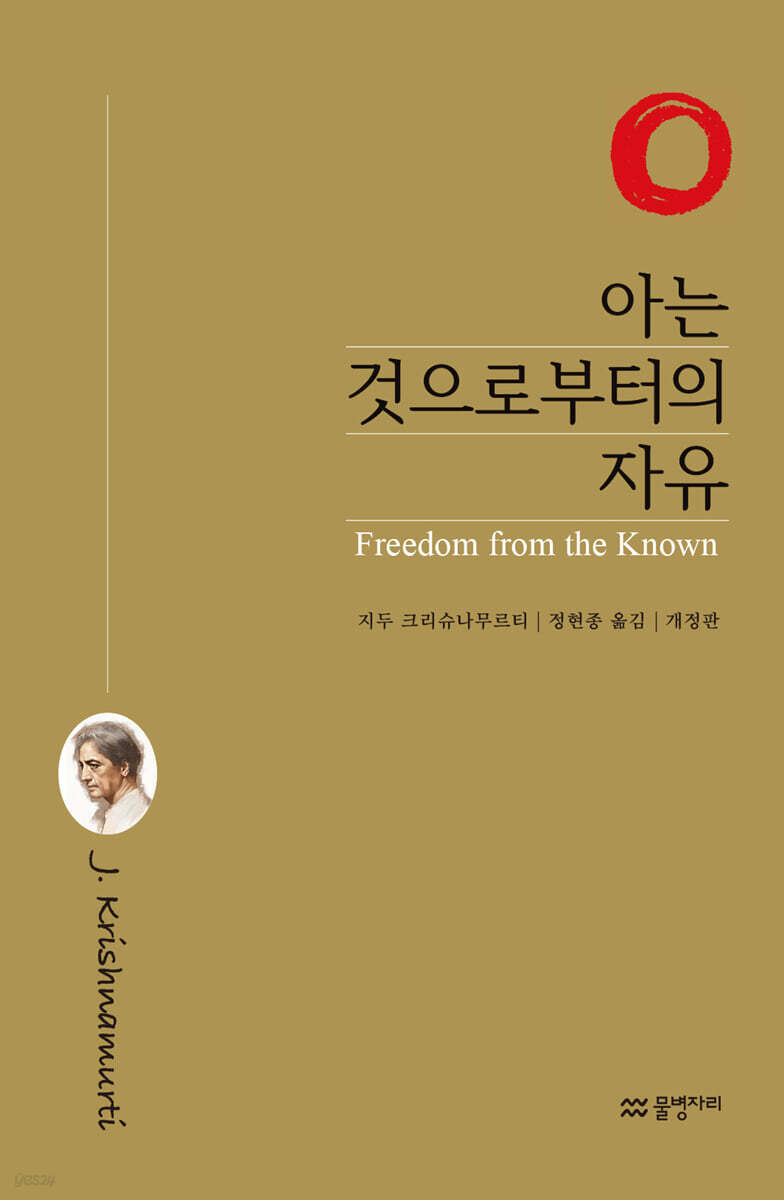
Freedom from what you know
 |
Description
Book Introduction
What matters is not 'knowing', but realizing it as soon as you do it.
Acting, driven by the energy of the soul's instinct toward truth! Like love.
Jiddu Krishnamurti, a great thinker who transcended centuries.
Born in India in 1895, he grew up under the influence of his father, a member of the Theosophical Society, and in 1909 was appointed its successor and trained to become a 'World Teacher'.
However, he rejected this messianic role, cut ties with his ideological followers, and disbanded the 'Star Church' he led in 1929 to convey a greater message to them.
He erased his own foundation and stood alone against the times.
He said, “Truth is a land without a path, and truth is inexhaustible, so it cannot be limited by any organization.
He left behind the teaching that “my only concern is to set people free.”
Krishnamurti's greatest work, which contains his intention, is "Freedom from What You Know."
This book argues that to be truly free, you don't need any leader or teacher, you just have to recognize that you are alone in a world of maddening cruelty, and that it's yours alone.
The important thing is not to learn any teaching or philosophy, but to observe what happens inside and outside of us every day, and then to realize that the recurring problems of suffering, violence, fear, love, time, and death are of our own making.
Meanwhile, the book is indifferent to what it means to know, what knowledge and wisdom are, and what enlightenment is.
Rather, it is saying that 'knowing' is the essence of the problem and that we must go beyond 'knowing'.
This is why misunderstandings arise.
Krishnamurti brings to mind the famous phrase from the Dhammapada, 'The first awakening is the right awakening.'
He says that 'knowing' is just a momentary process towards 'doing', and that we must go beyond the meaning of 'knowing' to move towards 'doing'.
Enlightenment is like falling into that moment of love.
The moment you fall in love, what use is wisdom about what love is, how love works, how to love well, etc.
Just as the moment of love is love, where the word love just happens without any room to intervene, all human understanding and enlightenment is simply jumping in without any rules or meaning.
Krishnamurti says so.
What is important is not 'knowing', but 'doing' as soon as you realize it, driven by the energy of your instinct toward the truth of your soul.
Like that thing called 'love'.
The teachings of "Freedom from Knowing" are an entirely new approach that cannot be found in any systematic or schematic philosophy.
Krishnamurti's message, which leads to immediate enlightenment, will once again revolutionize the dulled minds of modern people, lost in the deluge of AI and information.
Acting, driven by the energy of the soul's instinct toward truth! Like love.
Jiddu Krishnamurti, a great thinker who transcended centuries.
Born in India in 1895, he grew up under the influence of his father, a member of the Theosophical Society, and in 1909 was appointed its successor and trained to become a 'World Teacher'.
However, he rejected this messianic role, cut ties with his ideological followers, and disbanded the 'Star Church' he led in 1929 to convey a greater message to them.
He erased his own foundation and stood alone against the times.
He said, “Truth is a land without a path, and truth is inexhaustible, so it cannot be limited by any organization.
He left behind the teaching that “my only concern is to set people free.”
Krishnamurti's greatest work, which contains his intention, is "Freedom from What You Know."
This book argues that to be truly free, you don't need any leader or teacher, you just have to recognize that you are alone in a world of maddening cruelty, and that it's yours alone.
The important thing is not to learn any teaching or philosophy, but to observe what happens inside and outside of us every day, and then to realize that the recurring problems of suffering, violence, fear, love, time, and death are of our own making.
Meanwhile, the book is indifferent to what it means to know, what knowledge and wisdom are, and what enlightenment is.
Rather, it is saying that 'knowing' is the essence of the problem and that we must go beyond 'knowing'.
This is why misunderstandings arise.
Krishnamurti brings to mind the famous phrase from the Dhammapada, 'The first awakening is the right awakening.'
He says that 'knowing' is just a momentary process towards 'doing', and that we must go beyond the meaning of 'knowing' to move towards 'doing'.
Enlightenment is like falling into that moment of love.
The moment you fall in love, what use is wisdom about what love is, how love works, how to love well, etc.
Just as the moment of love is love, where the word love just happens without any room to intervene, all human understanding and enlightenment is simply jumping in without any rules or meaning.
Krishnamurti says so.
What is important is not 'knowing', but 'doing' as soon as you realize it, driven by the energy of your instinct toward the truth of your soul.
Like that thing called 'love'.
The teachings of "Freedom from Knowing" are an entirely new approach that cannot be found in any systematic or schematic philosophy.
Krishnamurti's message, which leads to immediate enlightenment, will once again revolutionize the dulled minds of modern people, lost in the deluge of AI and information.
index
First: What are we looking for?
Second: Understanding yourself
Third: The Wholeness of Life
Fourth: Between Joy and Pleasure
Fifth: Freedom from Fear
Sixth: Freedom from violence
Seventh: About Relationships
Eighth: What is True Freedom?
Ninth: Transcendence of Time
Tenth: What it means to truly love
Eleventh: Seeing Things as They Are
Twelfth: Things I Look At
Thirteenth: What Does It Mean to Think?
Fourteenth: Yesterday's Baggage
Fifteenth: On Meditation
Sixteenth: Complete Revolution
Second: Understanding yourself
Third: The Wholeness of Life
Fourth: Between Joy and Pleasure
Fifth: Freedom from Fear
Sixth: Freedom from violence
Seventh: About Relationships
Eighth: What is True Freedom?
Ninth: Transcendence of Time
Tenth: What it means to truly love
Eleventh: Seeing Things as They Are
Twelfth: Things I Look At
Thirteenth: What Does It Mean to Think?
Fourteenth: Yesterday's Baggage
Fifteenth: On Meditation
Sixteenth: Complete Revolution
Into the book
So when you ask yourself what love is, you may be too scared to answer.
It could mean a complete upheaval.
That is, it can break up a family.
You may discover that you do not love your wife, husband, or children, that you may have to tear down the house you built, and that you may never go to the temple again.
But if you still seek to find out, you will find that fear is not love, dependence is not love, jealousy is not love, responsibility and duty are not love, self-pity is not love, the pain of not being loved is not love, and love is no more the opposite of hate than humility is the opposite of pride.
And if you can get rid of all this, that is, wash it away, not by force, but as the rain washes away the dust that has accumulated over many days from the leaves, then you may finally meet that strange flower for which man is always thirsting.
--- p.155
There is a saying that all roads lead to truth.
But truth has no path, and that is the beauty of truth.
Also, the truth is alive.
The dead have a way because they are static, but truth is alive and moving and has no resting place.
When you realize that no temple or church, no religion, no teacher, no philosopher can lead you to the truth, you will realize that this living thing is none other than you, as you are.
--- p.8
When you perceive risk as merely a concept, there is a conflict between the concept and action, and that conflict drains your energy.
Only when you are immediately aware of your limitations and the dangers of them will you act as if you knew you were on the edge of a cliff.
So to know is to act.
--- p.48
For many years we have been spoon-fed by teachers, by authorities, by books and by adults.
There is nothing new within us.
There is nothing original, original, or clear.
--- p.14
It rained heavily last night, but it's starting to clear up now.
It's a new and fresh day.
Let's meet this new day as if it were just one day.
Let's leave all the memories of yesterday behind and go on a journey together.
and
Let us begin to understand ourselves for the first time.
--- p.33
You say, “I’ll think about it.
“I’m going to try to be free,” he says.
Saying "I'm going to try" is one of the most concerning statements you can make.
There is no such thing as trying, and there is no such thing as doing your best.
It's either do it or don't do it.
The house is burning and you are taking a break.
Your house is burning because of the violence in the world and within yourself, and you say this.
“Let’s think about it for a moment.
“Which ideology would be best to put out that fire?” When your house is on fire, would you comment on the color of the water carrier’s hair?
--- p.103
You only act when you immediately realize that you are limited, as when you realize that there is a cliff right in front of you.
So to know is to act.
--- p.34
Only when your mind is not fragmented can you see your wholeness.
This would involve complete self-renunciation, and then there would be no fear, no contradiction, no conflict.
What we see in this wholeness is the truth.
--- p.50
Joy is immediate, it becomes pleasure by thinking about it.
Living in the present is the immediate perception of beauty, and if we do not seek pleasure in it, it becomes a great joy.
--- p.60
When you realize that you are not separate from fear but a part of it, you can do nothing about it.
So the fear completely disappears.
--- p.70
There is no such thing as trying, and there is no such thing as doing your best.
It's either do it or don't do it.
The house is burning and you are taking a break.
When your house is burning because of violence in the world and within yourself, would you comment on the color of the water carrier's hair?
--- p.88
We must become poor inwardly.
Only this inner poverty can see the truth of life, where there is no conflict.
Such a life is a blessing that cannot be found in any church or temple.
--- p.104
To be alone, you have to let go of everything about the past.
When you are completely alone, you feel like an outsider.
A person who is completely free like this is innocent, and this innocence can free him from sorrow.
--- p.120
Death is a new birth.
It is a change, and in it thoughts disappear.
Freedom from what you know is death, and then you are living.
--- p.130
Just as rain washes away the dust accumulated over many days from leaves, can the heart find love without thought, without compulsion, without books, without teachers? Can it, so to speak, find love like a beautiful sunset?
--- p.142
There is a whole different beauty in that silence when both the observer and the observed are silent.
There is no nature or observer there.
All that exists is a state of mind that is completely alone.
It is a solitude in silence, not isolation, and that silence is beauty.
--- p.160
Why do you have to do something? If that something were you, what could you do? You couldn't resist it, escape it, or accept it.
There is no like or dislike, no conflict.
--- p.174
Thoughts accumulate countless memories of pleasure and pain, and from these memories thoughts are born again.
Therefore, thoughts are of the past and are always old.
--- p.182
We always carry a burden with us, but we cannot forget it.
There is solitude only when we give our full attention to a problem and resolve it immediately.
It is a quiet mind without any center, space or time.
--- p.192
We say, 'I am unhappy.
So I say, 'I must be happy.'
But in the very demand to be happy lies unhappiness.
We must break free from this constant demand, or the corridors of duality will never end.
--- p.202
A religious mind is completely different from a mind that believes in religion.
You can be Hindu, Christian, or Buddhist without being religious.
A religious mind does not seek anything at all and is a state of having no faith whatsoever.
It is just what is, what truly is.
--- p.216
This land, this life, is all we know, and we are so afraid of the immense struggle of existence that we cannot comprehend it that we try to escape from it in various strange ways.
We also fear what we don't know.
We fear death, we fear what lies beyond tomorrow. Ultimately, we fear what we know, and we fear what we don't know.
--- p.12
He who is not afraid of life is not afraid of uncertainty.
Because he understands internally, psychologically, that there is no safety.
Without safety there is endless movement, and so life and death are the same.
--- p.140
If you die naturally, without any compulsion or discussion, to one of the pleasures, the smallest or the greatest, you will finally know what it means to die.
Dying means completely emptying your mind.
Dying means completely emptying the mind, death is a new birth, a change, in which thought becomes completely incapable of functioning.
Because the idea is old.
When there is death there is something entirely new.
Freedom from what you know is death, and then you are living.
--- p.141
And if you can get rid of all this, that is, wash it away, not by force, but as the rain washes away the dust that has accumulated over many days from the leaves, then you may finally meet that strange flower for which man is always thirsting.
--- p.155
The only way to find love is to meet it without trying to get it, because the mind that seeks it is not a passionate mind.
That is, we encounter it without knowing it and do not discover it as a result of any effort or experience.
--- p.157
Love is new, fresh, and alive.
It has no yesterday and no tomorrow.
It is beyond the confusion of thought.
Only an innocent heart knows what love is, and this innocent heart can live in this not-so-innocent world.
Discovering that extraordinary thing that has been constantly sought through sacrifice, worship, relationships, sex, and all kinds of pleasure and pain is only possible when thought understands itself and comes to a natural end.
In that case, love has no opposition and no conflict.
--- p.158
As long as there is a center that creates space around it, there is no love or beauty.
There is love when there is no center and no periphery, and when you love, you are beauty.
The sky is full of shining stars, the air is cool, and then there is you.
That is, there is you who is the observer, the experiencer, the thinker, the active heart, you who is the center and creates space.
You will not understand the distance (space) between you and the stars, the distance between you and your wife, husband or friend.
Because you've never seen something without an image.
--- p.172
A living mind is a quiet mind, a mind without center, without space, without time.
Such a mind is infinite, the only truth, the only reality.
--- p.201
Only through complete negation, which is the highest form of passion, does it, that is, love, come into existence.
Like humility, you cannot cultivate love.
Humility exists when pride is completely eliminated.
Then you will not know what it means to be humble.
A person who knows what it means to be humble is an empty person.
Likewise, when you give your heart, your mind, your nerves, your eyes, your whole being to discover the way of life, to know what is truly there and to go beyond it, and when you deny completely and utterly the life you are now living, then in that very rejection of the ugly and the cruel, something else comes into being.
And you won't even know it.
That is, he who knows that he is silent, he who knows that he loves, does not know what love is and what silence is.
It could mean a complete upheaval.
That is, it can break up a family.
You may discover that you do not love your wife, husband, or children, that you may have to tear down the house you built, and that you may never go to the temple again.
But if you still seek to find out, you will find that fear is not love, dependence is not love, jealousy is not love, responsibility and duty are not love, self-pity is not love, the pain of not being loved is not love, and love is no more the opposite of hate than humility is the opposite of pride.
And if you can get rid of all this, that is, wash it away, not by force, but as the rain washes away the dust that has accumulated over many days from the leaves, then you may finally meet that strange flower for which man is always thirsting.
--- p.155
There is a saying that all roads lead to truth.
But truth has no path, and that is the beauty of truth.
Also, the truth is alive.
The dead have a way because they are static, but truth is alive and moving and has no resting place.
When you realize that no temple or church, no religion, no teacher, no philosopher can lead you to the truth, you will realize that this living thing is none other than you, as you are.
--- p.8
When you perceive risk as merely a concept, there is a conflict between the concept and action, and that conflict drains your energy.
Only when you are immediately aware of your limitations and the dangers of them will you act as if you knew you were on the edge of a cliff.
So to know is to act.
--- p.48
For many years we have been spoon-fed by teachers, by authorities, by books and by adults.
There is nothing new within us.
There is nothing original, original, or clear.
--- p.14
It rained heavily last night, but it's starting to clear up now.
It's a new and fresh day.
Let's meet this new day as if it were just one day.
Let's leave all the memories of yesterday behind and go on a journey together.
and
Let us begin to understand ourselves for the first time.
--- p.33
You say, “I’ll think about it.
“I’m going to try to be free,” he says.
Saying "I'm going to try" is one of the most concerning statements you can make.
There is no such thing as trying, and there is no such thing as doing your best.
It's either do it or don't do it.
The house is burning and you are taking a break.
Your house is burning because of the violence in the world and within yourself, and you say this.
“Let’s think about it for a moment.
“Which ideology would be best to put out that fire?” When your house is on fire, would you comment on the color of the water carrier’s hair?
--- p.103
You only act when you immediately realize that you are limited, as when you realize that there is a cliff right in front of you.
So to know is to act.
--- p.34
Only when your mind is not fragmented can you see your wholeness.
This would involve complete self-renunciation, and then there would be no fear, no contradiction, no conflict.
What we see in this wholeness is the truth.
--- p.50
Joy is immediate, it becomes pleasure by thinking about it.
Living in the present is the immediate perception of beauty, and if we do not seek pleasure in it, it becomes a great joy.
--- p.60
When you realize that you are not separate from fear but a part of it, you can do nothing about it.
So the fear completely disappears.
--- p.70
There is no such thing as trying, and there is no such thing as doing your best.
It's either do it or don't do it.
The house is burning and you are taking a break.
When your house is burning because of violence in the world and within yourself, would you comment on the color of the water carrier's hair?
--- p.88
We must become poor inwardly.
Only this inner poverty can see the truth of life, where there is no conflict.
Such a life is a blessing that cannot be found in any church or temple.
--- p.104
To be alone, you have to let go of everything about the past.
When you are completely alone, you feel like an outsider.
A person who is completely free like this is innocent, and this innocence can free him from sorrow.
--- p.120
Death is a new birth.
It is a change, and in it thoughts disappear.
Freedom from what you know is death, and then you are living.
--- p.130
Just as rain washes away the dust accumulated over many days from leaves, can the heart find love without thought, without compulsion, without books, without teachers? Can it, so to speak, find love like a beautiful sunset?
--- p.142
There is a whole different beauty in that silence when both the observer and the observed are silent.
There is no nature or observer there.
All that exists is a state of mind that is completely alone.
It is a solitude in silence, not isolation, and that silence is beauty.
--- p.160
Why do you have to do something? If that something were you, what could you do? You couldn't resist it, escape it, or accept it.
There is no like or dislike, no conflict.
--- p.174
Thoughts accumulate countless memories of pleasure and pain, and from these memories thoughts are born again.
Therefore, thoughts are of the past and are always old.
--- p.182
We always carry a burden with us, but we cannot forget it.
There is solitude only when we give our full attention to a problem and resolve it immediately.
It is a quiet mind without any center, space or time.
--- p.192
We say, 'I am unhappy.
So I say, 'I must be happy.'
But in the very demand to be happy lies unhappiness.
We must break free from this constant demand, or the corridors of duality will never end.
--- p.202
A religious mind is completely different from a mind that believes in religion.
You can be Hindu, Christian, or Buddhist without being religious.
A religious mind does not seek anything at all and is a state of having no faith whatsoever.
It is just what is, what truly is.
--- p.216
This land, this life, is all we know, and we are so afraid of the immense struggle of existence that we cannot comprehend it that we try to escape from it in various strange ways.
We also fear what we don't know.
We fear death, we fear what lies beyond tomorrow. Ultimately, we fear what we know, and we fear what we don't know.
--- p.12
He who is not afraid of life is not afraid of uncertainty.
Because he understands internally, psychologically, that there is no safety.
Without safety there is endless movement, and so life and death are the same.
--- p.140
If you die naturally, without any compulsion or discussion, to one of the pleasures, the smallest or the greatest, you will finally know what it means to die.
Dying means completely emptying your mind.
Dying means completely emptying the mind, death is a new birth, a change, in which thought becomes completely incapable of functioning.
Because the idea is old.
When there is death there is something entirely new.
Freedom from what you know is death, and then you are living.
--- p.141
And if you can get rid of all this, that is, wash it away, not by force, but as the rain washes away the dust that has accumulated over many days from the leaves, then you may finally meet that strange flower for which man is always thirsting.
--- p.155
The only way to find love is to meet it without trying to get it, because the mind that seeks it is not a passionate mind.
That is, we encounter it without knowing it and do not discover it as a result of any effort or experience.
--- p.157
Love is new, fresh, and alive.
It has no yesterday and no tomorrow.
It is beyond the confusion of thought.
Only an innocent heart knows what love is, and this innocent heart can live in this not-so-innocent world.
Discovering that extraordinary thing that has been constantly sought through sacrifice, worship, relationships, sex, and all kinds of pleasure and pain is only possible when thought understands itself and comes to a natural end.
In that case, love has no opposition and no conflict.
--- p.158
As long as there is a center that creates space around it, there is no love or beauty.
There is love when there is no center and no periphery, and when you love, you are beauty.
The sky is full of shining stars, the air is cool, and then there is you.
That is, there is you who is the observer, the experiencer, the thinker, the active heart, you who is the center and creates space.
You will not understand the distance (space) between you and the stars, the distance between you and your wife, husband or friend.
Because you've never seen something without an image.
--- p.172
A living mind is a quiet mind, a mind without center, without space, without time.
Such a mind is infinite, the only truth, the only reality.
--- p.201
Only through complete negation, which is the highest form of passion, does it, that is, love, come into existence.
Like humility, you cannot cultivate love.
Humility exists when pride is completely eliminated.
Then you will not know what it means to be humble.
A person who knows what it means to be humble is an empty person.
Likewise, when you give your heart, your mind, your nerves, your eyes, your whole being to discover the way of life, to know what is truly there and to go beyond it, and when you deny completely and utterly the life you are now living, then in that very rejection of the ugly and the cruel, something else comes into being.
And you won't even know it.
That is, he who knows that he is silent, he who knows that he loves, does not know what love is and what silence is.
--- p.227
Publisher's Review
- A beautiful translation that highlights poet Jeong Hyeon-jong's aesthetic sensibility!
- Revised editing to clearly show the context by reorganizing the content into meaningful units!
- The bestseller "Freedom from What You Know", revised and published after 23 years!!!
Readers' evaluations of "Freedom from What You Know," which was published by Aquarius in 2002 and became a steady seller, vary depending on the reader and the circumstances in which they read the book.
If there is a common evaluation, it is that it is a difficult book, but it has a deep resonance within it.
What I realized while reading deeply to edit this book is that it is a 'book of misunderstandings.'
For readers who have experienced a moment of enlightenment, this book will be instantly understandable, but for readers who have not experienced the spiritual experience of enlightenment, it feels like standing in front of a huge wall.
So, instead of reading for enlightenment, we end up being moved by the beauty of the sentences and the resonance they give us, and as a result, we end up reading a book that is difficult to understand but resonates.
The reason this book is called a book of misunderstanding arises at this point.
In the context of 'enlightenment', sentences that are used in a negative sense are sometimes misunderstood as memorable sentences that deserve to be underlined and indexed because of their own charm.
Even though Krishnamurti is constantly warning us against such practices.
'Misunderstanding' can also be seen as something that arose during the writing process of this book.
This book is a compilation of Krishnamurti's lectures.
This may not matter to readers who understand the context through experience, but for the average reader, this process itself can act as a factor that causes misunderstanding.
Due to the nature of lectures that involve persuading an audience on the spot, they sometimes choose to refute the initially presented argument, then refute it again, and then refute it again, or they sometimes reflect the on-site nature of the presentation outside of the overall context.
There is a possibility that misunderstandings may arise during the process of transcribing the lecture.
Therefore, it is easy to get lost and wander about which argument is correct, and it may not be easy to grasp the context of the development.
"Freedom from What You Know," published by Aquarius, is recognized as a very beautiful translation.
Poet Jeong Hyeon-jong was deeply enlightened after reading the original version of this book, and so he took on the task of translating it himself. He beautifully and elegantly expressed the spiritual experience of enlightenment in his own style.
However, translating spiritual experiences completely is not an easy task.
So the poet refers to this book and says, “This book just exists.
This is not a book.
He confesses that it is “not a book, but something alive,” “a book that we cannot tell whether we are reading or writing ourselves while reading, and a book that is still being written.”
The reason why Aquarius undertook the task of revising “Freedom from What You Know” after 23 years was to try to reduce the extent of that “misunderstanding.”
Following Krishnamurti's teachings, I acknowledge that this book also contains elements of 'misunderstanding' disguised as 'knowledge', and I have looked into it deeply with a mind that excludes any preconceived notions about the past and the future, understanding and misunderstanding, knowledge and observation, etc.
As a result, we discovered that the problem causing the misunderstanding was not the words and sentences, but rather the somewhat disorganized context in which the message was expressed. We tried to clearly reveal the context through the revised edition.
Of course, I was always wary that this work could lead to another 'misunderstanding', and I still committed to acknowledging the misunderstanding and remaining open about the consequences.
The way to read this book should not be a matter of misunderstanding and understanding, nor should it be a reading as an experience, as an action, toward the direction of ‘freedom from knowing’ rather than the purpose of ‘knowing’ itself.
The meaning revealed in poet Jeong Hyeon-jong's preface finally comes to us fully.
“This book is not to be read, but to be drunk like water.
No, we breathe this book.
“Because this book is breathtaking.”
- Revised editing to clearly show the context by reorganizing the content into meaningful units!
- The bestseller "Freedom from What You Know", revised and published after 23 years!!!
Readers' evaluations of "Freedom from What You Know," which was published by Aquarius in 2002 and became a steady seller, vary depending on the reader and the circumstances in which they read the book.
If there is a common evaluation, it is that it is a difficult book, but it has a deep resonance within it.
What I realized while reading deeply to edit this book is that it is a 'book of misunderstandings.'
For readers who have experienced a moment of enlightenment, this book will be instantly understandable, but for readers who have not experienced the spiritual experience of enlightenment, it feels like standing in front of a huge wall.
So, instead of reading for enlightenment, we end up being moved by the beauty of the sentences and the resonance they give us, and as a result, we end up reading a book that is difficult to understand but resonates.
The reason this book is called a book of misunderstanding arises at this point.
In the context of 'enlightenment', sentences that are used in a negative sense are sometimes misunderstood as memorable sentences that deserve to be underlined and indexed because of their own charm.
Even though Krishnamurti is constantly warning us against such practices.
'Misunderstanding' can also be seen as something that arose during the writing process of this book.
This book is a compilation of Krishnamurti's lectures.
This may not matter to readers who understand the context through experience, but for the average reader, this process itself can act as a factor that causes misunderstanding.
Due to the nature of lectures that involve persuading an audience on the spot, they sometimes choose to refute the initially presented argument, then refute it again, and then refute it again, or they sometimes reflect the on-site nature of the presentation outside of the overall context.
There is a possibility that misunderstandings may arise during the process of transcribing the lecture.
Therefore, it is easy to get lost and wander about which argument is correct, and it may not be easy to grasp the context of the development.
"Freedom from What You Know," published by Aquarius, is recognized as a very beautiful translation.
Poet Jeong Hyeon-jong was deeply enlightened after reading the original version of this book, and so he took on the task of translating it himself. He beautifully and elegantly expressed the spiritual experience of enlightenment in his own style.
However, translating spiritual experiences completely is not an easy task.
So the poet refers to this book and says, “This book just exists.
This is not a book.
He confesses that it is “not a book, but something alive,” “a book that we cannot tell whether we are reading or writing ourselves while reading, and a book that is still being written.”
The reason why Aquarius undertook the task of revising “Freedom from What You Know” after 23 years was to try to reduce the extent of that “misunderstanding.”
Following Krishnamurti's teachings, I acknowledge that this book also contains elements of 'misunderstanding' disguised as 'knowledge', and I have looked into it deeply with a mind that excludes any preconceived notions about the past and the future, understanding and misunderstanding, knowledge and observation, etc.
As a result, we discovered that the problem causing the misunderstanding was not the words and sentences, but rather the somewhat disorganized context in which the message was expressed. We tried to clearly reveal the context through the revised edition.
Of course, I was always wary that this work could lead to another 'misunderstanding', and I still committed to acknowledging the misunderstanding and remaining open about the consequences.
The way to read this book should not be a matter of misunderstanding and understanding, nor should it be a reading as an experience, as an action, toward the direction of ‘freedom from knowing’ rather than the purpose of ‘knowing’ itself.
The meaning revealed in poet Jeong Hyeon-jong's preface finally comes to us fully.
“This book is not to be read, but to be drunk like water.
No, we breathe this book.
“Because this book is breathtaking.”
GOODS SPECIFICS
- Date of issue: November 18, 2025
- Page count, weight, size: 228 pages | 136*208*20mm
- ISBN13: 9791192087368
- ISBN10: 1192087364
You may also like
카테고리
korean


korean

![ELLE 엘르 스페셜 에디션 A형 : 12월 [2025]](http://librairie.coreenne.fr/cdn/shop/files/b8e27a3de6c9538896439686c6b0e8fb.jpg?v=1766436872&width=3840)


