

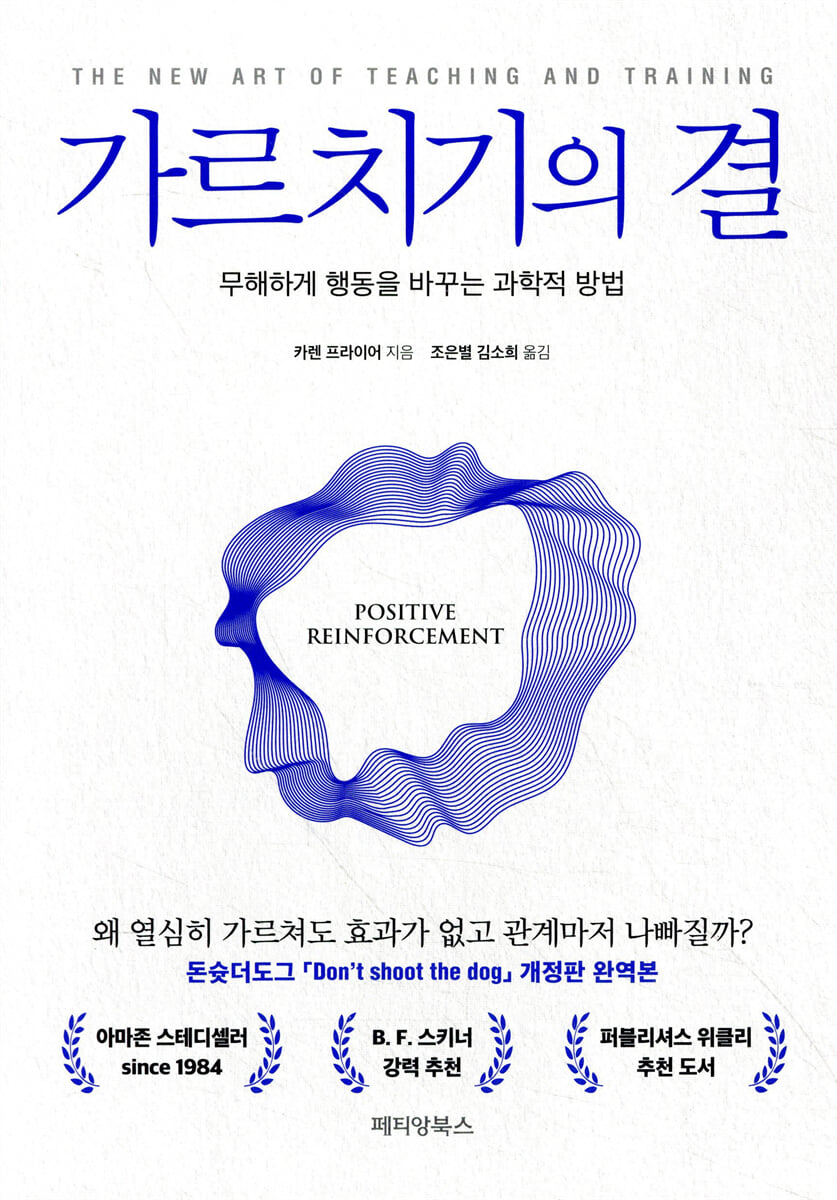
The conclusion of teaching
 |
Description
Book Introduction
- Highly recommended by BF Skinner
- Amazon Bestseller since 1984
- Publisher's Weekly Recommendation
- Don't Shoot the Dog (Revised Edition Complete Translation)
- A classic in the field of behavioral education that has led to the popularization of behavioral science since its publication in 1984.
- Training Methods of Successful People
- Scientific learning principles hidden in behavioral psychology
- A new behavioral training method for those who dislike coercive methods.
- Published in translations in over 10 countries, including Germany, Spain, France, Italy, China, and Japan.
The 'Bible' of Education Using Positive Reinforcement
How to Change Behavior in a Way That Makes Both Learners and Teachers Feel Good
This book teaches you how to “teach pleasant behavior” to everything from animals to people and even yourself.
It contains the secrets of enjoyable teaching methods that can be applied in a variety of situations, such as how to get the cat off the kitchen counter, how to stop your parents from nagging, how to positively influence the behavior of pets, children, students, friends, and bosses, how to improve your tennis or golf posture, or how to improve your math skills and memory.
The answer to all of this lies in the principle of 'positive reinforcement'.
In particular, utilizing this principle makes it possible to quickly and enjoyably improve learning and skills, such as memorizing English words, correcting sports posture, and improving memory.
The Law of Reinforcement is simple yet effective, and you can understand the basic principles in just 10 minutes.
Karen Pryor has published a practical book that systematically organizes reinforcement theory so that it can be applied to everyday life.
"The Knot of Teaching" is a classic in behavioral psychology that has been consistently loved since its first publication in 1984. It presents a scientific yet humane approach to changing behavior without coercion or punishment.
Positive reinforcement is a method of promoting change and growth without conflict by linking behavior to desired outcomes through rewards.
From pet training to improving parent-child relationships to coaching team members, readers will gain practical tools for behavior change through a variety of case studies and practical methods.
"The Teaching Knot" is a revolutionary guide to behavioral change for educators, parents, supervisors, managers, and everyone else, empowering them to understand and grow with one another.
- Amazon Bestseller since 1984
- Publisher's Weekly Recommendation
- Don't Shoot the Dog (Revised Edition Complete Translation)
- A classic in the field of behavioral education that has led to the popularization of behavioral science since its publication in 1984.
- Training Methods of Successful People
- Scientific learning principles hidden in behavioral psychology
- A new behavioral training method for those who dislike coercive methods.
- Published in translations in over 10 countries, including Germany, Spain, France, Italy, China, and Japan.
The 'Bible' of Education Using Positive Reinforcement
How to Change Behavior in a Way That Makes Both Learners and Teachers Feel Good
This book teaches you how to “teach pleasant behavior” to everything from animals to people and even yourself.
It contains the secrets of enjoyable teaching methods that can be applied in a variety of situations, such as how to get the cat off the kitchen counter, how to stop your parents from nagging, how to positively influence the behavior of pets, children, students, friends, and bosses, how to improve your tennis or golf posture, or how to improve your math skills and memory.
The answer to all of this lies in the principle of 'positive reinforcement'.
In particular, utilizing this principle makes it possible to quickly and enjoyably improve learning and skills, such as memorizing English words, correcting sports posture, and improving memory.
The Law of Reinforcement is simple yet effective, and you can understand the basic principles in just 10 minutes.
Karen Pryor has published a practical book that systematically organizes reinforcement theory so that it can be applied to everyday life.
"The Knot of Teaching" is a classic in behavioral psychology that has been consistently loved since its first publication in 1984. It presents a scientific yet humane approach to changing behavior without coercion or punishment.
Positive reinforcement is a method of promoting change and growth without conflict by linking behavior to desired outcomes through rewards.
From pet training to improving parent-child relationships to coaching team members, readers will gain practical tools for behavior change through a variety of case studies and practical methods.
"The Teaching Knot" is a revolutionary guide to behavioral change for educators, parents, supervisors, managers, and everyone else, empowering them to understand and grow with one another.
index
prolog
Everything You Need to Know About Positive Reinforcement Education: A Replacement for Coercive Teaching Methods (8)
Chapter 1.
Reinforcement, Better Than Reward: The Fundamentals of Reinforcement Training
What are positive reinforcers? 22
Negative reinforcement 26
Timing is important for reinforcements 32
Size of reinforcement 35
Jackpot 37
The Power of Conditioned Reinforcement 39
The Various Functions of Conditioned Reinforcers 43
Conditioned Aversion Signal 48
Fluctuation Reinforcement Plan 52
56 When the variable reinforcement plan is inadequate
Creating Long-Term Sustaining Behaviors 57
The Secret of Superstitious Behavior: Accidental Reinforcement 60
64 Everyday Cases That Can Be Solved with Positive Reinforcement
Reinforcement in Groups 68
Strengthening Myself 70
Chapter 2.
Behavior Shaping, Creating Peak Performance Without Pressure and Pain: The Fastest Way to Create New Behaviors
What is behavioral formation? 74
Methods and Principles of Behavior Formation 77
Ten Laws of Behavior Formation 78
Discussion of the Ten Laws of Behavior Formation 80
Training Game 99
Shortcuts to Behavior Shaping: Targeting, Imitation, and Modeling 107
Behavior shaping is applicable to all animals 113
Shaping Actions Without Words 117
Chapter 3.
Stimulus Control, Coercion-Free, Enjoyable Education: How to Teach Children to Behave Correctly
Stimulus and Stimulus Control 124
Setting up the signal 127
Stimulus Control Rule 131
What types of signals are there? 134
Signal Strength and Fading 137
Targeting 140
Aversive stimuli conditioned by cues 144
Limiting Reaction Time 147
Anticipating Signals 149
Stimulus as Reinforcement, Behavior Chain 150
Generalization of Stimulus Control 158
The regression and frustration of pre-learning 160
Using Stimulus Control 163
Chapter 4.
Modifying Behavior Using Untraining and Reinforcement: How to Eliminate Unwanted Behaviors
Eight Ways to Eliminate Behavior: The Devil's Way vs. the Angel's Way 170
[Method 1] Shooting 172
[Method 2] Punishment 176
[Method 3] Reinforcing Negatives 184
[Method 4] Eliminate 193
[Method 5] Teaching Incompatible Behaviors 200
[Method 6] Making People Act on Signals 206
[Method 7] Creating Absence of Action 212
[Method 8] Changing the Motive 215
Eliminating Complex Problems 223
Chapter 5: Reinforcement in Everyday Life: A Changing World
Strengthening in Sports 235
Strengthening in the Business Field 239
Strengthening in Animal Education 241
Reinforcement and Society 246
Chapter 6: New Technology Clicker Training
Clicker Training Craze 260
Long-Term Side Effects of Reinforcement Training: Playfulness, Intelligence, Agreeableness… 264
Long-term effects: recalling old learning 265
Accelerated Learning 266
Clearing the Clicker 268
Clicker Training and Creativity 270
Freedom from Fear 272
Learning and Fun 274
Clicker Training for People 275
Additional Cases Applied to Humans 279
Clicker Training Around the World 284
Glossary 287
Everything You Need to Know About Positive Reinforcement Education: A Replacement for Coercive Teaching Methods (8)
Chapter 1.
Reinforcement, Better Than Reward: The Fundamentals of Reinforcement Training
What are positive reinforcers? 22
Negative reinforcement 26
Timing is important for reinforcements 32
Size of reinforcement 35
Jackpot 37
The Power of Conditioned Reinforcement 39
The Various Functions of Conditioned Reinforcers 43
Conditioned Aversion Signal 48
Fluctuation Reinforcement Plan 52
56 When the variable reinforcement plan is inadequate
Creating Long-Term Sustaining Behaviors 57
The Secret of Superstitious Behavior: Accidental Reinforcement 60
64 Everyday Cases That Can Be Solved with Positive Reinforcement
Reinforcement in Groups 68
Strengthening Myself 70
Chapter 2.
Behavior Shaping, Creating Peak Performance Without Pressure and Pain: The Fastest Way to Create New Behaviors
What is behavioral formation? 74
Methods and Principles of Behavior Formation 77
Ten Laws of Behavior Formation 78
Discussion of the Ten Laws of Behavior Formation 80
Training Game 99
Shortcuts to Behavior Shaping: Targeting, Imitation, and Modeling 107
Behavior shaping is applicable to all animals 113
Shaping Actions Without Words 117
Chapter 3.
Stimulus Control, Coercion-Free, Enjoyable Education: How to Teach Children to Behave Correctly
Stimulus and Stimulus Control 124
Setting up the signal 127
Stimulus Control Rule 131
What types of signals are there? 134
Signal Strength and Fading 137
Targeting 140
Aversive stimuli conditioned by cues 144
Limiting Reaction Time 147
Anticipating Signals 149
Stimulus as Reinforcement, Behavior Chain 150
Generalization of Stimulus Control 158
The regression and frustration of pre-learning 160
Using Stimulus Control 163
Chapter 4.
Modifying Behavior Using Untraining and Reinforcement: How to Eliminate Unwanted Behaviors
Eight Ways to Eliminate Behavior: The Devil's Way vs. the Angel's Way 170
[Method 1] Shooting 172
[Method 2] Punishment 176
[Method 3] Reinforcing Negatives 184
[Method 4] Eliminate 193
[Method 5] Teaching Incompatible Behaviors 200
[Method 6] Making People Act on Signals 206
[Method 7] Creating Absence of Action 212
[Method 8] Changing the Motive 215
Eliminating Complex Problems 223
Chapter 5: Reinforcement in Everyday Life: A Changing World
Strengthening in Sports 235
Strengthening in the Business Field 239
Strengthening in Animal Education 241
Reinforcement and Society 246
Chapter 6: New Technology Clicker Training
Clicker Training Craze 260
Long-Term Side Effects of Reinforcement Training: Playfulness, Intelligence, Agreeableness… 264
Long-term effects: recalling old learning 265
Accelerated Learning 266
Clearing the Clicker 268
Clicker Training and Creativity 270
Freedom from Fear 272
Learning and Fun 274
Clicker Training for People 275
Additional Cases Applied to Humans 279
Clicker Training Around the World 284
Glossary 287
Detailed image

Into the book
Let's say we want someone—a child, a parent, a lover—to call us more often.
First of all, if the person doesn't call at all, there's not much we can do.
Because you can't reinforce a behavior that hasn't happened.
This is the main point of reinforcement training.
On the other hand, if we are always happy when our loved ones call, this behavior becomes positive reinforcement, making it more likely that they will call us in the future.
Conversely, negative reinforcement can also be used.
"Why didn't you call me? Do I always have to call first? You never call me!" If you irritate someone with words like these, they'll be more likely to stop calling to avoid hearing that unpleasant comment.
In other words, they are teaching the other person not to call them.
--- p.23
Because reinforcement is given according to a fixed schedule, employees are naturally motivated to do just enough to keep their jobs, regardless of the quality of their performance, and this can lead to lower performance levels, especially during the early part of the workday.
It's the same reason why receiving a weekly salary every Friday causes Monday blues.
--- p.58
It's truly appalling that so many of the teaching, coaching, training, and treatment methods we use on students, trainees, soldiers, patients, and employees are not scientifically proven, but are simply the way they've always been done or the way everyone else does it.
--- p.63
A well-planned behavioral shaping program minimizes the amount of practice required and makes every single practice valuable, so progress is dramatically accelerated.
Ultimately, we want to empower ourselves and those we teach to achieve not only consistent performance but also peak performance in sports, music, and other creative pursuits.
--- p.76
A variable reinforcement schedule means that sometimes you reinforce and sometimes you don't.
When teaching a new behavior, a fixed schedule of reinforcement is usually used.
That is, every time an appropriate behavior is shown, it is reinforced.
However, when you want to maintain a behavior that has already been established, reinforcement is provided sporadically or intermittently, only occasionally.
--- p.84
However, when we learn using aversive stimuli such as punishment, blame, or reprimand, we are often taught that it is important to correct mistakes or misbehavior whenever they occur.
--- p.84
There are two pitfalls.
One is that mistakes are more noticeable than improvements.
So, linguistic animals like us tend to complain rather than reinforce when our expectations are not met.
Then, all your efforts so far may go down the drain.
Another pitfall is that when you're planning to shape someone's behavior, it's tempting to tell them what it is.
But the moment you talk about it, you can ruin the education.
--- p.118
Wise parents never boast about the wonderful things they did to raise their children.
First of all, we all know that parenting is never over, and children deserve recognition for surviving all the training mistakes we've made.
--- p.
119
If our children procrastinate and don't come when we call them, our stimulus control isn't very good.
If you have to re-direct or check your employees' work two, three, or sometimes even three or four times before they finish it properly, this too is a problem with your stimulus control.
“If I say it one more time, it will probably be the thousandth time.
Have you ever said, "Please don't slam the door!" or "I told you not to leave your wet swimsuit on the couch!"? If saying it once or a thousand times doesn't work, it means the behavior isn't under stimulus control.
--- p.
126
Whenever someone tries to exercise authority, the other person is likely to get into trouble for "disobedience," but the truth of this all-too-common conflict is not a question of authority versus disobedience, but rather a question of not understanding instructions or being unable to follow signals.
In other words, it is due to miscommunication or poor stimulus control.
--- p.127
The so-called 'discipline leader' is not someone who demands perfection and punishes those who don't, but rather someone who rewards improvement in the right direction and brings out perfection.
So, people who try to establish 'discipline' often say, "Do as I say.
Otherwise, he tries to gain stimulus control by saying, “If not…”
However, the learner must misbehave or disobey to find out what “otherwise…” means, and once they do, it is too late to undo what has already been done.
In this respect, a discipline-centered approach is really ineffective.
--- p.
165
Learning how to exercise stimulus control without fuss or coercion makes life much more peaceful for both trainer and trainee.
They don't get upset easily when they get a bad reaction.
Don't nag, scold, whine, coerce, plead, or threaten to get what you want.
Because there is no need to do that.
--- p.
167
A child who struggles not to please his parents but to temporarily interrupt their chronic disapproval may grow up to be timid, self-doubting, and insecure.
One phobia specialist psychotherapist once said that people who have irrational and excessive phobias, such as those in crowds or elevators, often grew up receiving negative reinforcement on a regular basis as children.
--- p.189
We can easily become fixated on the harsh words we exchange, often without even realizing that we are reinforcing them.
We are not just angry.
Think of your husband who always comes home in a bad mood.
The more eccentric the husband is, the faster the wife tries to appease him.
What is my wife really strengthening? It's her eccentricity.
--- p.199
One of the central tenets of learning theory is that when a behavior is placed under stimulus control—that is, when an organism learns to behave in response to some kind of cue—that behavior tends to disappear in the absence of the cue.
We can use this natural law to eliminate all kinds of unwanted behavior.
Just keep it under the control of the signal and don't present the signal.
--- p.208
Training subjects enjoy learning with reinforcement learning not because they get food or other rewards, but because they actually have some control over what is happening.
Another reason people enjoy modifying others' behavior through reinforcement is that the response is very satisfying.
Seeing animals come to life, children's eyes light up, and people grow and shine with your help is a powerful reinforcement in itself.
It's about being completely captivated by the experience that leads to good results.
--- p.253
For the trainee, the trainer is a source of fun, interest, rewards, and events that enhance the quality of daily life, and for the trainer, the trainee's responses are interesting and rewarding, leading to a genuine attachment to each other.
Not dependence, but attachment! Perhaps it's camaraderie in the battle of life? Even in human interactions, the appropriate use of positive reinforcement can yield significant results.
Positive reinforcement creates and strengthens family relationships, fosters friendships, empowers children, and ultimately teaches them to become imaginative and skilled reinforcers.
Positive reinforcement also contributes to great romantic relationships, because ultimately, relationships are built in part on the reciprocal exchange of positive reinforcers.
--- p.254
“I once managed hospital staff through direction and correction.
Now I use behavior shaping and reinforcement.
“After that, our turnover rate dropped to zero,” he said. “This was good for our dog, but of course, it was good for me too.
“It changed the way I treat everyone in my life.”
--- p.278
Parents are learning to shape appropriate behaviors instead of unintentionally reinforcing inappropriate ones.
For example, reinforce quietness rather than noise, and reinforce play rather than irritation.
The common aggressive stereotype that “treating your children like animals” is wrong.
Clicker training is not about whether the target is an animal or a person.
It's about better teaching and education methods.
First of all, if the person doesn't call at all, there's not much we can do.
Because you can't reinforce a behavior that hasn't happened.
This is the main point of reinforcement training.
On the other hand, if we are always happy when our loved ones call, this behavior becomes positive reinforcement, making it more likely that they will call us in the future.
Conversely, negative reinforcement can also be used.
"Why didn't you call me? Do I always have to call first? You never call me!" If you irritate someone with words like these, they'll be more likely to stop calling to avoid hearing that unpleasant comment.
In other words, they are teaching the other person not to call them.
--- p.23
Because reinforcement is given according to a fixed schedule, employees are naturally motivated to do just enough to keep their jobs, regardless of the quality of their performance, and this can lead to lower performance levels, especially during the early part of the workday.
It's the same reason why receiving a weekly salary every Friday causes Monday blues.
--- p.58
It's truly appalling that so many of the teaching, coaching, training, and treatment methods we use on students, trainees, soldiers, patients, and employees are not scientifically proven, but are simply the way they've always been done or the way everyone else does it.
--- p.63
A well-planned behavioral shaping program minimizes the amount of practice required and makes every single practice valuable, so progress is dramatically accelerated.
Ultimately, we want to empower ourselves and those we teach to achieve not only consistent performance but also peak performance in sports, music, and other creative pursuits.
--- p.76
A variable reinforcement schedule means that sometimes you reinforce and sometimes you don't.
When teaching a new behavior, a fixed schedule of reinforcement is usually used.
That is, every time an appropriate behavior is shown, it is reinforced.
However, when you want to maintain a behavior that has already been established, reinforcement is provided sporadically or intermittently, only occasionally.
--- p.84
However, when we learn using aversive stimuli such as punishment, blame, or reprimand, we are often taught that it is important to correct mistakes or misbehavior whenever they occur.
--- p.84
There are two pitfalls.
One is that mistakes are more noticeable than improvements.
So, linguistic animals like us tend to complain rather than reinforce when our expectations are not met.
Then, all your efforts so far may go down the drain.
Another pitfall is that when you're planning to shape someone's behavior, it's tempting to tell them what it is.
But the moment you talk about it, you can ruin the education.
--- p.118
Wise parents never boast about the wonderful things they did to raise their children.
First of all, we all know that parenting is never over, and children deserve recognition for surviving all the training mistakes we've made.
--- p.
119
If our children procrastinate and don't come when we call them, our stimulus control isn't very good.
If you have to re-direct or check your employees' work two, three, or sometimes even three or four times before they finish it properly, this too is a problem with your stimulus control.
“If I say it one more time, it will probably be the thousandth time.
Have you ever said, "Please don't slam the door!" or "I told you not to leave your wet swimsuit on the couch!"? If saying it once or a thousand times doesn't work, it means the behavior isn't under stimulus control.
--- p.
126
Whenever someone tries to exercise authority, the other person is likely to get into trouble for "disobedience," but the truth of this all-too-common conflict is not a question of authority versus disobedience, but rather a question of not understanding instructions or being unable to follow signals.
In other words, it is due to miscommunication or poor stimulus control.
--- p.127
The so-called 'discipline leader' is not someone who demands perfection and punishes those who don't, but rather someone who rewards improvement in the right direction and brings out perfection.
So, people who try to establish 'discipline' often say, "Do as I say.
Otherwise, he tries to gain stimulus control by saying, “If not…”
However, the learner must misbehave or disobey to find out what “otherwise…” means, and once they do, it is too late to undo what has already been done.
In this respect, a discipline-centered approach is really ineffective.
--- p.
165
Learning how to exercise stimulus control without fuss or coercion makes life much more peaceful for both trainer and trainee.
They don't get upset easily when they get a bad reaction.
Don't nag, scold, whine, coerce, plead, or threaten to get what you want.
Because there is no need to do that.
--- p.
167
A child who struggles not to please his parents but to temporarily interrupt their chronic disapproval may grow up to be timid, self-doubting, and insecure.
One phobia specialist psychotherapist once said that people who have irrational and excessive phobias, such as those in crowds or elevators, often grew up receiving negative reinforcement on a regular basis as children.
--- p.189
We can easily become fixated on the harsh words we exchange, often without even realizing that we are reinforcing them.
We are not just angry.
Think of your husband who always comes home in a bad mood.
The more eccentric the husband is, the faster the wife tries to appease him.
What is my wife really strengthening? It's her eccentricity.
--- p.199
One of the central tenets of learning theory is that when a behavior is placed under stimulus control—that is, when an organism learns to behave in response to some kind of cue—that behavior tends to disappear in the absence of the cue.
We can use this natural law to eliminate all kinds of unwanted behavior.
Just keep it under the control of the signal and don't present the signal.
--- p.208
Training subjects enjoy learning with reinforcement learning not because they get food or other rewards, but because they actually have some control over what is happening.
Another reason people enjoy modifying others' behavior through reinforcement is that the response is very satisfying.
Seeing animals come to life, children's eyes light up, and people grow and shine with your help is a powerful reinforcement in itself.
It's about being completely captivated by the experience that leads to good results.
--- p.253
For the trainee, the trainer is a source of fun, interest, rewards, and events that enhance the quality of daily life, and for the trainer, the trainee's responses are interesting and rewarding, leading to a genuine attachment to each other.
Not dependence, but attachment! Perhaps it's camaraderie in the battle of life? Even in human interactions, the appropriate use of positive reinforcement can yield significant results.
Positive reinforcement creates and strengthens family relationships, fosters friendships, empowers children, and ultimately teaches them to become imaginative and skilled reinforcers.
Positive reinforcement also contributes to great romantic relationships, because ultimately, relationships are built in part on the reciprocal exchange of positive reinforcers.
--- p.254
“I once managed hospital staff through direction and correction.
Now I use behavior shaping and reinforcement.
“After that, our turnover rate dropped to zero,” he said. “This was good for our dog, but of course, it was good for me too.
“It changed the way I treat everyone in my life.”
--- p.278
Parents are learning to shape appropriate behaviors instead of unintentionally reinforcing inappropriate ones.
For example, reinforce quietness rather than noise, and reinforce play rather than irritation.
The common aggressive stereotype that “treating your children like animals” is wrong.
Clicker training is not about whether the target is an animal or a person.
It's about better teaching and education methods.
--- p.279
Publisher's Review
Change your behavior with positive results
There are many different types of resolution training, coaching, and human relations theories in this world.
But which theory has the gentle, pleasant, and even scientific edge? "The Edge of Teaching" is a book by behavioral biologist Karen Pryor that explores how to change behavior in a fun way without punishment, using positive reinforcement theory.
Drawing on his experience as an animal training expert, the author introduces principles of reward-based behavior change that can be applied to people as well as pets.
Positive reinforcement is a method of freely changing behavior by ensuring that desired behavior leads to positive consequences. It is a soft educational method that flexibly changes the other person's behavior through encouragement, praise, and joy, rather than harsh methods such as yelling, coercion, or punishment.
In this book, Pryor presents the 'Laws of Reinforcement,' '10 Laws of Behavior Shaping,' and '8 Ways to Deal with Unwanted Behaviors,' and provides examples of how positive reinforcement works effectively in various situations, such as quieting a four-year-old, training a pet, overcoming addictions, and improving relationships with a volatile spouse.
Through this, readers gain a powerful tool to change their own behavior and that of those around them.
Beyond the science of behavior change, "The Knot of Teaching" explores how to read and respect others' minds and naturally change their behavior.
A gentle approach to changing behavior based on mutual respect and consideration, rather than a coercive and rigid approach, teaches readers how to create relationships that foster mutual growth.
Fryer emphasizes that this theory, which originated in animal training, can also be applied to human relationships, noting that both humans and animals have an instinct to repeat a behavior when given a positive outcome.
Unlike traditional educational methods, this is a method that respects freedom of action while also encouraging positive change.
The book provides practical guidance for those seeking to grow with others in a variety of situations, including parent-child, teacher-student, and leader-employee relationships.
In this book, readers will learn how to create, change, and eliminate actions in joy.
"The Knot of Teaching" guides us through a process of growth filled with mutual understanding and consideration, and will serve as an excellent guide for all who wish to help each other grow.
There are many different types of resolution training, coaching, and human relations theories in this world.
But which theory has the gentle, pleasant, and even scientific edge? "The Edge of Teaching" is a book by behavioral biologist Karen Pryor that explores how to change behavior in a fun way without punishment, using positive reinforcement theory.
Drawing on his experience as an animal training expert, the author introduces principles of reward-based behavior change that can be applied to people as well as pets.
Positive reinforcement is a method of freely changing behavior by ensuring that desired behavior leads to positive consequences. It is a soft educational method that flexibly changes the other person's behavior through encouragement, praise, and joy, rather than harsh methods such as yelling, coercion, or punishment.
In this book, Pryor presents the 'Laws of Reinforcement,' '10 Laws of Behavior Shaping,' and '8 Ways to Deal with Unwanted Behaviors,' and provides examples of how positive reinforcement works effectively in various situations, such as quieting a four-year-old, training a pet, overcoming addictions, and improving relationships with a volatile spouse.
Through this, readers gain a powerful tool to change their own behavior and that of those around them.
Beyond the science of behavior change, "The Knot of Teaching" explores how to read and respect others' minds and naturally change their behavior.
A gentle approach to changing behavior based on mutual respect and consideration, rather than a coercive and rigid approach, teaches readers how to create relationships that foster mutual growth.
Fryer emphasizes that this theory, which originated in animal training, can also be applied to human relationships, noting that both humans and animals have an instinct to repeat a behavior when given a positive outcome.
Unlike traditional educational methods, this is a method that respects freedom of action while also encouraging positive change.
The book provides practical guidance for those seeking to grow with others in a variety of situations, including parent-child, teacher-student, and leader-employee relationships.
In this book, readers will learn how to create, change, and eliminate actions in joy.
"The Knot of Teaching" guides us through a process of growth filled with mutual understanding and consideration, and will serve as an excellent guide for all who wish to help each other grow.
GOODS SPECIFICS
- Date of issue: January 10, 2025
- Page count, weight, size: 292 pages | 416g | 148*210*20mm
- ISBN13: 9791195500994
- ISBN10: 1195500998
You may also like
카테고리
korean


korean

![GQ KOREA Mark (Monthly): December [2025]](http://librairie.coreenne.fr/cdn/shop/files/8ef265dbbfbf186523ed75ba7319009d.jpg?v=1765340328&width=3840)


