

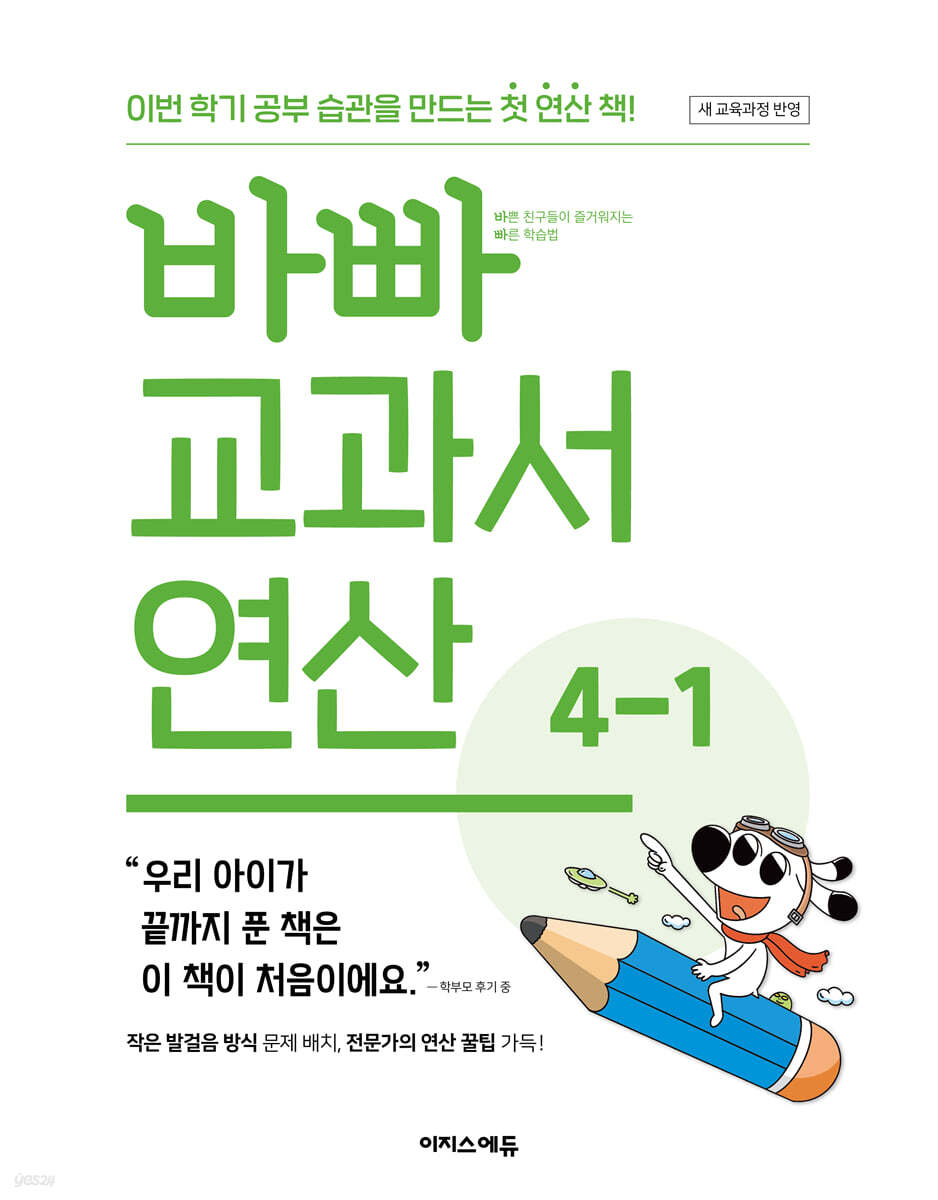
Busy Textbook Operation 4-1 (for 2026)
 |
Description
Book Introduction
Books that touched mothers
“This is the first workbook my child has ever finished!”
The first math book to help you build study habits this semester!
"Busy Textbook Calculations 4-1," a one-volume textbook that covers all the math you need for this semester, has been updated to reflect the revised curriculum! "Busy Textbook Calculations" explains math in a way that students learn in school, and the problems are laid out in small steps, allowing for smooth, uninterrupted solutions.
Here, we've included 'calculation tips' that you can only hear from the director of a math academy, helping you calculate twice as fast with just a small amount of training.
Additionally, we provide 'passing problems by yard' so that you can check and supplement any areas you are lacking at the end of each yard study.
After solving this book, you'll feel confident in class and on unit tests, thanks to the benefit of having already solved the math textbook! Experience the joy of seeing your math skills soar with this new curriculum-aligned calculation training!
“This is the first workbook my child has ever finished!”
The first math book to help you build study habits this semester!
"Busy Textbook Calculations 4-1," a one-volume textbook that covers all the math you need for this semester, has been updated to reflect the revised curriculum! "Busy Textbook Calculations" explains math in a way that students learn in school, and the problems are laid out in small steps, allowing for smooth, uninterrupted solutions.
Here, we've included 'calculation tips' that you can only hear from the director of a math academy, helping you calculate twice as fast with just a small amount of training.
Additionally, we provide 'passing problems by yard' so that you can check and supplement any areas you are lacking at the end of each yard study.
After solving this book, you'll feel confident in class and on unit tests, thanks to the benefit of having already solved the math textbook! Experience the joy of seeing your math skills soar with this new curriculum-aligned calculation training!
- You can preview some of the book's contents.
Preview
index
Busy Textbook Operation 4-1
First yard.
large number
01.
Ten thousand, write and read
02.
Writing and reading five-digit numbers
03 The value represented by the number is different depending on the digit!
04.
Write and read hundreds of thousands, millions, and ten million
05.
Find out what each digit represents
06.
100 million is 8 zeros, 1 trillion is 12 zeros!
07.
Write and read eons and trillions
08.
Let's focus on the numbers that change when jumping to large numbers (1)
09.
Let's focus on the numbers that change when counting large numbers (2)
10.
First, let's compare if the number of digits is the same.
11.
Focused practice comparing the sizes of numbers
12.
Operations in Daily Life - Large Numbers
First yard passage problem
Second yard.
angle
13.
Add the numbers together and then add a degree (˚) to get the sum of the angles!
14.
If you subtract the numbers and add a degree (˚), it is the difference in angles!
15.
Intensive practice of finding the sum and difference of angles
16.
The sum of the three angles of a triangle is 180˚
17.
Angles found with triangles
18.
The sum of the four angles of a square is 360˚
19.
Angle calculated using a square
20.
Operations in Daily Life - Angles
Second yard passage problem
Third yard.
multiplication
21.
Add as many zeros as there are at the end of the two numbers being multiplied!
22.
When you multiply by tens, add a zero at the end!
23.
It's easy to start from 0 when counting horizontally.
24.
Starting from 0, (three digit number) × (tens) one more time!
25.
Let's divide and multiply by the ones and tens digits.
26.
If there is a rounding, be sure to write down the rounded number when solving the problem.
27.
Let's solve complex horizontal arithmetic by converting it to vertical arithmetic.
28.
(three-digit number) × (two-digit number) intensive practice
29.
Operations in Daily Life - Multiplication
Third yard passage problem
Fourth yard.
Division (1)
30.
The quotients of 120÷20 and 12÷2 are the same!
31.
Let's find the quotient by erasing the trailing zeros one by one.
32.
The remainder is always less than the divisor!
33.
(Two-digit number)÷(tens) Let's solve and check if it's correct.
34.
Estimating the quotient using multiplication facts
35.
(three-digit number)÷(tens) Let's solve and check if it's correct.
36.
Division of two-digit numbers without remainder
37.
Easily solve the horizontal division problem by estimating the quotient
38.
If the remainder is greater than the divisor, increase the quotient by 1!
39.
(two-digit number)÷(two-digit number) Let's solve it and check if it's correct.
40.
It's best to solve it horizontally and check it vertically!
41.
One more two-digit division with remainder!
42.
Operations in Daily Life - Division (1)
Fourth yard passage problem
Fifth yard.
Division (2)
43.
If the first two digits are not divisible, divide them all at once!
44.
Intensive practice of division with no remainder and single-digit quotient
45.
Let's find the closest number by estimating the quotient of a three-digit number.
46.
The more difficult the division, the more you should check that your calculations are correct.
47.
Intensive practice of division with a remainder and a single-digit quotient
48.
Let's divide the first two digits first!
49.
Intensive practice of division with no remainder and two-digit quotient
50.
Let's find the quotient of division starting from the highest place!
51.
Let's check if the calculation is correct for division with two-digit quotients.
52.
Let's solve difficult horizontal arithmetic by converting it to vertical arithmetic.
53.
Division with remainder solved in one go!
54.
Operations in Daily Life - Division (2)
Fifth yard passage problem
First yard.
large number
01.
Ten thousand, write and read
02.
Writing and reading five-digit numbers
03 The value represented by the number is different depending on the digit!
04.
Write and read hundreds of thousands, millions, and ten million
05.
Find out what each digit represents
06.
100 million is 8 zeros, 1 trillion is 12 zeros!
07.
Write and read eons and trillions
08.
Let's focus on the numbers that change when jumping to large numbers (1)
09.
Let's focus on the numbers that change when counting large numbers (2)
10.
First, let's compare if the number of digits is the same.
11.
Focused practice comparing the sizes of numbers
12.
Operations in Daily Life - Large Numbers
First yard passage problem
Second yard.
angle
13.
Add the numbers together and then add a degree (˚) to get the sum of the angles!
14.
If you subtract the numbers and add a degree (˚), it is the difference in angles!
15.
Intensive practice of finding the sum and difference of angles
16.
The sum of the three angles of a triangle is 180˚
17.
Angles found with triangles
18.
The sum of the four angles of a square is 360˚
19.
Angle calculated using a square
20.
Operations in Daily Life - Angles
Second yard passage problem
Third yard.
multiplication
21.
Add as many zeros as there are at the end of the two numbers being multiplied!
22.
When you multiply by tens, add a zero at the end!
23.
It's easy to start from 0 when counting horizontally.
24.
Starting from 0, (three digit number) × (tens) one more time!
25.
Let's divide and multiply by the ones and tens digits.
26.
If there is a rounding, be sure to write down the rounded number when solving the problem.
27.
Let's solve complex horizontal arithmetic by converting it to vertical arithmetic.
28.
(three-digit number) × (two-digit number) intensive practice
29.
Operations in Daily Life - Multiplication
Third yard passage problem
Fourth yard.
Division (1)
30.
The quotients of 120÷20 and 12÷2 are the same!
31.
Let's find the quotient by erasing the trailing zeros one by one.
32.
The remainder is always less than the divisor!
33.
(Two-digit number)÷(tens) Let's solve and check if it's correct.
34.
Estimating the quotient using multiplication facts
35.
(three-digit number)÷(tens) Let's solve and check if it's correct.
36.
Division of two-digit numbers without remainder
37.
Easily solve the horizontal division problem by estimating the quotient
38.
If the remainder is greater than the divisor, increase the quotient by 1!
39.
(two-digit number)÷(two-digit number) Let's solve it and check if it's correct.
40.
It's best to solve it horizontally and check it vertically!
41.
One more two-digit division with remainder!
42.
Operations in Daily Life - Division (1)
Fourth yard passage problem
Fifth yard.
Division (2)
43.
If the first two digits are not divisible, divide them all at once!
44.
Intensive practice of division with no remainder and single-digit quotient
45.
Let's find the closest number by estimating the quotient of a three-digit number.
46.
The more difficult the division, the more you should check that your calculations are correct.
47.
Intensive practice of division with a remainder and a single-digit quotient
48.
Let's divide the first two digits first!
49.
Intensive practice of division with no remainder and two-digit quotient
50.
Let's find the quotient of division starting from the highest place!
51.
Let's check if the calculation is correct for division with two-digit quotients.
52.
Let's solve difficult horizontal arithmetic by converting it to vertical arithmetic.
53.
Division with remainder solved in one go!
54.
Operations in Daily Life - Division (2)
Fifth yard passage problem
Detailed image

Publisher's Review
The first math book to create study habits!
All the calculations you need for this semester are covered in this book!
Busy Textbook Operations 4-1
· This semester's calculations can be solved without difficulty by taking small steps!
'Busy Textbook Calculation' is a 'school progress-tailored calculation book' that collects only the calculations needed for this semester and trains them in a smart way.
It explains things the way you would learn in a real school, and the problems are laid out in small steps so you can solve them without any difficulties.
Here are some great tips to help you understand and reduce mistakes! With the "busy tips" you'd only hear from math academy directors and the helpful hints provided throughout the book, you'll easily understand and solve problems.
· This book's clever devices help you focus your attention when you're distracted!
In 'Busy Textbook Operations', operation problems where digits are important have been edited to be calculated accurately on a grid.
Also, fourth graders frequently make mistakes in the "Oops! Mistakes" section, which allows them to review their mistakes again and learn faster and more thoroughly. Each page also has a target clock with a focus time.
This watch is not meant to urge you to speed up.
The time given is enough for a 4th grader to solve the problem without doing anything else.
Try to time yourself so you don't get distracted while studying.
You will experience the fun of concentration and a sense of accomplishment at the same time.
· A book that touched moms - "This is the first workbook my child has ever finished!"
This book is perfect for kids who haven't developed good study habits yet! Parents who have used "Busy Textbook Calculation" for the past five years have left impressive reviews, saying things like, "This is the workbook my child chose himself," "This is the first book he's finished!" and "My child, who used to hate math, says this book is fun and wants to do it again!" This book is full of touching reviews that say it's a book that really helped children develop good study habits. After solving this book, when they go to school, they'll feel more confident in class and on unit tests because they've already solved the math textbook.
Experience the joy of seeing your math skills soar with computational training tailored to the new curriculum!
· Study 'Busy Textbook Calculation' like this!
Step 1 | Essential Concept Summary: We've carefully selected and compiled only the core concepts from math textbooks!
First, you can review the key concepts you need to know for each yard, then check if you have understood the concepts correctly with the 'Quiz'.
Step 2 | Systematic Operational Training: Build your skills step by step, taking small steps.
There are no problems that suddenly jump in difficulty, so you can solve them on your own! Be sure to check out the "Computation Tips" collected from math academy directors across the country! You'll be able to solve them smoothly without any difficulties.
The "Oops! Mistake" section, which contains only the problems that fourth graders frequently get wrong, is a great place to go for those problems that you're prone to making mistakes on.
Step 3 | Bonus Problems: Build your math skills with basic word problems and fun math activities!
You can build a foundation for descriptive writing with 'Basic Sentence Problems in Daily Life' and develop your mathematical application and thinking skills with 'fun calculation activities' such as drawing and connecting lines.
Step 4 | Yard-by-yard passage problems: If you can solve the passage problems, you've finished studying this yard's operations!
It's time to check your progress with the "Pass Problems" to see if you can wrap up this lesson! If you get any questions wrong, check the relevant section and try again! It's even more effective to review before taking the unit assessment.
· A word from a parent who experienced 'Busy Textbook Calculation' in advance!
The first workbook I ever completed was 'Busy Textbook Math'.
The child was very proud after solving it all.
- Busy reader 'Daebaktakpul'
This is a textbook that my son and I chose together so that we could work through one page a day.
My child solves the problems without any burden.
-Busy reader 'ereum1034'
As soon as the child saw it, he said, “This is it!” and sat down to solve it.
I like it very much.
-Busy reader 'Sweet Len'
All the calculations you need for this semester are covered in this book!
Busy Textbook Operations 4-1
· This semester's calculations can be solved without difficulty by taking small steps!
'Busy Textbook Calculation' is a 'school progress-tailored calculation book' that collects only the calculations needed for this semester and trains them in a smart way.
It explains things the way you would learn in a real school, and the problems are laid out in small steps so you can solve them without any difficulties.
Here are some great tips to help you understand and reduce mistakes! With the "busy tips" you'd only hear from math academy directors and the helpful hints provided throughout the book, you'll easily understand and solve problems.
· This book's clever devices help you focus your attention when you're distracted!
In 'Busy Textbook Operations', operation problems where digits are important have been edited to be calculated accurately on a grid.
Also, fourth graders frequently make mistakes in the "Oops! Mistakes" section, which allows them to review their mistakes again and learn faster and more thoroughly. Each page also has a target clock with a focus time.
This watch is not meant to urge you to speed up.
The time given is enough for a 4th grader to solve the problem without doing anything else.
Try to time yourself so you don't get distracted while studying.
You will experience the fun of concentration and a sense of accomplishment at the same time.
· A book that touched moms - "This is the first workbook my child has ever finished!"
This book is perfect for kids who haven't developed good study habits yet! Parents who have used "Busy Textbook Calculation" for the past five years have left impressive reviews, saying things like, "This is the workbook my child chose himself," "This is the first book he's finished!" and "My child, who used to hate math, says this book is fun and wants to do it again!" This book is full of touching reviews that say it's a book that really helped children develop good study habits. After solving this book, when they go to school, they'll feel more confident in class and on unit tests because they've already solved the math textbook.
Experience the joy of seeing your math skills soar with computational training tailored to the new curriculum!
· Study 'Busy Textbook Calculation' like this!
Step 1 | Essential Concept Summary: We've carefully selected and compiled only the core concepts from math textbooks!
First, you can review the key concepts you need to know for each yard, then check if you have understood the concepts correctly with the 'Quiz'.
Step 2 | Systematic Operational Training: Build your skills step by step, taking small steps.
There are no problems that suddenly jump in difficulty, so you can solve them on your own! Be sure to check out the "Computation Tips" collected from math academy directors across the country! You'll be able to solve them smoothly without any difficulties.
The "Oops! Mistake" section, which contains only the problems that fourth graders frequently get wrong, is a great place to go for those problems that you're prone to making mistakes on.
Step 3 | Bonus Problems: Build your math skills with basic word problems and fun math activities!
You can build a foundation for descriptive writing with 'Basic Sentence Problems in Daily Life' and develop your mathematical application and thinking skills with 'fun calculation activities' such as drawing and connecting lines.
Step 4 | Yard-by-yard passage problems: If you can solve the passage problems, you've finished studying this yard's operations!
It's time to check your progress with the "Pass Problems" to see if you can wrap up this lesson! If you get any questions wrong, check the relevant section and try again! It's even more effective to review before taking the unit assessment.
· A word from a parent who experienced 'Busy Textbook Calculation' in advance!
The first workbook I ever completed was 'Busy Textbook Math'.
The child was very proud after solving it all.
- Busy reader 'Daebaktakpul'
This is a textbook that my son and I chose together so that we could work through one page a day.
My child solves the problems without any burden.
-Busy reader 'ereum1034'
As soon as the child saw it, he said, “This is it!” and sat down to solve it.
I like it very much.
-Busy reader 'Sweet Len'
GOODS SPECIFICS
- Date of issue: February 25, 2025
- Page count, weight, size: 168 pages | 474g | 215*275*8mm
- ISBN13: 9791163036777
- Reference book for use in grades: 4th grade elementary school
- Reference book usage period: 1st semester
- KC Certification: Certification Type: Conformity Confirmation
You may also like
카테고리
korean


korean

![GQ KOREA Mark (Monthly): December [2025]](http://librairie.coreenne.fr/cdn/shop/files/8ef265dbbfbf186523ed75ba7319009d.jpg?v=1765340328&width=3840)


