

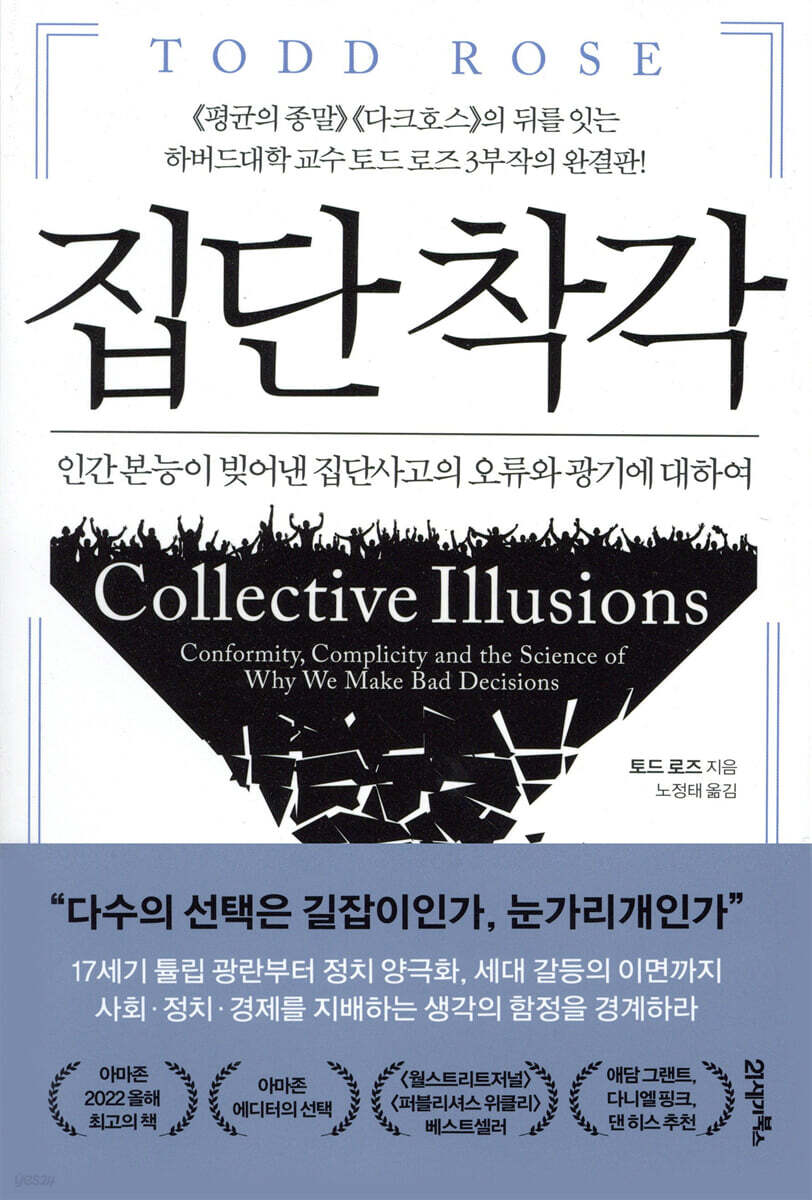
mass delusion
 |
Description
Book Introduction
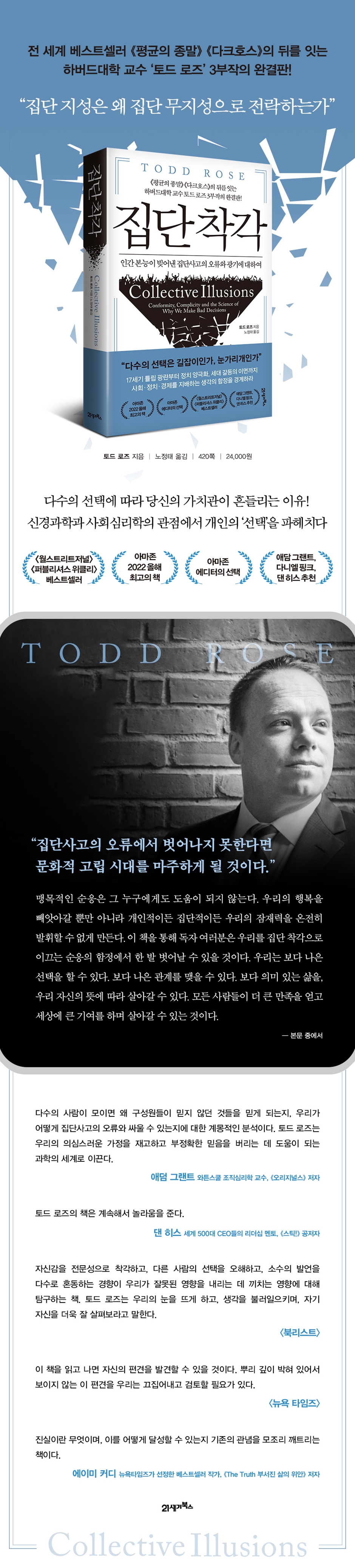
Is majority choice a guide or a blindfold? From the 17th-century tulip mania to political polarization and the dark side of generational conflict. Beware of the traps of thought that dominate society, politics, and the economy. The Netflix documentary "I Am God," which recently caused a huge social stir, features a demagogue who exploits the public's psychology to pursue his own pleasure, power, and financial gain. We have previously encountered tragic endings through extreme group thinking, such as the Jonestown mass suicide incident, which left 913 dead. Why do we follow the majority's choices and engage in such irrational behavior, even when it's clearly a decision that harms us? Todd Rose, author of the international bestsellers The End of Average and Dark Horse, a professor at Harvard's Graduate School of Education, and a leading authority on educational neuroscience, offers a simple answer to this question. It is because of human instinct. As social animals, humans change their behavior depending on the thoughts and views of others. Think about times when you don't really like something, but the majority of people say it's okay, or when you can't say "no" when everyone else says "yes." The urge to coordinate our behavior with others, a phenomenon sociologists often call "conformity bias," is not something we can choose. It is a biological human instinct to lie, remain silent, or stand by for a sense of belonging. The author named this phenomenon 'Collective Illusion'. With the invention of the Internet and the rise of social media as a vehicle for capturing people's daily lives, the world has become awash with a myriad of agitators. As a result, we live in an era of extreme political confrontation, a polarized economy, and cultural isolation, each shouting from their own well to echo only in their own ears. Korean society has long been influenced by Confucian culture, making people more sensitive to the gaze of others. Recently, with the development of smartphones and social media, they have suffered from endless peer pressure. It's like we're living in an environment that's perfect for being swayed by group delusion. Although social instincts are biological, we can control how we respond to them. The purpose of this book is to help you understand why and how we conform to groups, how such conformity creates group illusions, and how social influence works so you can avoid being swayed by it. Blind compliance helps no one. Not only does it rob us of our happiness, it also prevents us from reaching our full potential, both individually and collectively. This book will help readers escape the trap of conformity that leads us into collective delusion. This book will guide you to make better choices, have better relationships, and live a more meaningful life. |
- You can preview some of the book's contents.
Preview
index
Introduction _The Secret of Elm Hollow
Modern people who fall into a collective delusion
Who is the silent majority?
Seneca's Advice for the Swaying You
Translator's Note
Part 1: The Trap of Conformity
Chapter 1: The Naked Kings
Bogotá's traffic clowns could cut death rates by 50 percent
Why Collective Intelligence Degenerates into Collective Ignorance
Public delusion and madness
The human instinct to imitate that hinders rational judgment
Beware of the halo effect
The difference between confidence and delusion is a sheet of paper.
The Power of the Question “Why?”
Chapter 2: Lying for Belonging
The sweet poison of belonging
Why Athens's Highest Citizen Was Banished
The ostracism that occurs in modern society
Either challenge the group or leave on your own.
Wrong choices brought about by cognitive dissonance
The horrific atrocities of a pseudo-religion impersonating God
Chapter 3 The Sound of Silence
A collective delusion that changes the political landscape
Choosing an uncomfortable but safe silence
Why NASA's Space Shuttle Exploded After 73 Seconds
A taste of the power of social media
The Trap of Self-Censorship Spreading Through Society Like a Plague
Seeds of Doubt
Part 2: The Social Dilemma
Chapter 4: The Little Chameleon
Social skills of Homo sapiens
Struggle to survive
Pay attention to other people's desires
The Comparative Brain
Chapter 5: Following the Ghost
Irresistible social forces
The brain craves predictable norms
Candide's Error
Chapter 6: The Kingdom of Error
Trap of Thought
The Harm of White Lies
A world where you only see the information you want to see
Living in an Algorithm
The Merchant of Illusions
Part 3: Reclaim Our Power
Chapter 7: The Virtue of Consistency
Your shattered identity
The difference between lying and deception
The simplest way to increase life satisfaction
Rewatch Homo Economicus
Truthfulness and authenticity
Learning Eastern sincerity
The happiness of a harmonious life
Chapter 8: Trusting Strangers
The price of patriarchy
Trust in the system
Mistrust and illusion
A polarized world
The power of trust in one another
The loss of trust and betrayal
What is your management philosophy?
Seeing the future from a Norwegian prison
Chapter 9: A World Built on Lies
Power of the Powerless
The courage to break the norm
positive deviance
Cracking the collective delusion
Acknowledgements
main
Modern people who fall into a collective delusion
Who is the silent majority?
Seneca's Advice for the Swaying You
Translator's Note
Part 1: The Trap of Conformity
Chapter 1: The Naked Kings
Bogotá's traffic clowns could cut death rates by 50 percent
Why Collective Intelligence Degenerates into Collective Ignorance
Public delusion and madness
The human instinct to imitate that hinders rational judgment
Beware of the halo effect
The difference between confidence and delusion is a sheet of paper.
The Power of the Question “Why?”
Chapter 2: Lying for Belonging
The sweet poison of belonging
Why Athens's Highest Citizen Was Banished
The ostracism that occurs in modern society
Either challenge the group or leave on your own.
Wrong choices brought about by cognitive dissonance
The horrific atrocities of a pseudo-religion impersonating God
Chapter 3 The Sound of Silence
A collective delusion that changes the political landscape
Choosing an uncomfortable but safe silence
Why NASA's Space Shuttle Exploded After 73 Seconds
A taste of the power of social media
The Trap of Self-Censorship Spreading Through Society Like a Plague
Seeds of Doubt
Part 2: The Social Dilemma
Chapter 4: The Little Chameleon
Social skills of Homo sapiens
Struggle to survive
Pay attention to other people's desires
The Comparative Brain
Chapter 5: Following the Ghost
Irresistible social forces
The brain craves predictable norms
Candide's Error
Chapter 6: The Kingdom of Error
Trap of Thought
The Harm of White Lies
A world where you only see the information you want to see
Living in an Algorithm
The Merchant of Illusions
Part 3: Reclaim Our Power
Chapter 7: The Virtue of Consistency
Your shattered identity
The difference between lying and deception
The simplest way to increase life satisfaction
Rewatch Homo Economicus
Truthfulness and authenticity
Learning Eastern sincerity
The happiness of a harmonious life
Chapter 8: Trusting Strangers
The price of patriarchy
Trust in the system
Mistrust and illusion
A polarized world
The power of trust in one another
The loss of trust and betrayal
What is your management philosophy?
Seeing the future from a Norwegian prison
Chapter 9: A World Built on Lies
Power of the Powerless
The courage to break the norm
positive deviance
Cracking the collective delusion
Acknowledgements
main
Detailed image
Into the book
A collective delusion is, in a word, a social lie.
Let's say a majority of members of a group reject a particular opinion.
The reason for making such a judgment is that it assumes (inaccurately) that most people would reject it.
This is precisely what is called a mass delusion.
If we just follow the answers that everyone thinks they want, we may end up heading in a direction that no one wants.
It is a black magic created by mass delusion.
One of the most famous examples of group illusion is Andersen's fairy tale The Emperor's New Clothes, published in 1837.
--- p.16
Unfortunately, the influence of group delusion is not limited to politics.
Group illusions negatively impact almost everything related to our social lives.
Readers, please bring up any topic you think is important.
It's not hard to show that on at least half of these topics, people are mistaken about what 'other people think'.
That is, at least, if the level of this collective delusion is not overestimated.
Given its destructive power, it seems clear that we need to address the collective delusion.
To do this, we need to fundamentally understand why group illusions exist.
--- p.23
In fact, the group preferences presented to them were completely fabricated.
It was just a number created by researchers to see how people reacted according to group tendencies.
However, the subjects were completely unaware of this fact.
This is a very important finding because it reveals the nature of our conformity bias.
The truth doesn't matter.
More precisely, our brains respond to the 'beliefs' we have about groups.
It doesn't matter whether that belief is based on fact or not.
--- p.25
At a national level, collective delusion fuels a deep and unsettling feeling that something is wrong with our society.
For the past few years, we have felt as if we were in a strange nightmare.
It seems like the top and bottom are reversed, the left has become right and the right has become left.
It seems as if our society's values have been completely turned upside down overnight.
We became disoriented, frustrated, dissatisfied with each other, and lost trust.
We can't help but live wondering if the world is crazy, or if we are crazy, or if it's both.
It's no surprise that Americans are waging a war on trust, building a fortress of conspiracy theories and risking our personal well-being and national prosperity.
--- p.28
Unfortunately, this rarely happens in reality.
This is because collective intelligence can be properly expressed only when judgment is made as an individual belonging to a group.
When people can see the choices of others, and thus imitate them, collective intelligence quickly degenerates into collective ignorance.
As we begin to doubt our own judgment and adopt conformity as our default attitude, we transform from individuals into members of a group.
When the seeds of error planted in this way germinate, they lead to a chain reaction and endless replication that overshadows all knowledge and leaves behind only a collective delusion.
--- p.54
We are constantly taking actions to strengthen our bonds with our closest groups.
From choosing what to wear today, all of our outward behavior reveals our relationships with the various groups we belong to.
We can say that we instinctively follow the norms of each group.
Because we understand how important it is to adapt our appearance and behavior to fit our social environment, rather than appearing awkward and out of place in certain places.
Every time we adjust ourselves to our surroundings, we reshape our perception of ourselves.
It's about aligning ourselves with what we think is ideal for that group.
In this way we scrape together a sense of satisfaction and stability.
It is a phenomenon that arises from our deep desire to feel psychological and emotional unity with the group we belong to.
--- p.85
As great and powerful as the pull toward a group is, there may be an even greater force.
It's the fear of being kicked out of the group.
Our social identity is so closely tied to our tribe that being expelled from it can feel like the kiss of death.
If we are not careful enough, that fear can lead us into the worst of collective delusions, and even make us its accomplices.
--- p.91
Imagine you, the reader, are a die-hard supporter of Amy Klobuchar (she was one of the candidates who dropped out after the South Carolina primary vote).
Will you still be urging your friends and family to embrace Klobuchar's core platform and values? Or will you settle for supporting Biden, who has become the Democratic Party's best candidate? This is what happens when the bandwagon effect takes hold.
It is not inevitable that you will change your preferred candidate or anything like that.
But it has become difficult to continue to publicly support a candidate who has not taken the lead.
So to speak, the bandwagon effect makes us reluctant to publicly voice unpopular opinions.
--- p.128
Russia has long used social bots to suppress dissent against Vladimir Putin and his policies.
Other leaders, like Venezuelan President Nicolás Maduro, have also recognized the political potential of social bots.
On October 31, 2013, Twitter suspended without warning more than 6,000 social media bot accounts that had been programmed to retweet (re-disseminate) Maduro's tweets.
These bots violate Twitter's Terms of Use, which qualifies as "unauthorized activity designed to make an account or post appear more popular or active than it actually is."
Although the bots only accounted for 0.5 percent of Maduro's total followers, the average number of retweets on Maduro's tweets plummeted by 81 percent after the social bots were blocked.
Let's say a majority of members of a group reject a particular opinion.
The reason for making such a judgment is that it assumes (inaccurately) that most people would reject it.
This is precisely what is called a mass delusion.
If we just follow the answers that everyone thinks they want, we may end up heading in a direction that no one wants.
It is a black magic created by mass delusion.
One of the most famous examples of group illusion is Andersen's fairy tale The Emperor's New Clothes, published in 1837.
--- p.16
Unfortunately, the influence of group delusion is not limited to politics.
Group illusions negatively impact almost everything related to our social lives.
Readers, please bring up any topic you think is important.
It's not hard to show that on at least half of these topics, people are mistaken about what 'other people think'.
That is, at least, if the level of this collective delusion is not overestimated.
Given its destructive power, it seems clear that we need to address the collective delusion.
To do this, we need to fundamentally understand why group illusions exist.
--- p.23
In fact, the group preferences presented to them were completely fabricated.
It was just a number created by researchers to see how people reacted according to group tendencies.
However, the subjects were completely unaware of this fact.
This is a very important finding because it reveals the nature of our conformity bias.
The truth doesn't matter.
More precisely, our brains respond to the 'beliefs' we have about groups.
It doesn't matter whether that belief is based on fact or not.
--- p.25
At a national level, collective delusion fuels a deep and unsettling feeling that something is wrong with our society.
For the past few years, we have felt as if we were in a strange nightmare.
It seems like the top and bottom are reversed, the left has become right and the right has become left.
It seems as if our society's values have been completely turned upside down overnight.
We became disoriented, frustrated, dissatisfied with each other, and lost trust.
We can't help but live wondering if the world is crazy, or if we are crazy, or if it's both.
It's no surprise that Americans are waging a war on trust, building a fortress of conspiracy theories and risking our personal well-being and national prosperity.
--- p.28
Unfortunately, this rarely happens in reality.
This is because collective intelligence can be properly expressed only when judgment is made as an individual belonging to a group.
When people can see the choices of others, and thus imitate them, collective intelligence quickly degenerates into collective ignorance.
As we begin to doubt our own judgment and adopt conformity as our default attitude, we transform from individuals into members of a group.
When the seeds of error planted in this way germinate, they lead to a chain reaction and endless replication that overshadows all knowledge and leaves behind only a collective delusion.
--- p.54
We are constantly taking actions to strengthen our bonds with our closest groups.
From choosing what to wear today, all of our outward behavior reveals our relationships with the various groups we belong to.
We can say that we instinctively follow the norms of each group.
Because we understand how important it is to adapt our appearance and behavior to fit our social environment, rather than appearing awkward and out of place in certain places.
Every time we adjust ourselves to our surroundings, we reshape our perception of ourselves.
It's about aligning ourselves with what we think is ideal for that group.
In this way we scrape together a sense of satisfaction and stability.
It is a phenomenon that arises from our deep desire to feel psychological and emotional unity with the group we belong to.
--- p.85
As great and powerful as the pull toward a group is, there may be an even greater force.
It's the fear of being kicked out of the group.
Our social identity is so closely tied to our tribe that being expelled from it can feel like the kiss of death.
If we are not careful enough, that fear can lead us into the worst of collective delusions, and even make us its accomplices.
--- p.91
Imagine you, the reader, are a die-hard supporter of Amy Klobuchar (she was one of the candidates who dropped out after the South Carolina primary vote).
Will you still be urging your friends and family to embrace Klobuchar's core platform and values? Or will you settle for supporting Biden, who has become the Democratic Party's best candidate? This is what happens when the bandwagon effect takes hold.
It is not inevitable that you will change your preferred candidate or anything like that.
But it has become difficult to continue to publicly support a candidate who has not taken the lead.
So to speak, the bandwagon effect makes us reluctant to publicly voice unpopular opinions.
--- p.128
Russia has long used social bots to suppress dissent against Vladimir Putin and his policies.
Other leaders, like Venezuelan President Nicolás Maduro, have also recognized the political potential of social bots.
On October 31, 2013, Twitter suspended without warning more than 6,000 social media bot accounts that had been programmed to retweet (re-disseminate) Maduro's tweets.
These bots violate Twitter's Terms of Use, which qualifies as "unauthorized activity designed to make an account or post appear more popular or active than it actually is."
Although the bots only accounted for 0.5 percent of Maduro's total followers, the average number of retweets on Maduro's tweets plummeted by 81 percent after the social bots were blocked.
--- p.146
Publisher's Review
Why Collective Intelligence Degenerates into Collective Ignorance
Why your values are shaken by the choices of many!
Exploring individual 'choice' from the perspectives of neuroscience and social psychology!
Following the global bestsellers The End of Average and Dark Horse
The final installment in the Harvard professor Todd Rose trilogy!
The Netflix documentary "I Am God," which recently caused a huge social stir, features a demagogue who exploits the public's psychology to pursue his own pleasure, power, and financial gain.
We have previously encountered tragic endings through extreme group thinking, such as the Jonestown mass suicide incident, which left 913 dead.
Why do we follow the majority's choices and engage in such irrational behavior, even when it's clearly a decision that harms us?
Because humans are social animals influenced by groups, we tend to uncritically believe in and follow the group's choices and values.
Especially when we are biased towards the choices of the 'majority', we feel secure and easily trust what is socially accepted.
In modern times, this is called collective intelligence, and it is firmly believed that if a 'group' works together to create 'intelligence', it will always produce better results.
However, Todd Rose persistently digs into and analyzes the 'collective delusion' as a side effect of collective intelligence.
‘Collective illusion’ is commonly observed in almost all areas of our daily lives, including politics, religion, and economics.
Like-minded people in the media, online discussion forums, and even in courtrooms foster the fallacy of groupthink.
This can eat away at an individual's thinking and manipulate the way they think and act.
Group illusions, which have a significant impact on social, political, and economic systems, are one type of groupthink error that is formed and reinforced through various mechanisms such as the media, political propaganda, cultural norms, and social pressure.
In the groups surrounding us, is majority rule truly the right choice? What errors does silence create? What consequences do we unknowingly contribute to by overthinking others' thinking? To answer these questions, the author draws on numerous historical examples, analyzing the dangers and maddening errors of groupthink prevalent in modern society through the lens of neuroscience and social psychology, with keen insight and wisdom.
It also emphasizes the importance of looking squarely at how individual choices work and the truth behind them.
A proper understanding of the group illusion will shatter the bias of conformity, foster critical thinking, challenge the blindness of the group, and bring about positive changes in individual choices and attitudes toward life.
An individual who believes he or she has a strong taste
Why are we swayed by groups and forced to follow opposite decisions?
In modern society, individuals believe that they can know exactly what they want and put it into practice through free will.
No one is forcing you to control them, nor is the state stepping in to force you to make absurd decisions.
Therefore, the being called 'I' can lead a life according to my own happiness and values, and can make countless 'choices' that I believe are right without hesitation.
But Todd Rose challenges this simple logic.
In modern society, it is emphasized that individuals belong to groups, large or small, and no matter how independent a person may be, he or she cannot help but be unconsciously influenced by the group.
We delude ourselves into thinking we are the ones making our own choices, but we uncritically absorb the wrong decisions made by the group.
This is not a problem of a particular individual, but rather a mindset that reinforces beliefs the moment you belong to a group, regardless of whether they are true or not.
The group does not express any specific opinion from above.
So there is no system that an individual has the power to fight against or resist and overcome.
We abandon our tastes and values by assuming that we are part of a group that doesn't actually exist, and we acquire the opposite idea by imagining 'what others would think'.
This is the scary thing about group delusion.
It is the vague realm of the group that controls us.
A powerful illusion of non-existence is circulating around us.
It is nearly impossible to recognize and distinguish this.
“Is your choice entirely your own judgment?”
Presenting a clear escape route from the swamp of collective delusion
The mindset that best fits the error created by group delusion is to believe that oneself is a being who makes good decisions, while believing that others are all negative beings who blindly believe in prejudice, stubbornness, and faulty values.
Do female politicians possess the same qualities as their male counterparts? No one would disagree.
But if we turn the question around a bit and ask, "Which candidate should we nominate to win the election?" Unlike before, everyone tends to say that male politicians have an advantage over female politicians.
This question naturally leads to the argument that the party must prioritize nominating white male politicians in order to win, and the collective delusion makes this seem natural.
This also touches on the most serious problem of group delusion that Todd Rose is concerned about.
Group delusion does not simply mean the erratic decisions of individuals.
Group delusions run the risk of producing results that run counter to the public good.
We end up blindly following the 'wrong choices' that we don't want to follow ourselves, mistakenly believing that everyone else believes 'that way'.
Blind faith causes society to lose competent female politicians and, furthermore, to repeat decisions that are detrimental to the public interest.
Humans are social animals, constantly interacting with their surroundings and living in groups.
Since this is an inevitable form of life, the impact of group delusion is beyond imagination.
We used to be confident that if we leaned in, stuck together, and worked together, we would always achieve good results, but we ended up facing even worse results when we stuck together, and we couldn't discern this.
How should we live if we fall into the collective delusion, make undesirable decisions, and go against the common good? Todd Rose advises us not to be swayed by the collective delusion, but to constantly be aware of our own position, question ourselves, and reflect on what we take for granted.
This advice may help to dispel some of the murky fog of the invisible, vast 'illusion' created by the 'group'.
Of course, it won't be easy.
Because an invisible hand that we had not seen before was covering our eyes.
Let's offer an exit from our polluted values with Todd Rose's dense and logical "Collective Delusion."
Let us remove the thin but strong membrane that weighs us down layer by layer, and create new right decisions and intellect.
“A book that explores how our tendency to mistake confidence for expertise, misunderstand other people's choices, and confuse the voices of the few for the many can lead us to misguided influences.
Todd Rose opens our eyes, provokes our thoughts, and challenges us to take a closer look at ourselves.”
- [Booklist]
“After reading this book, you will be able to discover your own prejudices.
“We need to dig up and examine this deeply ingrained, invisible bias.”
- [New York Times]
Why your values are shaken by the choices of many!
Exploring individual 'choice' from the perspectives of neuroscience and social psychology!
Following the global bestsellers The End of Average and Dark Horse
The final installment in the Harvard professor Todd Rose trilogy!
The Netflix documentary "I Am God," which recently caused a huge social stir, features a demagogue who exploits the public's psychology to pursue his own pleasure, power, and financial gain.
We have previously encountered tragic endings through extreme group thinking, such as the Jonestown mass suicide incident, which left 913 dead.
Why do we follow the majority's choices and engage in such irrational behavior, even when it's clearly a decision that harms us?
Because humans are social animals influenced by groups, we tend to uncritically believe in and follow the group's choices and values.
Especially when we are biased towards the choices of the 'majority', we feel secure and easily trust what is socially accepted.
In modern times, this is called collective intelligence, and it is firmly believed that if a 'group' works together to create 'intelligence', it will always produce better results.
However, Todd Rose persistently digs into and analyzes the 'collective delusion' as a side effect of collective intelligence.
‘Collective illusion’ is commonly observed in almost all areas of our daily lives, including politics, religion, and economics.
Like-minded people in the media, online discussion forums, and even in courtrooms foster the fallacy of groupthink.
This can eat away at an individual's thinking and manipulate the way they think and act.
Group illusions, which have a significant impact on social, political, and economic systems, are one type of groupthink error that is formed and reinforced through various mechanisms such as the media, political propaganda, cultural norms, and social pressure.
In the groups surrounding us, is majority rule truly the right choice? What errors does silence create? What consequences do we unknowingly contribute to by overthinking others' thinking? To answer these questions, the author draws on numerous historical examples, analyzing the dangers and maddening errors of groupthink prevalent in modern society through the lens of neuroscience and social psychology, with keen insight and wisdom.
It also emphasizes the importance of looking squarely at how individual choices work and the truth behind them.
A proper understanding of the group illusion will shatter the bias of conformity, foster critical thinking, challenge the blindness of the group, and bring about positive changes in individual choices and attitudes toward life.
An individual who believes he or she has a strong taste
Why are we swayed by groups and forced to follow opposite decisions?
In modern society, individuals believe that they can know exactly what they want and put it into practice through free will.
No one is forcing you to control them, nor is the state stepping in to force you to make absurd decisions.
Therefore, the being called 'I' can lead a life according to my own happiness and values, and can make countless 'choices' that I believe are right without hesitation.
But Todd Rose challenges this simple logic.
In modern society, it is emphasized that individuals belong to groups, large or small, and no matter how independent a person may be, he or she cannot help but be unconsciously influenced by the group.
We delude ourselves into thinking we are the ones making our own choices, but we uncritically absorb the wrong decisions made by the group.
This is not a problem of a particular individual, but rather a mindset that reinforces beliefs the moment you belong to a group, regardless of whether they are true or not.
The group does not express any specific opinion from above.
So there is no system that an individual has the power to fight against or resist and overcome.
We abandon our tastes and values by assuming that we are part of a group that doesn't actually exist, and we acquire the opposite idea by imagining 'what others would think'.
This is the scary thing about group delusion.
It is the vague realm of the group that controls us.
A powerful illusion of non-existence is circulating around us.
It is nearly impossible to recognize and distinguish this.
“Is your choice entirely your own judgment?”
Presenting a clear escape route from the swamp of collective delusion
The mindset that best fits the error created by group delusion is to believe that oneself is a being who makes good decisions, while believing that others are all negative beings who blindly believe in prejudice, stubbornness, and faulty values.
Do female politicians possess the same qualities as their male counterparts? No one would disagree.
But if we turn the question around a bit and ask, "Which candidate should we nominate to win the election?" Unlike before, everyone tends to say that male politicians have an advantage over female politicians.
This question naturally leads to the argument that the party must prioritize nominating white male politicians in order to win, and the collective delusion makes this seem natural.
This also touches on the most serious problem of group delusion that Todd Rose is concerned about.
Group delusion does not simply mean the erratic decisions of individuals.
Group delusions run the risk of producing results that run counter to the public good.
We end up blindly following the 'wrong choices' that we don't want to follow ourselves, mistakenly believing that everyone else believes 'that way'.
Blind faith causes society to lose competent female politicians and, furthermore, to repeat decisions that are detrimental to the public interest.
Humans are social animals, constantly interacting with their surroundings and living in groups.
Since this is an inevitable form of life, the impact of group delusion is beyond imagination.
We used to be confident that if we leaned in, stuck together, and worked together, we would always achieve good results, but we ended up facing even worse results when we stuck together, and we couldn't discern this.
How should we live if we fall into the collective delusion, make undesirable decisions, and go against the common good? Todd Rose advises us not to be swayed by the collective delusion, but to constantly be aware of our own position, question ourselves, and reflect on what we take for granted.
This advice may help to dispel some of the murky fog of the invisible, vast 'illusion' created by the 'group'.
Of course, it won't be easy.
Because an invisible hand that we had not seen before was covering our eyes.
Let's offer an exit from our polluted values with Todd Rose's dense and logical "Collective Delusion."
Let us remove the thin but strong membrane that weighs us down layer by layer, and create new right decisions and intellect.
“A book that explores how our tendency to mistake confidence for expertise, misunderstand other people's choices, and confuse the voices of the few for the many can lead us to misguided influences.
Todd Rose opens our eyes, provokes our thoughts, and challenges us to take a closer look at ourselves.”
- [Booklist]
“After reading this book, you will be able to discover your own prejudices.
“We need to dig up and examine this deeply ingrained, invisible bias.”
- [New York Times]
GOODS SPECIFICS
- Date of issue: May 3, 2023
- Page count, weight, size: 420 pages | 640g | 152*225*26mm
- ISBN13: 9788950910945
- ISBN10: 8950910942
You may also like
카테고리
korean


korean

![GQ KOREA Mark (Monthly): December [2025]](http://librairie.coreenne.fr/cdn/shop/files/8ef265dbbfbf186523ed75ba7319009d.jpg?v=1765340328&width=3840)


