

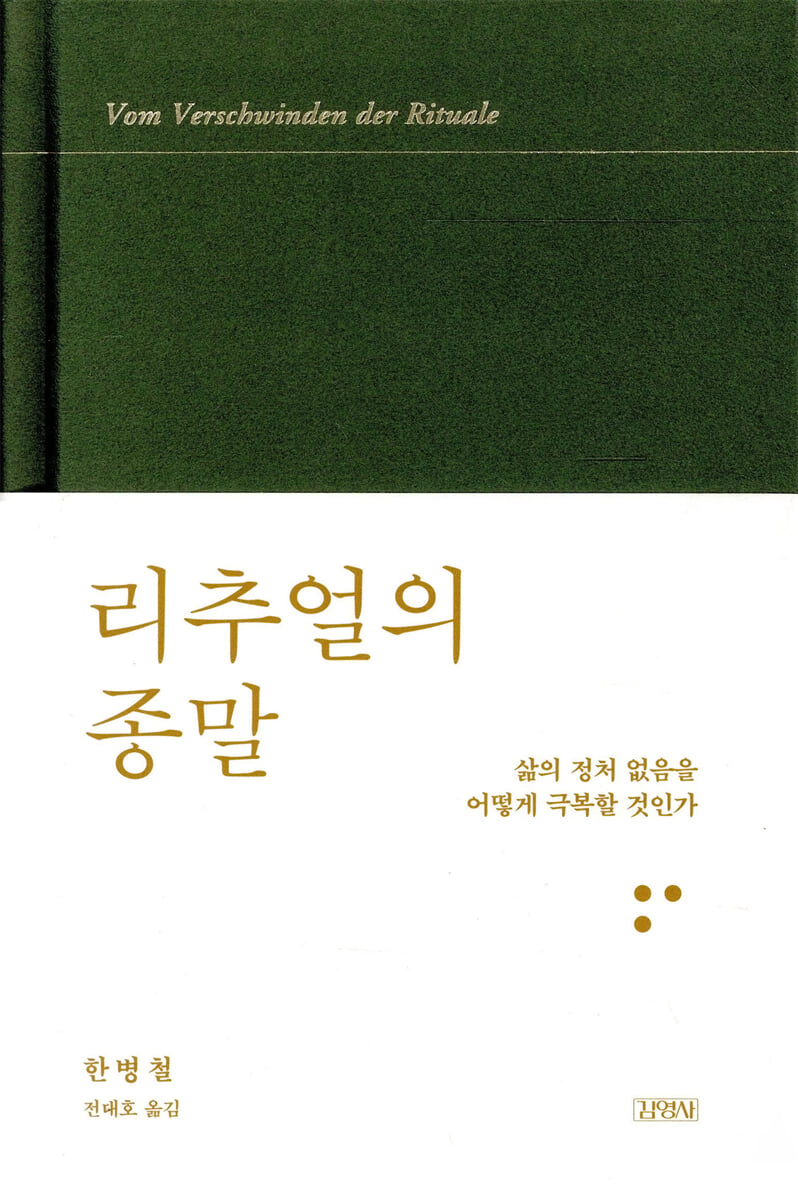
The End of Ritual
 |
Description
Book Introduction
A new work by German-based philosopher Han Byung-chul!
On Ritual, Play, Festivals, and the Pandemics and the Loss of Community
A new work by philosopher Han Byung-chul, who has consistently presented sharp analysis and uncompromising critique of today's world.
Using the keyword 'ritual', we diagnose the state of our society and continue our search for a better life.
It examines how superficial life becomes in a neoliberal world where formality has been eliminated, how the obsessive pursuit of individual "authenticity" operates and what consequences it produces, and what paths can be taken to escape the collective narcissism that pervades this society.
We reexamine the old new path of 'ritual' as an alternative practice that goes beyond the ego, desire, and consumption, and propose 'ethics in a beautiful form.'
On Ritual, Play, Festivals, and the Pandemics and the Loss of Community
A new work by philosopher Han Byung-chul, who has consistently presented sharp analysis and uncompromising critique of today's world.
Using the keyword 'ritual', we diagnose the state of our society and continue our search for a better life.
It examines how superficial life becomes in a neoliberal world where formality has been eliminated, how the obsessive pursuit of individual "authenticity" operates and what consequences it produces, and what paths can be taken to escape the collective narcissism that pervades this society.
We reexamine the old new path of 'ritual' as an alternative practice that goes beyond the ego, desire, and consumption, and propose 'ethics in a beautiful form.'
- You can preview some of the book's contents.
Preview
index
Introduction
forced production
Forced authenticity
Closing ritual
Festivals and Religion
A game of life and death
The End of History
Empire of Symbols
From duels to drone warfare
From Myth to Dataism
From seduction to pornography
References
main
Appendix _ Author Interview
Translator's Note
forced production
Forced authenticity
Closing ritual
Festivals and Religion
A game of life and death
The End of History
Empire of Symbols
From duels to drone warfare
From Myth to Dataism
From seduction to pornography
References
main
Appendix _ Author Interview
Translator's Note
Into the book
Rituals make the world a safe place.
Ritual in time corresponds to dwelling in space.
Ritual makes time habitable.
...
Rituals give order to time.
--- p.9~10
A person who is absorbed in a ritual must turn his gaze away from himself.
Ritual creates self-distance (Selbst-Distanz) and self-transcendence (Selbst-Transzendenz).
--- p.15~16
Repetition is an essential characteristic of ritual.
However, rituals differ from routines in that they have the ability to produce consistency.
...
According to Kierkegaard, “We only get tired of the new, and never of the old.”
--- p.18~19
Digital communication is largely driven by excitement.
Digital communication encourages the immediate release of excitement.
Twitter functions as an excitement medium.
Politics based on Twitter is politics of excitement.
Politics is originally about reason and mediation.
Reason, which requires a very long time, is increasingly being pushed aside by short-term excitement these days.
--- p.22
It is not uncommon for hierarchy and power relations to intervene in rituals.
Rituals can also beautify the ruler with an aura through aesthetic presentation.
However, the essence of the ritual is to symbolically practice 'entering the house'.
Roland Barthes also uses 'entering the house' as a starting point to develop his thoughts on ritual and ceremony.
Rituals and ceremonies protect us from the abyss of existence (Abgrund).
--- p.26
Funeral services are like varnish that covers the skin, protecting it from the terrible burns of grief at the death of a loved one.
When ritual as a protective device is removed, life becomes completely defenseless.
The compulsion to produce will not be able to overcome this transcendental defenselessness and non-inhabitation.
Rather, it will ultimately deepen this defenselessness and non-residence.
--- p.26
Because of its narcissistic structure, authenticity hinders community formation.
What is decisive about the content of authenticity is not its connection to the community of authenticity or to some other higher order, but its market value, a market value that weighs down and subdues all other values.
Thus, the form and content of authenticity are unified.
Both are related to the ego.
The cult of authenticity shifts the question of society's identity onto individual individuals.
Thus, self-production takes place permanently.
In this way, the cult of authenticity atomizes society.
--- p.29
Rituals and ceremonies are truly human acts.
The act makes life seem festive and magical.
The disappearance of ritual and ceremony reduces life to survival and secularizes it.
Therefore, we can expect the power to heal collective narcissism from the re-enchantment of the world.
--- p.38
Rites of transition, or rites of passage, structure life like seasons.
A person who crosses a threshold ends one stage of life and enters a new one.
Thresholds serve as transition points, making space and time rhythmic and clear.
In short, it makes space and time into a story.
Thresholds enable a profound experience of order.
Thresholds are time-intensive transition points.
Thresholds are being removed today to allow for faster and more uninterrupted communication and production.
--- p.49
Even rest is taken over by production and relegated to a vacation, a break for recovery.
Vacations do not trigger periods of sacred gathering.
For some people, vacation is an empty time, a fear of emptiness horro vacui.
The mounting pressure to perform makes even pauses that help recovery impossible.
That's why so many people get sick while on vacation.
The disease even earned the name 'leisure sickness'.
In this case, vacation is a painful and empty form of labor.
Active, ritualistic rest is being pushed aside today by painful inaction.
--- p.60
Nowadays, moralization is constantly taking place.
But at the same time, society becomes violent.
Politeness disappears.
The cult of authenticity despises politeness.
Beautiful forms of communication are becoming increasingly rare.
In this respect too, we are hostile to formality.
Morality does not seem to exclude the barbarism of society.
Morality has no form.
Moral inwardness operates without form.
You could even say this:
'The more a society tends to moralize, the more impertinent it becomes.' We must defend a beautiful form of ethics against this formless morality.
--- p.90
A liberal society cannot afford to subject each individual to surveillance, so it has no choice but to impose a complete lockdown, which would cause enormous economic damage.
Soon, Western societies will reach the fateful realization that only through biopolitics, through digital surveillance of the body, can we intervene unhindered in individual lives and prevent lockdowns.
But that realization is the end of liberalism.
Ritual in time corresponds to dwelling in space.
Ritual makes time habitable.
...
Rituals give order to time.
--- p.9~10
A person who is absorbed in a ritual must turn his gaze away from himself.
Ritual creates self-distance (Selbst-Distanz) and self-transcendence (Selbst-Transzendenz).
--- p.15~16
Repetition is an essential characteristic of ritual.
However, rituals differ from routines in that they have the ability to produce consistency.
...
According to Kierkegaard, “We only get tired of the new, and never of the old.”
--- p.18~19
Digital communication is largely driven by excitement.
Digital communication encourages the immediate release of excitement.
Twitter functions as an excitement medium.
Politics based on Twitter is politics of excitement.
Politics is originally about reason and mediation.
Reason, which requires a very long time, is increasingly being pushed aside by short-term excitement these days.
--- p.22
It is not uncommon for hierarchy and power relations to intervene in rituals.
Rituals can also beautify the ruler with an aura through aesthetic presentation.
However, the essence of the ritual is to symbolically practice 'entering the house'.
Roland Barthes also uses 'entering the house' as a starting point to develop his thoughts on ritual and ceremony.
Rituals and ceremonies protect us from the abyss of existence (Abgrund).
--- p.26
Funeral services are like varnish that covers the skin, protecting it from the terrible burns of grief at the death of a loved one.
When ritual as a protective device is removed, life becomes completely defenseless.
The compulsion to produce will not be able to overcome this transcendental defenselessness and non-inhabitation.
Rather, it will ultimately deepen this defenselessness and non-residence.
--- p.26
Because of its narcissistic structure, authenticity hinders community formation.
What is decisive about the content of authenticity is not its connection to the community of authenticity or to some other higher order, but its market value, a market value that weighs down and subdues all other values.
Thus, the form and content of authenticity are unified.
Both are related to the ego.
The cult of authenticity shifts the question of society's identity onto individual individuals.
Thus, self-production takes place permanently.
In this way, the cult of authenticity atomizes society.
--- p.29
Rituals and ceremonies are truly human acts.
The act makes life seem festive and magical.
The disappearance of ritual and ceremony reduces life to survival and secularizes it.
Therefore, we can expect the power to heal collective narcissism from the re-enchantment of the world.
--- p.38
Rites of transition, or rites of passage, structure life like seasons.
A person who crosses a threshold ends one stage of life and enters a new one.
Thresholds serve as transition points, making space and time rhythmic and clear.
In short, it makes space and time into a story.
Thresholds enable a profound experience of order.
Thresholds are time-intensive transition points.
Thresholds are being removed today to allow for faster and more uninterrupted communication and production.
--- p.49
Even rest is taken over by production and relegated to a vacation, a break for recovery.
Vacations do not trigger periods of sacred gathering.
For some people, vacation is an empty time, a fear of emptiness horro vacui.
The mounting pressure to perform makes even pauses that help recovery impossible.
That's why so many people get sick while on vacation.
The disease even earned the name 'leisure sickness'.
In this case, vacation is a painful and empty form of labor.
Active, ritualistic rest is being pushed aside today by painful inaction.
--- p.60
Nowadays, moralization is constantly taking place.
But at the same time, society becomes violent.
Politeness disappears.
The cult of authenticity despises politeness.
Beautiful forms of communication are becoming increasingly rare.
In this respect too, we are hostile to formality.
Morality does not seem to exclude the barbarism of society.
Morality has no form.
Moral inwardness operates without form.
You could even say this:
'The more a society tends to moralize, the more impertinent it becomes.' We must defend a beautiful form of ethics against this formless morality.
--- p.90
A liberal society cannot afford to subject each individual to surveillance, so it has no choice but to impose a complete lockdown, which would cause enormous economic damage.
Soon, Western societies will reach the fateful realization that only through biopolitics, through digital surveillance of the body, can we intervene unhindered in individual lives and prevent lockdowns.
But that realization is the end of liberalism.
--- p.133
Publisher's Review
A new work by German-based philosopher Han Byung-chul!
On Ritual, Play, Festivals, and the Pandemics and the Loss of Community
The new book, "The End of Ritual," by philosopher Han Byung-chul, who has consistently presented sharp analyses and uncompromising critiques of today's world, has been published.
Using the keyword 'ritual', we diagnose the state of our society and continue our search for a better life.
It examines how superficial life becomes in a neoliberal world where formality has been eliminated, how the obsessive pursuit of individual "authenticity" operates and what consequences it produces, and what paths can be taken to escape the collective narcissism that pervades this society.
We reexamine the old new path of 'ritual' as an alternative practice that goes beyond the ego, desire, and consumption, and propose 'ethics in a beautiful form.'
“I will briefly describe the history of the disappearance of rituals without any nostalgia, and I will not interpret the history of their disappearance as the history of liberation.
In addition, it will clearly reveal the current pathological phenomena, above all, the erosion of community.
“In the process, we will consider other Lebensforms that might liberate society from collective narcissism.” (p. 7)
In the age of routines and challenges, the disappearance of rituals
In some ways, it seems like we are living in an era of rituals.
Miracle Morning, meditation, yoga, fitness, running, reading, journaling, etc. Social media is full of posts introducing their own 'rituals' and 'routines' or 'challenging' others to join.
Many people are joining this trend to make their daily lives more fulfilling, even as their range of movement is limited due to the coronavirus pandemic.
But why the "end of ritual"? Like previous works like "The Burnout Society," "The Transparent Society," "Psychopolitics," and "The Painless Society," this book focuses thoroughly on the "here and now" where we live, on the issues facing our society.
We explore what binds our existence and perception, and explore the possibility of freedom from it.
As can be guessed from the original title, “The Disappearance of Ritual: The Topology of the Present,” this book explores the disappearing ‘ritual’, assesses its current position, and tenaciously delves into the contradictions of this era.
Rituals keep life going
The German word 'Ritual', which is mostly translated as 'ritual' in this book, encompasses the meanings of 'rite', 'ceremony', 'liturgy', 'ceremony', 'festival', and 'feast', according to the author.
This is quite different from the meaning of “an individual’s daily habits that are performed repeatedly to stabilize the mind and provide rhythm to life” as referred to in the recent “ritual” trend mentioned above. In this book, rituals have “symbolic power that aligns life with something higher and thereby provides meaning and direction” (p. 122).
It acts like a solid anchor that allows us to anchor our restless lives.
Just as a house (in space) can be entered and inhabited at any time, it allows one to stay in time (p. 10).
By focusing on certain forms and rules, the self is de-internalized (p. 16) and relationships are formed with others, surrounding objects, and the world.
Crucially, it plays a role in forming and binding communities without any specific communication.
A world that breathes the chill of 'aloneness' and 'transience'
The book constantly contrasts a society, era, and culture where rituals worked well with a present that has lost them, and portrays the present.
Neoliberalism forces constant production and consumption, and eliminates anything that gets in the way. Rituals are one of the things that disappear as a result.
What does it look like? A world where we must constantly produce, consume, and update new things, a world that doesn't allow us to settle on anything, to continue and end.
For example, we binge-watch series through OTT services like Netflix until we get tired of them (p. 16).
Trapped in the rapid scrolling and clicking of the digital world, we are less likely to engage with solid 'things'.
The sense of community that once made the community strong is overshadowed by short-term excitement that is not shared (p. 22).
People are individualized and atomized.
As the translator says, “We live, separated from the sense of security that comes from ‘togetherness’ and ‘staying,’ breathing the coldness of ‘aloneness’ and ‘transience’” (p. 159).
Language “works instead of plays” (p. 82).
Festivals are transformed into events (page 59), duels that followed strict rules are transformed into drone wars (where a 'scorecard' is awarded to record how many targets were killed) ([From Duels to Drone Wars]), and reason is replaced by data that is incredibly abundant, fast, and transparent ([From Myth to Dataism]).
The temptation that was based on the externality of the other while maintaining a staged and playful distance has come to an end, and narcissistic pornography has taken its place ([From Temptation to Pornography]).
Beyond self, desire, and consumption, in search of a new way of life
This diagnosis may seem too negative, but it is something most people in our society have experienced.
As stated in the [Introduction] and emphasized in the interview in the appendix, what the author is saying is not to return to the past when Ritual was alive.
It is about finding a new way of life, breaking free from the trap of constant production and consumption, desire and narcissism.
This book provides a clue to this, inviting readers to “invent new forms of action and play that create community, that take place beyond the self, beyond desire, beyond consumption.”
Last spring, the publication of this book became a hot topic in Spain.
This book's content likely resonated with readers who felt the loss of rituals in the midst of a pandemic where even handshakes and hugs were impossible.
The author's interviews conducted by two major Spanish media outlets at the time (El País and El Mundo) were translated and included as an appendix.
It is full of questions that readers are likely to have while reading the text, and it includes explanations of the author's position, which can easily be misunderstood.
The author's outlook on the social changes brought about by the pandemic is also interesting.
On Ritual, Play, Festivals, and the Pandemics and the Loss of Community
The new book, "The End of Ritual," by philosopher Han Byung-chul, who has consistently presented sharp analyses and uncompromising critiques of today's world, has been published.
Using the keyword 'ritual', we diagnose the state of our society and continue our search for a better life.
It examines how superficial life becomes in a neoliberal world where formality has been eliminated, how the obsessive pursuit of individual "authenticity" operates and what consequences it produces, and what paths can be taken to escape the collective narcissism that pervades this society.
We reexamine the old new path of 'ritual' as an alternative practice that goes beyond the ego, desire, and consumption, and propose 'ethics in a beautiful form.'
“I will briefly describe the history of the disappearance of rituals without any nostalgia, and I will not interpret the history of their disappearance as the history of liberation.
In addition, it will clearly reveal the current pathological phenomena, above all, the erosion of community.
“In the process, we will consider other Lebensforms that might liberate society from collective narcissism.” (p. 7)
In the age of routines and challenges, the disappearance of rituals
In some ways, it seems like we are living in an era of rituals.
Miracle Morning, meditation, yoga, fitness, running, reading, journaling, etc. Social media is full of posts introducing their own 'rituals' and 'routines' or 'challenging' others to join.
Many people are joining this trend to make their daily lives more fulfilling, even as their range of movement is limited due to the coronavirus pandemic.
But why the "end of ritual"? Like previous works like "The Burnout Society," "The Transparent Society," "Psychopolitics," and "The Painless Society," this book focuses thoroughly on the "here and now" where we live, on the issues facing our society.
We explore what binds our existence and perception, and explore the possibility of freedom from it.
As can be guessed from the original title, “The Disappearance of Ritual: The Topology of the Present,” this book explores the disappearing ‘ritual’, assesses its current position, and tenaciously delves into the contradictions of this era.
Rituals keep life going
The German word 'Ritual', which is mostly translated as 'ritual' in this book, encompasses the meanings of 'rite', 'ceremony', 'liturgy', 'ceremony', 'festival', and 'feast', according to the author.
This is quite different from the meaning of “an individual’s daily habits that are performed repeatedly to stabilize the mind and provide rhythm to life” as referred to in the recent “ritual” trend mentioned above. In this book, rituals have “symbolic power that aligns life with something higher and thereby provides meaning and direction” (p. 122).
It acts like a solid anchor that allows us to anchor our restless lives.
Just as a house (in space) can be entered and inhabited at any time, it allows one to stay in time (p. 10).
By focusing on certain forms and rules, the self is de-internalized (p. 16) and relationships are formed with others, surrounding objects, and the world.
Crucially, it plays a role in forming and binding communities without any specific communication.
A world that breathes the chill of 'aloneness' and 'transience'
The book constantly contrasts a society, era, and culture where rituals worked well with a present that has lost them, and portrays the present.
Neoliberalism forces constant production and consumption, and eliminates anything that gets in the way. Rituals are one of the things that disappear as a result.
What does it look like? A world where we must constantly produce, consume, and update new things, a world that doesn't allow us to settle on anything, to continue and end.
For example, we binge-watch series through OTT services like Netflix until we get tired of them (p. 16).
Trapped in the rapid scrolling and clicking of the digital world, we are less likely to engage with solid 'things'.
The sense of community that once made the community strong is overshadowed by short-term excitement that is not shared (p. 22).
People are individualized and atomized.
As the translator says, “We live, separated from the sense of security that comes from ‘togetherness’ and ‘staying,’ breathing the coldness of ‘aloneness’ and ‘transience’” (p. 159).
Language “works instead of plays” (p. 82).
Festivals are transformed into events (page 59), duels that followed strict rules are transformed into drone wars (where a 'scorecard' is awarded to record how many targets were killed) ([From Duels to Drone Wars]), and reason is replaced by data that is incredibly abundant, fast, and transparent ([From Myth to Dataism]).
The temptation that was based on the externality of the other while maintaining a staged and playful distance has come to an end, and narcissistic pornography has taken its place ([From Temptation to Pornography]).
Beyond self, desire, and consumption, in search of a new way of life
This diagnosis may seem too negative, but it is something most people in our society have experienced.
As stated in the [Introduction] and emphasized in the interview in the appendix, what the author is saying is not to return to the past when Ritual was alive.
It is about finding a new way of life, breaking free from the trap of constant production and consumption, desire and narcissism.
This book provides a clue to this, inviting readers to “invent new forms of action and play that create community, that take place beyond the self, beyond desire, beyond consumption.”
Last spring, the publication of this book became a hot topic in Spain.
This book's content likely resonated with readers who felt the loss of rituals in the midst of a pandemic where even handshakes and hugs were impossible.
The author's interviews conducted by two major Spanish media outlets at the time (El País and El Mundo) were translated and included as an appendix.
It is full of questions that readers are likely to have while reading the text, and it includes explanations of the author's position, which can easily be misunderstood.
The author's outlook on the social changes brought about by the pandemic is also interesting.
GOODS SPECIFICS
- Publication date: October 15, 2021
- Format: Hardcover book binding method guide
- Page count, weight, size: 160 pages | 292g | 124*190*20mm
- ISBN13: 9788934980285
- ISBN10: 8934980281
You may also like
카테고리
korean


korean

![GQ KOREA Mark (Monthly): December [2025]](http://librairie.coreenne.fr/cdn/shop/files/8ef265dbbfbf186523ed75ba7319009d.jpg?v=1765340328&width=3840)


