

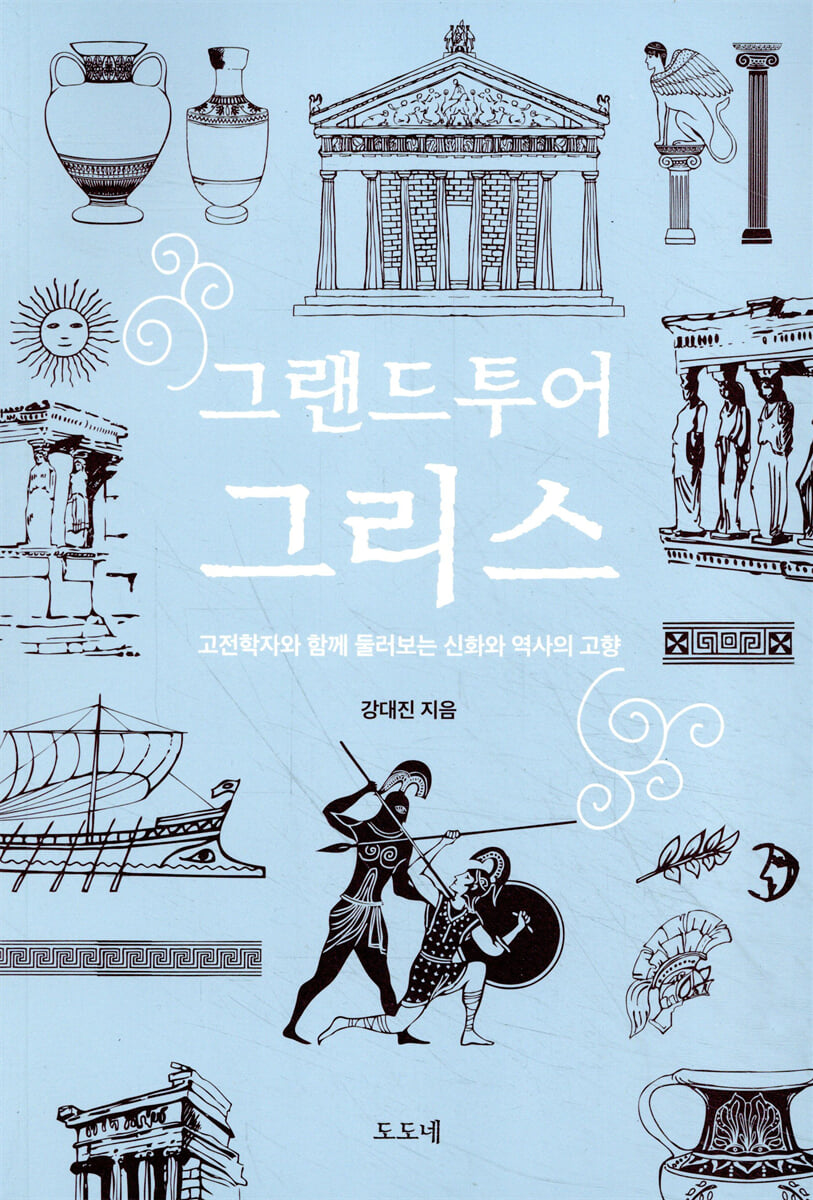
Grand Tour Greece
 |
Description
Book Introduction
♣ EBS TV Class e broadcast!! 'Kang Dae-jin's Greek & Italian Mythology Journey' ♣
A grand tour of Greece to discover the origins of Western culture!
Kang Dae-jin, a Western classicist who has introduced Greek mythology and history through Greek classics including Homer's two great epics, talks about the ruins and relics he encountered while traveling throughout Greece.
This journey, which explores the myths and historical sites that have been preserved for thousands of years and meticulously examines ancient artifacts excavated there, guides you through Greece as a kind of grand tour that traces the origins of Western culture.
For those who wish to truly understand Western culture from its roots, the focus is on where to visit, what myths and history are embedded there, and what to pay attention to when viewing ruins and relics.
(_From "Introductory Remarks")
A grand tour of Greece to discover the origins of Western culture!
Kang Dae-jin, a Western classicist who has introduced Greek mythology and history through Greek classics including Homer's two great epics, talks about the ruins and relics he encountered while traveling throughout Greece.
This journey, which explores the myths and historical sites that have been preserved for thousands of years and meticulously examines ancient artifacts excavated there, guides you through Greece as a kind of grand tour that traces the origins of Western culture.
For those who wish to truly understand Western culture from its roots, the focus is on where to visit, what myths and history are embedded there, and what to pay attention to when viewing ruins and relics.
(_From "Introductory Remarks")
- You can preview some of the book's contents.
Preview
index
Introduction
1 Athens
Acropolis, the realm of the gods
Areopagus, a place steeped in history
Odeon and Theater of Dionysus
The Propylaia group of buildings at the gateway to the Acropolis
Temple of Athena Nike, a great place to study the structure and decoration of temples
T-shaped structure of the propulsion
Erechtheion Temple of Poseidon
The unexpected building Pandroseion
The slightly complex structure of the Erechtheion
The Parthenon, the pinnacle of ancient architecture
Parthenon Sculptures
Personal addition
A step further in myth and historical knowledge
Acropolis Museum
Agora, the training ground of democracy, and the Stoa of Attalos
The Temple of Hephaestus, which remains almost intact
Other buildings in the Agora
Buildings added later
Pnyx, the site of Athenian democracy
The Kerameikos Cemetery, the resting place of heroes, the Dipylon Gate, and the Walls of Themistocles
Plato's Academy
Memories of Hadrian, the Temple of Olympian Zeus and Hadrian's Gate
Now located in the heart of the city, Aristotle's school, the Lyceum
The unexpectedly old Panathenaic Stadium
National Archaeological Museum of Athens, a treasure trove of ancient civilization
2 Cities around Athens
Eleusis, the sacred place of Demeter and Persephone
Ruins for the high-end traveler
Marathon, the site of the defeat of the Persian army
Brauron, the sanctuary of Artemis
The Laureion silver mine, the financial foundation of the Athenian navy
Sounion, the end of Attica
The Piraeus, the main gate of Athens, opened outwards
Salamis, the historical site of East-West clashes
Aegina, the hometown of Achilles' family
3 Crete and other islands
Crete, the cradle of European civilization
Knossos, where Minos' palace was located
Other sites in Crete
Heraklion Archaeological Museum, a treasure trove of Minoan civilization
Great Men Born in Crete - El Greco and Kazantzakis
Santorini: A Photogenic Spot - An Unexpected Bronze Age Ruins
Delos, the island of Apollo
Naxos, the island of Ariadne
4 Peloponnese Peninsula
Megara, the northern region of the isthmus
Corinth Canal, shipping lanes, and barriers
Isthmia, where ancient games were held
Corinth, embraced by the sea on both sides
Nemea, the site of ancient international athletic festivals
Mycenae, Agamemnon's base
Argos, the hometown of Perseus
Tiryns, the hometown of Hercules
Epidaurus, the holy city of Asclepius
Sparta, surprisingly lacking in ruins
Messene, surprisingly rich in historical sites
Nestor's hometown, Pylos
Batsai hidden in a remote place in the mountains
Olympia, where international sports competitions were held
5 Central and Northern Greece
Naupactus, the Athenian naval base and site of modern sea battles
Delphi, the sacred site of Apollo with a mystical atmosphere
Calydon, famous for its boar hunting
Dodone, where the sacred oak tree gave oracles
Nausicaa's Island, Kerkyra
Thermopylae, defended by 300 warriors until the end
Macedonia, Alexander's homeland
Istanbul, the Eastern Roman stronghold
Ancient Greek chronology
Roman Chronology
Source of the illustration
Search
1 Athens
Acropolis, the realm of the gods
Areopagus, a place steeped in history
Odeon and Theater of Dionysus
The Propylaia group of buildings at the gateway to the Acropolis
Temple of Athena Nike, a great place to study the structure and decoration of temples
T-shaped structure of the propulsion
Erechtheion Temple of Poseidon
The unexpected building Pandroseion
The slightly complex structure of the Erechtheion
The Parthenon, the pinnacle of ancient architecture
Parthenon Sculptures
Personal addition
A step further in myth and historical knowledge
Acropolis Museum
Agora, the training ground of democracy, and the Stoa of Attalos
The Temple of Hephaestus, which remains almost intact
Other buildings in the Agora
Buildings added later
Pnyx, the site of Athenian democracy
The Kerameikos Cemetery, the resting place of heroes, the Dipylon Gate, and the Walls of Themistocles
Plato's Academy
Memories of Hadrian, the Temple of Olympian Zeus and Hadrian's Gate
Now located in the heart of the city, Aristotle's school, the Lyceum
The unexpectedly old Panathenaic Stadium
National Archaeological Museum of Athens, a treasure trove of ancient civilization
2 Cities around Athens
Eleusis, the sacred place of Demeter and Persephone
Ruins for the high-end traveler
Marathon, the site of the defeat of the Persian army
Brauron, the sanctuary of Artemis
The Laureion silver mine, the financial foundation of the Athenian navy
Sounion, the end of Attica
The Piraeus, the main gate of Athens, opened outwards
Salamis, the historical site of East-West clashes
Aegina, the hometown of Achilles' family
3 Crete and other islands
Crete, the cradle of European civilization
Knossos, where Minos' palace was located
Other sites in Crete
Heraklion Archaeological Museum, a treasure trove of Minoan civilization
Great Men Born in Crete - El Greco and Kazantzakis
Santorini: A Photogenic Spot - An Unexpected Bronze Age Ruins
Delos, the island of Apollo
Naxos, the island of Ariadne
4 Peloponnese Peninsula
Megara, the northern region of the isthmus
Corinth Canal, shipping lanes, and barriers
Isthmia, where ancient games were held
Corinth, embraced by the sea on both sides
Nemea, the site of ancient international athletic festivals
Mycenae, Agamemnon's base
Argos, the hometown of Perseus
Tiryns, the hometown of Hercules
Epidaurus, the holy city of Asclepius
Sparta, surprisingly lacking in ruins
Messene, surprisingly rich in historical sites
Nestor's hometown, Pylos
Batsai hidden in a remote place in the mountains
Olympia, where international sports competitions were held
5 Central and Northern Greece
Naupactus, the Athenian naval base and site of modern sea battles
Delphi, the sacred site of Apollo with a mystical atmosphere
Calydon, famous for its boar hunting
Dodone, where the sacred oak tree gave oracles
Nausicaa's Island, Kerkyra
Thermopylae, defended by 300 warriors until the end
Macedonia, Alexander's homeland
Istanbul, the Eastern Roman stronghold
Ancient Greek chronology
Roman Chronology
Source of the illustration
Search
Publisher's Review
A vivid reconstruction of Greece's cultural heyday.
We will focus on classical architecture and relics built in Greece and the Greek lands during the cultural heyday of the 5th to 4th centuries BC.
Of course, even if it is a site built in an earlier period, such as Knossos from the Bronze Age, we will examine sites and relics that are civilizationally significant.
At the desolate temple site that we found with great difficulty, the author tells us to first feel the energy of the old land.
Then, we present related images to vividly portray the temple's former, splendid past appearance, with its perfect form, and tell the story of its appearance and use.
It explains in detail the rules by which the temples dedicated to the major Olympian gods, including Zeus, Hera, Apollo, and Athena, were built and located. It also includes maps of the ruins, floor plans, and restoration drawings to help readers understand the site, allowing them to see the appearance at the time in three dimensions.
We will also check the number of pillars surrounding the temple and distinguish the various styles that decorated the pillars.
The temples were generally built in the form of a gable roof with gables at both ends, and the stories of the gods and heroes carved on the gables and metopes that decorated the walls, as well as the lives of the common people, are told in detail.
As you follow the author's story step by step, a vivid reconstruction takes place in your mind, as if you were facing a gigantic temple built in Greece 2,500 years ago.
After exploring the site, we head to the local archaeological museum to see the artifacts excavated there.
It helps you enjoy the museum more easily by explaining the classification method by era and region and pointing out artifacts that should be viewed first.
Additionally, the author's friendly tone, as if explaining to the group of people who went on the field trip together, and his affectionate interest in historical relics and witty explanations to share the meaning and value contained in even small items with the reader add to the enjoyment of reading.
Over 200 color illustrations and clear maps of ancient Greece and the Mediterranean world are included on the pages and throughout the text to aid readers' spatial understanding.
Encounter stories from mythology and history
The author frequently cites relevant content and records from many classical works, including Homer, Herodotus, Thucydides, Greek tragicomedies, Plato, Aristotle, and Ovid, to reaffirm the literary and historical basis of relics and artifacts.
For example, the Acropolis of Athens is also filled with myths and history. The story of Poseidon and Athens competing to become the guardian deity of Athens and Athens ultimately winning by gifting an olive tree remains in the Acropolis (Ovid, Metamorphoses). It also tells the story of how the buildings of the Acropolis were destroyed by the Persian invasion and rebuilt after the Persian Wars, resulting in the Parthenon, Erechtheion, and Propylaia that we see today. It also tells the story of the unfortunate ordeals that the Parthenon and other major buildings suffered later.
Knowing these myths and historical facts, the Acropolis looks different from before.
We'll explore Greece in five parts.
First, we will look at Athens, the center of Greece, the origin of Western culture, in Part 1.
Explore the Athenian Acropolis and Agora, and see artifacts at the Acropolis Museum and the National Archaeological Museum.
Part 2 explores the cities surrounding Athens, which have long been under the influence of the city, and Part 3 explores several islands, including Crete, where civilization first blossomed in all of Europe, as well as Santorini and Delos.
And then, returning to the Peloponnese Peninsula (Part 4), starting from the Corinth Canal, passing through Mycenae where Agamemnon's golden mask was discovered, Leonidas' Sparta, and Olympia where the Olympic Games began, we cross over to mainland Greece and in Part 5, we pass through Delphi, Dodona, and the cities of Alexander the Great and head to Thessaloniki.
We also introduce Istanbul as the final stopover.
It also offers the joy of encountering unexpectedly beautiful relics in unexpected places, such as visiting temples hidden in remote mountain areas that are rarely visited by the general public, or discovering colorful bronze frescoes in the sun-drenched tourist destination of Santorini.
If you've traveled to Greece before, this book will provide an opportunity to reflect on your previous journey and revisit it in more depth. It will also serve as a pre-trip exploration trip for those planning a grand tour of Greece someday, once the pandemic is over and free international travel is possible.
We will focus on classical architecture and relics built in Greece and the Greek lands during the cultural heyday of the 5th to 4th centuries BC.
Of course, even if it is a site built in an earlier period, such as Knossos from the Bronze Age, we will examine sites and relics that are civilizationally significant.
At the desolate temple site that we found with great difficulty, the author tells us to first feel the energy of the old land.
Then, we present related images to vividly portray the temple's former, splendid past appearance, with its perfect form, and tell the story of its appearance and use.
It explains in detail the rules by which the temples dedicated to the major Olympian gods, including Zeus, Hera, Apollo, and Athena, were built and located. It also includes maps of the ruins, floor plans, and restoration drawings to help readers understand the site, allowing them to see the appearance at the time in three dimensions.
We will also check the number of pillars surrounding the temple and distinguish the various styles that decorated the pillars.
The temples were generally built in the form of a gable roof with gables at both ends, and the stories of the gods and heroes carved on the gables and metopes that decorated the walls, as well as the lives of the common people, are told in detail.
As you follow the author's story step by step, a vivid reconstruction takes place in your mind, as if you were facing a gigantic temple built in Greece 2,500 years ago.
After exploring the site, we head to the local archaeological museum to see the artifacts excavated there.
It helps you enjoy the museum more easily by explaining the classification method by era and region and pointing out artifacts that should be viewed first.
Additionally, the author's friendly tone, as if explaining to the group of people who went on the field trip together, and his affectionate interest in historical relics and witty explanations to share the meaning and value contained in even small items with the reader add to the enjoyment of reading.
Over 200 color illustrations and clear maps of ancient Greece and the Mediterranean world are included on the pages and throughout the text to aid readers' spatial understanding.
Encounter stories from mythology and history
The author frequently cites relevant content and records from many classical works, including Homer, Herodotus, Thucydides, Greek tragicomedies, Plato, Aristotle, and Ovid, to reaffirm the literary and historical basis of relics and artifacts.
For example, the Acropolis of Athens is also filled with myths and history. The story of Poseidon and Athens competing to become the guardian deity of Athens and Athens ultimately winning by gifting an olive tree remains in the Acropolis (Ovid, Metamorphoses). It also tells the story of how the buildings of the Acropolis were destroyed by the Persian invasion and rebuilt after the Persian Wars, resulting in the Parthenon, Erechtheion, and Propylaia that we see today. It also tells the story of the unfortunate ordeals that the Parthenon and other major buildings suffered later.
Knowing these myths and historical facts, the Acropolis looks different from before.
We'll explore Greece in five parts.
First, we will look at Athens, the center of Greece, the origin of Western culture, in Part 1.
Explore the Athenian Acropolis and Agora, and see artifacts at the Acropolis Museum and the National Archaeological Museum.
Part 2 explores the cities surrounding Athens, which have long been under the influence of the city, and Part 3 explores several islands, including Crete, where civilization first blossomed in all of Europe, as well as Santorini and Delos.
And then, returning to the Peloponnese Peninsula (Part 4), starting from the Corinth Canal, passing through Mycenae where Agamemnon's golden mask was discovered, Leonidas' Sparta, and Olympia where the Olympic Games began, we cross over to mainland Greece and in Part 5, we pass through Delphi, Dodona, and the cities of Alexander the Great and head to Thessaloniki.
We also introduce Istanbul as the final stopover.
It also offers the joy of encountering unexpectedly beautiful relics in unexpected places, such as visiting temples hidden in remote mountain areas that are rarely visited by the general public, or discovering colorful bronze frescoes in the sun-drenched tourist destination of Santorini.
If you've traveled to Greece before, this book will provide an opportunity to reflect on your previous journey and revisit it in more depth. It will also serve as a pre-trip exploration trip for those planning a grand tour of Greece someday, once the pandemic is over and free international travel is possible.
GOODS SPECIFICS
- Date of issue: January 30, 2021
- Page count, weight, size: 408 pages | 745g | 152*225*30mm
- ISBN13: 9791197336102
- ISBN10: 1197336109
You may also like
카테고리
korean


korean

![GQ KOREA Mark (Monthly): December [2025]](http://librairie.coreenne.fr/cdn/shop/files/8ef265dbbfbf186523ed75ba7319009d.jpg?v=1765340328&width=3840)


