

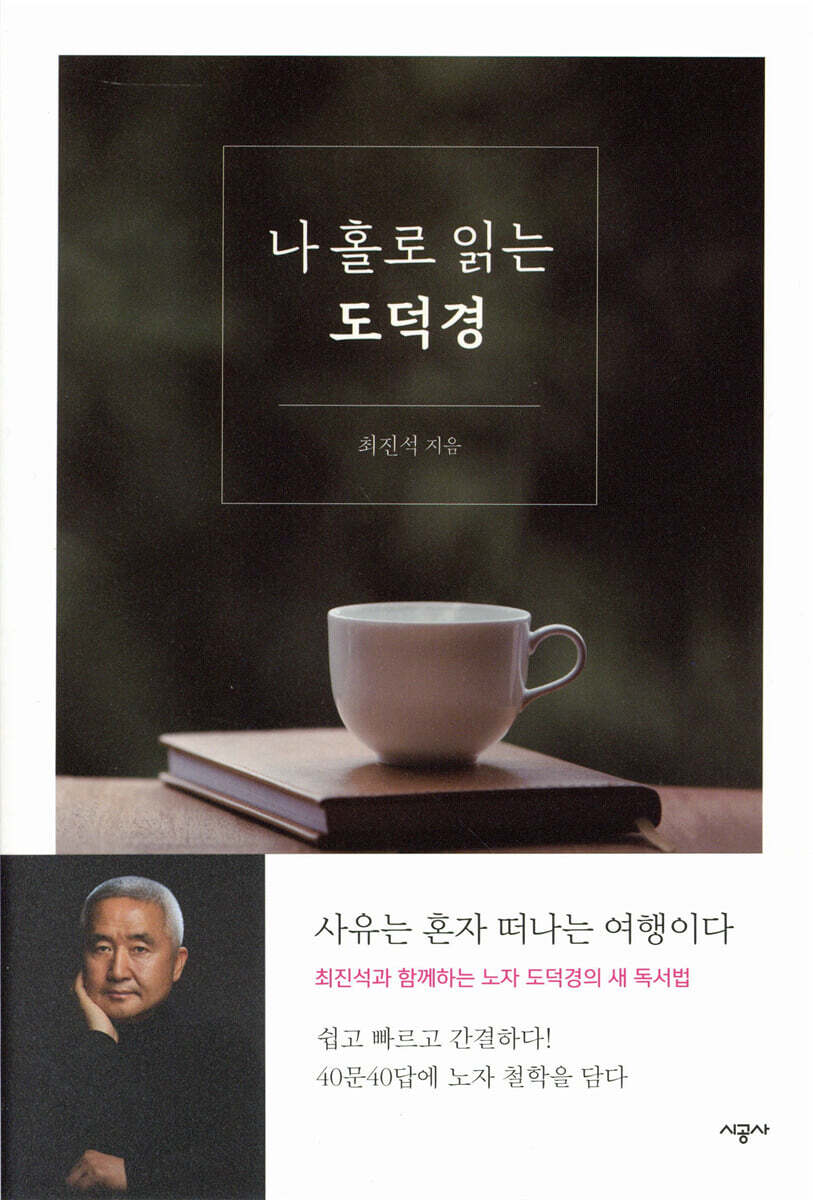
The Tao Te Ching I Read Alone
 |
Description
Book Introduction
Five thousand characters of wisdom that have shone for 2,500 years
How will I read today?
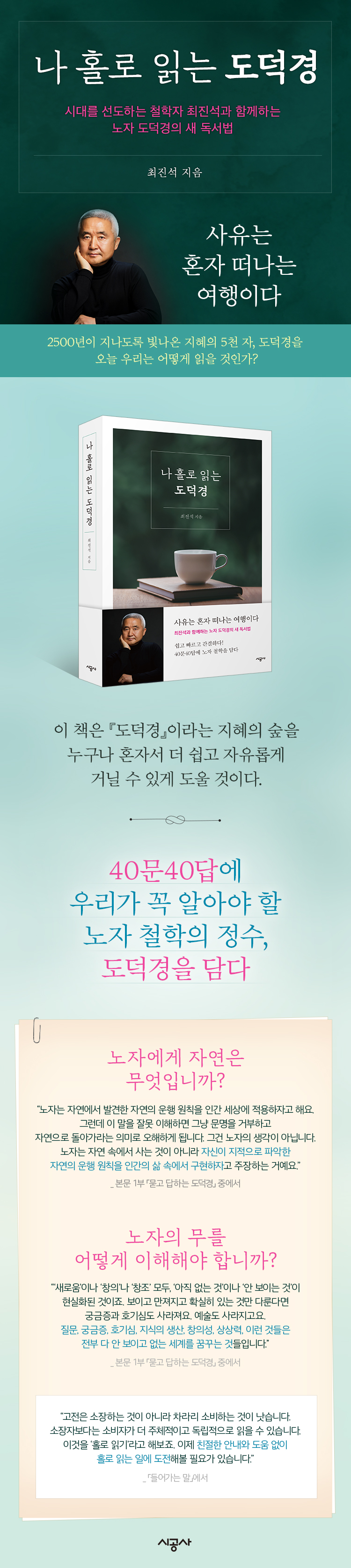
The new book 『Reading the Tao Te Ching Alone』 by Choi Jin-seok, a leading philosopher who has expounded Taoist philosophy and humanistic insights through numerous lectures and writings for over 20 years, presents a new way to read 『Tao Te Ching』, the essence of Lao-tzu's philosophy.
It is to read the 5,000 characters of wisdom called the Tao Te Ching, which has been a classic for over 2,500 years, alone, using only the original text and translation, without any commentary.
This can be said to be a reading of the Tao Te Ching that directly incorporates the attitude of standing as the true master of one's own thoughts, which Choi Jin-seok has emphasized.
"Reading the Tao Te Ching Alone" began with the meeting between Jinseok Choi and a reader studying the Tao Te Ching.
He collected the numerous questions and answers about the Tao Te Ching that he shared with this reader, along with the curiosities many people have had about the Tao Te Ching and the core points of the Tao Te Ching that he himself considers important. Using this content as a compass, he organized it into 40 questions and 40 answers so that anyone can challenge themselves to 'read it alone.'
The first part of 『Reading the Tao Te Ching Alone』, ‘Questions and Answers to the Tao Te Ching’, corresponds to these 40 questions and 40 answers, and the second part, ‘Reading the Tao Te Ching Alone’, consists only of the original text of the Tao Te Ching and Choi Jin-seok’s translation without any commentary.
In particular, the 40 Questions and 40 Answers are organized in oral form, allowing for reading as if you were having a direct conversation with Jinseok Choi.
Additionally, the 81 chapters that make up the Tao Te Ching are titled so that they can be read like 81 poems rather than as verses from scripture.
"Reading the Tao Te Ching Alone" will help anyone wander more easily and freely through the forest of wisdom that is the Tao Te Ching.
You can follow the table of contents and read the 40 questions and 40 answers in Part 1 first and then move on to the 『Tao Te Ching』 in Part 2, but you can also bravely read the 『Tao Te Ching』 first and then move on to the dialogue of the 40 questions and 40 answers.
For those who have found reading the scriptures difficult, it will make the Tao Te Ching more accessible, and for those already familiar with Lao-tzu's philosophy, it will provide an opportunity to read the Tao Te Ching in a more creative and challenging way.
No matter which path or step you take, the reader is the master of reading.
『Reading the Tao Te Ching Alone』 will allow you to experience how Lao Tzu's 『Tao Te Ching』 becomes a classic of wisdom that shines even brighter through such independent reading.
Even the most highly regarded classics don't need to be objects of worship.
It may be hard not to worship it, but somehow you must use it only as fuel to grow yourself.
Classics are better consumed than collected.
Consumers can read more independently and proactively than owners.
Let's call this 'reading alone'.
Now it's time to try reading on your own, without any friendly guidance or help. _From "Introduction"
How will I read today?
The new book 『Reading the Tao Te Ching Alone』 by Choi Jin-seok, a leading philosopher who has expounded Taoist philosophy and humanistic insights through numerous lectures and writings for over 20 years, presents a new way to read 『Tao Te Ching』, the essence of Lao-tzu's philosophy.
It is to read the 5,000 characters of wisdom called the Tao Te Ching, which has been a classic for over 2,500 years, alone, using only the original text and translation, without any commentary.
This can be said to be a reading of the Tao Te Ching that directly incorporates the attitude of standing as the true master of one's own thoughts, which Choi Jin-seok has emphasized.
"Reading the Tao Te Ching Alone" began with the meeting between Jinseok Choi and a reader studying the Tao Te Ching.
He collected the numerous questions and answers about the Tao Te Ching that he shared with this reader, along with the curiosities many people have had about the Tao Te Ching and the core points of the Tao Te Ching that he himself considers important. Using this content as a compass, he organized it into 40 questions and 40 answers so that anyone can challenge themselves to 'read it alone.'
The first part of 『Reading the Tao Te Ching Alone』, ‘Questions and Answers to the Tao Te Ching’, corresponds to these 40 questions and 40 answers, and the second part, ‘Reading the Tao Te Ching Alone’, consists only of the original text of the Tao Te Ching and Choi Jin-seok’s translation without any commentary.
In particular, the 40 Questions and 40 Answers are organized in oral form, allowing for reading as if you were having a direct conversation with Jinseok Choi.
Additionally, the 81 chapters that make up the Tao Te Ching are titled so that they can be read like 81 poems rather than as verses from scripture.
"Reading the Tao Te Ching Alone" will help anyone wander more easily and freely through the forest of wisdom that is the Tao Te Ching.
You can follow the table of contents and read the 40 questions and 40 answers in Part 1 first and then move on to the 『Tao Te Ching』 in Part 2, but you can also bravely read the 『Tao Te Ching』 first and then move on to the dialogue of the 40 questions and 40 answers.
For those who have found reading the scriptures difficult, it will make the Tao Te Ching more accessible, and for those already familiar with Lao-tzu's philosophy, it will provide an opportunity to read the Tao Te Ching in a more creative and challenging way.
No matter which path or step you take, the reader is the master of reading.
『Reading the Tao Te Ching Alone』 will allow you to experience how Lao Tzu's 『Tao Te Ching』 becomes a classic of wisdom that shines even brighter through such independent reading.
Even the most highly regarded classics don't need to be objects of worship.
It may be hard not to worship it, but somehow you must use it only as fuel to grow yourself.
Classics are better consumed than collected.
Consumers can read more independently and proactively than owners.
Let's call this 'reading alone'.
Now it's time to try reading on your own, without any friendly guidance or help. _From "Introduction"
- You can preview some of the book's contents.
Preview
index
Introductory remarks 9
Part 1: The Tao Te Ching: Questions and Answers
Before reading the Tao Te Ching
Who is Lao Tzu and what is the Tao Te Ching?
What kind of era was the Spring and Autumn Period and Warring States Period when Laozi lived?
What was Eastern philosophy like before Lao-tzu?
What is the difference between thought and philosophy?
Why are there multiple editions of the Tao Te Ching?
How do the thoughts of Lao-tzu and Confucius differ?
How did Lao Tzu and Confucius view humanity?
How does Lao Tzu express himself?
What is the relationship between Lao-tzu's thought and Legalist thought?
What are the characteristics of Do-gyeong and Deok-gyeong?
What is the significance of the emergence of virtue?
Into the Tao Te Ching
Why do you deny naming?
How should we understand Lao Tzu's nothingness?
How should we understand Lao Tzu's relational thinking?
What is nature to Lao Tzu?
What is femininity in Lao-tzu's thought?
What properties does water have in Lao-tzu's thought?
What is for the stomach and not the eyes?
What does the body mean to Lao Tzu?
What is the difference between poetry and poetry, and between poetry and poetry?
What does guest mean?
How should I understand the name?
How can we find true knowledge?
Is bending natural?
How should we understand oppositions like good and evil?
How should we understand the term "anti-vagina"?
What does it mean that if you want to take, you have to give?
What does a ruler of a country need?
What does it mean to throw that away and take this?
What is the difference between chronic and chronic waiting?
How are the states of inaction and newborn infants connected?
What does it mean to make the people honest?
What does it mean to follow the contract, not the record?
How should we understand what it means to make the country small?
The Present and Future of the Tao Te Ching
What kind of guide can the Tao Te Ching serve in modern society?
Could Lao Tzu's philosophy be an alternative to overcoming anthropocentrism?
What about the deconstructive aspect of Lao-tzu's thought?
Why have you been talking about Lao Tzu all this time?
What path should young people of this era find?
What should philosophy and literature of our time look like?
Part 2: Reading the Tao Te Ching Alone
Chapter 1: The Door to All Things
Chapter 2: Letting each other live
Chapter 3: The Governance of Inaction
Chapter 4: Empty but Endless
Chapter 5: Like a full moon
Chapter 6: Subtle Motherhood
Chapter 7: The Reason for Longevity
Chapter 8: The Virtue of Water
Chapter 9: The Moment to Step Back
Chapter 10: The Attitude of Ignorance
Chapter 11: The Function of Nothingness
Chapter 12 Not for the Eyes
Chapter 13 Like My Body
Chapter 14: The Appearance of Nothing
Chapter 15 Like a Guest
Chapter 16: The Long-Lasting Road
Chapter 17: The People and the Ruler
Chapter 18: When the Great Way is Broken
If you break Chapter 19 or more
Chapter 20: Alone and Foolish
Chapter 21: The Yellow and the Hallowed
Chapter 22: When you bend, you become whole.
Chapter 23: Natural Things
Chapter 24: When You Reveal Yourself
Chapter 25: Without Sound or Form
Chapter 26: The Heavy and Stable
Chapter 27: The Teacher and the Mirror
Chapter 28: Return
Chapter 29 As You Wish
Chapter 30 Stopping There
Chapter 31: War and Weapons
Chapter 32 Always Nameless
Chapter 33: He Who Knows Himself
Chapter 34: The Breadth of the Great Way
Chapter 35: The Way of a Peaceful World
Chapter 36: Soft and Weak
Chapter 37: The Silence of Desire
Chapter 38: What to Throw Away and What to Take
Chapter 39 Get One
Chapter 40: Being and Nothingness
Chapter 41: Hidden and Revealed
Chapter 42: The sound of the sheep
Chapter 43: The Benefits of Inaction
Chapter 44: What Matters?
Chapter 45 What is well done
Chapter 46: Knowing Contentment
Chapter 47 Without Seeing
Chapter 48: Less and Less Again
Chapter 49: The Mind of an Adult
Chapter 50: The Way of Living and the Way of Dying
Chapter 51: Help and Virtue
Chapter 52: The Truth of This World
Chapter 53: The Great Road and the Steep Path
Chapter 54: Well-Planted
Chapter 55: Knowing Harmony
Chapter 56 Those who know
Chapter 57: How to Govern a Country
Chapter 58 What is decided
Chapter 59: Only to Save
Chapter 60: Like Grilling a Small Fish
Chapter 61: Humbling Yourself
Chapter 62: What All Things Depend on
Chapter 63: Difficult Things and Easy Things
Chapter 64: How Not to Lose
Chapter 65: Wisdom and Honesty
Chapter 66 If you want to stand on top
Chapter 67: The Great Treasure
Chapter 68: The Virtue of Not Fighting
Chapter 69: The absence of enemies
Chapter 70: You Don't Understand
Chapter 71: The Illness of an Unknown Person
Chapter 72 If you don't make it difficult
Chapter 73: Courage and Hesitation
Chapter 74: Governing Death
Chapter 75: If you do the above
Chapter 76: The Strong and the Weak
Chapter 77: The Way of Nature and the Way of Man
Chapter 78: Speaking to the Front
Chapter 79 Contracts and Conduct
Chapter 80: If the country is made small
Chapter 81: Even if you give everything, you still have something
Part 1: The Tao Te Ching: Questions and Answers
Before reading the Tao Te Ching
Who is Lao Tzu and what is the Tao Te Ching?
What kind of era was the Spring and Autumn Period and Warring States Period when Laozi lived?
What was Eastern philosophy like before Lao-tzu?
What is the difference between thought and philosophy?
Why are there multiple editions of the Tao Te Ching?
How do the thoughts of Lao-tzu and Confucius differ?
How did Lao Tzu and Confucius view humanity?
How does Lao Tzu express himself?
What is the relationship between Lao-tzu's thought and Legalist thought?
What are the characteristics of Do-gyeong and Deok-gyeong?
What is the significance of the emergence of virtue?
Into the Tao Te Ching
Why do you deny naming?
How should we understand Lao Tzu's nothingness?
How should we understand Lao Tzu's relational thinking?
What is nature to Lao Tzu?
What is femininity in Lao-tzu's thought?
What properties does water have in Lao-tzu's thought?
What is for the stomach and not the eyes?
What does the body mean to Lao Tzu?
What is the difference between poetry and poetry, and between poetry and poetry?
What does guest mean?
How should I understand the name?
How can we find true knowledge?
Is bending natural?
How should we understand oppositions like good and evil?
How should we understand the term "anti-vagina"?
What does it mean that if you want to take, you have to give?
What does a ruler of a country need?
What does it mean to throw that away and take this?
What is the difference between chronic and chronic waiting?
How are the states of inaction and newborn infants connected?
What does it mean to make the people honest?
What does it mean to follow the contract, not the record?
How should we understand what it means to make the country small?
The Present and Future of the Tao Te Ching
What kind of guide can the Tao Te Ching serve in modern society?
Could Lao Tzu's philosophy be an alternative to overcoming anthropocentrism?
What about the deconstructive aspect of Lao-tzu's thought?
Why have you been talking about Lao Tzu all this time?
What path should young people of this era find?
What should philosophy and literature of our time look like?
Part 2: Reading the Tao Te Ching Alone
Chapter 1: The Door to All Things
Chapter 2: Letting each other live
Chapter 3: The Governance of Inaction
Chapter 4: Empty but Endless
Chapter 5: Like a full moon
Chapter 6: Subtle Motherhood
Chapter 7: The Reason for Longevity
Chapter 8: The Virtue of Water
Chapter 9: The Moment to Step Back
Chapter 10: The Attitude of Ignorance
Chapter 11: The Function of Nothingness
Chapter 12 Not for the Eyes
Chapter 13 Like My Body
Chapter 14: The Appearance of Nothing
Chapter 15 Like a Guest
Chapter 16: The Long-Lasting Road
Chapter 17: The People and the Ruler
Chapter 18: When the Great Way is Broken
If you break Chapter 19 or more
Chapter 20: Alone and Foolish
Chapter 21: The Yellow and the Hallowed
Chapter 22: When you bend, you become whole.
Chapter 23: Natural Things
Chapter 24: When You Reveal Yourself
Chapter 25: Without Sound or Form
Chapter 26: The Heavy and Stable
Chapter 27: The Teacher and the Mirror
Chapter 28: Return
Chapter 29 As You Wish
Chapter 30 Stopping There
Chapter 31: War and Weapons
Chapter 32 Always Nameless
Chapter 33: He Who Knows Himself
Chapter 34: The Breadth of the Great Way
Chapter 35: The Way of a Peaceful World
Chapter 36: Soft and Weak
Chapter 37: The Silence of Desire
Chapter 38: What to Throw Away and What to Take
Chapter 39 Get One
Chapter 40: Being and Nothingness
Chapter 41: Hidden and Revealed
Chapter 42: The sound of the sheep
Chapter 43: The Benefits of Inaction
Chapter 44: What Matters?
Chapter 45 What is well done
Chapter 46: Knowing Contentment
Chapter 47 Without Seeing
Chapter 48: Less and Less Again
Chapter 49: The Mind of an Adult
Chapter 50: The Way of Living and the Way of Dying
Chapter 51: Help and Virtue
Chapter 52: The Truth of This World
Chapter 53: The Great Road and the Steep Path
Chapter 54: Well-Planted
Chapter 55: Knowing Harmony
Chapter 56 Those who know
Chapter 57: How to Govern a Country
Chapter 58 What is decided
Chapter 59: Only to Save
Chapter 60: Like Grilling a Small Fish
Chapter 61: Humbling Yourself
Chapter 62: What All Things Depend on
Chapter 63: Difficult Things and Easy Things
Chapter 64: How Not to Lose
Chapter 65: Wisdom and Honesty
Chapter 66 If you want to stand on top
Chapter 67: The Great Treasure
Chapter 68: The Virtue of Not Fighting
Chapter 69: The absence of enemies
Chapter 70: You Don't Understand
Chapter 71: The Illness of an Unknown Person
Chapter 72 If you don't make it difficult
Chapter 73: Courage and Hesitation
Chapter 74: Governing Death
Chapter 75: If you do the above
Chapter 76: The Strong and the Weak
Chapter 77: The Way of Nature and the Way of Man
Chapter 78: Speaking to the Front
Chapter 79 Contracts and Conduct
Chapter 80: If the country is made small
Chapter 81: Even if you give everything, you still have something
Detailed image
Into the book
History, in which humans take responsibility and lead, begins only when they turn away from God.
To say that philosophy began is to say that we passed from the age of belief to the age of thought.
It is a story about moving from an era where God was the master to an era where humans wanted to become the masters.
Human history begins with the ability to think.
The most advanced form of this ability is philosophy.
With the advent of philosophy, human history continues to move in the direction of diminishing the role and status of God and strengthening the role and status of humans.
---From "What is the meaning of the appearance of virtue?"
When we look at answers and questions, it is the question, not the answer, that is closer to the activity of virtue.
Answers are a functional activity that takes in existing theories and knowledge and spits them out again when someone asks for them, but questions are the power that comes from being yourself, that is, the curiosity and wonder that burst out.
It is close to virtue because it is a power that exists only within oneself and enables one to act.
It's important to remember that almost everything new and great in this world came about as a result of a question.
There is very little that comes out of the answer.
---From "What is the meaning of the appearance of virtue?"
Humans must learn to deal with the 'non-existent' and the 'invisible'.
‘Newness’, ‘creativity’, and ‘creation’ are all things that ‘do not yet exist’ or ‘are not visible’ made real.
If we only deal with things that are visible, tangible, and certain, it is difficult to produce new theories and we cannot have an attitude that pursues new things.
If that happens, curiosity and wonder will disappear.
Art is also disappearing.
Questions, wonder, curiosity, the production of knowledge, creativity, imagination—these are all dreams of an invisible and nonexistent world.
---From "How should we understand Lao Tzu's nothingness?"
Lao Tzu suggests that we apply the principles of nature that he discovered in nature to the human world.
However, if you misunderstand this, you may misunderstand it to mean that you should simply reject civilization and return to nature.
That's not Lao Tzu's idea.
Lao Tzu argued that rather than living in nature, we should implement the principles of nature that he had intellectually grasped in human life.
Because we do not have a clear understanding of this part, we misunderstand Lao-tzu's thought as anti-civilization, and mistake a life that denies civilization itself for a life of great enlightenment.
The statement that Lao Tzu pursues nature and rejects civilization is the result of a misunderstanding of Lao Tzu.
---From "What is nature to Lao Tzu?"
Water in Lao Tzu's eyes does not compete.
This is the characteristic of water that does not fight.
Because they don't compete, they choose to take a completely different path than the one no one else takes, rather than trying to fit into the existing system.
So, instead of being in a place that others have already taken, you end up in a place that still seems strange and awkward to others.
It's not a place where anyone rushes in to take over first.
It is in these strange places that no one rushes to occupy, that the seeds of innovation grow secretly.
The spirit of creation does not begin in a place that everyone knows, but in a strange place that is still hidden and secret.
Water has the power to reach those strange places.
---From “What are the characteristics of water in Lao-tzu’s thought?”
Confucius said that we must define 'us' and incorporate 'me's' into it, so 'me's' must become 'me's' that fit the ideology of 'us', and Lao-tzu said that we pursue a 'us' that 'me's' create autonomously, so some people say lightly that Confucius affirms 'us' and Lao-tzu denies 'us'.
This is a big mistake.
We just have different perspectives on 'us'.
It's similar to the misunderstanding that Confucius affirmed civilization and Laozi denied it.
Both Laozi and Confucius affirmed civilization.
It's not that they denied civilization, they just tried to build different civilizations.
---From "What does the body mean to Lao Tzu?"
The phrase 'doing nothing and doing nothing' really encapsulates Lao Tzu's philosophy.
Doesn't this mean, "Do nothing, and everything will go well"? Lao Tzu's gaze is focused on "do nothing" rather than "doing nothing."
But people usually don't look at 'no-action', they only look at 'no-action'.
It's as if we're stubbornly trying to see Lao Tzu as a thinker who emphasized retreat, giving, and bending over getting ahead, having, and becoming whole.
Lao Tzu was not someone who did not want to do work, but someone who wanted to do work well.
To send an arrow far forward, you have to pull the bowstring back.
These two movements are a set of movements for shooting a bow well.
Lao Tzu was not a thinker who tried to shoot his bow haphazardly, but a thinker who tried to shoot accurately.
---From "Does bending follow nature?"
The saying '名可名非常名' means that the truth of the world cannot be contained by using concepts without margins or gaps.
Isn't the world about dividing space between us and allowing for gaps? It's about the coexistence of the ubiquitous and the non-ubiquitous.
[…] the poet rearranges language, shifts its position, and leaves gaps and spaces between concepts.
Let's plant sound between those gaps and spaces.
The gaps and spaces left between languages give elasticity to concepts that have been given sound, allowing truths that are not yet revealed or not yet there to emerge.
[…] How much more moving are things like cooperation and inclusion than exclusion and division? And how much new paths can they create? These are all emotions born from the margins and gaps.
---From "What Does a National Ruler Need?"
When playing golf, the most important thing is to keep your eyes on the ball until the very end and not look up.
Lifting your head means you're trying to see where your ball is going before it even hits the club.
Everyone shows this kind of foolishness.
But if you suppress your desire to see how far the ball will fly and just focus on the club hitting the ball, you will hit the ball more accurately and it will go farther.
If you try to look at where the ball is going before the club even hits the ball, you will never hit the ball properly.
Moreover, the moment you decide to hit the ball far away or hit it hard to send it far away, your whole body becomes tense and it doesn't go well.
The basic principle of exercise is to release strength.
That is inaction.
That is why Lao Tzu says that if you practice inaction, there is nothing that cannot be achieved.
Or you could just engrave it that everything will be fine as long as you do nothing.
---From "What does it mean to throw that away and take this?"
We usually see children as not yet adults.
Adults are an ideal state to be reached, and children are still lacking and insufficient adults, so they must strive to become adults.
Looking at it this way, children are destined to always live in a state of lack.
You just have to strive to become an adult.
As a child, you can never be happy.
How can a child who has never experienced happiness develop self-esteem, confidence, or pride as an adult? Without confidence and self-esteem, there can be no creativity or questioning.
You will become good at just following and answering.
We must return the happiness of children to children.
A child is not yet an adult, he is just a child.
The happiness of childhood is a goal in itself for a child.
---From "How are the states of inaction and newborn babies connected?"
What Laozi ultimately tried to dismantle was all structure.
That is, it dismantles essentialism.
In my view, the deconstructive nature of Lao-tzu's thought, that is, its relational nature, is an important factor in demonstrating its modernity.
If Lao-tzu's thought has a much older origin than Confucius's and exhibits relational characteristics, I wonder if the prototype of our civilization might have had a much more relational aspect.
So I see Lao Tzu as a modern philosopher.
It is the needs of society that call for ideas.
I believe that we are summoning Laozi now because we, living in the 21st century, can benefit from his thought and find something worth referencing.
---From "What is the deconstructive aspect of Lao-tzu's thought?"
If the Tao can be spoken, it is not the true Tao.
If a name can be conceptualized, it is not a true name.
Mu points to the beginning of this world
Oil is a general term for all things.
Always with nothing
To show the mysterious realm of the world,
Always have milk
It is intended to indicate a specific visible area.
These two appear together but have different names.
It is said that being together is mysterious.
It's so mysterious and mystical.
This is the door through which all things pass.
To say that philosophy began is to say that we passed from the age of belief to the age of thought.
It is a story about moving from an era where God was the master to an era where humans wanted to become the masters.
Human history begins with the ability to think.
The most advanced form of this ability is philosophy.
With the advent of philosophy, human history continues to move in the direction of diminishing the role and status of God and strengthening the role and status of humans.
---From "What is the meaning of the appearance of virtue?"
When we look at answers and questions, it is the question, not the answer, that is closer to the activity of virtue.
Answers are a functional activity that takes in existing theories and knowledge and spits them out again when someone asks for them, but questions are the power that comes from being yourself, that is, the curiosity and wonder that burst out.
It is close to virtue because it is a power that exists only within oneself and enables one to act.
It's important to remember that almost everything new and great in this world came about as a result of a question.
There is very little that comes out of the answer.
---From "What is the meaning of the appearance of virtue?"
Humans must learn to deal with the 'non-existent' and the 'invisible'.
‘Newness’, ‘creativity’, and ‘creation’ are all things that ‘do not yet exist’ or ‘are not visible’ made real.
If we only deal with things that are visible, tangible, and certain, it is difficult to produce new theories and we cannot have an attitude that pursues new things.
If that happens, curiosity and wonder will disappear.
Art is also disappearing.
Questions, wonder, curiosity, the production of knowledge, creativity, imagination—these are all dreams of an invisible and nonexistent world.
---From "How should we understand Lao Tzu's nothingness?"
Lao Tzu suggests that we apply the principles of nature that he discovered in nature to the human world.
However, if you misunderstand this, you may misunderstand it to mean that you should simply reject civilization and return to nature.
That's not Lao Tzu's idea.
Lao Tzu argued that rather than living in nature, we should implement the principles of nature that he had intellectually grasped in human life.
Because we do not have a clear understanding of this part, we misunderstand Lao-tzu's thought as anti-civilization, and mistake a life that denies civilization itself for a life of great enlightenment.
The statement that Lao Tzu pursues nature and rejects civilization is the result of a misunderstanding of Lao Tzu.
---From "What is nature to Lao Tzu?"
Water in Lao Tzu's eyes does not compete.
This is the characteristic of water that does not fight.
Because they don't compete, they choose to take a completely different path than the one no one else takes, rather than trying to fit into the existing system.
So, instead of being in a place that others have already taken, you end up in a place that still seems strange and awkward to others.
It's not a place where anyone rushes in to take over first.
It is in these strange places that no one rushes to occupy, that the seeds of innovation grow secretly.
The spirit of creation does not begin in a place that everyone knows, but in a strange place that is still hidden and secret.
Water has the power to reach those strange places.
---From “What are the characteristics of water in Lao-tzu’s thought?”
Confucius said that we must define 'us' and incorporate 'me's' into it, so 'me's' must become 'me's' that fit the ideology of 'us', and Lao-tzu said that we pursue a 'us' that 'me's' create autonomously, so some people say lightly that Confucius affirms 'us' and Lao-tzu denies 'us'.
This is a big mistake.
We just have different perspectives on 'us'.
It's similar to the misunderstanding that Confucius affirmed civilization and Laozi denied it.
Both Laozi and Confucius affirmed civilization.
It's not that they denied civilization, they just tried to build different civilizations.
---From "What does the body mean to Lao Tzu?"
The phrase 'doing nothing and doing nothing' really encapsulates Lao Tzu's philosophy.
Doesn't this mean, "Do nothing, and everything will go well"? Lao Tzu's gaze is focused on "do nothing" rather than "doing nothing."
But people usually don't look at 'no-action', they only look at 'no-action'.
It's as if we're stubbornly trying to see Lao Tzu as a thinker who emphasized retreat, giving, and bending over getting ahead, having, and becoming whole.
Lao Tzu was not someone who did not want to do work, but someone who wanted to do work well.
To send an arrow far forward, you have to pull the bowstring back.
These two movements are a set of movements for shooting a bow well.
Lao Tzu was not a thinker who tried to shoot his bow haphazardly, but a thinker who tried to shoot accurately.
---From "Does bending follow nature?"
The saying '名可名非常名' means that the truth of the world cannot be contained by using concepts without margins or gaps.
Isn't the world about dividing space between us and allowing for gaps? It's about the coexistence of the ubiquitous and the non-ubiquitous.
[…] the poet rearranges language, shifts its position, and leaves gaps and spaces between concepts.
Let's plant sound between those gaps and spaces.
The gaps and spaces left between languages give elasticity to concepts that have been given sound, allowing truths that are not yet revealed or not yet there to emerge.
[…] How much more moving are things like cooperation and inclusion than exclusion and division? And how much new paths can they create? These are all emotions born from the margins and gaps.
---From "What Does a National Ruler Need?"
When playing golf, the most important thing is to keep your eyes on the ball until the very end and not look up.
Lifting your head means you're trying to see where your ball is going before it even hits the club.
Everyone shows this kind of foolishness.
But if you suppress your desire to see how far the ball will fly and just focus on the club hitting the ball, you will hit the ball more accurately and it will go farther.
If you try to look at where the ball is going before the club even hits the ball, you will never hit the ball properly.
Moreover, the moment you decide to hit the ball far away or hit it hard to send it far away, your whole body becomes tense and it doesn't go well.
The basic principle of exercise is to release strength.
That is inaction.
That is why Lao Tzu says that if you practice inaction, there is nothing that cannot be achieved.
Or you could just engrave it that everything will be fine as long as you do nothing.
---From "What does it mean to throw that away and take this?"
We usually see children as not yet adults.
Adults are an ideal state to be reached, and children are still lacking and insufficient adults, so they must strive to become adults.
Looking at it this way, children are destined to always live in a state of lack.
You just have to strive to become an adult.
As a child, you can never be happy.
How can a child who has never experienced happiness develop self-esteem, confidence, or pride as an adult? Without confidence and self-esteem, there can be no creativity or questioning.
You will become good at just following and answering.
We must return the happiness of children to children.
A child is not yet an adult, he is just a child.
The happiness of childhood is a goal in itself for a child.
---From "How are the states of inaction and newborn babies connected?"
What Laozi ultimately tried to dismantle was all structure.
That is, it dismantles essentialism.
In my view, the deconstructive nature of Lao-tzu's thought, that is, its relational nature, is an important factor in demonstrating its modernity.
If Lao-tzu's thought has a much older origin than Confucius's and exhibits relational characteristics, I wonder if the prototype of our civilization might have had a much more relational aspect.
So I see Lao Tzu as a modern philosopher.
It is the needs of society that call for ideas.
I believe that we are summoning Laozi now because we, living in the 21st century, can benefit from his thought and find something worth referencing.
---From "What is the deconstructive aspect of Lao-tzu's thought?"
If the Tao can be spoken, it is not the true Tao.
If a name can be conceptualized, it is not a true name.
Mu points to the beginning of this world
Oil is a general term for all things.
Always with nothing
To show the mysterious realm of the world,
Always have milk
It is intended to indicate a specific visible area.
These two appear together but have different names.
It is said that being together is mysterious.
It's so mysterious and mystical.
This is the door through which all things pass.
---From the full translation of "Chapter 1: The Door to All Things"
Publisher's Review
“Philosophy is a product of its time.”
Lao Tzu and Confucius lived in an era of radical class change brought about by the introduction of iron into industry, and they were people who took a step back from such changes and closely observed the times in which they lived.
According to Choi Jin-seok, it is desirable to interpret the passages appearing in the Tao Te Ching within the context of the time in which they were created.
It is necessary to organically examine the specific soil in which the philosophy was born and the process through which it was later sublimated into a theoretical system.
However, Jinseok Choi cautions that many people simply bring in a universally sublimated and systematized pale philosophy and try to apply it to their own specific reality, and emphasizes that it is important to form a universal philosophy in the specific soil where one currently resides.
Philosophy, as an existing universal theoretical system, should not be an object of worship, but should serve as fuel for producing a philosophical perspective in my specific life.
He says that those who read the Tao Te Ching should approach it with the attitude of borrowing Lao Tzu's thoughts to train their wisdom muscles and expand their thinking, rather than trying to solve and explain all their problems with the Tao Te Ching.
It is more important to grow yourself bigger and stronger than the Tao Te Ching than to follow the Tao Te Ching.
Whether it's philosophy or literature, the form it presents is important, but more importantly, the philosopher or writer must uniquely answer the following questions within the specific era in which they lived.
"Who were you in your time?", "What did you see? What problems did you find there, and what discomfort did you feel?", "What did you do to resolve those discomforts and problems?", "Who exactly are you?"—I believe that philosophy and literature should respond at a high level to these questions. _From "What Should Philosophy and Literature of Our Time Look Like?" (pp. 181-182)
“You must dream your own dreams, not someone else’s.”
Why We Need Lao Tzu's Poetry Now
Jinseok Choi says that the highest level of virtue a human being can possess is to dream and run recklessly toward that dream.
Dreams and ideals are not the same.
Here, ideal refers to something like ideology, such as moralism, socialism, or capitalism.
If you define your life by capitalism, you will end up living a life that cannot go beyond capitalism even one step.
But life is much more complex and expansive than capitalism or socialism.
Only by letting go of these things that limit and regulate our vast and complex lives can we become beings who dream.
Lao Tzu tells us through the Tao Te Ching not to pursue some distant collective ideal, but to pursue our own desires, and not to be a practitioner of a set ideology, but to be a dreamer of our own dreams.
In today's hyper-connected society, where the pace of change is accelerating in almost every field, including politics, economics, education, and culture, it is more important than ever to dream your own dreams without being swept away by external waves.
This is why we must now read Lao Tzu's Tao Te Ching more independently and freely.
Anbinnakdo is an extremely positive word.
It means, do not be discouraged by your poverty, but stand tall and proud on the heights of virtue.
No matter how poor you are, as long as you are at the height of 'Tao', you can never be discouraged.
It is a very luxurious belief that allows you to affirm yourself and enjoy life.
If you pursue your ideals, you will only be someone who carries out what the group has decided. Only by pursuing yourself can you become a truly independent and free person, and that is where great achievements come from. This is what is meant by the phrase "Geupichwicha."
It means to see yourself through your own eyes, not through the eyes of others. _From "What does it mean to give up that and take this?" (pp. 138-139)
Lao Tzu and Confucius lived in an era of radical class change brought about by the introduction of iron into industry, and they were people who took a step back from such changes and closely observed the times in which they lived.
According to Choi Jin-seok, it is desirable to interpret the passages appearing in the Tao Te Ching within the context of the time in which they were created.
It is necessary to organically examine the specific soil in which the philosophy was born and the process through which it was later sublimated into a theoretical system.
However, Jinseok Choi cautions that many people simply bring in a universally sublimated and systematized pale philosophy and try to apply it to their own specific reality, and emphasizes that it is important to form a universal philosophy in the specific soil where one currently resides.
Philosophy, as an existing universal theoretical system, should not be an object of worship, but should serve as fuel for producing a philosophical perspective in my specific life.
He says that those who read the Tao Te Ching should approach it with the attitude of borrowing Lao Tzu's thoughts to train their wisdom muscles and expand their thinking, rather than trying to solve and explain all their problems with the Tao Te Ching.
It is more important to grow yourself bigger and stronger than the Tao Te Ching than to follow the Tao Te Ching.
Whether it's philosophy or literature, the form it presents is important, but more importantly, the philosopher or writer must uniquely answer the following questions within the specific era in which they lived.
"Who were you in your time?", "What did you see? What problems did you find there, and what discomfort did you feel?", "What did you do to resolve those discomforts and problems?", "Who exactly are you?"—I believe that philosophy and literature should respond at a high level to these questions. _From "What Should Philosophy and Literature of Our Time Look Like?" (pp. 181-182)
“You must dream your own dreams, not someone else’s.”
Why We Need Lao Tzu's Poetry Now
Jinseok Choi says that the highest level of virtue a human being can possess is to dream and run recklessly toward that dream.
Dreams and ideals are not the same.
Here, ideal refers to something like ideology, such as moralism, socialism, or capitalism.
If you define your life by capitalism, you will end up living a life that cannot go beyond capitalism even one step.
But life is much more complex and expansive than capitalism or socialism.
Only by letting go of these things that limit and regulate our vast and complex lives can we become beings who dream.
Lao Tzu tells us through the Tao Te Ching not to pursue some distant collective ideal, but to pursue our own desires, and not to be a practitioner of a set ideology, but to be a dreamer of our own dreams.
In today's hyper-connected society, where the pace of change is accelerating in almost every field, including politics, economics, education, and culture, it is more important than ever to dream your own dreams without being swept away by external waves.
This is why we must now read Lao Tzu's Tao Te Ching more independently and freely.
Anbinnakdo is an extremely positive word.
It means, do not be discouraged by your poverty, but stand tall and proud on the heights of virtue.
No matter how poor you are, as long as you are at the height of 'Tao', you can never be discouraged.
It is a very luxurious belief that allows you to affirm yourself and enjoy life.
If you pursue your ideals, you will only be someone who carries out what the group has decided. Only by pursuing yourself can you become a truly independent and free person, and that is where great achievements come from. This is what is meant by the phrase "Geupichwicha."
It means to see yourself through your own eyes, not through the eyes of others. _From "What does it mean to give up that and take this?" (pp. 138-139)
GOODS SPECIFICS
- Publication date: March 31, 2021
- Page count, weight, size: 376 pages | 572g | 140*210*30mm
- ISBN13: 9791165795054
- ISBN10: 1165795051
You may also like
카테고리
korean


korean

![GQ KOREA Mark (Monthly): December [2025]](http://librairie.coreenne.fr/cdn/shop/files/8ef265dbbfbf186523ed75ba7319009d.jpg?v=1765340328&width=3840)


