

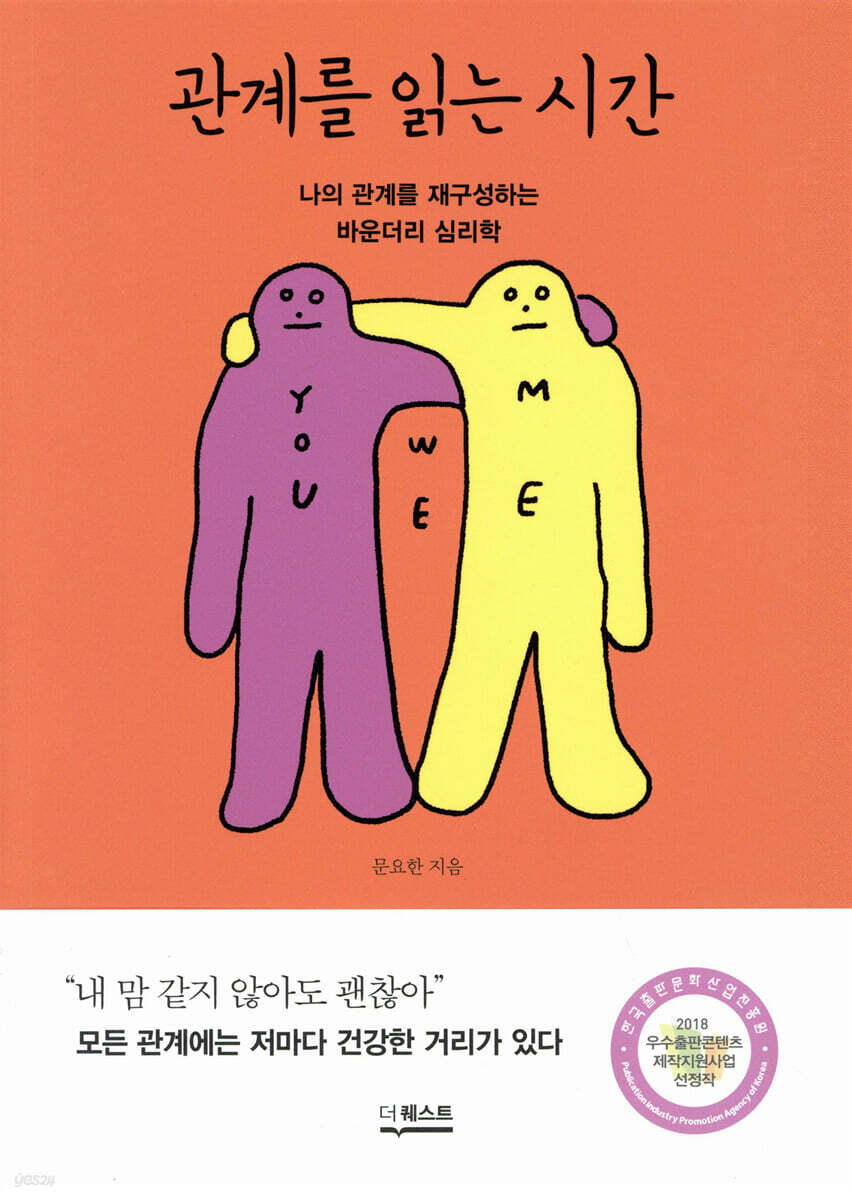
Time to read the relationship
 |
Description
Book Introduction
If your relationship as an adult continues to be difficult
Let's start by looking at the 'framework of relationships'.
People always have a hard time with interpersonal relationships and lament, “It’s not what I want.”
Psychiatrist Moon Yo-han, who has consistently worked with the theme of “growing life,” advises us to face the fact that “the nature of human relationships is that when you get close to someone, you can hurt them even if you didn’t intend to.”
It may be natural that things don't go my way, but this is different from the empty consolation of 'It'll be hard, so just stay the same.'
Rather, it is a psychology of 'change' that accepts inevitable differences as they are, restores a 'healthy distance' in each relationship, and lives as one's own.
In 『Time to Read Relationships』, we focus on the ‘framework of relationships’ as the starting point of change.
Everyone unconsciously repeats the same relationship patterns, and unless we understand and change them, the suffering we experience in relationships will continue to repeat itself.
So how can we understand and change our relationship framework? That journey begins with the concept of "boundary."
Let's start by looking at the 'framework of relationships'.
People always have a hard time with interpersonal relationships and lament, “It’s not what I want.”
Psychiatrist Moon Yo-han, who has consistently worked with the theme of “growing life,” advises us to face the fact that “the nature of human relationships is that when you get close to someone, you can hurt them even if you didn’t intend to.”
It may be natural that things don't go my way, but this is different from the empty consolation of 'It'll be hard, so just stay the same.'
Rather, it is a psychology of 'change' that accepts inevitable differences as they are, restores a 'healthy distance' in each relationship, and lives as one's own.
In 『Time to Read Relationships』, we focus on the ‘framework of relationships’ as the starting point of change.
Everyone unconsciously repeats the same relationship patterns, and unless we understand and change them, the suffering we experience in relationships will continue to repeat itself.
So how can we understand and change our relationship framework? That journey begins with the concept of "boundary."
- You can preview some of the book's contents.
Preview
index
Prologue / From Child Relationships to Adult Relationships
Part 1.
The problem is boundaries
How is your relationship?
Chapter 1.
It's not hard because you're kind
Being kind always comes at a loss? Immature kindness and mature kindness · Why that woman is overly kind · Not being kind, but being 'weak'
Chapter 2.
Why do people close to us hurt more?
Many people receive, but no one gives. 'Wounds' · When boundaries become ambiguous: Possessiveness in relationships · When you desire the impossible: The catastrophe brought about by lack
Chapter 3.
The manipulator and the manipulated
When Connection Becomes a Chain: Emotional Chains · Common Emotional Chains · Emotional Manipulators and Emotionally Manipulated · Who Gets Manipulated?
Chapter 4.
But what is a boundary?
What do boundaries do? When boundaries are disrupted: blurred, rigid, or unbalanced. The tragedy of unbalanced boundaries: Echo and Narcissus.
Chapter 5.
How are boundaries created?
The Psychology of Self-Emergence · Attachment Damage Distorts Self-Development · So Is It All Your Parents' Fault? · 'Repairing' Attachment Is Much More Important · Further Considerations: Culture and Boundaries
Part 2.
Distorted boundaries:
Compliant · Caring · Defensive · Dominant
Why would that person relate in that way?
Chapter 6.
If there is a problem with the boundary
Human Development · Trauma in Children: Traumatic Developmental Disorders · Psychological Prematurity and Psychological Postmaturity · Boundary Crossers and Boundary Guarders · Dysfunctional Relationship Frameworks Due to Boundary Abnormalities
Chapter 7.
I hate being uncomfortable with someone: conformist
Why do we have to be so attuned to others? · Separation anxiety that hasn't been resolved yet · Problems that conformists face in interpersonal relationships
Chapter 8.
I'm happy when you're happy: Caring type
People who feel like they have to take care of someone to survive · A bundle of over-responsibility · Problems that caregivers face in interpersonal relationships
Chapter 9.
Don't pay attention to me: defensive
You are you, I am me, deep-rooted distrust, defensiveness are the problems encountered in interpersonal relationships.
Chapter 10.
People who only care about themselves: Dominant
Human relationships stained by dominance and exploitation · The 'shame' hidden behind anger · The problems that dominance types face in interpersonal relationships
Part 3.
Conditions for a happy relationship
Five Things You Need to Have Healthy Boundaries
Chapter 11.
Relationship management: the ability to control the depth of relationships
Health encompasses both aspects of life, the ability to question and think actively, differentiation of schemas, and basic trust.
Chapter 12.
Mutual Respect: Apart and Together
What is most important in human relationships? · The ability to get along without demanding conformity · Going beyond mechanical symmetry
Chapter 13.
A Mind That Reads Hearts: My Heart and Your Heart
The Secret to Secure Attachment · Why Didn't I Tell You I Was Having a Hard Time? · Everyone Has a "Circle of Empathy" · The Problem of Empathy Based on Boundaries · Sharing Inner Experiences
Chapter 14.
Conflict Resilience: Recovery is More Important Than Avoidance
How to Deal with Conflict · Conflict resilience is more important than avoiding conflict.
Chapter 15.
Honest Self-Expression: Letting Go of Exaggerated Fears
What's there to fear from being a little more honest? · When your feelings and your expressions are infinitely out of sync · Gentle honesty versus rough honesty
Part 4.
Reconstruction of boundaries
How to Re-establish Boundaries and Live 'My Way'
Chapter 16.
Understanding the History of Relationships
Our first relationship governs our relationships · Understanding the 'history of relationships' that repeats itself to me · What will I understand?
Chapter 17.
Attachment Damage Healing Practice
Can relationships change? · Distinguishing between past and present relationships · Do you want to escape the hurt? · The ability to comfort yourself
Chapter 18.
PACE: Self-expression training to establish boundaries
Step 1.
Pause_Practice of pausing and postponing automatic responses · Step 2.
Awareness_Awareness of my emotions, desires, and responsibilities · Step 3.
Control_Adjust your reactions according to the situation and the other person · Step 4.
Self-Expression_Honestly but Politely
Chapter 19.
Practice saying 'no'
You have the power to decide · Request training: I can ask and you can refuse · Expressing refusal: It's not you I'm rejecting, it's your request · Rejection training by boundary type · If you need to end the relationship: How to calmly express your displeasure
Chapter 20.
Creating Your Own World
Have I been present in my life so far? · What is needed to create a healthy self-world? · What is my 'Otium', the power to create my own joy?
Epilogue / Boundaries Transcend Boundaries
Part 1.
The problem is boundaries
How is your relationship?
Chapter 1.
It's not hard because you're kind
Being kind always comes at a loss? Immature kindness and mature kindness · Why that woman is overly kind · Not being kind, but being 'weak'
Chapter 2.
Why do people close to us hurt more?
Many people receive, but no one gives. 'Wounds' · When boundaries become ambiguous: Possessiveness in relationships · When you desire the impossible: The catastrophe brought about by lack
Chapter 3.
The manipulator and the manipulated
When Connection Becomes a Chain: Emotional Chains · Common Emotional Chains · Emotional Manipulators and Emotionally Manipulated · Who Gets Manipulated?
Chapter 4.
But what is a boundary?
What do boundaries do? When boundaries are disrupted: blurred, rigid, or unbalanced. The tragedy of unbalanced boundaries: Echo and Narcissus.
Chapter 5.
How are boundaries created?
The Psychology of Self-Emergence · Attachment Damage Distorts Self-Development · So Is It All Your Parents' Fault? · 'Repairing' Attachment Is Much More Important · Further Considerations: Culture and Boundaries
Part 2.
Distorted boundaries:
Compliant · Caring · Defensive · Dominant
Why would that person relate in that way?
Chapter 6.
If there is a problem with the boundary
Human Development · Trauma in Children: Traumatic Developmental Disorders · Psychological Prematurity and Psychological Postmaturity · Boundary Crossers and Boundary Guarders · Dysfunctional Relationship Frameworks Due to Boundary Abnormalities
Chapter 7.
I hate being uncomfortable with someone: conformist
Why do we have to be so attuned to others? · Separation anxiety that hasn't been resolved yet · Problems that conformists face in interpersonal relationships
Chapter 8.
I'm happy when you're happy: Caring type
People who feel like they have to take care of someone to survive · A bundle of over-responsibility · Problems that caregivers face in interpersonal relationships
Chapter 9.
Don't pay attention to me: defensive
You are you, I am me, deep-rooted distrust, defensiveness are the problems encountered in interpersonal relationships.
Chapter 10.
People who only care about themselves: Dominant
Human relationships stained by dominance and exploitation · The 'shame' hidden behind anger · The problems that dominance types face in interpersonal relationships
Part 3.
Conditions for a happy relationship
Five Things You Need to Have Healthy Boundaries
Chapter 11.
Relationship management: the ability to control the depth of relationships
Health encompasses both aspects of life, the ability to question and think actively, differentiation of schemas, and basic trust.
Chapter 12.
Mutual Respect: Apart and Together
What is most important in human relationships? · The ability to get along without demanding conformity · Going beyond mechanical symmetry
Chapter 13.
A Mind That Reads Hearts: My Heart and Your Heart
The Secret to Secure Attachment · Why Didn't I Tell You I Was Having a Hard Time? · Everyone Has a "Circle of Empathy" · The Problem of Empathy Based on Boundaries · Sharing Inner Experiences
Chapter 14.
Conflict Resilience: Recovery is More Important Than Avoidance
How to Deal with Conflict · Conflict resilience is more important than avoiding conflict.
Chapter 15.
Honest Self-Expression: Letting Go of Exaggerated Fears
What's there to fear from being a little more honest? · When your feelings and your expressions are infinitely out of sync · Gentle honesty versus rough honesty
Part 4.
Reconstruction of boundaries
How to Re-establish Boundaries and Live 'My Way'
Chapter 16.
Understanding the History of Relationships
Our first relationship governs our relationships · Understanding the 'history of relationships' that repeats itself to me · What will I understand?
Chapter 17.
Attachment Damage Healing Practice
Can relationships change? · Distinguishing between past and present relationships · Do you want to escape the hurt? · The ability to comfort yourself
Chapter 18.
PACE: Self-expression training to establish boundaries
Step 1.
Pause_Practice of pausing and postponing automatic responses · Step 2.
Awareness_Awareness of my emotions, desires, and responsibilities · Step 3.
Control_Adjust your reactions according to the situation and the other person · Step 4.
Self-Expression_Honestly but Politely
Chapter 19.
Practice saying 'no'
You have the power to decide · Request training: I can ask and you can refuse · Expressing refusal: It's not you I'm rejecting, it's your request · Rejection training by boundary type · If you need to end the relationship: How to calmly express your displeasure
Chapter 20.
Creating Your Own World
Have I been present in my life so far? · What is needed to create a healthy self-world? · What is my 'Otium', the power to create my own joy?
Epilogue / Boundaries Transcend Boundaries
Detailed image
Into the book
Why is that? It's because of the 'framework of relationships.'
Just like a bread pan that continuously bakes bread of a certain shape, human relationships have a mold.
Because of this framework, we repeat similar patterns of relationship even when we meet different people.
The problem is that the basic framework was created in childhood.
This basic framework was created from the 'child-adult' relationship, so it does not fit the 'adult-adult' relationship.
As we become adults, we must change the 'child-adult' relationship framework to an 'adult-adult' relationship framework.
_prolog
Even if the relationship framework that helped us survive in childhood is applied to adult relationships, it can cause many problems.
(…) Therefore, if your interpersonal relationships as an adult continue to be difficult, you must definitely examine the framework of your relationships.
This is because we are unknowingly forming relationships today based on the relationships we had as children.
Therefore, the relationship difficulties you are experiencing are not something that can be solved by changing the other person.
Unless you understand your relationship style and change your past relationship style, the problem will repeat itself.
_prolog
But they have one thing in common.
The problem is that the boundaries that separate you and me are confusing and we cannot form horizontal relationships.
In other words, their relationship is one-sided and out of balance with the ego.
Why can't they form healthy relationships? Why do they lose their sense of self-worth in relationships? It's because the boundaries that regulate that balance aren't well developed.
Now we need to really understand how boundaries are created and how they function.
_Chapter 4.
But what is the boundary?
I recently discovered something disappointing in some psychology books on human relationships.
There was a concern that readers might interpret and accept it incorrectly because it focused on one issue without striking a balance between protection and communication.
For example, people with blurred boundaries need to focus more on themselves and strengthen their boundaries.
However, when these people read books that emphasize empathy or attachment, they are more likely to reinforce their own problems.
Conversely, people who are too rigid in their boundaries and cannot empathize with others and are stubborn about their opinions need to be able to respect others and think from their perspectives.
When they read books that emphasize rejection or self-assertion, they may rationalize or exacerbate their problems.
To avoid these side effects, you must first know your relationship type.
_Chapter 4.
But what is a boundary?
Ironically, humans need 'appropriate attachment damage'.
(Although it is not possible) the absence of any attachment damage can be just as problematic as the severity of the attachment damage.
'Frustration of appropriate attachment needs' gives us the independence to navigate the world, becomes the foundation for building reciprocal relationships by moving beyond egocentrism, and provides us with the perspective to see and integrate the good and bad sides of others.
Frustration is an important element of development.
_Chapter 5.
How are boundaries created?
To summarize simply, when there is an abnormality in ego development due to damaged attachment, the ego becomes undifferentiated or overdifferentiated.
The undifferentiated type is preoccupied with relationships, while the hyperdifferentiated type is preoccupied with self.
Likewise, people who have problems with their relationships due to attachment damage are divided into 'boundary crossers' and 'boundary guarders'.
Boundary Crossers constantly invade the opponent's territory without their consent, while Boundary Guarders are constantly on guard against the opponent's approach.
_Chapter 6.
If there is a problem with the boundary
Dysfunctional relationship frameworks are not fixed.
Just because you're experiencing the same difficulties in your relationships over and over again doesn't mean you always fall into one of these four types.
Depending on who you are relating to, your dysfunctional relationship framework can vary.
For example, a person who is dominant in their relationship with their spouse may be compliant in their relationship with a coworker.
Therefore, it is not a matter of choosing one of the four types, but rather of understanding them in relation to each other.
Also, even in relationships with one person, it can change over time, and even within the same time period, any number of secondary types can appear alongside the primary type.
_Chapter 6.
If there is a problem with the boundary
A more serious problem than being bad at refusing or asserting yourself is the fact that you 'don't know' your own thoughts, feelings, preferences, and tastes.
It doesn't mean that you don't have your own thoughts, feelings, preferences, or tastes.
However, in many cases, it is not one's own but rather an imitation of someone around them.
Because the boundaries are blurred.
_Chapter 7.
I hate being uncomfortable with someone - conformist
Why on earth is that? The caregiver type doesn't want the other person to be the problem solver or achieve happiness on their own.
What matters to them is that their help reduces the other person's suffering and makes them feel better.
In other words, they do not help others stand on their own, but rather help them rely on themselves.
So, ironically, the more you help, the more likely it is that the problem will get worse.
_Chapter 8.
I'm happy when you're happy - caring type
In the hyperdifferentiated type, where the self and object are often separated, a reversal of the relational schema often occurs, and in the undifferentiated type, where the self and object are not separated, a fixation of the relational schema often appears.
For example, let's say that in a romantic relationship, your partner was treating you well, but then at some point, he or she did something you didn't like.
The hyperdifferentiated type initially thinks the other person is a very good person, but then suddenly changes their evaluation and attitude toward the other person when they discover something disappointing.
Even if the other person does ten things well, if they fail at one thing, the nine things they have done well disappear, and because of that one thing, they suddenly become a bad person, a terrible person, an untrustworthy person.
_Chapter 11.
Relationship management: the ability to control the depth of relationships
A mind that understands the heart is similar to empathy, but goes beyond empathy.
If empathy is understanding the other person's feelings and pain, then understanding the other person's heart goes further and involves paying attention to and understanding the other person's entire mind, including their interests, desires, thoughts, talents, happiness, and future.
They ask those close to them:
“When are you happy?” “What are you interested in these days?” “What makes me feel good?” “Where and what do you want to do when you retire?” If someone were interested in your interests, happiness, future, etc. and asked you about them, how would you feel about them? _Chapter 13.
A Mind That Reads Hearts: My Heart and Your Heart
Herbert Fensterheim, an expert in assertiveness training, said, “The degree to which you can express yourself determines the degree of your self-esteem.”
The surprising thing is that the better you express yourself, the more others will like you.
So, you don't have to worry about losing much by expressing yourself.
It's true.
And the best part is that you get to live your own life.
Self-expression is not limited to mere rejections or requests, but extends to finding and expressing the fundamental needs of one's life.
What will you choose? _Chapter 18.
PACE: Self-expression training to establish boundaries
The rejection method should vary depending on the boundary type.
Compliance begins with recognizing that the power to refuse is yours.
Because compliance is ingrained in them, they seek permission even to refuse.
It's to check whether it's okay to refuse.
Even when they are proselytized on the street or receive phone calls soliciting them to sign up for financial products, they listen to the other person's story for a long time.
Because I feel sorry about the rejection itself.
But the other person is someone who is used to such rejection.
The compliant type needs to express their refusal more clearly.
There is no need to go into detail about the reasons.
You need to train yourself to simply say, “I’m not interested,” or to clearly state, “I’m busy, so I’ll hang up first.”
_Chapter 19.
Practice saying 'no'
So what exactly does self-understanding mean? What does it mean to live "truly"? There are many areas, but the most important is understanding your desires, talents, and values.
One more thing to add is self-critical thinking, which questions what you think you know.
'Desire' is what you like and what you dislike, 'talent' is what you are good at and what you are not good at, and 'value' is what is important to you and what is not important.
_Chapter 20.
Creating Your Own World
Just like a bread pan that continuously bakes bread of a certain shape, human relationships have a mold.
Because of this framework, we repeat similar patterns of relationship even when we meet different people.
The problem is that the basic framework was created in childhood.
This basic framework was created from the 'child-adult' relationship, so it does not fit the 'adult-adult' relationship.
As we become adults, we must change the 'child-adult' relationship framework to an 'adult-adult' relationship framework.
_prolog
Even if the relationship framework that helped us survive in childhood is applied to adult relationships, it can cause many problems.
(…) Therefore, if your interpersonal relationships as an adult continue to be difficult, you must definitely examine the framework of your relationships.
This is because we are unknowingly forming relationships today based on the relationships we had as children.
Therefore, the relationship difficulties you are experiencing are not something that can be solved by changing the other person.
Unless you understand your relationship style and change your past relationship style, the problem will repeat itself.
_prolog
But they have one thing in common.
The problem is that the boundaries that separate you and me are confusing and we cannot form horizontal relationships.
In other words, their relationship is one-sided and out of balance with the ego.
Why can't they form healthy relationships? Why do they lose their sense of self-worth in relationships? It's because the boundaries that regulate that balance aren't well developed.
Now we need to really understand how boundaries are created and how they function.
_Chapter 4.
But what is the boundary?
I recently discovered something disappointing in some psychology books on human relationships.
There was a concern that readers might interpret and accept it incorrectly because it focused on one issue without striking a balance between protection and communication.
For example, people with blurred boundaries need to focus more on themselves and strengthen their boundaries.
However, when these people read books that emphasize empathy or attachment, they are more likely to reinforce their own problems.
Conversely, people who are too rigid in their boundaries and cannot empathize with others and are stubborn about their opinions need to be able to respect others and think from their perspectives.
When they read books that emphasize rejection or self-assertion, they may rationalize or exacerbate their problems.
To avoid these side effects, you must first know your relationship type.
_Chapter 4.
But what is a boundary?
Ironically, humans need 'appropriate attachment damage'.
(Although it is not possible) the absence of any attachment damage can be just as problematic as the severity of the attachment damage.
'Frustration of appropriate attachment needs' gives us the independence to navigate the world, becomes the foundation for building reciprocal relationships by moving beyond egocentrism, and provides us with the perspective to see and integrate the good and bad sides of others.
Frustration is an important element of development.
_Chapter 5.
How are boundaries created?
To summarize simply, when there is an abnormality in ego development due to damaged attachment, the ego becomes undifferentiated or overdifferentiated.
The undifferentiated type is preoccupied with relationships, while the hyperdifferentiated type is preoccupied with self.
Likewise, people who have problems with their relationships due to attachment damage are divided into 'boundary crossers' and 'boundary guarders'.
Boundary Crossers constantly invade the opponent's territory without their consent, while Boundary Guarders are constantly on guard against the opponent's approach.
_Chapter 6.
If there is a problem with the boundary
Dysfunctional relationship frameworks are not fixed.
Just because you're experiencing the same difficulties in your relationships over and over again doesn't mean you always fall into one of these four types.
Depending on who you are relating to, your dysfunctional relationship framework can vary.
For example, a person who is dominant in their relationship with their spouse may be compliant in their relationship with a coworker.
Therefore, it is not a matter of choosing one of the four types, but rather of understanding them in relation to each other.
Also, even in relationships with one person, it can change over time, and even within the same time period, any number of secondary types can appear alongside the primary type.
_Chapter 6.
If there is a problem with the boundary
A more serious problem than being bad at refusing or asserting yourself is the fact that you 'don't know' your own thoughts, feelings, preferences, and tastes.
It doesn't mean that you don't have your own thoughts, feelings, preferences, or tastes.
However, in many cases, it is not one's own but rather an imitation of someone around them.
Because the boundaries are blurred.
_Chapter 7.
I hate being uncomfortable with someone - conformist
Why on earth is that? The caregiver type doesn't want the other person to be the problem solver or achieve happiness on their own.
What matters to them is that their help reduces the other person's suffering and makes them feel better.
In other words, they do not help others stand on their own, but rather help them rely on themselves.
So, ironically, the more you help, the more likely it is that the problem will get worse.
_Chapter 8.
I'm happy when you're happy - caring type
In the hyperdifferentiated type, where the self and object are often separated, a reversal of the relational schema often occurs, and in the undifferentiated type, where the self and object are not separated, a fixation of the relational schema often appears.
For example, let's say that in a romantic relationship, your partner was treating you well, but then at some point, he or she did something you didn't like.
The hyperdifferentiated type initially thinks the other person is a very good person, but then suddenly changes their evaluation and attitude toward the other person when they discover something disappointing.
Even if the other person does ten things well, if they fail at one thing, the nine things they have done well disappear, and because of that one thing, they suddenly become a bad person, a terrible person, an untrustworthy person.
_Chapter 11.
Relationship management: the ability to control the depth of relationships
A mind that understands the heart is similar to empathy, but goes beyond empathy.
If empathy is understanding the other person's feelings and pain, then understanding the other person's heart goes further and involves paying attention to and understanding the other person's entire mind, including their interests, desires, thoughts, talents, happiness, and future.
They ask those close to them:
“When are you happy?” “What are you interested in these days?” “What makes me feel good?” “Where and what do you want to do when you retire?” If someone were interested in your interests, happiness, future, etc. and asked you about them, how would you feel about them? _Chapter 13.
A Mind That Reads Hearts: My Heart and Your Heart
Herbert Fensterheim, an expert in assertiveness training, said, “The degree to which you can express yourself determines the degree of your self-esteem.”
The surprising thing is that the better you express yourself, the more others will like you.
So, you don't have to worry about losing much by expressing yourself.
It's true.
And the best part is that you get to live your own life.
Self-expression is not limited to mere rejections or requests, but extends to finding and expressing the fundamental needs of one's life.
What will you choose? _Chapter 18.
PACE: Self-expression training to establish boundaries
The rejection method should vary depending on the boundary type.
Compliance begins with recognizing that the power to refuse is yours.
Because compliance is ingrained in them, they seek permission even to refuse.
It's to check whether it's okay to refuse.
Even when they are proselytized on the street or receive phone calls soliciting them to sign up for financial products, they listen to the other person's story for a long time.
Because I feel sorry about the rejection itself.
But the other person is someone who is used to such rejection.
The compliant type needs to express their refusal more clearly.
There is no need to go into detail about the reasons.
You need to train yourself to simply say, “I’m not interested,” or to clearly state, “I’m busy, so I’ll hang up first.”
_Chapter 19.
Practice saying 'no'
So what exactly does self-understanding mean? What does it mean to live "truly"? There are many areas, but the most important is understanding your desires, talents, and values.
One more thing to add is self-critical thinking, which questions what you think you know.
'Desire' is what you like and what you dislike, 'talent' is what you are good at and what you are not good at, and 'value' is what is important to you and what is not important.
_Chapter 20.
Creating Your Own World
--- From the text
Publisher's Review
Boundaries: The starting point for regaining self-determination in relationships
The stories of those who visit the counseling room are stained with various wounds and pain.
People who complain that they live 'good' lives and always get hurt, but in reality, they have a faint ego and cannot let go of their unfulfilled expectations; people who resent that they have done everything for the relationship, but when you get to know them, they constantly want what they cannot and pressure the other person; people who are bound by emotional chains created by fear, excessive responsibility, and guilt, and cannot escape the relationship of manipulating and being manipulated... ...These problems may seem diverse, but they all start from the same starting point.
That is, the ‘boundary’ was not established healthily, and as a result, the ‘self’ and ‘relationships’ lost their balance.
Boundaries are formed through the process of 'individuation' in which a person is born and interacts with caregivers during childhood.
One of the important things that plays a role in the process of forming healthy boundaries is ‘attachment’.
Recently, the concept of 'attachment' has been appearing with considerable weight in psychology and parenting books, which often leads to the misunderstanding that 'stable attachment means avoiding attachment damage.'
But it is much more important to 'repair' attachment than to not damage it.
Breaking free from the myth of 'secure attachment' is the first step toward restructuring the framework of relationships and creating healthy ones.
Why on earth would that person relate to something like that?
The distorted relationship framework: compliant, caring, controlling, and defensive.
A boundary is a boundary of the self that distinguishes between 'me' and 'not me' in human relationships, and it is also a passage through which relationship exchanges occur.
The true nature of the self is revealed not when one is alone, but in relationships, in the form of boundaries.
As such, distorted boundaries inevitably lead to dysfunctional relationships.
There are two main types of problems that arise with boundaries.
Mainly, due to attachment damage, 1) problems arise in self-development, or 2) distortions occur in interpersonal relationships.
Four dysfunctional relational frameworks emerge: compliant, caring, dominating, and defensive, based on two variables: distortion of ego development (underdifferentiation, overdifferentiation) and distortion of relationship exchange (inhibited, disinhibited).
Part 2 of this book specifically describes the psychological and emotional characteristics of people of each type, along with why they became that way and what problems they typically face in life.
Anyone who has ever struggled with a relationship will recognize one or more of these dysfunctional patterns within themselves.
It is very important to know your own relationship framework/relationship type.
(However, it should be kept in mind that this relationship framework is not fixed and can change depending on who you are in a relationship with and over time, and that secondary types can appear alongside the main type in a relationship.) To break the distorted relationship framework and regain healthy relationships and your own world, you must start by re-establishing 'boundaries'.
Boundaries, can they be rebuilt healthily?
Reconstructing boundaries to live 'my way'
Healthy boundaries are by no means an abstract expression.
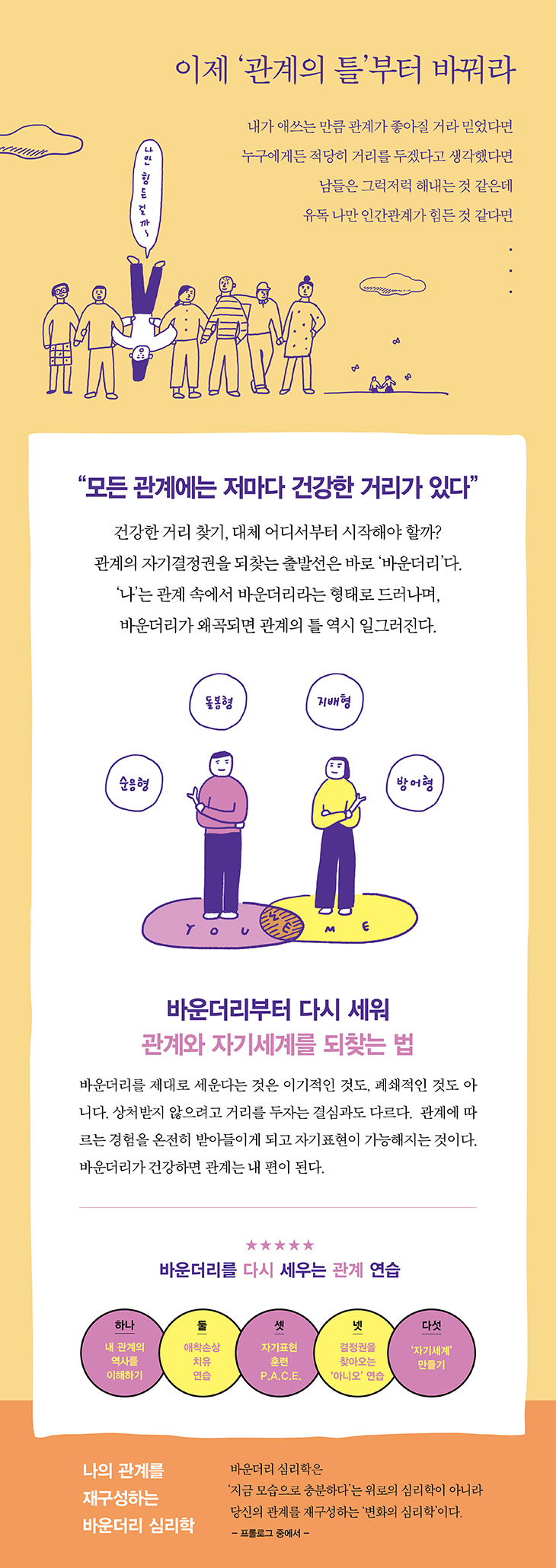
Part 3 of this book presents five competencies that form the "relationship resources" area that concretely demonstrate healthy boundaries: relationship regulation, mutual respect, empathy, conflict resilience, and honest self-expression.
In "Time to Read Relationships," we suggest the following "relationship exercises" that we can personally practice to develop these capabilities and re-establish healthy boundaries.
★ Relationship Practice to Re-establish Boundaries ★
one.
First, understand the history of my relationship.
two.
Recovery is more important than damage avoidance.
Attachment Damage Healing Practice
Third, establish boundaries with PACE, a self-expression training program.
Fourth, practice saying "no" to gain decision-making power, starting with small things.
Five, I have to be there to have a relationship.
Creating a 'personal world'
The subtitle of this book is 'The Psychology of Boundaries that Reconstructs My Relationships'.
Restructuring my relationship framework to address the challenges I constantly face in relationships is, in a word, about restoring my "right to self-determination" in relationships.
So in any relationship, “take care of yourself while getting to know the other person, respect the other person to live as they are just as you want to live as yourself, know how to resolve conflicts rather than avoid them, and be mindful of the other person while saying no to what you don’t want and being specific about what you do want.”
Setting proper boundaries is neither selfish nor closed-minded.
It's different from the current trend of always keeping your distance to avoid getting hurt.
When boundaries are healthy, relationships are on my side.
When we can fully embrace the experiences that come with relationships and restore relationships that allow for self-expression, we can enjoy truly healthy and happy relationships.
The stories of those who visit the counseling room are stained with various wounds and pain.
People who complain that they live 'good' lives and always get hurt, but in reality, they have a faint ego and cannot let go of their unfulfilled expectations; people who resent that they have done everything for the relationship, but when you get to know them, they constantly want what they cannot and pressure the other person; people who are bound by emotional chains created by fear, excessive responsibility, and guilt, and cannot escape the relationship of manipulating and being manipulated... ...These problems may seem diverse, but they all start from the same starting point.
That is, the ‘boundary’ was not established healthily, and as a result, the ‘self’ and ‘relationships’ lost their balance.
Boundaries are formed through the process of 'individuation' in which a person is born and interacts with caregivers during childhood.
One of the important things that plays a role in the process of forming healthy boundaries is ‘attachment’.
Recently, the concept of 'attachment' has been appearing with considerable weight in psychology and parenting books, which often leads to the misunderstanding that 'stable attachment means avoiding attachment damage.'
But it is much more important to 'repair' attachment than to not damage it.
Breaking free from the myth of 'secure attachment' is the first step toward restructuring the framework of relationships and creating healthy ones.
Why on earth would that person relate to something like that?
The distorted relationship framework: compliant, caring, controlling, and defensive.
A boundary is a boundary of the self that distinguishes between 'me' and 'not me' in human relationships, and it is also a passage through which relationship exchanges occur.
The true nature of the self is revealed not when one is alone, but in relationships, in the form of boundaries.
As such, distorted boundaries inevitably lead to dysfunctional relationships.
There are two main types of problems that arise with boundaries.
Mainly, due to attachment damage, 1) problems arise in self-development, or 2) distortions occur in interpersonal relationships.
Four dysfunctional relational frameworks emerge: compliant, caring, dominating, and defensive, based on two variables: distortion of ego development (underdifferentiation, overdifferentiation) and distortion of relationship exchange (inhibited, disinhibited).
Part 2 of this book specifically describes the psychological and emotional characteristics of people of each type, along with why they became that way and what problems they typically face in life.
Anyone who has ever struggled with a relationship will recognize one or more of these dysfunctional patterns within themselves.
It is very important to know your own relationship framework/relationship type.
(However, it should be kept in mind that this relationship framework is not fixed and can change depending on who you are in a relationship with and over time, and that secondary types can appear alongside the main type in a relationship.) To break the distorted relationship framework and regain healthy relationships and your own world, you must start by re-establishing 'boundaries'.
Boundaries, can they be rebuilt healthily?
Reconstructing boundaries to live 'my way'
Healthy boundaries are by no means an abstract expression.
Part 3 of this book presents five competencies that form the "relationship resources" area that concretely demonstrate healthy boundaries: relationship regulation, mutual respect, empathy, conflict resilience, and honest self-expression.
In "Time to Read Relationships," we suggest the following "relationship exercises" that we can personally practice to develop these capabilities and re-establish healthy boundaries.
★ Relationship Practice to Re-establish Boundaries ★
one.
First, understand the history of my relationship.
two.
Recovery is more important than damage avoidance.
Attachment Damage Healing Practice
Third, establish boundaries with PACE, a self-expression training program.
Fourth, practice saying "no" to gain decision-making power, starting with small things.
Five, I have to be there to have a relationship.
Creating a 'personal world'
The subtitle of this book is 'The Psychology of Boundaries that Reconstructs My Relationships'.
Restructuring my relationship framework to address the challenges I constantly face in relationships is, in a word, about restoring my "right to self-determination" in relationships.
So in any relationship, “take care of yourself while getting to know the other person, respect the other person to live as they are just as you want to live as yourself, know how to resolve conflicts rather than avoid them, and be mindful of the other person while saying no to what you don’t want and being specific about what you do want.”
Setting proper boundaries is neither selfish nor closed-minded.
It's different from the current trend of always keeping your distance to avoid getting hurt.
When boundaries are healthy, relationships are on my side.
When we can fully embrace the experiences that come with relationships and restore relationships that allow for self-expression, we can enjoy truly healthy and happy relationships.
GOODS SPECIFICS
- Date of publication: October 25, 2018
- Page count, weight, size: 320 pages | 536g | 148*210*30mm
- ISBN13: 9791160505801
- ISBN10: 1160505802
You may also like
카테고리
korean


korean

![GQ KOREA Mark (Monthly): December [2025]](http://librairie.coreenne.fr/cdn/shop/files/8ef265dbbfbf186523ed75ba7319009d.jpg?v=1765340328&width=3840)


