

Revolution of consciousness
 |
Description
Book Introduction
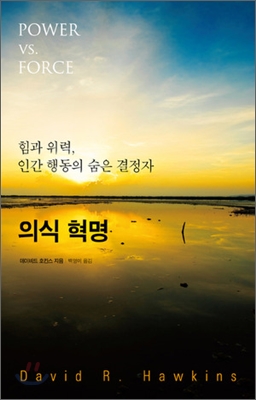
Translator Baek Young-mi presents a new translation of David Hawkins' first work, faithful to the original text, which was the founder of the 'Consciousness Map'.
Why are our lives mired in suffering?
Why do we always fail to make the right choices?
We have had no objective standard to distinguish between the negative and the positive, and spiritual truths have been ignored because they lack explanation.
The reason Dr. Hawkins' research is attracting attention is because it approaches and explains spiritual truths that have been ignored from a scientific perspective.
Dr. Hawkins noticed that when our body is exposed to a noxious stimulus, our muscles immediately weaken.
This simple test, which later evolved into the 'muscle test', made it clear that our bodies respond positively to things that support life and negatively to things that do not.
Over the course of 20 years, Dr. Hawkins conducted millions of tests on thousands of subjects from all walks of life, across all ages and personality types.
What emerged through this process was the 'Consciousness Map', which marked the beginning of a new paradigm of scientific understanding of spiritual truth.
In this book, Dr. Hawkins shows that the results we obtain in the social, cultural, and political spheres can differ depending on whether we follow the power represented by reason, spontaneity, love, joy, and peace, or the power expressed by apathy, fear, desire, anger, and sadness.
At the same time, he said that when we fail to distinguish between these two and act according to power, our lives inevitably attract negative energies, represented by violence, war, and death.
In other words, power and might are the hidden determinants that determine our actions.
About the author
I have been researching for a long time on the topic of spiritually evolved states and consciousness studies and awakening to the presence of God as the true Self.
He has been practicing psychiatry since 1952 and is a lifetime member of the American Psychiatric Association.
Orthomolecular Psychiatry, published in 1973 with Nobel laureate Linus Pauling, has become a monumental work that has inspired countless psychiatric researchers since then.
He has lectured at Harvard University, the Oxford Forum, and the University of California Medical School, and has appeared on numerous television programs, including The Barbara Walters Show.
He is currently engaged in a variety of lectures and writings aimed at recontextualizing the human experience from the perspective of the evolution of consciousness and integrating the understanding of mind and spirit, both as expressions of the immanent divinity that is the foundational and enduring source of life and existence.
Why are our lives mired in suffering?
Why do we always fail to make the right choices?
We have had no objective standard to distinguish between the negative and the positive, and spiritual truths have been ignored because they lack explanation.
The reason Dr. Hawkins' research is attracting attention is because it approaches and explains spiritual truths that have been ignored from a scientific perspective.
Dr. Hawkins noticed that when our body is exposed to a noxious stimulus, our muscles immediately weaken.
This simple test, which later evolved into the 'muscle test', made it clear that our bodies respond positively to things that support life and negatively to things that do not.
Over the course of 20 years, Dr. Hawkins conducted millions of tests on thousands of subjects from all walks of life, across all ages and personality types.
What emerged through this process was the 'Consciousness Map', which marked the beginning of a new paradigm of scientific understanding of spiritual truth.
In this book, Dr. Hawkins shows that the results we obtain in the social, cultural, and political spheres can differ depending on whether we follow the power represented by reason, spontaneity, love, joy, and peace, or the power expressed by apathy, fear, desire, anger, and sadness.
At the same time, he said that when we fail to distinguish between these two and act according to power, our lives inevitably attract negative energies, represented by violence, war, and death.
In other words, power and might are the hidden determinants that determine our actions.
About the author
I have been researching for a long time on the topic of spiritually evolved states and consciousness studies and awakening to the presence of God as the true Self.
He has been practicing psychiatry since 1952 and is a lifetime member of the American Psychiatric Association.
Orthomolecular Psychiatry, published in 1973 with Nobel laureate Linus Pauling, has become a monumental work that has inspired countless psychiatric researchers since then.
He has lectured at Harvard University, the Oxford Forum, and the University of California Medical School, and has appeared on numerous television programs, including The Barbara Walters Show.
He is currently engaged in a variety of lectures and writings aimed at recontextualizing the human experience from the perspective of the evolution of consciousness and integrating the understanding of mind and spirit, both as expressions of the immanent divinity that is the foundational and enduring source of life and existence.
- You can preview some of the book's contents.
Preview
index
Editor's Note
introduction
introduction
Part 1 _ Tools
Chapter 1: Critical Advances in Knowledge
Chapter 2: History and Methodology
Chapter 3 Test Results and Interpretation
Chapter 4 Levels of Human Consciousness
Chapter 5 Social Distribution of Levels of Consciousness
Chapter 6: New Horizons in Research
Chapter 7: Analysis of Everyday Critical Points
Chapter 8: The Source of Power
Part 2 - Power vs. Might
Chapter 9: Patterns of Power in Human Attitudes
Chapter 10 Power in Politics
Chapter 11 Power in the Market
Chapter 12: Strength and Sports
Chapter 13 Social Power and the Human Spirit
Chapter 14: Power in Art
Chapter 15: Genius and Creativity
Chapter 16: Surviving Success
Chapter 17 Physical Health and Strength
Chapter 18: The Process of Health and Disease
Part 3 _ Meaning
Chapter 19: The Database of Consciousness
Chapter 20: The Evolution of Consciousness
Chapter 21: Studies on Pure Consciousness
Chapter 22: Spiritual Struggle
Chapter 23: The Quest for Truth
Chapter 24 Conclusion
Part 4 _ Appendix
Appendix A: Chapter-by-Chapter Truth Level Measurement
Appendix B: Muscle Testing
Appendix C Glossary of Terms
Appendix D Notes
Appendix E References
Translator's Note
introduction
introduction
Part 1 _ Tools
Chapter 1: Critical Advances in Knowledge
Chapter 2: History and Methodology
Chapter 3 Test Results and Interpretation
Chapter 4 Levels of Human Consciousness
Chapter 5 Social Distribution of Levels of Consciousness
Chapter 6: New Horizons in Research
Chapter 7: Analysis of Everyday Critical Points
Chapter 8: The Source of Power
Part 2 - Power vs. Might
Chapter 9: Patterns of Power in Human Attitudes
Chapter 10 Power in Politics
Chapter 11 Power in the Market
Chapter 12: Strength and Sports
Chapter 13 Social Power and the Human Spirit
Chapter 14: Power in Art
Chapter 15: Genius and Creativity
Chapter 16: Surviving Success
Chapter 17 Physical Health and Strength
Chapter 18: The Process of Health and Disease
Part 3 _ Meaning
Chapter 19: The Database of Consciousness
Chapter 20: The Evolution of Consciousness
Chapter 21: Studies on Pure Consciousness
Chapter 22: Spiritual Struggle
Chapter 23: The Quest for Truth
Chapter 24 Conclusion
Part 4 _ Appendix
Appendix A: Chapter-by-Chapter Truth Level Measurement
Appendix B: Muscle Testing
Appendix C Glossary of Terms
Appendix D Notes
Appendix E References
Translator's Note
Publisher's Review
The first book by David Hawkins, the founder of 'Consciousness Mapping'
Meet the translation faithful to the original text
[The Revolution of Consciousness] (original title: Power vs.
Force, first edition 1995, revised edition 2002) was published by Panmidong.
Observing that many spiritual truths have been misunderstood for centuries due to a lack of explanation, Dr. Hawkins proposed the "Consciousness Map," a numerical index that quantifies human consciousness levels on a scale from 1 to 1,000.
[Consciousness Revolution], which contains the process of birth and significance of consciousness map based on the theory of 'kinesiology', is recognized for its value as the starting point of an innovative paradigm called 'scientification of consciousness research'.
Dr. Hawkins began his career with this book, [The Eye of I](2001), [Homo Spiritus I: Reality and Subjectivity](2003), and [Truth vs.
He has established himself as a world-renowned spiritual teacher by publishing books such as [Falshood](2005), [Discovery of the Presence of God](2006), and [Beyond the Levels of Consciousness](2006).
Panmidong plans to sequentially publish [My Eyes], which is called Dr. Hawkins' 'early trilogy' along with [Consciousness Revolution] and [Homo Spiritus], and [Healing and Recovery], the latest and most popular book published in 2009, through the first half of 2012.
Where does pain come from?
_ The birth of a new paradigm for measuring spiritual truth, the map of consciousness
Why are our lives mired in suffering?
Why do we always fail to make the right choices?
The reason we seek religion and are interested in spirituality is to find answers to these questions.
However, we have not had an objective standard to distinguish between the negative and the positive, and spiritual truth has been ignored because it lacks explanation.
The reason Dr. Hawkins' research is attracting attention is because it approaches and explains spiritual truths that have been ignored from a scientific perspective.
Dr. Hawkins noticed that when our body is exposed to a noxious stimulus, our muscles immediately weaken.
This simple test, which later evolved into the 'muscle test', made it clear that our bodies respond positively to things that support life and negatively to things that do not.
Over the course of 20 years, Dr. Hawkins conducted millions of tests on thousands of subjects from all walks of life, across all ages and personality types.
What emerged through this process was a map of consciousness that signaled the beginning of a new paradigm of scientific spiritual truth.
Comprehensive coverage of human consciousness levels
_ The level of human consciousness quantified on a scale from 1 to 1,000
Part 1 of this book covers the process of creating a map of consciousness and the characteristics of each stage.
Dr. Hawkins expressed the level of human consciousness on a scale from 1 to 1,000, and divided it into 17 levels.
Among the 17 levels from the lowest level of shame (consciousness level 20) to the peak of human consciousness, enlightenment (700-1,000), Dr. Hawkins focused particularly on level 200, which corresponds to courage.
200 is the threshold that separates positive and negative influences on life, and represents a level combined with wholeness and courage.
Any attitude, thought, feeling, group, entity, or historical figure below this level weakens a person.
Anything that measures more than that makes the subject stronger.
If we look at the results alone, we might think that any level below 200 is negative, but Dr. Hawkins did not interpret the level of human consciousness so fragmentarily.
The doctor looked at levels that we often think of as negative, such as sadness (consciousness level 70) or anger (consciousness level 150), from a different perspective.
For example, sadness has a positive aspect because it has the potential to lead to development by expressing sadness, rather than being apathetic, filled with despair without any will or motivation.
Regarding anger, he also cited the historical example of how social change was possible through anger arising from social injustice and unfairness.
Energy Level 20: Shame
The level of shame is dangerously close to death.
Death may be chosen as a conscious suicide out of shame, or it may be more subtly decided as a failure to take steps to prolong life.
Energy Level 50: Apathy
This level is characterized by poverty, despair, and hopelessness.
The world and the future seem bleak, and sorrow is the theme of life.
Apathy is a state of helplessness.
Victims of apathy, who are deprived in every way, lack not only resources but also the energy to utilize what is available.
Energy Level 75: Sadness
This is the level of sorrow, loss, and discouragement.
(...) Although sadness is the grave of life, it still holds much energy compared to apathy.
So when a traumatized, unaffected patient starts crying, we know he's getting better.
Once he starts crying, he will start eating again.
Energy Level 100: Fear
Fear limits the growth of personality and leads to oppression.
Because it takes energy to rise above fear, the oppressed cannot reach higher levels without help.
So those who are afraid seek a strong leader who appears to have conquered fear and who will free them from their bondage to fear.
Energy Level 150: Anger
Although anger can lead to murder and war, anger as an energy level is far removed from death compared to those below it.
Anger can lead to either constructive or destructive actions.
(...) Since anger comes from frustrated desires, there is an underlying energy field at the root of anger.
Energy Level 175: Pride
The shadow of pride is arrogance and denial.
These characteristics hinder growth.
Recovery from addiction is impossible within pride because pride denies emotional problems or character flaws.
The whole problem of injustice is a problem of pride.
So pride is a formidable obstacle to the acquisition of true power, which replaces pride with genuine status and prestige.
Energy Level 200: Courage
The power first appears at level 200.
(...) Courage means the willingness to try new things and to face the changes and challenges of life.
(...) People at this level give back to the world as much energy as they receive.
On the consciousness map, there are cases where areas that we tend to think positively are shown below 200.
One example is pride (consciousness level 175), which Dr. Hawkins said makes people vulnerable to defensive and arrogant pride, and cited extreme nationalism as an example of its perversion.
Levels above 200 are all positive, ranging from neutrality, spontaneity, acceptance, love, joy, and peace.
People who are characterized by these levels do not stop at growing their personal consciousness, but seek to use their state of consciousness for the benefit of life itself.
Those we refer to as spiritual masters are those who have reached this level, and those who correspond to the stage of enlightenment are supreme beings connected to God, such as Jesus Christ, Krishna, and Buddha.
By mapping the scope and terrain of this uncharted territory of human research, we can explore potential areas of knowledge that have previously been inaccessible.
It is as applicable to the most advanced theoretical inquiry as it is to the most everyday practical questions in social issues, product development, scientific research, medicine, and industry.
This was also the part that Dr. Hawkins noticed.
Power must yield to strength.
_ True strength and power
Consciousness level 200 has important implications beyond being the threshold that separates positive from negative influences.
This very level of courage is where we become empowered, empowering us to respond to life's opportunities and deal with them effectively.
But most people think they survive because of the power they have over themselves.
In reality, we are governed by forces over which we have no control, but because forces require no effort, they move unseen and undisclosed.
Because of this misunderstanding, people are floating without making a leap of consciousness.
To solve this problem, which arises from not being able to properly distinguish between force and power, Dr. Hawkins set the goal of his research to distinguish between force and true power through consciousness mapping.
In Part 2 of this book, Dr. Hawkins details how power and strength operate in our real lives, encompassing politics, economics, culture, the arts, sports, and health.
The aim is to highlight the stark difference between power and strength by showing what we can gain and what state we can leap to when we exert our power, while also showing what changes occur when power is applied.
When we examine the influence of power and force at work in our lives, it becomes clear why we must break away from power and follow force.
Follow the power and escape the power.
_ The hidden determinants of human behavior, power and might
What about Gandhi's non-violent civil disobedience movement, as Dr. Hawkins cites as an example?
Dr. Hawkins says that Gandhi's victory in his struggle against the British Empire was due to his position as a much greater power.
Gandhi's desire was peace (consciousness level 600), while the British Empire's colonialism measures at 175, the level of hubris.
This was the result of extreme nationalism, which resulted from the negative influence of pride.
Let's think about international sporting events like the Daegu Athletics Championships that just concluded.
According to Dr. Hawkins, audiences are energized when they intuitively recognize the heroic struggle required to overcome human limitations or achieve new heights.
When we see athletes breaking the 9-second mark in the 100-meter dash, which was once considered the human limit, or athletes striving to surpass that record, the audience goes wild, even if the results aren't great.
The reason I cheered until the end for the athletes who crossed the finish line of the marathon after more than three hours was because I felt that they were running with the honor of their country and the game itself in mind.
On the other hand, when players compete to boost their own self-esteem, it can sometimes lead to unexpected results.
Dr. Hawkins also argues that by distinguishing between power and force, we can distinguish between politicians who seek to serve their own interests and those who prioritize the public interest, and between works of art that lower our consciousness and those that, simply by looking at them, can elevate our consciousness.
According to Dr. Hawkins, health issues, which we place great value on in our lives, are also greatly influenced by strength and power.
Physical and mental health come from a positive attitude, whereas resentment, jealousy, hostility, self-pity, fear, and anxiety invite unhealthy states.
The source of stress, which causes various diseases, also lies in our attitude toward it.
For some, divorce brings despair, while for others it brings peace.
True strength sustains life and is connected to the spiritual, while might represents weakness and is connected to death.
People who have reached enlightenment through connection to power, such as Jesus Christ, become conduits of great power, and their teachings have had an impact that lasted for thousands of years.
Just as the teachings of Jesus Christ have been at the center of human history for the past two thousand years.
Of all these measures of power, the highest are invariably associated with the teachings of the great spiritual masters of history.
There is great power within us.
_ The power to escape despair and reach peace
In this book, Dr. Hawkins shows that the results we obtain in the social, cultural, and political spheres can differ depending on whether we follow the power represented by reason, spontaneity, love, joy, and peace, or the power expressed by apathy, fear, desire, anger, and sadness.
At the same time, he said that when we fail to distinguish between these two and act according to power, our lives inevitably attract negative energies, represented by violence, war, and death.
In other words, power and might are the hidden determinants that determine our actions.
The consequences of whether we act on power or follow power do not end with ourselves.
Imagine that many people, influenced by power, elected a person with a low level of consciousness as a representative of the people.
Dr. Hawkins says that our individual consciousness ripples throughout the universe, affecting everyone's life.
His thoughts are not merely mystical or fanciful.
The idea that everything in the universe is connected to everything else is a fundamental tenet of new theoretical physics.
The research in this book leads us to the realization that we have an inherent ability to discern the difference between truth (aligning with power) and lies (aligning with authority).
Dr. Hawkins says we all have the potential to be a genius within us.
Making possibility a reality will require effort, but aligning your energy with your goals and values is paramount.
Most people are at the mercy of invisible forces and spend much of their lives in despair over that fact.
But the simple fact is that the energy of the thought of love is vastly more powerful than the energy of negative thoughts, and we can save ourselves by choosing love.
We just have to choose the power that is inherent in our nature.
At that time, we will be free from the suffering that surrounds us and enjoy peace.
Meet the translation faithful to the original text
[The Revolution of Consciousness] (original title: Power vs.
Force, first edition 1995, revised edition 2002) was published by Panmidong.
Observing that many spiritual truths have been misunderstood for centuries due to a lack of explanation, Dr. Hawkins proposed the "Consciousness Map," a numerical index that quantifies human consciousness levels on a scale from 1 to 1,000.
[Consciousness Revolution], which contains the process of birth and significance of consciousness map based on the theory of 'kinesiology', is recognized for its value as the starting point of an innovative paradigm called 'scientification of consciousness research'.
Dr. Hawkins began his career with this book, [The Eye of I](2001), [Homo Spiritus I: Reality and Subjectivity](2003), and [Truth vs.
He has established himself as a world-renowned spiritual teacher by publishing books such as [Falshood](2005), [Discovery of the Presence of God](2006), and [Beyond the Levels of Consciousness](2006).
Panmidong plans to sequentially publish [My Eyes], which is called Dr. Hawkins' 'early trilogy' along with [Consciousness Revolution] and [Homo Spiritus], and [Healing and Recovery], the latest and most popular book published in 2009, through the first half of 2012.
Where does pain come from?
_ The birth of a new paradigm for measuring spiritual truth, the map of consciousness
Why are our lives mired in suffering?
Why do we always fail to make the right choices?
The reason we seek religion and are interested in spirituality is to find answers to these questions.
However, we have not had an objective standard to distinguish between the negative and the positive, and spiritual truth has been ignored because it lacks explanation.
The reason Dr. Hawkins' research is attracting attention is because it approaches and explains spiritual truths that have been ignored from a scientific perspective.
Dr. Hawkins noticed that when our body is exposed to a noxious stimulus, our muscles immediately weaken.
This simple test, which later evolved into the 'muscle test', made it clear that our bodies respond positively to things that support life and negatively to things that do not.
Over the course of 20 years, Dr. Hawkins conducted millions of tests on thousands of subjects from all walks of life, across all ages and personality types.
What emerged through this process was a map of consciousness that signaled the beginning of a new paradigm of scientific spiritual truth.
Comprehensive coverage of human consciousness levels
_ The level of human consciousness quantified on a scale from 1 to 1,000
Part 1 of this book covers the process of creating a map of consciousness and the characteristics of each stage.
Dr. Hawkins expressed the level of human consciousness on a scale from 1 to 1,000, and divided it into 17 levels.
Among the 17 levels from the lowest level of shame (consciousness level 20) to the peak of human consciousness, enlightenment (700-1,000), Dr. Hawkins focused particularly on level 200, which corresponds to courage.
200 is the threshold that separates positive and negative influences on life, and represents a level combined with wholeness and courage.
Any attitude, thought, feeling, group, entity, or historical figure below this level weakens a person.
Anything that measures more than that makes the subject stronger.
If we look at the results alone, we might think that any level below 200 is negative, but Dr. Hawkins did not interpret the level of human consciousness so fragmentarily.
The doctor looked at levels that we often think of as negative, such as sadness (consciousness level 70) or anger (consciousness level 150), from a different perspective.
For example, sadness has a positive aspect because it has the potential to lead to development by expressing sadness, rather than being apathetic, filled with despair without any will or motivation.
Regarding anger, he also cited the historical example of how social change was possible through anger arising from social injustice and unfairness.
Energy Level 20: Shame
The level of shame is dangerously close to death.
Death may be chosen as a conscious suicide out of shame, or it may be more subtly decided as a failure to take steps to prolong life.
Energy Level 50: Apathy
This level is characterized by poverty, despair, and hopelessness.
The world and the future seem bleak, and sorrow is the theme of life.
Apathy is a state of helplessness.
Victims of apathy, who are deprived in every way, lack not only resources but also the energy to utilize what is available.
Energy Level 75: Sadness
This is the level of sorrow, loss, and discouragement.
(...) Although sadness is the grave of life, it still holds much energy compared to apathy.
So when a traumatized, unaffected patient starts crying, we know he's getting better.
Once he starts crying, he will start eating again.
Energy Level 100: Fear
Fear limits the growth of personality and leads to oppression.
Because it takes energy to rise above fear, the oppressed cannot reach higher levels without help.
So those who are afraid seek a strong leader who appears to have conquered fear and who will free them from their bondage to fear.
Energy Level 150: Anger
Although anger can lead to murder and war, anger as an energy level is far removed from death compared to those below it.
Anger can lead to either constructive or destructive actions.
(...) Since anger comes from frustrated desires, there is an underlying energy field at the root of anger.
Energy Level 175: Pride
The shadow of pride is arrogance and denial.
These characteristics hinder growth.
Recovery from addiction is impossible within pride because pride denies emotional problems or character flaws.
The whole problem of injustice is a problem of pride.
So pride is a formidable obstacle to the acquisition of true power, which replaces pride with genuine status and prestige.
Energy Level 200: Courage
The power first appears at level 200.
(...) Courage means the willingness to try new things and to face the changes and challenges of life.
(...) People at this level give back to the world as much energy as they receive.
On the consciousness map, there are cases where areas that we tend to think positively are shown below 200.
One example is pride (consciousness level 175), which Dr. Hawkins said makes people vulnerable to defensive and arrogant pride, and cited extreme nationalism as an example of its perversion.
Levels above 200 are all positive, ranging from neutrality, spontaneity, acceptance, love, joy, and peace.
People who are characterized by these levels do not stop at growing their personal consciousness, but seek to use their state of consciousness for the benefit of life itself.
Those we refer to as spiritual masters are those who have reached this level, and those who correspond to the stage of enlightenment are supreme beings connected to God, such as Jesus Christ, Krishna, and Buddha.
By mapping the scope and terrain of this uncharted territory of human research, we can explore potential areas of knowledge that have previously been inaccessible.
It is as applicable to the most advanced theoretical inquiry as it is to the most everyday practical questions in social issues, product development, scientific research, medicine, and industry.
This was also the part that Dr. Hawkins noticed.
Power must yield to strength.
_ True strength and power
Consciousness level 200 has important implications beyond being the threshold that separates positive from negative influences.
This very level of courage is where we become empowered, empowering us to respond to life's opportunities and deal with them effectively.
But most people think they survive because of the power they have over themselves.
In reality, we are governed by forces over which we have no control, but because forces require no effort, they move unseen and undisclosed.
Because of this misunderstanding, people are floating without making a leap of consciousness.
To solve this problem, which arises from not being able to properly distinguish between force and power, Dr. Hawkins set the goal of his research to distinguish between force and true power through consciousness mapping.
In Part 2 of this book, Dr. Hawkins details how power and strength operate in our real lives, encompassing politics, economics, culture, the arts, sports, and health.
The aim is to highlight the stark difference between power and strength by showing what we can gain and what state we can leap to when we exert our power, while also showing what changes occur when power is applied.
When we examine the influence of power and force at work in our lives, it becomes clear why we must break away from power and follow force.
Follow the power and escape the power.
_ The hidden determinants of human behavior, power and might
What about Gandhi's non-violent civil disobedience movement, as Dr. Hawkins cites as an example?
Dr. Hawkins says that Gandhi's victory in his struggle against the British Empire was due to his position as a much greater power.
Gandhi's desire was peace (consciousness level 600), while the British Empire's colonialism measures at 175, the level of hubris.
This was the result of extreme nationalism, which resulted from the negative influence of pride.
Let's think about international sporting events like the Daegu Athletics Championships that just concluded.
According to Dr. Hawkins, audiences are energized when they intuitively recognize the heroic struggle required to overcome human limitations or achieve new heights.
When we see athletes breaking the 9-second mark in the 100-meter dash, which was once considered the human limit, or athletes striving to surpass that record, the audience goes wild, even if the results aren't great.
The reason I cheered until the end for the athletes who crossed the finish line of the marathon after more than three hours was because I felt that they were running with the honor of their country and the game itself in mind.
On the other hand, when players compete to boost their own self-esteem, it can sometimes lead to unexpected results.
Dr. Hawkins also argues that by distinguishing between power and force, we can distinguish between politicians who seek to serve their own interests and those who prioritize the public interest, and between works of art that lower our consciousness and those that, simply by looking at them, can elevate our consciousness.
According to Dr. Hawkins, health issues, which we place great value on in our lives, are also greatly influenced by strength and power.
Physical and mental health come from a positive attitude, whereas resentment, jealousy, hostility, self-pity, fear, and anxiety invite unhealthy states.
The source of stress, which causes various diseases, also lies in our attitude toward it.
For some, divorce brings despair, while for others it brings peace.
True strength sustains life and is connected to the spiritual, while might represents weakness and is connected to death.
People who have reached enlightenment through connection to power, such as Jesus Christ, become conduits of great power, and their teachings have had an impact that lasted for thousands of years.
Just as the teachings of Jesus Christ have been at the center of human history for the past two thousand years.
Of all these measures of power, the highest are invariably associated with the teachings of the great spiritual masters of history.
There is great power within us.
_ The power to escape despair and reach peace
In this book, Dr. Hawkins shows that the results we obtain in the social, cultural, and political spheres can differ depending on whether we follow the power represented by reason, spontaneity, love, joy, and peace, or the power expressed by apathy, fear, desire, anger, and sadness.
At the same time, he said that when we fail to distinguish between these two and act according to power, our lives inevitably attract negative energies, represented by violence, war, and death.
In other words, power and might are the hidden determinants that determine our actions.
The consequences of whether we act on power or follow power do not end with ourselves.
Imagine that many people, influenced by power, elected a person with a low level of consciousness as a representative of the people.
Dr. Hawkins says that our individual consciousness ripples throughout the universe, affecting everyone's life.
His thoughts are not merely mystical or fanciful.
The idea that everything in the universe is connected to everything else is a fundamental tenet of new theoretical physics.
The research in this book leads us to the realization that we have an inherent ability to discern the difference between truth (aligning with power) and lies (aligning with authority).
Dr. Hawkins says we all have the potential to be a genius within us.
Making possibility a reality will require effort, but aligning your energy with your goals and values is paramount.
Most people are at the mercy of invisible forces and spend much of their lives in despair over that fact.
But the simple fact is that the energy of the thought of love is vastly more powerful than the energy of negative thoughts, and we can save ourselves by choosing love.
We just have to choose the power that is inherent in our nature.
At that time, we will be free from the suffering that surrounds us and enjoy peace.
GOODS SPECIFICS
- Date of issue: September 2, 2011
- Page count, weight, size: 368 pages | 477g | 137*215*30mm
- ISBN13: 9788960170834
- ISBN10: 8960170836
You may also like
카테고리
korean


korean

![GQ KOREA Mark (Monthly): December [2025]](http://librairie.coreenne.fr/cdn/shop/files/8ef265dbbfbf186523ed75ba7319009d.jpg?v=1765340328&width=3840)


