

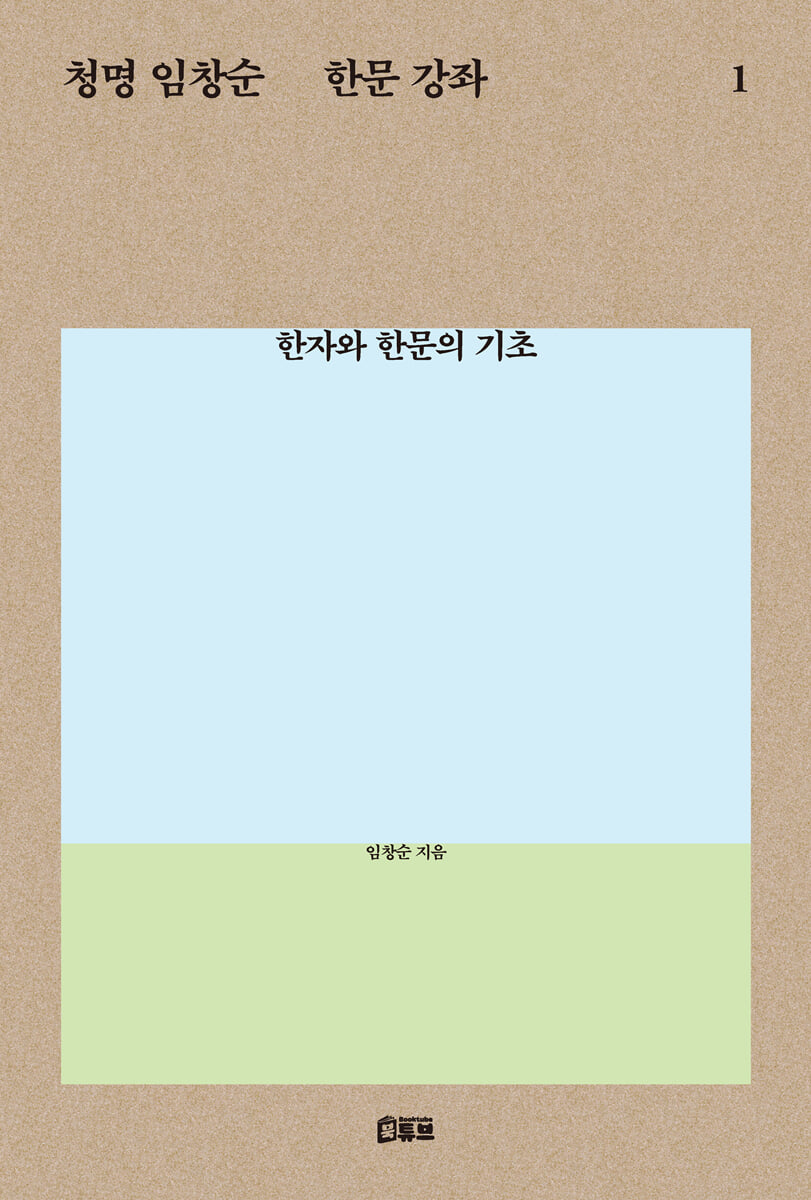
Cheongmyeong Im Chang-sun Chinese Character Lecture 1
 |
Description
Book Introduction
This book is the first in the 'Cheongmyeong Im Chang-sun Chinese Character Lecture' series, which compiles the Chinese character lectures given by Cheongmyeong Im Chang-sun (1914-1999) on KBS 3TV (now EBS) from 1981 to 1990. It contains the basics you need to know to understand Chinese characters and classical Chinese.
The author, Mr. Im Chang-sun, is a master of Chinese literature and calligrapher who achieved outstanding results in epigraphy. He is also well known for founding the Taedong Classical Studies Institute (Jigok Seodang) and nurturing numerous future generations of Chinese literature writers.
This book contains the scholarly insights of a teacher who has devoted a long time to the study of Chinese characters and the interpretation of classics, as well as his educational philosophy that argues that Chinese characters should be translated and understood in the language of the here and now.
『Cheongmyeong Im Chang-soon Chinese Character Lecture 1: The Basics of Chinese Characters and Classical Chinese』 contains lectures from 10 years of lectures on how the character structure of Chinese characters has changed, how Chinese characters are structured, how Chinese sentences are structured, how each part of speech is used, and lectures on frequently used idioms.
* The 'Cheongmyeong Im Chang-soon Chinese Character Lectures' series will be published in a total of four volumes, starting with Volume 1, 'Basics of Chinese Characters and Classical Chinese.'
Volume 2 is ‘Korean and Chinese Classics,’ Volume 3 is ‘Lectures on the Four Books,’ and Volume 4 is ‘Lectures on Chinese Poetry.’
The author, Mr. Im Chang-sun, is a master of Chinese literature and calligrapher who achieved outstanding results in epigraphy. He is also well known for founding the Taedong Classical Studies Institute (Jigok Seodang) and nurturing numerous future generations of Chinese literature writers.
This book contains the scholarly insights of a teacher who has devoted a long time to the study of Chinese characters and the interpretation of classics, as well as his educational philosophy that argues that Chinese characters should be translated and understood in the language of the here and now.
『Cheongmyeong Im Chang-soon Chinese Character Lecture 1: The Basics of Chinese Characters and Classical Chinese』 contains lectures from 10 years of lectures on how the character structure of Chinese characters has changed, how Chinese characters are structured, how Chinese sentences are structured, how each part of speech is used, and lectures on frequently used idioms.
* The 'Cheongmyeong Im Chang-soon Chinese Character Lectures' series will be published in a total of four volumes, starting with Volume 1, 'Basics of Chinese Characters and Classical Chinese.'
Volume 2 is ‘Korean and Chinese Classics,’ Volume 3 is ‘Lectures on the Four Books,’ and Volume 4 is ‘Lectures on Chinese Poetry.’
- You can preview some of the book's contents.
Preview
index
Publisher's Note: Publishing the "Chinese Classics" series by Master Cheongmyeong (Seong Tae-yong, Chairman of the Cheongmyeong Cultural Foundation)
Part 1: Basics of Chinese Characters
Chapter 1 _ The Evolution of Itself
Oracle bone script, ancient gold script, small seal script, clerical script, cursive script, regular script, running script
Chapter 2 - The Composition Principles of Chinese Characters: The Six Books
Instructions, pictographs, sounds, meanings, introductory remarks, and borrowings
Chapter 3 _ Names of strokes and parts
The name of the stroke (字?) and the composition and name of the part
Chapter 4 - Key Auxiliary Practice
Head (頁)ㆍHorse (馬)ㆍBone (骨)ㆍFight (魚)ㆍFish (魚)
Part 2 Sentence Structure
Chapter 1 _ Poems
Monosyllabic verbs, evangelical verbs, simple verbs, and compound verbs
Chapter 2 - Structure of Phrases
Those united by a relationship of equivalence, those united by a relationship of connection, those united by a relationship of modification, and those united by a relationship of subordination
Chapter 3: The Basic Structure of Chinese Characters
Predicate and auxiliary elements
Part 3
Chapter 1 _ Noun
Chapter 2 _ Ambassador
Chapter 3 _ Verbs
Ordinary verbs, special verbs, and verb phrases
Chapter 4 _ Adjectives
Common adjectives and special adjectives
Chapter 5 _ Adverbs
Special adverbs and ordinary adverbs
Chapter 6 _ Introduction
Omission of nouns and objects that are used as both nouns and nouns
Chapter 7 _ Speaker
Parallel speech, connection speech, relational speech, pre-insulation speech, selection speech, all speech, speech phrase
Chapter 8 _ The Knight
Indicates presentation and organization, indicates conclusion and affirmation, indicates a decisive situation, indicates a limited situation, indicates a question, indicates exclamation, and uses a series of articles.
Chapter 9 Onomatopoeia
Chapter 10: Props
Usage of the prop noun 'so' (所), usage of the prop noun 'ja' (者), usage of the prop noun 'yeon' (然)
Part 4 Chinese Idioms
ㆍGeumseul (琴瑟), Anhang (雁行), Gugyeong (具慶), Yeonggam (永感), Siha (侍下), Jiranoksu (芝蘭玉樹), Iosun (矛盾), Gwagi (瓜期), Okbaek (玉帛), Cheongsa (靑史), Hangan (汗簡), Ssaecheong (殺靑), Oksaewajeon (玉碎瓦全), Gyeokjisu (桂玉之愁), Jeungjinbueo (甑塵釜魚), Gwajeonnapri (瓜田納履), Jurangbandae (酒囊飯袋), Geumsimsugu (錦心繡口), A brush throws words to make a letter, a spit out poem becomes a chapter, a dream brush gives birth to a flower, jade and stone burn together, a fish in a pond, a single character is worth a thousand gold coins, the momentum of a riding tiger, a pillow draws water from a stone, a fox borrows the might of a tiger, the friendship of a coffin and a blackfish, a wife like grain, the friendship of gold and stone, a car with a helping hand and lips, a family of hair and a shawl, The great wooden minister, the crown and canopy of a mirror, the golden branches and jade leaves, the lonely man in the cold gate, the lonely chicken and rotting rat, the lonely man in the dark gate, the meat-eater has no plan, the man who eats meat late in the day should eat meat, the same Luoyang person, the hometown of Bingzhou, the friendship of a long life, the canopy of a mirror is like the old days, the reunion after a long time, Cunningly diverging, a hawk in hemp, a party that spreads discord, bringing harmony and thunder together, hiding disaster in a bag, discussing two sides, chicken ribs, chicken eggs with bones, getting a farmer to seek Shu, the desire of the valleys and plains, Qin’s pursuit of nothing, Tanglang’s rejection of ants, the momentum of the horns, the dog’s teeth and the monkey’s relationship, Killing two birds with one stone, retreating after a great achievement, retreating in a hurry, marching in embroidered clothes at night, forbearing shame in impurity, the benevolence of Song Xiang, sleeping on firewood and tasting gall? Wu and Yue in the same boat? Digging a well when thirsty, being afraid of three caves in Kyoto, standing up without fear, not being afraid of heaven or the earth? The old man lost his horse
Part 1: Basics of Chinese Characters
Chapter 1 _ The Evolution of Itself
Oracle bone script, ancient gold script, small seal script, clerical script, cursive script, regular script, running script
Chapter 2 - The Composition Principles of Chinese Characters: The Six Books
Instructions, pictographs, sounds, meanings, introductory remarks, and borrowings
Chapter 3 _ Names of strokes and parts
The name of the stroke (字?) and the composition and name of the part
Chapter 4 - Key Auxiliary Practice
Head (頁)ㆍHorse (馬)ㆍBone (骨)ㆍFight (魚)ㆍFish (魚)
Part 2 Sentence Structure
Chapter 1 _ Poems
Monosyllabic verbs, evangelical verbs, simple verbs, and compound verbs
Chapter 2 - Structure of Phrases
Those united by a relationship of equivalence, those united by a relationship of connection, those united by a relationship of modification, and those united by a relationship of subordination
Chapter 3: The Basic Structure of Chinese Characters
Predicate and auxiliary elements
Part 3
Chapter 1 _ Noun
Chapter 2 _ Ambassador
Chapter 3 _ Verbs
Ordinary verbs, special verbs, and verb phrases
Chapter 4 _ Adjectives
Common adjectives and special adjectives
Chapter 5 _ Adverbs
Special adverbs and ordinary adverbs
Chapter 6 _ Introduction
Omission of nouns and objects that are used as both nouns and nouns
Chapter 7 _ Speaker
Parallel speech, connection speech, relational speech, pre-insulation speech, selection speech, all speech, speech phrase
Chapter 8 _ The Knight
Indicates presentation and organization, indicates conclusion and affirmation, indicates a decisive situation, indicates a limited situation, indicates a question, indicates exclamation, and uses a series of articles.
Chapter 9 Onomatopoeia
Chapter 10: Props
Usage of the prop noun 'so' (所), usage of the prop noun 'ja' (者), usage of the prop noun 'yeon' (然)
Part 4 Chinese Idioms
ㆍGeumseul (琴瑟), Anhang (雁行), Gugyeong (具慶), Yeonggam (永感), Siha (侍下), Jiranoksu (芝蘭玉樹), Iosun (矛盾), Gwagi (瓜期), Okbaek (玉帛), Cheongsa (靑史), Hangan (汗簡), Ssaecheong (殺靑), Oksaewajeon (玉碎瓦全), Gyeokjisu (桂玉之愁), Jeungjinbueo (甑塵釜魚), Gwajeonnapri (瓜田納履), Jurangbandae (酒囊飯袋), Geumsimsugu (錦心繡口), A brush throws words to make a letter, a spit out poem becomes a chapter, a dream brush gives birth to a flower, jade and stone burn together, a fish in a pond, a single character is worth a thousand gold coins, the momentum of a riding tiger, a pillow draws water from a stone, a fox borrows the might of a tiger, the friendship of a coffin and a blackfish, a wife like grain, the friendship of gold and stone, a car with a helping hand and lips, a family of hair and a shawl, The great wooden minister, the crown and canopy of a mirror, the golden branches and jade leaves, the lonely man in the cold gate, the lonely chicken and rotting rat, the lonely man in the dark gate, the meat-eater has no plan, the man who eats meat late in the day should eat meat, the same Luoyang person, the hometown of Bingzhou, the friendship of a long life, the canopy of a mirror is like the old days, the reunion after a long time, Cunningly diverging, a hawk in hemp, a party that spreads discord, bringing harmony and thunder together, hiding disaster in a bag, discussing two sides, chicken ribs, chicken eggs with bones, getting a farmer to seek Shu, the desire of the valleys and plains, Qin’s pursuit of nothing, Tanglang’s rejection of ants, the momentum of the horns, the dog’s teeth and the monkey’s relationship, Killing two birds with one stone, retreating after a great achievement, retreating in a hurry, marching in embroidered clothes at night, forbearing shame in impurity, the benevolence of Song Xiang, sleeping on firewood and tasting gall? Wu and Yue in the same boat? Digging a well when thirsty, being afraid of three caves in Kyoto, standing up without fear, not being afraid of heaven or the earth? The old man lost his horse
Into the book
Qin Shi Huang unified the various characters used before into one, which is the Xiaodian.
Before Qin Shi Huang unified China, it was a feudal system.
Each region had its own country, and each country ruled independently, with the throne being hereditary.
There was no such thing as taking orders from other countries.
However, when the Jin Dynasty unified the country, it abolished the feudal system and appointed officials from the central government.
Local officials must receive orders from the central government and report back to the central government.
To do this, the characters must be unified.
So, the first thing we did after unification was to unify the characters.
You saw the ancient and modern script a little while ago, but if you look at the shapes of the letters at that time, the structure is not organized.
All of that was organized in the small intestine, and the letters created in that way were unified so that the whole world could use them.
--- p.33
While writing this book, Heo Shin added a note titled “Seomunhaejaseo” (說文解字?).
Here, Seo(?) means West Gate.
This is a text written by Heo Shin explaining the purpose of his autobiography, 『Seolmunhaeja』.
In the preface, there is content called the Six Books.
The six letters mean ‘the basic six letters.’
Since the term "Six Books" appeared in the "Shuo Wen Zi Zi", it has been said that "the basis of Chinese characters is the Six Books" when explaining Chinese characters.
The term 'Yukseo' existed even before Heo Shin.
Although the names of the compositions and the order have changed slightly, there were people who talked about the Six Books even before Heo Shin.
However, it is explained most specifically and in detail in Heo Shin's 『Seomunhaeja』.
Let's study the six books in this book one by one.
--- p.49
The character 'sa' (駟) in 'sima' (駟馬) is strange.
It is a character whose meaning can be known immediately when you look at it.
Since the character 'Nok Sa' is attached next to 'Mal Ma', it must mean four horses.
And the reading is read as 'sa'.
But why did they make four horses into one letter?
In the old days, to pull a cart, you need four horses.
So, a horse that pulls a cart is called a ‘sa’ (駟).
A cart is called a 'seung' (乘).
There is a saying in the Analects of Confucius, “Chen Wenzi has ten horse-riding chariots.”
The phrase "ten-seung" means to own ten carts, which means to own ten carts and forty horses to pull them.
So, this character ‘seung’ (乘) is also used as a number representing four.
In the Mencius, there is a saying called ‘chengshi’ (乘矢), and shooting four arrows is called ‘chengshi’.
Here too, we can see that 'seung' (乘) refers to the number 4.
--- p.70
Among the demonstrative expressions that point to something close, '차' (此) and '시' (是) are used a lot and are similar in usage, but there is a slight difference between the two characters.
The biggest difference is that '차' is used in contrast to '피', but '시' is not used in that way.
For example, there is a saying by Mencius.
When Mencius told a story, a disciple who was listening said, “Teacher.
He said, “It’s a little different from what you said before.”
At that time, Mencius answered, “It is the same time, it is the same time.”
It means 'that was once, and this was also once.'
What I'm saying is that then and now are different.
In this way, ‘pi’ and ‘cha’ are used in contrast, but ‘si’ is not used in place of ‘cha’.
Also, '차' is used to indicate something more direct and specific than '시'.
So, when referring to something visible, such as a person or the land, the character '차' is used, and when referring to something abstract and invisible, such as time, the character '시' is often used.
And '시' is often used to indicate the limitation of a predicate rather than a directive.
--- p.100
However, this 'gi' alone cannot be an element of a question, but rather forms a phrase in conjunction with other words.
When you say 'I go there', it does not become a sentence like '아왕기' (我往其).
This is because 'gi' cannot independently indicate it or that place.
So, another saga must be attached.
For example, in phrases like ‘아왕기처’ (我往其處) and ‘아왕기소’ (我往其所), ‘기’ can function properly only when a noun comes after it.
It has to be written in formula form.
It must be used in phrases such as ‘the teaching’ [其敎], ‘the words’ [其言], ‘the next day’ [其明日], ‘the many brothers’ [其諸昆弟], and cannot be used as a sentence element on its own.
It is different from ‘Pi’ (彼) or ‘Cha’ (此).
--- p.124
This saying comes from 『Zhuangzi』, and this person named 'Zhang' is a slave, and this person named 'Guk' is also a slave.
What these two people do is raise sheep.
But when he goes out and tends the sheep, all the sheep run away.
So the owner asks, “What were you doing that you lost all your sheep?”
Then, a man named Jang says that he lost it while reading a book, and a man named Gok says that he lost it while playing with a gourd.
What this story is saying is that some people lost their sheep while doing good deeds, while others lost them while just having fun, but the loss is the same.
This is a metaphorical story about how people come into this world and live their lives doing good deeds, while others are rumored to have done bad things, but it's all the same after death.
This is a sentence from the story.
--- p.136
The sorrow of cinnamon jade: Next, let’s look at the word ‘cinnamon jade’.
'Cinnamon' (桂) is a very expensive and precious tree.
Jade is also precious.
The meaning of 'Gyeokjisu' is 'Singwiyeogye, Migwiyeook' (薪貴如桂, 米貴如玉).
'Shin' (薪) means firewood.
So, firewood is as precious as 'gye', and rice is as precious as 'jade'.
It means that firewood is so expensive that you can't light a fire in the stove, and rice is so expensive that you have to sell all the jade you have to buy one meal.
This is a saying that a certain scholar made when he visited a country during the Warring States period of China and ridiculed that country.
This saying later became an idiom describing the plight of a poor family.
There is an expression that says, “You cannot escape the Gyeokjisu.”
If you write to a friend, “I’m not worried about anything other than the fact that I can’t avoid the Gyeokjisu these days,” people who know how to read will think, “I wonder if this friend is in trouble these days,” and send them a bag of rice or some money.
There's no use sending a letter like this to someone who doesn't know how to read.
So, when writing a letter, you should write in a language that the person understands.
That's why there's an old saying, 'A book written after skipping dinner.'
I was writing a letter asking for rice because I didn't have any, but I wrote it in cursive and sent it, but the recipient couldn't read it, so I couldn't send it.
It's called 'Dinner-Hungry Cursor'.
Even now, if you look at it, you see people pretending to be knowledgeable and writing in a way that the other person can't even understand. It's the same as 'writing cursive after skipping dinner.'
The purpose of language is to enable the other person to understand and resonate, but that shouldn't be the case.
So, even if you know things like ‘Gyeokjisu’, don’t use them carelessly.
Before Qin Shi Huang unified China, it was a feudal system.
Each region had its own country, and each country ruled independently, with the throne being hereditary.
There was no such thing as taking orders from other countries.
However, when the Jin Dynasty unified the country, it abolished the feudal system and appointed officials from the central government.
Local officials must receive orders from the central government and report back to the central government.
To do this, the characters must be unified.
So, the first thing we did after unification was to unify the characters.
You saw the ancient and modern script a little while ago, but if you look at the shapes of the letters at that time, the structure is not organized.
All of that was organized in the small intestine, and the letters created in that way were unified so that the whole world could use them.
--- p.33
While writing this book, Heo Shin added a note titled “Seomunhaejaseo” (說文解字?).
Here, Seo(?) means West Gate.
This is a text written by Heo Shin explaining the purpose of his autobiography, 『Seolmunhaeja』.
In the preface, there is content called the Six Books.
The six letters mean ‘the basic six letters.’
Since the term "Six Books" appeared in the "Shuo Wen Zi Zi", it has been said that "the basis of Chinese characters is the Six Books" when explaining Chinese characters.
The term 'Yukseo' existed even before Heo Shin.
Although the names of the compositions and the order have changed slightly, there were people who talked about the Six Books even before Heo Shin.
However, it is explained most specifically and in detail in Heo Shin's 『Seomunhaeja』.
Let's study the six books in this book one by one.
--- p.49
The character 'sa' (駟) in 'sima' (駟馬) is strange.
It is a character whose meaning can be known immediately when you look at it.
Since the character 'Nok Sa' is attached next to 'Mal Ma', it must mean four horses.
And the reading is read as 'sa'.
But why did they make four horses into one letter?
In the old days, to pull a cart, you need four horses.
So, a horse that pulls a cart is called a ‘sa’ (駟).
A cart is called a 'seung' (乘).
There is a saying in the Analects of Confucius, “Chen Wenzi has ten horse-riding chariots.”
The phrase "ten-seung" means to own ten carts, which means to own ten carts and forty horses to pull them.
So, this character ‘seung’ (乘) is also used as a number representing four.
In the Mencius, there is a saying called ‘chengshi’ (乘矢), and shooting four arrows is called ‘chengshi’.
Here too, we can see that 'seung' (乘) refers to the number 4.
--- p.70
Among the demonstrative expressions that point to something close, '차' (此) and '시' (是) are used a lot and are similar in usage, but there is a slight difference between the two characters.
The biggest difference is that '차' is used in contrast to '피', but '시' is not used in that way.
For example, there is a saying by Mencius.
When Mencius told a story, a disciple who was listening said, “Teacher.
He said, “It’s a little different from what you said before.”
At that time, Mencius answered, “It is the same time, it is the same time.”
It means 'that was once, and this was also once.'
What I'm saying is that then and now are different.
In this way, ‘pi’ and ‘cha’ are used in contrast, but ‘si’ is not used in place of ‘cha’.
Also, '차' is used to indicate something more direct and specific than '시'.
So, when referring to something visible, such as a person or the land, the character '차' is used, and when referring to something abstract and invisible, such as time, the character '시' is often used.
And '시' is often used to indicate the limitation of a predicate rather than a directive.
--- p.100
However, this 'gi' alone cannot be an element of a question, but rather forms a phrase in conjunction with other words.
When you say 'I go there', it does not become a sentence like '아왕기' (我往其).
This is because 'gi' cannot independently indicate it or that place.
So, another saga must be attached.
For example, in phrases like ‘아왕기처’ (我往其處) and ‘아왕기소’ (我往其所), ‘기’ can function properly only when a noun comes after it.
It has to be written in formula form.
It must be used in phrases such as ‘the teaching’ [其敎], ‘the words’ [其言], ‘the next day’ [其明日], ‘the many brothers’ [其諸昆弟], and cannot be used as a sentence element on its own.
It is different from ‘Pi’ (彼) or ‘Cha’ (此).
--- p.124
This saying comes from 『Zhuangzi』, and this person named 'Zhang' is a slave, and this person named 'Guk' is also a slave.
What these two people do is raise sheep.
But when he goes out and tends the sheep, all the sheep run away.
So the owner asks, “What were you doing that you lost all your sheep?”
Then, a man named Jang says that he lost it while reading a book, and a man named Gok says that he lost it while playing with a gourd.
What this story is saying is that some people lost their sheep while doing good deeds, while others lost them while just having fun, but the loss is the same.
This is a metaphorical story about how people come into this world and live their lives doing good deeds, while others are rumored to have done bad things, but it's all the same after death.
This is a sentence from the story.
--- p.136
The sorrow of cinnamon jade: Next, let’s look at the word ‘cinnamon jade’.
'Cinnamon' (桂) is a very expensive and precious tree.
Jade is also precious.
The meaning of 'Gyeokjisu' is 'Singwiyeogye, Migwiyeook' (薪貴如桂, 米貴如玉).
'Shin' (薪) means firewood.
So, firewood is as precious as 'gye', and rice is as precious as 'jade'.
It means that firewood is so expensive that you can't light a fire in the stove, and rice is so expensive that you have to sell all the jade you have to buy one meal.
This is a saying that a certain scholar made when he visited a country during the Warring States period of China and ridiculed that country.
This saying later became an idiom describing the plight of a poor family.
There is an expression that says, “You cannot escape the Gyeokjisu.”
If you write to a friend, “I’m not worried about anything other than the fact that I can’t avoid the Gyeokjisu these days,” people who know how to read will think, “I wonder if this friend is in trouble these days,” and send them a bag of rice or some money.
There's no use sending a letter like this to someone who doesn't know how to read.
So, when writing a letter, you should write in a language that the person understands.
That's why there's an old saying, 'A book written after skipping dinner.'
I was writing a letter asking for rice because I didn't have any, but I wrote it in cursive and sent it, but the recipient couldn't read it, so I couldn't send it.
It's called 'Dinner-Hungry Cursor'.
Even now, if you look at it, you see people pretending to be knowledgeable and writing in a way that the other person can't even understand. It's the same as 'writing cursive after skipping dinner.'
The purpose of language is to enable the other person to understand and resonate, but that shouldn't be the case.
So, even if you know things like ‘Gyeokjisu’, don’t use them carelessly.
--- From the text
Publisher's Review
The basics of Chinese characters and classical Chinese through the voice of a master
Translating Professor Im Chang-sun's TV lectures into a book
Cheongmyeong Im Chang-sun was a master of Chinese literature who made outstanding achievements in the field of epigraphy, and he also played a major role in cultivating the next generation of scholars by establishing the Taedong Classical Studies Institute (Jigok Seodang).
Since 1976, the Taedong Classics Research Institute has been teaching Chinese classics to students by selecting them and supporting their tuition and living expenses. It is well known for its teaching method of having them memorize the entire Four Books and Three Classics.
While providing specialized Chinese classics education, primarily for graduate students, the teacher also actively engaged in popular lectures, a prime example being the "Chinese Classics Lecture" that ran throughout the 1980s on KBS 3TV, the predecessor of the current EBS.
Through this lecture program, the teacher has explained in a simple way with abundant examples so that even those who have not majored in Chinese characters can easily listen and learn topics such as 'Basics of Chinese Characters', 'Basic Chinese Grammar', 'Chinese Idioms', 'Chinese Classics', 'Korean Classics', 'Four Books', and 'Chinese Poetry'.
The 'Im Chang-soon's Chinese Character Lectures' series aims to convey these TV lectures to today's readers by transcribing them into a book.
The newly published Volume 1, 『Cheongmyeong Im Chang-soon Chinese Character Lecture 1: The Basics of Chinese Characters and Classical Chinese』, contains lectures from 10 years of lectures on how the character structure of Chinese characters has changed, how Chinese characters are composed, how Chinese sentences are structured, how each part of speech is used, and lectures on frequently used idioms.
Through this book's rich examples and engaging background explanations, readers will not only enjoyably lay the foundation for studying Chinese characters, but will also encounter the scholarly insights of a master who has dedicated his life to the study of Chinese characters and the interpretation of classics, as well as the educational philosophy that advocates translating and understanding Chinese characters into the language of the here and now.
Author's Note
The hot topic of this era is, without a doubt, ‘fun.’
But the teacher's lectures are interesting.
The examples the teacher gives are interesting, the content of the exams and such are interesting, and the brilliant insights and clear explanations are interesting.
Through this fun, we can learn Chinese characters, improve our Chinese character skills, and even get a glimpse of the realm of a master who is one level higher than the master.
From this perspective, although Master Im Chang-sun was a generation older than us, he still provides much-needed teachings for this era, and in some ways, he was a step ahead of his time.
With that in mind, I plan to compile meaningful things that the teacher left behind, such as his lectures on the Four Books and Chinese Poetry, and publish them in a book.
_ From the 'Publisher's Note'
Translating Professor Im Chang-sun's TV lectures into a book
Cheongmyeong Im Chang-sun was a master of Chinese literature who made outstanding achievements in the field of epigraphy, and he also played a major role in cultivating the next generation of scholars by establishing the Taedong Classical Studies Institute (Jigok Seodang).
Since 1976, the Taedong Classics Research Institute has been teaching Chinese classics to students by selecting them and supporting their tuition and living expenses. It is well known for its teaching method of having them memorize the entire Four Books and Three Classics.
While providing specialized Chinese classics education, primarily for graduate students, the teacher also actively engaged in popular lectures, a prime example being the "Chinese Classics Lecture" that ran throughout the 1980s on KBS 3TV, the predecessor of the current EBS.
Through this lecture program, the teacher has explained in a simple way with abundant examples so that even those who have not majored in Chinese characters can easily listen and learn topics such as 'Basics of Chinese Characters', 'Basic Chinese Grammar', 'Chinese Idioms', 'Chinese Classics', 'Korean Classics', 'Four Books', and 'Chinese Poetry'.
The 'Im Chang-soon's Chinese Character Lectures' series aims to convey these TV lectures to today's readers by transcribing them into a book.
The newly published Volume 1, 『Cheongmyeong Im Chang-soon Chinese Character Lecture 1: The Basics of Chinese Characters and Classical Chinese』, contains lectures from 10 years of lectures on how the character structure of Chinese characters has changed, how Chinese characters are composed, how Chinese sentences are structured, how each part of speech is used, and lectures on frequently used idioms.
Through this book's rich examples and engaging background explanations, readers will not only enjoyably lay the foundation for studying Chinese characters, but will also encounter the scholarly insights of a master who has dedicated his life to the study of Chinese characters and the interpretation of classics, as well as the educational philosophy that advocates translating and understanding Chinese characters into the language of the here and now.
Author's Note
The hot topic of this era is, without a doubt, ‘fun.’
But the teacher's lectures are interesting.
The examples the teacher gives are interesting, the content of the exams and such are interesting, and the brilliant insights and clear explanations are interesting.
Through this fun, we can learn Chinese characters, improve our Chinese character skills, and even get a glimpse of the realm of a master who is one level higher than the master.
From this perspective, although Master Im Chang-sun was a generation older than us, he still provides much-needed teachings for this era, and in some ways, he was a step ahead of his time.
With that in mind, I plan to compile meaningful things that the teacher left behind, such as his lectures on the Four Books and Chinese Poetry, and publish them in a book.
_ From the 'Publisher's Note'
GOODS SPECIFICS
- Date of issue: November 5, 2025
- Page count, weight, size: 360 pages | 444g | 139*205*22mm
- ISBN13: 9791192628561
- ISBN10: 119262856X
You may also like
카테고리
korean


korean

![GQ KOREA Mark (Monthly): December [2025]](http://librairie.coreenne.fr/cdn/shop/files/8ef265dbbfbf186523ed75ba7319009d.jpg?v=1765340328&width=3840)


