

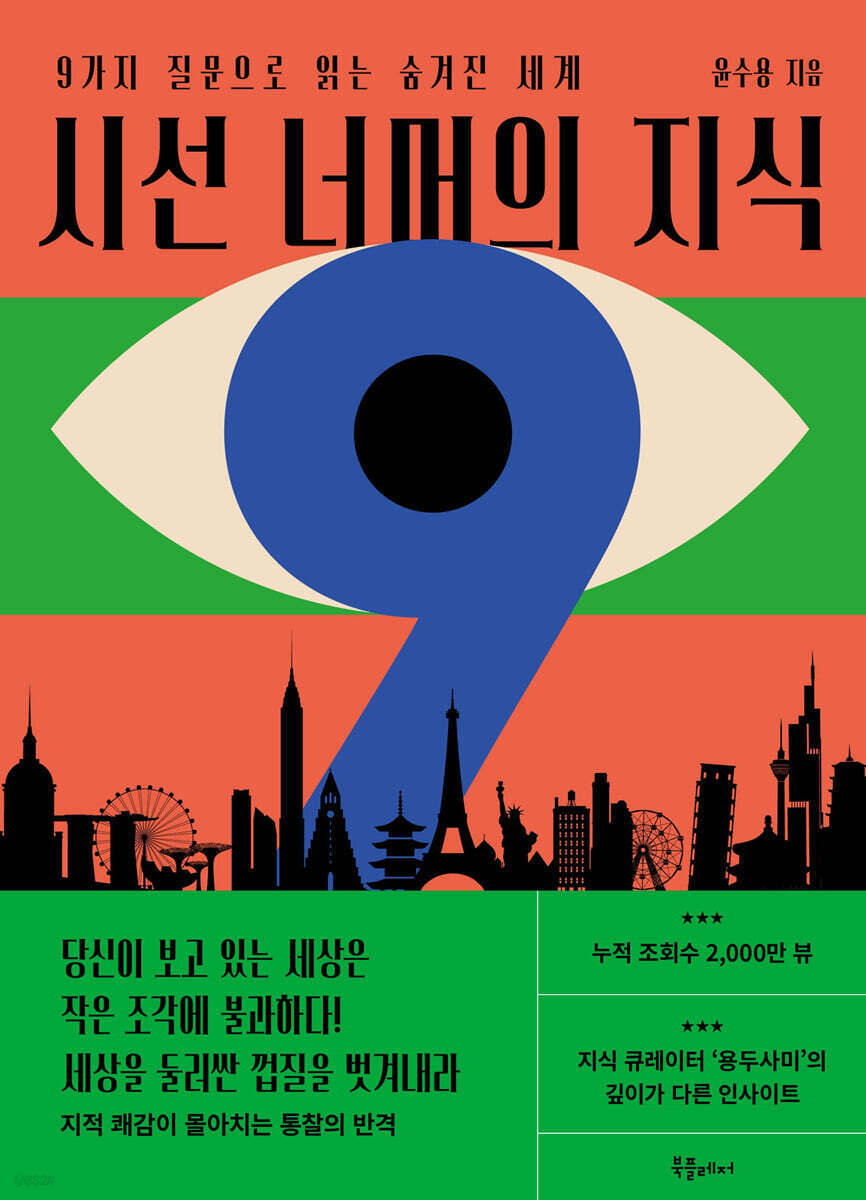
Knowledge beyond sight
 |
Description
Book Introduction
The world you see is just a small piece
Peel off the shell that surrounds the world!
A Hidden World in 9 Questions
★★★ A journey of insight filled with intellectual pleasure.
★★★ 20 million cumulative views
★★★ Knowledge curator Yongdusami publishes his first book, "Knowledge Beyond the Eyes."
With over 20 million cumulative views, 'Yongdusami', which has been raising hot intellectual topics, has published its first book, 'Knowledge Beyond Gaze', containing the depth of insight that could not be fully conveyed through video.
This book analyzes the cracks and contradictions in the social structures, histories, and cultures of nine countries, including Denmark, Japan, Singapore, and France, and directly dismantles the standards we have taken for granted.
We uncover the untold stories behind the so-called "advanced nations," and offer a three-dimensional perspective by comparing and deconstructing a single country.
In an age overflowing with light and fragmented information, "Knowledge Beyond the Gaze" restores the "joy of thinking" beyond simple knowledge consumption through an exploratory attitude of questioning, re-examining, and pursuing the truth.
It will provide an intellectual exploration of insight for readers seeking intellectual stimulation and cultured readers seeking a deeper understanding of the world.
Peel off the shell that surrounds the world!
A Hidden World in 9 Questions
★★★ A journey of insight filled with intellectual pleasure.
★★★ 20 million cumulative views
★★★ Knowledge curator Yongdusami publishes his first book, "Knowledge Beyond the Eyes."
With over 20 million cumulative views, 'Yongdusami', which has been raising hot intellectual topics, has published its first book, 'Knowledge Beyond Gaze', containing the depth of insight that could not be fully conveyed through video.
This book analyzes the cracks and contradictions in the social structures, histories, and cultures of nine countries, including Denmark, Japan, Singapore, and France, and directly dismantles the standards we have taken for granted.
We uncover the untold stories behind the so-called "advanced nations," and offer a three-dimensional perspective by comparing and deconstructing a single country.
In an age overflowing with light and fragmented information, "Knowledge Beyond the Gaze" restores the "joy of thinking" beyond simple knowledge consumption through an exploratory attitude of questioning, re-examining, and pursuing the truth.
It will provide an intellectual exploration of insight for readers seeking intellectual stimulation and cultured readers seeking a deeper understanding of the world.
- You can preview some of the book's contents.
Preview
index
Chapter 1.
The Shadow of Happiness - About the Ideals We Have Been Believing in
· The contradiction hidden behind happiness: Denmark
“Why does Denmark put its flag on its birthday cake?”
· The true face of a hyper-competitive society: Singapore
“Why is rude behavior reported every day in Singapore news?”
· Unresolved past, America
“Why is the American South so friendly?”
Chapter 2.
At the Boundaries of Identity - Questions Asking Who We Are
· Shadows of Typed History, Iceland
“Why did McDonald’s disappear from Iceland?”
· Mirror of Complex, Japan
“Why do only Westerners appear on Japanese TV?”
· The Reality of Elitism, France
“Why did the respected Prime Minister, who came from a poor family, commit suicide with a pistol?”
Chapter 3.
Faces of Capital - A World Ruled by Materialism
· The Shadow of Neoliberalism, Britain
“What made Britain’s ‘roadman’?”
· The Trap of Familyism, Italy
“Why don’t young people leave their parents’ homes?”
· China, a materialistic society
“Why does the conflict between socialism and materialism occur?”
The Shadow of Happiness - About the Ideals We Have Been Believing in
· The contradiction hidden behind happiness: Denmark
“Why does Denmark put its flag on its birthday cake?”
· The true face of a hyper-competitive society: Singapore
“Why is rude behavior reported every day in Singapore news?”
· Unresolved past, America
“Why is the American South so friendly?”
Chapter 2.
At the Boundaries of Identity - Questions Asking Who We Are
· Shadows of Typed History, Iceland
“Why did McDonald’s disappear from Iceland?”
· Mirror of Complex, Japan
“Why do only Westerners appear on Japanese TV?”
· The Reality of Elitism, France
“Why did the respected Prime Minister, who came from a poor family, commit suicide with a pistol?”
Chapter 3.
Faces of Capital - A World Ruled by Materialism
· The Shadow of Neoliberalism, Britain
“What made Britain’s ‘roadman’?”
· The Trap of Familyism, Italy
“Why don’t young people leave their parents’ homes?”
· China, a materialistic society
“Why does the conflict between socialism and materialism occur?”
Detailed image

Into the book
This is the question that Knowledge Beyond Gaze poses.
"Who evaluates us, and why do we internalize that evaluation?", "From whose perspective is the standard for what constitutes a developed nation established?" Only when we transcend that perspective can we truly understand ourselves.
This book makes us look at the perspectives we take for granted in a new way.
I propose an attitude that seeks to go beyond superficial evaluations and images and understand the historical context and essence behind them.
This creates a new connection between me and the world, and leads to deep insights into the communities we belong to.
At the same time, it reminds us that knowledge is not simply an accumulation of information, but a framework for perceiving and interpreting the world, and a power to reconstruct existing cognitive structures.
--- From the "Prologue"
The collective narrative that "we" who have overcome pain together should be the happiest has become a force that unites Danes' pride, but at the same time, it can also act as a harsh signal of exclusion for those excluded from the narrative—that is, outsiders or those who do not belong to the Danish "us."
So, are the happiness, equality, and hygge that Denmark emphasizes for everyone? Or have they become exclusive tools of solidarity for only a select few who have shared in the suffering?
--- From "The Contradiction Hidden Behind Happiness, Denmark"
This passage from former Deputy Prime Minister Wong sounds like it hits the heart of Singapore's social problems, symbolized by Kia Su.
But the nice words he spouts about “needing to change our mindset toward success” sound like empty words to Singaporeans living in a society where cutthroat competition is already deeply ingrained.
The People's Action Party, to which former Deputy Prime Minister Wong belongs, is the one that transplanted that mindset of endless competition to Singapore.
--- From "The True Face of a Hyper-Competitive Society, Singapore"
The warm and friendly atmosphere that many people experience when traveling through the American South seems to be inherent to some extent in the people of the South.
Southern hospitality, which began as a culture of hospitality among a small number of plantation owners 200 years ago, was shaped by a long history of oppression and victimization of Black people.
It is difficult for us to view this purely as a warm and friendly concept,
--- From "The Unresolved Past, America"
Just because one McDonald's franchise disappears, it doesn't mean Iceland will fall out of the developed world.
Nevertheless, Iceland's long history of being dominated and marginalized, coupled with its desire for recognition from more powerful nations, has left it feeling anxious and lost at joining the ranks of "countries without McDonald's."
The absence of McDonald's in Iceland is viewed with some irony.
--- From "Shadows of Typed History, Iceland"
The program's structure is to confirm Japanese pride through the eyes of an American who admires Japanese culture, which may be a cross-section of the Western-centric complex deeply ingrained in Japanese society.
Ultimately, the current "Japaneseness" is closer to an image borrowed and constructed from outside sources to fill in the missing spiritual identity.
The spirit of Japan in the past, symbolized by the national system, was buried along with the fall of militarism, but without a proper opportunity to reflect on it, a new identity was forced upon us within the framework of the "good people."
--- From "Mirror of Complexes, Japan"
Today, France, despite being the birthplace of the revolutionary spirit, cries out from the gap between its ideal of a republic advocating "equality before the law" and its actual social structure.
While the slogans of liberty, equality, and fraternity remain the national symbols, the fact that these ideals are monopolized by the culture and institutions of the upper classes reveals that France is still in a state where the contradictions of the old system have not yet been completely eradicated.
As long as French society embraces a new feudal system called elitism, can it easily escape this sad fate of repetition?
--- From "The Reality of Elitism, France"
For decades, the working class has been utterly marginalized by neoliberalism.
But at the same time, they are a generation that grew up in another huge trend: modern consumer capitalism.
A shocking paradox arises: we are raised to value and desire material wealth, yet the legitimate avenues for accessing it are completely blocked.
Youssef analyzed that the Roadmen, who were born in such a place where they experienced extreme disadvantage, mobilized what little "capital" they had to produce value in order to combat contradictions and inequality.
--- From "The Shadow of Neoliberalism, Britain"
The state tolerates this trend, views citizens as petty producers who value material gain, and begins to organize society around material gain.
As a result, China rapidly transformed into a society where communal ideals disappeared and values centered on materialism and achievement dominated.
Nihilism after the Cultural Revolution was not merely an individual problem, but a problem for Chinese society as a whole, which failed to fill the ideological vacuum during the period of systemic transition.
The shadow of this nihilism and materialism remains deeply imprinted in Chinese society, leaving an indelible scar.
"Who evaluates us, and why do we internalize that evaluation?", "From whose perspective is the standard for what constitutes a developed nation established?" Only when we transcend that perspective can we truly understand ourselves.
This book makes us look at the perspectives we take for granted in a new way.
I propose an attitude that seeks to go beyond superficial evaluations and images and understand the historical context and essence behind them.
This creates a new connection between me and the world, and leads to deep insights into the communities we belong to.
At the same time, it reminds us that knowledge is not simply an accumulation of information, but a framework for perceiving and interpreting the world, and a power to reconstruct existing cognitive structures.
--- From the "Prologue"
The collective narrative that "we" who have overcome pain together should be the happiest has become a force that unites Danes' pride, but at the same time, it can also act as a harsh signal of exclusion for those excluded from the narrative—that is, outsiders or those who do not belong to the Danish "us."
So, are the happiness, equality, and hygge that Denmark emphasizes for everyone? Or have they become exclusive tools of solidarity for only a select few who have shared in the suffering?
--- From "The Contradiction Hidden Behind Happiness, Denmark"
This passage from former Deputy Prime Minister Wong sounds like it hits the heart of Singapore's social problems, symbolized by Kia Su.
But the nice words he spouts about “needing to change our mindset toward success” sound like empty words to Singaporeans living in a society where cutthroat competition is already deeply ingrained.
The People's Action Party, to which former Deputy Prime Minister Wong belongs, is the one that transplanted that mindset of endless competition to Singapore.
--- From "The True Face of a Hyper-Competitive Society, Singapore"
The warm and friendly atmosphere that many people experience when traveling through the American South seems to be inherent to some extent in the people of the South.
Southern hospitality, which began as a culture of hospitality among a small number of plantation owners 200 years ago, was shaped by a long history of oppression and victimization of Black people.
It is difficult for us to view this purely as a warm and friendly concept,
--- From "The Unresolved Past, America"
Just because one McDonald's franchise disappears, it doesn't mean Iceland will fall out of the developed world.
Nevertheless, Iceland's long history of being dominated and marginalized, coupled with its desire for recognition from more powerful nations, has left it feeling anxious and lost at joining the ranks of "countries without McDonald's."
The absence of McDonald's in Iceland is viewed with some irony.
--- From "Shadows of Typed History, Iceland"
The program's structure is to confirm Japanese pride through the eyes of an American who admires Japanese culture, which may be a cross-section of the Western-centric complex deeply ingrained in Japanese society.
Ultimately, the current "Japaneseness" is closer to an image borrowed and constructed from outside sources to fill in the missing spiritual identity.
The spirit of Japan in the past, symbolized by the national system, was buried along with the fall of militarism, but without a proper opportunity to reflect on it, a new identity was forced upon us within the framework of the "good people."
--- From "Mirror of Complexes, Japan"
Today, France, despite being the birthplace of the revolutionary spirit, cries out from the gap between its ideal of a republic advocating "equality before the law" and its actual social structure.
While the slogans of liberty, equality, and fraternity remain the national symbols, the fact that these ideals are monopolized by the culture and institutions of the upper classes reveals that France is still in a state where the contradictions of the old system have not yet been completely eradicated.
As long as French society embraces a new feudal system called elitism, can it easily escape this sad fate of repetition?
--- From "The Reality of Elitism, France"
For decades, the working class has been utterly marginalized by neoliberalism.
But at the same time, they are a generation that grew up in another huge trend: modern consumer capitalism.
A shocking paradox arises: we are raised to value and desire material wealth, yet the legitimate avenues for accessing it are completely blocked.
Youssef analyzed that the Roadmen, who were born in such a place where they experienced extreme disadvantage, mobilized what little "capital" they had to produce value in order to combat contradictions and inequality.
--- From "The Shadow of Neoliberalism, Britain"
The state tolerates this trend, views citizens as petty producers who value material gain, and begins to organize society around material gain.
As a result, China rapidly transformed into a society where communal ideals disappeared and values centered on materialism and achievement dominated.
Nihilism after the Cultural Revolution was not merely an individual problem, but a problem for Chinese society as a whole, which failed to fill the ideological vacuum during the period of systemic transition.
The shadow of this nihilism and materialism remains deeply imprinted in Chinese society, leaving an indelible scar.
--- From "China, a Materialistic Society"
Publisher's Review
A dragon head snake that digs tenaciously and digs sharply
The counterattack of insight, a surge of intellectual pleasure, begins.
The author, who gained recognition for his insightful analysis and critical perspective through the YouTube channel 'Yongdusami', has become even more sharp and profound through 'Knowledge Beyond Gaze'.
It unfolds the reality of world power, culture, history, and identity, which has been persistently explored for a long time, with a deeper and more refined perspective.
The author's experience of facing the extreme gap between black and white neighborhoods led him to become interested in social issues and history in many countries, including the United States.
Since then, he has traced the cultures and hidden sides of various countries, and through his YouTube channel, he has gone beyond simple information delivery to reveal the hidden power structures and roots of inequality.
This book is the culmination of that exploration, not satisfied with superficial narratives but persistently questioning and revealing the truth behind what is taken for granted.
We dissect society and relentlessly delve into the depths of knowledge that news and content can never reach.
Three-dimensional insights that will expand your perspective
The beginning of a broad intellectual exploration encompassing history, society, culture, and capital.
We have been accustomed to the framework of a ‘developed country’ for too long.
『Knowledge Beyond the Gaze』 begins by overturning that obviousness.
This book shatters the familiar perspective on societies around the world and meticulously dismantles the workings of the massive structures of power, history, identity, culture, and capital.
Rather than simply comparing countries, it leads to a deeper and more multi-layered understanding by asking the question, "Why?"
It reveals where the world order we only saw in fragments originated and what power has maintained it.
In an age where we've become accustomed to accepting what we see, "Knowledge Beyond the Gaze" suggests the joy of knowledge that comes from thinking deeply, asking questions, connecting, and understanding, rather than speed.
This book will take you on an intellectual journey that peels back the layers of the world and delves head-on into the structures and contexts beyond.
Nine Questions That Started with a Little Curiosity
The key to looking deeper into the world
When you question the obvious, your perspective on the world changes.
When we question familiarity, dismantle standards, and expand our perspectives, we finally encounter a deeper and more three-dimensional world.
The author begins with the simple question, “Why do people in Denmark plant the national flag on their birthdays?” and delves into the contradictions of Denmark’s happy society.
Furthermore, the question, “Why can’t young people in Italy leave their parents’ homes?” expands into a story about the welfare problems of Italian society, and the question, “Why did McDonald’s disappear from Iceland?” expands into a story about Icelandic identity.
The question of why China, a socialist country, became so rife with materialism, contrary to its ideology, and how the friendly image of the American South is actually connected to a history of racial discrimination, expands into a fundamental question that permeates both the country and its culture, prompting readers to change their thinking.
One question penetrates the diverse aspects of each country and provides a three-dimensional look into the various aspects of society.
The counterattack of insight, a surge of intellectual pleasure, begins.
The author, who gained recognition for his insightful analysis and critical perspective through the YouTube channel 'Yongdusami', has become even more sharp and profound through 'Knowledge Beyond Gaze'.
It unfolds the reality of world power, culture, history, and identity, which has been persistently explored for a long time, with a deeper and more refined perspective.
The author's experience of facing the extreme gap between black and white neighborhoods led him to become interested in social issues and history in many countries, including the United States.
Since then, he has traced the cultures and hidden sides of various countries, and through his YouTube channel, he has gone beyond simple information delivery to reveal the hidden power structures and roots of inequality.
This book is the culmination of that exploration, not satisfied with superficial narratives but persistently questioning and revealing the truth behind what is taken for granted.
We dissect society and relentlessly delve into the depths of knowledge that news and content can never reach.
Three-dimensional insights that will expand your perspective
The beginning of a broad intellectual exploration encompassing history, society, culture, and capital.
We have been accustomed to the framework of a ‘developed country’ for too long.
『Knowledge Beyond the Gaze』 begins by overturning that obviousness.
This book shatters the familiar perspective on societies around the world and meticulously dismantles the workings of the massive structures of power, history, identity, culture, and capital.
Rather than simply comparing countries, it leads to a deeper and more multi-layered understanding by asking the question, "Why?"
It reveals where the world order we only saw in fragments originated and what power has maintained it.
In an age where we've become accustomed to accepting what we see, "Knowledge Beyond the Gaze" suggests the joy of knowledge that comes from thinking deeply, asking questions, connecting, and understanding, rather than speed.
This book will take you on an intellectual journey that peels back the layers of the world and delves head-on into the structures and contexts beyond.
Nine Questions That Started with a Little Curiosity
The key to looking deeper into the world
When you question the obvious, your perspective on the world changes.
When we question familiarity, dismantle standards, and expand our perspectives, we finally encounter a deeper and more three-dimensional world.
The author begins with the simple question, “Why do people in Denmark plant the national flag on their birthdays?” and delves into the contradictions of Denmark’s happy society.
Furthermore, the question, “Why can’t young people in Italy leave their parents’ homes?” expands into a story about the welfare problems of Italian society, and the question, “Why did McDonald’s disappear from Iceland?” expands into a story about Icelandic identity.
The question of why China, a socialist country, became so rife with materialism, contrary to its ideology, and how the friendly image of the American South is actually connected to a history of racial discrimination, expands into a fundamental question that permeates both the country and its culture, prompting readers to change their thinking.
One question penetrates the diverse aspects of each country and provides a three-dimensional look into the various aspects of society.
GOODS SPECIFICS
- Date of issue: July 30, 2025
- Page count, weight, size: 400 pages | 148*205*30mm
- ISBN13: 9791193937785
- ISBN10: 1193937787
You may also like
카테고리
korean


korean

![GQ KOREA Mark (Monthly): December [2025]](http://librairie.coreenne.fr/cdn/shop/files/8ef265dbbfbf186523ed75ba7319009d.jpg?v=1765340328&width=3840)


