

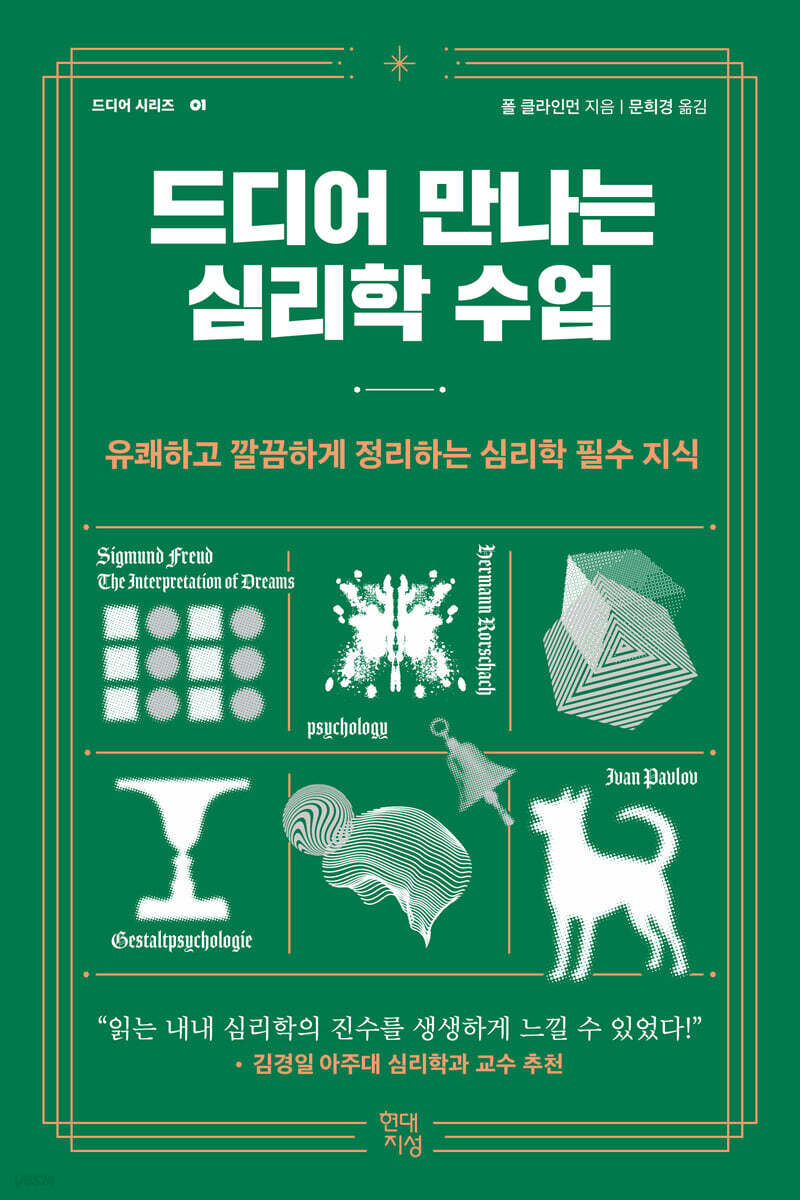
Finally meeting the psychology class
 |
Description
Book Introduction
Conditioned reflexes, defense mechanisms, panic disorder, consciousness and unconsciousness…
“I’ve heard this psychology term somewhere before.”
Psychological terms that are floating around in my head,
Now, let's organize it all clearly in this one book!
"I could vividly feel the essence of psychology throughout the book."
Kim Kyung-il | Cognitive psychologist, author of "The Wisdom of the Mind"
“If you want to study psychology properly, this book will definitely save you a lot of wasted time.”
Choi Seol-min | Operator of the YouTube channel "Learn Psychology Through Play" with 850,000 subscribers
Numerous fields of psychology have become popular recently, including criminal psychology, educational psychology, counseling psychology, consumer psychology, and investment psychology.
When we wonder about our boss's feelings, our child's feelings, or even the feelings of a close friend, we try to find answers in psychology.
Nowadays, it is essential to study psychology.
However, the psychological knowledge introduced in various media such as books, lectures, TV, and YouTube is still vague.
In particular, there is a severe lack of content that clearly organizes the fragmented and confusing knowledge floating around.
For readers thirsty for psychological knowledge, “Finally, Psychology Class” was published.
This book neatly organizes the work of about 80 psychologists and 50 psychological theories.
Readers can now make their own the psychological knowledge they had vaguely known.
In the process of acquiring various psychological knowledge, we will be able to solve the big and small problems we face in our daily lives one by one.
It also includes colorful visual aids to help you understand the content, so anyone can study psychology easily and enjoyably.
Whether you're new to psychology or want to systematically organize your knowledge, this book is all you need.
“I’ve heard this psychology term somewhere before.”
Psychological terms that are floating around in my head,
Now, let's organize it all clearly in this one book!
"I could vividly feel the essence of psychology throughout the book."
Kim Kyung-il | Cognitive psychologist, author of "The Wisdom of the Mind"
“If you want to study psychology properly, this book will definitely save you a lot of wasted time.”
Choi Seol-min | Operator of the YouTube channel "Learn Psychology Through Play" with 850,000 subscribers
Numerous fields of psychology have become popular recently, including criminal psychology, educational psychology, counseling psychology, consumer psychology, and investment psychology.
When we wonder about our boss's feelings, our child's feelings, or even the feelings of a close friend, we try to find answers in psychology.
Nowadays, it is essential to study psychology.
However, the psychological knowledge introduced in various media such as books, lectures, TV, and YouTube is still vague.
In particular, there is a severe lack of content that clearly organizes the fragmented and confusing knowledge floating around.
For readers thirsty for psychological knowledge, “Finally, Psychology Class” was published.
This book neatly organizes the work of about 80 psychologists and 50 psychological theories.
Readers can now make their own the psychological knowledge they had vaguely known.
In the process of acquiring various psychological knowledge, we will be able to solve the big and small problems we face in our daily lives one by one.
It also includes colorful visual aids to help you understand the content, so anyone can study psychology easily and enjoyably.
Whether you're new to psychology or want to systematically organize your knowledge, this book is all you need.
- You can preview some of the book's contents.
Preview
index
Recommendation
Introduction
Chapter 1: Psychology of Understanding the Inner Self
Sigmund Freud: Founder of Psychoanalysis
Carl Jung: Introversion, Extroversion, and the Unconscious
Hermann Rorschach: Personality in Inkblots
Karen Horney: Women, Neurosis, and Escaping Freud
Henry Murray: Personality Traits
Anna Freud: Thinking of Children
Erich Fromm: Fundamental Human Needs
Abraham Maslow: Focusing on Human Potential
Cognitive Psychology: Understanding What Really Goes On in Your Head
Emotions: Why do we feel this way?
Drive Reduction Theory: Striving for Balance
Cognitive Dissonance Theory: The Battle with Myself
Self-Discrepancy Theory: The Impact of Achievement or Underachievement
Heuristics: Decision Making
The illusion of consensus and the illusion of uniqueness: You think the same thing as me… right?
Left Brain and Right Brain: Thinking from My Side
Perception: How We See What We See
Chapter 2: The Psychology of Understanding Relationships
Ivan Pavlov: The man who studied man's best friend
Alfred Adler: The Individual Matters
John Broadus Watson: Founder of Behaviorism
Kurt Lewin: The Father of Modern Social Psychology
Harry Stack Sullivan: Interpersonal Psychoanalysis
Jean Piaget: Child Development
Lev Vygotsky: The Importance of Social Interaction
Carl Rogers: Helping People Stand Up for Themselves
Burroughs Frederick Skinner: The Importance of Consequences
John Bowlby: The Father of Maternal Love Theory
Harry Harlow: Not Just a Monkey's Story
Solomon Ashe: The Power of Social Influence
Mary Ainsworth and the Strange Situation: A Different Approach to Attachment
Albert Ellis: Founder of a New Type of Psychotherapy
Albert Bandura: Learning by Observing Others
Lawrence Kohlberg: Moral Dilemmas
Rosenhan Experiment: What Happens When Healthy People Are Mixed with Mentally Ill Patients?
Stanley Milgram: A Shocking Psychologist
Philip Zimbardo: The Researcher Who Created Prisons
Chapter 3: Psychology for Understanding the World
Gestalt Psychology: Seeing Behavior and Mind as a Whole
Dream: What appears when the light disappears
Stress: The Science of Pressure
Personality: How do we become who we are?
Love: Listening with all your heart
Theories of Intelligence: Thinking About Thinking
Leadership Theory: What Does It Take to Be a Leader?
Attribution Theory: Giving Meaning to Everything We Do
Foundational Theory of Groups: What Happens When People Gather
David Kolb's Learning Styles: Learning Through Experience
Personality Disorders: When Behavior Goes Wrong
Dissociative Disorder: People Who Suddenly Disconnect
Anxiety Disorder: More Than Just Nervousness
Mood Disorders: When Your Emotions Run High
Body dysmorphic disorder: a condition in which pain is felt but the cause is unknown
Cognitive Behavioral Therapy: Recognizing Negative Behaviors
Art Therapy: Art for Healing
Hypnosis: Not a Clever Trick
The Good Samaritan Experiment: Understanding Help
The Magic Number 7, Plus or Minus 2: The Limits of Memory
Appendix: Table of Contents by Psychological Theory
Appendix: Psychology: Making Studying More Enjoyable
Image source
Search
Introduction
Chapter 1: Psychology of Understanding the Inner Self
Sigmund Freud: Founder of Psychoanalysis
Carl Jung: Introversion, Extroversion, and the Unconscious
Hermann Rorschach: Personality in Inkblots
Karen Horney: Women, Neurosis, and Escaping Freud
Henry Murray: Personality Traits
Anna Freud: Thinking of Children
Erich Fromm: Fundamental Human Needs
Abraham Maslow: Focusing on Human Potential
Cognitive Psychology: Understanding What Really Goes On in Your Head
Emotions: Why do we feel this way?
Drive Reduction Theory: Striving for Balance
Cognitive Dissonance Theory: The Battle with Myself
Self-Discrepancy Theory: The Impact of Achievement or Underachievement
Heuristics: Decision Making
The illusion of consensus and the illusion of uniqueness: You think the same thing as me… right?
Left Brain and Right Brain: Thinking from My Side
Perception: How We See What We See
Chapter 2: The Psychology of Understanding Relationships
Ivan Pavlov: The man who studied man's best friend
Alfred Adler: The Individual Matters
John Broadus Watson: Founder of Behaviorism
Kurt Lewin: The Father of Modern Social Psychology
Harry Stack Sullivan: Interpersonal Psychoanalysis
Jean Piaget: Child Development
Lev Vygotsky: The Importance of Social Interaction
Carl Rogers: Helping People Stand Up for Themselves
Burroughs Frederick Skinner: The Importance of Consequences
John Bowlby: The Father of Maternal Love Theory
Harry Harlow: Not Just a Monkey's Story
Solomon Ashe: The Power of Social Influence
Mary Ainsworth and the Strange Situation: A Different Approach to Attachment
Albert Ellis: Founder of a New Type of Psychotherapy
Albert Bandura: Learning by Observing Others
Lawrence Kohlberg: Moral Dilemmas
Rosenhan Experiment: What Happens When Healthy People Are Mixed with Mentally Ill Patients?
Stanley Milgram: A Shocking Psychologist
Philip Zimbardo: The Researcher Who Created Prisons
Chapter 3: Psychology for Understanding the World
Gestalt Psychology: Seeing Behavior and Mind as a Whole
Dream: What appears when the light disappears
Stress: The Science of Pressure
Personality: How do we become who we are?
Love: Listening with all your heart
Theories of Intelligence: Thinking About Thinking
Leadership Theory: What Does It Take to Be a Leader?
Attribution Theory: Giving Meaning to Everything We Do
Foundational Theory of Groups: What Happens When People Gather
David Kolb's Learning Styles: Learning Through Experience
Personality Disorders: When Behavior Goes Wrong
Dissociative Disorder: People Who Suddenly Disconnect
Anxiety Disorder: More Than Just Nervousness
Mood Disorders: When Your Emotions Run High
Body dysmorphic disorder: a condition in which pain is felt but the cause is unknown
Cognitive Behavioral Therapy: Recognizing Negative Behaviors
Art Therapy: Art for Healing
Hypnosis: Not a Clever Trick
The Good Samaritan Experiment: Understanding Help
The Magic Number 7, Plus or Minus 2: The Limits of Memory
Appendix: Table of Contents by Psychological Theory
Appendix: Psychology: Making Studying More Enjoyable
Image source
Search
Detailed image

Into the book
The ego develops naturally as a child interacts with the world around him or her over the course of three years.
So Freud said that the ego follows the 'reality principle'.
The ego gradually realizes that there are people around it with desires and needs, and that acting impulsively or selfishly can cause real harm.
The ego must satisfy the id's needs while taking into account realistic situations.
For example, if a child reconsiders a wrong action after considering the negative consequences of the wrong action, it means that the ego is at work.
--- p.26
While Fromm agreed with the common belief that individuals must be free from external authority to be free, he argued that there are psychological processes within humans that limit and suppress freedom.
So, I said that in order for an individual to enjoy true freedom, he or she must overcome this process.
According to Fromm, freedom is a state of independence and a state of not relying on anyone outside of oneself for purpose or meaning.
Therefore, freedom can lead to feelings of isolation, fear, alienation, emptiness, and in extreme cases, true freedom can become a form of mental illness.
--- p.73
Cognitive psychology is a branch of psychology that focuses on how humans acquire, process, and store information.
Before the 1950s, behaviorism was the dominant school of thought, but over the next two decades, psychology shifted from studying observable behavior to studying internal mental processes.
We started focusing on topics like attention, memory, problem solving, perception, intelligence, decision making, and language processing.
Cognitive psychology differs from psychoanalysis in that it examines mental processes through scientific research methods rather than relying on the subjective perceptions of the psychoanalyst.
--- p.85
The illusion of consensus is the phenomenon of believing that one's opinions or beliefs are the common opinions and beliefs of everyone else.
Similarly, the illusion of uniqueness effect is the phenomenon of underestimating how common our abilities and good traits actually are.
The illusion of consensus and the illusion of uniqueness are examples of cognitive biases, which are judgmental flaws that occur in our minds to process information at a faster rate.
--- p.123
Adler was convinced that the drive for personal gain, "superiority," and the drive for community gain, "success," are the driving forces that drive us to act.
Everyone feels inferior from the beginning because they are born with a small and weak body.
And we try to overcome this feeling.
People who strive for superiority are psychologically unhealthy because they are not interested in others and are focused only on their own interests.
On the other hand, people who strive for success are psychologically healthy because they do not lose their own identity while striving for the good of all humanity.
--- p.153
John Bowlby was the first researcher to develop attachment theory and a psychologist who examined how early attachments significantly impact our lives.
Attachment refers to the psychological bond between two people.
Attachment is a psychological force that keeps a child close to its mother, increasing the child's chances of survival.
Bowlby believed that children are hardwired to form attachments for survival.
Furthermore, the bond formed in early life is a bond between a child and a caregiver, and this bond can have a lasting impact on the child's life later on.
--- p.201
The main goal of Ellis' rational emotive behavior therapy is to help patients change their irrational beliefs into rational ones.
This is done by the therapist challenging the patient's irrational beliefs.
For example, a therapist might ask a patient, “Why should people be kind to you?”
In answering this question, the patient realizes that there is no rational reason why this belief should necessarily be realized.
--- p.227
The Stanford Prison Experiment is one of the most important and controversial psychological experiments ever conducted.
The current ethical guidelines of the American Psychological Association make it impossible to replicate this experiment.
However, Zimbardo has clearly demonstrated how a given situation can influence people's behavior.
Numerous real-world cases, including the prisoner abuse incident at Abu Ghraib in Iraq, corroborate Zimbardo's research.
--- p.261
Stress is a state in which a physiological response occurs due to external stimuli.
The stimulus can be psychological or physiological.
Stress can be long-term or short-term.
Contrary to popular belief, stress is not just a feeling.
Stress can have a real impact on our biological and psychological state.
Although we often think of stress as a worry, it is actually more than that and is not necessarily a bad thing.
In fact, there are two types of stress: negative stress and positive stress, and each type of stress is caused by negative or positive events.
--- p.280
Good leadership can come from helping followers understand what they need to reach their full potential, or it can come from establishing a system of rewards and punishments.
Studying leadership theories and understanding how others respond to your leadership style can be a practical way to adapt to the world.
Because there are many ways to become a great leader, it's important to explore various leadership theories to become a good leader.
--- p.314
Personality disorders are patterns of behavior and internal experiences that deviate from the norms of the society to which a person belongs.
This pattern is inflexible and inevitable, beginning in adolescence or early adulthood.
It may cause serious distress or damage to your daily life.
Researchers haven't yet pinpointed what causes personality disorders.
Some believe it is a result of genetics, while others believe the underlying cause lies in childhood experiences that prevent the development of normal behavior and thought patterns.
--- p.334
Art is a richly expressive medium.
Art helps people communicate and relieve stress.
It also allows each individual to discover and study the various aspects of their personality.
In psychology, art is used to improve an individual's mental health or treat psychological disorders, a process called 'art therapy'.
Art therapy integrates the process of creating art with psychotherapy techniques to help individuals resolve their problems and regulate their behavior.
It also helps reduce the stress you face in everyday life, improve interpersonal skills, and strengthen self-awareness and self-control.
So Freud said that the ego follows the 'reality principle'.
The ego gradually realizes that there are people around it with desires and needs, and that acting impulsively or selfishly can cause real harm.
The ego must satisfy the id's needs while taking into account realistic situations.
For example, if a child reconsiders a wrong action after considering the negative consequences of the wrong action, it means that the ego is at work.
--- p.26
While Fromm agreed with the common belief that individuals must be free from external authority to be free, he argued that there are psychological processes within humans that limit and suppress freedom.
So, I said that in order for an individual to enjoy true freedom, he or she must overcome this process.
According to Fromm, freedom is a state of independence and a state of not relying on anyone outside of oneself for purpose or meaning.
Therefore, freedom can lead to feelings of isolation, fear, alienation, emptiness, and in extreme cases, true freedom can become a form of mental illness.
--- p.73
Cognitive psychology is a branch of psychology that focuses on how humans acquire, process, and store information.
Before the 1950s, behaviorism was the dominant school of thought, but over the next two decades, psychology shifted from studying observable behavior to studying internal mental processes.
We started focusing on topics like attention, memory, problem solving, perception, intelligence, decision making, and language processing.
Cognitive psychology differs from psychoanalysis in that it examines mental processes through scientific research methods rather than relying on the subjective perceptions of the psychoanalyst.
--- p.85
The illusion of consensus is the phenomenon of believing that one's opinions or beliefs are the common opinions and beliefs of everyone else.
Similarly, the illusion of uniqueness effect is the phenomenon of underestimating how common our abilities and good traits actually are.
The illusion of consensus and the illusion of uniqueness are examples of cognitive biases, which are judgmental flaws that occur in our minds to process information at a faster rate.
--- p.123
Adler was convinced that the drive for personal gain, "superiority," and the drive for community gain, "success," are the driving forces that drive us to act.
Everyone feels inferior from the beginning because they are born with a small and weak body.
And we try to overcome this feeling.
People who strive for superiority are psychologically unhealthy because they are not interested in others and are focused only on their own interests.
On the other hand, people who strive for success are psychologically healthy because they do not lose their own identity while striving for the good of all humanity.
--- p.153
John Bowlby was the first researcher to develop attachment theory and a psychologist who examined how early attachments significantly impact our lives.
Attachment refers to the psychological bond between two people.
Attachment is a psychological force that keeps a child close to its mother, increasing the child's chances of survival.
Bowlby believed that children are hardwired to form attachments for survival.
Furthermore, the bond formed in early life is a bond between a child and a caregiver, and this bond can have a lasting impact on the child's life later on.
--- p.201
The main goal of Ellis' rational emotive behavior therapy is to help patients change their irrational beliefs into rational ones.
This is done by the therapist challenging the patient's irrational beliefs.
For example, a therapist might ask a patient, “Why should people be kind to you?”
In answering this question, the patient realizes that there is no rational reason why this belief should necessarily be realized.
--- p.227
The Stanford Prison Experiment is one of the most important and controversial psychological experiments ever conducted.
The current ethical guidelines of the American Psychological Association make it impossible to replicate this experiment.
However, Zimbardo has clearly demonstrated how a given situation can influence people's behavior.
Numerous real-world cases, including the prisoner abuse incident at Abu Ghraib in Iraq, corroborate Zimbardo's research.
--- p.261
Stress is a state in which a physiological response occurs due to external stimuli.
The stimulus can be psychological or physiological.
Stress can be long-term or short-term.
Contrary to popular belief, stress is not just a feeling.
Stress can have a real impact on our biological and psychological state.
Although we often think of stress as a worry, it is actually more than that and is not necessarily a bad thing.
In fact, there are two types of stress: negative stress and positive stress, and each type of stress is caused by negative or positive events.
--- p.280
Good leadership can come from helping followers understand what they need to reach their full potential, or it can come from establishing a system of rewards and punishments.
Studying leadership theories and understanding how others respond to your leadership style can be a practical way to adapt to the world.
Because there are many ways to become a great leader, it's important to explore various leadership theories to become a good leader.
--- p.314
Personality disorders are patterns of behavior and internal experiences that deviate from the norms of the society to which a person belongs.
This pattern is inflexible and inevitable, beginning in adolescence or early adulthood.
It may cause serious distress or damage to your daily life.
Researchers haven't yet pinpointed what causes personality disorders.
Some believe it is a result of genetics, while others believe the underlying cause lies in childhood experiences that prevent the development of normal behavior and thought patterns.
--- p.334
Art is a richly expressive medium.
Art helps people communicate and relieve stress.
It also allows each individual to discover and study the various aspects of their personality.
In psychology, art is used to improve an individual's mental health or treat psychological disorders, a process called 'art therapy'.
Art therapy integrates the process of creating art with psychotherapy techniques to help individuals resolve their problems and regulate their behavior.
It also helps reduce the stress you face in everyday life, improve interpersonal skills, and strengthen self-awareness and self-control.
--- p.371
Publisher's Review
Psychology is common, but
I don't know much about psychology
Paul Kleinman, author of "Psychology: A New Beginning," defines psychology as the study of mental and behavioral processes.
It is also said to be a process of answering fundamental questions such as 'What moves us?' and 'How do we view the world?'
The emotions, thoughts, dreams, memories, perceptions, personalities, diseases, and treatments contained in these questions are closely related to our lives.
Therefore, only by knowing psychology can we easily solve minor problems in daily life.
Many types of psychology have become popular or are being used recently, including criminal psychology, educational psychology, counseling psychology, and industrial psychology.
The word 'psychology' itself is commonly seen in terms such as consumer psychology, investment psychology, and child psychology.
When we wonder about our boss's feelings, our child's feelings, or our friend's or close acquaintance's feelings, we try to find answers in psychology.
We already live with various psychologies, and now we have entered an era where studying psychology is essential both in daily life and academically.
Perhaps that is why psychological knowledge has been pouring out recently through various media such as books, lectures, TV, and YouTube.
However, there is still a lack of means to properly study psychology, with only occasional introductions.
In particular, there is a severe lack of content that organizes fragmented psychological knowledge in an easily understandable manner.
For a fun study of psychology
Organize neatly and tidy
This book neatly organizes the work of about 80 psychologists and 50 psychological theories.
Part 1 mainly deals with the psychology necessary to understand the inner self.
It helps us understand various psychological elements within ourselves, such as the unconscious, desires, ego, personality, and defense mechanisms.
You will be able to resolve big and small questions about the human mind, such as why humans value balance when making decisions, what are the fundamental human desires, and what causes cognitive biases.
Part 2 introduces psychology to help us understand relationships.
Humans form their self-image through interactions with others, and most psychologists focus on the relationship with their mother.
The bond between mother and baby can be understood through Bowlby's 'maternal deprivation', Harlow's 'rhesus monkey experiment', and Ainsworth's 'strange situation experiment'.
Additionally, you can study various psychological theories that deal with relationships, such as the importance of social interaction, the impact of interpersonal relationships on self-actualization, and human conformity.
Finally, Part 3 focuses on using psychology to understand the world.
You can find practical psychology on topics such as stress, love, learning, disability, and therapy.
It is filled with a wealth of psychological knowledge that becomes more useful the more you learn about it, including negative and positive stress, various psychological views on love, types of leadership theories, and the chronology of intelligence theories.
At the back of the book, there is a list of interesting psychology-themed content, including books, dramas, and movies, to help readers study psychology more deeply and enjoyably.
As you read the book with these contents, you will feel the psychological knowledge that was floating around in your head being organized clearly.
Studying psychology
Understanding the inner self, relationships, and the world
By reading this book, readers will be able to internalize numerous pieces of psychological knowledge that they have heard of but never properly understood.
It can clearly organize and organize the fragmented psychological knowledge, such as what cognitive psychology deals with, what the difference is between the ego and the superego, and what causes defense mechanisms to appear.
In addition, through the process of acquiring various psychological knowledge, you can solve the big and small problems you encounter in daily life, such as why you behave in certain ways, how to communicate with this person, and how to utilize positive stress.
As you follow the guide and read the book, you will find yourself with a deeper understanding of yourself, your relationships, and the world.
Whether you're new to psychology or want to systematically organize your knowledge, this book is all you need.
I don't know much about psychology
Paul Kleinman, author of "Psychology: A New Beginning," defines psychology as the study of mental and behavioral processes.
It is also said to be a process of answering fundamental questions such as 'What moves us?' and 'How do we view the world?'
The emotions, thoughts, dreams, memories, perceptions, personalities, diseases, and treatments contained in these questions are closely related to our lives.
Therefore, only by knowing psychology can we easily solve minor problems in daily life.
Many types of psychology have become popular or are being used recently, including criminal psychology, educational psychology, counseling psychology, and industrial psychology.
The word 'psychology' itself is commonly seen in terms such as consumer psychology, investment psychology, and child psychology.
When we wonder about our boss's feelings, our child's feelings, or our friend's or close acquaintance's feelings, we try to find answers in psychology.
We already live with various psychologies, and now we have entered an era where studying psychology is essential both in daily life and academically.
Perhaps that is why psychological knowledge has been pouring out recently through various media such as books, lectures, TV, and YouTube.
However, there is still a lack of means to properly study psychology, with only occasional introductions.
In particular, there is a severe lack of content that organizes fragmented psychological knowledge in an easily understandable manner.
For a fun study of psychology
Organize neatly and tidy
This book neatly organizes the work of about 80 psychologists and 50 psychological theories.
Part 1 mainly deals with the psychology necessary to understand the inner self.
It helps us understand various psychological elements within ourselves, such as the unconscious, desires, ego, personality, and defense mechanisms.
You will be able to resolve big and small questions about the human mind, such as why humans value balance when making decisions, what are the fundamental human desires, and what causes cognitive biases.
Part 2 introduces psychology to help us understand relationships.
Humans form their self-image through interactions with others, and most psychologists focus on the relationship with their mother.
The bond between mother and baby can be understood through Bowlby's 'maternal deprivation', Harlow's 'rhesus monkey experiment', and Ainsworth's 'strange situation experiment'.
Additionally, you can study various psychological theories that deal with relationships, such as the importance of social interaction, the impact of interpersonal relationships on self-actualization, and human conformity.
Finally, Part 3 focuses on using psychology to understand the world.
You can find practical psychology on topics such as stress, love, learning, disability, and therapy.
It is filled with a wealth of psychological knowledge that becomes more useful the more you learn about it, including negative and positive stress, various psychological views on love, types of leadership theories, and the chronology of intelligence theories.
At the back of the book, there is a list of interesting psychology-themed content, including books, dramas, and movies, to help readers study psychology more deeply and enjoyably.
As you read the book with these contents, you will feel the psychological knowledge that was floating around in your head being organized clearly.
Studying psychology
Understanding the inner self, relationships, and the world
By reading this book, readers will be able to internalize numerous pieces of psychological knowledge that they have heard of but never properly understood.
It can clearly organize and organize the fragmented psychological knowledge, such as what cognitive psychology deals with, what the difference is between the ego and the superego, and what causes defense mechanisms to appear.
In addition, through the process of acquiring various psychological knowledge, you can solve the big and small problems you encounter in daily life, such as why you behave in certain ways, how to communicate with this person, and how to utilize positive stress.
As you follow the guide and read the book, you will find yourself with a deeper understanding of yourself, your relationships, and the world.
Whether you're new to psychology or want to systematically organize your knowledge, this book is all you need.
GOODS SPECIFICS
- Date of issue: September 27, 2024
- Page count, weight, size: 408 pages | 524g | 140*210*25mm
- ISBN13: 9791139717006
- ISBN10: 1139717006
You may also like
카테고리
korean


korean

![GQ KOREA Mark (Monthly): December [2025]](http://librairie.coreenne.fr/cdn/shop/files/8ef265dbbfbf186523ed75ba7319009d.jpg?v=1765340328&width=3840)


