

The power of metacognition
 |
Description
Book Introduction
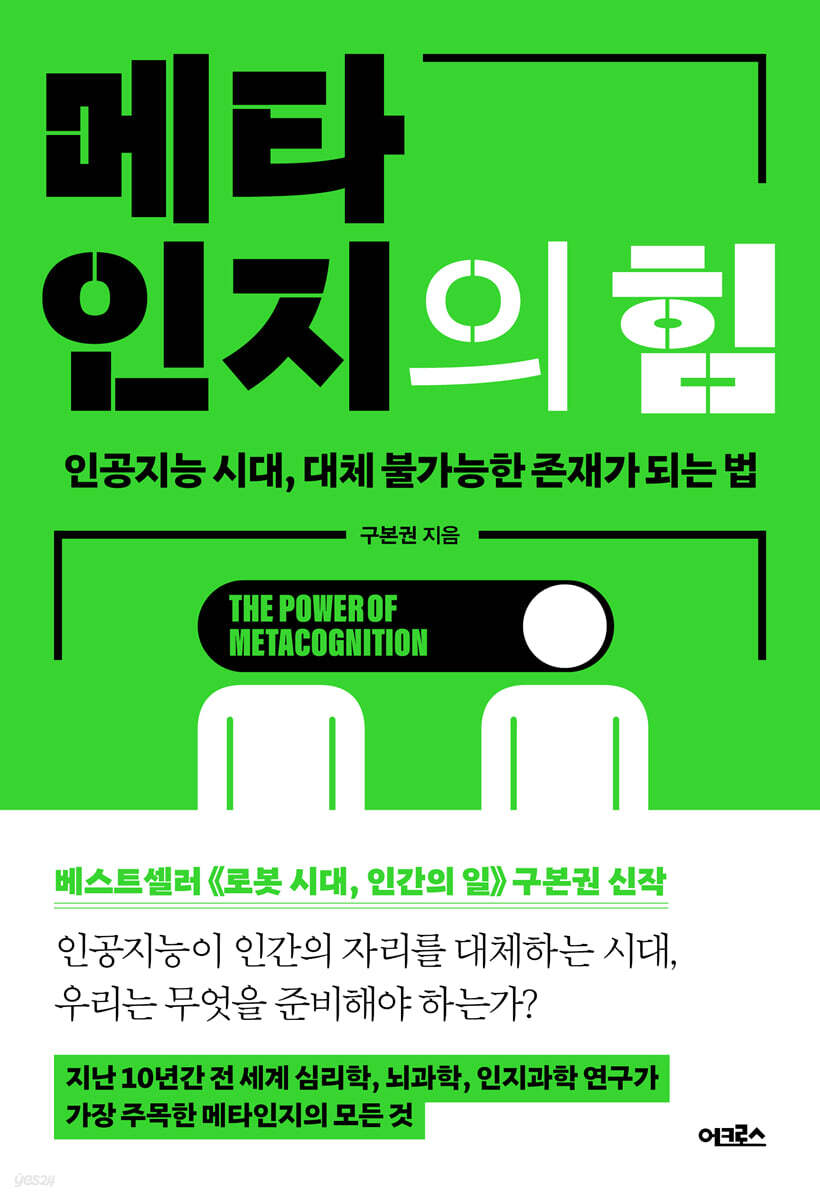
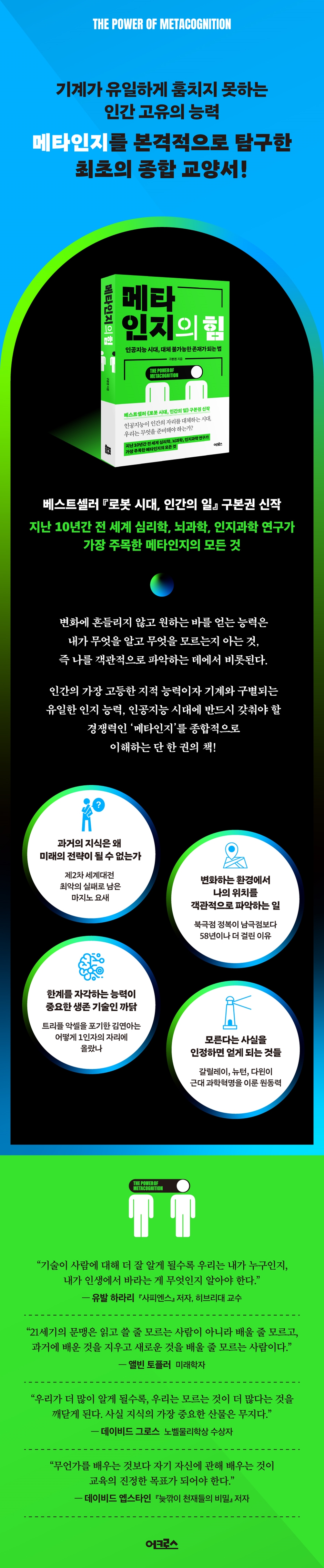
A comprehensive textbook on 'metacognition,' the highest intellectual ability of humans and the only cognitive ability that distinguishes them from machines.
It helps you comprehensively understand 'metacognition,' a topic that has been the most important topic of study by researchers in brain science, neuroscience, psychology, and cognitive science around the world and an essential competitive edge in the age of artificial intelligence.
A new work by Koo Bon-kwon, author of the best-selling book “Human Work in the Robot Age” and digital humanist.
It helps you comprehensively understand 'metacognition,' a topic that has been the most important topic of study by researchers in brain science, neuroscience, psychology, and cognitive science around the world and an essential competitive edge in the age of artificial intelligence.
A new work by Koo Bon-kwon, author of the best-selling book “Human Work in the Robot Age” and digital humanist.
- You can preview some of the book's contents.
Preview
index
Author's Note: The Absolute Ring to Navigate the AI Era
Chapter 1: Why They Failed - The Beginning of Metacognition
1.
What Unexpected Monumental Failures Have in Common
2.
Why Success Is So Hard to Sustain
3.
The Link Between Failure and Metacognition
Chapter 2: Understanding My Coordinates - The Core of Metacognition
1.
How Britain Conquered the Seas
2.
The Critical Difference Between Success and Failure in North Pole Expeditions
3.
How to objectively understand my position
Chapter 3: How the Illusion of Rationality Is Created: The Difficulty of Metacognition
1.
Fish don't know water
2.
Two systems that move thoughts
3.
The brain is not rational, it just rationalizes.
4.
The Truth the Enlightenment Missed
Chapter 4: Why Do We Learn More as We Learn More? - Metacognition and Learning
1.
What the Dunning-Kruger Experiment Tells Us
2.
Your attitude toward uncertainty determines your intellectual capacity.
3.
Metacognition is the process of discovering more ignorance.
Chapter 5: Essential Skills in the Digital and AI Era: Artificial Intelligence and Metacognition
1.
A changing landscape in the age of information chaos
2.
The impact of 'real-time' technology
3.
Algorithms and filters rule our thoughts.
4.
To avoid confusion in a world where the virtual and the real are mixed
Chapter 6: Why Important Things Are Invisible - Metacognition and the Invisible World
1.
The visible world, the invisible world
2.
The ability that makes humans superior beings
3.
Metacognition, the eye that sees the invisible
Chapter 7: Metacognition: Insights that Embrace the Duality of Life - Metacognition and the Wisdom of Paradox
1.
The paradox of freedom and choice
2.
Why did the Germans give up their freedom?
3.
Paradox is the power to discover truth beyond what is visible.
Chapter 8: A Starting Point for Ultimate Wisdom - Cultivating Metacognition
1.
Discover and read signals
2.
The First Step to Metacognition: Questions Have Answers
3.
Metacognition is accepting one's limitations.
4.
Discovering Long-Term Goals and Motivations
5.
How to borrow someone else's eyes
6.
Tools of metacognition
Chapter 9 Conclusion: Pay Attention to Yourself
Chapter 1: Why They Failed - The Beginning of Metacognition
1.
What Unexpected Monumental Failures Have in Common
2.
Why Success Is So Hard to Sustain
3.
The Link Between Failure and Metacognition
Chapter 2: Understanding My Coordinates - The Core of Metacognition
1.
How Britain Conquered the Seas
2.
The Critical Difference Between Success and Failure in North Pole Expeditions
3.
How to objectively understand my position
Chapter 3: How the Illusion of Rationality Is Created: The Difficulty of Metacognition
1.
Fish don't know water
2.
Two systems that move thoughts
3.
The brain is not rational, it just rationalizes.
4.
The Truth the Enlightenment Missed
Chapter 4: Why Do We Learn More as We Learn More? - Metacognition and Learning
1.
What the Dunning-Kruger Experiment Tells Us
2.
Your attitude toward uncertainty determines your intellectual capacity.
3.
Metacognition is the process of discovering more ignorance.
Chapter 5: Essential Skills in the Digital and AI Era: Artificial Intelligence and Metacognition
1.
A changing landscape in the age of information chaos
2.
The impact of 'real-time' technology
3.
Algorithms and filters rule our thoughts.
4.
To avoid confusion in a world where the virtual and the real are mixed
Chapter 6: Why Important Things Are Invisible - Metacognition and the Invisible World
1.
The visible world, the invisible world
2.
The ability that makes humans superior beings
3.
Metacognition, the eye that sees the invisible
Chapter 7: Metacognition: Insights that Embrace the Duality of Life - Metacognition and the Wisdom of Paradox
1.
The paradox of freedom and choice
2.
Why did the Germans give up their freedom?
3.
Paradox is the power to discover truth beyond what is visible.
Chapter 8: A Starting Point for Ultimate Wisdom - Cultivating Metacognition
1.
Discover and read signals
2.
The First Step to Metacognition: Questions Have Answers
3.
Metacognition is accepting one's limitations.
4.
Discovering Long-Term Goals and Motivations
5.
How to borrow someone else's eyes
6.
Tools of metacognition
Chapter 9 Conclusion: Pay Attention to Yourself
Detailed image
Into the book
It is difficult to generalize why they failed.
Nevertheless, two common causes can be found.
One is that we failed to grasp the objective situation.
It is a failure to perceive and judge external reality, that is, to perceive the object.
Another is to be confident that the knowledge and judgment you have cannot be wrong.
It is a cognitive failure of the subject of perception.
It is the illusion of knowing something about a subject without realizing what you know and what you don't know.
The two things that those who have failed have overlooked: object recognition and subject recognition, are metacognition, which this book aims to address.
---From "Page 28, Chapter 1, Why They Failed"
The history of the countless challenges faced in reaching the North Pole vividly illustrates the challenges of exploration in a world where the target is constantly moving and accurate measurement and verification tools are lacking.
This also awakens the conditions for accurately determining one's current location.
First, you need to know whether your goals are fixed or fluid, and you need to understand the characteristics and limitations of the measuring tools you use to determine your current position and the path you are taking.
Without knowing this, no matter how arduous or courageous the challenge, it will only lead to the wrong goal.
---From "Page 64, Chapter 2: Understanding My Coordinates"
As the Rumsfeld Matrix demonstrates, the discovery of ignorance is the starting point of knowledge and the driving force behind scientific progress.
Columbia University biology professor Stuart Firestein said that ignorance and failure are the two pillars that support science and the engines of scientific progress.
In the world of science, knowledge is constantly evolving, supplementing and replacing past knowledge, making what was once considered unwavering and immutable knowledge provisional and changeable.
The history of physics is a process of change and development in which Newton's classical mechanics was replaced by Einstein's theory of relativity, which was in turn supplemented and replaced by quantum mechanics by Niels Bohr and Heisenberg.
---From "Page 138, Chapter 4, Why Do We Unknow More as We Learn?"
Metacognition, a core human cognition, is becoming an increasingly important ability in a digital world where infinite information and virtuality are intertwined, created by machines.
In the past, I didn't have to worry about whether the information I was using was true or not, whether it was virtual and automatically created by a machine, or whether it passed through some filters or algorithms before being delivered to me.
This is because there wasn't a lot of virtual reality and misinformation, and it was very rare for it to be indistinguishable from reality.
Metacognitive abilities are essential to avoid falling into the cognitive traps hidden by convenience and abundance in a digital society.
---From "Page 178, Chapter 5: Essential Skills in the Digital and Artificial Intelligence Era"
The important thing is to acknowledge that I myself am a being with various innate biases and cognitive error tendencies, and that these influence my thoughts and judgments.
We must acknowledge that humans are fundamentally vulnerable beings, not dignified and powerful beings capable of demonstrating the indomitable will to "do it."
We cannot find a proper response without acknowledging the existence and power of the forces that exert a profound influence on us and our cognition.
So the first step to metacognition is to discover the beings that influence me and acknowledge their power.
Nevertheless, two common causes can be found.
One is that we failed to grasp the objective situation.
It is a failure to perceive and judge external reality, that is, to perceive the object.
Another is to be confident that the knowledge and judgment you have cannot be wrong.
It is a cognitive failure of the subject of perception.
It is the illusion of knowing something about a subject without realizing what you know and what you don't know.
The two things that those who have failed have overlooked: object recognition and subject recognition, are metacognition, which this book aims to address.
---From "Page 28, Chapter 1, Why They Failed"
The history of the countless challenges faced in reaching the North Pole vividly illustrates the challenges of exploration in a world where the target is constantly moving and accurate measurement and verification tools are lacking.
This also awakens the conditions for accurately determining one's current location.
First, you need to know whether your goals are fixed or fluid, and you need to understand the characteristics and limitations of the measuring tools you use to determine your current position and the path you are taking.
Without knowing this, no matter how arduous or courageous the challenge, it will only lead to the wrong goal.
---From "Page 64, Chapter 2: Understanding My Coordinates"
As the Rumsfeld Matrix demonstrates, the discovery of ignorance is the starting point of knowledge and the driving force behind scientific progress.
Columbia University biology professor Stuart Firestein said that ignorance and failure are the two pillars that support science and the engines of scientific progress.
In the world of science, knowledge is constantly evolving, supplementing and replacing past knowledge, making what was once considered unwavering and immutable knowledge provisional and changeable.
The history of physics is a process of change and development in which Newton's classical mechanics was replaced by Einstein's theory of relativity, which was in turn supplemented and replaced by quantum mechanics by Niels Bohr and Heisenberg.
---From "Page 138, Chapter 4, Why Do We Unknow More as We Learn?"
Metacognition, a core human cognition, is becoming an increasingly important ability in a digital world where infinite information and virtuality are intertwined, created by machines.
In the past, I didn't have to worry about whether the information I was using was true or not, whether it was virtual and automatically created by a machine, or whether it passed through some filters or algorithms before being delivered to me.
This is because there wasn't a lot of virtual reality and misinformation, and it was very rare for it to be indistinguishable from reality.
Metacognitive abilities are essential to avoid falling into the cognitive traps hidden by convenience and abundance in a digital society.
---From "Page 178, Chapter 5: Essential Skills in the Digital and Artificial Intelligence Era"
The important thing is to acknowledge that I myself am a being with various innate biases and cognitive error tendencies, and that these influence my thoughts and judgments.
We must acknowledge that humans are fundamentally vulnerable beings, not dignified and powerful beings capable of demonstrating the indomitable will to "do it."
We cannot find a proper response without acknowledging the existence and power of the forces that exert a profound influence on us and our cognition.
So the first step to metacognition is to discover the beings that influence me and acknowledge their power.
---From "Page 262, Chapter 8: The Starting Point for the Highest Wisdom"
Publisher's Review
The highest intellectual ability of humans and the only cognitive ability that distinguishes them from machines.
Essential skills in the age of artificial intelligence
The only book that comprehensively understands 'metacognition'
From the Internet to smartphones to artificial intelligence, digital technology has opened up a new world where anyone can easily access knowledge and information.
However, rapid environmental changes and information overload can also cause us to become confused and lose sight of what we really need to know.
The ability to get what you want without being swayed by change begins with knowing what you know and what you don't know—that is, understanding yourself objectively.
This is the area of 'metacognition' that has been the most important area of research by researchers in brain science, neuroscience, psychology, and cognitive science around the world.
This book, "The Power of Metacognition," is a comprehensive textbook on metacognition, the highest intellectual ability of humans.
The author, who has observed the light and dark sides of technological advancement and the resulting cognitive and social changes in humans from the front lines as an IT journalist for over 30 years, notes that metacognition is the only ability that distinguishes humans from machines and is a competitive edge that is essential in the age of artificial intelligence.
World-renowned scholars such as Yuval Harari and Alvin Toffler have consistently emphasized the importance of metacognition.
In particular, Yuval Harari emphasized that metacognition is an essential ability in the digital world, saying, “As technology gets to know people better, we need to know who we are and what we want from life.”
In this book, the author examines how metacognition impacts work and life, drawing on research in cognitive science, brain science, and psychology, various case studies, and philosophical questions to explore why past knowledge cannot serve as a strategy for the future, how to objectively assess one's position, and what can be gained by acknowledging one's ignorance and limitations.
For those seeking to acquire new intellectual abilities different from those of the past, this book will serve as a compass that helps them objectively understand themselves and provides direction for learning.
Yuna Kim gave up on the triple axel
How did you manage to rise to the top?
Metacognition, the ability to objectively understand oneself
France, which suffered a staggering 4.2 million casualties during World War I, built a 750-kilometer-long fortification along its border with Germany over a period of ten years starting in 1927.
This powerful fortress, which blocks attacks from the outside with natural terrain and concrete walls several meters thick, is the 'Maginot Line'.
When the Germans invaded in 1940 during World War II, the Maginot Line did not break through or collapse as expected, but it failed miserably in stopping the German attack.
Instead, while the French were tied down in their fortresses, the Germans advanced through an unexpected highland area, catching the French off guard.
Although the development of weapons completely changed the form and strategy of battle, the French army relied on past experiences to prepare for future wars and overestimated their effectiveness, resulting in a painful defeat.
The Maginot Fortress case vividly illustrates the consequences of a lack of metacognition, the ability to objectively perceive external circumstances and oneself.
The introduction to this book cites former figure skater Yuna Kim as an example of someone with outstanding metacognitive abilities.
While her junior rival Mao Asada was making strides with the difficult triple Axel technique, Yuna Kim gave up the triple Axel, which carries a high risk of error, and instead focused on perfecting various jump techniques and maximizing artistry.
The author says that Kim Yuna was able to rise to the top spot at the 2010 Vancouver Winter Olympics by beating Mao Asada with a world record because she possessed metacognition that objectively and clearly recognized her strengths and limitations.
The author said in “The Art of War”, “Even if you don’t know your enemy, if you know yourself, you will win once and lose once.
“But if you don’t know your opponent and don’t know yourself, you’re always in danger every time you fight,” he quotes from the book.
This passage, which states that even if you don't know much about your enemy, you can win half the battle if you have a good understanding of your own strength, reminds us that, especially for modern people who live in numerous social relationships, objective awareness of oneself is more important and valuable than understanding external circumstances.
Top technology companies like Nokia, Kodak, and Blackberry
How did it all fall in an instant?
The impact of metacognition on our work and life
Let's look at various studies and cases.
Kodak, a leading company in film and photography technology, filed for bankruptcy protection in 2012, unable to overcome losses as film cameras declined and digital cameras became the norm.
But in fact, Kodak was the first company in the world to develop a digital camera.
However, the company failed to grasp reality and ended up going bankrupt as it was complacent about the stable profits generated from its main product, the film division.
The history of science, technology, and industry is often filled with examples of companies that once dominated the market with unparalleled competitiveness only to suddenly fall.
This is also the case for Nokia, which accounted for 40 percent of global mobile phone sales, and BlackBerry, which dominated the business smartphone market.
In the constantly changing 21st century, we must adapt by intentionally forgetting what we previously knew and learning new things, but this is a task that places a great cognitive and psychological burden on us.
This is why companies that make the mistake of ignoring the changing knowledge and social environment and clinging to old knowledge still persist.
This is not just a problem for groups like corporations.
Humans, armed with smartphones and artificial intelligence, have enjoyed convenience and abundance unimaginable in the past, but the information-rich digital world has also depleted our intellectual capacity and caused us to lose our attention span.
In addition, the validity period of knowledge is becoming shorter and shorter, and the phenomenon of 'liquid knowledge' is spreading, in which knowledge becomes inaccurate as soon as it is established and becomes subject to update.
In this environment, it is not important to learn specific knowledge before others.
It requires the ability to find what you need from the overflowing information and to understand it comprehensively according to the situation.
This book starkly demonstrates that in a changing world, past knowledge cannot serve as a strategy for the future, and that metacognition is increasingly influencing our lives and work.
Humans cannot understand themselves objectively.
Researchers in psychology, brain science, and cognitive science around the world
Why focus on metacognition
We think we know ourselves well and consider ourselves rational, logical, and objective.
But in reality, human reason is full of loopholes.
We fail to perceive the certain and clear existence that surrounds us, like water and air, and the more familiar something is, the more we fail to see it.
The author asserts that most of what we feel, do, and think is governed by instinct and intuition, and that the great illusion arises from thinking of ourselves as rational.
The reason that various fields of study, including evolutionary biology, behavioral economics, cognitive psychology, and neuroscience, are paying attention to metacognition today is because metacognition is the most difficult and advanced ability in human cognition.
This book comprehensively covers various studies on human cognition, including the 'invisible gorilla' experiment by Harvard psychologists Daniel Simons and Christopher Chabris, the 'heuristic' research by Nobel Prize winner in economics Daniel Kahneman, and the 'cognitive dissonance' research by University of Minnesota social psychologist Leon Festinger, to help us understand metacognition, such as how we perceive ourselves and the world and why it is so difficult to think objectively and rationally.
Metacognition, a core human cognition, is becoming an increasingly important ability in a digital world where infinite information and virtuality are intertwined, created by machines.
It is an essential ability to understand whether the information I use is true or not, whether what is in front of me is virtual or real, automatically created by a machine, and what filters and algorithms it passed through to be delivered to me, and to avoid falling into the cognitive traps hidden by the convenience and abundance of the digital society.
Furthermore, the core question of metacognition, ‘What do I know and what do I not know?’ leads to the essential question of life, ‘Who am I?’
This is because reflecting on one's cognitive state inevitably leads to looking into one's inner self.
In this book, the author reminds us that metacognition is not simply a means to improve learning and work efficiency, but is none other than self-reflection that countless thinkers from the East and the West, including Socrates and Confucius, have talked about for 2,500 years. Ultimately, he emphasizes that the metacognition we must possess is the ability to focus on what is finite and precious in life, and the ability to pay attention to our inner selves.
Essential skills in the age of artificial intelligence
The only book that comprehensively understands 'metacognition'
From the Internet to smartphones to artificial intelligence, digital technology has opened up a new world where anyone can easily access knowledge and information.
However, rapid environmental changes and information overload can also cause us to become confused and lose sight of what we really need to know.
The ability to get what you want without being swayed by change begins with knowing what you know and what you don't know—that is, understanding yourself objectively.
This is the area of 'metacognition' that has been the most important area of research by researchers in brain science, neuroscience, psychology, and cognitive science around the world.
This book, "The Power of Metacognition," is a comprehensive textbook on metacognition, the highest intellectual ability of humans.
The author, who has observed the light and dark sides of technological advancement and the resulting cognitive and social changes in humans from the front lines as an IT journalist for over 30 years, notes that metacognition is the only ability that distinguishes humans from machines and is a competitive edge that is essential in the age of artificial intelligence.
World-renowned scholars such as Yuval Harari and Alvin Toffler have consistently emphasized the importance of metacognition.
In particular, Yuval Harari emphasized that metacognition is an essential ability in the digital world, saying, “As technology gets to know people better, we need to know who we are and what we want from life.”
In this book, the author examines how metacognition impacts work and life, drawing on research in cognitive science, brain science, and psychology, various case studies, and philosophical questions to explore why past knowledge cannot serve as a strategy for the future, how to objectively assess one's position, and what can be gained by acknowledging one's ignorance and limitations.
For those seeking to acquire new intellectual abilities different from those of the past, this book will serve as a compass that helps them objectively understand themselves and provides direction for learning.
Yuna Kim gave up on the triple axel
How did you manage to rise to the top?
Metacognition, the ability to objectively understand oneself
France, which suffered a staggering 4.2 million casualties during World War I, built a 750-kilometer-long fortification along its border with Germany over a period of ten years starting in 1927.
This powerful fortress, which blocks attacks from the outside with natural terrain and concrete walls several meters thick, is the 'Maginot Line'.
When the Germans invaded in 1940 during World War II, the Maginot Line did not break through or collapse as expected, but it failed miserably in stopping the German attack.
Instead, while the French were tied down in their fortresses, the Germans advanced through an unexpected highland area, catching the French off guard.
Although the development of weapons completely changed the form and strategy of battle, the French army relied on past experiences to prepare for future wars and overestimated their effectiveness, resulting in a painful defeat.
The Maginot Fortress case vividly illustrates the consequences of a lack of metacognition, the ability to objectively perceive external circumstances and oneself.
The introduction to this book cites former figure skater Yuna Kim as an example of someone with outstanding metacognitive abilities.
While her junior rival Mao Asada was making strides with the difficult triple Axel technique, Yuna Kim gave up the triple Axel, which carries a high risk of error, and instead focused on perfecting various jump techniques and maximizing artistry.
The author says that Kim Yuna was able to rise to the top spot at the 2010 Vancouver Winter Olympics by beating Mao Asada with a world record because she possessed metacognition that objectively and clearly recognized her strengths and limitations.
The author said in “The Art of War”, “Even if you don’t know your enemy, if you know yourself, you will win once and lose once.
“But if you don’t know your opponent and don’t know yourself, you’re always in danger every time you fight,” he quotes from the book.
This passage, which states that even if you don't know much about your enemy, you can win half the battle if you have a good understanding of your own strength, reminds us that, especially for modern people who live in numerous social relationships, objective awareness of oneself is more important and valuable than understanding external circumstances.
Top technology companies like Nokia, Kodak, and Blackberry
How did it all fall in an instant?
The impact of metacognition on our work and life
Let's look at various studies and cases.
Kodak, a leading company in film and photography technology, filed for bankruptcy protection in 2012, unable to overcome losses as film cameras declined and digital cameras became the norm.
But in fact, Kodak was the first company in the world to develop a digital camera.
However, the company failed to grasp reality and ended up going bankrupt as it was complacent about the stable profits generated from its main product, the film division.
The history of science, technology, and industry is often filled with examples of companies that once dominated the market with unparalleled competitiveness only to suddenly fall.
This is also the case for Nokia, which accounted for 40 percent of global mobile phone sales, and BlackBerry, which dominated the business smartphone market.
In the constantly changing 21st century, we must adapt by intentionally forgetting what we previously knew and learning new things, but this is a task that places a great cognitive and psychological burden on us.
This is why companies that make the mistake of ignoring the changing knowledge and social environment and clinging to old knowledge still persist.
This is not just a problem for groups like corporations.
Humans, armed with smartphones and artificial intelligence, have enjoyed convenience and abundance unimaginable in the past, but the information-rich digital world has also depleted our intellectual capacity and caused us to lose our attention span.
In addition, the validity period of knowledge is becoming shorter and shorter, and the phenomenon of 'liquid knowledge' is spreading, in which knowledge becomes inaccurate as soon as it is established and becomes subject to update.
In this environment, it is not important to learn specific knowledge before others.
It requires the ability to find what you need from the overflowing information and to understand it comprehensively according to the situation.
This book starkly demonstrates that in a changing world, past knowledge cannot serve as a strategy for the future, and that metacognition is increasingly influencing our lives and work.
Humans cannot understand themselves objectively.
Researchers in psychology, brain science, and cognitive science around the world
Why focus on metacognition
We think we know ourselves well and consider ourselves rational, logical, and objective.
But in reality, human reason is full of loopholes.
We fail to perceive the certain and clear existence that surrounds us, like water and air, and the more familiar something is, the more we fail to see it.
The author asserts that most of what we feel, do, and think is governed by instinct and intuition, and that the great illusion arises from thinking of ourselves as rational.
The reason that various fields of study, including evolutionary biology, behavioral economics, cognitive psychology, and neuroscience, are paying attention to metacognition today is because metacognition is the most difficult and advanced ability in human cognition.
This book comprehensively covers various studies on human cognition, including the 'invisible gorilla' experiment by Harvard psychologists Daniel Simons and Christopher Chabris, the 'heuristic' research by Nobel Prize winner in economics Daniel Kahneman, and the 'cognitive dissonance' research by University of Minnesota social psychologist Leon Festinger, to help us understand metacognition, such as how we perceive ourselves and the world and why it is so difficult to think objectively and rationally.
Metacognition, a core human cognition, is becoming an increasingly important ability in a digital world where infinite information and virtuality are intertwined, created by machines.
It is an essential ability to understand whether the information I use is true or not, whether what is in front of me is virtual or real, automatically created by a machine, and what filters and algorithms it passed through to be delivered to me, and to avoid falling into the cognitive traps hidden by the convenience and abundance of the digital society.
Furthermore, the core question of metacognition, ‘What do I know and what do I not know?’ leads to the essential question of life, ‘Who am I?’
This is because reflecting on one's cognitive state inevitably leads to looking into one's inner self.
In this book, the author reminds us that metacognition is not simply a means to improve learning and work efficiency, but is none other than self-reflection that countless thinkers from the East and the West, including Socrates and Confucius, have talked about for 2,500 years. Ultimately, he emphasizes that the metacognition we must possess is the ability to focus on what is finite and precious in life, and the ability to pay attention to our inner selves.
GOODS SPECIFICS
- Date of issue: June 26, 2023
- Page count, weight, size: 312 pages | 510g | 147*215*20mm
- ISBN13: 9791167741066
- ISBN10: 1167741064
You may also like
카테고리
korean


korean

![GQ KOREA Mark (Monthly): December [2025]](http://librairie.coreenne.fr/cdn/shop/files/8ef265dbbfbf186523ed75ba7319009d.jpg?v=1765340328&width=3840)


