

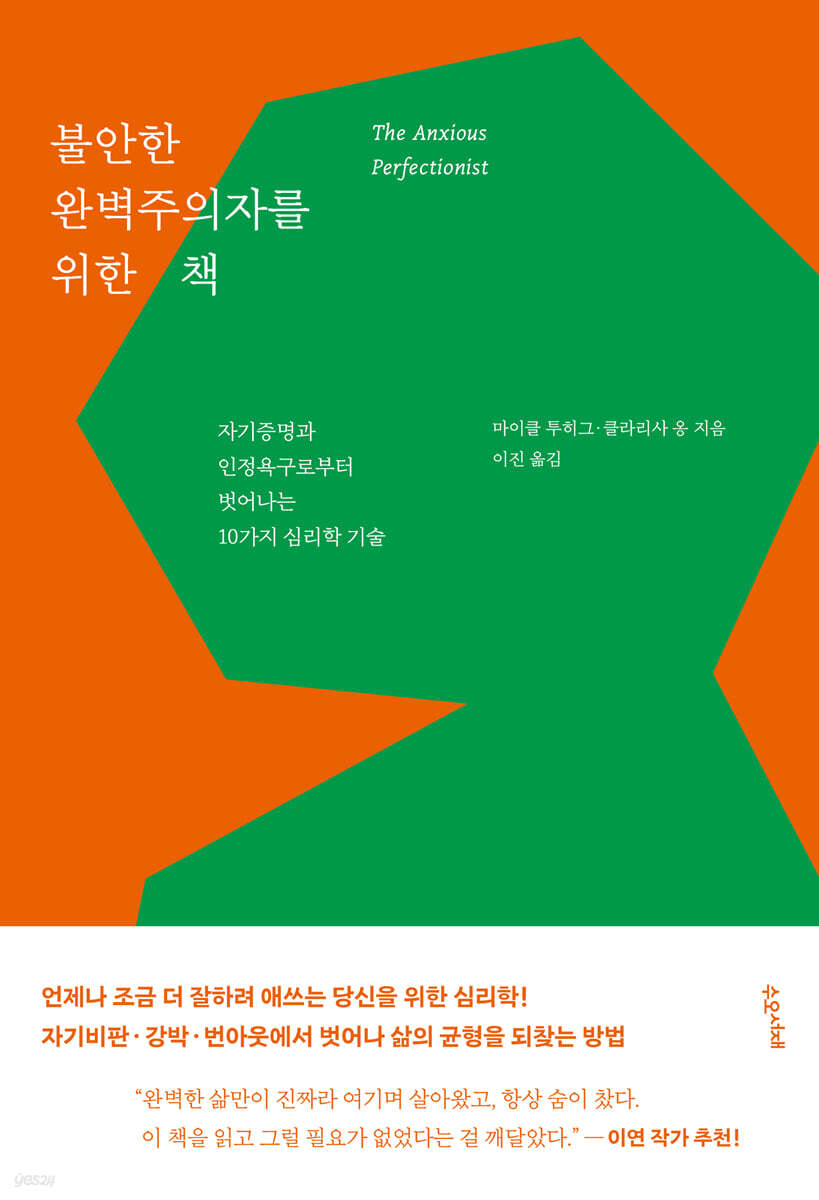
A Book for Anxious Perfectionists
 |
Description
Book Introduction
Are you someone who strives for achievement and self-satisfaction, or someone who strives to avoid mistakes and failure? Perfectionism manifests itself in two ways.
There is "adaptive" perfectionism, which leads to high productivity and the rewards and fulfillment that come with it, while there is "maladaptive" perfectionism, which leads to constant tension in achieving goals, excessive self-control, ruining relationships, and chronic procrastination.
Maladaptive perfectionists are constantly trying to prove themselves and gain approval from others, which can lead to anxiety, worry, depression, and stress.
The two authors, clinical psychologists who study anxiety and obsessive-compulsive disorders, realized that not only their clients, but also their close colleagues, and even themselves were trapped by perfectionism and felt a deep sense of incompleteness. They wrote this book to understand perfectionism and apply treatment methods in real life, not just in theory.
They offer practical ways to cope with the anxiety caused by perfectionism and introduce 10 psychological techniques that can help you reset your values and priorities in life.
This book will help you break free from the shackles of perfectionism that defines you and cultivate perspectives and attitudes that will allow you to live life more flexibly.
There is "adaptive" perfectionism, which leads to high productivity and the rewards and fulfillment that come with it, while there is "maladaptive" perfectionism, which leads to constant tension in achieving goals, excessive self-control, ruining relationships, and chronic procrastination.
Maladaptive perfectionists are constantly trying to prove themselves and gain approval from others, which can lead to anxiety, worry, depression, and stress.
The two authors, clinical psychologists who study anxiety and obsessive-compulsive disorders, realized that not only their clients, but also their close colleagues, and even themselves were trapped by perfectionism and felt a deep sense of incompleteness. They wrote this book to understand perfectionism and apply treatment methods in real life, not just in theory.
They offer practical ways to cope with the anxiety caused by perfectionism and introduce 10 psychological techniques that can help you reset your values and priorities in life.
This book will help you break free from the shackles of perfectionism that defines you and cultivate perspectives and attitudes that will allow you to live life more flexibly.
- You can preview some of the book's contents.
Preview
index
Recommendation_If you are willing to embrace mistakes and failures
Introduction_To you who are struggling in a sea of anxiety, stress, and worry
Chapter 1: Perfectionism: A Losing Game
Why You Had to Become a Perfectionist
Chapter 2: The Illusion of Moving Toward Success
Adaptive Perfectionism vs. Maladaptive Perfectionism
Chapter 3: How to Deal with Fear
When the principles I created hold me back
Chapter 4: Living as an Imperfect Me
Practice allowing uncomfortable feelings
Chapter 5: The Reality of Self-Criticism
Cutting Out the 'Tag' That Narrows Your Vision
Chapter 6: Why You Should Set Values
Questions for prioritizing life
Chapter 7: Life is a process, not an outcome.
How to Develop Attention to Manage Anxiety
Chapter 8: The Usefulness of Self-Kindness
Taking care of myself is not an option, it's a necessity.
Chapter 9: How to Take Charge of Failure
Set specific, quantifiable goals
Chapter 10: The Courage to Choose
Small changes to restore balance to your daily life
Translator's Note_To my beloved perfectionists
References
Introduction_To you who are struggling in a sea of anxiety, stress, and worry
Chapter 1: Perfectionism: A Losing Game
Why You Had to Become a Perfectionist
Chapter 2: The Illusion of Moving Toward Success
Adaptive Perfectionism vs. Maladaptive Perfectionism
Chapter 3: How to Deal with Fear
When the principles I created hold me back
Chapter 4: Living as an Imperfect Me
Practice allowing uncomfortable feelings
Chapter 5: The Reality of Self-Criticism
Cutting Out the 'Tag' That Narrows Your Vision
Chapter 6: Why You Should Set Values
Questions for prioritizing life
Chapter 7: Life is a process, not an outcome.
How to Develop Attention to Manage Anxiety
Chapter 8: The Usefulness of Self-Kindness
Taking care of myself is not an option, it's a necessity.
Chapter 9: How to Take Charge of Failure
Set specific, quantifiable goals
Chapter 10: The Courage to Choose
Small changes to restore balance to your daily life
Translator's Note_To my beloved perfectionists
References
Detailed image
Into the book
In the real world, there are always flaws, mistakes, and missteps.
Moreover, the definition of perfection itself is constantly changing.
The concept of perfection you have when you first start something changes once you actually get there.
Therefore, pursuing perfection is like chasing a mirage that doesn't exist.
No matter how fast you run, you can never catch it.
It's as if the person you're playing with changes the rules of the game every time you get ahead.
It's an unfair and tiring game.
---From "Page 30, "Perfectionism, a Game You Always Lose"
In adaptive perfectionism, the motivation is to 'get closer' to a desirable outcome (positive reinforcement), whereas in maladaptive perfectionism, the motivation is to 'avoid or escape' an undesirable outcome (negative reinforcement).
Positive reinforcement is the carrot, while negative reinforcement is the stick.
Do you act to get a reward or to avoid a bad outcome?
---From page 39, “The Illusion of Moving Toward Success”
Perfectionism uses principles and logic to exert power over actions.
Perfectionism tells us what we 'should' do and why we 'should' do it.
However, these principles have no basis and cannot actually make you take any action.
No matter how strong the words, no matter how loud the sound.
So, when perfectionism threatens that your life will be over if you get a B or break up with your long-term partner, don't take it at face value.
---From page 75, “How to Deal with Fear”
The process of accepting a feeling means giving it space to exist.
Like making room in the living room for that ugly piece of furniture you inherited from your grandmother.
Accepting something doesn't necessarily mean you like it.
Just give it space.
Conversely, to reject feelings is to reject oneself.
Because feelings are a product of the past and you are made from the past.
Emotional avoidance is ultimately self-denial from within.
---From page 87, “Living as an Imperfect Me”
As psychotherapists who have treated countless clients struggling with self-criticism, we firmly reject the myth that self-criticism is the fuel for success.
You have been harsh on yourself and have only accomplished what you set out to do.
In other words, the two things happened simultaneously, but one did not cause the other.
Even if the causal relationship is clear, do you want to live your life repeatedly feeling inadequate and proving that criticism is wrong?
---From "Page 111, "The Reality of Self-Criticism"
Think about what keeps you alive, what makes you excited to start your day, what makes you willing to suffer.
Start from there.
There is no good or bad in values, no right or wrong.
It is right because you chose it.
There is no need to make excuses for your worth.
You are the one who will enjoy a meaningful life, and you are the one who will suffer while living a life far from values.
---From page 119, “Why Values Must Be Set”
If you focus only on the results of your efforts rather than the process of pursuing your goals, you will always feel like you are chasing something, and your attention will be caught up in the past or future, losing sight of the present.
But the present is the only space where life happens.
Moreover, because attention is finite, using it for anxiety, stress, and worry can cause you to miss out on other things worth focusing on, like the things you love and the people you care about.
---From page 149, “Life is a process, not a result”
Self-kindness demands the opposite.
Accept all of yourself, even the parts you don't like, and demand that others give you the same opportunity.
Think about the last time you exposed a weakness.
When I opened up about the difficulties I had trying to keep up with other parents, and the traumas of my childhood that I thought others would never understand.
How did it feel to reveal yourself as you really are, rather than as you believe people should see you? Weakness doesn't make us weak.
It just makes you human.
Exposing our weaknesses gives us the strength to live as ourselves and opens our hearts to the world.
---From “The Usefulness of Self-Kindness,” page 165
Instead of blindly believing the "I'm too busy" narrative, see busy situations as a signal to prioritize the moment.
This means you actually have control over your busy situation.
Being busy is choosing what you'll make time for, and what you'll give up to make time for it.
Even if both align with your values, you have to choose one or the other.
---From "How to Take Responsibility for Failure" on page 204
Because society continues to emphasize the pursuit of success, perfectionist tendencies that avoid mistakes, please others, and criticize oneself will return.
When that happens, use appropriate strategies to distance yourself from perfectionism and avoid falling back into old habits.
Nevertheless, you can fail.
Failure is inevitable.
Moreover, anxiety, stress, and worry are always waiting for an opportunity to return.
Don't beat yourself up for not embracing your imperfections. When you stray from the path, turn back to your values and resume your journey.
After all, this is your life too.
Live that life.
Moreover, the definition of perfection itself is constantly changing.
The concept of perfection you have when you first start something changes once you actually get there.
Therefore, pursuing perfection is like chasing a mirage that doesn't exist.
No matter how fast you run, you can never catch it.
It's as if the person you're playing with changes the rules of the game every time you get ahead.
It's an unfair and tiring game.
---From "Page 30, "Perfectionism, a Game You Always Lose"
In adaptive perfectionism, the motivation is to 'get closer' to a desirable outcome (positive reinforcement), whereas in maladaptive perfectionism, the motivation is to 'avoid or escape' an undesirable outcome (negative reinforcement).
Positive reinforcement is the carrot, while negative reinforcement is the stick.
Do you act to get a reward or to avoid a bad outcome?
---From page 39, “The Illusion of Moving Toward Success”
Perfectionism uses principles and logic to exert power over actions.
Perfectionism tells us what we 'should' do and why we 'should' do it.
However, these principles have no basis and cannot actually make you take any action.
No matter how strong the words, no matter how loud the sound.
So, when perfectionism threatens that your life will be over if you get a B or break up with your long-term partner, don't take it at face value.
---From page 75, “How to Deal with Fear”
The process of accepting a feeling means giving it space to exist.
Like making room in the living room for that ugly piece of furniture you inherited from your grandmother.
Accepting something doesn't necessarily mean you like it.
Just give it space.
Conversely, to reject feelings is to reject oneself.
Because feelings are a product of the past and you are made from the past.
Emotional avoidance is ultimately self-denial from within.
---From page 87, “Living as an Imperfect Me”
As psychotherapists who have treated countless clients struggling with self-criticism, we firmly reject the myth that self-criticism is the fuel for success.
You have been harsh on yourself and have only accomplished what you set out to do.
In other words, the two things happened simultaneously, but one did not cause the other.
Even if the causal relationship is clear, do you want to live your life repeatedly feeling inadequate and proving that criticism is wrong?
---From "Page 111, "The Reality of Self-Criticism"
Think about what keeps you alive, what makes you excited to start your day, what makes you willing to suffer.
Start from there.
There is no good or bad in values, no right or wrong.
It is right because you chose it.
There is no need to make excuses for your worth.
You are the one who will enjoy a meaningful life, and you are the one who will suffer while living a life far from values.
---From page 119, “Why Values Must Be Set”
If you focus only on the results of your efforts rather than the process of pursuing your goals, you will always feel like you are chasing something, and your attention will be caught up in the past or future, losing sight of the present.
But the present is the only space where life happens.
Moreover, because attention is finite, using it for anxiety, stress, and worry can cause you to miss out on other things worth focusing on, like the things you love and the people you care about.
---From page 149, “Life is a process, not a result”
Self-kindness demands the opposite.
Accept all of yourself, even the parts you don't like, and demand that others give you the same opportunity.
Think about the last time you exposed a weakness.
When I opened up about the difficulties I had trying to keep up with other parents, and the traumas of my childhood that I thought others would never understand.
How did it feel to reveal yourself as you really are, rather than as you believe people should see you? Weakness doesn't make us weak.
It just makes you human.
Exposing our weaknesses gives us the strength to live as ourselves and opens our hearts to the world.
---From “The Usefulness of Self-Kindness,” page 165
Instead of blindly believing the "I'm too busy" narrative, see busy situations as a signal to prioritize the moment.
This means you actually have control over your busy situation.
Being busy is choosing what you'll make time for, and what you'll give up to make time for it.
Even if both align with your values, you have to choose one or the other.
---From "How to Take Responsibility for Failure" on page 204
Because society continues to emphasize the pursuit of success, perfectionist tendencies that avoid mistakes, please others, and criticize oneself will return.
When that happens, use appropriate strategies to distance yourself from perfectionism and avoid falling back into old habits.
Nevertheless, you can fail.
Failure is inevitable.
Moreover, anxiety, stress, and worry are always waiting for an opportunity to return.
Don't beat yourself up for not embracing your imperfections. When you stray from the path, turn back to your values and resume your journey.
After all, this is your life too.
Live that life.
---From "The Courage to Choose" on page 224
Publisher's Review
For fear of looking incompetent, for fear of making mistakes
For those who are trapped in the frame of perfectionism,
A guide to living independently!
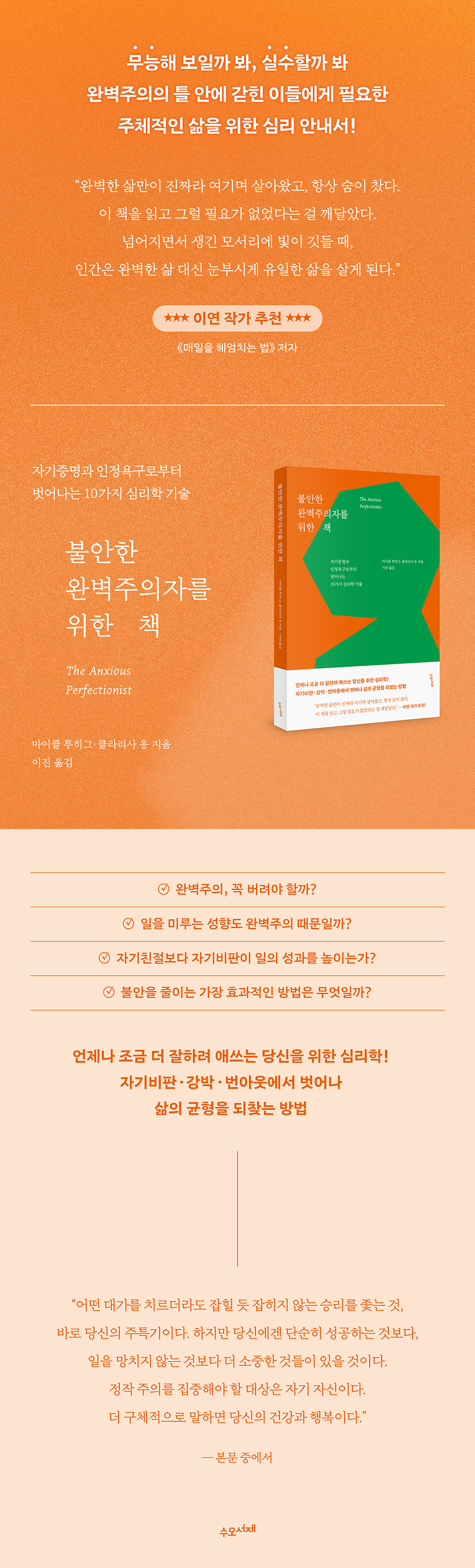
“I lived my life believing that only a perfect life was real, and I was always out of breath.
After reading this book, I realized that I didn't need to do that." - Recommended by author Lee Yeon!
Do you feel compelled to double-check even the simplest emails? Do you neglect the mundane routines of eating, exercising, and meeting friends to ensure a perfect completion of a given task? Do you procrastinate on important tasks until the last minute, doubting there might be a better option? Perfectionists, constantly striving for better, are driven by fear and anxiety about appearing incompetent or making mistakes.
Perfectionists are inherently self-critical.
I believe that I was able to achieve this much because I pushed myself hard.
But this book firmly denies the myth that self-criticism is the driving force behind success.
If you use self-pressure and self-flagellation as your driving force in life, even if you achieve success, you will still be unhappy.
The two authors, clinical psychologists who study anxiety and obsessive-compulsive disorders, realized that not only their clients, but also their close colleagues, and even themselves were trapped by perfectionism and felt a deep sense of incompleteness. They wrote this book to understand perfectionism and apply treatment methods in real life, not just in theory.
They offer practical ways to cope with the anxiety caused by perfectionism and introduce 10 psychological techniques that can help you reset your values and priorities in life.
Modern society demands ever higher standards and judges everything based on results, but we need to recognize the pitfalls of striving for perfection in an imperfect world.
This book will help you break free from the shackles of perfectionism that defines you and cultivate perspectives and attitudes that will allow you to live more flexibly.
“For you, there is more to it than just success,
Rather than messing things up
“There will be more precious things.”
Free yourself from self-criticism, obsession, and burnout.
Introducing 10 Psychological Techniques That Will Help You Take Back Control of Your Life!
Perfectionism comes in two forms:
There is "adaptive" perfectionism, which leads to rewarding achievements, high productivity, and the accompanying rewards and self-satisfaction. On the other hand, there is "maladaptive" perfectionism, which leads to constant tension in achieving goals, excessive self-control, ruining relationships, and habitual procrastination.
Maladaptive perfectionists are constantly trying to prove themselves and gain approval from others, which can lead to anxiety, worry, depression, and stress.
They pursue an elusive goal at all costs.
They believe that if they become more perfect and achieve more, they will be able to compensate for everything they have lost.
The most important thing, your own health and happiness, are put on the back burner.
So, does perfectionism necessarily need to be abandoned? Is procrastination also a result of perfectionism? What's the most effective way to reduce anxiety? This book reveals how perfectionism has been interfering with our lives and offers ways to break free from it.
Chapter 1 examines the background that led us to become perfectionists and helps us take an objective look at the perfectionism that has dominated our lives.
It presents a new path for those who have believed that doing better is the only way to 'prove' themselves.
Chapter 2 shows the duality of perfectionism.
By focusing on 'maladaptive' perfectionism, we can understand why pursuing perfectionism can lead to worry, anxiety, and stress.
In Chapter 3, we will learn about the 'principles' that strongly maintain perfectionism.
It contains techniques for breaking your own rules and dealing with the fear that comes with it.
Chapter 4 tells you how to deal with the uncomfortable 'feeling' that comes when you break free from perfectionism.
Chapters 5 and 6 introduce practical methods for setting priorities in life centered on your own 'values' without 'self-criticism'.
Chapter 7, How to Develop 'Attention', teaches you how to practice shifting your attention to control anxiety.
Chapter 8 guides you toward self-kindness, the most powerful tool for dealing with perfectionism.
It emphasizes that we should be kind to ourselves unconditionally, without fear of exposing our mistakes or weaknesses.
Chapter 9 provides encouragement for those who procrastinate and avoid tasks while waiting for the perfect time by setting specific, quantifiable "goals" to move forward one step at a time.
The final ten chapters offer ways to find balance in your daily life, showing you that you can always "choose" to revert back to your previous perfectionism.
“Instead of a perfect life, a dazzlingly unique life.”
How to respect my choices and love life
This book offers a chance for change, creating a small crack in a life rigid with perfectionism and finding a new way of life through that crack.
Neither author condemns perfectionism per se.
It is something that needs to be avoided, but it is also a defensive strategy that has been chosen so far.
But if the pain of perfectionism outweighs the benefits, simply recognizing that you can choose and act in other ways is a good starting point.
Perfectionists find it difficult to imagine a space outside the sphere of perfectionism, where they must do better and avoid mistakes.
When you stop doing things because you "want to succeed" or "don't want to mess things up," a kind of vacuum is created in your life, leaving you with no choice but to rely on something to act on.
Perfectionists who have lost their way can learn to move from self-criticism to self-kindness through this book, and to set new priorities and values in life.
Author Lee Yeon, who recommended this book, said, “I gained courage despite my anxiety and shortcomings because I realized that the reason life is beautiful lies in its squalor.
“When light shines through the corners of a fall, humans live a dazzlingly unique life instead of a perfect life,” he said.
When we reveal our weaknesses, we are not becoming weaker.
However, he ends up living in his own unique way.
By following the 10 psychological techniques introduced by these two authors, you will not only be able to break free from perfectionism, but also regain pride, fulfillment, and vitality in your life.
For those who are trapped in the frame of perfectionism,
A guide to living independently!
“I lived my life believing that only a perfect life was real, and I was always out of breath.
After reading this book, I realized that I didn't need to do that." - Recommended by author Lee Yeon!
Do you feel compelled to double-check even the simplest emails? Do you neglect the mundane routines of eating, exercising, and meeting friends to ensure a perfect completion of a given task? Do you procrastinate on important tasks until the last minute, doubting there might be a better option? Perfectionists, constantly striving for better, are driven by fear and anxiety about appearing incompetent or making mistakes.
Perfectionists are inherently self-critical.
I believe that I was able to achieve this much because I pushed myself hard.
But this book firmly denies the myth that self-criticism is the driving force behind success.
If you use self-pressure and self-flagellation as your driving force in life, even if you achieve success, you will still be unhappy.
The two authors, clinical psychologists who study anxiety and obsessive-compulsive disorders, realized that not only their clients, but also their close colleagues, and even themselves were trapped by perfectionism and felt a deep sense of incompleteness. They wrote this book to understand perfectionism and apply treatment methods in real life, not just in theory.
They offer practical ways to cope with the anxiety caused by perfectionism and introduce 10 psychological techniques that can help you reset your values and priorities in life.
Modern society demands ever higher standards and judges everything based on results, but we need to recognize the pitfalls of striving for perfection in an imperfect world.
This book will help you break free from the shackles of perfectionism that defines you and cultivate perspectives and attitudes that will allow you to live more flexibly.
“For you, there is more to it than just success,
Rather than messing things up
“There will be more precious things.”
Free yourself from self-criticism, obsession, and burnout.
Introducing 10 Psychological Techniques That Will Help You Take Back Control of Your Life!
Perfectionism comes in two forms:
There is "adaptive" perfectionism, which leads to rewarding achievements, high productivity, and the accompanying rewards and self-satisfaction. On the other hand, there is "maladaptive" perfectionism, which leads to constant tension in achieving goals, excessive self-control, ruining relationships, and habitual procrastination.
Maladaptive perfectionists are constantly trying to prove themselves and gain approval from others, which can lead to anxiety, worry, depression, and stress.
They pursue an elusive goal at all costs.
They believe that if they become more perfect and achieve more, they will be able to compensate for everything they have lost.
The most important thing, your own health and happiness, are put on the back burner.
So, does perfectionism necessarily need to be abandoned? Is procrastination also a result of perfectionism? What's the most effective way to reduce anxiety? This book reveals how perfectionism has been interfering with our lives and offers ways to break free from it.
Chapter 1 examines the background that led us to become perfectionists and helps us take an objective look at the perfectionism that has dominated our lives.
It presents a new path for those who have believed that doing better is the only way to 'prove' themselves.
Chapter 2 shows the duality of perfectionism.
By focusing on 'maladaptive' perfectionism, we can understand why pursuing perfectionism can lead to worry, anxiety, and stress.
In Chapter 3, we will learn about the 'principles' that strongly maintain perfectionism.
It contains techniques for breaking your own rules and dealing with the fear that comes with it.
Chapter 4 tells you how to deal with the uncomfortable 'feeling' that comes when you break free from perfectionism.
Chapters 5 and 6 introduce practical methods for setting priorities in life centered on your own 'values' without 'self-criticism'.
Chapter 7, How to Develop 'Attention', teaches you how to practice shifting your attention to control anxiety.
Chapter 8 guides you toward self-kindness, the most powerful tool for dealing with perfectionism.
It emphasizes that we should be kind to ourselves unconditionally, without fear of exposing our mistakes or weaknesses.
Chapter 9 provides encouragement for those who procrastinate and avoid tasks while waiting for the perfect time by setting specific, quantifiable "goals" to move forward one step at a time.
The final ten chapters offer ways to find balance in your daily life, showing you that you can always "choose" to revert back to your previous perfectionism.
“Instead of a perfect life, a dazzlingly unique life.”
How to respect my choices and love life
This book offers a chance for change, creating a small crack in a life rigid with perfectionism and finding a new way of life through that crack.
Neither author condemns perfectionism per se.
It is something that needs to be avoided, but it is also a defensive strategy that has been chosen so far.
But if the pain of perfectionism outweighs the benefits, simply recognizing that you can choose and act in other ways is a good starting point.
Perfectionists find it difficult to imagine a space outside the sphere of perfectionism, where they must do better and avoid mistakes.
When you stop doing things because you "want to succeed" or "don't want to mess things up," a kind of vacuum is created in your life, leaving you with no choice but to rely on something to act on.
Perfectionists who have lost their way can learn to move from self-criticism to self-kindness through this book, and to set new priorities and values in life.
Author Lee Yeon, who recommended this book, said, “I gained courage despite my anxiety and shortcomings because I realized that the reason life is beautiful lies in its squalor.
“When light shines through the corners of a fall, humans live a dazzlingly unique life instead of a perfect life,” he said.
When we reveal our weaknesses, we are not becoming weaker.
However, he ends up living in his own unique way.
By following the 10 psychological techniques introduced by these two authors, you will not only be able to break free from perfectionism, but also regain pride, fulfillment, and vitality in your life.
GOODS SPECIFICS
- Date of issue: April 12, 2023
- Page count, weight, size: 232 pages | 318g | 140*205*15mm
- ISBN13: 9791190382991
- ISBN10: 1190382997
You may also like
카테고리
korean


korean

![GQ KOREA Mark (Monthly): December [2025]](http://librairie.coreenne.fr/cdn/shop/files/8ef265dbbfbf186523ed75ba7319009d.jpg?v=1765340328&width=3840)


