

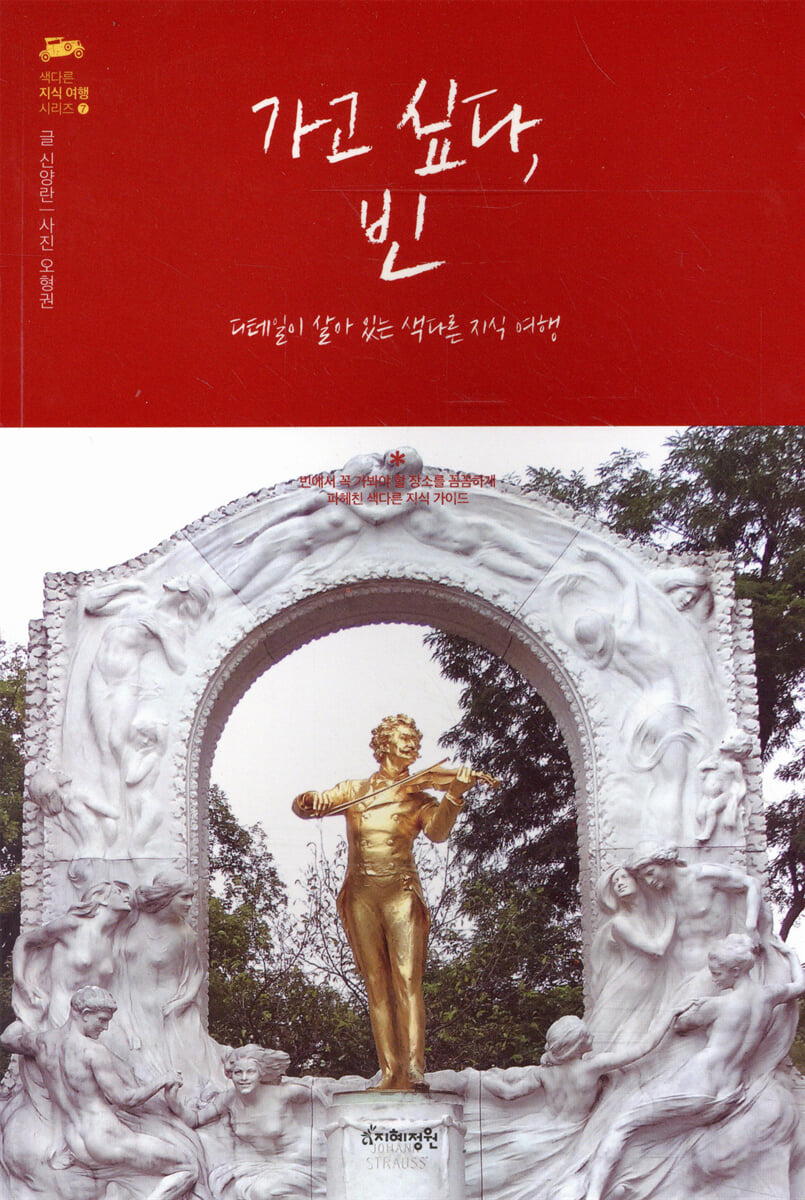
I want to go, Bin
 |
Description
Book Introduction
A knowledgeable travel guide that delves into Vienna's culture and history.
This is a knowledge travel guide that thoroughly explores the must-see places in Vienna, Austria.
From the Hofburg, where the Habsburg emperors and their families resided, to Schönbrunn Palace, the imperial summer residence, the Belvedere, famous for housing Gustav Klimt's "The Kiss," St. Stephen's Cathedral, the heart of Vienna, and the Kunsthistorisches Museum, Austria's representative museum, the book meticulously explains every small sculpture along the route, without missing a single one.
By examining the main characters of the statues located throughout the famous attractions and the meaning of the small sculptures attached to the buildings, you can naturally learn about Vienna's history and culture, and by learning about mythology and the Bible through the stories contained in the works of art in the museum.
This is a knowledge travel guide that thoroughly explores the must-see places in Vienna, Austria.
From the Hofburg, where the Habsburg emperors and their families resided, to Schönbrunn Palace, the imperial summer residence, the Belvedere, famous for housing Gustav Klimt's "The Kiss," St. Stephen's Cathedral, the heart of Vienna, and the Kunsthistorisches Museum, Austria's representative museum, the book meticulously explains every small sculpture along the route, without missing a single one.
By examining the main characters of the statues located throughout the famous attractions and the meaning of the small sculptures attached to the buildings, you can naturally learn about Vienna's history and culture, and by learning about mythology and the Bible through the stories contained in the works of art in the museum.
- You can preview some of the book's contents.
Preview
index
[Reading History Stories First 1] A Brief History of Austria
[Reading History Story 2] The Rise and Fall of the Habsburg Empire
[Reading History Story 3] The Bad Relationship Between the Habsburg Empire and the Ottoman Turks
Chapter 1.
Hofburg
1.
Hofburg, the Imperial Palace
2.
Heldenplatz
3.
Neuer Burg
- Kaiserforum and Ringstrasse
[Knowledge Boost] Otto Wagner, the Master of Art Nouveau Architecture
- Frontal figure sculptures
- The Ephesus Museum, where ancient relics are alive
4.
Alteburg
- Statue of Franz I at Burgplatz
- The oldest Swiss palace in Hofburg
- Imperial Treasure Hall, where treasures from the Habsburg Empire are displayed
[Knowledge Boost] The Holy Roman Empire: A Nation or a Confederation?
[Knowledge Boost] The Habsburg Empire, a Great Empire Built Through Political Marriages
- Royal Chapel
5.
Michael Dong
- The entrance to the Altenburg, Michael's Gate
- Michael's Church
[Knowledge Boost] Austria's Sweetheart, Sisi: Who Is She?
6.
Josef Square
7.
Royal Palace Library
8.
Augustinian Church
9.
Burggarten
Chapter 2.
Schönbrunn Palace
1.
Schönbrunn Palace, the imperial summer residence
2.
Rooms of Schönbrunn Palace
3.
Historical Figures You'll Meet at Schönbrunn Palace
- The eventful life of Franz Joseph I
- Children of Maria Theresa
- Schönbrunn Palace and Napoleon
- Charles I, the last emperor of the empire
4.
Schönbrunn's gardens
- Statues in the garden
- Gloriette
- Fountain of Neptune
- Ruins of Rome
- Statue of Egeria
Chapter 3.
Belvedere Palace
1.
Belvedere, Prince Eugene's summer residence
[Knowledge Boost] Prince Eugene of Savoy, Austrian Hero
[Knowledge Boost] The Assassination of the Crown Prince That Caused World War I
2.
The spaces and works of art at Belvedere
- The Marble Room
- Napoleon of Saint-Bernard
- Austria's three greatest painters
-Ha Belvedere
Part 2.
Vienna Cathedral
Chapter 1.
St. Stephen's Cathedral
1.
St. Stephen's Cathedral, the heart of Vienna
[Knowledge Boost] Characteristics of Gothic Architecture
2.
The exterior of St. Stephen's Cathedral
- Tower and exterior sculptures on the west face
- Tower and exterior sculptures on the south face
- Exterior sculptures on the east side
- Tower and exterior sculptures on the north face
3.
Interior of St. Stephen's Cathedral
- Altar and chapels on the right (south) nave
- The central altar and the altars in front of it
- Altar and chapels on the left (north) nave
Chapter 2.
Other cathedrals
1.
Charles Church
- Columns and angel statues on the front
- Central Altar
- Fresco ceiling
2.
Capuchin Cathedral
3.
Votif Church
[Knowledge Boost] Who is Maximilian I?
Part 3.
Museums and Art Galleries in Vienna
Chapter 1.
Museum of Art History
1.
Maria Theresa Square and the Maria Theresa Monument
[Knowledge Boost] The Ascension and Reign of Maria Theresa
2.
Exterior of the Museum of Art History
- Sculptures in front of the Art History Museum
- Sculptures at the back of the Art History Museum
3.
Central Hall of the Museum of Art History
4.
Art History Museum collection
Chapter 2.
Other museums and art galleries
1.
Vienna Museum of Natural History
- Sculptures in front of the Natural History Museum
- Sculptures at the back of the Natural History Museum
- Major collections of the Natural History Museum
2.
Jechesion
3.
Hundertwasserhaus and Kunsthaus Vienna
Part 4.
Other places
Chapter 1.
National Assembly Building
1.
The Reichstag, one of the landmarks of Ringstrasse
2.
The exterior of the National Assembly building, which resembles a Greek temple
3.
Conference rooms and rooms inside the National Assembly building
Chapter 2.
Empty Central Cemetery
1.
Vienna's famous figures sleep
2.
The most popular musician's grave in the Central Cemetery
3.
Karl Lueger Memorial Church
Chapter 3.
A good place to see together
1.
empty city hall
2.
Burgtheater
3.
National Opera House
4.
Graben Street and the Plague Memorial
[Knowledge Boost] Gustav Mahler, the Musician Who Loved Vienna
5.
Anker watch
6.
City park
[Reading History Story 2] The Rise and Fall of the Habsburg Empire
[Reading History Story 3] The Bad Relationship Between the Habsburg Empire and the Ottoman Turks
Chapter 1.
Hofburg
1.
Hofburg, the Imperial Palace
2.
Heldenplatz
3.
Neuer Burg
- Kaiserforum and Ringstrasse
[Knowledge Boost] Otto Wagner, the Master of Art Nouveau Architecture
- Frontal figure sculptures
- The Ephesus Museum, where ancient relics are alive
4.
Alteburg
- Statue of Franz I at Burgplatz
- The oldest Swiss palace in Hofburg
- Imperial Treasure Hall, where treasures from the Habsburg Empire are displayed
[Knowledge Boost] The Holy Roman Empire: A Nation or a Confederation?
[Knowledge Boost] The Habsburg Empire, a Great Empire Built Through Political Marriages
- Royal Chapel
5.
Michael Dong
- The entrance to the Altenburg, Michael's Gate
- Michael's Church
[Knowledge Boost] Austria's Sweetheart, Sisi: Who Is She?
6.
Josef Square
7.
Royal Palace Library
8.
Augustinian Church
9.
Burggarten
Chapter 2.
Schönbrunn Palace
1.
Schönbrunn Palace, the imperial summer residence
2.
Rooms of Schönbrunn Palace
3.
Historical Figures You'll Meet at Schönbrunn Palace
- The eventful life of Franz Joseph I
- Children of Maria Theresa
- Schönbrunn Palace and Napoleon
- Charles I, the last emperor of the empire
4.
Schönbrunn's gardens
- Statues in the garden
- Gloriette
- Fountain of Neptune
- Ruins of Rome
- Statue of Egeria
Chapter 3.
Belvedere Palace
1.
Belvedere, Prince Eugene's summer residence
[Knowledge Boost] Prince Eugene of Savoy, Austrian Hero
[Knowledge Boost] The Assassination of the Crown Prince That Caused World War I
2.
The spaces and works of art at Belvedere
- The Marble Room
- Napoleon of Saint-Bernard
- Austria's three greatest painters
-Ha Belvedere
Part 2.
Vienna Cathedral
Chapter 1.
St. Stephen's Cathedral
1.
St. Stephen's Cathedral, the heart of Vienna
[Knowledge Boost] Characteristics of Gothic Architecture
2.
The exterior of St. Stephen's Cathedral
- Tower and exterior sculptures on the west face
- Tower and exterior sculptures on the south face
- Exterior sculptures on the east side
- Tower and exterior sculptures on the north face
3.
Interior of St. Stephen's Cathedral
- Altar and chapels on the right (south) nave
- The central altar and the altars in front of it
- Altar and chapels on the left (north) nave
Chapter 2.
Other cathedrals
1.
Charles Church
- Columns and angel statues on the front
- Central Altar
- Fresco ceiling
2.
Capuchin Cathedral
3.
Votif Church
[Knowledge Boost] Who is Maximilian I?
Part 3.
Museums and Art Galleries in Vienna
Chapter 1.
Museum of Art History
1.
Maria Theresa Square and the Maria Theresa Monument
[Knowledge Boost] The Ascension and Reign of Maria Theresa
2.
Exterior of the Museum of Art History
- Sculptures in front of the Art History Museum
- Sculptures at the back of the Art History Museum
3.
Central Hall of the Museum of Art History
4.
Art History Museum collection
Chapter 2.
Other museums and art galleries
1.
Vienna Museum of Natural History
- Sculptures in front of the Natural History Museum
- Sculptures at the back of the Natural History Museum
- Major collections of the Natural History Museum
2.
Jechesion
3.
Hundertwasserhaus and Kunsthaus Vienna
Part 4.
Other places
Chapter 1.
National Assembly Building
1.
The Reichstag, one of the landmarks of Ringstrasse
2.
The exterior of the National Assembly building, which resembles a Greek temple
3.
Conference rooms and rooms inside the National Assembly building
Chapter 2.
Empty Central Cemetery
1.
Vienna's famous figures sleep
2.
The most popular musician's grave in the Central Cemetery
3.
Karl Lueger Memorial Church
Chapter 3.
A good place to see together
1.
empty city hall
2.
Burgtheater
3.
National Opera House
4.
Graben Street and the Plague Memorial
[Knowledge Boost] Gustav Mahler, the Musician Who Loved Vienna
5.
Anker watch
6.
City park
Detailed image
Into the book
If Rudolf I laid the foundation for the prosperity of the House of Habsburg, his sixth-generation descendant, Maximilian I, further solidified that foundation.
Not only did he secure financial stability by marrying the wealthy heiress Marie de Bourgogne, but he also arranged political marriages for his children, paving the way for the Habsburg family to develop into a great empire.
He married his son Felipe I to the Spanish princess Juana, who was fortunate enough to inherit both Spain and its colonies from her parents, the rulers of the Castilian-Aragonese dynasty (Isabella I of Castile and Ferdinand II of Aragon).
Juana passed her inheritance back to her son Carlos, so that Maximilian I's grandson became the legitimate heir to Spain.
With this, the Habsburg family grew into an empire that ruled not only Austria but also Spain.
---From "The Rise and Fall of the Habsburg Empire"
Gustav Klimt was a renowned Austrian painter and a key figure in the Secession movement.
He has demonstrated his talent not only through painting but also through the paintings he has created on the walls and ceilings of the Kunsthistorisches Museum, the Burgtheater, and the Secession Hall.
Born the son of a goldsmith, Klimt entered the Vienna School of Arts and Crafts to study painting.
The fact that his paintings often feature gold and patterns reminiscent of metal crafts is probably not unrelated to the fact that he grew up watching his father's work as a child.
After graduating from school, Klimt was recognized for his work on murals and ceilings in public buildings around the Ringstrasse, and was awarded the Golden Order of Merit by Emperor Franz Joseph I.
At that time, it seemed like a smooth road had opened up for him.
However, the ceiling painting for the Great Hall of the University of Vienna, commissioned in 1894, became the catalyst for his break with the conservative Viennese art world and the founding of the Secession.
He depicted allegories of philosophy, medicine, and law in his own unique style, but his overly erotic nature became a problem.
There was an uproar of criticism for painting vulgar, pornographic pictures in the hallowed halls of learning.
After finally accepting public opinion and revising the painting to tone it down, Klimt never again undertook public works.
They founded the Secession, calling for "every era has its own art, and art has freedom," and focused on freely developing their own world of works.
---From "The Three Great Austrian Painters"
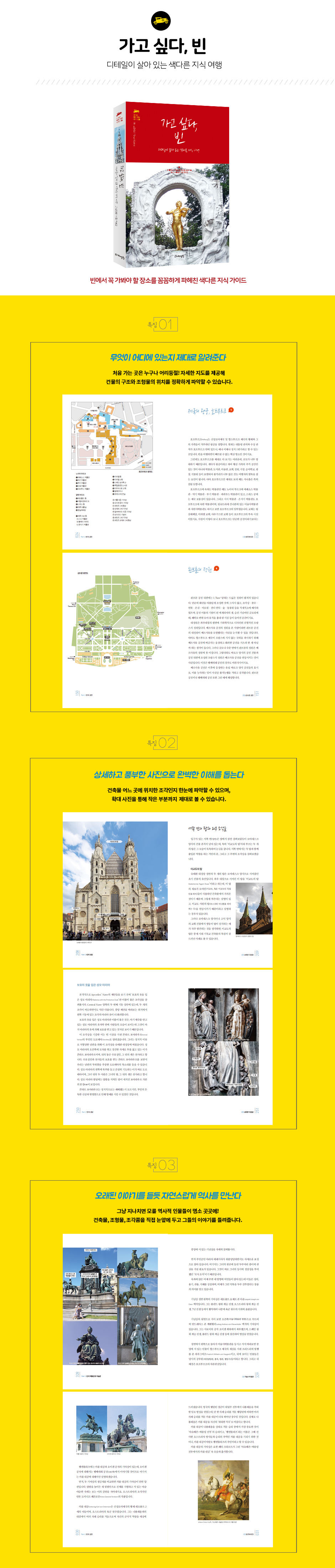
Before we delve into the altars of the Apostles' Nave, let's take a look at the statue entitled 'Madonna with the Protective Cloak'.
It is located on the top of the second pillar on either side of the Central Nave, and the two carvings are similar yet slightly different.
When looking at the central altar, the sculpture of Mary's clothes on the left pillar is more ornate.
The name Virgin Mary in the Garment of Protection is given because the figures of people can be seen inside the garb of the Virgin Mary holding the baby Jesus, as if they were protected by Mary's garb.
The donor of this statue is said to be Dorothea, wife of Konrad Vorlauf, the former mayor of Vienna.
She dedicated this statue to St. Stephen's Cathedral in memory of her husband, who was executed for political reasons.
The one kneeling with his hat off in a devout pose to the right of the Virgin Mary is Konrad Vorrauf, the two behind him are patron saints, and the three behind them are said to be angels.
As we look at Konrad Vorrauf, protected by his patron saints and angels, we hear the voice of Dorothea, who asserted her husband's innocence.
The one praying fervently while holding a rosary to the left of the Virgin Mary is Dorothea, the two behind her are her daughters, and the three behind them are said to be angels.
At the feet of the Virgin Mary, the coat of arms of the Poarauf family is visible, depicting a horse with its paw raised.
Konrad Vorrauf may have been politically defeated, but his wife's strong faith and wisdom saved his honor.
---From "St. Stephen's Cathedral - The Virgin Mary in the Robe of Protection"
The Christ with a toothache seen from outside (eastern side) was a replica, this is the real thing.
Originally titled 'Jesus on the Cross', it is a sculpture of the upper body of Jesus wearing a crown of thorns (although the shape of the thorns is not visible) and with wounds on his side and the back of his hands.
There is a story about how he was given the somewhat ridiculous name of 'Christ of Toothache' instead of his original name.
Originally, this was a statue placed in a cemetery.
However, when they found the place and saw Jesus with a look of extreme pain on his face due to his suffering on the cross, some mischievous young men joked, “It looks like Jesus has a toothache!”
But coincidentally, that night, the young men suddenly suffered from toothaches. Believing that they were being punished, they went to a statue of Christ and prayed for atonement before being freed from the excruciating pain.
It is said that after this incident became known, he was given the nickname of the Toothache Christ.
---From "St. Stephen's Cathedral - Christ in Toothache"
Born in 1717, Maria Theresa was the eldest daughter of Charles VI.
If Charles VI were unable to produce a son, the throne would pass to her according to the Pragmatic Decree.
Before his death, Charles VI is said to have repeatedly urged neighboring countries to respect the Pragmatic Sanction in preparation for Maria Theresa's succession to the throne.
However, when Charles VI died, the surrounding countries started a war, saying they could not recognize her succession to the throne.
The 'War of the Austrian Succession (1740-1748)' broke out.
In particular, Prussia occupied Silesia, the most important of the Habsburg territories.
The loss of this place was a heartbreaking thing for Maria Theresa.
Maria Theresa, who had to recover Silesia no matter what, started a war against Prussia in 1756 (the Seven Years' War), but ultimately failed, and Silesia remained Prussian territory.
Although she ascended to the throne after going through many twists and turns, she reformed the Habsburg Empire, which was in chaos, and ruled it stably with her passion and determination for state affairs.
To secure finances, the tax system was reformed, the military system was reorganized to train a modernized army, and elementary education was implemented as compulsory.
Her reign is called the "last Habsburg revival" because it brought political stability, cultural prosperity, and modernization to the monarchy.
---From “The Ascension and Reign of Maria Theresa”
So who was Margarita Teresa, and why did Velázquez paint her portrait year after year?
Margaret was the daughter of King Philip IV of Spain's Habsburg dynasty.
At the time, the Habsburg dynasty was divided between Spain and Austria, and incestuous marriages between royal family members continued to preserve the purity of the bloodline.
Margaret was also engaged to Leopold I, who would later become Holy Roman Emperor, when she was young.
She was only two years old when she became engaged to her uncle, Leopold.
It is said that the Spanish Habsburg dynasty painted a portrait of Margaret and sent it to the Austrian Habsburg dynasty, Margaret's in-laws, every year.
It seems like he was trying to tell her, “Your daughter-in-law is growing up so healthy and pretty.”
However, since Velazquez was the most favored painter of Philip IV, he painted the princess's portrait.
Margaret became the Holy Roman Empress when she married Leopold at the age of 15.
Although the Emperor and Buddha's marriage was said to be good, Margarita died at the age of 22 (1651-1673).
Considering that many of her siblings died before they could survive infancy, she might have lived a long life, but it was a pity that she died so young.
Looking at the portrait of the lovely princess, I am suddenly reminded of the transience of life.
---From "The Museum of Art History - Princess Margarita Teresa"
Franz Schubert, known as the 'King of Lieder', was a musician who was born, worked, and died in Vienna.
He died in 1828 at the age of 31 and was buried right next to Beethoven in Währing Cemetery, as he wished to be buried next to Beethoven, whom he always admired.
It is said that he was so fond of Beethoven that he volunteered to carry the coffin when Beethoven died a year ago.
Schubert's wish to be with Beethoven even after death was fulfilled at the Central Cemetery after passing through the Währing Cemetery, so he must have been satisfied.
Schubert's tombstone, erected in the Währing Cemetery, has an inscription written by Franz Grillparzer, a famous poet of the time. I would like to introduce it because the sentence is beautiful.
'The art of music has buried here a wealth of riches, and a hope far more beautiful than that.'
There could be no more splendid tribute to Schubert, who passed away at such a young age.
Not only did he secure financial stability by marrying the wealthy heiress Marie de Bourgogne, but he also arranged political marriages for his children, paving the way for the Habsburg family to develop into a great empire.
He married his son Felipe I to the Spanish princess Juana, who was fortunate enough to inherit both Spain and its colonies from her parents, the rulers of the Castilian-Aragonese dynasty (Isabella I of Castile and Ferdinand II of Aragon).
Juana passed her inheritance back to her son Carlos, so that Maximilian I's grandson became the legitimate heir to Spain.
With this, the Habsburg family grew into an empire that ruled not only Austria but also Spain.
---From "The Rise and Fall of the Habsburg Empire"
Gustav Klimt was a renowned Austrian painter and a key figure in the Secession movement.
He has demonstrated his talent not only through painting but also through the paintings he has created on the walls and ceilings of the Kunsthistorisches Museum, the Burgtheater, and the Secession Hall.
Born the son of a goldsmith, Klimt entered the Vienna School of Arts and Crafts to study painting.
The fact that his paintings often feature gold and patterns reminiscent of metal crafts is probably not unrelated to the fact that he grew up watching his father's work as a child.
After graduating from school, Klimt was recognized for his work on murals and ceilings in public buildings around the Ringstrasse, and was awarded the Golden Order of Merit by Emperor Franz Joseph I.
At that time, it seemed like a smooth road had opened up for him.
However, the ceiling painting for the Great Hall of the University of Vienna, commissioned in 1894, became the catalyst for his break with the conservative Viennese art world and the founding of the Secession.
He depicted allegories of philosophy, medicine, and law in his own unique style, but his overly erotic nature became a problem.
There was an uproar of criticism for painting vulgar, pornographic pictures in the hallowed halls of learning.
After finally accepting public opinion and revising the painting to tone it down, Klimt never again undertook public works.
They founded the Secession, calling for "every era has its own art, and art has freedom," and focused on freely developing their own world of works.
---From "The Three Great Austrian Painters"
Before we delve into the altars of the Apostles' Nave, let's take a look at the statue entitled 'Madonna with the Protective Cloak'.
It is located on the top of the second pillar on either side of the Central Nave, and the two carvings are similar yet slightly different.
When looking at the central altar, the sculpture of Mary's clothes on the left pillar is more ornate.
The name Virgin Mary in the Garment of Protection is given because the figures of people can be seen inside the garb of the Virgin Mary holding the baby Jesus, as if they were protected by Mary's garb.
The donor of this statue is said to be Dorothea, wife of Konrad Vorlauf, the former mayor of Vienna.
She dedicated this statue to St. Stephen's Cathedral in memory of her husband, who was executed for political reasons.
The one kneeling with his hat off in a devout pose to the right of the Virgin Mary is Konrad Vorrauf, the two behind him are patron saints, and the three behind them are said to be angels.
As we look at Konrad Vorrauf, protected by his patron saints and angels, we hear the voice of Dorothea, who asserted her husband's innocence.
The one praying fervently while holding a rosary to the left of the Virgin Mary is Dorothea, the two behind her are her daughters, and the three behind them are said to be angels.
At the feet of the Virgin Mary, the coat of arms of the Poarauf family is visible, depicting a horse with its paw raised.
Konrad Vorrauf may have been politically defeated, but his wife's strong faith and wisdom saved his honor.
---From "St. Stephen's Cathedral - The Virgin Mary in the Robe of Protection"
The Christ with a toothache seen from outside (eastern side) was a replica, this is the real thing.
Originally titled 'Jesus on the Cross', it is a sculpture of the upper body of Jesus wearing a crown of thorns (although the shape of the thorns is not visible) and with wounds on his side and the back of his hands.
There is a story about how he was given the somewhat ridiculous name of 'Christ of Toothache' instead of his original name.
Originally, this was a statue placed in a cemetery.
However, when they found the place and saw Jesus with a look of extreme pain on his face due to his suffering on the cross, some mischievous young men joked, “It looks like Jesus has a toothache!”
But coincidentally, that night, the young men suddenly suffered from toothaches. Believing that they were being punished, they went to a statue of Christ and prayed for atonement before being freed from the excruciating pain.
It is said that after this incident became known, he was given the nickname of the Toothache Christ.
---From "St. Stephen's Cathedral - Christ in Toothache"
Born in 1717, Maria Theresa was the eldest daughter of Charles VI.
If Charles VI were unable to produce a son, the throne would pass to her according to the Pragmatic Decree.
Before his death, Charles VI is said to have repeatedly urged neighboring countries to respect the Pragmatic Sanction in preparation for Maria Theresa's succession to the throne.
However, when Charles VI died, the surrounding countries started a war, saying they could not recognize her succession to the throne.
The 'War of the Austrian Succession (1740-1748)' broke out.
In particular, Prussia occupied Silesia, the most important of the Habsburg territories.
The loss of this place was a heartbreaking thing for Maria Theresa.
Maria Theresa, who had to recover Silesia no matter what, started a war against Prussia in 1756 (the Seven Years' War), but ultimately failed, and Silesia remained Prussian territory.
Although she ascended to the throne after going through many twists and turns, she reformed the Habsburg Empire, which was in chaos, and ruled it stably with her passion and determination for state affairs.
To secure finances, the tax system was reformed, the military system was reorganized to train a modernized army, and elementary education was implemented as compulsory.
Her reign is called the "last Habsburg revival" because it brought political stability, cultural prosperity, and modernization to the monarchy.
---From “The Ascension and Reign of Maria Theresa”
So who was Margarita Teresa, and why did Velázquez paint her portrait year after year?
Margaret was the daughter of King Philip IV of Spain's Habsburg dynasty.
At the time, the Habsburg dynasty was divided between Spain and Austria, and incestuous marriages between royal family members continued to preserve the purity of the bloodline.
Margaret was also engaged to Leopold I, who would later become Holy Roman Emperor, when she was young.
She was only two years old when she became engaged to her uncle, Leopold.
It is said that the Spanish Habsburg dynasty painted a portrait of Margaret and sent it to the Austrian Habsburg dynasty, Margaret's in-laws, every year.
It seems like he was trying to tell her, “Your daughter-in-law is growing up so healthy and pretty.”
However, since Velazquez was the most favored painter of Philip IV, he painted the princess's portrait.
Margaret became the Holy Roman Empress when she married Leopold at the age of 15.
Although the Emperor and Buddha's marriage was said to be good, Margarita died at the age of 22 (1651-1673).
Considering that many of her siblings died before they could survive infancy, she might have lived a long life, but it was a pity that she died so young.
Looking at the portrait of the lovely princess, I am suddenly reminded of the transience of life.
---From "The Museum of Art History - Princess Margarita Teresa"
Franz Schubert, known as the 'King of Lieder', was a musician who was born, worked, and died in Vienna.
He died in 1828 at the age of 31 and was buried right next to Beethoven in Währing Cemetery, as he wished to be buried next to Beethoven, whom he always admired.
It is said that he was so fond of Beethoven that he volunteered to carry the coffin when Beethoven died a year ago.
Schubert's wish to be with Beethoven even after death was fulfilled at the Central Cemetery after passing through the Währing Cemetery, so he must have been satisfied.
Schubert's tombstone, erected in the Währing Cemetery, has an inscription written by Franz Grillparzer, a famous poet of the time. I would like to introduce it because the sentence is beautiful.
'The art of music has buried here a wealth of riches, and a hope far more beautiful than that.'
There could be no more splendid tribute to Schubert, who passed away at such a young age.
---Among the “musician graves that receive the most attention in the Central Cemetery”
Publisher's Review
A unique, knowledgeable guide that meticulously explores the must-see places in Vienna!
The [Unique Knowledge Travel] series is designed to help travelers experience the joy of knowledge by acquiring new knowledge through travel and integrating it with existing knowledge by providing detailed explanations of must-see attractions in cities around the world along the route.
Everyone has been there, and everyone thinks they know, but the depth of knowledge varies depending on how you see it.
Covering a wide range of topics, including mythology, history, art, and the Bible, which serve as background knowledge for European travel, the book is written in a natural, flowing style, as if told by a witty storyteller, capturing the reader's heart without being boring or difficult.
In the unique knowledge travel series 'I Want to Go' [I Want to Go, Vienna], we start with the Hofburg, a key attraction in Vienna, Austria, and visit historic cathedrals and museums located throughout Vienna.
The Hofburg is the imperial palace where the Habsburg emperors and their families resided. It is not only the residence of the imperial family, but also includes museums, libraries, art galleries, churches, gardens, theaters, riding schools, squares, and botanical gardens. There is so much to see that just knowing about the Hofburg is enough to understand Austrian history and culture.
The Hofburg tour begins at Heldenplatz, which can be reached by passing Burgtor, the entrance to Hofburg.
Heldenplatz means 'Heroes' Square', and starting with finding out who the 'heroes' are that are honored here, you can naturally learn about Vienna's history by carefully examining the equestrian statues and statues that occupy each square within Hofburg, as well as the faces and figures of the statues that decorate the facades of buildings.
It also tells the story of the museum collections within the Hofburg and the historical figures associated with them.
Schönbrunn Palace, the imperial summer residence, is also a must-see when traveling to Vienna.
Here, you can find rooms where historical figures stayed, including Maria Theresa, who led the empire to its final golden age with her strong ruling power, Franz Joseph I and Empress Elisabeth, who did their best to maintain the empire in the midst of rapidly changing political situations, Charles I, the last emperor of the empire, and Napoleon, who won the battle against Austria and once occupied Austria.
Hear stories of the history of the Austrian Empire while following the footsteps of historical figures who remain here.
At the turn of the century, Vienna was a European center for various artistic fields.
Vienna enjoyed a cultural golden age, attracting talented artists not only in music but also in painting, architecture, interior design, and performing arts.
Today's Vienna attracts countless travelers by showcasing such fin-de-siècle artistic achievements.
The Belvedere is a special place where you can see works by Gustav Klimt, Egon Schiele, and Oskar Kokoschka.
Stephen's Cathedral, located in the center of Vienna, is like the heart of Vienna.
Like many cathedrals in Europe, the exterior walls of St. Stephen's Cathedral are adorned with various sculptures. You can begin by examining the meaning of these sculptures, and when you enter the cathedral, you can hear stories about the various chapels and altars located in each nave, as well as the saints who are the main characters in them.
We will also learn about Vienna's many cathedrals, including the Karlskirche, built to commemorate the end of the plague, the Capuchin Cathedral, which houses the imperial crypt, and the Votive Church, dedicated to the emperor by his brother Maximilian.
The Kunsthistorisches Museum, which can be said to be Austria's representative museum, is located across from the Natural History Museum, centered around Maria Theresa Square, where a statue of Empress Maria Theresa stands.
She sits with a dignified yet benevolent expression, and the scroll of paper in her left hand is the 'National Imperial Decree' that legitimized her ascension to the throne.
Beginning with her story, the Museum of Fine Arts' collection of paintings rivals those of the Louvre and the Prado, enrich your knowledge of mythology, history, art, and the Bible through the many works of art housed within the museum.
Here are some places where you can experience Austria's diverse culture and arts, such as the Natural History Museum, which started out based on the diverse rock and gem collection of Francis I, the Holy Roman Emperor who was very interested in natural science; the Secession, which exhibits the works of the Secession painters who enriched Vienna's cultural and artistic scene by carrying out various artistic activities regardless of customs and traditions; and the outstanding architecture of Hundertwasser, who is called the Gaudí of Austria. We also introduce places that are worth seeing together, such as the Parliament Building in the style of a Greek temple, the Vienna Central Cemetery where famous people of Vienna are buried, the Vienna City Hall, the Burgtheater, and the State Opera.
Vienna is more like a city of polite gentlemen who keep their mouths shut to save face, rather than a city of sweet-voiced, gentlewomen.
But the gentleman was of noble birth, had a deep knowledge of the arts, and possessed a gentle and kind personality.
Vienna, a place where you can hear the clatter of horse hooves and see trams slowly moving along their paths.
For travelers planning to travel to Vienna, Austria, [I Want to Go, Vienna] will be a friendly and detailed travel guide.
The [Unique Knowledge Travel] series is designed to help travelers experience the joy of knowledge by acquiring new knowledge through travel and integrating it with existing knowledge by providing detailed explanations of must-see attractions in cities around the world along the route.
Everyone has been there, and everyone thinks they know, but the depth of knowledge varies depending on how you see it.
Covering a wide range of topics, including mythology, history, art, and the Bible, which serve as background knowledge for European travel, the book is written in a natural, flowing style, as if told by a witty storyteller, capturing the reader's heart without being boring or difficult.
In the unique knowledge travel series 'I Want to Go' [I Want to Go, Vienna], we start with the Hofburg, a key attraction in Vienna, Austria, and visit historic cathedrals and museums located throughout Vienna.
The Hofburg is the imperial palace where the Habsburg emperors and their families resided. It is not only the residence of the imperial family, but also includes museums, libraries, art galleries, churches, gardens, theaters, riding schools, squares, and botanical gardens. There is so much to see that just knowing about the Hofburg is enough to understand Austrian history and culture.
The Hofburg tour begins at Heldenplatz, which can be reached by passing Burgtor, the entrance to Hofburg.
Heldenplatz means 'Heroes' Square', and starting with finding out who the 'heroes' are that are honored here, you can naturally learn about Vienna's history by carefully examining the equestrian statues and statues that occupy each square within Hofburg, as well as the faces and figures of the statues that decorate the facades of buildings.
It also tells the story of the museum collections within the Hofburg and the historical figures associated with them.
Schönbrunn Palace, the imperial summer residence, is also a must-see when traveling to Vienna.
Here, you can find rooms where historical figures stayed, including Maria Theresa, who led the empire to its final golden age with her strong ruling power, Franz Joseph I and Empress Elisabeth, who did their best to maintain the empire in the midst of rapidly changing political situations, Charles I, the last emperor of the empire, and Napoleon, who won the battle against Austria and once occupied Austria.
Hear stories of the history of the Austrian Empire while following the footsteps of historical figures who remain here.
At the turn of the century, Vienna was a European center for various artistic fields.
Vienna enjoyed a cultural golden age, attracting talented artists not only in music but also in painting, architecture, interior design, and performing arts.
Today's Vienna attracts countless travelers by showcasing such fin-de-siècle artistic achievements.
The Belvedere is a special place where you can see works by Gustav Klimt, Egon Schiele, and Oskar Kokoschka.
Stephen's Cathedral, located in the center of Vienna, is like the heart of Vienna.
Like many cathedrals in Europe, the exterior walls of St. Stephen's Cathedral are adorned with various sculptures. You can begin by examining the meaning of these sculptures, and when you enter the cathedral, you can hear stories about the various chapels and altars located in each nave, as well as the saints who are the main characters in them.
We will also learn about Vienna's many cathedrals, including the Karlskirche, built to commemorate the end of the plague, the Capuchin Cathedral, which houses the imperial crypt, and the Votive Church, dedicated to the emperor by his brother Maximilian.
The Kunsthistorisches Museum, which can be said to be Austria's representative museum, is located across from the Natural History Museum, centered around Maria Theresa Square, where a statue of Empress Maria Theresa stands.
She sits with a dignified yet benevolent expression, and the scroll of paper in her left hand is the 'National Imperial Decree' that legitimized her ascension to the throne.
Beginning with her story, the Museum of Fine Arts' collection of paintings rivals those of the Louvre and the Prado, enrich your knowledge of mythology, history, art, and the Bible through the many works of art housed within the museum.
Here are some places where you can experience Austria's diverse culture and arts, such as the Natural History Museum, which started out based on the diverse rock and gem collection of Francis I, the Holy Roman Emperor who was very interested in natural science; the Secession, which exhibits the works of the Secession painters who enriched Vienna's cultural and artistic scene by carrying out various artistic activities regardless of customs and traditions; and the outstanding architecture of Hundertwasser, who is called the Gaudí of Austria. We also introduce places that are worth seeing together, such as the Parliament Building in the style of a Greek temple, the Vienna Central Cemetery where famous people of Vienna are buried, the Vienna City Hall, the Burgtheater, and the State Opera.
Vienna is more like a city of polite gentlemen who keep their mouths shut to save face, rather than a city of sweet-voiced, gentlewomen.
But the gentleman was of noble birth, had a deep knowledge of the arts, and possessed a gentle and kind personality.
Vienna, a place where you can hear the clatter of horse hooves and see trams slowly moving along their paths.
For travelers planning to travel to Vienna, Austria, [I Want to Go, Vienna] will be a friendly and detailed travel guide.
GOODS SPECIFICS
- Date of issue: April 25, 2019
- Page count, weight, size: 480 pages | 726g | 152*225*30mm
- ISBN13: 9791187616627
- ISBN10: 1187616621
You may also like
카테고리
korean


korean

![GQ KOREA Mark (Monthly): December [2025]](http://librairie.coreenne.fr/cdn/shop/files/8ef265dbbfbf186523ed75ba7319009d.jpg?v=1765340328&width=3840)


