

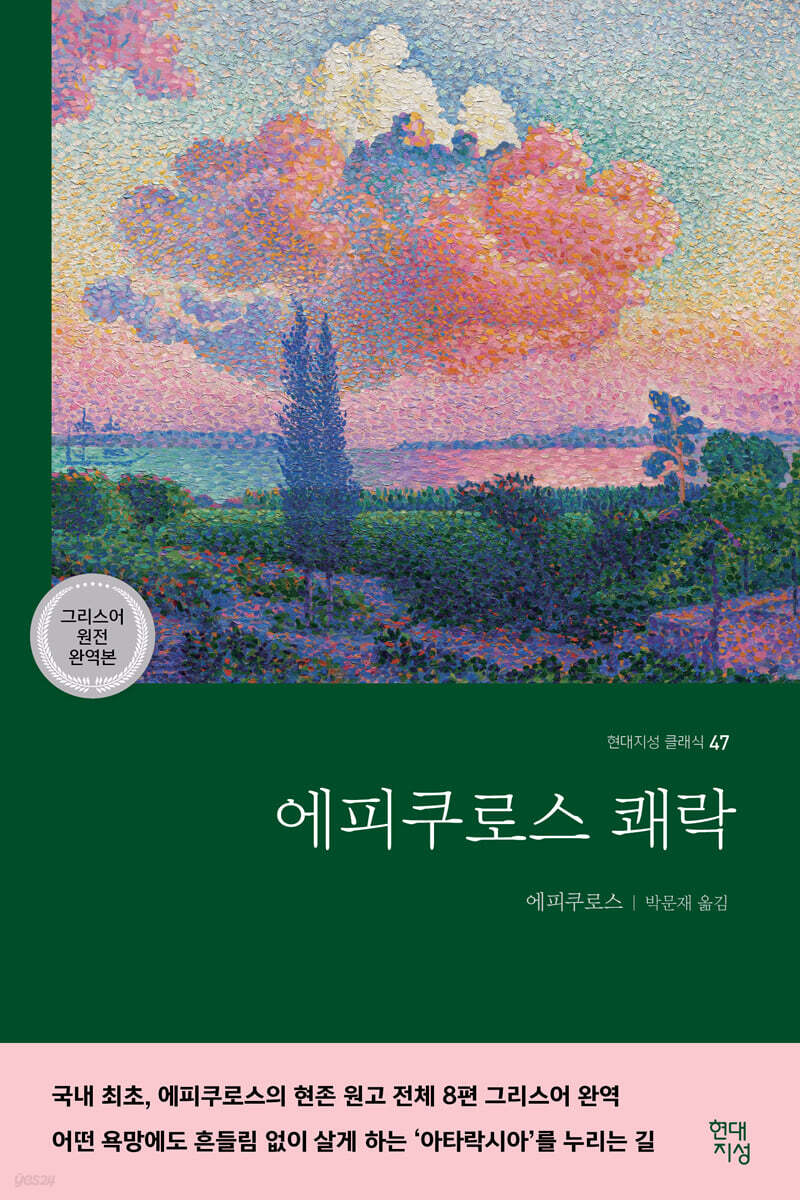
Epicurean pleasure
 |
Description
Book Introduction
The path to enjoying 'ataraxia', which allows you to live unshaken by any desire.
The first complete Greek translation of all eight surviving manuscripts of Epicurus.
The era in which Epicurus was active was a time when the First and Second Peloponnesian Wars broke out, Athens' national power was declining, and Macedonia, led by Alexander, was sweeping the world.
As the city-state (polis) fell and a period of chaos began, an individualistic and existentialist philosophy was needed to enable people to live in the Hellenistic era, rather than the polis-centered Plato and Aristotle, and Epicurus developed a philosophy that enabled just such thinking.
Because he was fundamentally an atomistic materialist based on the natural philosophy of Democritus, he viewed the human soul and gods as material beings and excluded the intervention of mythical gods.
According to him, the highest good for human beings is to enjoy simple, static, and sustainable 'pleasures' called 'ataraxia' (αταραξ?α, a state of tranquility in which the mind is freed from fear) and 'aponia' (?πον?α, absence of bodily pain) through true knowledge of the workings of the world and the limits of desire, pleasure, and pain.
To enjoy this life, they avoided ambition and competition, which could undermine their peace of mind, and lived a simple and humble life. They pursued small but certain happiness rather than the physical pleasures we often think of, and sought knowledge that could lead to peace, such as minimalism and mindfulness.
『Epicurean Pleasures』, published by Hyundai Jisung Classics as the 47th edition, is the first complete Greek translation in Korea that introduces all eight extant manuscripts.
Epicurus is said to have written over 300 books, but the eight introduced in this book are almost the only ones that have survived intact (four of them are later edited versions).
His hedonistic philosophy, which emphasized that the happiest path is to be free from the pain of mind and body and to live a life of peace, holds great implications for modern people who are consumed by endless competition, comparison, success, and stimulating excitement.
Although the text itself is not long, it provides 283 footnotes and 35 pages of extensive annotations, providing thorough and comprehensive explanations for any part that readers may be curious about, helping readers gain a deeper understanding.
The first complete Greek translation of all eight surviving manuscripts of Epicurus.
The era in which Epicurus was active was a time when the First and Second Peloponnesian Wars broke out, Athens' national power was declining, and Macedonia, led by Alexander, was sweeping the world.
As the city-state (polis) fell and a period of chaos began, an individualistic and existentialist philosophy was needed to enable people to live in the Hellenistic era, rather than the polis-centered Plato and Aristotle, and Epicurus developed a philosophy that enabled just such thinking.
Because he was fundamentally an atomistic materialist based on the natural philosophy of Democritus, he viewed the human soul and gods as material beings and excluded the intervention of mythical gods.
According to him, the highest good for human beings is to enjoy simple, static, and sustainable 'pleasures' called 'ataraxia' (αταραξ?α, a state of tranquility in which the mind is freed from fear) and 'aponia' (?πον?α, absence of bodily pain) through true knowledge of the workings of the world and the limits of desire, pleasure, and pain.
To enjoy this life, they avoided ambition and competition, which could undermine their peace of mind, and lived a simple and humble life. They pursued small but certain happiness rather than the physical pleasures we often think of, and sought knowledge that could lead to peace, such as minimalism and mindfulness.
『Epicurean Pleasures』, published by Hyundai Jisung Classics as the 47th edition, is the first complete Greek translation in Korea that introduces all eight extant manuscripts.
Epicurus is said to have written over 300 books, but the eight introduced in this book are almost the only ones that have survived intact (four of them are later edited versions).
His hedonistic philosophy, which emphasized that the happiest path is to be free from the pain of mind and body and to live a life of peace, holds great implications for modern people who are consumed by endless competition, comparison, success, and stimulating excitement.
Although the text itself is not long, it provides 283 footnotes and 35 pages of extensive annotations, providing thorough and comprehensive explanations for any part that readers may be curious about, helping readers gain a deeper understanding.
- You can preview some of the book's contents.
Preview
index
01.
The Life of Epicurus
02.
Letter to Herodotus
03.
Letter to Pythocles
04.
Theory of the Sage
05.
Letter to Menoeceus
06.
Key Teachings
07.
Epicurus's Quotes
08.
Fragments of Epicurean writings
Release | Park Moon-jae
Epicurus Chronology
The Life of Epicurus
02.
Letter to Herodotus
03.
Letter to Pythocles
04.
Theory of the Sage
05.
Letter to Menoeceus
06.
Key Teachings
07.
Epicurus's Quotes
08.
Fragments of Epicurean writings
Release | Park Moon-jae
Epicurus Chronology
Detailed image

Into the book
The universe is made up of matter and space.
The existence of bodies is everywhere proved by the senses themselves, and to prove anything uncertain by reasoning, one must necessarily rely on the senses.
And if there were no such thing as void, space, or the insensible, there would be no space for things to be, and although things appear to us to be moving, there would be no space for them to move.
…some of the objects are composites, and some are elements that make up composites.
If everything is not to be destroyed and become nothing, its elements must be indivisible and unchangeable, and their properties must be strong enough to survive the dissolution of the composite, so that they cannot be dismantled by anything or in any way.
Therefore, the beginning of things is something that has an indivisible nature.
…composites are created from these atoms that fill the object, and when they are disassembled, they return to atoms, and atoms take on countless different forms.
Because such an infinite number of things cannot be created from atoms with a finite form.
The number of atoms, each of the same form, is absolutely infinite, and the number of different forms that atoms can have is infinite, but not absolutely infinite.
---「02.
From "Letter to Herodotus"
Besides all that has been said, it must be understood that the greatest confusion and distress arises in the mind, not because men, on the basis of rational thought, but because, in some irrational way, they believe that the heavenly bodies are blessed and immortal, but because they believe that these bodies have wills, actions, and motives that are contrary to immortality, and because they expect or imagine that these bodies will inflict eternal calamity on them, either through myth or through fear of death and insensibility (as if that had anything to do with them).
Therefore, if they cannot control the fears that arise from such expectations or imaginations, they will experience the same or greater confusion and distress as those who have vague ideas about such celestial phenomena.
On the other hand, if you have equanimity, you can escape all of this by firmly remembering the universal and most important principles.
---「02.
From "Letter to Herodotus"
When dealing with celestial phenomena, we should not try to explain them by forcing explanations on them that cannot be called explanations, nor should we use the same methods of inquiry that we use to explain various theories about human life or other problems related to natural phenomena.
For example, we should not apply to celestial phenomena the methods we use in the study of all things, such as propositions like “the universe is made of objects and things of a nature imperceptible to the senses” or “the elements are indivisible”, where there is only one explanation that corresponds to the phenomenon.
In contrast, there are many causes for certain celestial phenomena, and therefore, there are many cases where the explanation for the phenomenon matches our perception based on our senses.
When exploring natural science, one should not follow baseless assumptions and pre-established laws, but follow what the phenomena themselves tell one.
We must live a life without noise, and to do so, we must empty our human lives of irrationality and baseless thoughts.
If each thing that can be explained in various ways is explained using a plausible theory in a way that matches the phenomenon, and we accept that explanation (as we should), all the fuss will be silenced.
But if we accept some of the theories that correspond to the phenomena and reject others, we will inevitably deviate completely from the study of nature and return to mythology.
---「03.
From the Epistle to Pythocles
Get used to the idea that death is nothing.
All good and bad are in the senses, and death is the deprivation of the senses.
Therefore, the right knowledge that death is nothing to us enables us to enjoy even the mortality of life, not by adding infinite time to our lives, but by removing the longing for immortality.
For those who thoroughly know that there is no need to fear death, there is no fear whatsoever in relation to living.
So, anyone who says that we fear death not because death is painful, but because the thought of dying is painful, is talking nonsense.
This is because, when death actually comes, we do not feel pain, but we suffer in vain in anticipation of such death.
Death is the most fearful and terrifying of all calamities, but it is nothing to us.
Because while we exist, death does not come to us, and when death comes to us, we no longer exist.
…On the other hand, the wise man does not try to escape from life, nor does he fear death.
Because the wise man does not regard life as an obstacle, nor does he regard death as a disaster.
Just as people choose food not only for its quantity but also for its taste and enjoyment, so the wise man does not seek to enjoy the longest time, but rather for the most enjoyable life.
…
By observing and knowing these things clearly, you can make all the right choices and avoidances to achieve the goals of a happy life: physical health and peace of mind.
Because all our actions are meant to free us from pain and fear.
Once this is accomplished in us, the fierce storm that has been raging in our hearts will disappear.
… For this reason we say that pleasure is the beginning and the end of a happy life.
We recognize pleasure as the highest and innate good, and we make it the starting point of all choices and avoidances.
When we use feeling as the standard for judging all good, we are ultimately basing it on pleasure.
…a thoughtful person believes that it is better to act rationally and fail than to act irrationally and succeed.
It is better to act with the right judgment and fail by chance than to act without the right judgment and succeed by chance.
The existence of bodies is everywhere proved by the senses themselves, and to prove anything uncertain by reasoning, one must necessarily rely on the senses.
And if there were no such thing as void, space, or the insensible, there would be no space for things to be, and although things appear to us to be moving, there would be no space for them to move.
…some of the objects are composites, and some are elements that make up composites.
If everything is not to be destroyed and become nothing, its elements must be indivisible and unchangeable, and their properties must be strong enough to survive the dissolution of the composite, so that they cannot be dismantled by anything or in any way.
Therefore, the beginning of things is something that has an indivisible nature.
…composites are created from these atoms that fill the object, and when they are disassembled, they return to atoms, and atoms take on countless different forms.
Because such an infinite number of things cannot be created from atoms with a finite form.
The number of atoms, each of the same form, is absolutely infinite, and the number of different forms that atoms can have is infinite, but not absolutely infinite.
---「02.
From "Letter to Herodotus"
Besides all that has been said, it must be understood that the greatest confusion and distress arises in the mind, not because men, on the basis of rational thought, but because, in some irrational way, they believe that the heavenly bodies are blessed and immortal, but because they believe that these bodies have wills, actions, and motives that are contrary to immortality, and because they expect or imagine that these bodies will inflict eternal calamity on them, either through myth or through fear of death and insensibility (as if that had anything to do with them).
Therefore, if they cannot control the fears that arise from such expectations or imaginations, they will experience the same or greater confusion and distress as those who have vague ideas about such celestial phenomena.
On the other hand, if you have equanimity, you can escape all of this by firmly remembering the universal and most important principles.
---「02.
From "Letter to Herodotus"
When dealing with celestial phenomena, we should not try to explain them by forcing explanations on them that cannot be called explanations, nor should we use the same methods of inquiry that we use to explain various theories about human life or other problems related to natural phenomena.
For example, we should not apply to celestial phenomena the methods we use in the study of all things, such as propositions like “the universe is made of objects and things of a nature imperceptible to the senses” or “the elements are indivisible”, where there is only one explanation that corresponds to the phenomenon.
In contrast, there are many causes for certain celestial phenomena, and therefore, there are many cases where the explanation for the phenomenon matches our perception based on our senses.
When exploring natural science, one should not follow baseless assumptions and pre-established laws, but follow what the phenomena themselves tell one.
We must live a life without noise, and to do so, we must empty our human lives of irrationality and baseless thoughts.
If each thing that can be explained in various ways is explained using a plausible theory in a way that matches the phenomenon, and we accept that explanation (as we should), all the fuss will be silenced.
But if we accept some of the theories that correspond to the phenomena and reject others, we will inevitably deviate completely from the study of nature and return to mythology.
---「03.
From the Epistle to Pythocles
Get used to the idea that death is nothing.
All good and bad are in the senses, and death is the deprivation of the senses.
Therefore, the right knowledge that death is nothing to us enables us to enjoy even the mortality of life, not by adding infinite time to our lives, but by removing the longing for immortality.
For those who thoroughly know that there is no need to fear death, there is no fear whatsoever in relation to living.
So, anyone who says that we fear death not because death is painful, but because the thought of dying is painful, is talking nonsense.
This is because, when death actually comes, we do not feel pain, but we suffer in vain in anticipation of such death.
Death is the most fearful and terrifying of all calamities, but it is nothing to us.
Because while we exist, death does not come to us, and when death comes to us, we no longer exist.
…On the other hand, the wise man does not try to escape from life, nor does he fear death.
Because the wise man does not regard life as an obstacle, nor does he regard death as a disaster.
Just as people choose food not only for its quantity but also for its taste and enjoyment, so the wise man does not seek to enjoy the longest time, but rather for the most enjoyable life.
…
By observing and knowing these things clearly, you can make all the right choices and avoidances to achieve the goals of a happy life: physical health and peace of mind.
Because all our actions are meant to free us from pain and fear.
Once this is accomplished in us, the fierce storm that has been raging in our hearts will disappear.
… For this reason we say that pleasure is the beginning and the end of a happy life.
We recognize pleasure as the highest and innate good, and we make it the starting point of all choices and avoidances.
When we use feeling as the standard for judging all good, we are ultimately basing it on pleasure.
…a thoughtful person believes that it is better to act rationally and fail than to act irrationally and succeed.
It is better to act with the right judgment and fail by chance than to act without the right judgment and succeed by chance.
---「05.
From the Epistle to Menoeceus
From the Epistle to Menoeceus
Publisher's Review
Each one must live for himself, as we face the harsh winter of life.
The most realistic philosophy that came to me like a gift
The criteria for defining the 'middle class' vary from country to country.
In American public schools, the middle class is defined as “people who are upright in their own opinions, help the socially disadvantaged, and resist injustice and illegality.
And he teaches that there is a class that receives critiques regularly.”
In the 'quality of life' pledge presented by President Georges Pompidou, France set the following standards: "You should be able to speak at least one foreign language, enjoy a sport, know how to play a musical instrument, know how to cook a dish that tastes different from others, and be able to participate in social issues, help the vulnerable, and consistently do volunteer work."
What about us? A survey of office workers yielded the following responses:
“Own an apartment larger than 30 pyeong (approximately 100 square meters) without debt, earn a monthly salary of more than 5 million won, own a mid-sized car with an engine displacement of 2000 cc or larger, have a bank account balance of more than 100 million won, and travel abroad at least once a year.” Of course, this isn’t an official standard, but sadly, it’s something we’re all quite familiar with.
The point is that they are putting forward spiritual values, not numbers.
The problem is that when we talk about 'success' or 'happiness', the standards are not within ourselves, but are all outside of us.
I've been trying to force myself to internalize standards that won't make me happy even if I achieve them, so I've been wearing clothes that don't fit me for a long time.
The era in which Epicurus was active was also a time of great turmoil, with great changes both within and outside the Greek city-states, much like the Spring and Autumn Period and Warring States Period in China.
It was a time when the First and Second Peloponnesian Wars broke out, Athens' national power was declining, and Macedonia, led by Alexander, was sweeping the world.
The era of stability and peace when the philosophies of Plato and Aristotle flourished has passed, and in an era where Hellenism was established as the cultural code, individuals had to learn self-reliance and self-respect.
It was a philosophy born when previous philosophical foundations and ideas could no longer provide help due to social chaos and anxiety.
We needed an existential philosophy that would allow us to live in reality, not an abstract and idealistic concept.
Epicurus was in this era and developed a philosophy that made such thinking possible.
For 500 years after his appearance, he was the most celebrated, yet also the most despised philosopher in the Mediterranean.
It was that groundbreaking, and it opened up a new path of thinking.
Even the philosopher of revolution, Karl Marx, chose "The Difference Between Democritus and Epicurean Philosophy of Nature" as the title of his doctoral dissertation and deeply embraced the dynamism contained in his philosophy.
Learning from the West's Lao Tzu and Epicurus
The path to happiness through developing composure
“True happiness lies not in debauchery and the satisfaction of desires, but in liberation from all mental and physical pain!” If we were to summarize Epicurus’s thoughts in two words, they would be ‘ataraxia’ (a state of tranquility in which the mind is free from fear) and ‘aponia’ (the absence of bodily pain).
He described a life lived while maintaining a state of peace of mind as ‘pleasure.’
To enjoy this life, I wanted to live a simple and humble life, keeping away from ambition and competition that could disturb my peace of mind, and making the highest pleasure that comes from being free from all pain and fear my only natural goal.
Furthermore, it is said that there is no need to hope for an afterlife or eternal life because this life alone is sufficient to enjoy the highest state of pleasure, 'ataraxia', and in fact, since the human soul and body are both material things, they will eventually disintegrate and face death, and that an afterlife or eternal life does not exist.
The universe was believed to be made up of atoms and empty space, and all things, including celestial bodies, gods, and human souls, were created from atoms.
Since atoms are the only substances that remain unchanged forever and can no longer be divided, everything is created by atoms and then returns to atoms again.
Epicurus wrote extensively on the atomistic cosmology, worldview, and natural science because he believed that such knowledge would free us from fear and anxiety.
Especially in an era when people still lived connected to gods through myths, if you savor his thoughts that boldly emphasized living independently from gods and being content with what was given to you, you can enjoy the joy of encountering the origins of 'hedonism', which gave rise to modern mindfulness, minimalism, and small happiness.
His extensive system of thought can be summarized as 'hedonism', but if you follow the branches, you will find a point that connects to the origins of naturalistic philosophy and scientific thinking.
Happiness and success are not a single standard.
8 articles that will help you understand the many branches.
『Epicurean Pleasures』, published by Hyundai Jisung Classics as the 47th edition, is the first complete Greek translation in Korea that introduces all eight extant manuscripts.
Epicurus is said to have written over 300 books, but the eight chapters introduced in this book are almost the only ones that have survived in their entirety.
His hedonistic philosophy, which emphasized that the happiest path is to be free from the pain of mind and body and to live a life of peace, holds great implications for modern people who are consumed by endless competition, comparison, success, and stimulating excitement.
Because it eloquently demonstrates that happiness and success are not proven by the possession of a few possessions or the length of the numbers on our bankbooks, but rather by the many diverse and abundant paths that lie before us.
The translator, who is renowned for his excellent understanding and translation of classical texts, added 283 footnotes to eight of Epicurus' writings, providing helpful explanations and commentary on parts that the general reader may be curious about. He also wrote a 35-page annotation so that readers can fully understand not only Epicurus's philosophy but also the environment and philosophical background surrounding him.
Above all, we worked hard to improve readability so that you can deeply savor the sentences themselves, without compromising accuracy even when translating a single word.
Now, let us take to heart a few words from Epicurus and dive into the ocean of freedom.
“We must not spoil what we have by wishing for what we do not have, but we must remember that what we have now was once what we wished for.”
“A free life cannot bring great wealth.
Because it is not easy to acquire great wealth without living a life subservient to the public or those in power.
But a person who lives a free life already has everything he needs.
And if you are lucky enough to acquire great wealth, it is easy to share it with your neighbors and win their favor.”
The most realistic philosophy that came to me like a gift
The criteria for defining the 'middle class' vary from country to country.
In American public schools, the middle class is defined as “people who are upright in their own opinions, help the socially disadvantaged, and resist injustice and illegality.
And he teaches that there is a class that receives critiques regularly.”
In the 'quality of life' pledge presented by President Georges Pompidou, France set the following standards: "You should be able to speak at least one foreign language, enjoy a sport, know how to play a musical instrument, know how to cook a dish that tastes different from others, and be able to participate in social issues, help the vulnerable, and consistently do volunteer work."
What about us? A survey of office workers yielded the following responses:
“Own an apartment larger than 30 pyeong (approximately 100 square meters) without debt, earn a monthly salary of more than 5 million won, own a mid-sized car with an engine displacement of 2000 cc or larger, have a bank account balance of more than 100 million won, and travel abroad at least once a year.” Of course, this isn’t an official standard, but sadly, it’s something we’re all quite familiar with.
The point is that they are putting forward spiritual values, not numbers.
The problem is that when we talk about 'success' or 'happiness', the standards are not within ourselves, but are all outside of us.
I've been trying to force myself to internalize standards that won't make me happy even if I achieve them, so I've been wearing clothes that don't fit me for a long time.
The era in which Epicurus was active was also a time of great turmoil, with great changes both within and outside the Greek city-states, much like the Spring and Autumn Period and Warring States Period in China.
It was a time when the First and Second Peloponnesian Wars broke out, Athens' national power was declining, and Macedonia, led by Alexander, was sweeping the world.
The era of stability and peace when the philosophies of Plato and Aristotle flourished has passed, and in an era where Hellenism was established as the cultural code, individuals had to learn self-reliance and self-respect.
It was a philosophy born when previous philosophical foundations and ideas could no longer provide help due to social chaos and anxiety.
We needed an existential philosophy that would allow us to live in reality, not an abstract and idealistic concept.
Epicurus was in this era and developed a philosophy that made such thinking possible.
For 500 years after his appearance, he was the most celebrated, yet also the most despised philosopher in the Mediterranean.
It was that groundbreaking, and it opened up a new path of thinking.
Even the philosopher of revolution, Karl Marx, chose "The Difference Between Democritus and Epicurean Philosophy of Nature" as the title of his doctoral dissertation and deeply embraced the dynamism contained in his philosophy.
Learning from the West's Lao Tzu and Epicurus
The path to happiness through developing composure
“True happiness lies not in debauchery and the satisfaction of desires, but in liberation from all mental and physical pain!” If we were to summarize Epicurus’s thoughts in two words, they would be ‘ataraxia’ (a state of tranquility in which the mind is free from fear) and ‘aponia’ (the absence of bodily pain).
He described a life lived while maintaining a state of peace of mind as ‘pleasure.’
To enjoy this life, I wanted to live a simple and humble life, keeping away from ambition and competition that could disturb my peace of mind, and making the highest pleasure that comes from being free from all pain and fear my only natural goal.
Furthermore, it is said that there is no need to hope for an afterlife or eternal life because this life alone is sufficient to enjoy the highest state of pleasure, 'ataraxia', and in fact, since the human soul and body are both material things, they will eventually disintegrate and face death, and that an afterlife or eternal life does not exist.
The universe was believed to be made up of atoms and empty space, and all things, including celestial bodies, gods, and human souls, were created from atoms.
Since atoms are the only substances that remain unchanged forever and can no longer be divided, everything is created by atoms and then returns to atoms again.
Epicurus wrote extensively on the atomistic cosmology, worldview, and natural science because he believed that such knowledge would free us from fear and anxiety.
Especially in an era when people still lived connected to gods through myths, if you savor his thoughts that boldly emphasized living independently from gods and being content with what was given to you, you can enjoy the joy of encountering the origins of 'hedonism', which gave rise to modern mindfulness, minimalism, and small happiness.
His extensive system of thought can be summarized as 'hedonism', but if you follow the branches, you will find a point that connects to the origins of naturalistic philosophy and scientific thinking.
Happiness and success are not a single standard.
8 articles that will help you understand the many branches.
『Epicurean Pleasures』, published by Hyundai Jisung Classics as the 47th edition, is the first complete Greek translation in Korea that introduces all eight extant manuscripts.
Epicurus is said to have written over 300 books, but the eight chapters introduced in this book are almost the only ones that have survived in their entirety.
His hedonistic philosophy, which emphasized that the happiest path is to be free from the pain of mind and body and to live a life of peace, holds great implications for modern people who are consumed by endless competition, comparison, success, and stimulating excitement.
Because it eloquently demonstrates that happiness and success are not proven by the possession of a few possessions or the length of the numbers on our bankbooks, but rather by the many diverse and abundant paths that lie before us.
The translator, who is renowned for his excellent understanding and translation of classical texts, added 283 footnotes to eight of Epicurus' writings, providing helpful explanations and commentary on parts that the general reader may be curious about. He also wrote a 35-page annotation so that readers can fully understand not only Epicurus's philosophy but also the environment and philosophical background surrounding him.
Above all, we worked hard to improve readability so that you can deeply savor the sentences themselves, without compromising accuracy even when translating a single word.
Now, let us take to heart a few words from Epicurus and dive into the ocean of freedom.
“We must not spoil what we have by wishing for what we do not have, but we must remember that what we have now was once what we wished for.”
“A free life cannot bring great wealth.
Because it is not easy to acquire great wealth without living a life subservient to the public or those in power.
But a person who lives a free life already has everything he needs.
And if you are lucky enough to acquire great wealth, it is easy to share it with your neighbors and win their favor.”
GOODS SPECIFICS
- Publication date: December 22, 2022
- Page count, weight, size: 208 pages | 314g | 150*225*12mm
- ISBN13: 9791139709834
- ISBN10: 1139709836
You may also like
카테고리
korean


korean

![GQ KOREA Mark (Monthly): December [2025]](http://librairie.coreenne.fr/cdn/shop/files/8ef265dbbfbf186523ed75ba7319009d.jpg?v=1765340328&width=3840)


