

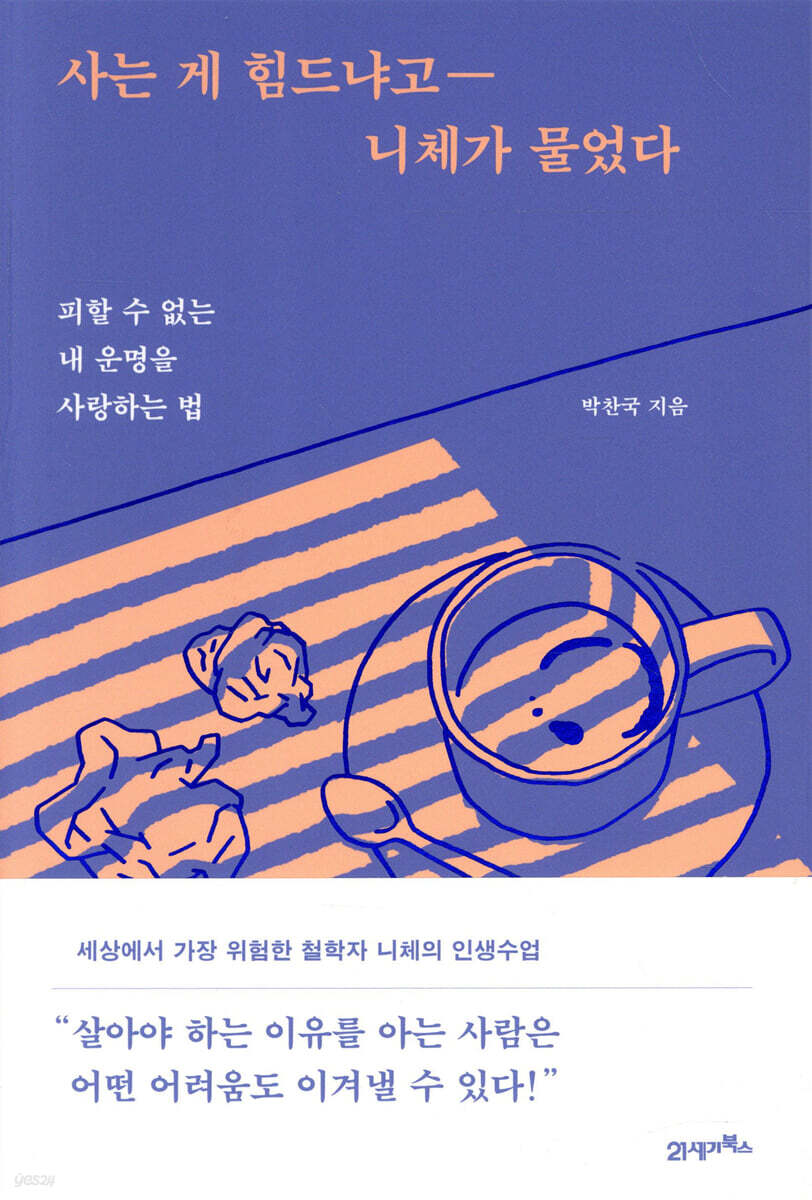
Nietzsche asked, "Is life hard?"
 |
Description
Book Introduction
When you don't want to do anything
When nothing goes my way
Life's Concerns I Want to Ask Nietzsche
Nietzsche, the world's most dangerous philosopher! This book contains ten life concerns that every human being experiences, along with Nietzsche's advice on them.
Professor Park Chan-guk of Seoul National University's Department of Philosophy, the nation's leading authority on Nietzsche, has explained Nietzsche's philosophy of life in a way that is easy for anyone to understand without losing depth.
To us who worry, “Why is my life so difficult?” Nietzsche tells us, “You can’t be happy if you’re afraid of getting hurt.” To us who worry, “Where should I find the meaning of life?” he presents a simple yet clear message: “A life without searching for meaning is a truly meaningful life.”
Anyone who is contemplating how to navigate their lives—whether it's the conditions for happiness, the value of work, conflict in interpersonal relationships, or the meaning of life—will find comfort and empathy in this book, as well as the opportunity to discover the courage hidden within.
When nothing goes my way
Life's Concerns I Want to Ask Nietzsche
Nietzsche, the world's most dangerous philosopher! This book contains ten life concerns that every human being experiences, along with Nietzsche's advice on them.
Professor Park Chan-guk of Seoul National University's Department of Philosophy, the nation's leading authority on Nietzsche, has explained Nietzsche's philosophy of life in a way that is easy for anyone to understand without losing depth.
To us who worry, “Why is my life so difficult?” Nietzsche tells us, “You can’t be happy if you’re afraid of getting hurt.” To us who worry, “Where should I find the meaning of life?” he presents a simple yet clear message: “A life without searching for meaning is a truly meaningful life.”
Anyone who is contemplating how to navigate their lives—whether it's the conditions for happiness, the value of work, conflict in interpersonal relationships, or the meaning of life—will find comfort and empathy in this book, as well as the opportunity to discover the courage hidden within.
- You can preview some of the book's contents.
Preview
index
Prologue: 10 Questions to Ask Nietzsche When Life Gets Hard
First question: “Why is my life so hard?”
Happiness does not come to those who only seek comfort.
- Life is a pendulum that swings between desire and boredom.
- No one can evaluate the value of life.
- The conditions of happiness we didn't know about
Second question: “Where should we find the meaning of life?”
Life becomes meaningful when you stop looking for meaning.
- From camel to lion, from lion to child
- Live like a child lost in play.
- If life were to repeat itself forever, would you still live like this?
Third question: “Why can’t anything ever go my way?”
There is nothing more beautiful than living dangerously.
- Why did Nietzsche love a difficult fate?
Fate! Will you change it, surrender, or embrace it?
- Harsh trials are my best friends who train me.
Fourth question: “How can conflicts between people be resolved?”
A noble man needs his enemies.
- This world is a world where everything competes for power.
- Why do we hate and fear competition?
- Be honest with yourself and your friends, be brave with your enemies.
- Don't try to eliminate desires, but sublimate them.
Fifth question: “Will I be unhappy if I don’t believe in God?”
There is no god for you anywhere
- Why did Nietzsche have to kill God?
- Jesus did not die for the salvation of mankind.
- Religion is a fiction created by weak humans.
- Live like a tree rooted in the earth.
Question Six: “Is belief really necessary?”
Beliefs are a burden that weighs down life.
- Those who fear growth create beliefs.
- Certainty is a more dangerous enemy of truth than lies.
- How to free yourself from the weight of life
Seventh question: “Why does life always feel so empty?”
Art is a great stimulant of life.
- Scientific knowledge is merely information necessary for survival.
- Life is fulfilled through art.
- Make life an art
Eighth question: “Is dying something to be feared?”
Death is not the end of life
- Death, the best opportunity for me to mature
- Pity makes people weak.
- Choose a free and conscious death.
Ninth question: “What does it mean to live true to myself?”
Make your own flower bloom
- How to create your own individuality
- Will you become a slave to other people's gaze?
- Boredom is a signal to change your lifestyle.
Tenth question: “What will it take to overcome me?”
Give your personality a style
- Make even your weaknesses dazzling.
- How to become a person with healthy instincts
- Learn to see, think, and write.
Epilogue: What Doesn't Kill Me Makes Me Stronger
References
First question: “Why is my life so hard?”
Happiness does not come to those who only seek comfort.
- Life is a pendulum that swings between desire and boredom.
- No one can evaluate the value of life.
- The conditions of happiness we didn't know about
Second question: “Where should we find the meaning of life?”
Life becomes meaningful when you stop looking for meaning.
- From camel to lion, from lion to child
- Live like a child lost in play.
- If life were to repeat itself forever, would you still live like this?
Third question: “Why can’t anything ever go my way?”
There is nothing more beautiful than living dangerously.
- Why did Nietzsche love a difficult fate?
Fate! Will you change it, surrender, or embrace it?
- Harsh trials are my best friends who train me.
Fourth question: “How can conflicts between people be resolved?”
A noble man needs his enemies.
- This world is a world where everything competes for power.
- Why do we hate and fear competition?
- Be honest with yourself and your friends, be brave with your enemies.
- Don't try to eliminate desires, but sublimate them.
Fifth question: “Will I be unhappy if I don’t believe in God?”
There is no god for you anywhere
- Why did Nietzsche have to kill God?
- Jesus did not die for the salvation of mankind.
- Religion is a fiction created by weak humans.
- Live like a tree rooted in the earth.
Question Six: “Is belief really necessary?”
Beliefs are a burden that weighs down life.
- Those who fear growth create beliefs.
- Certainty is a more dangerous enemy of truth than lies.
- How to free yourself from the weight of life
Seventh question: “Why does life always feel so empty?”
Art is a great stimulant of life.
- Scientific knowledge is merely information necessary for survival.
- Life is fulfilled through art.
- Make life an art
Eighth question: “Is dying something to be feared?”
Death is not the end of life
- Death, the best opportunity for me to mature
- Pity makes people weak.
- Choose a free and conscious death.
Ninth question: “What does it mean to live true to myself?”
Make your own flower bloom
- How to create your own individuality
- Will you become a slave to other people's gaze?
- Boredom is a signal to change your lifestyle.
Tenth question: “What will it take to overcome me?”
Give your personality a style
- Make even your weaknesses dazzling.
- How to become a person with healthy instincts
- Learn to see, think, and write.
Epilogue: What Doesn't Kill Me Makes Me Stronger
References
Detailed image

Into the book
Nietzsche believes that humans are beings who want to feel their own strength, or in other words, their own vitality, enhanced even if their lives are short and difficult.
To put it simply, what humans pursue is not longevity and a comfortable life, but rather the enhancement and increase of power.
Nietzsche says this:
“What is happiness? ―It is the feeling of increasing strength, of overcoming resistance.”
Happiness Never Comes to Those Who Seek Only Comfort: pp. 34-35
People who see life as a fun game don't ask themselves, "Should I continue playing this game?"
I just get lost in the game called life and enjoy it.
We begin to question the meaning of life when it no longer feels like a fun game but rather a heavy burden we must bear.
That's when we feel life is a heavy burden and ask, 'Why do I have to carry this burden?'
【Life becomes meaningful when you stop looking for meaning: Page 60】
Nietzsche was not at all famous, his books barely sold, but he was still satisfied with his life and affirmed it.
He believes that even those who are not socially successful can use their fateful circumstances as opportunities for self-development by making the most of their abilities without wasting their lives.
Nietzsche even said that the most difficult times in his life were the most helpful for his development.
There's nothing more beautiful than living dangerously: Page 85
People often view cooperation and collaboration positively, while competition is viewed negatively.
However, Nietzsche believed that a society without competition would not develop.
It is only through competition that people are able to maximize their potential and strive to excel.
A Noble Man Needs His Enemy: pp. 100-101
I think the phrase 'God is dead' is one of the most famous sayings of Nietzsche.
But these words of Nietzsche are very paradoxical.
(…) Nietzsche’s words, ‘God is dead,’ should be interpreted symbolically rather than taken literally.
It refers to the fact that in modern times, people stopped believing in God.
There's No God for You: Page 124
The free spirit that Nietzsche speaks of is someone who rejects the comfort of life that dogmatic ideologies provide, considering it to be a cheap comfort, and who can see the world and things from various perspectives.
Only when one becomes this free-spirited can one avoid becoming a slave to any ideology and use various ideologies as nutrients for one's own development.
Beliefs are a burden that weighs down life: p. 176
Nietzsche's concern was ultimately how life could be affirmed in a world where 'God has been killed' by science.
Nietzsche ultimately finds the way to affirm life in art, and above all, in each of us living our lives with an artistic mentality.
Art is Life's Great Stimulant: Page 200
Nietzsche criticized compassion.
Nietzsche criticized compassion not because he was a cruel person, but because compassion weakens people rather than fostering their growth.
To look at someone with pity is to see them as pitiful, and to see them as pitiful is to see them as weak and helpless.
Death Is Not the End of Life: pp. 212-213
Without even realizing it, we are always concerned about other people's opinions and evaluations, and worry that others will ignore us.
Nietzsche believes that the reason we are so sensitive to other people's evaluations is because of the slave mentality that exists within us.
(…) When we are concerned with the gaze and evaluation of others, we are reducing ourselves to the status of slaves.
【Make Your Own Flower Bloom: Page 237】
Nietzsche says that in order to overcome oneself, one must go beyond controlling one's emotions and thoughts and control one's body.
The point is that you shouldn't just lie down because it's hard, but you should be able to take the appropriate posture required for each situation.
(…) Only when we can completely control our bodies in this way can we become healthy and noble, even in our instincts.
【Give Your Personality a Style: Page 255】
To put it simply, what humans pursue is not longevity and a comfortable life, but rather the enhancement and increase of power.
Nietzsche says this:
“What is happiness? ―It is the feeling of increasing strength, of overcoming resistance.”
Happiness Never Comes to Those Who Seek Only Comfort: pp. 34-35
People who see life as a fun game don't ask themselves, "Should I continue playing this game?"
I just get lost in the game called life and enjoy it.
We begin to question the meaning of life when it no longer feels like a fun game but rather a heavy burden we must bear.
That's when we feel life is a heavy burden and ask, 'Why do I have to carry this burden?'
【Life becomes meaningful when you stop looking for meaning: Page 60】
Nietzsche was not at all famous, his books barely sold, but he was still satisfied with his life and affirmed it.
He believes that even those who are not socially successful can use their fateful circumstances as opportunities for self-development by making the most of their abilities without wasting their lives.
Nietzsche even said that the most difficult times in his life were the most helpful for his development.
There's nothing more beautiful than living dangerously: Page 85
People often view cooperation and collaboration positively, while competition is viewed negatively.
However, Nietzsche believed that a society without competition would not develop.
It is only through competition that people are able to maximize their potential and strive to excel.
A Noble Man Needs His Enemy: pp. 100-101
I think the phrase 'God is dead' is one of the most famous sayings of Nietzsche.
But these words of Nietzsche are very paradoxical.
(…) Nietzsche’s words, ‘God is dead,’ should be interpreted symbolically rather than taken literally.
It refers to the fact that in modern times, people stopped believing in God.
There's No God for You: Page 124
The free spirit that Nietzsche speaks of is someone who rejects the comfort of life that dogmatic ideologies provide, considering it to be a cheap comfort, and who can see the world and things from various perspectives.
Only when one becomes this free-spirited can one avoid becoming a slave to any ideology and use various ideologies as nutrients for one's own development.
Beliefs are a burden that weighs down life: p. 176
Nietzsche's concern was ultimately how life could be affirmed in a world where 'God has been killed' by science.
Nietzsche ultimately finds the way to affirm life in art, and above all, in each of us living our lives with an artistic mentality.
Art is Life's Great Stimulant: Page 200
Nietzsche criticized compassion.
Nietzsche criticized compassion not because he was a cruel person, but because compassion weakens people rather than fostering their growth.
To look at someone with pity is to see them as pitiful, and to see them as pitiful is to see them as weak and helpless.
Death Is Not the End of Life: pp. 212-213
Without even realizing it, we are always concerned about other people's opinions and evaluations, and worry that others will ignore us.
Nietzsche believes that the reason we are so sensitive to other people's evaluations is because of the slave mentality that exists within us.
(…) When we are concerned with the gaze and evaluation of others, we are reducing ourselves to the status of slaves.
【Make Your Own Flower Bloom: Page 237】
Nietzsche says that in order to overcome oneself, one must go beyond controlling one's emotions and thoughts and control one's body.
The point is that you shouldn't just lie down because it's hard, but you should be able to take the appropriate posture required for each situation.
(…) Only when we can completely control our bodies in this way can we become healthy and noble, even in our instincts.
【Give Your Personality a Style: Page 255】
--- From the text
Publisher's Review
He who knows why he must live
You can overcome any difficulty!
Life Lessons from Nietzsche, the World's Most Dangerous Philosopher
“Why does life feel so meaningless?” “Everyone else seems happy, so why am I the only one having such a hard time?” “What is the meaning of life?” There are times when these thoughts make me feel depressed.
When there are many painful things, but no clear solution, and comfort and sympathy alone don't solve the problem, don't you want to grab someone and ask them if you're living well and what it means to live happily?
If you were to ask Nietzsche, the philosopher who lived a more painful life than anyone else, about his worries, what would he say?
『Nietzsche asked if life is hard』(published by 21st Century Books) is a reissue of 『Superhuman Class』, published in 2014, with a newly designed title and cover.
Since the first edition was published, it has been loved by many readers, receiving praise as “the most friendly introduction to Nietzsche” thanks to the in-depth knowledge and warm lecture-style commentary of Professor Park Chan-guk (Department of Philosophy, Seoul National University).
This book, "Nietzsche Asked if Life Was Hard," was planned with the intention of once again conveying Nietzsche's passionate message to many people who are exhausted by the various problems of life.
Nietzsche's words for a beautiful and noble life
A warm commentary by Professor Park Chan-guk of the Department of Philosophy at Seoul National University.
This book consists of ten concerns about life, including the conditions for happiness, the meaning of life, conflicts in human relationships, and the value of work, along with Nietzsche's answers.
Nietzsche's message, especially clear and powerful, is filled with content that can resonate with and give courage to those in their 20s and 30s who want to design their lives in their own way.
The message Nietzsche wants to convey to us is that when life feels difficult, we should not blame the world, and we should not get frustrated by comparing ourselves to others. Instead, we should create our own values and live true to ourselves, which is the most humane way to live.
- No one can evaluate my worth but me.
- People who care about other people's opinions and evaluations are reducing themselves to the status of slaves.
- Be honest with yourself and your friends, and brave with your enemies.
- Make even your weaknesses dazzling.
- A life lived long and uneventfully is of no value.
- Don't be satisfied with living according to your natural nature, but create your own style.
The conditions for true happiness as told by Nietzsche
“Respect yourself for overcoming trials.”
The context of Nietzsche's time and our current reality are intertwined.
The 19th century, in which Nietzsche lived, was a time when the religious worldview and values that had given life meaning and purpose began to crumble.
People tried to find answers to why they should live, but in the end, they thought life was meaningless and meaningless and only tried to avoid the pain and trials they faced in life.
At this time, Nietzsche cried out that human life is inevitably painful and therefore cannot be avoided.
And he argued that happiness is not a state of being free from worries or concerns, but rather a feeling of being uplifted and strengthened as you overcome the difficulties and trials that lie ahead.
Therefore, a truly happy person is one who willingly accepts pain and hardship and loves that life itself.
Nietzsche exclaims, “Respect yourself for overcoming trials.”
And it is said that a person who lives with this kind of mind is beautiful and noble in itself.
When we feel irritated by life's various problems, when our self-esteem is low and we don't want to do anything, Nietzsche's message that resonates with our souls will give us the courage to live again when we are tired.
You can overcome any difficulty!
Life Lessons from Nietzsche, the World's Most Dangerous Philosopher
“Why does life feel so meaningless?” “Everyone else seems happy, so why am I the only one having such a hard time?” “What is the meaning of life?” There are times when these thoughts make me feel depressed.
When there are many painful things, but no clear solution, and comfort and sympathy alone don't solve the problem, don't you want to grab someone and ask them if you're living well and what it means to live happily?
If you were to ask Nietzsche, the philosopher who lived a more painful life than anyone else, about his worries, what would he say?
『Nietzsche asked if life is hard』(published by 21st Century Books) is a reissue of 『Superhuman Class』, published in 2014, with a newly designed title and cover.
Since the first edition was published, it has been loved by many readers, receiving praise as “the most friendly introduction to Nietzsche” thanks to the in-depth knowledge and warm lecture-style commentary of Professor Park Chan-guk (Department of Philosophy, Seoul National University).
This book, "Nietzsche Asked if Life Was Hard," was planned with the intention of once again conveying Nietzsche's passionate message to many people who are exhausted by the various problems of life.
Nietzsche's words for a beautiful and noble life
A warm commentary by Professor Park Chan-guk of the Department of Philosophy at Seoul National University.
This book consists of ten concerns about life, including the conditions for happiness, the meaning of life, conflicts in human relationships, and the value of work, along with Nietzsche's answers.
Nietzsche's message, especially clear and powerful, is filled with content that can resonate with and give courage to those in their 20s and 30s who want to design their lives in their own way.
The message Nietzsche wants to convey to us is that when life feels difficult, we should not blame the world, and we should not get frustrated by comparing ourselves to others. Instead, we should create our own values and live true to ourselves, which is the most humane way to live.
- No one can evaluate my worth but me.
- People who care about other people's opinions and evaluations are reducing themselves to the status of slaves.
- Be honest with yourself and your friends, and brave with your enemies.
- Make even your weaknesses dazzling.
- A life lived long and uneventfully is of no value.
- Don't be satisfied with living according to your natural nature, but create your own style.
The conditions for true happiness as told by Nietzsche
“Respect yourself for overcoming trials.”
The context of Nietzsche's time and our current reality are intertwined.
The 19th century, in which Nietzsche lived, was a time when the religious worldview and values that had given life meaning and purpose began to crumble.
People tried to find answers to why they should live, but in the end, they thought life was meaningless and meaningless and only tried to avoid the pain and trials they faced in life.
At this time, Nietzsche cried out that human life is inevitably painful and therefore cannot be avoided.
And he argued that happiness is not a state of being free from worries or concerns, but rather a feeling of being uplifted and strengthened as you overcome the difficulties and trials that lie ahead.
Therefore, a truly happy person is one who willingly accepts pain and hardship and loves that life itself.
Nietzsche exclaims, “Respect yourself for overcoming trials.”
And it is said that a person who lives with this kind of mind is beautiful and noble in itself.
When we feel irritated by life's various problems, when our self-esteem is low and we don't want to do anything, Nietzsche's message that resonates with our souls will give us the courage to live again when we are tired.
GOODS SPECIFICS
- Date of issue: December 3, 2018
- Page count, weight, size: 268 pages | 438g | 140*210*20mm
- ISBN13: 9788950978518
- ISBN10: 8950978512
You may also like
카테고리
korean


korean

![GQ KOREA Mark (Monthly): December [2025]](http://librairie.coreenne.fr/cdn/shop/files/8ef265dbbfbf186523ed75ba7319009d.jpg?v=1765340328&width=3840)


