

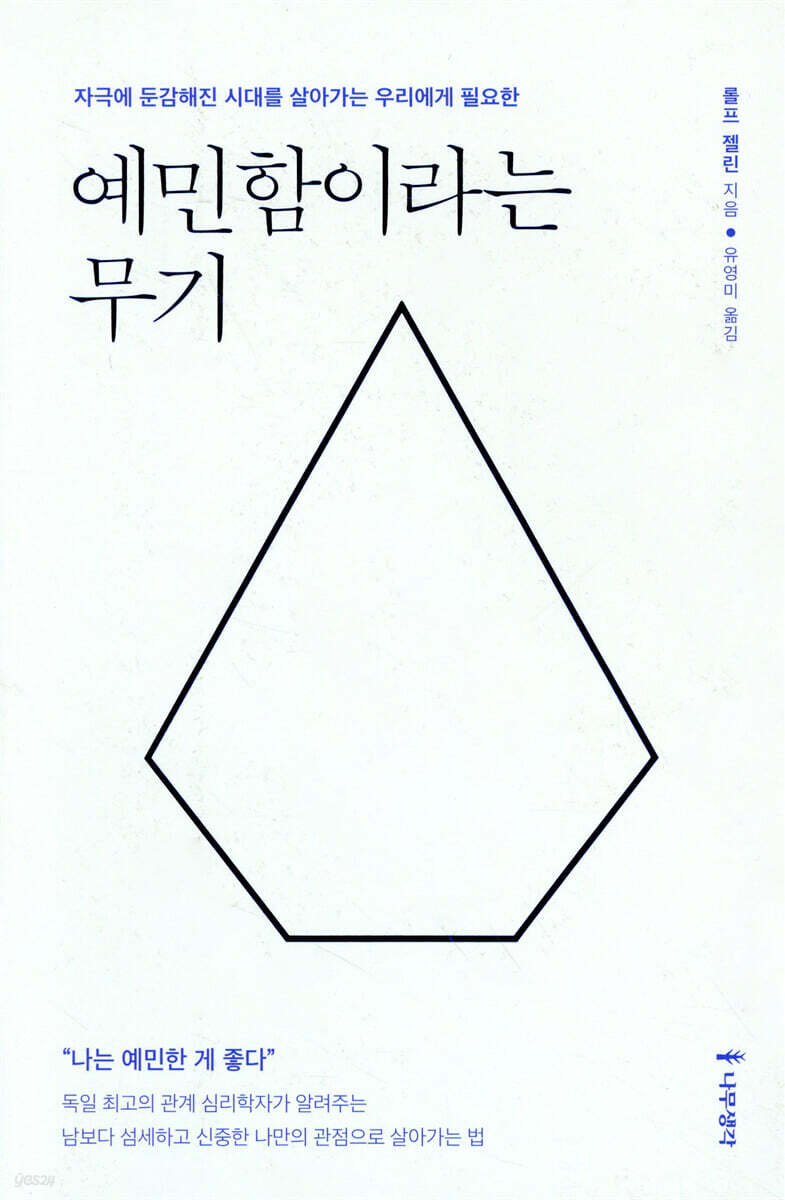
The weapon of sensitivity
 |
Description
Book Introduction
Germany's top relationship psychologist tells you
More delicate, careful and sensitive than others
How to live with your own talents
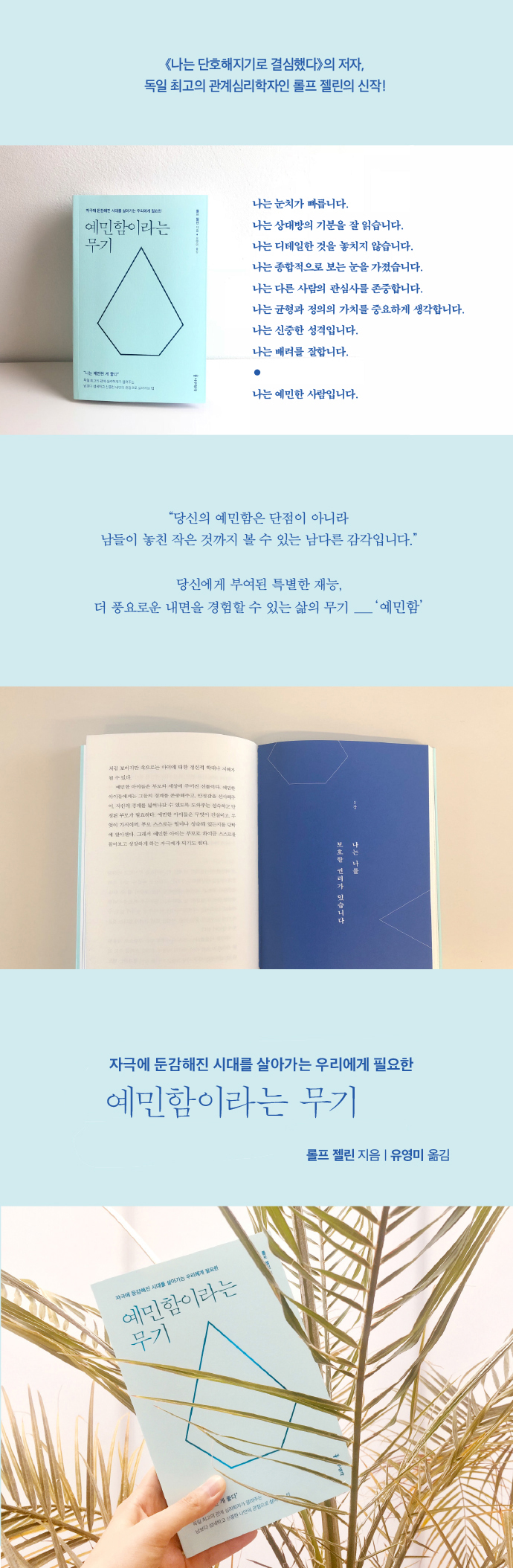
Relationship psychology for people who unconditionally bend their positions to avoid conflict with others and even live by taking on other people's problems.
Rolf Selin, author of the German Amazon psychology bestseller "I Decided to Be Resolute," delivers a much-needed message of empathy and prescription to those who have had to hide their innate sensitivity to hide from the world's misguided view of sensitive people.
He also advises that when sensitive people live with their own delicate and careful perspectives, they can encounter a wider world and a richer inner self.
We also provide useful information through a checklist that allows you to self-diagnose your sensitivity and interviews with counselors sharing their vivid experiences.
More delicate, careful and sensitive than others
How to live with your own talents
Relationship psychology for people who unconditionally bend their positions to avoid conflict with others and even live by taking on other people's problems.
Rolf Selin, author of the German Amazon psychology bestseller "I Decided to Be Resolute," delivers a much-needed message of empathy and prescription to those who have had to hide their innate sensitivity to hide from the world's misguided view of sensitive people.
He also advises that when sensitive people live with their own delicate and careful perspectives, they can encounter a wider world and a richer inner self.
We also provide useful information through a checklist that allows you to self-diagnose your sensitivity and interviews with counselors sharing their vivid experiences.
- You can preview some of the book's contents.
Preview
index
Our story
The story we hope for
Entering: I like being sensitive
Chapter 1 I am a sensitive person: Diagnosing the shield of the mind
An underrated and unique temperament
Between talent and flaws
My Sensitivity Self-Diagnosis Method
Diagnosing Your Child's Sensitivity
Highly sensitive and extroverted people
Self-Diagnosis for Sensitivity and Extroversion
Chapter 2: I Have a More Detailed Sense Than Others: Stereotypes That Hide Talent
The war going on inside me
Parents' greed that doesn't even know their child's heart
Shouldn't men be sensitive?
Women are naturally sensitive, right?
Give sensitive children time.
Chapter 3 I Have the Right to Protect Myself: Coping with Internal Triggers
Building stress resistance
Centering from stimulation
Building boundaries to protect myself
The first step toward others and the world
Prerequisites for boundary setting
Listen to your body's signals
Chapter 4: Between Egoists and Altruists: Coping with External Stimuli
Escape from stress and burnout
Things that disturb the thoughts of a sensitive person
The ability to read other people's minds
How to Deal with Conflict Effectively
People who are both advisors and victims
Longing or retreating
A team of sensitive people only
Chapter 5: How to Live as a Sensitive Person
Misconceptions about high sensitivity
Understanding your connection to the world
Untie a faulty link
In conclusion: A continuous driving force for self-improvement.
Acknowledgements
The story we hope for
Entering: I like being sensitive
Chapter 1 I am a sensitive person: Diagnosing the shield of the mind
An underrated and unique temperament
Between talent and flaws
My Sensitivity Self-Diagnosis Method
Diagnosing Your Child's Sensitivity
Highly sensitive and extroverted people
Self-Diagnosis for Sensitivity and Extroversion
Chapter 2: I Have a More Detailed Sense Than Others: Stereotypes That Hide Talent
The war going on inside me
Parents' greed that doesn't even know their child's heart
Shouldn't men be sensitive?
Women are naturally sensitive, right?
Give sensitive children time.
Chapter 3 I Have the Right to Protect Myself: Coping with Internal Triggers
Building stress resistance
Centering from stimulation
Building boundaries to protect myself
The first step toward others and the world
Prerequisites for boundary setting
Listen to your body's signals
Chapter 4: Between Egoists and Altruists: Coping with External Stimuli
Escape from stress and burnout
Things that disturb the thoughts of a sensitive person
The ability to read other people's minds
How to Deal with Conflict Effectively
People who are both advisors and victims
Longing or retreating
A team of sensitive people only
Chapter 5: How to Live as a Sensitive Person
Misconceptions about high sensitivity
Understanding your connection to the world
Untie a faulty link
In conclusion: A continuous driving force for self-improvement.
Acknowledgements
Detailed image
Into the book
A sensitive child perceives contradictions in people and situations.
But his perception is not usually understood by people.
Adults don't explain why children can perceive things that way.
Then, children often have to ignore what they see and feel by pretending not to see or feel it.
For example, if a sensitive child tells his mother that his "loving aunt" doesn't seem to like him at all despite what she says, he's likely to get scolded.
Misunderstandings arise, and the child's feelings are dismissed as nonsense.
Additionally, sensitive children are not only able to observe contradictions, but are also keenly aware of other people's thoughts and expectations.
But in trying to fit in with other people's expectations and thoughts, we tend to ignore our own observations and suppress our own perceptions.
And then, you gradually lose yourself.
--- p.62
If we divide perception into external and internal stimuli, and then allow some of that perception to remain within ourselves, the experience of walking around a crowded city will be completely different.
You will be able to feel the strength of your breathing, your stomach, and your muscles, and enjoy the subtle but effective changes.
We are no longer vulnerable to external stimuli, but can choose them and control their amount.
If you only direct your attention outward without being aware of your own state, the energy will not remain within you.
Then there is a problem with energy management.
Living that way will cause you to lose energy, lose your center, and easily neglect yourself because you are not centered.
This is how we end up overstepping our boundaries, failing to find our place in life, and losing respect.
--- pp.128-129
Sensitive people usually want to grab the cake later, after the cake has been shared.
They are so concerned about making sure everyone gets a piece of cake that they realize they are the only one left empty-handed while everyone else gets a little. Only then do they raise the issue of injustice and try to make amends.
If you do that, you may end up raising your voice in criticism out of disappointment.
Sensitive people, while neglecting themselves, secretly expect others to treat them as well as they treat themselves.
If others fail to do so, it is the sensitive people themselves who will disrupt the peace.
Then the tables are turned, and sensitive people who had previously shown altruistic tendencies turn into egoists.
People who were tolerant just a moment ago are now revealed to be selfish, stingy, and narrow-minded.
--- pp.208-209
Sensitive people perceive differently, think differently, and work differently.
Sensitive people usually volunteer to do difficult things.
They care more about ensuring that their work is of high quality than about their own convenience.
Observe everything, have foresight, perceive what is wrong, feel the needs of customers, business partners, colleagues, and superiors, and be considerate of others.
Because they have an excellent ability to read between the lines and hear what is not said.
Despite their stubbornness, sensitive people are highly adaptable, flexible to situations and people, and willing to roll up their sleeves and help those in need.
By being quiet and discreet, you contribute to the company atmosphere, always ensuring fair treatment among employees, and being considerate and encouraging of others.
But his perception is not usually understood by people.
Adults don't explain why children can perceive things that way.
Then, children often have to ignore what they see and feel by pretending not to see or feel it.
For example, if a sensitive child tells his mother that his "loving aunt" doesn't seem to like him at all despite what she says, he's likely to get scolded.
Misunderstandings arise, and the child's feelings are dismissed as nonsense.
Additionally, sensitive children are not only able to observe contradictions, but are also keenly aware of other people's thoughts and expectations.
But in trying to fit in with other people's expectations and thoughts, we tend to ignore our own observations and suppress our own perceptions.
And then, you gradually lose yourself.
--- p.62
If we divide perception into external and internal stimuli, and then allow some of that perception to remain within ourselves, the experience of walking around a crowded city will be completely different.
You will be able to feel the strength of your breathing, your stomach, and your muscles, and enjoy the subtle but effective changes.
We are no longer vulnerable to external stimuli, but can choose them and control their amount.
If you only direct your attention outward without being aware of your own state, the energy will not remain within you.
Then there is a problem with energy management.
Living that way will cause you to lose energy, lose your center, and easily neglect yourself because you are not centered.
This is how we end up overstepping our boundaries, failing to find our place in life, and losing respect.
--- pp.128-129
Sensitive people usually want to grab the cake later, after the cake has been shared.
They are so concerned about making sure everyone gets a piece of cake that they realize they are the only one left empty-handed while everyone else gets a little. Only then do they raise the issue of injustice and try to make amends.
If you do that, you may end up raising your voice in criticism out of disappointment.
Sensitive people, while neglecting themselves, secretly expect others to treat them as well as they treat themselves.
If others fail to do so, it is the sensitive people themselves who will disrupt the peace.
Then the tables are turned, and sensitive people who had previously shown altruistic tendencies turn into egoists.
People who were tolerant just a moment ago are now revealed to be selfish, stingy, and narrow-minded.
--- pp.208-209
Sensitive people perceive differently, think differently, and work differently.
Sensitive people usually volunteer to do difficult things.
They care more about ensuring that their work is of high quality than about their own convenience.
Observe everything, have foresight, perceive what is wrong, feel the needs of customers, business partners, colleagues, and superiors, and be considerate of others.
Because they have an excellent ability to read between the lines and hear what is not said.
Despite their stubbornness, sensitive people are highly adaptable, flexible to situations and people, and willing to roll up their sleeves and help those in need.
By being quiet and discreet, you contribute to the company atmosphere, always ensuring fair treatment among employees, and being considerate and encouraging of others.
--- pp.219-220
Publisher's Review
Sensitive people who hide their innate talents and live according to the standards of others.
Telling a sensitive person not to be sensitive is like telling a blue-eyed person why they have blue eyes and that having blue eyes is wrong.
There is no more offensive attitude toward a fundamental human nature than to tell someone with light or dark skin that it is a shame that their skin color is different from yours.
Sensitivity is not a bad trait that harms others, nor is it a habit that must be corrected. It is a special talent bestowed upon each human being.
Rolf Selin, who founded and runs the Highly Sensitive Persons Institute in Stuttgart, is skeptical of the medical and psychotherapy fields' treatment of high-sensitivity traits, such as shyness, timidity, depression, stress vulnerability, and chronic illness.
This attitude is what causes most people with high sensitivity to feel their talents as a burden and suffer because of it.
This stems from a misconception about the unique temperament of sensitivity.
Sensitive people tend to hide their delicate and perceptive talents to avoid the conflicts and side effects that arise from their unique temperament in interpersonal relationships.
However, there are many cases where people try to avoid conflict unconditionally and fail to recognize their own position in time, become frustrated because they try to put in more effort than is required of them, or fail to properly take care of their own work because they take on other people's problems.
Sometimes we even focus only on the obstacles that always come up and put all other possibilities on the back burner.
The author presents typical examples of pitfalls and misunderstandings that sensitive people can easily fall into, along with vivid interviews with counselors.
Your sensitivity is not a weakness,
A unique sense that allows you to see even the smallest details that others miss.
We are all sensitive.
People who consider themselves to be sensitive, or who consider themselves not sensitive, or who live with or are surrounded by sensitive people experience a great deal of stress.
Because our bias against sensitivity is subtly suppressing us and telling us that it is uncomfortable.
Rolf Zelin writes that he wrote the book to show that being highly sensitive is not a weakness or a disadvantage, but rather that if you handle this unique trait well, it can become a very great talent.
This book presents a self-diagnosis method that can help men who are stressed out from suppressing their innate sensitivity while being forced to live a 'masculine' life, women who are misunderstood for their sensitive nature or forced to sacrifice themselves simply because they are women, and children who are more concerned about their parents' expectations and interests and try to force themselves to fit into society and always try not to stand out and deviate from the norm.
This helps people with high sensitivity to see their talents not as flaws but as gifts in their lives.
When you regain your delicate and careful senses
We can experience a wider world and a richer inner self.
This book teaches highly sensitive people how to recognize boundaries that allow them to focus their perceptions, thoughts, and energy, and protect themselves from interference from others, so that they can utilize their temperament effectively.
Conforming to other people's standards and external stimuli drains your energy and ultimately lowers your self-esteem.
In other words, to develop high sensitivity as an advantage, you must focus on yourself while clearly recognizing the boundaries of your body and nerves.
We need to train ourselves to focus on ourselves rather than others.
In this book, the author vividly shares his experiences of how sensitive people accept their own characteristics as they are and live lives of greater joy and abundance by making better use of their delicate and careful senses than others.
Above all, when you focus on developing your strengths while maintaining a balanced boundary with others, you can experience a wider world and a richer inner self.
Telling a sensitive person not to be sensitive is like telling a blue-eyed person why they have blue eyes and that having blue eyes is wrong.
There is no more offensive attitude toward a fundamental human nature than to tell someone with light or dark skin that it is a shame that their skin color is different from yours.
Sensitivity is not a bad trait that harms others, nor is it a habit that must be corrected. It is a special talent bestowed upon each human being.
Rolf Selin, who founded and runs the Highly Sensitive Persons Institute in Stuttgart, is skeptical of the medical and psychotherapy fields' treatment of high-sensitivity traits, such as shyness, timidity, depression, stress vulnerability, and chronic illness.
This attitude is what causes most people with high sensitivity to feel their talents as a burden and suffer because of it.
This stems from a misconception about the unique temperament of sensitivity.
Sensitive people tend to hide their delicate and perceptive talents to avoid the conflicts and side effects that arise from their unique temperament in interpersonal relationships.
However, there are many cases where people try to avoid conflict unconditionally and fail to recognize their own position in time, become frustrated because they try to put in more effort than is required of them, or fail to properly take care of their own work because they take on other people's problems.
Sometimes we even focus only on the obstacles that always come up and put all other possibilities on the back burner.
The author presents typical examples of pitfalls and misunderstandings that sensitive people can easily fall into, along with vivid interviews with counselors.
Your sensitivity is not a weakness,
A unique sense that allows you to see even the smallest details that others miss.
We are all sensitive.
People who consider themselves to be sensitive, or who consider themselves not sensitive, or who live with or are surrounded by sensitive people experience a great deal of stress.
Because our bias against sensitivity is subtly suppressing us and telling us that it is uncomfortable.
Rolf Zelin writes that he wrote the book to show that being highly sensitive is not a weakness or a disadvantage, but rather that if you handle this unique trait well, it can become a very great talent.
This book presents a self-diagnosis method that can help men who are stressed out from suppressing their innate sensitivity while being forced to live a 'masculine' life, women who are misunderstood for their sensitive nature or forced to sacrifice themselves simply because they are women, and children who are more concerned about their parents' expectations and interests and try to force themselves to fit into society and always try not to stand out and deviate from the norm.
This helps people with high sensitivity to see their talents not as flaws but as gifts in their lives.
When you regain your delicate and careful senses
We can experience a wider world and a richer inner self.
This book teaches highly sensitive people how to recognize boundaries that allow them to focus their perceptions, thoughts, and energy, and protect themselves from interference from others, so that they can utilize their temperament effectively.
Conforming to other people's standards and external stimuli drains your energy and ultimately lowers your self-esteem.
In other words, to develop high sensitivity as an advantage, you must focus on yourself while clearly recognizing the boundaries of your body and nerves.
We need to train ourselves to focus on ourselves rather than others.
In this book, the author vividly shares his experiences of how sensitive people accept their own characteristics as they are and live lives of greater joy and abundance by making better use of their delicate and careful senses than others.
Above all, when you focus on developing your strengths while maintaining a balanced boundary with others, you can experience a wider world and a richer inner self.
GOODS SPECIFICS
- Date of issue: July 18, 2018
- Page count, weight, size: 276 pages | 332g | 135*205*20mm
- ISBN13: 9791162180297
- ISBN10: 1162180293
You may also like
카테고리
korean


korean

![GQ KOREA Mark (Monthly): December [2025]](http://librairie.coreenne.fr/cdn/shop/files/8ef265dbbfbf186523ed75ba7319009d.jpg?v=1765340328&width=3840)


