

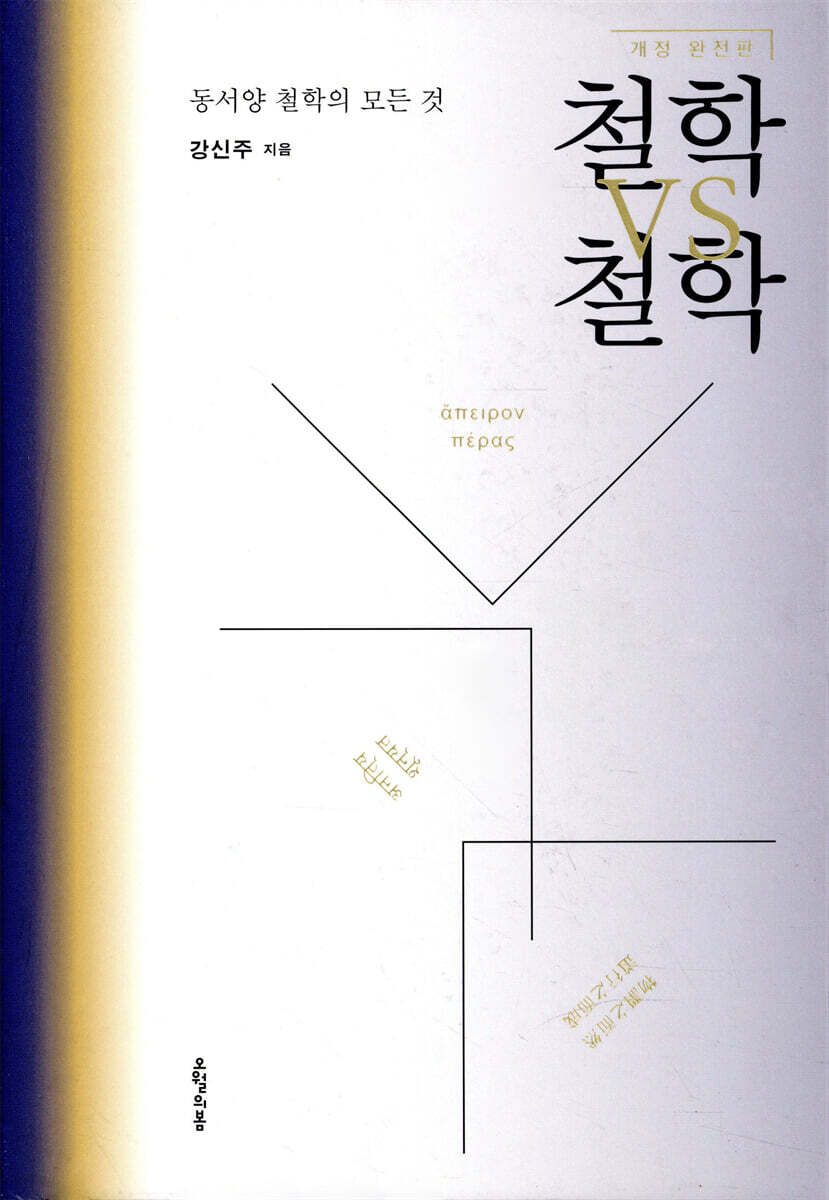
Philosophy VS Philosophy
 |
Description
Book Introduction
“A training ground for philosophical thinking, an arsenal of critical intelligence!”
A history of philosophy that provides a perspective on our lives today
All the world's philosophies, spanning East and West, ancient and modern
The definitive edition of Kang Shin-ju's philosophy! The revised and complete edition of "Philosophy vs. Philosophy" is out now.
The revised and complete edition of philosopher Kang Shin-ju's masterpiece, "Philosophy VS Philosophy," which has been much loved, has been released.
It has been six years since it was first published in February 2010.
Even at the time of publication, this book was a masterpiece with over 3,500 pages.
However, in this revised and complete edition, author Kang Shin-ju added an additional 3,000 pages of manuscript.
Ten new chapters have been added, and new articles have been written, including 'First, What is Philosophy?' and 'Now, What is Philosophy?'
(Added philosopher entries are as follows:
Hilbert vs. Brauer, Gramsci vs. Benjamin, Klee vs. Roscoe, Heisenberg vs. Prigogine, Merleau-Ponty vs. Lyotard, Sunja vs. Song Gyeon, Stiramatti vs. Dignaga, Jeong Yak-yong vs. Choi Je-woo, young Shin Chae-ho vs. middle-aged Shin Chae-ho, Lee Eo-ryeong vs. Kim Su-yeong).
Moreover, a new section called 'Remarks' was created that was not in the first edition, and the positions of existing philosophers were supplemented in large numbers.
Through this 'consideration,' the author introduces important philosophical historical issues and information that might otherwise be overlooked when writing a history of philosophy in terms of confrontation, as well as comparative philosophical perspectives related to those issues.
Through this book, readers will not only gain a more complete overview of the history of philosophy, but will also gain a deeper understanding of why the philosophical issues discussed are crucial for understanding our lives today.
The contents of the 'Dictionary of Biographical Names' and 'Dictionary of Conceptual Terms' included as appendices have also been supplemented, and the 'Chronology of the History of Philosophy', which is over 20 pages long, is also full of content.
What is particularly noteworthy is that the comparative philosophical perspective of Eastern and Western philosophy has been further strengthened.
In this book, Kang Shin-ju encompasses Eastern and Western philosophy, including Nagarjuna, Zhuangzi, Spinoza, and Wittgenstein, completing a history of philosophy that only philosopher Kang Shin-ju, like no other, can write.
This revised and complete edition can truly be said to be the definitive version of Kang Shin-ju's philosophy.
“I think it’s because I was so absorbed in writing it as if it were a completely new edition, but it hardly feels like a revised edition.
Writing time is almost twice as much as in the past, and the number of manuscripts has nearly doubled.
The price was fatal.
The physical aftereffects are worse than those of six years ago.
My right shoulder was so dislocated that I couldn't even type on the computer keyboard.
Although I am receiving treatment, even as I write this introduction, a sharp pain still lingers in my shoulder.
If the conjunctivitis caused by "Philosophy vs. Philosophy" six years ago was the price of planting a small seedling, the pain in my right shoulder caused by "Philosophy vs. Philosophy" now seems to be proof that that seedling has grown into a large tree with lush foliage.
A history of philosophy that provides a perspective on our lives today
All the world's philosophies, spanning East and West, ancient and modern
The definitive edition of Kang Shin-ju's philosophy! The revised and complete edition of "Philosophy vs. Philosophy" is out now.
The revised and complete edition of philosopher Kang Shin-ju's masterpiece, "Philosophy VS Philosophy," which has been much loved, has been released.
It has been six years since it was first published in February 2010.
Even at the time of publication, this book was a masterpiece with over 3,500 pages.
However, in this revised and complete edition, author Kang Shin-ju added an additional 3,000 pages of manuscript.
Ten new chapters have been added, and new articles have been written, including 'First, What is Philosophy?' and 'Now, What is Philosophy?'
(Added philosopher entries are as follows:
Hilbert vs. Brauer, Gramsci vs. Benjamin, Klee vs. Roscoe, Heisenberg vs. Prigogine, Merleau-Ponty vs. Lyotard, Sunja vs. Song Gyeon, Stiramatti vs. Dignaga, Jeong Yak-yong vs. Choi Je-woo, young Shin Chae-ho vs. middle-aged Shin Chae-ho, Lee Eo-ryeong vs. Kim Su-yeong).
Moreover, a new section called 'Remarks' was created that was not in the first edition, and the positions of existing philosophers were supplemented in large numbers.
Through this 'consideration,' the author introduces important philosophical historical issues and information that might otherwise be overlooked when writing a history of philosophy in terms of confrontation, as well as comparative philosophical perspectives related to those issues.
Through this book, readers will not only gain a more complete overview of the history of philosophy, but will also gain a deeper understanding of why the philosophical issues discussed are crucial for understanding our lives today.
The contents of the 'Dictionary of Biographical Names' and 'Dictionary of Conceptual Terms' included as appendices have also been supplemented, and the 'Chronology of the History of Philosophy', which is over 20 pages long, is also full of content.
What is particularly noteworthy is that the comparative philosophical perspective of Eastern and Western philosophy has been further strengthened.
In this book, Kang Shin-ju encompasses Eastern and Western philosophy, including Nagarjuna, Zhuangzi, Spinoza, and Wittgenstein, completing a history of philosophy that only philosopher Kang Shin-ju, like no other, can write.
This revised and complete edition can truly be said to be the definitive version of Kang Shin-ju's philosophy.
“I think it’s because I was so absorbed in writing it as if it were a completely new edition, but it hardly feels like a revised edition.
Writing time is almost twice as much as in the past, and the number of manuscripts has nearly doubled.
The price was fatal.
The physical aftereffects are worse than those of six years ago.
My right shoulder was so dislocated that I couldn't even type on the computer keyboard.
Although I am receiving treatment, even as I write this introduction, a sharp pain still lingers in my shoulder.
If the conjunctivitis caused by "Philosophy vs. Philosophy" six years ago was the price of planting a small seedling, the pain in my right shoulder caused by "Philosophy vs. Philosophy" now seems to be proof that that seedling has grown into a large tree with lush foliage.
- You can preview some of the book's contents.
Preview
index
time
Preface to the Revised Complete Edition 4
Preface 6
Prologue 19
First, What is Philosophy? - Socrates and Confucius 29
Part 1 Western Philosophy
1.
Where Does Essence Lie? Plato vs. Aristotle 36
Beyond Essence to Freedom 37
Plato: “For the individual, essence is transcendent.” 41
Aristotle: “Essence is inherent in the individual.” 46
Reflections: The All-too-human Nature of Humanity! 52
2.
How Was the World Made? Plato vs. Lucretius 54
Differences Between Eastern and Western Cosmogony: Transcendentalism and Immanenceism 55
Plato: “The universe was made by a creator.” 60
Lucretius: “The universe was created by the collision of atoms.” 65
Reflections: The Phase of Meaning, the Gap Between Pre- and Post- 72
3.
When Is Happiness Possible? Epicureanism vs. Stoicism 74
Hellenistic Philosophy 75: The Center of Possibilities for the Future of Western Philosophy
Epicureanism: “Think about and care for your pleasure!” 79
Stoicism: "Seek harmony with the whole!" 86
Reflections: The Task of Western Philosophy: Unifying Epicureanism and Stoicism 92
4.
Do Universals Exist? Aquinas vs. Ockham 94
The Political Underpinnings of Realism and Nominalism 95
Aquinas: “Universals are realities created by God.” 99
Ockham: “Universals are inventions of the human mind.” 103
Reflections: Two Jewels of Medieval Philosophy: Scotus and Ockham 108
5.
What Kind of Being Are Humans? Pascal vs. Descartes 113
The Birth of the Humanities and the Fate of the Humanistic Spirit 114
Descartes: “Man is a rational and reasonable being.” 119
Pascal: “Man is a vain and sentimental being.” 124
Reflections: Cartesian and Pascalian 129
6.
Is the State Inevitable? Hobbes vs. Clastres 131
Between Absolutism and Anarchism 132
Hobbes: “A state is a state of civilization that has overcome barbarism.” 137
Clastres: “Free society resisted the state.” 143
Reflections: The Bare Face of Social Contract Theory: Statism 150
7.
Is Communication Possible? Spinoza vs. Leibniz 152
Blind Spots in Modern Philosophy: The Other 153
Spinoza: “Solidarity with others who give you joy.” 158
Leibniz: “Don’t be anxious about the communication that is expected.” 163
Reflection: Are Relationships Extrinsic or Intrinsic? 168
8.
When is goodness revealed? Hume vs. Kant 170
Beyond Good and Evil, into the World of Ethics 171
Hume: “The experience of suffering gives rise to sympathy for others.” 174
Kant: “Only autonomous action can be good.” 179
Reflections: Beyond the Ethics of the Subject to the Ethics of the Other 185
9.
Is Private Property Justifiable? Locke vs. Rousseau, 189
You can only own what you see.
190
Locke: “Everything I touch is mine.” 193
Rousseau: “Private property is the cause of all inequality.” 199
Reflections: How to Create a Community of Love, From Possession to Non-Possession 205
10.
Why Does the Type Matter? Berkeley vs. Deleuze 207
Beyond the distinction between empiricism and rationalism 208
Berkeley: “The world exists because God sees it.” 211
Deleuze: “Others see what I cannot.” 215
Reflection: Trusting Others: A Life-Challenging Adventure! 222
11.
Does matter-in-itself exist? Kant vs. Nietzsche 224
When one living being dies, a world disappears.
225
Kant: “There is something outside of us, though we cannot know it.” 228
Nietzsche: “Only the world we perceive exists.” 233
Reflections: Doppelganger, Western Modern Philosophy, and Buddhist Philosophy 240
12.
Is Memory Positive? Fichte vs. Nietzsche 242
Eastern traditions that overlooked Plato 243
Fichte: “Both the subject and the world are creations of memory.” 246
Nietzsche: “Only forgetting makes creation and becoming possible.” 250
Reflections: Impersonality, the Moment of the Birth of a New Self 255
13.
What Drives History? Hegel vs. Marx 257
The Meaning of the Word 'Historical' 258
Hegel: “History is the process by which the Absolute Spirit reveals itself.” 260
Marx: "Material productive forces transform people and society." 264
Reflections: Regrets of Institutional Marxism 273
14.
How does beauty feel? Kant vs. Bourdieu 278
Kant, distinguish between truth, goodness, and beauty.
279
Kant: “The aesthetic is born from disinterested interest.” 283
Bourdieu: “Kant’s aesthetics is nothing but bourgeois aesthetics.” 287
Reflections: From the Aesthetics of Spectating to the Aesthetics of Creation 293
15.
Is Eroticism Instinctive? Schopenhauer vs. Bataille 299
Between the pleasure principle and the reality principle 300
Schopenhauer: “The blind will to life triggers human sexual desire.” 304
Bataille: "Social taboos humanize sexuality." 308
Reflections: Eroticism on a Diamond Chariot 314
16.
When Does the Heart Move? Heidegger vs. Merleau-Ponty 319
320 Until the Western Mind Meets the Eastern Mind
Heidegger: “The mind awakens and operates only in unfamiliar situations.” 325
Merleau-Ponty: “The mind cannot act independently of the body.” 331
Reflections: Phenomenology, Another Name for Philosophizing in Our Time 336
17.
Can a Name Be Changed? Russell vs. Kripke 339
Do proper nouns also have connotations? 340
Russell: “Proper nouns can also be translated into common nouns.” 343
Kripke: “Proper nouns apply in all possible worlds.” 348
Reflections: The Icarus of Analytic Philosophy, Russell 355
18.
Is Freedom Possible? Sartre vs. Althusser 357
Beyond Kant's Freedom to the Freedom of the Great Pyong 358
Sartre: “Man is condemned to be free.” 362
Althusser: “Ideology gives birth to human beings as subjects.” 368
Reflections: The Wisdom of Old Age and the Reconciliation of Sartre and Althusser 374
19.
Can Infinity Be Caught? Hilbert vs. Brouwer 376
The Fate of Modern Mathematics: Stepping into Infinity 377
Hilbert: "The laws of reason are universally valid even in an infinite world." 383
Brower: “Human reason must not attempt to transcend life.” 388
Reflections: Hilbert's Dream and Wittgenstein's Smile 394
20.
What is Language? Young Wittgenstein vs. Middle-Aged Wittgenstein 399
Can I express all my thoughts in words? 400
Young Wittgenstein: "Whereof one cannot speak, thereof one must be silent." 403
Young Wittgenstein: "Language cannot be separated from the context of life." 407
Reflections: Philosophy as Therapy, Wittgenstein and Nagarjuna 416
21.
How is Truth Communicated? Gramsci vs. Benjamin 421
From Truth to Expediency, or From Courage to Affection 422
Gramsci: "Move with the masses and lead them!" 426
Benjamin: "Wake people up by startling them!" 432
Reflections: An Antidote to Bewilderment and Cynicism 437
22.
Why Totalitarianism Occurs? Adorno vs. Arendt 439
The Secret Cohabitation Between Nazism and Heidegger 440
Adorno: “The identity pursued by reason produces exclusion and oppression.” 444
Arendt: “Thoughtlessness means not being able to think from the perspective of others.” 448
Reflections: The Fever of Festivals, and the Cold Logic Behind It 453
23.
How Does the Future Arrive? Bergson vs. Levinas 456
The Secret of Time Found in the Heart 457
Bergson: "The future is possible because of the mind that expects it." 461
Levinas: "Only by encountering the Other can the future be opened." 465
Reflections: Beyond Representational Temporality 469
24.
What Does Capital Live On? Weber vs. Baudrillard 476
How Capital Lives 477
Weber: "Without the spirit of asceticism, the productive power of capital declines." 479
Baudrillard: "Reckless consumption animates capital." 485
Reflections: The Capitalist, the Tazza of Our Time 491
25.
Is Love a Becoming of Oneness? Hegel vs. Badiou 494
The Inner Logic of the Word "I Love You" 495
Hegel: “Marriage and family perfect imperfect love.” 499
Badiou: “Love is an experience of two, an infinitely open relationship.” 504
Reflections: The Philosophy of Love, or Philosophy of Love 510
26.
Is the History of Science Continuous? Popper vs. Kuhn 513
Between the Revolutionary Power of Science, Heidegger and Badiou 514
Popper: "Science, like critical intelligence, develops continuously." 518
Kuhn: "Science undergoes a process of discontinuous revolutions." 523
Reflections: Bachelard, Between Science and Literature 530
27.
How Do Paintings Move Us? Klee vs. Rothko 535
The Crisis of Representation, or Cézanne's Anguish 536
Klee: "Lines can also express other worlds." 541
Roscoe: “Only fiery colors can convey tragic emotions.” 547
Reflections: What Wittgenstein Felt About Schubert's Melodies 557
28.
Is Desire Negative? Lacan vs. Deleuze 564
565 Until the curse of the concept of desire is lifted
Lacan: “I desire the desire of the Other.” 567
Deleuze: “Desire is the power to create new relations.” 573
Reflection: The Paradox That the Most Unique Can Be the Most Universal 579
29.
What Power Does Sound Have? Derrida vs. Deleuze 581
What We Can Learn from Yogacara Buddhism 582
Derrida: “The inner voice is contaminated by the text.” 585
Deleuze: “External sounds can overturn the visual world.” 591
Reflections: Our Brains and the Power of Art! 596
30.
Is Science Deterministic? Heisenberg vs. Prigogine 599
The Shaken Foundations of a Mechanistic Worldview 600
Heisenberg: “The microscopic world is a discontinuous world governed by probability.” 604
Prigogine: “Disorder makes possible not only destruction but also creation.” 612
Reflections: Natural Science, Metaphysics, and Political Philosophy 618
31.
What Logic Does Life Follow? Dawkins vs. Maturana 621
Beyond the Logic of Genes to the Logic of Life 622
Dawkins: "Humans are merely vehicles for their genes." 625
Maturana: “Evolution is the result of natural drift, not natural selection.” 629
Reflections: Neuro-Buddhism, or Synapses and Liberation 636
32.
How New Is Film? Merleau-Ponty vs. Lyotard 639
Montage, Oriental, so Oriental 640
Merleau-Ponty: “We learn to act from the movies.” 643
Lyotard: “Film can offer subversive pleasures.” 647
Reflections: Benjamin, Cinematic Imagination, and Cinematic Humanities 652
33.
Where is Politics Headed? Schmitt vs. Agamben 654
A New Paradigm for Political Philosophy: Foucault's "Biopolitics" 655
Schmitt: “The political divides individuals into enemies and friends.” 658
Agamben: “Politics imprints in us the fear of exclusion.” 663
Reflections: Beyond Representative System to Democracy, or Beyond Public Security to Politics 668
Part 2: Eastern Philosophy
1.
How is love realized? Confucius vs. Mozi 676
Was the love Confucius advocated universal? 677
Confucius: "Harmony among the ruling class makes harmony possible for the entire society." 680
Mozi: "We must cherish and help all people without any discrimination." 685
Reflections: The Pride of Living as a Mohist 690
2.
What is the Self? Lokayata School vs. Siddhartha 693
Pantheism or the World of Pantheism 694
Lokayata School: "Man is neither more nor less than the body." 697
Siddhartha: “Humans have not only a body but also a mind.” 702
Reflections: The Dizzying Balance, the Difficulty of the Middle Way 709
3.
What Determines Victory? Sun Tzu vs. Wu Tzu 711
The State as an Institutionalized War Machine 712
Sun Tzu: "Throw your soldiers into situations where they have no choice but to fight!" 716
Oja: "Encourage voluntary obedience from the soldiers!" 721
Reflections: Jean Giono's Insight: War Can Be a Nation's Achilles' Heel (726)
4.
Where Is the Tao? Laozi vs. Zhuangzi 729
Between Truth and Tao, or West and East 730
Lao Tzu: “There is a One who precedes all things and gives birth to them.” 733
Zhuangzi: "The path is made by the traces we walk." 737
Reflection: The Reason of the Day vs. the Reason of the Other 744
5.
Is Logic Possible in the East? Hui Shi vs. Gongsun Long 747
The Long-Forgotten Tradition of Logical Thinking in Ancient China 748
Hye-si: “Only those filled with love discover the unity of all things.” 751
Gongsun Long: "Only empiricism and pragmatics can serve as the foundation of argument." 757
Reflections: Logic, Rhetoric, and Vitaviryang 763
6.
How Does the Body Move? Married vs. Unmarried 765
A Reviving Organic View of Nature 766
Yubu: "You can diagnose and treat your body like a machine." 769
Edit: “The body is not a machine, but an organism whose parts reflect the whole.” 772
Reflections: Yin-Yang and the Five Elements: The Center of East Asian Traditional Views of Nature 778
7.
Is Humanity Good? Mencius vs. Xunzi 787
Beyond the political, overly political, humanistic theory of 788
Mencius: “Because they have a good nature, humans can become good on their own.” 791
Sunja: "The theory of human nature's goodness nullifies the very existence of public authority and norms." 795
Reflections: The True Humanist, Gaozi 801
8.
How is life protected? Yangju vs. Hanbija 803
Enemy and Comrade, or Beyond Politics 804
Yangju: "A community free from the state is possible." 808
Han Feizi: "Only a country governed by law can end war and slaughter." 812
Reflections: 818 Philosophy of Yangju: Reread and Deeply Engraved
9.
Is the struggle for recognition inevitable? Sunja vs. Song Gyeon 821
Beyond the timid struggle for recognition, becoming a confident subject 822
Sunja: "Humans are beings who desire social recognition." 827
Song Jian: "The desire for recognition is the root of all conflict and opposition." 832
Reflection: Dignity is an Elegant Virtue 836
10.
Does contingency exist? Dong Zhongshu vs. Wang Chong, 838
Philosophy of Contingency and Philosophy of Necessity 839
Dong Zhongshu: "A single, inevitable causal relationship governs the world." 846
Wang Chong: “Everything arises from chance encounters.” 851
Reflections: The Detonator of East Asian Thought, Wang Chong 857
11.
How is liberation possible? Nagarjuna vs. Vasubandhu 862
Mechanisms of Memory, Absence, and Attachment 863
Nagarjuna: “Get rid of the metaphysical illusion that concepts point to reality.” 865
Vasubandhu: "Sever utterly from the unconscious workings of memory consciousness." 872
Consideration: The Four Schools of Indian Buddhism: Sarvāstivāda, Sarvāstivāda, Madhyamaka, and Vijñāna 878
12.
Can Emptiness Be Justified? Nyaya vs. Nagarjuna 884
From Logic to Rhetoric, or From Obsession to Liberation 885
Nyaya School: "The claim that everything is empty is self-contradictory." 890
Nagarjuna: “Emptiness is simply the concept of the interdependence of all things.” 894
Reflections: Cantor's Paradox and the Wisdom of Nagarjuna 898
13.
Is the mind eternal? Hyewon vs. Beomjin 900
How did the ancient Chinese view the body and mind? 901
Hyewon: "The mind is unrelated to changes in the body." 904
Beomjin: "Mind and body are two aspects of our lives." 908
Reflections: Between Philosophy and Religion, or the Agony of the Quantitative Department 912
14.
Does a Date Exist? Wang Bi vs. Guo Xiang, 916
From Old Metaphysics to New Metaphysics 917
Wang Bi: "Think of the world through the image of a tree." 921
Kwak Sang: "The relationships of all things are destined to be harmonious." 925
Reflections: China's Leading Anarchist, Po Jingyan 931
15.
Are the scriptures true? Stiramati vs. Dignaga 935
Faith, or a Leap of Life 936
Stiramathi: “The teachings of the Buddhist scriptures are sacred and inviolable.” 939
Dignaga: "The unexamined words of Siddhartha are not the truth." 945
Reflections: Dignāga 952, the Heart of Indian Philosophy
16.
How Does Obsession Arose? Shinsoo vs. Huineng 955
956 until the legend of Hye-neung was created
Shinsoo: "An obsessive mind is like a dirty mirror." 961
Hye-neung: “The very act of thinking of the mind as a mirror is the greatest obsession.” 963
Reflections: The Hwaeom and Seon sects, and the brilliant Cheontae sect between them 969
17.
What Does Buddha See? Uisang vs. Wonhyo 974
Wonhyo and Uisang: The Two Paths Korean Intellectuals Walked 975
Costume: “For the Buddha, the individual is the whole, and the whole is only the individual.” 978
Wonhyo: "The liberated mind is deeply moved by the suffering of others." 986
Reflections: Wonhyo's Thought, the Center of Its Possibility 992
18.
Can Buddhism Transcend Power? Beopjang vs. Baekjang 999
The Secret Relationship Between Mahayana Buddhism and Political Power 1000
Beopjang: "Opening the Path to Oriental Totalitarianism with the Avatamsaka Worldview." 1002
Baekjang: "Seeking Freedom from Power through Non-Discriminatory Physical Labor." 1008
Reflection: Can Buddhism Refute Confucianism's Ridicule? 1016
19.
What is the Mind? Jongmil vs. Imje 1019
How much do we know about our bodies? 1020
Jongmil: "Systematizing the Mind with Mirror Images." 1022
Imje: "Dreaming of freedom in the world of life, beyond contemplative consciousness." 1028
Reflections: The Essence of Buddhism: The Teachings of Impermanence and the Cessation of the Moment 1035
20.
What Rules the World? Jang Jae vs. Joo Hee 1039
The Birth of Neo-Confucianism, an Update on Confucius and Mencius, 1040
Jang Jae: "Qi is the only entity that moves spontaneously." 1046
Joohee: "The will of the world to give birth to all things controls the world." 1051
Reflections: The Core of Zhu Xi's Theory of Human Nature and Self-Cultivation in the Original Text 1057
21.
Does the Taegeuk Exist? Yuk Gu-yeon vs. Joo Hee 1061
The Basis of Zhu Xi's Metaphysics, "Taegeukdosul" (Taegeukdosul), 1062
Yuk Guyeon: "The concept of Tai Chi, derived from Laozi, must be abandoned." 1065
Joohee: "Taegeuk is like the moon casting its shadow on countless rivers." 1069
Reflections: A Young Fundamentalist Who Embarrassed Ju Hee 1074
22.
Does reason transcend the mind? Joo Hee vs. Wang Su-in, 1076
The teleological principle that guarantees relationships between things 1077
Joohee: "There are laws in things that we cannot control." 1080
Wang Su-in: "The laws of things are always related to our minds." 1083
Reflection: Wang Su-in, who unknowingly becomes like Ju-hee, 1090
23.
Is Don-Oh Possible? Jinul vs. Seongcheol 1093
What happened in Tibet in 794? 1094
Jinul: "You have to know where you need to go and then try to find your way." 1097
Seongcheol: "If we truly know where we're going, we've already arrived." 1101
Reflections: Samye and Seoul, once a tragedy, once a comedy! 1106
24.
Is Satan a Transcendental Emotion? Lee Hwang vs. Lee Yi 1111
From the conflict between the monarch and the Confucian scholars to the conflict within the Confucian scholars in 1112
Lee Hwang: "The ethical mind transcends the everyday mind of the individual." 1116
Lee: "The only good thing about everyday life is the ethical mind." 1121
Reflections: Confucianism as Moral Politics 1128
25.
Are Human and Animal Natures the Same? Lee Gan vs. Han Won-jin 1131
The Dilemma of Late Joseon Confucian Scholars, Qing Dynasty 1132
Igan: "Humans and animals are the same because they are the result of the world's will." 1140
Han Won-jin: "Humans differ from animals because they are capable of self-cultivation." 1144
Reflections: Behind the Character Debate: The Heterogeneity of the Four Books 1150
26.
Can Zhu Xi's Learning Be Overcome? Lee Ji vs. Daejin 1152
The Internal Logic of Zhu Xi's Learning, the Ontology of the One and the Cultivation of the Denial of Desire 1153
Easy: "The many cannot come from the one." 1155
Daejin: "If desire is denied, human relationships become impossible." 1160
Reflections: Nietzsche in East Asia, Lee Ji 1165
27.
Who is Confucius? Ito Jinsai vs. Ogyu Sorai 1168
Was Confucius a divine figure? 1169
Ito Jinsai: "Confucius, a philosopher sensitive to others."1172
Ogyu Sorai: "Confucius, an ambitious man whose dream of becoming an emperor was dashed." 1176
Reflections: Blind Spots in Zhu Xi's Thought, The Other 1181
28.
How Do Reason and Energy Transform? Jeong Yak-yong vs. Choi Han-gi, 1183
Can "Li" and "Qi" be translated into Western philosophical concepts? 1184
Jeong Yak-yong: "Principle and energy are merely attributes and entities." 1186
Choi Han-gi: "Qi is energy and yi is law." 1190
Consideration: The Three Families of Neo-Confucianism: Lihak, Simhak, and Gihak (1196)
29.
Where is Eastern Philosophy Headed? Jeong Yak-yong vs. Choi Je-u, 1199
The Impact of Neo-Confucianism and Matteo Ricci in 1200
Jeong Yak-yong: "Let's restore the subject of self-censorship through a Christian view of humanity!" 1207
Choi Je-woo: "Let's redefine Eastern pantheism for horizontal solidarity!" 1212
Reflections: Donghak's Bloody Cry, Song of the Sword 1219
30.
Can Nationalism Be Overcome? Young Shin Chae-ho vs. Middle-Aged Shin Chae-ho (1224)
Our Anarchist Imprisoned by the Enemy, Shin Chae-ho, 1225
Young Shin Chae-ho: "Heroes, people, and nation must be united as a trinity." 1230
Young Shin Chae-ho: "Only the master of life is not subject to domination." 1236
Reflections: The Dream of Anarchism, a Community of Solidarity and Freedom 1242
31.
Has Imperialism Disappeared? Nishida Kitaro vs. Karatani Kojin 1244
The Eastern Origins of Imperial Logic, Lao Tzu's Philosophy, 1245
Nishida Kitaro: "To participate in the whole, you must deny yourself." 1249
Kojin Karatani: "The logic of the other collapses imperialism." 1255
Reflections: 1261: Escape from the Tragedy of History
32.
Is Literature Pure? Lee Eo-ryeong vs. Kim Su-yeong 1263
The Dream of Literature, or the Imagination That Makes the Impossible Possible 1264
Lee Eo-ryeong: "For the sake of literary purity, we must remain indifferent to politics." 1269
Kim Su-yeong: "Literature cannot be free unless it is subversive." 1277
Reflections: Literature Never Dies! 1285
33.
Is Korean Philosophy Possible? Park Jong-hong vs. Park Dong-hwan 1287
Philosophizing on This Earth: A Sad Self-Portrait, 1288
Park Jong-hong: "Guided by Juhee and Hegel, the Enlightenment Joins Hands with Dictatorship." 1291
Park Dong-hwan: "A universal philosophy has always existed on the Korean Peninsula." 1296
Reflections: The Mission of the Peripheral Intellectual 1303
What is Philosophy Now? - Deleuze and Badiou 1305
Epilogue 1311
supplement
Biographical Dictionary 1325
Concept Dictionary 1375
Further Reading & References 1456
Chronology of Philosophy 1470
Preface to the Revised Complete Edition 4
Preface 6
Prologue 19
First, What is Philosophy? - Socrates and Confucius 29
Part 1 Western Philosophy
1.
Where Does Essence Lie? Plato vs. Aristotle 36
Beyond Essence to Freedom 37
Plato: “For the individual, essence is transcendent.” 41
Aristotle: “Essence is inherent in the individual.” 46
Reflections: The All-too-human Nature of Humanity! 52
2.
How Was the World Made? Plato vs. Lucretius 54
Differences Between Eastern and Western Cosmogony: Transcendentalism and Immanenceism 55
Plato: “The universe was made by a creator.” 60
Lucretius: “The universe was created by the collision of atoms.” 65
Reflections: The Phase of Meaning, the Gap Between Pre- and Post- 72
3.
When Is Happiness Possible? Epicureanism vs. Stoicism 74
Hellenistic Philosophy 75: The Center of Possibilities for the Future of Western Philosophy
Epicureanism: “Think about and care for your pleasure!” 79
Stoicism: "Seek harmony with the whole!" 86
Reflections: The Task of Western Philosophy: Unifying Epicureanism and Stoicism 92
4.
Do Universals Exist? Aquinas vs. Ockham 94
The Political Underpinnings of Realism and Nominalism 95
Aquinas: “Universals are realities created by God.” 99
Ockham: “Universals are inventions of the human mind.” 103
Reflections: Two Jewels of Medieval Philosophy: Scotus and Ockham 108
5.
What Kind of Being Are Humans? Pascal vs. Descartes 113
The Birth of the Humanities and the Fate of the Humanistic Spirit 114
Descartes: “Man is a rational and reasonable being.” 119
Pascal: “Man is a vain and sentimental being.” 124
Reflections: Cartesian and Pascalian 129
6.
Is the State Inevitable? Hobbes vs. Clastres 131
Between Absolutism and Anarchism 132
Hobbes: “A state is a state of civilization that has overcome barbarism.” 137
Clastres: “Free society resisted the state.” 143
Reflections: The Bare Face of Social Contract Theory: Statism 150
7.
Is Communication Possible? Spinoza vs. Leibniz 152
Blind Spots in Modern Philosophy: The Other 153
Spinoza: “Solidarity with others who give you joy.” 158
Leibniz: “Don’t be anxious about the communication that is expected.” 163
Reflection: Are Relationships Extrinsic or Intrinsic? 168
8.
When is goodness revealed? Hume vs. Kant 170
Beyond Good and Evil, into the World of Ethics 171
Hume: “The experience of suffering gives rise to sympathy for others.” 174
Kant: “Only autonomous action can be good.” 179
Reflections: Beyond the Ethics of the Subject to the Ethics of the Other 185
9.
Is Private Property Justifiable? Locke vs. Rousseau, 189
You can only own what you see.
190
Locke: “Everything I touch is mine.” 193
Rousseau: “Private property is the cause of all inequality.” 199
Reflections: How to Create a Community of Love, From Possession to Non-Possession 205
10.
Why Does the Type Matter? Berkeley vs. Deleuze 207
Beyond the distinction between empiricism and rationalism 208
Berkeley: “The world exists because God sees it.” 211
Deleuze: “Others see what I cannot.” 215
Reflection: Trusting Others: A Life-Challenging Adventure! 222
11.
Does matter-in-itself exist? Kant vs. Nietzsche 224
When one living being dies, a world disappears.
225
Kant: “There is something outside of us, though we cannot know it.” 228
Nietzsche: “Only the world we perceive exists.” 233
Reflections: Doppelganger, Western Modern Philosophy, and Buddhist Philosophy 240
12.
Is Memory Positive? Fichte vs. Nietzsche 242
Eastern traditions that overlooked Plato 243
Fichte: “Both the subject and the world are creations of memory.” 246
Nietzsche: “Only forgetting makes creation and becoming possible.” 250
Reflections: Impersonality, the Moment of the Birth of a New Self 255
13.
What Drives History? Hegel vs. Marx 257
The Meaning of the Word 'Historical' 258
Hegel: “History is the process by which the Absolute Spirit reveals itself.” 260
Marx: "Material productive forces transform people and society." 264
Reflections: Regrets of Institutional Marxism 273
14.
How does beauty feel? Kant vs. Bourdieu 278
Kant, distinguish between truth, goodness, and beauty.
279
Kant: “The aesthetic is born from disinterested interest.” 283
Bourdieu: “Kant’s aesthetics is nothing but bourgeois aesthetics.” 287
Reflections: From the Aesthetics of Spectating to the Aesthetics of Creation 293
15.
Is Eroticism Instinctive? Schopenhauer vs. Bataille 299
Between the pleasure principle and the reality principle 300
Schopenhauer: “The blind will to life triggers human sexual desire.” 304
Bataille: "Social taboos humanize sexuality." 308
Reflections: Eroticism on a Diamond Chariot 314
16.
When Does the Heart Move? Heidegger vs. Merleau-Ponty 319
320 Until the Western Mind Meets the Eastern Mind
Heidegger: “The mind awakens and operates only in unfamiliar situations.” 325
Merleau-Ponty: “The mind cannot act independently of the body.” 331
Reflections: Phenomenology, Another Name for Philosophizing in Our Time 336
17.
Can a Name Be Changed? Russell vs. Kripke 339
Do proper nouns also have connotations? 340
Russell: “Proper nouns can also be translated into common nouns.” 343
Kripke: “Proper nouns apply in all possible worlds.” 348
Reflections: The Icarus of Analytic Philosophy, Russell 355
18.
Is Freedom Possible? Sartre vs. Althusser 357
Beyond Kant's Freedom to the Freedom of the Great Pyong 358
Sartre: “Man is condemned to be free.” 362
Althusser: “Ideology gives birth to human beings as subjects.” 368
Reflections: The Wisdom of Old Age and the Reconciliation of Sartre and Althusser 374
19.
Can Infinity Be Caught? Hilbert vs. Brouwer 376
The Fate of Modern Mathematics: Stepping into Infinity 377
Hilbert: "The laws of reason are universally valid even in an infinite world." 383
Brower: “Human reason must not attempt to transcend life.” 388
Reflections: Hilbert's Dream and Wittgenstein's Smile 394
20.
What is Language? Young Wittgenstein vs. Middle-Aged Wittgenstein 399
Can I express all my thoughts in words? 400
Young Wittgenstein: "Whereof one cannot speak, thereof one must be silent." 403
Young Wittgenstein: "Language cannot be separated from the context of life." 407
Reflections: Philosophy as Therapy, Wittgenstein and Nagarjuna 416
21.
How is Truth Communicated? Gramsci vs. Benjamin 421
From Truth to Expediency, or From Courage to Affection 422
Gramsci: "Move with the masses and lead them!" 426
Benjamin: "Wake people up by startling them!" 432
Reflections: An Antidote to Bewilderment and Cynicism 437
22.
Why Totalitarianism Occurs? Adorno vs. Arendt 439
The Secret Cohabitation Between Nazism and Heidegger 440
Adorno: “The identity pursued by reason produces exclusion and oppression.” 444
Arendt: “Thoughtlessness means not being able to think from the perspective of others.” 448
Reflections: The Fever of Festivals, and the Cold Logic Behind It 453
23.
How Does the Future Arrive? Bergson vs. Levinas 456
The Secret of Time Found in the Heart 457
Bergson: "The future is possible because of the mind that expects it." 461
Levinas: "Only by encountering the Other can the future be opened." 465
Reflections: Beyond Representational Temporality 469
24.
What Does Capital Live On? Weber vs. Baudrillard 476
How Capital Lives 477
Weber: "Without the spirit of asceticism, the productive power of capital declines." 479
Baudrillard: "Reckless consumption animates capital." 485
Reflections: The Capitalist, the Tazza of Our Time 491
25.
Is Love a Becoming of Oneness? Hegel vs. Badiou 494
The Inner Logic of the Word "I Love You" 495
Hegel: “Marriage and family perfect imperfect love.” 499
Badiou: “Love is an experience of two, an infinitely open relationship.” 504
Reflections: The Philosophy of Love, or Philosophy of Love 510
26.
Is the History of Science Continuous? Popper vs. Kuhn 513
Between the Revolutionary Power of Science, Heidegger and Badiou 514
Popper: "Science, like critical intelligence, develops continuously." 518
Kuhn: "Science undergoes a process of discontinuous revolutions." 523
Reflections: Bachelard, Between Science and Literature 530
27.
How Do Paintings Move Us? Klee vs. Rothko 535
The Crisis of Representation, or Cézanne's Anguish 536
Klee: "Lines can also express other worlds." 541
Roscoe: “Only fiery colors can convey tragic emotions.” 547
Reflections: What Wittgenstein Felt About Schubert's Melodies 557
28.
Is Desire Negative? Lacan vs. Deleuze 564
565 Until the curse of the concept of desire is lifted
Lacan: “I desire the desire of the Other.” 567
Deleuze: “Desire is the power to create new relations.” 573
Reflection: The Paradox That the Most Unique Can Be the Most Universal 579
29.
What Power Does Sound Have? Derrida vs. Deleuze 581
What We Can Learn from Yogacara Buddhism 582
Derrida: “The inner voice is contaminated by the text.” 585
Deleuze: “External sounds can overturn the visual world.” 591
Reflections: Our Brains and the Power of Art! 596
30.
Is Science Deterministic? Heisenberg vs. Prigogine 599
The Shaken Foundations of a Mechanistic Worldview 600
Heisenberg: “The microscopic world is a discontinuous world governed by probability.” 604
Prigogine: “Disorder makes possible not only destruction but also creation.” 612
Reflections: Natural Science, Metaphysics, and Political Philosophy 618
31.
What Logic Does Life Follow? Dawkins vs. Maturana 621
Beyond the Logic of Genes to the Logic of Life 622
Dawkins: "Humans are merely vehicles for their genes." 625
Maturana: “Evolution is the result of natural drift, not natural selection.” 629
Reflections: Neuro-Buddhism, or Synapses and Liberation 636
32.
How New Is Film? Merleau-Ponty vs. Lyotard 639
Montage, Oriental, so Oriental 640
Merleau-Ponty: “We learn to act from the movies.” 643
Lyotard: “Film can offer subversive pleasures.” 647
Reflections: Benjamin, Cinematic Imagination, and Cinematic Humanities 652
33.
Where is Politics Headed? Schmitt vs. Agamben 654
A New Paradigm for Political Philosophy: Foucault's "Biopolitics" 655
Schmitt: “The political divides individuals into enemies and friends.” 658
Agamben: “Politics imprints in us the fear of exclusion.” 663
Reflections: Beyond Representative System to Democracy, or Beyond Public Security to Politics 668
Part 2: Eastern Philosophy
1.
How is love realized? Confucius vs. Mozi 676
Was the love Confucius advocated universal? 677
Confucius: "Harmony among the ruling class makes harmony possible for the entire society." 680
Mozi: "We must cherish and help all people without any discrimination." 685
Reflections: The Pride of Living as a Mohist 690
2.
What is the Self? Lokayata School vs. Siddhartha 693
Pantheism or the World of Pantheism 694
Lokayata School: "Man is neither more nor less than the body." 697
Siddhartha: “Humans have not only a body but also a mind.” 702
Reflections: The Dizzying Balance, the Difficulty of the Middle Way 709
3.
What Determines Victory? Sun Tzu vs. Wu Tzu 711
The State as an Institutionalized War Machine 712
Sun Tzu: "Throw your soldiers into situations where they have no choice but to fight!" 716
Oja: "Encourage voluntary obedience from the soldiers!" 721
Reflections: Jean Giono's Insight: War Can Be a Nation's Achilles' Heel (726)
4.
Where Is the Tao? Laozi vs. Zhuangzi 729
Between Truth and Tao, or West and East 730
Lao Tzu: “There is a One who precedes all things and gives birth to them.” 733
Zhuangzi: "The path is made by the traces we walk." 737
Reflection: The Reason of the Day vs. the Reason of the Other 744
5.
Is Logic Possible in the East? Hui Shi vs. Gongsun Long 747
The Long-Forgotten Tradition of Logical Thinking in Ancient China 748
Hye-si: “Only those filled with love discover the unity of all things.” 751
Gongsun Long: "Only empiricism and pragmatics can serve as the foundation of argument." 757
Reflections: Logic, Rhetoric, and Vitaviryang 763
6.
How Does the Body Move? Married vs. Unmarried 765
A Reviving Organic View of Nature 766
Yubu: "You can diagnose and treat your body like a machine." 769
Edit: “The body is not a machine, but an organism whose parts reflect the whole.” 772
Reflections: Yin-Yang and the Five Elements: The Center of East Asian Traditional Views of Nature 778
7.
Is Humanity Good? Mencius vs. Xunzi 787
Beyond the political, overly political, humanistic theory of 788
Mencius: “Because they have a good nature, humans can become good on their own.” 791
Sunja: "The theory of human nature's goodness nullifies the very existence of public authority and norms." 795
Reflections: The True Humanist, Gaozi 801
8.
How is life protected? Yangju vs. Hanbija 803
Enemy and Comrade, or Beyond Politics 804
Yangju: "A community free from the state is possible." 808
Han Feizi: "Only a country governed by law can end war and slaughter." 812
Reflections: 818 Philosophy of Yangju: Reread and Deeply Engraved
9.
Is the struggle for recognition inevitable? Sunja vs. Song Gyeon 821
Beyond the timid struggle for recognition, becoming a confident subject 822
Sunja: "Humans are beings who desire social recognition." 827
Song Jian: "The desire for recognition is the root of all conflict and opposition." 832
Reflection: Dignity is an Elegant Virtue 836
10.
Does contingency exist? Dong Zhongshu vs. Wang Chong, 838
Philosophy of Contingency and Philosophy of Necessity 839
Dong Zhongshu: "A single, inevitable causal relationship governs the world." 846
Wang Chong: “Everything arises from chance encounters.” 851
Reflections: The Detonator of East Asian Thought, Wang Chong 857
11.
How is liberation possible? Nagarjuna vs. Vasubandhu 862
Mechanisms of Memory, Absence, and Attachment 863
Nagarjuna: “Get rid of the metaphysical illusion that concepts point to reality.” 865
Vasubandhu: "Sever utterly from the unconscious workings of memory consciousness." 872
Consideration: The Four Schools of Indian Buddhism: Sarvāstivāda, Sarvāstivāda, Madhyamaka, and Vijñāna 878
12.
Can Emptiness Be Justified? Nyaya vs. Nagarjuna 884
From Logic to Rhetoric, or From Obsession to Liberation 885
Nyaya School: "The claim that everything is empty is self-contradictory." 890
Nagarjuna: “Emptiness is simply the concept of the interdependence of all things.” 894
Reflections: Cantor's Paradox and the Wisdom of Nagarjuna 898
13.
Is the mind eternal? Hyewon vs. Beomjin 900
How did the ancient Chinese view the body and mind? 901
Hyewon: "The mind is unrelated to changes in the body." 904
Beomjin: "Mind and body are two aspects of our lives." 908
Reflections: Between Philosophy and Religion, or the Agony of the Quantitative Department 912
14.
Does a Date Exist? Wang Bi vs. Guo Xiang, 916
From Old Metaphysics to New Metaphysics 917
Wang Bi: "Think of the world through the image of a tree." 921
Kwak Sang: "The relationships of all things are destined to be harmonious." 925
Reflections: China's Leading Anarchist, Po Jingyan 931
15.
Are the scriptures true? Stiramati vs. Dignaga 935
Faith, or a Leap of Life 936
Stiramathi: “The teachings of the Buddhist scriptures are sacred and inviolable.” 939
Dignaga: "The unexamined words of Siddhartha are not the truth." 945
Reflections: Dignāga 952, the Heart of Indian Philosophy
16.
How Does Obsession Arose? Shinsoo vs. Huineng 955
956 until the legend of Hye-neung was created
Shinsoo: "An obsessive mind is like a dirty mirror." 961
Hye-neung: “The very act of thinking of the mind as a mirror is the greatest obsession.” 963
Reflections: The Hwaeom and Seon sects, and the brilliant Cheontae sect between them 969
17.
What Does Buddha See? Uisang vs. Wonhyo 974
Wonhyo and Uisang: The Two Paths Korean Intellectuals Walked 975
Costume: “For the Buddha, the individual is the whole, and the whole is only the individual.” 978
Wonhyo: "The liberated mind is deeply moved by the suffering of others." 986
Reflections: Wonhyo's Thought, the Center of Its Possibility 992
18.
Can Buddhism Transcend Power? Beopjang vs. Baekjang 999
The Secret Relationship Between Mahayana Buddhism and Political Power 1000
Beopjang: "Opening the Path to Oriental Totalitarianism with the Avatamsaka Worldview." 1002
Baekjang: "Seeking Freedom from Power through Non-Discriminatory Physical Labor." 1008
Reflection: Can Buddhism Refute Confucianism's Ridicule? 1016
19.
What is the Mind? Jongmil vs. Imje 1019
How much do we know about our bodies? 1020
Jongmil: "Systematizing the Mind with Mirror Images." 1022
Imje: "Dreaming of freedom in the world of life, beyond contemplative consciousness." 1028
Reflections: The Essence of Buddhism: The Teachings of Impermanence and the Cessation of the Moment 1035
20.
What Rules the World? Jang Jae vs. Joo Hee 1039
The Birth of Neo-Confucianism, an Update on Confucius and Mencius, 1040
Jang Jae: "Qi is the only entity that moves spontaneously." 1046
Joohee: "The will of the world to give birth to all things controls the world." 1051
Reflections: The Core of Zhu Xi's Theory of Human Nature and Self-Cultivation in the Original Text 1057
21.
Does the Taegeuk Exist? Yuk Gu-yeon vs. Joo Hee 1061
The Basis of Zhu Xi's Metaphysics, "Taegeukdosul" (Taegeukdosul), 1062
Yuk Guyeon: "The concept of Tai Chi, derived from Laozi, must be abandoned." 1065
Joohee: "Taegeuk is like the moon casting its shadow on countless rivers." 1069
Reflections: A Young Fundamentalist Who Embarrassed Ju Hee 1074
22.
Does reason transcend the mind? Joo Hee vs. Wang Su-in, 1076
The teleological principle that guarantees relationships between things 1077
Joohee: "There are laws in things that we cannot control." 1080
Wang Su-in: "The laws of things are always related to our minds." 1083
Reflection: Wang Su-in, who unknowingly becomes like Ju-hee, 1090
23.
Is Don-Oh Possible? Jinul vs. Seongcheol 1093
What happened in Tibet in 794? 1094
Jinul: "You have to know where you need to go and then try to find your way." 1097
Seongcheol: "If we truly know where we're going, we've already arrived." 1101
Reflections: Samye and Seoul, once a tragedy, once a comedy! 1106
24.
Is Satan a Transcendental Emotion? Lee Hwang vs. Lee Yi 1111
From the conflict between the monarch and the Confucian scholars to the conflict within the Confucian scholars in 1112
Lee Hwang: "The ethical mind transcends the everyday mind of the individual." 1116
Lee: "The only good thing about everyday life is the ethical mind." 1121
Reflections: Confucianism as Moral Politics 1128
25.
Are Human and Animal Natures the Same? Lee Gan vs. Han Won-jin 1131
The Dilemma of Late Joseon Confucian Scholars, Qing Dynasty 1132
Igan: "Humans and animals are the same because they are the result of the world's will." 1140
Han Won-jin: "Humans differ from animals because they are capable of self-cultivation." 1144
Reflections: Behind the Character Debate: The Heterogeneity of the Four Books 1150
26.
Can Zhu Xi's Learning Be Overcome? Lee Ji vs. Daejin 1152
The Internal Logic of Zhu Xi's Learning, the Ontology of the One and the Cultivation of the Denial of Desire 1153
Easy: "The many cannot come from the one." 1155
Daejin: "If desire is denied, human relationships become impossible." 1160
Reflections: Nietzsche in East Asia, Lee Ji 1165
27.
Who is Confucius? Ito Jinsai vs. Ogyu Sorai 1168
Was Confucius a divine figure? 1169
Ito Jinsai: "Confucius, a philosopher sensitive to others."1172
Ogyu Sorai: "Confucius, an ambitious man whose dream of becoming an emperor was dashed." 1176
Reflections: Blind Spots in Zhu Xi's Thought, The Other 1181
28.
How Do Reason and Energy Transform? Jeong Yak-yong vs. Choi Han-gi, 1183
Can "Li" and "Qi" be translated into Western philosophical concepts? 1184
Jeong Yak-yong: "Principle and energy are merely attributes and entities." 1186
Choi Han-gi: "Qi is energy and yi is law." 1190
Consideration: The Three Families of Neo-Confucianism: Lihak, Simhak, and Gihak (1196)
29.
Where is Eastern Philosophy Headed? Jeong Yak-yong vs. Choi Je-u, 1199
The Impact of Neo-Confucianism and Matteo Ricci in 1200
Jeong Yak-yong: "Let's restore the subject of self-censorship through a Christian view of humanity!" 1207
Choi Je-woo: "Let's redefine Eastern pantheism for horizontal solidarity!" 1212
Reflections: Donghak's Bloody Cry, Song of the Sword 1219
30.
Can Nationalism Be Overcome? Young Shin Chae-ho vs. Middle-Aged Shin Chae-ho (1224)
Our Anarchist Imprisoned by the Enemy, Shin Chae-ho, 1225
Young Shin Chae-ho: "Heroes, people, and nation must be united as a trinity." 1230
Young Shin Chae-ho: "Only the master of life is not subject to domination." 1236
Reflections: The Dream of Anarchism, a Community of Solidarity and Freedom 1242
31.
Has Imperialism Disappeared? Nishida Kitaro vs. Karatani Kojin 1244
The Eastern Origins of Imperial Logic, Lao Tzu's Philosophy, 1245
Nishida Kitaro: "To participate in the whole, you must deny yourself." 1249
Kojin Karatani: "The logic of the other collapses imperialism." 1255
Reflections: 1261: Escape from the Tragedy of History
32.
Is Literature Pure? Lee Eo-ryeong vs. Kim Su-yeong 1263
The Dream of Literature, or the Imagination That Makes the Impossible Possible 1264
Lee Eo-ryeong: "For the sake of literary purity, we must remain indifferent to politics." 1269
Kim Su-yeong: "Literature cannot be free unless it is subversive." 1277
Reflections: Literature Never Dies! 1285
33.
Is Korean Philosophy Possible? Park Jong-hong vs. Park Dong-hwan 1287
Philosophizing on This Earth: A Sad Self-Portrait, 1288
Park Jong-hong: "Guided by Juhee and Hegel, the Enlightenment Joins Hands with Dictatorship." 1291
Park Dong-hwan: "A universal philosophy has always existed on the Korean Peninsula." 1296
Reflections: The Mission of the Peripheral Intellectual 1303
What is Philosophy Now? - Deleuze and Badiou 1305
Epilogue 1311
supplement
Biographical Dictionary 1325
Concept Dictionary 1375
Further Reading & References 1456
Chronology of Philosophy 1470
Into the book
As I wrote, I tried not to forget the bright eyes of the readers, audiences, and countless students I met.
A history of philosophy that can satisfy their philosophical desires, a history of philosophy that directly shows the inner struggles of important philosophers from the East and the West, a history of philosophy that tempts them to turn the pages of philosophers' texts as soon as they start reading.
This is exactly the kind of history of philosophy I wanted to write.
--- p.23
So, the 66 issues spread out over 66 chapters took on the character of a kind of theoretical battlefield.
This is because, among the two philosophers surrounding an issue, one side often takes a position that supports the system, while the other side often takes a humanistic position.
Of course, I did not hesitate to advocate the latter position rather than the former.
If the philosopher I support had a weak argument, I was willing to step in and provide it.
Why hesitate to strengthen the humanist front that affirms and defends human freedom and love?
--- p.27
So, whether it is the truth of courage or the courage of truth, it only has to do with one's inner self.
Because you just have to be confident in yourself.
But the moment you love someone, you must know how to use expedient means.
This is love.
The important thing is that only when this happens can we stop being truth or subjects of truth and instead form a community of truth.
Without solidarity and solidarity, how can we effectively respond to the immense pressures of the state and capital and achieve freedom? --- p.426
If it makes our desired life possible, it doesn't matter even if it is a foreign, heterogeneous idea.
But it must be ours.
This was Shin Chae-ho's core message.
There is an unbridgeable gap between “the Buddha of Joseon” and “the Buddha’s Joseon,” “our Marx” and “Marx’s us,” or “our Deleuze” and “Deleuze’s us.”
Shin Chae-ho's brilliance lies in his ability to perceive this very point.
A history of philosophy that can satisfy their philosophical desires, a history of philosophy that directly shows the inner struggles of important philosophers from the East and the West, a history of philosophy that tempts them to turn the pages of philosophers' texts as soon as they start reading.
This is exactly the kind of history of philosophy I wanted to write.
--- p.23
So, the 66 issues spread out over 66 chapters took on the character of a kind of theoretical battlefield.
This is because, among the two philosophers surrounding an issue, one side often takes a position that supports the system, while the other side often takes a humanistic position.
Of course, I did not hesitate to advocate the latter position rather than the former.
If the philosopher I support had a weak argument, I was willing to step in and provide it.
Why hesitate to strengthen the humanist front that affirms and defends human freedom and love?
--- p.27
So, whether it is the truth of courage or the courage of truth, it only has to do with one's inner self.
Because you just have to be confident in yourself.
But the moment you love someone, you must know how to use expedient means.
This is love.
The important thing is that only when this happens can we stop being truth or subjects of truth and instead form a community of truth.
Without solidarity and solidarity, how can we effectively respond to the immense pressures of the state and capital and achieve freedom? --- p.426
If it makes our desired life possible, it doesn't matter even if it is a foreign, heterogeneous idea.
But it must be ours.
This was Shin Chae-ho's core message.
There is an unbridgeable gap between “the Buddha of Joseon” and “the Buddha’s Joseon,” “our Marx” and “Marx’s us,” or “our Deleuze” and “Deleuze’s us.”
Shin Chae-ho's brilliance lies in his ability to perceive this very point.
--- p.1316
Publisher's Review
Neither Western nor Eastern philosophy, but 'our history of philosophy'
Why have readers loved "Philosophy vs. Philosophy" so much? Perhaps the biggest factor was its self-directed history of philosophy.
The author Kang Shin-ju's perspective in writing the history of philosophy is to seek "our Eastern philosophy, not 'our Eastern philosophy,' and "our Western philosophy,' not 'our Western philosophy.'"
In other words, we are attempting to create a history of philosophy that is neither Western nor Eastern, but rather ‘our own history of philosophy’, that is, a subjective history of philosophy.
Through this perspective, the author guides readers to directly engage with philosophers and their texts, offering unique insights.
In doing so, the author also strongly expresses his subjective position.
“Ultimately, there is no such thing as an absolutely objective viewpoint in the history of philosophy.
Because there is only a true, fierce and honest dialogue between philosophers of the past and historians of philosophy of the present.
It should not be a blind obedience to past philosophers, nor should it be my own monologue as a historian of philosophy.
“My philosophy is to listen carefully and seriously to the stories of important philosophers, and then to share my thoughts and opinions with an open mind.”
《Philosophy VS Philosophy》 has been loved by readers as a book that fills in the gaps in existing philosophy history books.
It has been widely known as a very useful book on the history of philosophy, especially for Koreans who live in a dynamic space and time where Eastern and Western thought intersect.
A history of philosophy viewed from a third perspective that is neither Western nor Eastern.
A history of philosophy needed in Korea, which is neither the center of Western philosophy nor the center of Eastern philosophy.
A history of philosophy encompassing Eastern and Western philosophy.
This is the greatest strength of Philosophy VS Philosophy and the reason why it is loved by readers.
And the author shows that Eastern and Western philosophies are not so different.
While we have tended to emphasize only the differences between the East and the West, the author devotes considerable effort to comparative philosophical work across the two.
“Of course, this directly reflects my desire to construct a true history of philosophy, or a subjective history of philosophy.
We must not be biased towards Western philosophy or Eastern philosophy.
Without this balance, religious blindness to a particular intellectual tradition will flourish.
To maintain this balance, I have at times constantly clashed East and West, or past and present, and at other times persistently attempted to create a dialogue between them.”
132 of humanity's greatest philosophers ask questions.
And 《Philosophy VS Philosophy》 is not difficult.
Breaking the stereotype that philosophy books are difficult, it guides readers into the world of philosophy in an easy and fun way.
It kindly explains the difficult concepts of each philosopher through various examples.
This book, consisting of 66 chapters, features no fewer than 132 philosophers.
Each of them is considered one of the greatest philosophers in the world, and in every chapter, these philosophers constantly pose questions to the readers.
Chapter 66 is divided into four parts:
First, there is a section explaining the importance of each issue.
Here, we discuss the basic context that must be understood for each philosophical issue, how the issue is understood in Eastern and Western thought traditions, and the thoughts of important philosophers not covered in the main text.
The second and third sections are the most important parts of the book, as they present the views of philosophers who have expressed different positions on each issue.
To truly appreciate the positions of each philosopher, the best way is to listen to them directly.
So I tried to directly quote at least two important original texts that show the philosopher's thinking.
The fourth and final section is titled 'Remarks'.
This section introduces important philosophical historical issues and information that may be missed when writing a history of philosophy due to conflicting views, as well as comparative philosophical perspectives related to those issues.
Through this book, readers will not only gain a more complete overview of the history of philosophy, but will also gain a deeper understanding of why the philosophical issues discussed are crucial for understanding our lives today.
Each chapter features at least two philosophers who engage in heated debates on philosophical issues.
If you follow those arguments, you will soon be able to understand the philosopher's thoughts and various issues surrounding our lives.
It can be said to be a true training ground for philosophical thinking.
“If anyone can properly pass through the 66 philosophical issues, he or she will mature into a humanist a hundred times more excellent than I.
So, this history of philosophy is a kind of training ground for nurturing humanists who can confidently stand up to power and the system.
The 66 chapters that make up the main text of this history of philosophy are like the gates that appear in martial arts movies that must be passed to become a master.
I believe that if we overcome this with sincerity and earnestness, the passive self accustomed to the system and power will disappear, and in its place, an active subject that praises human freedom and love will grow.”
The spirit of a free person who neither dominates nor is dominated by others
Ultimately, what the author wants to convey to readers through this book, Philosophy vs. Philosophy, is that human freedom and love are supreme values, and that humans have the power to decide their own lives.
That is why I defend philosophers who affirm human freedom and love, and criticize philosophers who defend systems and power.
This book is filled with the ideas that philosopher Kang Shin-ju has been advocating for, such as “the spirit of a free person who neither dominates nor is dominated by others,” “solidarity of joy through new encounters,” and “the difficulty of love and relationships with others.”
“So we must expose the weakness of the internal logic of these dark philosophers and their pessimistic outlook on humanity.
Only then will the majority of our neighbors avoid being ensnared by the logic of dark philosophers.
This is exactly what I truly intended to convey through this book.
I sought to restore to their proper place the philosophers who had promised pleasant memories and a hopeful future, while exposing the inner logic of those who had sung of gloomy memories and a gray future.
“So, I wanted to build a strong fortress with this history of philosophy that could protect humanistic philosophers while also repelling the incursions of institutional philosophers who sought to degrade humanism.”
Why have readers loved "Philosophy vs. Philosophy" so much? Perhaps the biggest factor was its self-directed history of philosophy.
The author Kang Shin-ju's perspective in writing the history of philosophy is to seek "our Eastern philosophy, not 'our Eastern philosophy,' and "our Western philosophy,' not 'our Western philosophy.'"
In other words, we are attempting to create a history of philosophy that is neither Western nor Eastern, but rather ‘our own history of philosophy’, that is, a subjective history of philosophy.
Through this perspective, the author guides readers to directly engage with philosophers and their texts, offering unique insights.
In doing so, the author also strongly expresses his subjective position.
“Ultimately, there is no such thing as an absolutely objective viewpoint in the history of philosophy.
Because there is only a true, fierce and honest dialogue between philosophers of the past and historians of philosophy of the present.
It should not be a blind obedience to past philosophers, nor should it be my own monologue as a historian of philosophy.
“My philosophy is to listen carefully and seriously to the stories of important philosophers, and then to share my thoughts and opinions with an open mind.”
《Philosophy VS Philosophy》 has been loved by readers as a book that fills in the gaps in existing philosophy history books.
It has been widely known as a very useful book on the history of philosophy, especially for Koreans who live in a dynamic space and time where Eastern and Western thought intersect.
A history of philosophy viewed from a third perspective that is neither Western nor Eastern.
A history of philosophy needed in Korea, which is neither the center of Western philosophy nor the center of Eastern philosophy.
A history of philosophy encompassing Eastern and Western philosophy.
This is the greatest strength of Philosophy VS Philosophy and the reason why it is loved by readers.
And the author shows that Eastern and Western philosophies are not so different.
While we have tended to emphasize only the differences between the East and the West, the author devotes considerable effort to comparative philosophical work across the two.
“Of course, this directly reflects my desire to construct a true history of philosophy, or a subjective history of philosophy.
We must not be biased towards Western philosophy or Eastern philosophy.
Without this balance, religious blindness to a particular intellectual tradition will flourish.
To maintain this balance, I have at times constantly clashed East and West, or past and present, and at other times persistently attempted to create a dialogue between them.”
132 of humanity's greatest philosophers ask questions.
And 《Philosophy VS Philosophy》 is not difficult.
Breaking the stereotype that philosophy books are difficult, it guides readers into the world of philosophy in an easy and fun way.
It kindly explains the difficult concepts of each philosopher through various examples.
This book, consisting of 66 chapters, features no fewer than 132 philosophers.
Each of them is considered one of the greatest philosophers in the world, and in every chapter, these philosophers constantly pose questions to the readers.
Chapter 66 is divided into four parts:
First, there is a section explaining the importance of each issue.
Here, we discuss the basic context that must be understood for each philosophical issue, how the issue is understood in Eastern and Western thought traditions, and the thoughts of important philosophers not covered in the main text.
The second and third sections are the most important parts of the book, as they present the views of philosophers who have expressed different positions on each issue.
To truly appreciate the positions of each philosopher, the best way is to listen to them directly.
So I tried to directly quote at least two important original texts that show the philosopher's thinking.
The fourth and final section is titled 'Remarks'.
This section introduces important philosophical historical issues and information that may be missed when writing a history of philosophy due to conflicting views, as well as comparative philosophical perspectives related to those issues.
Through this book, readers will not only gain a more complete overview of the history of philosophy, but will also gain a deeper understanding of why the philosophical issues discussed are crucial for understanding our lives today.
Each chapter features at least two philosophers who engage in heated debates on philosophical issues.
If you follow those arguments, you will soon be able to understand the philosopher's thoughts and various issues surrounding our lives.
It can be said to be a true training ground for philosophical thinking.
“If anyone can properly pass through the 66 philosophical issues, he or she will mature into a humanist a hundred times more excellent than I.
So, this history of philosophy is a kind of training ground for nurturing humanists who can confidently stand up to power and the system.
The 66 chapters that make up the main text of this history of philosophy are like the gates that appear in martial arts movies that must be passed to become a master.
I believe that if we overcome this with sincerity and earnestness, the passive self accustomed to the system and power will disappear, and in its place, an active subject that praises human freedom and love will grow.”
The spirit of a free person who neither dominates nor is dominated by others
Ultimately, what the author wants to convey to readers through this book, Philosophy vs. Philosophy, is that human freedom and love are supreme values, and that humans have the power to decide their own lives.
That is why I defend philosophers who affirm human freedom and love, and criticize philosophers who defend systems and power.
This book is filled with the ideas that philosopher Kang Shin-ju has been advocating for, such as “the spirit of a free person who neither dominates nor is dominated by others,” “solidarity of joy through new encounters,” and “the difficulty of love and relationships with others.”
“So we must expose the weakness of the internal logic of these dark philosophers and their pessimistic outlook on humanity.
Only then will the majority of our neighbors avoid being ensnared by the logic of dark philosophers.
This is exactly what I truly intended to convey through this book.
I sought to restore to their proper place the philosophers who had promised pleasant memories and a hopeful future, while exposing the inner logic of those who had sung of gloomy memories and a gray future.
“So, I wanted to build a strong fortress with this history of philosophy that could protect humanistic philosophers while also repelling the incursions of institutional philosophers who sought to degrade humanism.”
GOODS SPECIFICS
- Date of issue: August 10, 2016
- Page count, weight, size: 1,492 pages | 1,916g | 153*225*80mm
- ISBN13: 9791187373018
- ISBN10: 118737301X
You may also like
카테고리
korean


korean

![GQ KOREA Mark (Monthly): December [2025]](http://librairie.coreenne.fr/cdn/shop/files/8ef265dbbfbf186523ed75ba7319009d.jpg?v=1765340328&width=3840)


