

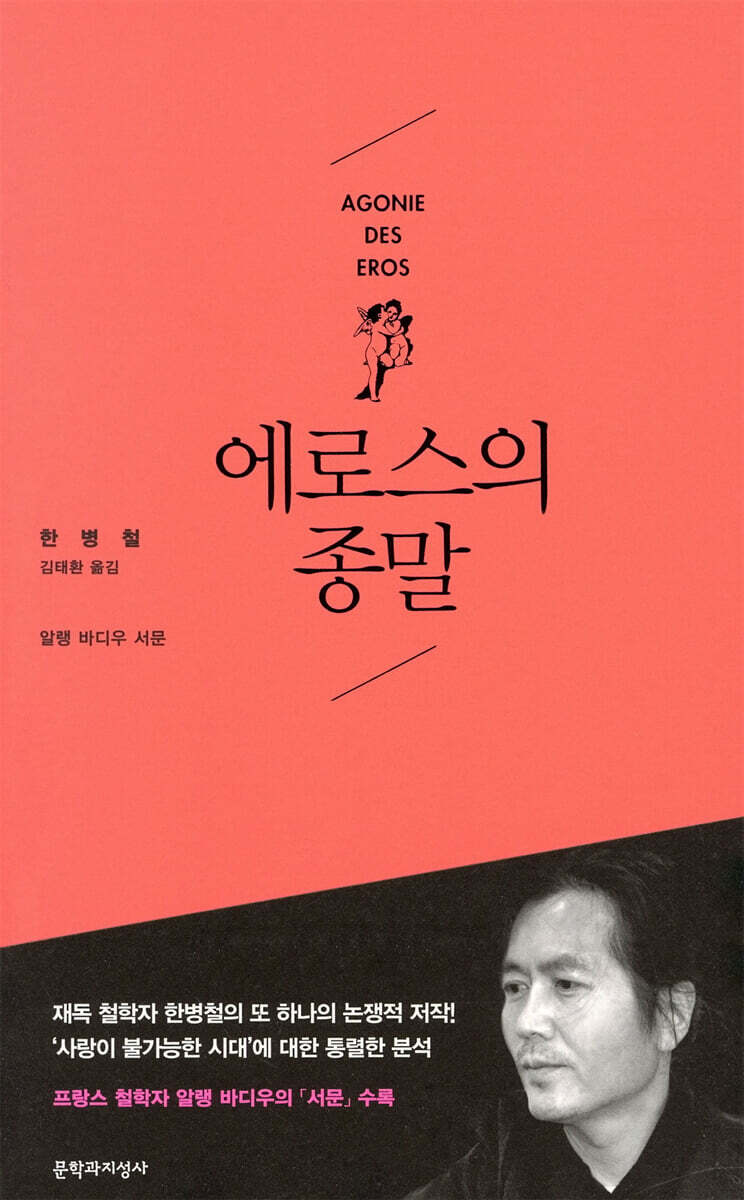
The End of Eros
 |
Description
Book Introduction
Another controversial work by German-based philosopher Han Byung-chul!
A poignant analysis of "the age when love is impossible."
Professor Han Byeong-cheol (Berlin University of the Arts), author of 『Fatigue Society』 and 『Psychopolitics』, has published a new book, 『The End of Eros』 (translated by Kim Tae-hwan).
While his previous work, "The Burnout Society," critically observed the exhaustion of modern people under the command of a performance-oriented society that dictates "can do," and "Psychopolitics" delved into the secret governance of the neoliberal system that exploits even freedom and desire, this book unfolds a fascinating analysis of why true love is in crisis in today's world.
The author argues that Eros can lead to “a revolutionary desire for a completely different form of life, a completely different society,” and invites us to engage in one of the most urgent struggles of our time: the struggle for the reinvention of love.
A poignant analysis of "the age when love is impossible."
Professor Han Byeong-cheol (Berlin University of the Arts), author of 『Fatigue Society』 and 『Psychopolitics』, has published a new book, 『The End of Eros』 (translated by Kim Tae-hwan).
While his previous work, "The Burnout Society," critically observed the exhaustion of modern people under the command of a performance-oriented society that dictates "can do," and "Psychopolitics" delved into the secret governance of the neoliberal system that exploits even freedom and desire, this book unfolds a fascinating analysis of why true love is in crisis in today's world.
The author argues that Eros can lead to “a revolutionary desire for a completely different form of life, a completely different society,” and invites us to engage in one of the most urgent struggles of our time: the struggle for the reinvention of love.
- You can preview some of the book's contents.
Preview
index
Introduction: The Reinvention of Love_Alain Badiou
Chapter 1: Melancholia
Chapter 2 Cannot be done
Chapter 3: Naked Life
Chapter 4 Porn
Chapter 5 Fantasy
Chapter 6: The Politics of Eros
Chapter 7: The End of Theory
Americas
Glossary of Terms
Chapter 1: Melancholia
Chapter 2 Cannot be done
Chapter 3: Naked Life
Chapter 4 Porn
Chapter 5 Fantasy
Chapter 6: The Politics of Eros
Chapter 7: The End of Theory
Americas
Glossary of Terms
Into the book
True love is in fact a rebellion against all the norms of the modern world, the secularized capitalist world.
all.
Because love is never just a contract between two individuals aimed at a pleasant cohabitation, but a fundamental experience of the other's existence, and perhaps at present, no other experience can be found like it.
Han Byung-chul combines a kind of phenomenology of true love, including sexual love, with a variety of investigations into the real forces that threaten love today.
[… … ] Reading Han Byung-chul's remarkable essay is a profound intellectual experience, one that will enable us to engage with a clearer consciousness in one of the most urgently needed struggles of our time.
It is a struggle for the defense of love, or, as Rimbaud would say, for the reinvention of love.
---From Alain Badiou's introduction to "The Reinvention of Love"
Eros is directed toward the other in the strong sense, that is, toward the other who is not included in my sphere of dominion.
Therefore, in today's society, which increasingly resembles the hell of the same person, erotic experiences are impossible.
Erotic experience presupposes the asymmetry and externality of the Other.
---From "Melancholia"
The tension between love and depression defines the film discourse of "Melancholia" from the very beginning.
The sound of the movie
The overture to "Tristan and Isolde," which provides a musical framework, powerfully evokes the power of love.
Depression means the impossibility of love.
Or impossible love breeds depression.
Only when the planet Melancholia, the atopos other, plunges into the hell of the same does Justine's erotic longing finally flare up.
In the nude scene on the riverside cliff, the audience sees the body of a woman in love, a body filled with pleasure.
Justin stretches his arms and legs expectantly in the blue light of the death-bringing planet.
This scene gives the impression that Justin is desperately longing for a fatal collision with an atophos-like body.
---From "Melancholia"
The negativity of absence is an essential factor in affection and pleasure.
Caressing is “playing with what is running away,” an act of constantly searching for something that is disappearing into the future.
The longing for affection grows by nourishing what has not yet come.
The intensity of pleasure also comes from the absence of the other even in the sharing of sensations.
Today, love cannot accept the deficiencies or delays of others because it means nothing more than desire, satisfaction, and pleasure.
Society, as a search engine and a consumption engine, discards all longing for the absent, the unsearchable, the uncatchable, the unconsumable. --- From "Cannot Be Done"
Love, according to Ficino, is “the worst of all contagious diseases.”
It is “transformation.”
Love “takes away from man his own nature and infuses him with the nature of another.” It is precisely this transformation and wounding that constitute the negative essence of love.
But as love becomes more and more positive and domesticated these days, negativity in love is also becoming rare.
People do not abandon their own identity, but simply seek to confirm themselves in others.
---From "Naked Life"
The barbed wire and barriers erected on borders today no longer inspire fantasy.
Barbed wire and barriers do not generate others, but rather penetrate the hell of the same, where only economic laws govern.
Thus the rich and the poor are separated.
It is capital that creates this new boundary.
But money makes everything equal in principle.
Money erases and equalizes essential differences.
The new boundary serves as a device of exclusion and expulsion, abolishing the illusion of the Other.
---From "Fantasy"
Reinventing love was a central concern of Surrealism.
[… … ] For the Surrealists, Eros is a medium for a poetic revolution of language and reality.
Eros is worshipped as the energy source of renewal, and political action must also draw nourishment from such Eros.
Eros, with its universal power, unites the artistic, the existential, and the political.
Eros appears as a revolutionary desire for a completely different form of life, a completely different society.
Yes, that's right.
Eros sustains the faithful heart toward what is to come.
all.
Because love is never just a contract between two individuals aimed at a pleasant cohabitation, but a fundamental experience of the other's existence, and perhaps at present, no other experience can be found like it.
Han Byung-chul combines a kind of phenomenology of true love, including sexual love, with a variety of investigations into the real forces that threaten love today.
[… … ] Reading Han Byung-chul's remarkable essay is a profound intellectual experience, one that will enable us to engage with a clearer consciousness in one of the most urgently needed struggles of our time.
It is a struggle for the defense of love, or, as Rimbaud would say, for the reinvention of love.
---From Alain Badiou's introduction to "The Reinvention of Love"
Eros is directed toward the other in the strong sense, that is, toward the other who is not included in my sphere of dominion.
Therefore, in today's society, which increasingly resembles the hell of the same person, erotic experiences are impossible.
Erotic experience presupposes the asymmetry and externality of the Other.
---From "Melancholia"
The tension between love and depression defines the film discourse of "Melancholia" from the very beginning.
The sound of the movie
The overture to "Tristan and Isolde," which provides a musical framework, powerfully evokes the power of love.
Depression means the impossibility of love.
Or impossible love breeds depression.
Only when the planet Melancholia, the atopos other, plunges into the hell of the same does Justine's erotic longing finally flare up.
In the nude scene on the riverside cliff, the audience sees the body of a woman in love, a body filled with pleasure.
Justin stretches his arms and legs expectantly in the blue light of the death-bringing planet.
This scene gives the impression that Justin is desperately longing for a fatal collision with an atophos-like body.
---From "Melancholia"
The negativity of absence is an essential factor in affection and pleasure.
Caressing is “playing with what is running away,” an act of constantly searching for something that is disappearing into the future.
The longing for affection grows by nourishing what has not yet come.
The intensity of pleasure also comes from the absence of the other even in the sharing of sensations.
Today, love cannot accept the deficiencies or delays of others because it means nothing more than desire, satisfaction, and pleasure.
Society, as a search engine and a consumption engine, discards all longing for the absent, the unsearchable, the uncatchable, the unconsumable. --- From "Cannot Be Done"
Love, according to Ficino, is “the worst of all contagious diseases.”
It is “transformation.”
Love “takes away from man his own nature and infuses him with the nature of another.” It is precisely this transformation and wounding that constitute the negative essence of love.
But as love becomes more and more positive and domesticated these days, negativity in love is also becoming rare.
People do not abandon their own identity, but simply seek to confirm themselves in others.
---From "Naked Life"
The barbed wire and barriers erected on borders today no longer inspire fantasy.
Barbed wire and barriers do not generate others, but rather penetrate the hell of the same, where only economic laws govern.
Thus the rich and the poor are separated.
It is capital that creates this new boundary.
But money makes everything equal in principle.
Money erases and equalizes essential differences.
The new boundary serves as a device of exclusion and expulsion, abolishing the illusion of the Other.
---From "Fantasy"
Reinventing love was a central concern of Surrealism.
[… … ] For the Surrealists, Eros is a medium for a poetic revolution of language and reality.
Eros is worshipped as the energy source of renewal, and political action must also draw nourishment from such Eros.
Eros, with its universal power, unites the artistic, the existential, and the political.
Eros appears as a revolutionary desire for a completely different form of life, a completely different society.
Yes, that's right.
Eros sustains the faithful heart toward what is to come.
---From "The Politics of Eros"
Publisher's Review
Another controversial work by German-based philosopher Han Byung-chul!
A poignant analysis of "the age when love is impossible."
Professor Han Byeong-cheol (Berlin University of the Arts), author of 『Fatigue Society』 and 『Psychopolitics』, has published a new book, 『The End of Eros』 (translated by Kim Tae-hwan).
While his previous work, "The Burnout Society," critically observed the exhaustion of modern people under the command of a performance-oriented society that dictates "can do," and "Psychopolitics" delved into the secret governance of the neoliberal system that exploits even freedom and desire, this book unfolds a fascinating analysis of why true love is in crisis in today's world.
The author argues that Eros can lead to “a revolutionary desire for a completely different form of life, a completely different society,” and invites us to engage in one of the most urgent struggles of our time: the struggle for the reinvention of love.
This is a translation of Agonie des Eros, published in Germany in 2013, and includes the preface “The Reinvention of Love” written by French philosopher Alain Badiou for the French edition of the book (Le Desir: Ou l'enfer de l'identique, 2015).
Han Byung-chul's sixth book to be introduced in Korea.
“A world where illusions have disappeared,
In the hell of the same person where only economic laws rule
Eros is bound to be in danger.”
“The End of Eros” begins with the sentence, “Recently, voices announcing the end of love have been heard often.”
If love has been given a strong meaning throughout history, today it is precisely that meaning of love that is under threat.
So who, then, is the enemy that makes love impossible today? Han Byung-chul argues that eros is "directed toward the other in the strong sense, that is, toward the other who is not within my sphere of control." He argues that in today's society, where fantasy has disappeared and only economic laws rule, increasingly resembling a "hell of the same," even erotic experiences are impossible.
According to the author, love is not a light contractual relationship between two individuals that can be enjoyed without risking anything and without falling into excess or madness, but rather a fundamental experience of the existence of the other.
This inevitably leads to the destruction of the self.
He uses examples such as Lars von Trier's film "Melancholia," Pieter Bruegel's painting "The Hunters in the Snow," and Wagner's opera "Tristan und Isolde" to talk about love as an experience of absolute otherness, love as a disaster that destroys the subject's normal state of balance through the catastrophic invasion of the complete other.
A sublime hymn to the nature of typing.
A merciless critique of the exhausted and individualized subject
On the one hand, it delves into the practical forces that are crushing the possibility of Eros in today's world, which is interested in nothing but comfort and narcissistic satisfaction.
According to Han Byung-chul, Eros is a relationship with others that is established in the peace of achievement and ‘can do.’
That is, “the negativity of otherness, the atopia of the Other who is completely outside the realm of the possible, constitutes an essential component of erotic experience.” The experience of love is created by impossibility, and impossibility is what must be paid for the full manifestation of the Other.
However, in modern secularized capitalist society, where the principle of performance dominates all areas of life, love is positively transformed into a simple 'sexuality' that knows no negativity.
Han Byung-chul cites the best-selling novel Fifty Shades of Grey as an example, in which the protagonist is bewildered by her partner's perception of their relationship as "a job with fixed working hours, clearly defined tasks, and thorough methods to ensure quality of performance."
The sadomasochism depicted in the novel is nothing more than a play for diversion during sexual intercourse, and has no negativity of violation or deviation.
Rather, it is closer to the archetype of sexuality we encounter in a world of positivity where only the consumable is permitted.
This book is a thorough argument for the minimum condition of true love—that love requires the courage to destroy the self in order to discover the other—while also making us aware of all the traps and threats that stifle the buds of eros in today's world, which is utterly uninterested in anything but comfort and narcissistic satisfaction.
The Politics of Eros―
“Eros is a completely different form of life,
“It appears as a revolutionary desire for a completely different society.”
Although the process of erosion of the other in all areas of life is progressing and, with it, the tendency of the self to become narcissistic is intensifying, and love is also disappearing, at present, perhaps nothing else makes possible a fundamental experience of the existence of the other.
True love rebels against all these norms of the modern world, the secularized capitalist world.
Here, Han Byung-chul talks about the political possibilities of Eros.
Political action, born of a shared desire for a different form of life, a different world, a more just world, is correlated at some deeper level with Eros.
Eros is the energy source of political resistance.
Eros, with its universal power, unites the artistic, the existential, and the political.
In the preface to this book, Alain Badiou said, “This short book, full of tension and rich content, is a sublime hymn to otherness and a merciless critique of the exhausted and individualized modern subject, the melancholic narcissist, and will provoke much discussion and debate.”
I hope that readers will also explore ways to reinvent "true love" that will enable a completely different way of life and a completely different society.
※ Professor Han Byung-chul will be recorded as the first Korean philosopher to receive intensive attention from major German media outlets and to elicit a broad reader response.
Major German media outlets have been paying attention to the author since "The Fatigued Society" (2010), and his subsequent publications "The Transparent Society" and "The End of Eros" also generated much buzz and controversy in German society.
His books have been introduced to many countries around the world, including Korea, Germany, Italy, Spain, and Greece.
In particular, the Spanish daily newspaper El País published an article focusing on the book The End of Eros (Spanish edition, 2014) when it was published.
A poignant analysis of "the age when love is impossible."
Professor Han Byeong-cheol (Berlin University of the Arts), author of 『Fatigue Society』 and 『Psychopolitics』, has published a new book, 『The End of Eros』 (translated by Kim Tae-hwan).
While his previous work, "The Burnout Society," critically observed the exhaustion of modern people under the command of a performance-oriented society that dictates "can do," and "Psychopolitics" delved into the secret governance of the neoliberal system that exploits even freedom and desire, this book unfolds a fascinating analysis of why true love is in crisis in today's world.
The author argues that Eros can lead to “a revolutionary desire for a completely different form of life, a completely different society,” and invites us to engage in one of the most urgent struggles of our time: the struggle for the reinvention of love.
This is a translation of Agonie des Eros, published in Germany in 2013, and includes the preface “The Reinvention of Love” written by French philosopher Alain Badiou for the French edition of the book (Le Desir: Ou l'enfer de l'identique, 2015).
Han Byung-chul's sixth book to be introduced in Korea.
“A world where illusions have disappeared,
In the hell of the same person where only economic laws rule
Eros is bound to be in danger.”
“The End of Eros” begins with the sentence, “Recently, voices announcing the end of love have been heard often.”
If love has been given a strong meaning throughout history, today it is precisely that meaning of love that is under threat.
So who, then, is the enemy that makes love impossible today? Han Byung-chul argues that eros is "directed toward the other in the strong sense, that is, toward the other who is not within my sphere of control." He argues that in today's society, where fantasy has disappeared and only economic laws rule, increasingly resembling a "hell of the same," even erotic experiences are impossible.
According to the author, love is not a light contractual relationship between two individuals that can be enjoyed without risking anything and without falling into excess or madness, but rather a fundamental experience of the existence of the other.
This inevitably leads to the destruction of the self.
He uses examples such as Lars von Trier's film "Melancholia," Pieter Bruegel's painting "The Hunters in the Snow," and Wagner's opera "Tristan und Isolde" to talk about love as an experience of absolute otherness, love as a disaster that destroys the subject's normal state of balance through the catastrophic invasion of the complete other.
A sublime hymn to the nature of typing.
A merciless critique of the exhausted and individualized subject
On the one hand, it delves into the practical forces that are crushing the possibility of Eros in today's world, which is interested in nothing but comfort and narcissistic satisfaction.
According to Han Byung-chul, Eros is a relationship with others that is established in the peace of achievement and ‘can do.’
That is, “the negativity of otherness, the atopia of the Other who is completely outside the realm of the possible, constitutes an essential component of erotic experience.” The experience of love is created by impossibility, and impossibility is what must be paid for the full manifestation of the Other.
However, in modern secularized capitalist society, where the principle of performance dominates all areas of life, love is positively transformed into a simple 'sexuality' that knows no negativity.
Han Byung-chul cites the best-selling novel Fifty Shades of Grey as an example, in which the protagonist is bewildered by her partner's perception of their relationship as "a job with fixed working hours, clearly defined tasks, and thorough methods to ensure quality of performance."
The sadomasochism depicted in the novel is nothing more than a play for diversion during sexual intercourse, and has no negativity of violation or deviation.
Rather, it is closer to the archetype of sexuality we encounter in a world of positivity where only the consumable is permitted.
This book is a thorough argument for the minimum condition of true love—that love requires the courage to destroy the self in order to discover the other—while also making us aware of all the traps and threats that stifle the buds of eros in today's world, which is utterly uninterested in anything but comfort and narcissistic satisfaction.
The Politics of Eros―
“Eros is a completely different form of life,
“It appears as a revolutionary desire for a completely different society.”
Although the process of erosion of the other in all areas of life is progressing and, with it, the tendency of the self to become narcissistic is intensifying, and love is also disappearing, at present, perhaps nothing else makes possible a fundamental experience of the existence of the other.
True love rebels against all these norms of the modern world, the secularized capitalist world.
Here, Han Byung-chul talks about the political possibilities of Eros.
Political action, born of a shared desire for a different form of life, a different world, a more just world, is correlated at some deeper level with Eros.
Eros is the energy source of political resistance.
Eros, with its universal power, unites the artistic, the existential, and the political.
In the preface to this book, Alain Badiou said, “This short book, full of tension and rich content, is a sublime hymn to otherness and a merciless critique of the exhausted and individualized modern subject, the melancholic narcissist, and will provoke much discussion and debate.”
I hope that readers will also explore ways to reinvent "true love" that will enable a completely different way of life and a completely different society.
※ Professor Han Byung-chul will be recorded as the first Korean philosopher to receive intensive attention from major German media outlets and to elicit a broad reader response.
Major German media outlets have been paying attention to the author since "The Fatigued Society" (2010), and his subsequent publications "The Transparent Society" and "The End of Eros" also generated much buzz and controversy in German society.
His books have been introduced to many countries around the world, including Korea, Germany, Italy, Spain, and Greece.
In particular, the Spanish daily newspaper El País published an article focusing on the book The End of Eros (Spanish edition, 2014) when it was published.
GOODS SPECIFICS
- Date of issue: October 5, 2015
- Page count, weight, size: 110 pages | 144g | 125*200*20mm
- ISBN13: 9788932027838
- ISBN10: 8932027838
You may also like
카테고리
korean


korean

![GQ KOREA Mark (Monthly): December [2025]](http://librairie.coreenne.fr/cdn/shop/files/8ef265dbbfbf186523ed75ba7319009d.jpg?v=1765340328&width=3840)


