

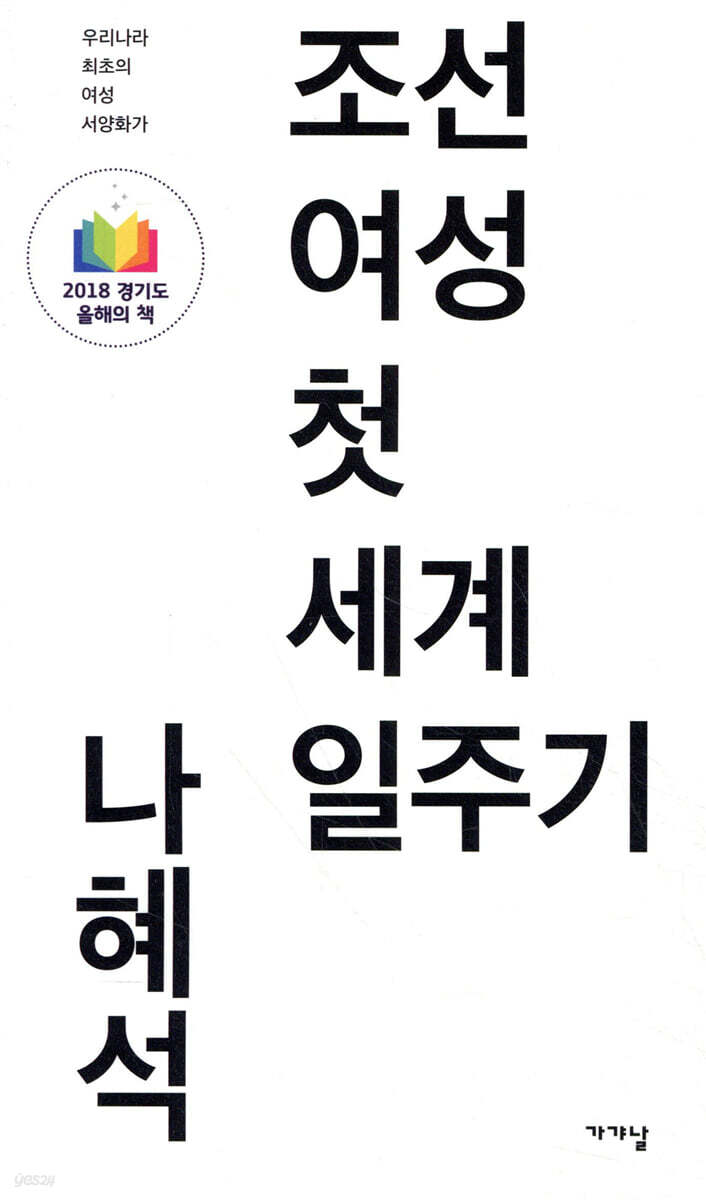
The first Korean woman to circumnavigate the world
 |
Description
Book Introduction
This book is the first world travelogue written by a Korean woman.
90 years ago, Western painter Na Hye-seok traveled around the world for 20 months.
It is surprising that it traveled the world for such a long time during the harsh Japanese colonial period, and it is also unique that its trajectory perfectly circled the globe.
Na Hye-seok's trip became a hot topic even before she left, and was published in newspapers and magazines after she returned home.
However, a book containing his complete travelogue has not yet been published.
This book is a compilation of all of Na Hye-seok's travel writings, organized in chronological order.
Na Hye-seok's travelogue is an important record for understanding the world of new women who are shedding their identity as modern individuals.
Although it is a record from 90 years ago, it is modern and vivid enough to be considered a recent travelogue.
90 years ago, Western painter Na Hye-seok traveled around the world for 20 months.
It is surprising that it traveled the world for such a long time during the harsh Japanese colonial period, and it is also unique that its trajectory perfectly circled the globe.
Na Hye-seok's trip became a hot topic even before she left, and was published in newspapers and magazines after she returned home.
However, a book containing his complete travelogue has not yet been published.
This book is a compilation of all of Na Hye-seok's travel writings, organized in chronological order.
Na Hye-seok's travelogue is an important record for understanding the world of new women who are shedding their identity as modern individuals.
Although it is a record from 90 years ago, it is modern and vivid enough to be considered a recent travelogue.
- You can preview some of the book's contents.
Preview
index
Traveling to Soviet Russia 9
45 from Paris to Switzerland
Western Art and Nudity: Belgium and the Netherlands 65
Ah, I miss the Paris of freedom 77
That Dawn in Berlin 113
In Search of Italian Art 125
Crossing the Strait of Dover 157
Passionate Journey to Spain 171
187 Crossing the Atlantic to the United States
Pacific waves crash against the bow 215
45 from Paris to Switzerland
Western Art and Nudity: Belgium and the Netherlands 65
Ah, I miss the Paris of freedom 77
That Dawn in Berlin 113
In Search of Italian Art 125
Crossing the Strait of Dover 157
Passionate Journey to Spain 171
187 Crossing the Atlantic to the United States
Pacific waves crash against the bow 215
Into the book
“Female painter Na Hye-seok will depart Gyeongseong Station at 10:05 PM on the 22nd to inspect paintings from East and West countries, centering on France, the kingdom of art. She will travel around the world for a year and a half. She left her home in Dongrae on the Gyeongbu Line train at 7:45 AM today and arrived in Gyeongseong. She is currently staying at the Chosun Hotel. She will cross Siberia and first travel through Red Russia, the union of worker-peasant socialist republics, and then travel to England, Germany, Italy, France, Belgium, Austria, the Netherlands, Spain, Denmark, Norway, Turkey, Persia, the Czech Republic, Thailand, Greece, and the United States…”
--- p.
14
I am now passing through the famous Lake Baikal.
It's a scenic spot beyond what I've heard.
… In the wasteland where the horizon seems to touch the blue sky, silver bells sparkle and flocks of sheep and cattle leisurely stroll.
This profound painting reminds me of the house site you always talked about.
I wish I could have a drink and dance with all my friends here…
--- p.
29
One day, I went to see the Moulin Rouge.
A naked woman in silver and turquoise jumps out and dances briskly, while a group of goddesses, two on each side, wearing winged robes, red feathers in their hair, and glittering gold beads, come out, shaking their hips and singing.
The seven-color and five-color gold and silver costumes are enchanting, the upper garment burying the face and the trousers covering the ground.
The group standing on either side, swinging small umbrellas that resemble long, fur-covered toys, soon begins to dance, shaking small drums with bells attached.
At the same time, the central goddess wields an ostrich feather and performs a muscular and bizarrely artistic dance.
I couldn't help but be captivated by this Greek physicality, and I couldn't help but notice the perspective, color, and focus of the composition, which were heavily influenced by the copperplate engravings of the time.
--- p.
83
In his later years, Goya suffered from failing eyesight, deafness, and poverty.
He left his homeland to paint prints and lived in the remote and desolate southern French city of Bordeaux, where he ended his eventful life in April 1828.
He was 82 years old.
He is dead.
But I lived.
He is not there.
But his masterpieces are countless.
I was amazed when I saw his tomb and his masterpieces.
I was envious and thought that I could do it too.
My feet didn't move easily.
I have never felt this inspired before.
--- p.
180
We left Washington and got off in Philadelphia along the way.
It was to meet Dr. Seo Jae-pil.
I went by car to a hospital located in a quiet place outside the city.
As I sat in the reception room waiting, a middle-aged man with a robust appearance, Dr. Seo, came out and shook my hand warmly.
After discussing the Korean issue for a while, we toured the hospital and left.
--- p.
199
Let's go to Paris.
Let's not go to live, let's go to die.
The place that killed me was Paris.
Paris is also the place that truly made me a woman.
I will go to Paris and die.
There is nothing to find, nothing to meet, nothing to gain.
There is no going back.
Let's go forever.
I, whose past and present are empty, go out into the future.
--- p.
14
I am now passing through the famous Lake Baikal.
It's a scenic spot beyond what I've heard.
… In the wasteland where the horizon seems to touch the blue sky, silver bells sparkle and flocks of sheep and cattle leisurely stroll.
This profound painting reminds me of the house site you always talked about.
I wish I could have a drink and dance with all my friends here…
--- p.
29
One day, I went to see the Moulin Rouge.
A naked woman in silver and turquoise jumps out and dances briskly, while a group of goddesses, two on each side, wearing winged robes, red feathers in their hair, and glittering gold beads, come out, shaking their hips and singing.
The seven-color and five-color gold and silver costumes are enchanting, the upper garment burying the face and the trousers covering the ground.
The group standing on either side, swinging small umbrellas that resemble long, fur-covered toys, soon begins to dance, shaking small drums with bells attached.
At the same time, the central goddess wields an ostrich feather and performs a muscular and bizarrely artistic dance.
I couldn't help but be captivated by this Greek physicality, and I couldn't help but notice the perspective, color, and focus of the composition, which were heavily influenced by the copperplate engravings of the time.
--- p.
83
In his later years, Goya suffered from failing eyesight, deafness, and poverty.
He left his homeland to paint prints and lived in the remote and desolate southern French city of Bordeaux, where he ended his eventful life in April 1828.
He was 82 years old.
He is dead.
But I lived.
He is not there.
But his masterpieces are countless.
I was amazed when I saw his tomb and his masterpieces.
I was envious and thought that I could do it too.
My feet didn't move easily.
I have never felt this inspired before.
--- p.
180
We left Washington and got off in Philadelphia along the way.
It was to meet Dr. Seo Jae-pil.
I went by car to a hospital located in a quiet place outside the city.
As I sat in the reception room waiting, a middle-aged man with a robust appearance, Dr. Seo, came out and shook my hand warmly.
After discussing the Korean issue for a while, we toured the hospital and left.
--- p.
199
Let's go to Paris.
Let's not go to live, let's go to die.
The place that killed me was Paris.
Paris is also the place that truly made me a woman.
I will go to Paris and die.
There is nothing to find, nothing to meet, nothing to gain.
There is no going back.
Let's go forever.
I, whose past and present are empty, go out into the future.
--- p.
227
227
Passing through Siberia
After passport control in Manchuria, the train enters Soviet territory.
As we gallop through the vast wilderness, we see herds of camels and small Buryat houses here and there through the car window.
After crossing the Onon River, the track becomes double-track from here on.
It was noon when we arrived at Chita Station.
A steady downpour of rain is pouring down, and Russian peasant women, wearing red kerchiefs on their heads and holding children, are standing there, watching the passengers come and go.
This place is famous for its agricultural products.
From here we traveled for 13 hours and arrived in Verkhneudinsk, a city with many factories.
From now on, the train races towards the famous Lake Baikal.
Water is always nice to see.
And of course, it gives a friendly taste to everyone.
How much more so is the silence of Lake Baikal, located in the vast plains of the vast plains?
Passengers who couldn't stand the heat gathered at the window.
As we approached Krasnoyarsk, a welcome sight was the church spire faintly visible through the pine forest.
We passed through Tomsk, known as the Athens of Siberia, and Novosibirsk, the political and economic center, and arrived in Omsk.
There are many collapsed huts and broken vehicles in this area, which bear witness to the tragedy of the revolution.
From here on, the color of the soil gradually turns black, and the clothes of the women selling plants gradually become cleaner.
This is Sverdlovsk*.
This is where the family of Russian Emperor Nicholas II met their tragic end, so the Nicholas family must have been wandering around this area before they died.
In the desolate field where the horizon and the blue sky met, green grass stretched endlessly, and white bellflowers and red roses, as if embroidered with silk thread, were mixed together.
There are countless bluntly cut birch trees and red pines that stretch out in a single breath.
A herd of spotted cattle, with black and white spots mixed in, stretches its necks and leisurely roams the countryside.
It's hard not to imagine Siberians galloping on sleds across the vast, snow-white plains here in winter.
Aurora
The sunset was cold over the birch forest.
The entire sky turns yellow, then crimson, and then blue-gray.
The sky was clearly round, and it became impossible to distinguish between day and night.
The sky is transparent like a mirror and shines dizzyingly.
And there all kinds of shapes were visible.
This is what we call the Aurora.
We sang the familiar song “Aurora.”
Should I go or not?
Below the Aurora
Russia is a northern country
There is no end
The sunset is burning in the western sky
Night falls in the eastern sky
Can you hear the bell?
From the middle of the sky
It's too bright to come
It's dark when I go out
Lights from afar
It's sparkling
Stand still, old carriage
Rest, white horse
The road to take tomorrow
It's not that there isn't one
I am a floating bush
Just as the wind blows
Flowing and flowing
Flowing endlessly
Walking down the street during the day
Dance all night long
Where in your later years
Finish the end
In one place, a group of collective farm women wearing wide trousers and red towels hanging down their heads stand in a line, and in another place, a group of Mongolians stand politely, stroking their beards.
At each stop, local peasant women offer eggs, milk, and smoked piglets to passengers at the stalls, and girls offer bouquets of fragrant flowers from the fields to passengers, creating a special atmosphere.
Our life was rich and fun when we put the flowers the train boy brought us in a can of leftover food, spread out the food we bought on the table, and sat down to eat together as a couple.
As we approached Moscow, the countryside became covered with potatoes.
There were many pedestrians around the tracks, and on the floor of the station waiting room, the sick, the elderly, children, and women were moaning, crying, dozing, or sitting with their arms down, or wrapped in blankets and carrying bags at their sides. Who could have imagined that the aftermath of the Russian Revolution would be like this?
When I think of Russia, I think of revolution, and when I think of revolution, I think of Russia. As I passed through Siberia, the air was filled with the inexplicable smell of blood.
Moscow CCCP
The capital of the old Russian Empire was St. Petersburg, but after the Great Revolution of 1917, the Soviet Union moved its capital to Moscow.
Moscow, given its geographical location, has a mission as a global highway connecting the West and East Asian countries.
After a long time in the car, I got off here and felt refreshed both physically and mentally.
While transiting through Russia is relatively easy, there are strict restrictions on entry and stay, requiring a residence permit from the Executive Committee's Foreign Passports Department. Therefore, travelers are advised to transit on the same day if possible.
We stayed here for three days.
I couldn't help but be surprised by the high prices of hotel accommodations and other items.
And since cars and taxis are all state-owned and not privately owned, and there aren't many of them, I ended up walking to get around, no matter how far or short it was.
When you get off at the Moscow station, there is a Korean named Park, so you ask for guidance, whether you are Korean or Japanese.
Mr. Park was formerly a counselor at the Korean embassy in Russia, but now makes a living as a tour guide.
Mr. Park guided the Japanese, and we were guided by a Japanese Russian exchange student.
First, I took a quick look at the Pushkin Museum of Fine Arts, the Tretyakov Gallery, the Museum of Modern French Art, the Morozov Museum, and the Museum of the Revolution.
Russian art has never been constrained by history.
As the center of Russian culture shifted, artists sought to revive art that had been dormant.
At the same time, Russian art was greatly influenced by many foreign countries, but it still preserved its original characteristics.
Russian contemporary art can be roughly divided into three waves.
The first is the conservative faction, which seeks to preserve pre-revolutionary traditions and prioritizes conception over technique. The second is the relatively progressive faction, which seeks to incorporate the strengths of Eastern and Western art into its own. The third is a very small minority, which seeks to popularize constructivist art.
There are also many factions from Moscow, Leningrad, and other regions.
Among them, Moscow, the center of art, has the Society of Revolutionary Russian Artists, the Society of Four Arts, and the Guild of Art Magazine Writers, which holds a lot of exhibitions every year.
The Pushkin and Tretyakov Gallery housed many famous paintings from various European countries collected privately by Pushkin and Tretyakov.
The Museum of Modern French Art had almost all the famous paintings of the modern French art world.
Above all, the Moscow Art Museum's display methods are said to be world-class.
Kremlin Palace
I walked around the Kremlin Palace with its high walls and cruciform roof, entered St. Basil's Cathedral, lost myself in its magnificent decorations, came out, saw the Napoleonic Wars Memorial Park, came out again, wound around the State Department Store, crossed the clear-flowing Moscow River, passed the white-stone Palace of Labor, and went to Sparrow Hills.
As I climbed the hill, the panoramic view of Moscow unfolded before my eyes, the golden roof of the domed church glistening in the sun, a spectacular sight.
I came back down and went to the club restaurant of the current Russian government authorities to eat, then walked around Erewa Park and came back.
In the morning, the bells ring from the churches on all sides.
I was curious, so I went and followed the people to a large church nearby.
A funeral was being held at the time.
The coffin lid is opened to reveal a corpse wrapped in flowers.
Anyone can go in, take a look, pray, kiss the portrait of Jesus next to it, and then leave.
A sign reading “Religion is opium” was posted on the main entrance of a church in the city.
When the crowd saw this, they went into the nearby synagogue, bowed down, and came out.
Moscow city is dirty.
And it seems like some kind of storm has passed and there is no way to recover.
Everyone looks like they've been beaten up and are thin, and they have a cynical attitude about what's next.
Men walk around in white shirts, and women walk around barefoot without wearing hats.
I heard that there are many miserable things, and that because there are no foreign goods, people have to live only with domestic products, so the prices are high and there are many inconveniences.
In the afternoon, I went to see Vladimir Lenin's tomb.
Spectators lined up before the opening time.
I entered with light footsteps solemnly between the gatekeepers guarding the left and right doors.
Descending to the basement stairs, I walk around the glass coffin and see Lenin's body lying quietly with a pale face.
There was much speculation about whether the corpse of the revolutionary Lenin was real or not, but it was a glorious sight to see.
In front of the square, the sound of trumpets and drums rose high into the sky, and tens of thousands of red flags fluttered in the square.
In the crowd of tens of thousands, young men and women wearing red hats and red ties were standing on carriages or in cars, stretching out their arms and stamping their feet, singing in chorus or solos with lively voices, creating a bustling and lively atmosphere.
It is said to be a protest movement to sever diplomatic relations with Britain.
After looking around for a while, I turned around because I was in a hurry to leave.
We left Moscow at 5 p.m. and headed to our destination, France.
It was quite awkward to have to take my luggage down one by one and have it inspected at the customs office on the Russian-Polish border.
Passing through Siberia
After passport control in Manchuria, the train enters Soviet territory.
As we gallop through the vast wilderness, we see herds of camels and small Buryat houses here and there through the car window.
After crossing the Onon River, the track becomes double-track from here on.
It was noon when we arrived at Chita Station.
A steady downpour of rain is pouring down, and Russian peasant women, wearing red kerchiefs on their heads and holding children, are standing there, watching the passengers come and go.
This place is famous for its agricultural products.
From here we traveled for 13 hours and arrived in Verkhneudinsk, a city with many factories.
From now on, the train races towards the famous Lake Baikal.
Water is always nice to see.
And of course, it gives a friendly taste to everyone.
How much more so is the silence of Lake Baikal, located in the vast plains of the vast plains?
Passengers who couldn't stand the heat gathered at the window.
As we approached Krasnoyarsk, a welcome sight was the church spire faintly visible through the pine forest.
We passed through Tomsk, known as the Athens of Siberia, and Novosibirsk, the political and economic center, and arrived in Omsk.
There are many collapsed huts and broken vehicles in this area, which bear witness to the tragedy of the revolution.
From here on, the color of the soil gradually turns black, and the clothes of the women selling plants gradually become cleaner.
This is Sverdlovsk*.
This is where the family of Russian Emperor Nicholas II met their tragic end, so the Nicholas family must have been wandering around this area before they died.
In the desolate field where the horizon and the blue sky met, green grass stretched endlessly, and white bellflowers and red roses, as if embroidered with silk thread, were mixed together.
There are countless bluntly cut birch trees and red pines that stretch out in a single breath.
A herd of spotted cattle, with black and white spots mixed in, stretches its necks and leisurely roams the countryside.
It's hard not to imagine Siberians galloping on sleds across the vast, snow-white plains here in winter.
Aurora
The sunset was cold over the birch forest.
The entire sky turns yellow, then crimson, and then blue-gray.
The sky was clearly round, and it became impossible to distinguish between day and night.
The sky is transparent like a mirror and shines dizzyingly.
And there all kinds of shapes were visible.
This is what we call the Aurora.
We sang the familiar song “Aurora.”
Should I go or not?
Below the Aurora
Russia is a northern country
There is no end
The sunset is burning in the western sky
Night falls in the eastern sky
Can you hear the bell?
From the middle of the sky
It's too bright to come
It's dark when I go out
Lights from afar
It's sparkling
Stand still, old carriage
Rest, white horse
The road to take tomorrow
It's not that there isn't one
I am a floating bush
Just as the wind blows
Flowing and flowing
Flowing endlessly
Walking down the street during the day
Dance all night long
Where in your later years
Finish the end
In one place, a group of collective farm women wearing wide trousers and red towels hanging down their heads stand in a line, and in another place, a group of Mongolians stand politely, stroking their beards.
At each stop, local peasant women offer eggs, milk, and smoked piglets to passengers at the stalls, and girls offer bouquets of fragrant flowers from the fields to passengers, creating a special atmosphere.
Our life was rich and fun when we put the flowers the train boy brought us in a can of leftover food, spread out the food we bought on the table, and sat down to eat together as a couple.
As we approached Moscow, the countryside became covered with potatoes.
There were many pedestrians around the tracks, and on the floor of the station waiting room, the sick, the elderly, children, and women were moaning, crying, dozing, or sitting with their arms down, or wrapped in blankets and carrying bags at their sides. Who could have imagined that the aftermath of the Russian Revolution would be like this?
When I think of Russia, I think of revolution, and when I think of revolution, I think of Russia. As I passed through Siberia, the air was filled with the inexplicable smell of blood.
Moscow CCCP
The capital of the old Russian Empire was St. Petersburg, but after the Great Revolution of 1917, the Soviet Union moved its capital to Moscow.
Moscow, given its geographical location, has a mission as a global highway connecting the West and East Asian countries.
After a long time in the car, I got off here and felt refreshed both physically and mentally.
While transiting through Russia is relatively easy, there are strict restrictions on entry and stay, requiring a residence permit from the Executive Committee's Foreign Passports Department. Therefore, travelers are advised to transit on the same day if possible.
We stayed here for three days.
I couldn't help but be surprised by the high prices of hotel accommodations and other items.
And since cars and taxis are all state-owned and not privately owned, and there aren't many of them, I ended up walking to get around, no matter how far or short it was.
When you get off at the Moscow station, there is a Korean named Park, so you ask for guidance, whether you are Korean or Japanese.
Mr. Park was formerly a counselor at the Korean embassy in Russia, but now makes a living as a tour guide.
Mr. Park guided the Japanese, and we were guided by a Japanese Russian exchange student.
First, I took a quick look at the Pushkin Museum of Fine Arts, the Tretyakov Gallery, the Museum of Modern French Art, the Morozov Museum, and the Museum of the Revolution.
Russian art has never been constrained by history.
As the center of Russian culture shifted, artists sought to revive art that had been dormant.
At the same time, Russian art was greatly influenced by many foreign countries, but it still preserved its original characteristics.
Russian contemporary art can be roughly divided into three waves.
The first is the conservative faction, which seeks to preserve pre-revolutionary traditions and prioritizes conception over technique. The second is the relatively progressive faction, which seeks to incorporate the strengths of Eastern and Western art into its own. The third is a very small minority, which seeks to popularize constructivist art.
There are also many factions from Moscow, Leningrad, and other regions.
Among them, Moscow, the center of art, has the Society of Revolutionary Russian Artists, the Society of Four Arts, and the Guild of Art Magazine Writers, which holds a lot of exhibitions every year.
The Pushkin and Tretyakov Gallery housed many famous paintings from various European countries collected privately by Pushkin and Tretyakov.
The Museum of Modern French Art had almost all the famous paintings of the modern French art world.
Above all, the Moscow Art Museum's display methods are said to be world-class.
Kremlin Palace
I walked around the Kremlin Palace with its high walls and cruciform roof, entered St. Basil's Cathedral, lost myself in its magnificent decorations, came out, saw the Napoleonic Wars Memorial Park, came out again, wound around the State Department Store, crossed the clear-flowing Moscow River, passed the white-stone Palace of Labor, and went to Sparrow Hills.
As I climbed the hill, the panoramic view of Moscow unfolded before my eyes, the golden roof of the domed church glistening in the sun, a spectacular sight.
I came back down and went to the club restaurant of the current Russian government authorities to eat, then walked around Erewa Park and came back.
In the morning, the bells ring from the churches on all sides.
I was curious, so I went and followed the people to a large church nearby.
A funeral was being held at the time.
The coffin lid is opened to reveal a corpse wrapped in flowers.
Anyone can go in, take a look, pray, kiss the portrait of Jesus next to it, and then leave.
A sign reading “Religion is opium” was posted on the main entrance of a church in the city.
When the crowd saw this, they went into the nearby synagogue, bowed down, and came out.
Moscow city is dirty.
And it seems like some kind of storm has passed and there is no way to recover.
Everyone looks like they've been beaten up and are thin, and they have a cynical attitude about what's next.
Men walk around in white shirts, and women walk around barefoot without wearing hats.
I heard that there are many miserable things, and that because there are no foreign goods, people have to live only with domestic products, so the prices are high and there are many inconveniences.
In the afternoon, I went to see Vladimir Lenin's tomb.
Spectators lined up before the opening time.
I entered with light footsteps solemnly between the gatekeepers guarding the left and right doors.
Descending to the basement stairs, I walk around the glass coffin and see Lenin's body lying quietly with a pale face.
There was much speculation about whether the corpse of the revolutionary Lenin was real or not, but it was a glorious sight to see.
In front of the square, the sound of trumpets and drums rose high into the sky, and tens of thousands of red flags fluttered in the square.
In the crowd of tens of thousands, young men and women wearing red hats and red ties were standing on carriages or in cars, stretching out their arms and stamping their feet, singing in chorus or solos with lively voices, creating a bustling and lively atmosphere.
It is said to be a protest movement to sever diplomatic relations with Britain.
After looking around for a while, I turned around because I was in a hurry to leave.
We left Moscow at 5 p.m. and headed to our destination, France.
It was quite awkward to have to take my luggage down one by one and have it inspected at the customs office on the Russian-Polish border.
After passport control in Manchuria, the train enters Soviet territory.
As we gallop through the vast wilderness, we see herds of camels and small Buryat houses here and there through the car window.
After crossing the Onon River, the track becomes double-track from here on.
It was noon when we arrived at Chita Station.
A steady downpour of rain is pouring down, and Russian peasant women, wearing red kerchiefs on their heads and holding children, are standing there, watching the passengers come and go.
This place is famous for its agricultural products.
From here we traveled for 13 hours and arrived in Verkhneudinsk, a city with many factories.
From now on, the train races towards the famous Lake Baikal.
Water is always nice to see.
And of course, it gives a friendly taste to everyone.
How much more so is the silence of Lake Baikal, located in the vast plains of the vast plains?
Passengers who couldn't stand the heat gathered at the window.
As we approached Krasnoyarsk, a welcome sight was the church spire faintly visible through the pine forest.
We passed through Tomsk, known as the Athens of Siberia, and Novosibirsk, the political and economic center, and arrived in Omsk.
There are many collapsed huts and broken vehicles in this area, which bear witness to the tragedy of the revolution.
From here on, the color of the soil gradually turns black, and the clothes of the women selling plants gradually become cleaner.
This is Sverdlovsk*.
This is where the family of Russian Emperor Nicholas II met their tragic end, so the Nicholas family must have been wandering around this area before they died.
In the desolate field where the horizon and the blue sky met, green grass stretched endlessly, and white bellflowers and red roses, as if embroidered with silk thread, were mixed together.
There are countless bluntly cut birch trees and red pines that stretch out in a single breath.
A herd of spotted cattle, with black and white spots mixed in, stretches its necks and leisurely roams the countryside.
It's hard not to imagine Siberians galloping on sleds across the vast, snow-white plains here in winter.
Aurora
The sunset was cold over the birch forest.
The entire sky turns yellow, then crimson, and then blue-gray.
The sky was clearly round, and it became impossible to distinguish between day and night.
The sky is transparent like a mirror and shines dizzyingly.
And there all kinds of shapes were visible.
This is what we call the Aurora.
We sang the familiar song “Aurora.”
Should I go or not?
Below the Aurora
Russia is a northern country
There is no end
The sunset is burning in the western sky
Night falls in the eastern sky
Can you hear the bell?
From the middle of the sky
It's too bright to come
It's dark when I go out
Lights from afar
It's sparkling
Stand still, old carriage
Rest, white horse
The road to take tomorrow
It's not that there isn't one
I am a floating bush
Just as the wind blows
Flowing and flowing
Flowing endlessly
Walking down the street during the day
Dance all night long
Where in your later years
Finish the end
In one place, a group of collective farm women wearing wide trousers and red towels hanging down their heads stand in a line, and in another place, a group of Mongolians stand politely, stroking their beards.
At each stop, local peasant women offer eggs, milk, and smoked piglets to passengers at the stalls, and girls offer bouquets of fragrant flowers from the fields to passengers, creating a special atmosphere.
Our life was rich and fun when we put the flowers the train boy brought us in a can of leftover food, spread out the food we bought on the table, and sat down to eat together as a couple.
As we approached Moscow, the countryside became covered with potatoes.
There were many pedestrians around the tracks, and on the floor of the station waiting room, the sick, the elderly, children, and women were moaning, crying, dozing, or sitting with their arms down, or wrapped in blankets and carrying bags at their sides. Who could have imagined that the aftermath of the Russian Revolution would be like this?
When I think of Russia, I think of revolution, and when I think of revolution, I think of Russia. As I passed through Siberia, the air was filled with the inexplicable smell of blood.
Moscow CCCP
The capital of the old Russian Empire was St. Petersburg, but after the Great Revolution of 1917, the Soviet Union moved its capital to Moscow.
Moscow, given its geographical location, has a mission as a global highway connecting the West and East Asian countries.
After a long time in the car, I got off here and felt refreshed both physically and mentally.
While transiting through Russia is relatively easy, there are strict restrictions on entry and stay, requiring a residence permit from the Executive Committee's Foreign Passports Department. Therefore, travelers are advised to transit on the same day if possible.
We stayed here for three days.
I couldn't help but be surprised by the high prices of hotel accommodations and other items.
And since cars and taxis are all state-owned and not privately owned, and there aren't many of them, I ended up walking to get around, no matter how far or short it was.
When you get off at the Moscow station, there is a Korean named Park, so you ask for guidance, whether you are Korean or Japanese.
Mr. Park was formerly a counselor at the Korean embassy in Russia, but now makes a living as a tour guide.
Mr. Park guided the Japanese, and we were guided by a Japanese Russian exchange student.
First, I took a quick look at the Pushkin Museum of Fine Arts, the Tretyakov Gallery, the Museum of Modern French Art, the Morozov Museum, and the Museum of the Revolution.
Russian art has never been constrained by history.
As the center of Russian culture shifted, artists sought to revive art that had been dormant.
At the same time, Russian art was greatly influenced by many foreign countries, but it still preserved its original characteristics.
Russian contemporary art can be roughly divided into three waves.
The first is the conservative faction, which seeks to preserve pre-revolutionary traditions and prioritizes conception over technique. The second is the relatively progressive faction, which seeks to incorporate the strengths of Eastern and Western art into its own. The third is a very small minority, which seeks to popularize constructivist art.
There are also many factions from Moscow, Leningrad, and other regions.
Among them, Moscow, the center of art, has the Society of Revolutionary Russian Artists, the Society of Four Arts, and the Guild of Art Magazine Writers, which holds a lot of exhibitions every year.
The Pushkin and Tretyakov Gallery housed many famous paintings from various European countries collected privately by Pushkin and Tretyakov.
The Museum of Modern French Art had almost all the famous paintings of the modern French art world.
Above all, the Moscow Art Museum's display methods are said to be world-class.
Kremlin Palace
I walked around the Kremlin Palace with its high walls and cruciform roof, entered St. Basil's Cathedral, lost myself in its magnificent decorations, came out, saw the Napoleonic Wars Memorial Park, came out again, wound around the State Department Store, crossed the clear-flowing Moscow River, passed the white-stone Palace of Labor, and went to Sparrow Hills.
As I climbed the hill, the panoramic view of Moscow unfolded before my eyes, the golden roof of the domed church glistening in the sun, a spectacular sight.
I came back down and went to the club restaurant of the current Russian government authorities to eat, then walked around Erewa Park and came back.
In the morning, the bells ring from the churches on all sides.
I was curious, so I went and followed the people to a large church nearby.
A funeral was being held at the time.
The coffin lid is opened to reveal a corpse wrapped in flowers.
Anyone can go in, take a look, pray, kiss the portrait of Jesus next to it, and then leave.
A sign reading “Religion is opium” was posted on the main entrance of a church in the city.
When the crowd saw this, they went into the nearby synagogue, bowed down, and came out.
Moscow city is dirty.
And it seems like some kind of storm has passed and there is no way to recover.
Everyone looks like they've been beaten up and are thin, and they have a cynical attitude about what's next.
Men walk around in white shirts, and women walk around barefoot without wearing hats.
I heard that there are many miserable things, and that because there are no foreign goods, people have to live only with domestic products, so the prices are high and there are many inconveniences.
In the afternoon, I went to see Vladimir Lenin's tomb.
Spectators lined up before the opening time.
I entered with light footsteps solemnly between the gatekeepers guarding the left and right doors.
Descending to the basement stairs, I walk around the glass coffin and see Lenin's body lying quietly with a pale face.
There was much speculation about whether the corpse of the revolutionary Lenin was real or not, but it was a glorious sight to see.
In front of the square, the sound of trumpets and drums rose high into the sky, and tens of thousands of red flags fluttered in the square.
In the crowd of tens of thousands, young men and women wearing red hats and red ties were standing on carriages or in cars, stretching out their arms and stamping their feet, singing in chorus or solos with lively voices, creating a bustling and lively atmosphere.
It is said to be a protest movement to sever diplomatic relations with Britain.
After looking around for a while, I turned around because I was in a hurry to leave.
We left Moscow at 5 p.m. and headed to our destination, France.
It was quite awkward to have to take my luggage down one by one and have it inspected at the customs office on the Russian-Polish border.
Passing through Siberia
After passport control in Manchuria, the train enters Soviet territory.
As we gallop through the vast wilderness, we see herds of camels and small Buryat houses here and there through the car window.
After crossing the Onon River, the track becomes double-track from here on.
It was noon when we arrived at Chita Station.
A steady downpour of rain is pouring down, and Russian peasant women, wearing red kerchiefs on their heads and holding children, are standing there, watching the passengers come and go.
This place is famous for its agricultural products.
From here we traveled for 13 hours and arrived in Verkhneudinsk, a city with many factories.
From now on, the train races towards the famous Lake Baikal.
Water is always nice to see.
And of course, it gives a friendly taste to everyone.
How much more so is the silence of Lake Baikal, located in the vast plains of the vast plains?
Passengers who couldn't stand the heat gathered at the window.
As we approached Krasnoyarsk, a welcome sight was the church spire faintly visible through the pine forest.
We passed through Tomsk, known as the Athens of Siberia, and Novosibirsk, the political and economic center, and arrived in Omsk.
There are many collapsed huts and broken vehicles in this area, which bear witness to the tragedy of the revolution.
From here on, the color of the soil gradually turns black, and the clothes of the women selling plants gradually become cleaner.
This is Sverdlovsk*.
This is where the family of Russian Emperor Nicholas II met their tragic end, so the Nicholas family must have been wandering around this area before they died.
In the desolate field where the horizon and the blue sky met, green grass stretched endlessly, and white bellflowers and red roses, as if embroidered with silk thread, were mixed together.
There are countless bluntly cut birch trees and red pines that stretch out in a single breath.
A herd of spotted cattle, with black and white spots mixed in, stretches its necks and leisurely roams the countryside.
It's hard not to imagine Siberians galloping on sleds across the vast, snow-white plains here in winter.
Aurora
The sunset was cold over the birch forest.
The entire sky turns yellow, then crimson, and then blue-gray.
The sky was clearly round, and it became impossible to distinguish between day and night.
The sky is transparent like a mirror and shines dizzyingly.
And there all kinds of shapes were visible.
This is what we call the Aurora.
We sang the familiar song “Aurora.”
Should I go or not?
Below the Aurora
Russia is a northern country
There is no end
The sunset is burning in the western sky
Night falls in the eastern sky
Can you hear the bell?
From the middle of the sky
It's too bright to come
It's dark when I go out
Lights from afar
It's sparkling
Stand still, old carriage
Rest, white horse
The road to take tomorrow
It's not that there isn't one
I am a floating bush
Just as the wind blows
Flowing and flowing
Flowing endlessly
Walking down the street during the day
Dance all night long
Where in your later years
Finish the end
In one place, a group of collective farm women wearing wide trousers and red towels hanging down their heads stand in a line, and in another place, a group of Mongolians stand politely, stroking their beards.
At each stop, local peasant women offer eggs, milk, and smoked piglets to passengers at the stalls, and girls offer bouquets of fragrant flowers from the fields to passengers, creating a special atmosphere.
Our life was rich and fun when we put the flowers the train boy brought us in a can of leftover food, spread out the food we bought on the table, and sat down to eat together as a couple.
As we approached Moscow, the countryside became covered with potatoes.
There were many pedestrians around the tracks, and on the floor of the station waiting room, the sick, the elderly, children, and women were moaning, crying, dozing, or sitting with their arms down, or wrapped in blankets and carrying bags at their sides. Who could have imagined that the aftermath of the Russian Revolution would be like this?
When I think of Russia, I think of revolution, and when I think of revolution, I think of Russia. As I passed through Siberia, the air was filled with the inexplicable smell of blood.
Moscow CCCP
The capital of the old Russian Empire was St. Petersburg, but after the Great Revolution of 1917, the Soviet Union moved its capital to Moscow.
Moscow, given its geographical location, has a mission as a global highway connecting the West and East Asian countries.
After a long time in the car, I got off here and felt refreshed both physically and mentally.
While transiting through Russia is relatively easy, there are strict restrictions on entry and stay, requiring a residence permit from the Executive Committee's Foreign Passports Department. Therefore, travelers are advised to transit on the same day if possible.
We stayed here for three days.
I couldn't help but be surprised by the high prices of hotel accommodations and other items.
And since cars and taxis are all state-owned and not privately owned, and there aren't many of them, I ended up walking to get around, no matter how far or short it was.
When you get off at the Moscow station, there is a Korean named Park, so you ask for guidance, whether you are Korean or Japanese.
Mr. Park was formerly a counselor at the Korean embassy in Russia, but now makes a living as a tour guide.
Mr. Park guided the Japanese, and we were guided by a Japanese Russian exchange student.
First, I took a quick look at the Pushkin Museum of Fine Arts, the Tretyakov Gallery, the Museum of Modern French Art, the Morozov Museum, and the Museum of the Revolution.
Russian art has never been constrained by history.
As the center of Russian culture shifted, artists sought to revive art that had been dormant.
At the same time, Russian art was greatly influenced by many foreign countries, but it still preserved its original characteristics.
Russian contemporary art can be roughly divided into three waves.
The first is the conservative faction, which seeks to preserve pre-revolutionary traditions and prioritizes conception over technique. The second is the relatively progressive faction, which seeks to incorporate the strengths of Eastern and Western art into its own. The third is a very small minority, which seeks to popularize constructivist art.
There are also many factions from Moscow, Leningrad, and other regions.
Among them, Moscow, the center of art, has the Society of Revolutionary Russian Artists, the Society of Four Arts, and the Guild of Art Magazine Writers, which holds a lot of exhibitions every year.
The Pushkin and Tretyakov Gallery housed many famous paintings from various European countries collected privately by Pushkin and Tretyakov.
The Museum of Modern French Art had almost all the famous paintings of the modern French art world.
Above all, the Moscow Art Museum's display methods are said to be world-class.
Kremlin Palace
I walked around the Kremlin Palace with its high walls and cruciform roof, entered St. Basil's Cathedral, lost myself in its magnificent decorations, came out, saw the Napoleonic Wars Memorial Park, came out again, wound around the State Department Store, crossed the clear-flowing Moscow River, passed the white-stone Palace of Labor, and went to Sparrow Hills.
As I climbed the hill, the panoramic view of Moscow unfolded before my eyes, the golden roof of the domed church glistening in the sun, a spectacular sight.
I came back down and went to the club restaurant of the current Russian government authorities to eat, then walked around Erewa Park and came back.
In the morning, the bells ring from the churches on all sides.
I was curious, so I went and followed the people to a large church nearby.
A funeral was being held at the time.
The coffin lid is opened to reveal a corpse wrapped in flowers.
Anyone can go in, take a look, pray, kiss the portrait of Jesus next to it, and then leave.
A sign reading “Religion is opium” was posted on the main entrance of a church in the city.
When the crowd saw this, they went into the nearby synagogue, bowed down, and came out.
Moscow city is dirty.
And it seems like some kind of storm has passed and there is no way to recover.
Everyone looks like they've been beaten up and are thin, and they have a cynical attitude about what's next.
Men walk around in white shirts, and women walk around barefoot without wearing hats.
I heard that there are many miserable things, and that because there are no foreign goods, people have to live only with domestic products, so the prices are high and there are many inconveniences.
In the afternoon, I went to see Vladimir Lenin's tomb.
Spectators lined up before the opening time.
I entered with light footsteps solemnly between the gatekeepers guarding the left and right doors.
Descending to the basement stairs, I walk around the glass coffin and see Lenin's body lying quietly with a pale face.
There was much speculation about whether the corpse of the revolutionary Lenin was real or not, but it was a glorious sight to see.
In front of the square, the sound of trumpets and drums rose high into the sky, and tens of thousands of red flags fluttered in the square.
In the crowd of tens of thousands, young men and women wearing red hats and red ties were standing on carriages or in cars, stretching out their arms and stamping their feet, singing in chorus or solos with lively voices, creating a bustling and lively atmosphere.
It is said to be a protest movement to sever diplomatic relations with Britain.
After looking around for a while, I turned around because I was in a hurry to leave.
We left Moscow at 5 p.m. and headed to our destination, France.
It was quite awkward to have to take my luggage down one by one and have it inspected at the customs office on the Russian-Polish border.
--- From the text
Publisher's Review
The First World Tour by a Joseon Woman, Reconstructed in Text and Illustration
Na Hye-seok is a figure who symbolizes the new woman.
She was the first female student in Tokyo and a Western painter.
She is also the first female novelist to compete with Kim Myeong-sun for seniority.
For new women, the world was a huge wall.
The oppressive order of colonialism, feudalism, and male-centeredness made it difficult to even breathe.
The greater my self-consciousness as a visionary, the more the pain doubled.
Kim Myeong-sun became mentally ill, Yun Sim-deok committed suicide, and Na Hye-seok ended her life as a wanderer.
Na Hye-seok, who tried to change society by saying, "If there is no explorer, that path will never be walked," marries lawyer Kim Woo-young after losing her first love to illness, "to preserve her art and ensure stability in her life."
But his wish to become a human being and an artist was still just a mirage.
Then, the opportunity to travel around the world, something I could only dream of, came.
It was thanks to my husband's bonus vacation.
Although he had three children, including a baby, he decided to leave 'for himself and for his children'.
The journey begins with a month-long journey across Siberia.
Stay in Paris for 1 year and 2 months and travel around Europe.
Next, we cross the Atlantic and tour various parts of the United States.
The journey, which lasted one year and nine months, ends with a final crossing of the Pacific Ocean via Hawaii.
It's truly amazing.
It is surprising that it traveled the world for such a long time in such an early period, in 1927, and it is also remarkable that its trajectory perfectly circled the Earth.
Before Na Hye-seok, there were only two trips that could be called a world tour: the Bobingsa group dispatched by the Joseon government in 1883 and Heo Heon, who traveled a year before Na Hye-seok.
Na Hye-seok's trip became a hot topic even before she left, and after she returned home, her travelogue was serialized in the Dong-A Ilbo and Samcheolli.
During her travels, Na Hye-seok endlessly questions and challenges her identity as a writer.
You could even call it an art tour.
Another topic was identity as a woman.
“I realized for sure that I was a woman.
…I realized that women are great and happy beings.
“I saw and knew that all things were under the control of women.” (Ah, I long for the Paris of freedom)
Na Hye-seok's travelogue is by no means light.
It is an important record for understanding the world of new women who are emerging as modern individuals.
His travelogues are only introduced in fragments of three or four parts or are crammed into a collection in a form that is difficult to access and read.
This book is a compilation of all the travel writings left behind by Na Hye-seok.
The text was based on the articles published in Samcheolli, but the content was enriched by finding new content published in other media.
Even fragments of travelogues were found and included in relevant sections in a box format.
A total of 23 articles (two of which are newspaper articles) became the flesh and blood of this book.
Additionally, the content is arranged in the order of travel.
Na Hye-seok continued to work on her paintings while traveling.
Among Na Hye-seok's paintings, we have selected works related to world travel and included them together.
Some of Na Hye-seok's non-painting works were judged to be helpful in understanding her travelogue.
With this, the journey of Na Hye-seok, the first woman to circumnavigate the globe 90 years ago, has been completely restored in writing and pictures.
Words before leaving
There were four issues that always gave me anxiety.
First, how should people live to live well?
Second, how should men and women live together in peace?
Third, what is the status of women?
Fourth, what is the point of the picture?
This is a really difficult question to understand.
Moreover, I have no way of knowing from my own knowledge and experience.
And yet, I suddenly felt a yearning and a desire to know more.
So, I admired the art worlds of Italy and France, wanted to see the activities of Western women, and wanted to experience the lives of Westerners.
I was really foolish.
I was infinitely happy to be able to go to the place I had longed for, but my circumstances were by no means simple.
I have three children, including a baby, and a 70-year-old mother who doesn't know what will happen today or tomorrow.
But I couldn't help but feel a surge of emotion.
For my family, for myself, for my children, I have finally decided to leave.
Na Hye-seok is a figure who symbolizes the new woman.
She was the first female student in Tokyo and a Western painter.
She is also the first female novelist to compete with Kim Myeong-sun for seniority.
For new women, the world was a huge wall.
The oppressive order of colonialism, feudalism, and male-centeredness made it difficult to even breathe.
The greater my self-consciousness as a visionary, the more the pain doubled.
Kim Myeong-sun became mentally ill, Yun Sim-deok committed suicide, and Na Hye-seok ended her life as a wanderer.
Na Hye-seok, who tried to change society by saying, "If there is no explorer, that path will never be walked," marries lawyer Kim Woo-young after losing her first love to illness, "to preserve her art and ensure stability in her life."
But his wish to become a human being and an artist was still just a mirage.
Then, the opportunity to travel around the world, something I could only dream of, came.
It was thanks to my husband's bonus vacation.
Although he had three children, including a baby, he decided to leave 'for himself and for his children'.
The journey begins with a month-long journey across Siberia.
Stay in Paris for 1 year and 2 months and travel around Europe.
Next, we cross the Atlantic and tour various parts of the United States.
The journey, which lasted one year and nine months, ends with a final crossing of the Pacific Ocean via Hawaii.
It's truly amazing.
It is surprising that it traveled the world for such a long time in such an early period, in 1927, and it is also remarkable that its trajectory perfectly circled the Earth.
Before Na Hye-seok, there were only two trips that could be called a world tour: the Bobingsa group dispatched by the Joseon government in 1883 and Heo Heon, who traveled a year before Na Hye-seok.
Na Hye-seok's trip became a hot topic even before she left, and after she returned home, her travelogue was serialized in the Dong-A Ilbo and Samcheolli.
During her travels, Na Hye-seok endlessly questions and challenges her identity as a writer.
You could even call it an art tour.
Another topic was identity as a woman.
“I realized for sure that I was a woman.
…I realized that women are great and happy beings.
“I saw and knew that all things were under the control of women.” (Ah, I long for the Paris of freedom)
Na Hye-seok's travelogue is by no means light.
It is an important record for understanding the world of new women who are emerging as modern individuals.
His travelogues are only introduced in fragments of three or four parts or are crammed into a collection in a form that is difficult to access and read.
This book is a compilation of all the travel writings left behind by Na Hye-seok.
The text was based on the articles published in Samcheolli, but the content was enriched by finding new content published in other media.
Even fragments of travelogues were found and included in relevant sections in a box format.
A total of 23 articles (two of which are newspaper articles) became the flesh and blood of this book.
Additionally, the content is arranged in the order of travel.
Na Hye-seok continued to work on her paintings while traveling.
Among Na Hye-seok's paintings, we have selected works related to world travel and included them together.
Some of Na Hye-seok's non-painting works were judged to be helpful in understanding her travelogue.
With this, the journey of Na Hye-seok, the first woman to circumnavigate the globe 90 years ago, has been completely restored in writing and pictures.
Words before leaving
There were four issues that always gave me anxiety.
First, how should people live to live well?
Second, how should men and women live together in peace?
Third, what is the status of women?
Fourth, what is the point of the picture?
This is a really difficult question to understand.
Moreover, I have no way of knowing from my own knowledge and experience.
And yet, I suddenly felt a yearning and a desire to know more.
So, I admired the art worlds of Italy and France, wanted to see the activities of Western women, and wanted to experience the lives of Westerners.
I was really foolish.
I was infinitely happy to be able to go to the place I had longed for, but my circumstances were by no means simple.
I have three children, including a baby, and a 70-year-old mother who doesn't know what will happen today or tomorrow.
But I couldn't help but feel a surge of emotion.
For my family, for myself, for my children, I have finally decided to leave.
GOODS SPECIFICS
- Date of issue: January 30, 2018
- Page count, weight, size: 232 pages | 296g | 120*200*14mm
- ISBN13: 9791187949152
- ISBN10: 1187949159
You may also like
카테고리
korean


korean

![GQ KOREA Mark (Monthly): December [2025]](http://librairie.coreenne.fr/cdn/shop/files/8ef265dbbfbf186523ed75ba7319009d.jpg?v=1765340328&width=3840)


