

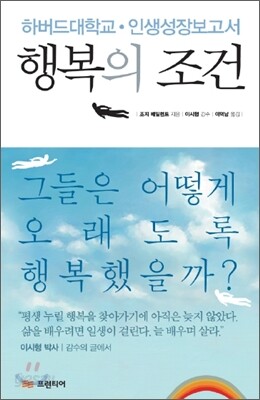
Conditions of Happiness
 |
Description
Book Introduction
In June 2009, Joshua Wolff Schenk, a reporter for the prestigious American monthly magazine Atlantic Monthly, spent a month intensively reporting on the archives of the Harvard University Study of Adult Development, which had never been made public, and its director, Professor George Vaillant.
Were the Harvard archives he covered truly the "conditions for happiness" we seek?
There was an answer.
"Are there rules to a happy and healthy life?" A Harvard University research team, including Professor George Vaillant, followed the lives of 268 sophomores who entered Harvard University in the late 1930s for 72 years to find the answer to this very question.
That is, happiness depends on how well a person has the seven conditions of happiness that can be controlled by human power before the age of 50.
Also, “The most important thing in life is human relationships, and happiness is ultimately love.”
Of the 106 people who had five or six of these seven characteristics at age 50, 50 percent were living 'happy and healthy' at age 80.
Among them, only 7.5 percent were considered 'unhappy and sick'.
Conversely, none of those who had three or fewer of these at age 50 were happy and healthy at age 80.
And they were three times more likely to die before age 80 than those with four or more of the conditions.
The research report contained in this book shows that if you constantly learn, enjoy humor, make friends, quit smoking and drinking, and come home early to see your family one more time, you can continue to grow and be happy.
This book discusses the conditions for happiness by providing a bird's-eye view of the lives and happiness of 814 people over several decades, based on research data from a Harvard research team.
Through this book, readers will have the opportunity to vicariously experience the 'lives' of people who truly shined by enjoying happiness and to reactivate their own lives.
Were the Harvard archives he covered truly the "conditions for happiness" we seek?
There was an answer.
"Are there rules to a happy and healthy life?" A Harvard University research team, including Professor George Vaillant, followed the lives of 268 sophomores who entered Harvard University in the late 1930s for 72 years to find the answer to this very question.
That is, happiness depends on how well a person has the seven conditions of happiness that can be controlled by human power before the age of 50.
Also, “The most important thing in life is human relationships, and happiness is ultimately love.”
Of the 106 people who had five or six of these seven characteristics at age 50, 50 percent were living 'happy and healthy' at age 80.
Among them, only 7.5 percent were considered 'unhappy and sick'.
Conversely, none of those who had three or fewer of these at age 50 were happy and healthy at age 80.
And they were three times more likely to die before age 80 than those with four or more of the conditions.
The research report contained in this book shows that if you constantly learn, enjoy humor, make friends, quit smoking and drinking, and come home early to see your family one more time, you can continue to grow and be happy.
This book discusses the conditions for happiness by providing a bird's-eye view of the lives and happiness of 814 people over several decades, based on research data from a Harvard research team.
Through this book, readers will have the opportunity to vicariously experience the 'lives' of people who truly shined by enjoying happiness and to reactivate their own lives.
- You can preview some of the book's contents.
Preview
index
A Great Journey in Search of the "Conditions of Happiness" by Gamsagam
Introduction: What Leads Us to Happiness
Chapter 1.
Adult Development Research: The Long Journey
The First Gate: Defining Positive Aging | Harvard University Study of Adult Development | Harvard Graduates (Grant) Group | Inner City Group | Terman Women Group | Different Yet Same: A Comparison of Three Groups | Me, George Vaillant, and the Study of Adult Development | What Prospective Research Can Teach Us | The Regrets of Prospective Research
Anthony Pirelli Overcomes a Dark Childhood to Enter a Glorious Old Age
Chapter 2.
How do people mature both inside and out?
Expanding the Social Horizon: Completing Developmental Tasks | Balancing Desire and Repression: Maturation of Defense Mechanisms
Adam Carson successfully completes six consecutive life tasks.
Susan Welcome: The Alchemist Who Turned Iron into Gold
Bill Roman's drinking and immature defense mechanisms ruined his life.
Chapter 3.
Does childhood shape your life?
How to Look Back on One's Childhood | How Childhood Happiness Affects Old Age | Fact or Speculation: Does Depression Cause Illness? | Reconstructing the Past and Your Life | The Healing Power of Rediscovered Love
Oliver Holmes passes on a warm childhood to the next generation.
Martha Mead Finds Forgotten Love and Heals Psychological Pain
Ted Merton (1) Unearthing Past Memories to Invest in the Future
Chapter 4.
Productivity: The Key to a Satisfying Life
What have you learned from your children?
Frederick Hope: Living a life of excellence despite low intelligence
Gwendoline Havisham was a dutiful daughter, but she never knew happiness.
Bill DiMaggio Overcomes Limitations and Transforms into a Productive Person
Frederick Chip: Learning to Navigate Life Through Relationships and Bonds
Anna Love, sowing the seeds of love in the harsh land of reality.
Chapter 5.
A guardian who connects the past and the future
Are all the defenders of meaning staunch republicans?
Peter Wiseman, a guardian of values who passes on memories of the past to future generations.
Maria Discovers the Power of Maturity in a Barren Land of Social Benefits
A sound conservative who lived faithfully as a defender of the meaning of Mark Stone.
Chapter 6.
A Time for Integration: Death, Be Not a Beast
Ellen Keller did not fear death because she gave generously.
Henry Emerson, a passionate activist who kept his eyes on the future until the very end
Eric Carrey Living well is not about living long, but about aging well.
Chapter 7.
Second Gate: Aging Healthy
Healthy aging means: 'A happy and healthy life', 'An unhappy and sick life', and 'Early death'. The three paths to a healthy life. Predicting life after 70 with life before 50. Six variables that are 'not directly related' to a healthy life. Seven factors that lead to a healthy old age. After 50, you decide your own destiny. Decline is inevitable, and the good news is there. How social ties can change your life.
Alfred Paine is a model of an unhappy and sickly life, neglected by himself.
Richard Luckey, a happy man who reserved immortality through play and creation.
Chapter 8.
The Secret of Play and Creativity in Enjoying Life
Create new social relationships | Enjoy playful activities | Seek opportunities to be creative | Be a lifelong learner
Mary Elder enriches her post-retirement life with a new relationship.
Francis Player & Sammy's Drawing Play Activity: The Difference Between Happiness and Health
Frank Wright's passionate life, transforming every corner of life into play.
John Boatwright: From a stuffy engineer to an expert in art and play
Mary Fasano, 89, becomes the oldest person to graduate from Harvard University.
Chapter 9.
Do we get wiser as we get older?
Chapter 10.
Spirituality, Religion, and Old Age
How Do Spirituality and Religion Differ? | Does Spirituality Deepen with Age?
Martha Jobe was deeply spiritual, but neglected social connections.
Ted Merton (2) Saving lives by broadening social horizons through religious activities
Bill Graham's Spiritual Healing Lifts Out Deep Depression and Helplessness
Chapter 11.
Do people change as time passes?
A life that always gets back up again
David Goodhart, the embodiment of resilience, transcending life's discontinuities.
Jim Hart Finds a Life-Changing Momentum in a Happy Marriage
Zelda Mouse Lost in a Failed Marriage and a Loveless Life
Chapter 12.
Again, asking the conditions for happiness
The Third Gate: Aging Gracefully
Bradford Babbitt: A dry life, devoid of all the essential qualities of a dignified old age.
Iris Joy, the Gardener of Life, the ultimate example of "graceful aging."
Introduction: What Leads Us to Happiness
Chapter 1.
Adult Development Research: The Long Journey
The First Gate: Defining Positive Aging | Harvard University Study of Adult Development | Harvard Graduates (Grant) Group | Inner City Group | Terman Women Group | Different Yet Same: A Comparison of Three Groups | Me, George Vaillant, and the Study of Adult Development | What Prospective Research Can Teach Us | The Regrets of Prospective Research
Anthony Pirelli Overcomes a Dark Childhood to Enter a Glorious Old Age
Chapter 2.
How do people mature both inside and out?
Expanding the Social Horizon: Completing Developmental Tasks | Balancing Desire and Repression: Maturation of Defense Mechanisms
Adam Carson successfully completes six consecutive life tasks.
Susan Welcome: The Alchemist Who Turned Iron into Gold
Bill Roman's drinking and immature defense mechanisms ruined his life.
Chapter 3.
Does childhood shape your life?
How to Look Back on One's Childhood | How Childhood Happiness Affects Old Age | Fact or Speculation: Does Depression Cause Illness? | Reconstructing the Past and Your Life | The Healing Power of Rediscovered Love
Oliver Holmes passes on a warm childhood to the next generation.
Martha Mead Finds Forgotten Love and Heals Psychological Pain
Ted Merton (1) Unearthing Past Memories to Invest in the Future
Chapter 4.
Productivity: The Key to a Satisfying Life
What have you learned from your children?
Frederick Hope: Living a life of excellence despite low intelligence
Gwendoline Havisham was a dutiful daughter, but she never knew happiness.
Bill DiMaggio Overcomes Limitations and Transforms into a Productive Person
Frederick Chip: Learning to Navigate Life Through Relationships and Bonds
Anna Love, sowing the seeds of love in the harsh land of reality.
Chapter 5.
A guardian who connects the past and the future
Are all the defenders of meaning staunch republicans?
Peter Wiseman, a guardian of values who passes on memories of the past to future generations.
Maria Discovers the Power of Maturity in a Barren Land of Social Benefits
A sound conservative who lived faithfully as a defender of the meaning of Mark Stone.
Chapter 6.
A Time for Integration: Death, Be Not a Beast
Ellen Keller did not fear death because she gave generously.
Henry Emerson, a passionate activist who kept his eyes on the future until the very end
Eric Carrey Living well is not about living long, but about aging well.
Chapter 7.
Second Gate: Aging Healthy
Healthy aging means: 'A happy and healthy life', 'An unhappy and sick life', and 'Early death'. The three paths to a healthy life. Predicting life after 70 with life before 50. Six variables that are 'not directly related' to a healthy life. Seven factors that lead to a healthy old age. After 50, you decide your own destiny. Decline is inevitable, and the good news is there. How social ties can change your life.
Alfred Paine is a model of an unhappy and sickly life, neglected by himself.
Richard Luckey, a happy man who reserved immortality through play and creation.
Chapter 8.
The Secret of Play and Creativity in Enjoying Life
Create new social relationships | Enjoy playful activities | Seek opportunities to be creative | Be a lifelong learner
Mary Elder enriches her post-retirement life with a new relationship.
Francis Player & Sammy's Drawing Play Activity: The Difference Between Happiness and Health
Frank Wright's passionate life, transforming every corner of life into play.
John Boatwright: From a stuffy engineer to an expert in art and play
Mary Fasano, 89, becomes the oldest person to graduate from Harvard University.
Chapter 9.
Do we get wiser as we get older?
Chapter 10.
Spirituality, Religion, and Old Age
How Do Spirituality and Religion Differ? | Does Spirituality Deepen with Age?
Martha Jobe was deeply spiritual, but neglected social connections.
Ted Merton (2) Saving lives by broadening social horizons through religious activities
Bill Graham's Spiritual Healing Lifts Out Deep Depression and Helplessness
Chapter 11.
Do people change as time passes?
A life that always gets back up again
David Goodhart, the embodiment of resilience, transcending life's discontinuities.
Jim Hart Finds a Life-Changing Momentum in a Happy Marriage
Zelda Mouse Lost in a Failed Marriage and a Loveless Life
Chapter 12.
Again, asking the conditions for happiness
The Third Gate: Aging Gracefully
Bradford Babbitt: A dry life, devoid of all the essential qualities of a dignified old age.
Iris Joy, the Gardener of Life, the ultimate example of "graceful aging."
Publisher's Review
Harvard's Bookworms' Life Reports: Are There Rules to a Happy Life?
"Are there rules to a happy and healthy life?" A Harvard University research team followed the lives of 268 sophomores who entered college in the late 1930s for 72 years to find the answer to this very question.
At the center of this was the Harvard Study of Adult Development, the longest-running longitudinal study of adult development throughout life.
The conclusion of research in the 21st century was that happiness depends on how well a person possesses the seven conditions of happiness that can be controlled by the power of a person before the age of 50, and that “the most important thing in life is human relationships, and happiness is ultimately love.”
This study will involve 456 ordinary males and 90 female geniuses as its subjects.
Their decades-long lives, totaling 814 people, unfold as a living, breathing portrait of human life and happiness.
A Prospective Longitudinal Study on 'Healthy and Happy Living' -
A monumental 72-year research period, and the research continues.
The Harvard Study of Adult Development is the longest-running prospective longitudinal study of adult development and growth, which has been ongoing for approximately 72 years since 1937.
'Prospective research' means that the research was conducted simultaneously with the occurrence of the situation, with the subjects not reminiscing about their 20s when they were in their 50s, but rather recording what they experienced in their 20s when they were in their 20s, and recording what they experienced in their 50s when they were in their 50s.
Completing this research is no easy task, as it requires enormous financial resources, the perseverance of researchers, and the cooperation of research subjects.
However, the Harvard University research team has been conducting research for over 70 years, and the curtain will fall the moment the last of their subjects passes away.
In June 2009, Joshua Wolf Schenk, a reporter for the prestigious American monthly magazine Atlantic Monthly, spent a month intensively reporting on the archives of the Harvard University Study of Adult Development, which had never been made public, and its director, Professor George Vaillant.
The in-depth article he wrote later, “What Makes Us Happy?”, became a huge hit along with Vaillant’s book (this book) published in 2002 (an excerpt from the article is included at the beginning of the book).
Could the Harvard archives really contain the "conditions for happiness" we seek?
Happy People - How Did They Stay Happy for So Long?
“It is not too late to find happiness that will last a lifetime.
It takes a lifetime to learn about life.
“Live your whole life learning.” _ From the editor’s note by Dr. Lee Si-hyung
The Harvard University Study of Adult Development studied three groups.
The first was 268 sophomore male students at Harvard University (the so-called "Grant Study").
The second is the 90 female geniuses selected from the Terman Study, another major longitudinal study and study of genius children.
The third is the control group of 456 self-made men who dropped out of high school and did not commit juvenile crimes among the subjects of the 'Glueck Study', a study on juvenile crime.
This book is filled with representative examples of how the subjects of the study led happy or unhappy lives.
Each case follows the twists and turns of life experienced by an individual, offering readers the thrill of watching a drama, as well as empathy, compassion, and even enlightenment and self-reflection.
Chapter 1 of the book looks back on the journey and identity of Harvard University's adult development research.
It begins with the definition of 'positive aging', and includes the purpose and subject of the study, methodology, its strengths and weaknesses, and an introduction to the author who wrote this work.
Chapter 2 presents the concept of adult development throughout life, focusing on adaptive defense mechanisms, or the attitude toward coping with pain, which is the author's main research topic and the most important variable among the conditions for happiness.
The next four chapters, from Chapters 3 to 6, discuss successful aging and social maturity along the developmental process of adults, examining three tasks essential for a dignified and satisfying old age: generativity, guardianship of meaning, and integration.
Chapters 7 through 10 examine in detail the important elements of the second half of life: ① health so that one does not feel pain even when sick, ② creativity so that one can enjoy play even after retirement, ③ pursuit of wisdom, and ④ cultivating spiritual nobility.
Finally, in Chapters 11 and 12, the author summarizes the lessons learned from adult development research.
The Seven Conditions of Happiness - Am I Happy? Can I Be Happy in the Future?
As the study subjects reached the ages of 70 and 80, the Harvard research team classified them into two groups: those with "happy and healthy lives" and those with "unhappy and sick lives" or "early death" based on six criteria for subjective and objective health.
And I was surprised to discover that whether or not you'll spend the last 10 years of your life healthy and happy can be predicted by looking at your life before age 50.
More importantly, what greatly influences happiness and unhappiness, health and frailty, are not simply God's will or genes, but factors that humans can 'control' to a great extent.
The seven 'conditions for happiness' that lead to a healthy and happy old age are not things like innate wealth, fame, or academic background.
The most important of the conditions was ‘attitude toward coping with hardship (mature defense mechanism)’.
And what supported it were the human relationships that had been formed until around the age of 47.
The remaining factors were years of education (lifelong education), stable marriage, non-smoker (or quit smoking before age 45), moderate drinking (no history of alcoholism), regular exercise, and moderate weight.
Of the 106 people who had five or six of these seven characteristics at age 50, 50 percent were living 'happy and healthy' at age 80.
Among them, only 7.5 percent were considered 'unhappy and sick'.
Conversely, none of those who had three or fewer of these at age 50 were happy and healthy at age 80.
And they were three times more likely to die before age 80 than those with four or more of the conditions.
Professor George Vaillant of the Department of Psychiatry at Harvard Medical School, who has led this research since 1967,
He concluded, “The most important thing in life is human relationships, and happiness is ultimately love.”
Professor Vaillant said, “Life radiates dramatic frequencies that cannot be revealed by any data.”
“It is too human to be judged by science, too beautiful to be expressed in numbers,
“It is too sad to be diagnosed, and too immortal to be published only in academic journals,” he said.
The endless pursuit of happiness - human, all too human
“George Vaillant is the poet who leads the positive psychology movement.” — Martin Seligman
The world of psychology, psychiatry, and countless business gurus and politicians talk about 'happiness'.
They produce countless 'laws' based on global surveys, personal experiences, and spiritual awakenings.
In this context, the significance and reliability of the Harvard University Study of Adult Development, which has maintained a prospective, long-term longitudinal study method for over 70 years, despite targeting a relatively specific group, possesses a unique and unrivaled aura of its own.
This study is also the product of the dedication and cooperation of countless people and the obsession of a psychiatrist for half a lifetime.
It expresses conclusions about happiness that could easily become trite in terms of much more empirical and concrete values and conditions.
Propositions such as "happiness is a choice," "ordinary people were happy," "human relationships are the most important," and "lifelong learners who constantly learn and practice are healthier and happier than rich people who have access to better doctors" are proven through the records of real lives, within the power of "long-term observation," the strength of this study.
Furthermore, rather than being abstract, it presents readers with the possibility that they can control their own happiness in the form of seven conditions that can be put into practice in daily life.
This study is basically a statistical study based on questionnaires, interviews, and health checkups.
In all statistics and probabilities, there are bound to be 'exceptions'.
Among the subjects of our research, there are certainly those who left a deep impression by surprising the research team and ending their lives dramatically, or by defying expectations and achieving success.
So, in his article in The Atlantic Monthly, Vaillant quotes William Blake's line, "Joy and grief are delicately woven together."
But it is more than enough to remind us that happiness does not come from fate or momentary pleasure, but from taking control of our own lives and respecting ourselves.
Wouldn't our country's middle-aged and older generations also need time and opportunities to prepare for long-term happiness, unswayed by worldly norms, for the rest of their lives? Why not find specific practical suggestions for doing so in this book?
If you constantly learn, enjoy humor, and make friends... and quit smoking and drinking less, and come home early to see your family one more time, you can constantly grow and be happy.
This is not a boring lecture, but a conclusion reached through a lifetime of close observation and insight.
The Roman philosopher Seneca said, "It takes a lifetime to learn about life."
This book not only contains the conditions for happiness, but also provides an opportunity to indirectly experience the 'lives' of people who truly shined by enjoying happiness and to restart your own life.
"Are there rules to a happy and healthy life?" A Harvard University research team followed the lives of 268 sophomores who entered college in the late 1930s for 72 years to find the answer to this very question.
At the center of this was the Harvard Study of Adult Development, the longest-running longitudinal study of adult development throughout life.
The conclusion of research in the 21st century was that happiness depends on how well a person possesses the seven conditions of happiness that can be controlled by the power of a person before the age of 50, and that “the most important thing in life is human relationships, and happiness is ultimately love.”
This study will involve 456 ordinary males and 90 female geniuses as its subjects.
Their decades-long lives, totaling 814 people, unfold as a living, breathing portrait of human life and happiness.
A Prospective Longitudinal Study on 'Healthy and Happy Living' -
A monumental 72-year research period, and the research continues.
The Harvard Study of Adult Development is the longest-running prospective longitudinal study of adult development and growth, which has been ongoing for approximately 72 years since 1937.
'Prospective research' means that the research was conducted simultaneously with the occurrence of the situation, with the subjects not reminiscing about their 20s when they were in their 50s, but rather recording what they experienced in their 20s when they were in their 20s, and recording what they experienced in their 50s when they were in their 50s.
Completing this research is no easy task, as it requires enormous financial resources, the perseverance of researchers, and the cooperation of research subjects.
However, the Harvard University research team has been conducting research for over 70 years, and the curtain will fall the moment the last of their subjects passes away.
In June 2009, Joshua Wolf Schenk, a reporter for the prestigious American monthly magazine Atlantic Monthly, spent a month intensively reporting on the archives of the Harvard University Study of Adult Development, which had never been made public, and its director, Professor George Vaillant.
The in-depth article he wrote later, “What Makes Us Happy?”, became a huge hit along with Vaillant’s book (this book) published in 2002 (an excerpt from the article is included at the beginning of the book).
Could the Harvard archives really contain the "conditions for happiness" we seek?
Happy People - How Did They Stay Happy for So Long?
“It is not too late to find happiness that will last a lifetime.
It takes a lifetime to learn about life.
“Live your whole life learning.” _ From the editor’s note by Dr. Lee Si-hyung
The Harvard University Study of Adult Development studied three groups.
The first was 268 sophomore male students at Harvard University (the so-called "Grant Study").
The second is the 90 female geniuses selected from the Terman Study, another major longitudinal study and study of genius children.
The third is the control group of 456 self-made men who dropped out of high school and did not commit juvenile crimes among the subjects of the 'Glueck Study', a study on juvenile crime.
This book is filled with representative examples of how the subjects of the study led happy or unhappy lives.
Each case follows the twists and turns of life experienced by an individual, offering readers the thrill of watching a drama, as well as empathy, compassion, and even enlightenment and self-reflection.
Chapter 1 of the book looks back on the journey and identity of Harvard University's adult development research.
It begins with the definition of 'positive aging', and includes the purpose and subject of the study, methodology, its strengths and weaknesses, and an introduction to the author who wrote this work.
Chapter 2 presents the concept of adult development throughout life, focusing on adaptive defense mechanisms, or the attitude toward coping with pain, which is the author's main research topic and the most important variable among the conditions for happiness.
The next four chapters, from Chapters 3 to 6, discuss successful aging and social maturity along the developmental process of adults, examining three tasks essential for a dignified and satisfying old age: generativity, guardianship of meaning, and integration.
Chapters 7 through 10 examine in detail the important elements of the second half of life: ① health so that one does not feel pain even when sick, ② creativity so that one can enjoy play even after retirement, ③ pursuit of wisdom, and ④ cultivating spiritual nobility.
Finally, in Chapters 11 and 12, the author summarizes the lessons learned from adult development research.
The Seven Conditions of Happiness - Am I Happy? Can I Be Happy in the Future?
As the study subjects reached the ages of 70 and 80, the Harvard research team classified them into two groups: those with "happy and healthy lives" and those with "unhappy and sick lives" or "early death" based on six criteria for subjective and objective health.
And I was surprised to discover that whether or not you'll spend the last 10 years of your life healthy and happy can be predicted by looking at your life before age 50.
More importantly, what greatly influences happiness and unhappiness, health and frailty, are not simply God's will or genes, but factors that humans can 'control' to a great extent.
The seven 'conditions for happiness' that lead to a healthy and happy old age are not things like innate wealth, fame, or academic background.
The most important of the conditions was ‘attitude toward coping with hardship (mature defense mechanism)’.
And what supported it were the human relationships that had been formed until around the age of 47.
The remaining factors were years of education (lifelong education), stable marriage, non-smoker (or quit smoking before age 45), moderate drinking (no history of alcoholism), regular exercise, and moderate weight.
Of the 106 people who had five or six of these seven characteristics at age 50, 50 percent were living 'happy and healthy' at age 80.
Among them, only 7.5 percent were considered 'unhappy and sick'.
Conversely, none of those who had three or fewer of these at age 50 were happy and healthy at age 80.
And they were three times more likely to die before age 80 than those with four or more of the conditions.
Professor George Vaillant of the Department of Psychiatry at Harvard Medical School, who has led this research since 1967,
He concluded, “The most important thing in life is human relationships, and happiness is ultimately love.”
Professor Vaillant said, “Life radiates dramatic frequencies that cannot be revealed by any data.”
“It is too human to be judged by science, too beautiful to be expressed in numbers,
“It is too sad to be diagnosed, and too immortal to be published only in academic journals,” he said.
The endless pursuit of happiness - human, all too human
“George Vaillant is the poet who leads the positive psychology movement.” — Martin Seligman
The world of psychology, psychiatry, and countless business gurus and politicians talk about 'happiness'.
They produce countless 'laws' based on global surveys, personal experiences, and spiritual awakenings.
In this context, the significance and reliability of the Harvard University Study of Adult Development, which has maintained a prospective, long-term longitudinal study method for over 70 years, despite targeting a relatively specific group, possesses a unique and unrivaled aura of its own.
This study is also the product of the dedication and cooperation of countless people and the obsession of a psychiatrist for half a lifetime.
It expresses conclusions about happiness that could easily become trite in terms of much more empirical and concrete values and conditions.
Propositions such as "happiness is a choice," "ordinary people were happy," "human relationships are the most important," and "lifelong learners who constantly learn and practice are healthier and happier than rich people who have access to better doctors" are proven through the records of real lives, within the power of "long-term observation," the strength of this study.
Furthermore, rather than being abstract, it presents readers with the possibility that they can control their own happiness in the form of seven conditions that can be put into practice in daily life.
This study is basically a statistical study based on questionnaires, interviews, and health checkups.
In all statistics and probabilities, there are bound to be 'exceptions'.
Among the subjects of our research, there are certainly those who left a deep impression by surprising the research team and ending their lives dramatically, or by defying expectations and achieving success.
So, in his article in The Atlantic Monthly, Vaillant quotes William Blake's line, "Joy and grief are delicately woven together."
But it is more than enough to remind us that happiness does not come from fate or momentary pleasure, but from taking control of our own lives and respecting ourselves.
Wouldn't our country's middle-aged and older generations also need time and opportunities to prepare for long-term happiness, unswayed by worldly norms, for the rest of their lives? Why not find specific practical suggestions for doing so in this book?
If you constantly learn, enjoy humor, and make friends... and quit smoking and drinking less, and come home early to see your family one more time, you can constantly grow and be happy.
This is not a boring lecture, but a conclusion reached through a lifetime of close observation and insight.
The Roman philosopher Seneca said, "It takes a lifetime to learn about life."
This book not only contains the conditions for happiness, but also provides an opportunity to indirectly experience the 'lives' of people who truly shined by enjoying happiness and to restart your own life.
GOODS SPECIFICS
- Date of issue: January 20, 2010
- Page count, weight, size: 488 pages | 685g | 146*225*30mm
- ISBN13: 9788947527385
- ISBN10: 8947527386
You may also like
카테고리
korean


korean

![GQ KOREA Mark (Monthly): December [2025]](http://librairie.coreenne.fr/cdn/shop/files/8ef265dbbfbf186523ed75ba7319009d.jpg?v=1765340328&width=3840)


