

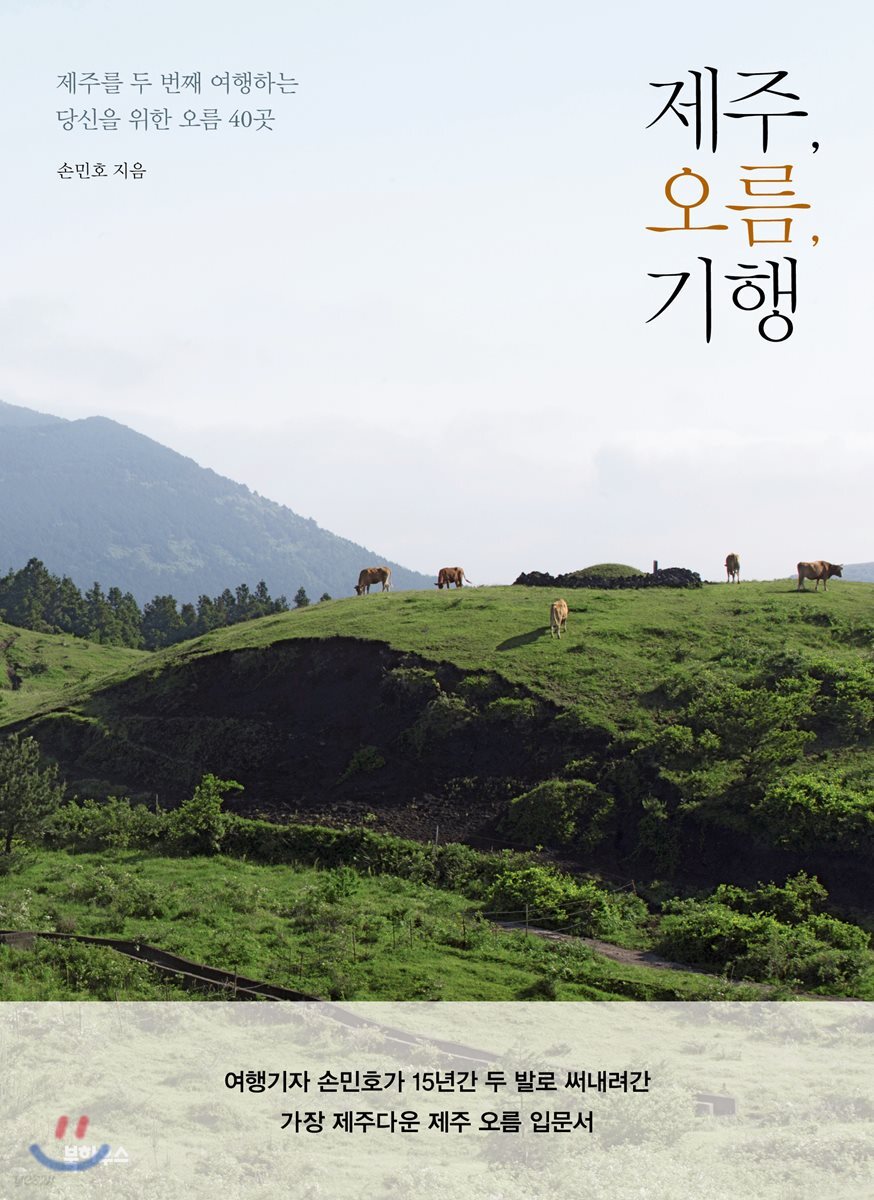
Jeju, Oreum, travel
 |
Description
Book Introduction
A journey of diligent curves,
Jeju Olleum, a deep and serene forest path where the primordial Earth sleeps
A record of low-speed travel that brought people back to their normal speed!
A travel book that captures Jeju in its most Jeju-like way has been published.
This is "Jeju, Oreum, Travelogue," a book in which reporter Minho Son, former head of the leisure team at JoongAng Ilbo, introduces 40 of the Jeju Oreums he has visited over the past 15 years.
Based on the JoongAng Ilbo serial project [Jeju Olle Trail], the missing content was added and compiled into a single volume.
『Jeju, Oreum, Travelogue』 is a meticulous and detailed report written by a reporter with the “seriousness of making a living.”
Unlike other Jeju travel books that are filled with only travel information or focused solely on impressions, this book illuminates Jeju's geology, history, and culture in a three-dimensional way.
The author has compiled a vast amount of information through diligent walking, meeting many people, and researching numerous materials, and has written it down in an easy-to-understand manner.
It is such a detailed record that even Jeju people said that after reading his writing, there was a lot of information about Jeju that they had not known before.
In 2003, after meeting Kim Young-gap, the author learned for the first time that there were smaller mountains in Jeju other than Hallasan. Fascinated by these mountains, the author spent the next 15 years traveling to Jeju and climbing countless mountains.
Not all oreums are the same, and each has its own interesting story, including those in the mid-mountains, those included in the Olle Trail course, and those important for their unique volcanic topography.
This book introduces 40 of the 368 Jeju Oreums that travelers should visit at least once, and categorizes them into five themes: 'To be (volcanoes and Oreums)', 'To live (people and Oreums)', 'To listen (forests and Oreums)', 'To walk (Olle and Oreums)', and 'To cry (Kim Young-gap and Oreums)'.
The magnificent beauty of the mountain was captured in over 100 elegant photos.
Jeju Olleum, a deep and serene forest path where the primordial Earth sleeps
A record of low-speed travel that brought people back to their normal speed!
A travel book that captures Jeju in its most Jeju-like way has been published.
This is "Jeju, Oreum, Travelogue," a book in which reporter Minho Son, former head of the leisure team at JoongAng Ilbo, introduces 40 of the Jeju Oreums he has visited over the past 15 years.
Based on the JoongAng Ilbo serial project [Jeju Olle Trail], the missing content was added and compiled into a single volume.
『Jeju, Oreum, Travelogue』 is a meticulous and detailed report written by a reporter with the “seriousness of making a living.”
Unlike other Jeju travel books that are filled with only travel information or focused solely on impressions, this book illuminates Jeju's geology, history, and culture in a three-dimensional way.
The author has compiled a vast amount of information through diligent walking, meeting many people, and researching numerous materials, and has written it down in an easy-to-understand manner.
It is such a detailed record that even Jeju people said that after reading his writing, there was a lot of information about Jeju that they had not known before.
In 2003, after meeting Kim Young-gap, the author learned for the first time that there were smaller mountains in Jeju other than Hallasan. Fascinated by these mountains, the author spent the next 15 years traveling to Jeju and climbing countless mountains.
Not all oreums are the same, and each has its own interesting story, including those in the mid-mountains, those included in the Olle Trail course, and those important for their unique volcanic topography.
This book introduces 40 of the 368 Jeju Oreums that travelers should visit at least once, and categorizes them into five themes: 'To be (volcanoes and Oreums)', 'To live (people and Oreums)', 'To listen (forests and Oreums)', 'To walk (Olle and Oreums)', and 'To cry (Kim Young-gap and Oreums)'.
The magnificent beauty of the mountain was captured in over 100 elegant photos.
- You can preview some of the book's contents.
Preview
index
Chapter 1: Nada _ Volcano and Ascent
For those starting anew _ Seongsan Ilchulbong
The World of Individuals _ Eoseungsaengak, Witseoreum
There is no island within an island _Biyangbong
Sanbangsan Mountain somewhere there
Lion and Tiger _Gunsan
Volcanology Textbook _ Suwolbong, Dangsanbong
Chapter 2: Living _ People and Climbing
Mother of God _ Dangoreum, Nonoreum
Protecting the Capital for 500 Years _ Yeongjusan Mountain, Namsan Peak
How to travel to Udo Island _Udobong
When the world turned its back on me _ Bagumjioreum
The waves cry with sorrow _Songaksan Mountain, Seottal Oreum
Uncle Sooni _ Seo Woo-bong
Chapter 3: Lifting the Forest and the Climb
In the beginning there was Geomun Oreum _ Geomun Oreum
Forbidden Forest _ Saryeoni Oreum, Mulchat Oreum
Red Oreum is green _Red Oreum
Low-altitude travel _Jeolmul Oreum
A forest cultivated by the village _Jeoji Oreum
The forest is healing _Sioreum
Chapter 4 Walking _ Olle and Oreum
Human speed _Malmi Oreum
I survived the hardships _Jimibong
A brief note on raw fish _Jejigi Oreum
About fate _Sammaebong, Sarabong
Jeju Olle Pilgrimage _ Gogunsan
The Story of Dandelions Blooming _Susanbong Peak, Anoreum
Chapter 5: Crying _ Kim Young-gap and the Ascent
What kind of meeting _Yongnuni Oreum
Belated obituary _Dunjibong
Straight lines and curves _ Darangshi Oreum, Akkeundarangshi Oreum
Looking at the wind _Ttarabioreum
Blend together _ Sonjabong, Mojabong
Donggeom Eui Oreum, like an old memory
References and Citations
For those starting anew _ Seongsan Ilchulbong
The World of Individuals _ Eoseungsaengak, Witseoreum
There is no island within an island _Biyangbong
Sanbangsan Mountain somewhere there
Lion and Tiger _Gunsan
Volcanology Textbook _ Suwolbong, Dangsanbong
Chapter 2: Living _ People and Climbing
Mother of God _ Dangoreum, Nonoreum
Protecting the Capital for 500 Years _ Yeongjusan Mountain, Namsan Peak
How to travel to Udo Island _Udobong
When the world turned its back on me _ Bagumjioreum
The waves cry with sorrow _Songaksan Mountain, Seottal Oreum
Uncle Sooni _ Seo Woo-bong
Chapter 3: Lifting the Forest and the Climb
In the beginning there was Geomun Oreum _ Geomun Oreum
Forbidden Forest _ Saryeoni Oreum, Mulchat Oreum
Red Oreum is green _Red Oreum
Low-altitude travel _Jeolmul Oreum
A forest cultivated by the village _Jeoji Oreum
The forest is healing _Sioreum
Chapter 4 Walking _ Olle and Oreum
Human speed _Malmi Oreum
I survived the hardships _Jimibong
A brief note on raw fish _Jejigi Oreum
About fate _Sammaebong, Sarabong
Jeju Olle Pilgrimage _ Gogunsan
The Story of Dandelions Blooming _Susanbong Peak, Anoreum
Chapter 5: Crying _ Kim Young-gap and the Ascent
What kind of meeting _Yongnuni Oreum
Belated obituary _Dunjibong
Straight lines and curves _ Darangshi Oreum, Akkeundarangshi Oreum
Looking at the wind _Ttarabioreum
Blend together _ Sonjabong, Mojabong
Donggeom Eui Oreum, like an old memory
References and Citations
Detailed image

Into the book
Seongsan Ilchulbong Peak, seen from the sea, was a sharply angled rock face.
The exterior of the exposed concrete building had rough, rugged rocks exposed like veins.
The rock was gray, but had prominent white spots.
As Mr. Han Cheon-bok said, it was a stray dog's dung.
The orchids hanging from the cliff were sadly fluttering in the wind.
The reef in front of Seongsan Ilchulbong Peak also glistened white with the droppings of sea squirts.
The baby blueberries weren't as green as rumored.
On the rock face, sharp peaks like the teeth of an animal protruded along the edge of the hump.
The Seongsan Ilchulbong Peak in front of me had an unfamiliar appearance that I had never seen before.
It was the discovery of a new secret.
Old records say that there were ninety-nine rock peaks on the edge of the cave.
--- p.
36
What caught my eye the most were the trees rooted on the rocks.
I have encountered this scene countless times in Gotjawal, and every time I have encountered it, my heart aches. It is a pitiful and heartbreaking scene of life.
A universe created by a single seed that flew onto a rock.
There was also a rock on which about ten different types of trees had taken root.
Just as I could not fathom the years of my youth, I could not fathom the size of the universe that had become my life's home.
In my eyes, that rock was Jeju Island.
--- p.
49
Udo is a huge island floating on the sea.
Below the lighthouse, in a hollow, is a green meadow, and horses let loose in the meadow wander between the mountain walls.
Houses with colorful roofs are clustered together along the coast, and on the right end, the yellow lighthouse of Biyangdo Lighthouse Island stands tall.
To the left is the land of Seongsan, Jeju Island, across the sea.
The first thing that catches your eye is Seongsan Ilchulbong Peak, which seems to be rushing towards the sea, and the neatly triangle-shaped Jimibong Peak.
Beyond Jimibong Peak, the vast outline of the foothills of Hallasan Mountain is faintly visible.
When I get up here, my resolve wavers.
The promise made in broad daylight never to return to Udo Island is shattered.
--- p.
144
It was just once.
I saw dawn only once at Dunjibong.
That day too, I stood in the same place my brother told me to stand and waited for dawn.
And there I witnessed the world opening up.
As if the primitive Earth were stretching, the middle class was lazily revealing its true nature.
I cried while pressing the camera shutter without thinking.
No, I kept wiping away tears, then came to my senses and pressed the shutter.
From the left, Darangshi Oreum, Bbaeng Oreum, Donggeomun Oreum, and Nono Oreum sparkled in the morning sunlight.
It was exactly the scene I had seen at the gallery.
Kim Young-gap was here now.
--- p.
375
Although it is a small and low volcano, each of its peaks has a name.
There are also forty names in this book.
Although it is not a mountain that commands the world like Hallasan, Jeju has 368 named oreums.
The reason why city life keeps going around in circles is because we are not called by our names.
Because they are both Mr. Kim and Manager Lee.
We may not be able to create a world as grand as Hallasan, but we can all create our own worlds, however shabby they may be.
So our climbing journey is both touching and tearful.
It is a journey from one ordinary life to another, an ordinary life, so it is both comfortable and sad.
The exterior of the exposed concrete building had rough, rugged rocks exposed like veins.
The rock was gray, but had prominent white spots.
As Mr. Han Cheon-bok said, it was a stray dog's dung.
The orchids hanging from the cliff were sadly fluttering in the wind.
The reef in front of Seongsan Ilchulbong Peak also glistened white with the droppings of sea squirts.
The baby blueberries weren't as green as rumored.
On the rock face, sharp peaks like the teeth of an animal protruded along the edge of the hump.
The Seongsan Ilchulbong Peak in front of me had an unfamiliar appearance that I had never seen before.
It was the discovery of a new secret.
Old records say that there were ninety-nine rock peaks on the edge of the cave.
--- p.
36
What caught my eye the most were the trees rooted on the rocks.
I have encountered this scene countless times in Gotjawal, and every time I have encountered it, my heart aches. It is a pitiful and heartbreaking scene of life.
A universe created by a single seed that flew onto a rock.
There was also a rock on which about ten different types of trees had taken root.
Just as I could not fathom the years of my youth, I could not fathom the size of the universe that had become my life's home.
In my eyes, that rock was Jeju Island.
--- p.
49
Udo is a huge island floating on the sea.
Below the lighthouse, in a hollow, is a green meadow, and horses let loose in the meadow wander between the mountain walls.
Houses with colorful roofs are clustered together along the coast, and on the right end, the yellow lighthouse of Biyangdo Lighthouse Island stands tall.
To the left is the land of Seongsan, Jeju Island, across the sea.
The first thing that catches your eye is Seongsan Ilchulbong Peak, which seems to be rushing towards the sea, and the neatly triangle-shaped Jimibong Peak.
Beyond Jimibong Peak, the vast outline of the foothills of Hallasan Mountain is faintly visible.
When I get up here, my resolve wavers.
The promise made in broad daylight never to return to Udo Island is shattered.
--- p.
144
It was just once.
I saw dawn only once at Dunjibong.
That day too, I stood in the same place my brother told me to stand and waited for dawn.
And there I witnessed the world opening up.
As if the primitive Earth were stretching, the middle class was lazily revealing its true nature.
I cried while pressing the camera shutter without thinking.
No, I kept wiping away tears, then came to my senses and pressed the shutter.
From the left, Darangshi Oreum, Bbaeng Oreum, Donggeomun Oreum, and Nono Oreum sparkled in the morning sunlight.
It was exactly the scene I had seen at the gallery.
Kim Young-gap was here now.
--- p.
375
Although it is a small and low volcano, each of its peaks has a name.
There are also forty names in this book.
Although it is not a mountain that commands the world like Hallasan, Jeju has 368 named oreums.
The reason why city life keeps going around in circles is because we are not called by our names.
Because they are both Mr. Kim and Manager Lee.
We may not be able to create a world as grand as Hallasan, but we can all create our own worlds, however shabby they may be.
So our climbing journey is both touching and tearful.
It is a journey from one ordinary life to another, an ordinary life, so it is both comfortable and sad.
--- p.
433
433
Publisher's Review
A journey of diligent curves,
Jeju Olleum, a deep and serene forest path where the primordial Earth sleeps
A record of low-speed travel that brought people back to their normal speed!
A travel book that captures Jeju in its most Jeju-like way has been published.
This is "Jeju, Oreum, Travelogue," a book in which reporter Minho Son, former head of the leisure team at JoongAng Ilbo, introduces 40 of the Jeju Oreums he has visited over the past 15 years.
Based on the JoongAng Ilbo serial project [Jeju Olle Trail], the missing content was added and compiled into a single volume.
『Jeju, Oreum, Travelogue』 is a meticulous and detailed report written by a reporter with the “seriousness of making a living.”
Unlike other Jeju travel books that are filled with only travel information or focused solely on impressions, this book illuminates Jeju's geology, history, and culture in a three-dimensional way.
The author has compiled a vast amount of information through diligent walking, meeting many people, and researching numerous materials, and has written it down in an easy-to-understand manner.
It is such a detailed record that even Jeju people said that after reading his writing, there was a lot of information about Jeju that they had not known before.
In 2003, after meeting Kim Young-gap, the author learned for the first time that there were smaller mountains in Jeju other than Hallasan. Fascinated by these mountains, the author spent the next 15 years traveling to Jeju and climbing countless mountains.
Not all oreums are the same, and each has its own interesting story, including those in the mid-mountains, those included in the Olle Trail course, and those important for their unique volcanic topography.
This book introduces 40 of the 368 Jeju Oreums that travelers should visit at least once, and categorizes them into five themes: 'To be (volcanoes and Oreums)', 'To live (people and Oreums)', 'To listen (forests and Oreums)', 'To walk (Olle and Oreums)', and 'To cry (Kim Young-gap and Oreums)'.
The magnificent beauty of the mountain was captured in over 100 elegant photos.
The wind and tears of Jeju that even Jeju people didn't know about
Jeju humanities engraved on the mountain!
Jeju is the land of the gods.
Since ancient times, there were so many shrines and temples that it was said, “Five hundred shrines, five hundred temples.”
The creation myth of the great goddess Seolmundae Halmang has been handed down, and a shrine dedicated to Baekju Halmang, the mother of 18,000 gods, is located in Songdang Dangoreum.
When you go to Jeju, you can vaguely feel why the legend of the giant god was born.
The imposing force of Hallasan Mountain, standing tall like a high wall in the distance, is truly impressive.
The people of Jeju lived on the low, small mountains located at the foot of Mt. Halla.
In other words, Jeju Oreum, along with the sea, is the foundation of life for Jeju people.
Jeju people “took the ribbons from the slopes of the mountain and made roofs out of them, grazed cattle in the crater, and built a wall around the slopes to bury the dead.” Jeju Oreum is Jeju itself.
So this book talks about climbing, but it doesn't just talk about climbing.
“It talks about the mother of the Jeju gods, Baekjutto Halmang, and Lee Jung-seop’s shabby one-room apartment, and his sour and hairy legs, and the red sea of Biyangdo, and the rainy Saryeoni Forest Path, and the wild flowers in the deep forests of Hallasan Mountain, and the legend of the Nokgo siblings perched on the cliffs of Suwolbong Peak, and the heartbreaking story of Haenyeo Kong, and the garlic chicken of Seogwipo Maeil Olle Market.” This book contains the history and culture of Jeju, which are embedded in Jeju Oreum, and the unique landscapes created by people and nature.
"Jeju, Oreum, Travelogue" is no exaggeration to say that it is a "Jeju Humanities Concert," as it vividly weaves together a rich and colorful content based on the experience of a 20-year veteran reporter.
As the saying goes, “You see as much as you know,” after reading this book, you will also be able to see the dandelions growing in clusters on every slope and the reeds covering Hallasan Mountain in Jeju.
A veteran travel journalist travels extensively and records
The final installment of the Jeju travelogue
The author of this book, Minho Son, is a culture reporter with 20 years of experience.
I spent more than 10 years of my life as a travel journalist.
It goes without saying that I know better than anyone else the changing travel trends in Jeju Island over the past 15 years.
To document Jeju Oreum, the author conducted three helicopter shoots and interviewed dozens of on-site staff, including cultural tour guides, forest interpreters, local historians, village heads, fishing village chiefs, and female divers.
The author said, “My travelogue was written with my ears, not my eyes.
That is why he said, “It was written with the soles of the feet, not with the hands.”
"Jeju, Oreum, Travelogue" is a solid Jeju travel guide.
In the Jejigi Oreum episode, you can really smell the fishy smell of Jeju jarimulhoe, and in the Ttarabi Oreum episode, the origin of dombeogogi and the story of pork at Gasiri Namokdo Restaurant are interestingly told.
After shedding tears at the heartbreaking story of the haenyeo, I was moved to tears by the foot of Dunjibong Peak where photographer Kim Young-gap witnessed the 'rapture of an instant'.
There are also some useful tips on how to properly enjoy Udo Island, which is crowded with tourists like the subway on the way to work.
As you read this book, which unfolds with a majestic landscape of the central mountain range waking up to the dawn as if the primitive Earth were stretching, fishing boats on the moonlit Jeju sea, the secret landscape within the primeval forest of Jeojioreum Gumburi, and Jeju Gotjawal, a paradise of bracken, you will realize anew why we love Jeju.
“If you read this book and dream of climbing!”
The comfort that this low, small mountain offers
The mountain has a sad history engraved on it.
The Jinji Cave, dug by the Japanese, and the caves where the residents of Jungsan-gan hid during the April 3 Incident are still at the foot of the mountain.
The history of brutal massacres dating back to the 'Mokho Rebellion' of the Goryeo Dynasty has plunged Jeju into a sea of sorrow.
The author climbs the mountain and tells us about Jeju's arduous history.
Climb Seoubong Peak and reflect on the pain of Bukchon Port depicted in “Uncle Suni,” and walk along Susanbong Peak and Anoreum to learn about the long-standing relationship between Goryeo and Jeju, from the Sambyeolcho Rebellion to the Mokho Rebellion.
And it asks us what the true meaning of travel is.
The author says:
“I believe that traveling is about observing the daily lives of Jeju people and the landscapes that bear the weight of everyday life.”
Jeju will become a true comfort to you when you learn about its painful history and culture hidden beyond the mere beauty of tourist Jeju.
Jeju Olleum, a deep and serene forest path where the primordial Earth sleeps
A record of low-speed travel that brought people back to their normal speed!
A travel book that captures Jeju in its most Jeju-like way has been published.
This is "Jeju, Oreum, Travelogue," a book in which reporter Minho Son, former head of the leisure team at JoongAng Ilbo, introduces 40 of the Jeju Oreums he has visited over the past 15 years.
Based on the JoongAng Ilbo serial project [Jeju Olle Trail], the missing content was added and compiled into a single volume.
『Jeju, Oreum, Travelogue』 is a meticulous and detailed report written by a reporter with the “seriousness of making a living.”
Unlike other Jeju travel books that are filled with only travel information or focused solely on impressions, this book illuminates Jeju's geology, history, and culture in a three-dimensional way.
The author has compiled a vast amount of information through diligent walking, meeting many people, and researching numerous materials, and has written it down in an easy-to-understand manner.
It is such a detailed record that even Jeju people said that after reading his writing, there was a lot of information about Jeju that they had not known before.
In 2003, after meeting Kim Young-gap, the author learned for the first time that there were smaller mountains in Jeju other than Hallasan. Fascinated by these mountains, the author spent the next 15 years traveling to Jeju and climbing countless mountains.
Not all oreums are the same, and each has its own interesting story, including those in the mid-mountains, those included in the Olle Trail course, and those important for their unique volcanic topography.
This book introduces 40 of the 368 Jeju Oreums that travelers should visit at least once, and categorizes them into five themes: 'To be (volcanoes and Oreums)', 'To live (people and Oreums)', 'To listen (forests and Oreums)', 'To walk (Olle and Oreums)', and 'To cry (Kim Young-gap and Oreums)'.
The magnificent beauty of the mountain was captured in over 100 elegant photos.
The wind and tears of Jeju that even Jeju people didn't know about
Jeju humanities engraved on the mountain!
Jeju is the land of the gods.
Since ancient times, there were so many shrines and temples that it was said, “Five hundred shrines, five hundred temples.”
The creation myth of the great goddess Seolmundae Halmang has been handed down, and a shrine dedicated to Baekju Halmang, the mother of 18,000 gods, is located in Songdang Dangoreum.
When you go to Jeju, you can vaguely feel why the legend of the giant god was born.
The imposing force of Hallasan Mountain, standing tall like a high wall in the distance, is truly impressive.
The people of Jeju lived on the low, small mountains located at the foot of Mt. Halla.
In other words, Jeju Oreum, along with the sea, is the foundation of life for Jeju people.
Jeju people “took the ribbons from the slopes of the mountain and made roofs out of them, grazed cattle in the crater, and built a wall around the slopes to bury the dead.” Jeju Oreum is Jeju itself.
So this book talks about climbing, but it doesn't just talk about climbing.
“It talks about the mother of the Jeju gods, Baekjutto Halmang, and Lee Jung-seop’s shabby one-room apartment, and his sour and hairy legs, and the red sea of Biyangdo, and the rainy Saryeoni Forest Path, and the wild flowers in the deep forests of Hallasan Mountain, and the legend of the Nokgo siblings perched on the cliffs of Suwolbong Peak, and the heartbreaking story of Haenyeo Kong, and the garlic chicken of Seogwipo Maeil Olle Market.” This book contains the history and culture of Jeju, which are embedded in Jeju Oreum, and the unique landscapes created by people and nature.
"Jeju, Oreum, Travelogue" is no exaggeration to say that it is a "Jeju Humanities Concert," as it vividly weaves together a rich and colorful content based on the experience of a 20-year veteran reporter.
As the saying goes, “You see as much as you know,” after reading this book, you will also be able to see the dandelions growing in clusters on every slope and the reeds covering Hallasan Mountain in Jeju.
A veteran travel journalist travels extensively and records
The final installment of the Jeju travelogue
The author of this book, Minho Son, is a culture reporter with 20 years of experience.
I spent more than 10 years of my life as a travel journalist.
It goes without saying that I know better than anyone else the changing travel trends in Jeju Island over the past 15 years.
To document Jeju Oreum, the author conducted three helicopter shoots and interviewed dozens of on-site staff, including cultural tour guides, forest interpreters, local historians, village heads, fishing village chiefs, and female divers.
The author said, “My travelogue was written with my ears, not my eyes.
That is why he said, “It was written with the soles of the feet, not with the hands.”
"Jeju, Oreum, Travelogue" is a solid Jeju travel guide.
In the Jejigi Oreum episode, you can really smell the fishy smell of Jeju jarimulhoe, and in the Ttarabi Oreum episode, the origin of dombeogogi and the story of pork at Gasiri Namokdo Restaurant are interestingly told.
After shedding tears at the heartbreaking story of the haenyeo, I was moved to tears by the foot of Dunjibong Peak where photographer Kim Young-gap witnessed the 'rapture of an instant'.
There are also some useful tips on how to properly enjoy Udo Island, which is crowded with tourists like the subway on the way to work.
As you read this book, which unfolds with a majestic landscape of the central mountain range waking up to the dawn as if the primitive Earth were stretching, fishing boats on the moonlit Jeju sea, the secret landscape within the primeval forest of Jeojioreum Gumburi, and Jeju Gotjawal, a paradise of bracken, you will realize anew why we love Jeju.
“If you read this book and dream of climbing!”
The comfort that this low, small mountain offers
The mountain has a sad history engraved on it.
The Jinji Cave, dug by the Japanese, and the caves where the residents of Jungsan-gan hid during the April 3 Incident are still at the foot of the mountain.
The history of brutal massacres dating back to the 'Mokho Rebellion' of the Goryeo Dynasty has plunged Jeju into a sea of sorrow.
The author climbs the mountain and tells us about Jeju's arduous history.
Climb Seoubong Peak and reflect on the pain of Bukchon Port depicted in “Uncle Suni,” and walk along Susanbong Peak and Anoreum to learn about the long-standing relationship between Goryeo and Jeju, from the Sambyeolcho Rebellion to the Mokho Rebellion.
And it asks us what the true meaning of travel is.
The author says:
“I believe that traveling is about observing the daily lives of Jeju people and the landscapes that bear the weight of everyday life.”
Jeju will become a true comfort to you when you learn about its painful history and culture hidden beyond the mere beauty of tourist Jeju.
GOODS SPECIFICS
- Date of publication: October 2, 2017
- Page count, weight, size: 440 pages | 748g | 153*210*24mm
- ISBN13: 9788956058269
- ISBN10: 8956058261
You may also like
카테고리
korean


korean

![GQ KOREA Mark (Monthly): December [2025]](http://librairie.coreenne.fr/cdn/shop/files/8ef265dbbfbf186523ed75ba7319009d.jpg?v=1765340328&width=3840)


